
William Littlejohn: Still Life, First Thoughts
Roger Spence considers the nurturing and development of one of Scotland’s unique artistic talents, William Littlejohn (1929-2006), and talks us through the passage of his artistic career from school to being regarded as one of Scotland’s most noted avant-garde painters. This is the first of a two-part article, covering the years 1929-1966, with 1966-2006 to follow.
INTRODUCTION: THE STARS ALIGN
Bill Littlejohn was born in Arbroath and lived there all of his life (1). He studied in Dundee, taught at Arbroath High School, and then at Gray’s School of Art in Aberdeen, but always made his home in his native town.
In 2026, Arbroath seems a bit of an artistic backwater, but eighty years ago, when Bill was at school and college, there was a thriving art community. Three towering figures, James Cowie, Ian Fleming and Talbert McLean lived and worked in the town; and there were a number of high quality young artists, including George and Morris Grassie; Irene Halliday; Ken Roberts; Kenneth Myles, and George Henry. Slightly older artists like W.P.Vannet and Joan Cuthill were making their way as educators while supporting the new and very dynamic Arbroath Art Society. Willie Reid was the new head of art at the High School. Youngsters like Dick Hunter, Dennis Buchan and Bob Cargill were growing up in the town, and surely having their artistic interests stimulated by the constant energy and activity of the art scene
Bill Littlejohn was in the same class at school as Barbara Cowie, James Cowie’s youngest daughter. Bill didn’t win the prizes or get the medals for art at school ( Kenneth Myles did!), but he did gain the attention and support of Cowie senior, and was invited to join the residential class at Hospitalfield in the summer of 1946, the year he finished school (2). At 17, he was preparing for his art college life by practising art with top graduates, all artists much older than himself, including Robert Henderson Blyth. Ian Fleming succeeded Cowie at Hospitalfield in 1948, and lived in the town for the next six years. Talbert McLean arrived in the same year to take up a post teaching art at Arbroath High School. Three of the most important and influential figures in mid-century Scottish art, all in Arbroath.
Bill graduated from Dundee College of Art in 1950, again without prizes, took a teacher training qualification, spent two years in National service, and got a job teaching with McLean at Arbroath High School for ten years from 1956 to 1966. Then with Ian Fleming as head of school, and Henderson Blyth as head of drawing and painting, and both eminent R.S.A. members, Bill was well-placed to be appointed to the Drawing and Painting department at Gray’s School of Art, Aberdeen, and to be elected A.R.S.A in 1966. He progressed to Head of the Fine Art department in 1970 on Blyth’s death and was elected to full R.S.A. status in 1973, aged 44 (3).
He missed the war and reached adulthood in time for the post-war flourishing of opportunity and wider interest in education and culture.
The stars aligned for Bill Littlejohn; these most propitious circumstances created the openings that made his career look stellar compared to many of his contemporaries of comparable talent.
There was something about Bill’s talent, personality and circumstances that picked him out, and that made others pick him out.
His circumstances were ordinary for a working class boy in a working town, growing up during the war. There was limited money in the family. They were not the poorest, but they were not in a position to promote Bill’s chances. He did that himself.
His strong engagement with the reality of what was around him in Arbroath, (not only the busy harbour, but the tanning; the weaving of jute; canvas and shoe production; ropes and sails; smoked fish and barrels of herring; seagulls and vermin…) combined with James Cowie’s strong example and especially his artistic philosophy; his deep understanding and interest in Braque’s two dimensional conflation of shapes and time; and McLean’s refined ideas of abstraction to underpin a career that might clumsily be described in three stages. Firstly, there was the full absorption of the learnings from his mentors and influences, progressing via copying and fully understanding their approaches. Then, secondly, dark pictures where dominant atmospheres of burnt umber, Van Dyck brown, black and grey frame orange and red and shapes that might represent lights, fragments of harbour images, or glowing embers mix with human symbols and establish a solid/fluid dynamic. And via further abstraction of those elements into almost subject-free shapes and colours; moving on towards, thirdly, a mature style that held for around forty years. This consisted of studio constructions of still-life oils and increasingly watercolours where interior and exterior realities were arranged and re-arranged in combinations with symbols and shapes in a hybrid of abstraction and reality, and where colour harmony was constantly in play with compositional concepts.

William Littlejohn, Scroll, Paper Bird and Comb, Watercolour, metallic leaf and mixed media on khaki paper. 80.5 x 116 cm. 1987.
This article discusses the first two periods, and another will survey Bill’s work after 1966.
Still-life was Bill Littlejohn’s forte and the world he created in his paintings was the world he inhabited. From Arbroath he would venture to Aberdeen and Edinburgh, but rarely beyond. He rarely referenced historical painting, although many of his later painting motifs were the same as those on the Pictish stones that abounded in the Angus countryside around Arbroath. After Braque his only significant foreign influence was his fascination with Japanese visual culture, which crystallised around a trip to Japan in 1984 made possible by an RSA William Gillies Award.
Elizabeth Blackadder dipped in and out of Bill’s world of tabletop still-lifes with Japanese flavours and objects, but her world was much more exotic and diverse. Not many other people ventured into Bill’s space. He spent most of his life working with the same ideas and concepts in the same place, and he didn’t tire, his productivity was prodigious, and he sustained imaginative and creative address to every picture despite the volumes and the limitations he set himself.
In terms of personality, the common descriptions of friends and associates include “shy”, “private”, “quiet”. He was conservative with a small C; an intellectual person who always dressed well - mostly in the same style, tweed jacket and tie; had cultured tastes in music and cars, furnishings and ornaments; and lived with one or two aunts for most of his adult life. He had a dry wit and was fun to be with, but he was always on the margin when any hijinks or hard partying started and the charismatic came to the fore. He was not a natural leader, not even a natural teacher.
He was happy and comfortable in social circumstances, and was a full member of the young artists social group that coalesced around Talbert McLean’s house and then met on Saturday nights to talk, eat and party in houses in Arbroath and at the Balmoral Arms in Friockheim. Ann Patrick and Dick Hunter; Alison and Ken Roberts; Freda Strachan and Bob Robertson (before and after their marriage); David Walker, Irene Halliday and Bill were all regulars. Bill was prone to say little during a section of a conversation and then produce a one-line input that summarised and often made fun of what had been said. He was there, always engaged, but always at a little distance.
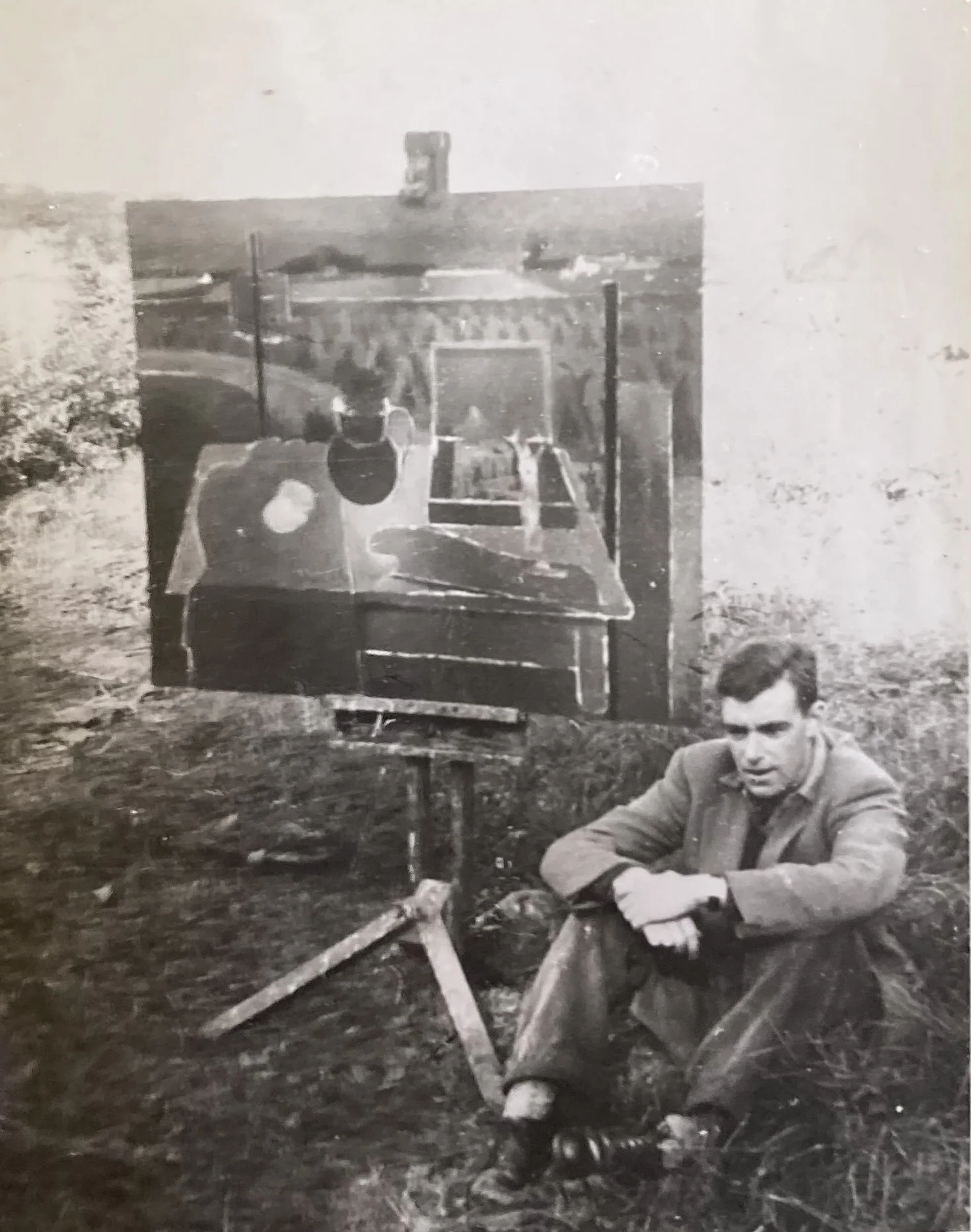
William Littlejohn, a rare example of the artist both painting outdoors and without a cigarette, c. 1960. Courtesy of Ann Patrick
There was one other aspect to Bill’s character that is almost the first thing that everyone who knew him recounts: his smoking. Ann Patrick said that he was ‘obsessive’ and had smoked from his early to mid-teens. She recounted how he could become irritable when asked or told not to smoke (in a concert hall, in a place with young children etc.)
However, it was his art and his application that surely attracted his early mentors to him and that sustained success for him throughout his career.
James Cowie, in opening the exhibition of three young Arbroath artists (Bill Littlejohn, George Henry and George Grassie) in March 1951, said of Bill: “His work is very sincere, and it is most unlike what other students are doing to-day; he has resisted a good deal of nonsense which is inevitably attached to a school.”
Even at the age of 21, his art looked distinctive and his temperament assured to a man who was amongst the most determined and principled of the day.
Cowie could have said that he recognised an element of himself in Bill.
THE IMPORTANCE OF ARBROATH
Throughout the late-war period and Bill’s student years, the home-town artistic stimuli continued to grow. Colin Gibson won the RSA Guthrie Award for young artists in 1943. John McKenzie had moved to the town from Glasgow and exhibited his unique slate sculptures at the SSA and RSA. The young painter, George Henry also exhibited at the SSA and RSA, and was joined by another young painter, Joan Cuthill.
The C.E.M.A. toured their exhibition of 70 pictures from the Scottish Modern Arts Association’s Collection to Arbroath Art Gallery from the 13th to 27th January, 1945 and had the largest audience (over 2000 visitors) and the largest collection of donations of the whole tour. That success led to a similar scale exhibition, organised by the civilian child of the C.E.M.A., the new Arts Council of Great Britain, in January 1946, when the McInnes Collection of mostly French and Scottish paintings ( Van Gogh, Matisse, Picasso, Renoir, Monet etc.; Colourists ( especially Hunter) and Glasgow Boys) was shown at the Arbroath Art Gallery.
Bill, in his final year at the High School would surely have been one of the many school visitors to the exhibition where George Mayer-Marton, the former Secretary of the Hagenbund artist group in Vienna, was on duty throughout, guiding people around the paintings. The Hagenbund included artists like Kokoschka; and showed Degas and Dufy; Matisse and Picasso; Renoir and Rodin. Lecturing and guiding in Arbroath was a man who had been a key player in the Viennese art world for two decades before the war.
The Arts Council/McInnes Collection exhibition led to the formation of the Arbroath Art Society who constituted themselves on 1st March 1946, and their inaugural event was a lecture on the 5th April by James Cowie, entitled “Modern Art”.
For Cowie, modern art was what he did, and his talk set out his artistic philosophy in strident terms: rejecting spontaneity and human emotion in painting, and rejecting the idea of representation of nature. He was free to use the skills he had acquired and any materials that he liked to produce a work of art that was composed and constructed to be complete in itself, without reference to any external truths (5).
It must have been stimulating for a 16-year old Bill. And after May’s “Design in the Home” lecture, a regular Friday evening sketching class was established, and at the beginning of June, Edward Baird talked on “The Art of Seeing”. We don’t have a report of what he said, but it would quite probably counter Cowie.
Meanwhile, the Director of the National Gallery, Stanley Cursiter and Cowie were engaged by Arbroath Council to review their art collection and select paintings to be re-hung in the renovated Art Gallery, which opened at the end of June. Two paintings by Peter Breughel the younger and a range of Scottish work including some by James Guthrie and James Watterston Herald, were on permanent show.
So Bill went to College having already been inspired by the momentum of Arbroath art activity; and having spent a summer at Hospitalfield with Cowie and his students, and sketching on Fridays with a cohort of Arbroath artists that one might assume included Vannet, Henry, George Grassie, and Halliday.
At Art College, Principal, Francis Cooper, and Head of Drawing and Painting, John Milne Purvis were in their final four years before retirement for the four years that Bill attended. Ian Eadie taught full time in the department and McIntosh Patrick part time. The McKenzie sisters were there, and Scott Sutherland arrived in 1947. The Governors of the Institute of Art and Technology were stalling on the establishment of the Duncan of Jordanstone Art College. Art students made public complaints. George Fairweather, Edward Baird’s close friend and lawyer, artist, Stewart Carmichael, and others campaigned for Mr. Duncan’s bequest to be used for art not technology, as was his wish. The College felt old, overcrowded, in transition, and without direction. There was no comparison with the post-war momentum and lively art scene in Arbroath. There were no students in Bill’s year who he seemed to engage with, either artistically or socially.
There is little available evidence of artistic output from Bill’s student years, but the sketchbooks in the R.S.A. archive show that he had absorbed James Cowie’s concepts and had the draughtsmanship skills to reproduce them.
In January 1947 the Art Society mounted what Douglas Bliss, Director of the Glasgow School of Art called “ one of the most exciting one-man shows I have seen in my career”: There were 51 pictures by James Cowie. “These still-life studies are the most remarkable achievements of the Scottish school of painting in the last 25 years.” Bliss was unconsciously undermining the Dundee tutors in Bill’s mind.
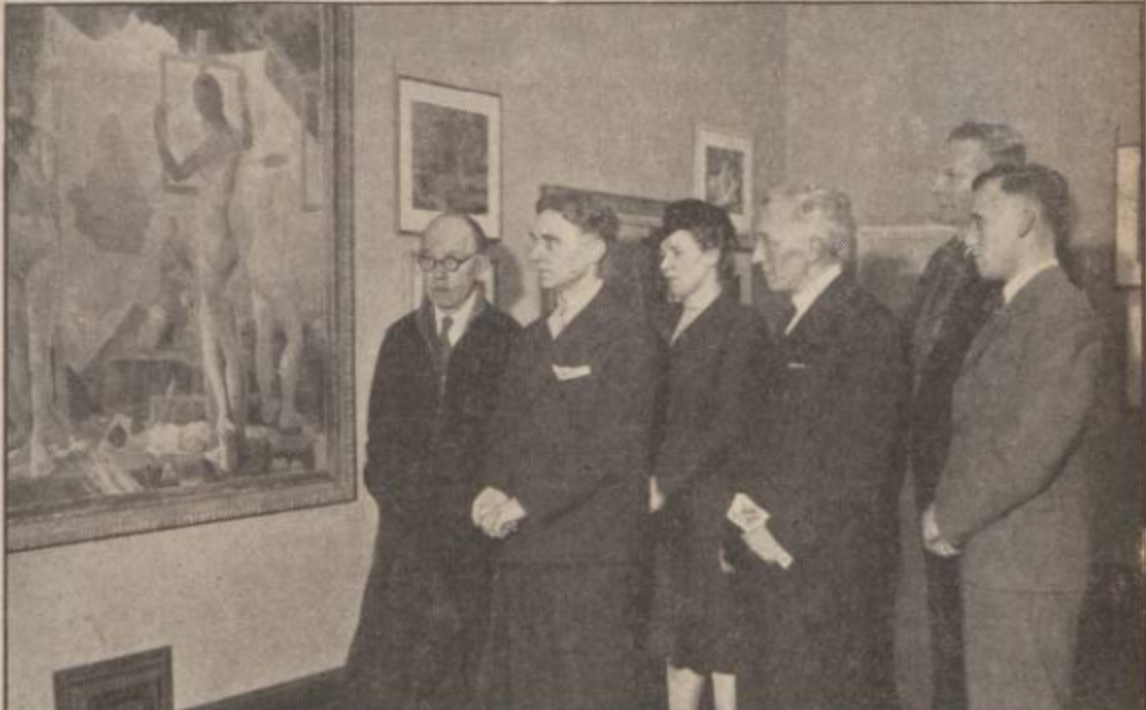
Arbroath Art Society opening of exhibition of work by James Cowie, Arbroath Art Gallery, January 11, 1947. James Cowie is far left, Douglas Bliss is second left. Courtesy of Arbroath Herald
Whilst at College, Bill exhibited paintings and drawings that often featured strong architectural subjects in the foreground and townscapes or pastoral settings in the background. He could make the seafront furniture and architecture of Arbroath almost classical. Cowie had got to Bill before he went to College. Cowie advocated close observation, but the extraordinary detailed approach of pre-war Dundee College teaching - with Edward Baird and James McIntosh Patrick to the fore - that manifested itself in Arbroath in Patrick Hennessy and W.P.Vannet (4) had been dissipated. Even Patrick was loosening up his style.
In this period, when Bill commuted to Dundee daily as a student, the activities of Hospitalfield, the Arbroath Art Society, and Arbroath Council’s Art Gallery, run by its Library Committee, created an environment that was as encouraging and stimulating as the experience at art college; perhaps more so. The Art Society momentum continued with lectures and exhibitions. The Cowie show was followed by the only Scottish date on an Arts Council tour of the works of British painters from 1939 to 1945 - the ones not painting war subjects. That brought Paul Nash, Colguhoun, Pasmore, Ivon Hitchens and fourteen more illustrious names to Arbroath, 70 pictures on display. A Burrell Collection show followed swiftly afterwards: another 70 pictures by Cezanne, Degas, Courbet etc. as well as Raeburn and Peploe. Young artists from Arbroath had first hand experience of great paintings to rival many of their contemporaries in Edinburgh and Glasgow.
Bill emerged from College having incorporated influences from all of these experiences, and somewhere along the line a strong link to Braque; but he was more under the sway of Cowie than any of the Dundee teachers or, for that matter, any other artist that he’d been introduced to as a student.
There was a hiatus in his artistic development whilst he carried out teacher-training and national service, but when he settled into a life of painting and teaching art, he had made a further distinctive leap, further embracing the work of Georges Braque and the inspiration and encouragement of Talbert McLean.
His years in the RAF (1951-1953) don’t seem to have produced anything visual. He was a participant in a landmark exhibition of young Arbroath artists in July 1952, but his contributions were home-based (6). His teacher training and peripatetic teaching in Angus Schools (1953-56) would have been diverting and challenging for his quiet, gentle temperament and not conducive to the still life he needed for drawing and painting. So, his appointment to a fixed post at Arbroath High School in 1956 would have felt like an achievement and a settlement. His life as an artist and teacher had been secured. Working alongside Talbert McLean every day was the start of further education. And then there was the Edinburgh International Festival exhibition of Georges Braque paintings in that same year.
THE PICTURES, 1951-1964
He exhibited sparingly, and offered limited amounts of work to the market from 1946-1960. Evidence of Bill Littlejohn’s artistic progress before 1960 is scarce. It seems to me that he felt his education was ongoing through the 1950s and he wanted to hold back from exposing himself to the wider art market until he was ready, but once he started to work and exhibit widely, from the turn of the 60s to his death in 2006, extraordinarily, he sustained healthy sales throughout.

William Littlejohn, Untitled (Nude and Conch Shell). Charcoal and chalk on paper, 27 x 30cm, 1951
In 1951, he’d assimilated Cowie’s methods as his untitled drawing of a nude and a conch shell showed. The set-up could have been a Cowie test, conch-shell and small mirror on a polished surface, painting of a nude behind, two colours available. Contrast Bill’s treatment with the Patrick-Baird boys who came though Dundee College of Art before the war. (4) The commitment to detailed observation remains. Firm outline underscores clarity and perspective, but soft and subtle tonal shading replaces the fine line work and polished finish. These objects are real, but their placement and the relationships between themselves, light and reflection, and the artists perceptions create a modernistic tableau that challenges the eye and the brain to dart around, questioning and measuring and checking, whilst constantly pulled by the dream-like seduction of the supine lady. Throughout this period, human figures were regular features in Bill’s thinking and drawing, although he doesn’t seem to have committed many to a finished picture. After 1956, they are passing thoughts.
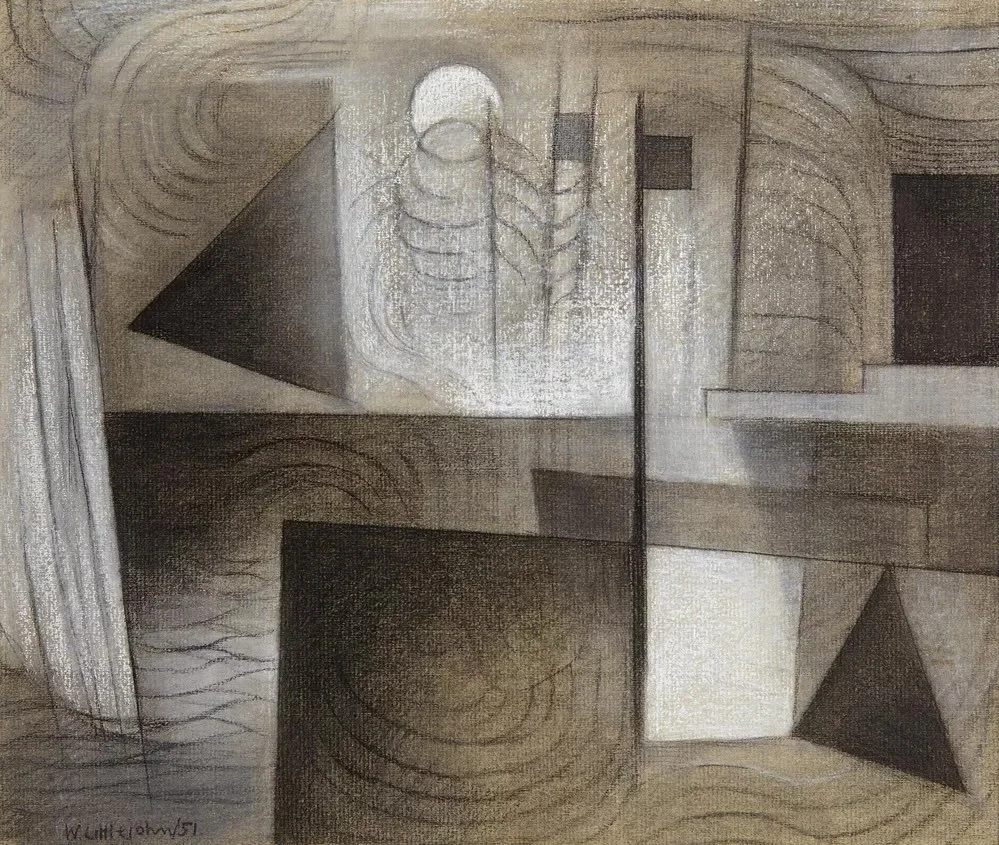
William Littlejohn, The Sun Rising. Conte on paper. 27 x 32cm. 1951.
Bill kept this image for fifty years. It’s hard to know whether it was an exercise or something that he regarded as a finished work. I’d err towards the former. It’s as though he wanted to prove to himself that he could integrate aspects of his learnings from Cowie - light falling on different angles, reflections, careful planning - into an abstract composition strongly influenced by Braque, in which the motifs and symbols could reflect the realities of Arbroath should you wish to interpret them in that way: sun or moon over harbour, with walls, masts, poles, pools, movements of water, solids and fluids… The entire composition is confined to three colours and their arrangements into subdued and subtle chromatic patterns as they respond to the solid lines and blocks that Bill has carefully installed in arhythmic sequences. There are multiple light sources and multiple angles in which the picture plane can be interpreted.
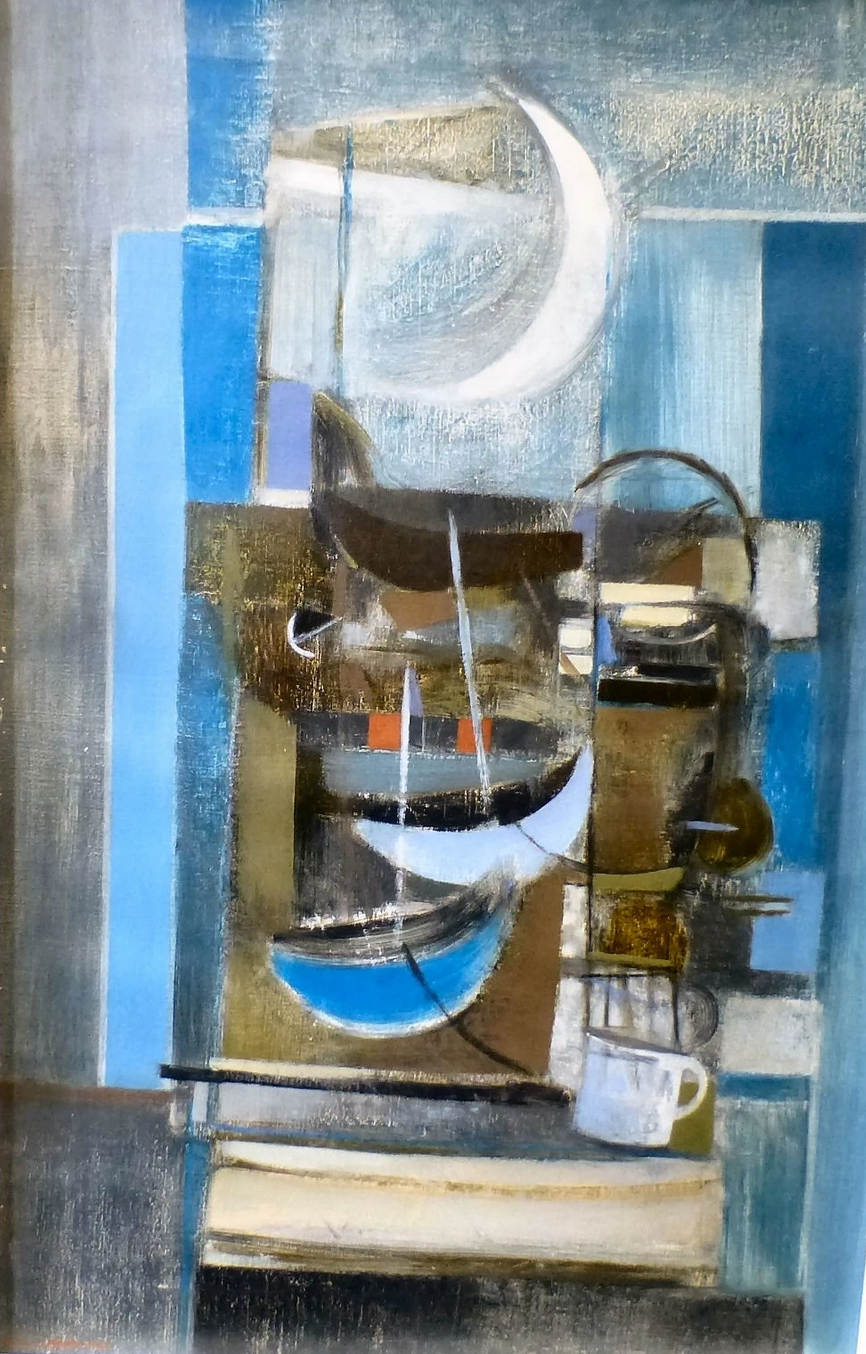
William Littlejohn, Moonlit Harbour. Oil on canvas, 75×60cm. 1954
Cowie-isms were beginning to recede by 1954. The composition of Moonlit Harbour with its view through a window; the foreground mug; and the clutch of visual stimuli in the background could be tracked back to Cowie. But the tonal blue and grey slabs, and the abstraction of the picture through the window into a play of shapes and lines speaks of the growing influence of Talbert McLean. Under the oversized moon, Bill offers the boat, anchor and mug motifs as crescents, and cuts his mid-right circle to produce two more. He reflects the moonlight on the frames of the window and its glass and picks out illogically moonlit boats from the dark brown, black, grey and rust harbour in Braque-like conceits of time and place.
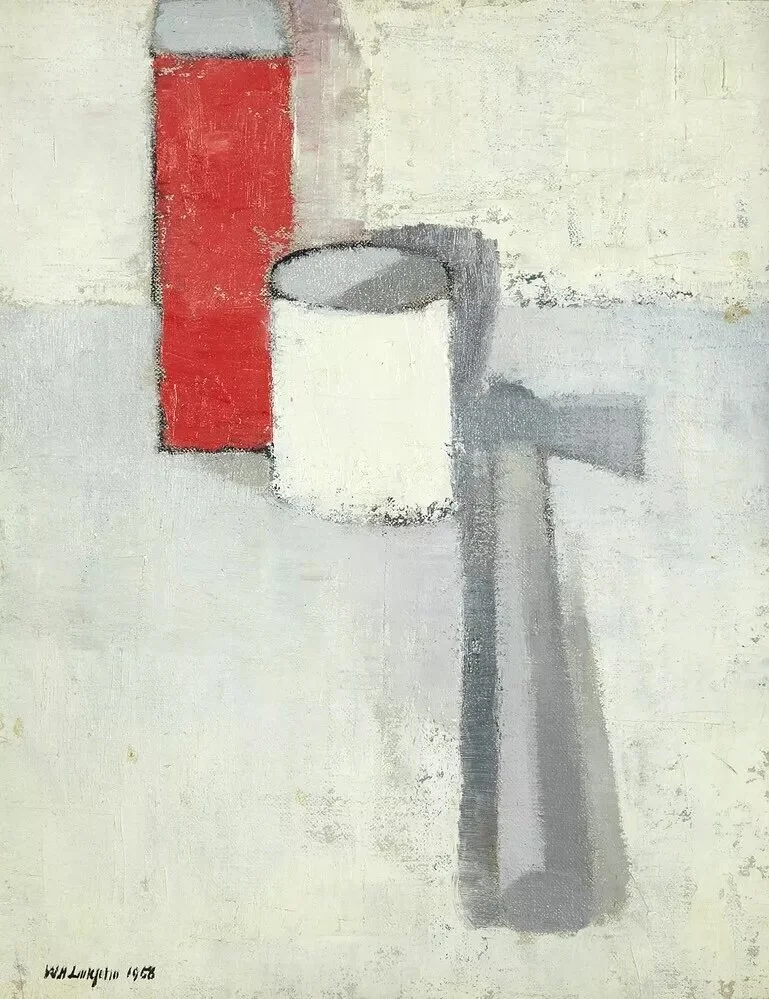
William Littlejohn, Untitled (Still Life with Hammer). Oil on Board, 49×38cm, 1956
Talbert McLean, educated in Dundee, had lived and worked in London and Liverpool, before returning to Angus. He knew William Scott as well as James Cowie. He was a fan of Keith Vaughan and well-versed in Ben Nicholson’s work. In the 1950s he produced meticulously painted still-life oils with large flat areas of low-toned colours, strong firm shapes in whites and greys, which he contrasted with detailed small shapes in powerful colours, reds, yellows… lemons, melons. Bill’s Still Life with Hammer could almost have been painted by Talbert. James Morrison, the painter, said in 1962 that Talbert was ‘by far the best abstractionist Scotland has so far produced’. Bill was learning by copying from the master.
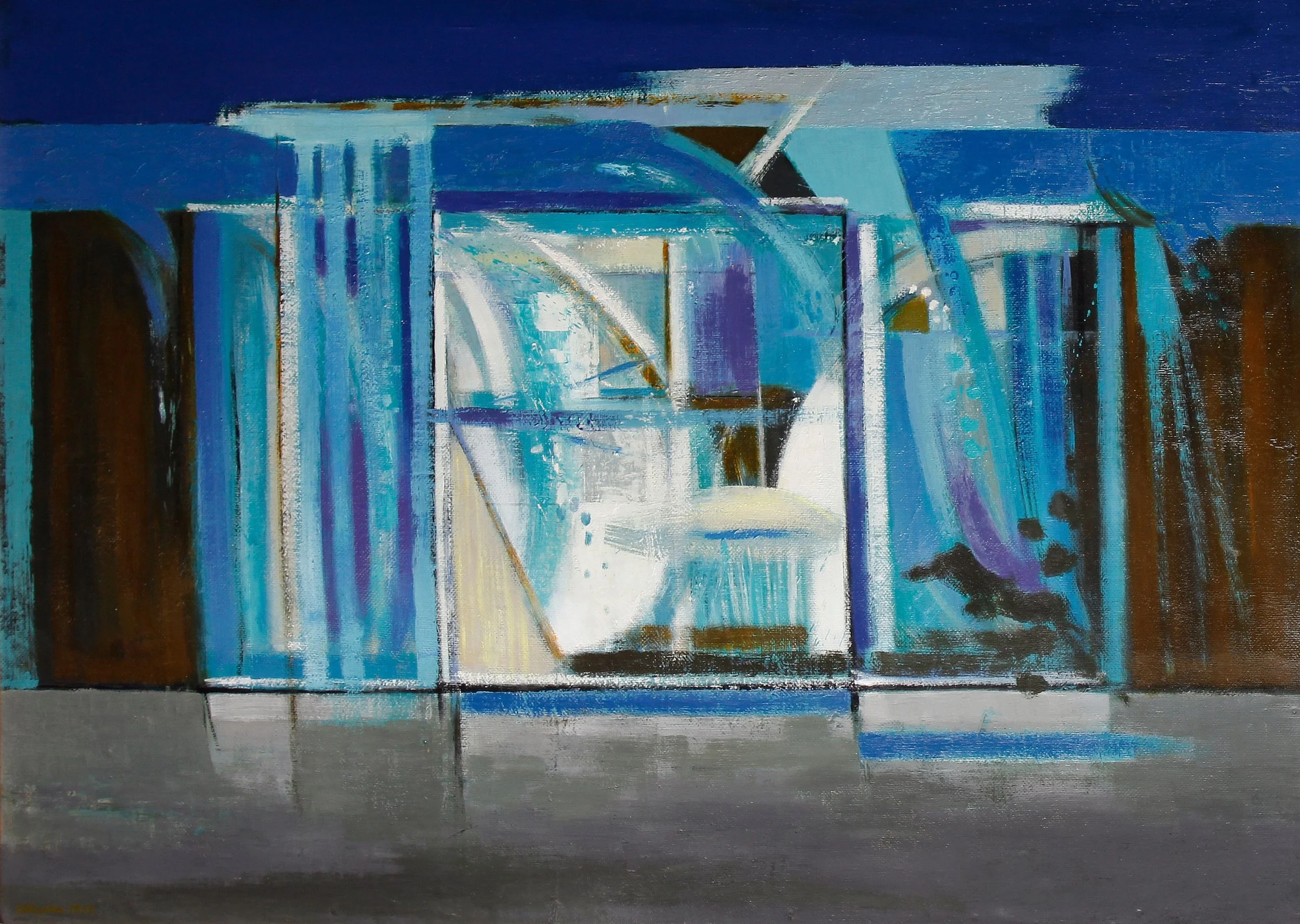
William Littlejohn, Sea Wall. Oil on board, 71.5 × 102cm. 1958
Talbert was the coolest man in Arbroath, and his house became a meeting place for young artists. And there were many. Bill was elected chairman of the Arbroath Art Society in 1956. The time had come for the younger generation.
Also in 1956, Dick Hunter, recently graduated from Dundee, was at Hospitalfield along with the Glasgow students who would soon set up the Glasgow Group: Anda Paterson and James Spence; Ewan McAslan and Isobel Colville; and Ian McCulloch. From Glasgow to Arbroath the new generation were bringing new ideas to the Scottish art world. Dick shared a spartan studio with Bill and they were both central characters in an artistic and social group mentored by Talbert McLean and including his son, John. Bill’s education continued through his involvement with these younger artists, and the quiet still-life oils, Braque-isms and harbour realities were thrown into an expressionistic pot, the Sea Wall seen as never before, a shock of abstracted images: fragments of boat architecture, water reflection, and harbour equipment in vivid blues and turquoise; thrown together with a loose framing of blocks of wet grey, jet black and burnt umber. It’s worth noting that Bill’s engagement with the sea, which he embraced throughout his whole career was always within the confines of a sea wall. His water is stilled. He left storms, waves, and wild seas for others. There was very little like this in Scotland in 1958.
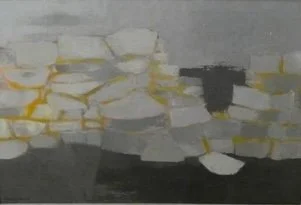
William Littlejohn, Drystane Dyke. Oil on board, no dimensions. 1958
Bill had had pictures exhibited at the RSA in 1951, but had concentrated all of his exhibiting since then in Arbroath. In 1958, he sent what he probably regarded as his first mature submission, Drystane Dyke. It feels like a conservative confidence-builder compared to Sea Wall. Bill’s psychological strength was about to be tested by an incident at Arbroath High School that became a media debate. Two boys (and their parents) took Bill to court for hitting them in the classroom. There was no denial from Bill but there were mitigating circumstances of exaggeration, insolence and disobedience. The rector, Mr.Wilson, backed him strongly. “The atmosphere in his classroom was harmonious and happy since and before the incident.They were a difficult class, and could be a troublesome class.” The Sheriff threw the case out, but it was one of the first cases of students challenging teacher’s authority and there was much media attention and letters to the editor.
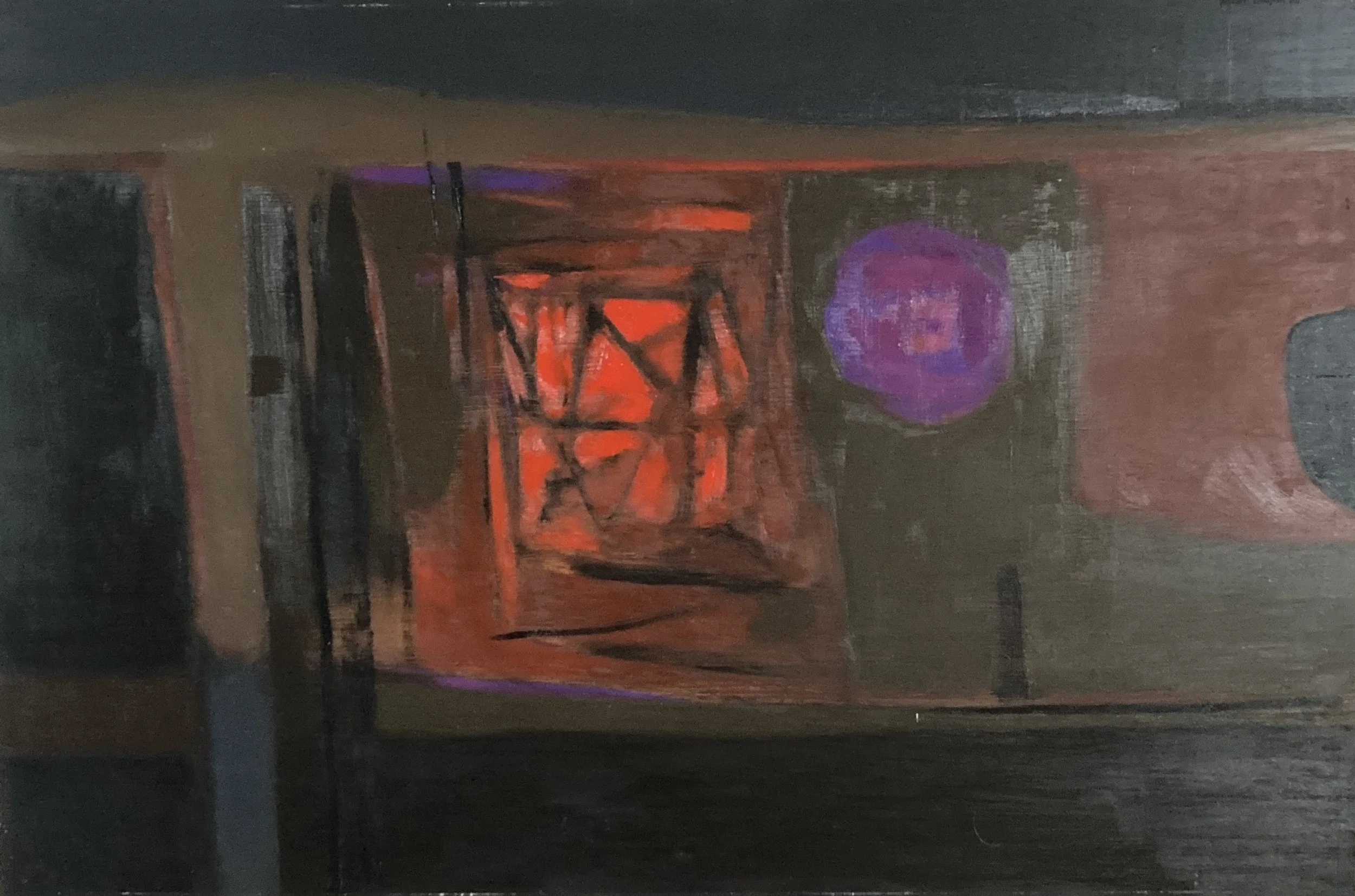
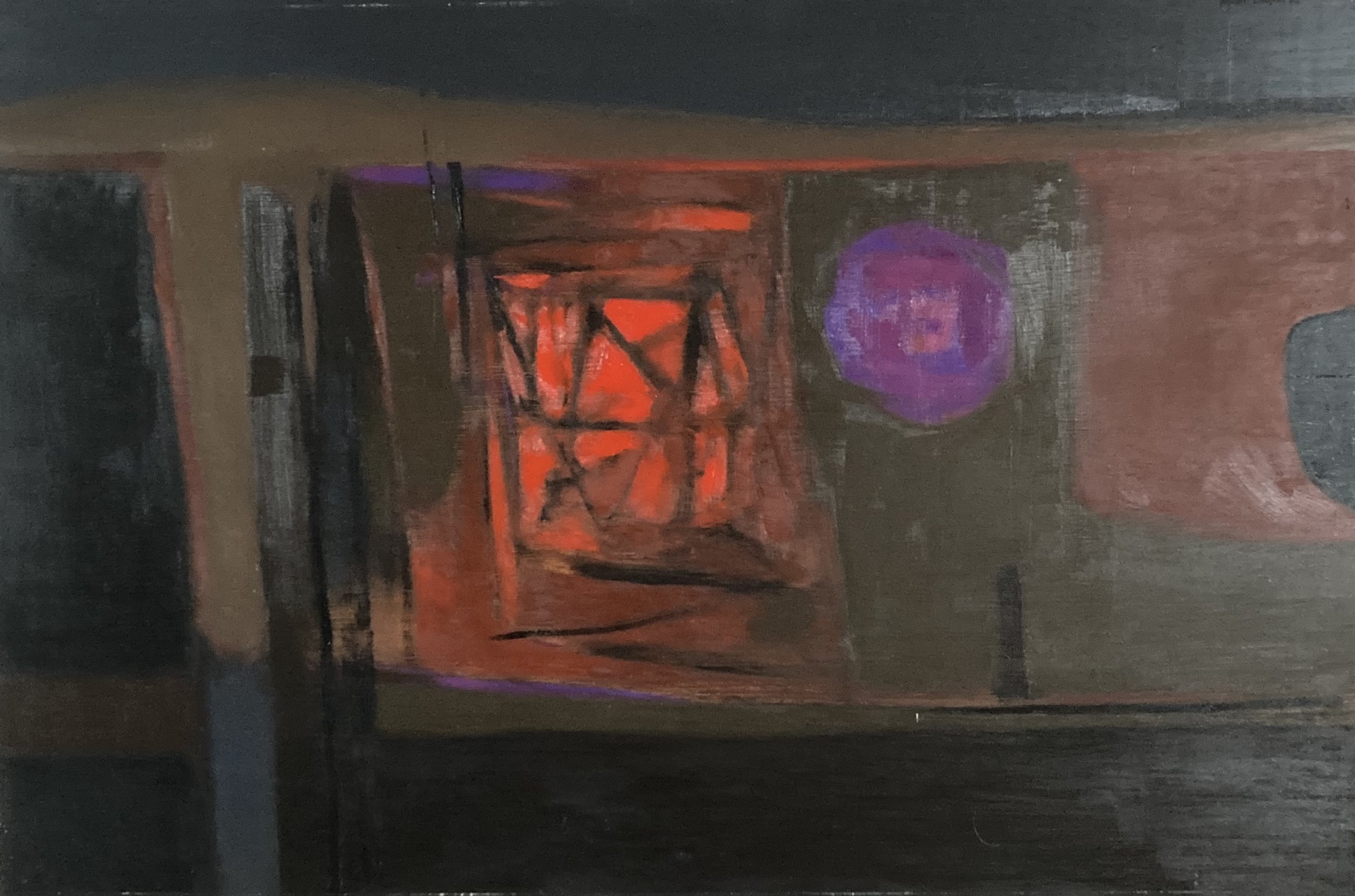
William Littlejohn, Painting, 1960. Oil on board, xx x xxcm. 1960
By 1961 his self-assuredness had grown, because he got a gilt-frame for his Painting,1960, sent it to the RSA and gave the wider world a first taste of Bill Littlejohn, the mature abstract artist. In this moment when modernism was the hot topic in Scottish art ( the Gallery of Modern Art was opened in Edinburgh), Bill Littlejohn trumped the local favourites (see my article on John Houston, 1960 in Issue 6), and produced a fully fledged abstract expressionist piece that could have been painted in New York if it had been ten times the size and hadn’t used oiled jute sacking in the framing. It won the Guthrie Prize for a young artist at the RSA show, and launched Bill’s career as a professional artist. It still looked and smelled like a painting from Arbroath, and it was bought, for £25 (the equivalent to £500 in 2026), by Bill’s old schoolfriend, Bob Robertson. Bill and Bob would have recognised (if they wanted to make such an interpretation) the realities of lights in darkness around the harbour.
It’s an oil on board painted in very dark colour and the gloss reflects the lowest light. It’s hard to imagine that it was exhibited under glass and lights at the RSA and was still picked out by the prize judges. It’s a painting in which the subtleties of light in dark circumstances are hypothesised and examined, and accentuated. The seven strips of colour to the left of the bright red central image may have had roots in a real-life but Bill is playing here with combinations of minor tones as they respond to the major tone of poster-red. It’s an essay in natural crepuscular colour schemes that could almost be figurative if you turned the painting on its side.
Meanwhile the central arrangement of complex, predominantly red and black shapes echoes the Braque-like exercise of Sun Rising. The leaching of shadowed reds into the surround of the pure toned, seemingly encased framework, suggests that the light and the colour is emanating from behind the irregular lattice-patterned structure in the way that a warning light on a harbour wall might. The artist suggests darker sections where the light falls at an angle to the viewer that is indirect, and then he revels in the bright purple and dark bottle green adumbrations that he applies to the edges of his construct. There is no explanation for the purple circle or the dark terracotta shape enclosing another grey shape bleeding off the edge to the right.
We are in the realms of strange chords of colour weighted and shaped to contribute to a tone poem that sits stylistically somewhere between the minimalist colour blocks of Rothko and Newman, and the complexities of layering and shape designs that contemporary Scottish artists like James Cumming and John Houston were exploring. McLean filtered the popular American expressionist approach of the day through the prism of St Ives. And McLean was Bill’s guiding star. William Scott and Peter Lanyon might have combined to produce Painting,1960 if they had more experience of dark November nights in working harbours in North East Scotland, rather than the beach, big skies and whitewashed buildings of Cornwall’s Mediterranean substitute.
This was a painting that was different. The impact of the very black encasement of subtle dark tones and the contrasting brilliant colours was something that hadn’t been seen, and Bill may have shocked himself. It was certainly at his dark extreme and although clearly considered and planned, the brushwork is bolder and looser than his norm..
However, the shock had repercussions. Littlejohn found himself at the vanguard of the Scottish modernists. He was quickly added to the essential lists for leading Scottish artists. He was featured in the Arts Council Scottish Art shows in Toronto in 1961; Kendal, Middlesbrough, in 1963; and in contemporary Scottish Art shows in Reading, The University of Glasgow and the Gallery of Modern Art in 1964 The Scottish Gallery offered him a solo show in 1963, and all of the paintings sold. Bill hardly knew what to do with the money.
Dark abstractions with harbour references were his ‘thing’ and having found a unique spot, he worked on developing the concept through variations; improving and polishing his compositional skills and language of colour combinations. He realised that black on board was not a tenable option, and he settled into using browns and greys as dominant colours.
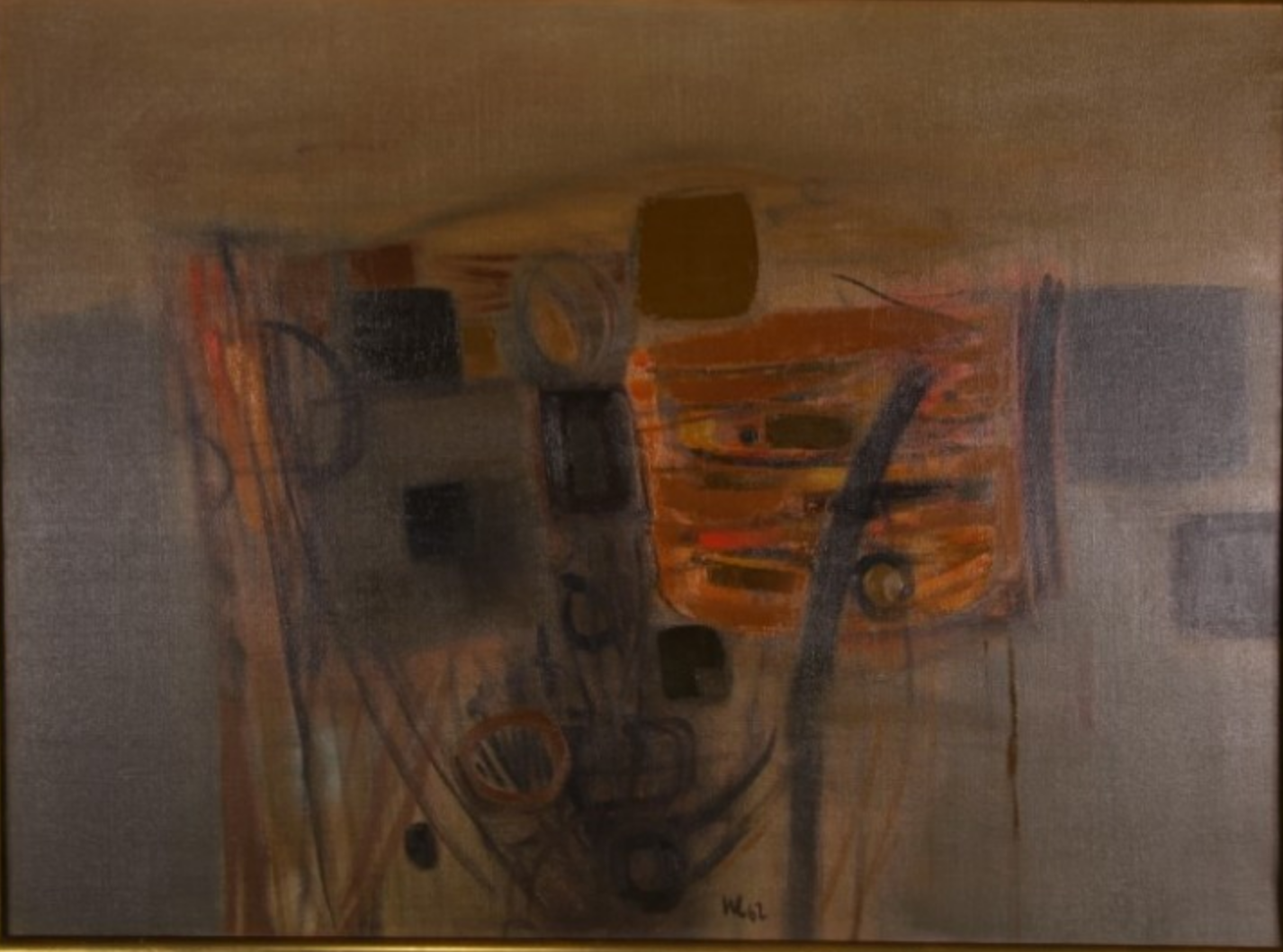
William Littlejohn, Fishing Gear. Oil on canvas. 74 × 100cm. 1962
And with brown and grey underpinning the composition, he could use black as a spot colour, as we see here in Fishing Gear. Bill discovered how to combine a sense of solidity, perhaps even age, with a sense of flux. We can feel the centuries old harbour walls interfacing with the tides and currents of today. His colour blends are warm and comforting. He has bright red in the centre of the picture again, but it’s a few dashes mixed in the ember glow of orange rusts. Big sweeping strokes bifurcate from a mysterious apex at the base of the picture. His ‘gear’ is unclear. All edges blur with colour transitions and the effect is soft and strangely warm in contrast to the cold functionality of the subject matter.

William Littlejohn, The Sun Shining through the Mist. Oil on canvas. 29×39cm. 1962
Bill was able to create that soft and warm sense even in a composition underpinned by many shades of grey. Sun shining through the Mist was as close the Bill got, in public in this period, to realising the harbour as others would see it. The main contrast colour is yellow and Bill’s low sun carries warmth and hope. His oft-used cut-out shapes of moons and suns are replaced by a representation that demonstrates close observation. The wisps of mist pick up a whiter colour as they move in front of the sun, whilst the yellow glow is diffused through the smirr across the picture. In the foreground mix he introduces jet black and brown curved blocks, and his striking spot colours are vivid red, yellow and cream. He shared the signature circular shape with Ian Fleming, whose Arbroath harbours invariably use life-buoys as design motifs. There is an extra reference here too, inasmuch as the ‘Round O’ was an Arbroath signifier, a key element of the gable end architecture of the ancient abbey.
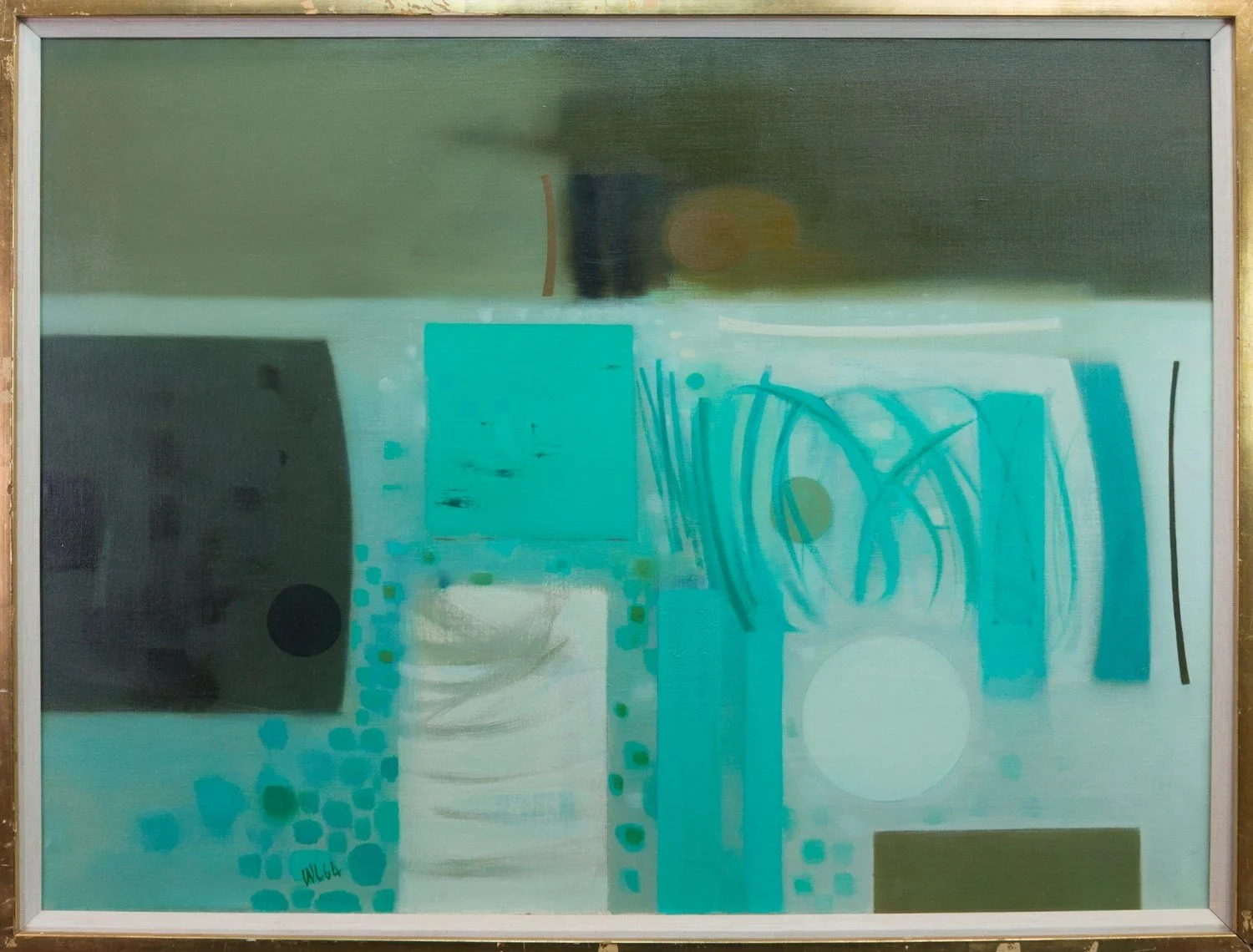
William Littlejohn, Green Painting, 1964. Oil on canvas. 90×120cm. 1964
Four years with significant output exhausted Bill’s brown and grey harbours. He’d introduced more and more shapes and blocks of colour, developing his solid/fluid correspondence, and by 1964, as we see in Green Painting, he was ready to come out of darkness into brightness. It is almost as though he has overpainted a brown/grey/black painting with a new turquoise based fancy. His playful placing of lines and shapes, curving in intersection and parting; creating a spontaneous, natural sense; contrasts with black, white, bottle green and turquoise blocks that offer the main notes in the colour chord. The divide between the turquoise and brown sections of the painting reflect an increasingly common device to break at this five-eighth point and suggest a foreground. His tendency to frame central constructs in solid dark surrounds had advanced to this break line before disappearing altogether as his all-foreground table-top still-life shapes, colours and real objects became his stock-in-trade.
The next phase of Bill Littlejohn’s artistic development was introducing itself, and as always with Bill, in a gentle, quiet way. In 1966 he was appointed to the Painting and Drawing department at Gray’s College of Art and his everyday modus operandi changed. His art and his social circumstances shifted, but only from Arbroath-centred to Aberdeen during-the-week, and Arbroath at weekends. I will return to follow the rest of Bill’s artistic career - the one that is perhaps better known - in a second piece.
But before I sign off for now, there is a mystery about Bill Littlejohn’s early years that I haven’t been able to solve. From his late teen years, and perhaps earlier, he lived with his Aunt Ann, who I have to assume was a real aunt, his father’s sister. His parents and his brother and sister lived elsewhere. It was the start of a singular life, throughout which neither he, nor any other source, suggested any kind of romantic attachment, male or female. He socialised and holidayed with friends, and most of them knew their friends’ parents, but no-one I’ve come across knew Bill’s. His relationship with his family is opaque, to say the least.
Perhaps it was this singularity, and the attributes associated with it ( determination, pride, discipline, principles…) that enabled him, like Cowie, to produce something unique. And the luck of being in Arbroath at such an exciting moment.
Roger Spence
Notes
(1) Bill was born on the 16th April, 1929, at 33 Rossie Street, Arbroath. Bill had a brother, Ed, and a sister, Ann.
(2) From a young age, Bill was interested and engaged in many cultural activities, and in July 1946, at the same time as he was attending Hospitalfield, he was producing “The play within the play” from Hamlet, and acting in another play at the High School’s Dramatic Society. He later helped Talbert McLean set up the Arbroath Film Society and was its treasurer in the 1950s
(3) At that time, RSA membership was restricted to thirty painters, sculptors and architects.
(4) see art-scot issue 14.
(5) The full report in The Arbroath Herald (12th April 1946) was as follows (my quotation marks) “The modern movement in art”, declared Mr Cowie, “was a revolt against the romantic idea of art which was held by most of the artists of the 19th century — a revolt not only against the degenerate examples of that period, but a revolt also against the ideas of art which animated its finest productions. To the 19th century painter art subserved the artist; to the modern painter the artist subserved art. The artist of today was tired of the work of art which was the vehicle of individual feeling, tired, that is, that an artist should think a recital of his personal emotions were important to others; tired of the man who thought it important that, in his art, he should talk of himself. It meant that the artist of today was tired of the stress which his predecessors had laid upon Spontaneity’ in art, fired that the sketch which, however spontaneous and charming he regarded as slight and unimportant, should, as result of this estimate, be reckoned as a work of art. Also, they were concerned to notice that, in the past, the habit of representing nature as it appeared to the physical eye had limited the use of language; and so the modern movement came to mean also, that the artist to-day had thrown overboard completely the notion that his picture must resemble nature in its physical aspects and had permitted himself a freedom in the use of language that had seldom been enjoyed in art. Instead of adhering what only happened, or could happen, in actual life, and painting it it happened, or could happen, he was prepared to use any material whatever, conditioned by such restriction, for his artistic purpose, and to treat it, if need be, without reference to visual truth.”
(6) The “Exhibition by Eight Young Arbroath Artists” mounted at Arbroath Art Gallery in December 1952, comprised 96 works by former High School pupils and Dundee College of Art students, Morris Grassie (born 1931), Irene Halliday (born 1931), Charles Hampton (born 1927), George Henry (born 1916), William Littlejohn (born 1929), Kenneth Myles (born 1928), architect, Charles Robertson (born 1928), and George Williamson (born 1927).
Acknowledgements
With thanks to Elspeth Duffin, Colin Greenslade (RSA), Ann Patrick, Mike Robertson, and David Walker who had time and patience to talk about their first-hand knowledge of Bill Littlejohn. Their contributions will be even more important to the second part of this survey.
Thanks, especially, to David Walker for making introductions
Thanks to the RSA, and especially Robin Rodger, for enabling me to spend much time with Bill Littlejohn’s archive, and for approving the picture rights.
Thanks to Ann Patrick for showing me her photo album from the 1950s and 1960s, from which the portrait of Bill Littlejohn is taken.