
Victorine Foot: Painter, Teacher
Victorine Foot (1920-2000) was a twentieth century painter who lived surrounded by the big personalities of the Edinburgh School. She was an observer, her work held true to her first love of the early Renaissance painters, her religious beliefs, and, as for many women artists, family came first.
The painter Victorine Anne Foot (1920-2000) was one of a group of painters in Edinburgh now known as the Edinburgh School. She came to Edinburgh when she was 26 and, with her husband, the sculptor Eric Schilsky, lived in a studio in Marchmont, which they modified to become a family home. Both taught at the Edinburgh College of Art; Foot only briefly, and she went on to become an art teacher at Oxenfoord School. Their close friends included William Gillies, John Maxwell, Robin Philipson and Anne Redpath. They also painted still lifes and the Scottish landscape, yet their names are rarely mentioned alongside these better-known artists; Schilsky occasionally, Foot not at all.
Foot was born on 1st May 1920 in Kent. The family later moved to Beaconsfield in Buckinghamshire, where Major Hammond-Foot had an agricultural machinery business. She was close to her sister, Jocelyn, and her mother, Elspeth (nee Rae), to whom she wrote daily while away. Her detailed diaries record her comfortable adolescence: music and Italian lessons, frequent shopping and theatre trips to London, tennis matches, horse and cycle rides, dances and parties (often fancy dress), and her chaperoned European art tour to Paris, Florence and Venice in 1937.
Foot began a course in Theatrical Design and Costume at the Central School of Art, London, in 1938, where she was taught by Jeanette Cochrane (1882-1957), a pioneering teacher who strongly advocated greater historical accuracy in theatrical Costume Design. Draped Life classes were with Christopher Ironside (“which dragged”, she wrote in her diary (1), and Composition with the illustrator John Fairleigh. There were also classes in Perspective and History of the Theatre. Foot loved her time at the Central as she later wrote in a memoir for her daughter, Chiara Schilska: “there were two kinds of parties; one kind we danced, the other kind we sat around on tea chests and talked, the staff would often be there. I felt very flattered because I was told that I was among the very few who were asked to both kinds of parties”(2)
Foot changed from Costume Design to Painting on impulse after seeing a painting of Jesus throwing the money-lenders out of the temple, which was hanging in Gerald Marks’s studio.(3) She said that Jeanette Cochrane had been rather upset: “(she) was a wonderful friend as well as a teacher and I learnt more about life than about costume from her lessons.” Foot began painting under the tutelage of the Scottish painter, Robert Kirkland Jamieson, and never returned to Costume.
Less comfortable reading is her references to bullying by fellow students, who were cruel and curious on discovering her religion. She wrote to her mother:
“Don’t call her darling, she’ll be shocked, she’s a Christian Scientist, she hasn’t any body, she just floats about in the air… I sat listening while he went on, saying he had read Stefan Zweig’s note on Mary Baker Eddy (4) and how she made her money etc etc until I felt as if lava was pouring out of my head and down my volcanic sides… I couldn’t trust myself to speak… It seems to have leaked out everywhere what my religion is, and several girls have asked me about it, it's a great responsibility - and what can one say when you are taunted with having no body? So not needing a chair, etc? I really broke down when I got outside that inferno…” (5)
Due to air raids, the Central was evacuated from London to Northampton in 1941, where the students were put to work on maps for the armed forces. To sustain her career ambitions, Foot took a front-of-house job at the local theatre. Quickly bored with drawing maps and keen to be more financially independent from her parents, she interviewed for a junior job with the Civil Defence Camouflage Establishment (CDCE) in May as they offered an attractive salary:
“This interview is on Tuesday is rather overshadowing…. (Reginald) Tomlinson asked us today if we had any perspective or architectural drawings to show - so there are 300 going in for six jobs - I don’t think it's even certain that two of us will get it. It’s £3.12.6 a week just think of it!” (6)
She was unsuccessful, and although placed at the top of the waiting list, by the time they offered her the post at the end of the summer, Foot had changed her mind:
“My parents felt I should do it and there was the feeling that one should help - and I didn’t want to be put in the forces… When I accepted the job I cried and wept on my bed for a whole day - I had just started to really paint on my own outside the rooms in the art college, I was getting ideas in paint, and I was in love with at least 2 of the other students (one was the political activist Gerald Marks, a painter; Foot went to Communist party meetings with him (7)). Suzy Einzig (a painter) said to me “I don’t know why you do not want to go - there are marvellous artists there like Eric Schilsky (a sculptor). And I remember so well saying ‘What do I care about Eric Schilsky? I want to paint!’ little knowing that I was to become his wife five years later.”(8)
Foot was 21 years old when she arrived in Leamington Spa to take up her post as a Junior Technical Assistant in the Naval Section of the CDCE in September 1941. The painter Felicity Sutton (née Fisher) became Foot’s close friend; they took rooms with the same landlady. Sutton gave a lively account of their life there in conversation with Chiara Schilska (9):
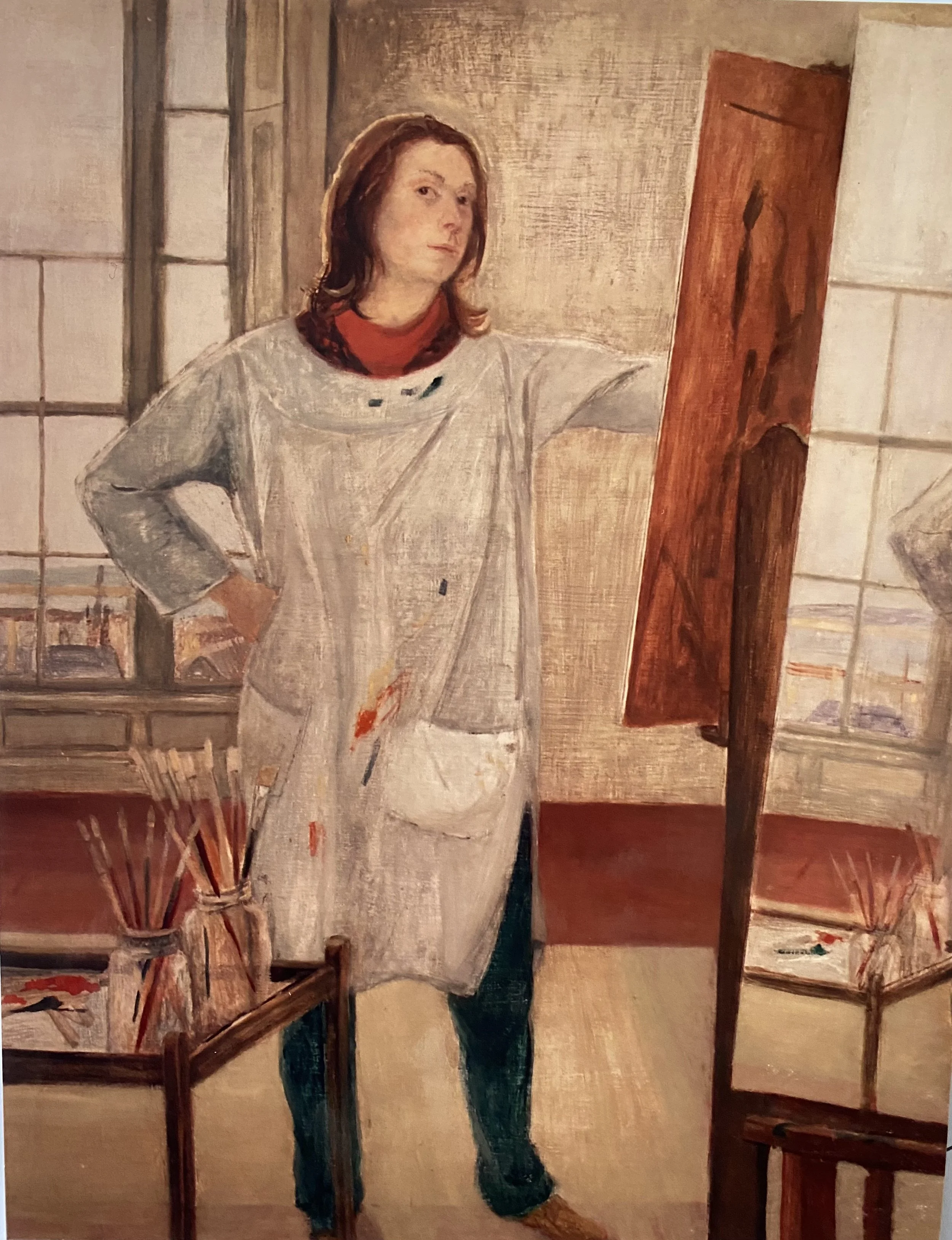
Victorine Foot, Self Portrait, oil on board, dimensions unknown, 1950s, private collection, image from artist’s archive.
Note: This interior is not the Foot/Schilsky home and studio at 16a Meadow Place, Edinburgh, but appears to be the first floor of 32 York Place, Henry Raeburn’s north-facing studio, later used by Samuel John Peploe. Its use is mentioned briefly in the artist’s archive.
“Victorine arrived one weekend in a taxi with her luggage from the station. I was immediately enchanted by her. Tall, beautifully made, pale creamy coloured skin, dark brown eyes of a special brightness and a thick mane of reddish-brown hair; she was strikingly lovely. Her voice, also, was lovely… Here were gathered about eighty artists and craftsmen, who, for some reason or other, were physically unfit, or past calling up age, to be in the forces… They were a kaleidoscopic collection, all different shapes and sizes and ages. Many of them had spouses, either with them, or left behind at home somewhere in England. The curious thing that occurred during the four years I worked there was the extraordinary re-arrangements of these married couples… ”(10)
Based at the Regent Hotel, the CDCE needed large spaces to simulate views of ships at sea and factories from the air, so the town’s Roller Skating Rink was requisitioned:(11)
“At The Rink, a tank of water took the place of the raging seas, and various “weathers” and times of day and night would be switched on by “that Miss Sutton” and the vessels conned through binoculars from the Black Box in the centre of the gallery. The effect of reality was astounding. Weather conditions were simulated with dimmed lighting and a fan. Victorine and I made exact machine drawings from “Jane’s Fighting Ships” … plans and elevations of battleships - using dividers, rulers, curves and various devices. These were printed. Then onto these prints we copied exact replicas of camouflage designs from models painted by the Officers. These plans were then rolled up and sent by courier to the dockyards. Seamen were slung over the sides of the ships, and painting began. We were made quite aware by our chief of the pungent expletives given vent to during this operation.” (12)
Foot was sent to Plymouth to record this process, and her painting, Camouflaging a Cruiser, was purchased by the War Artists’ Advisory Committee in June 1943. (13)
In 1993, Foot talked about the experience with Angela Wait of the Imperial War Museum (IWM):
“I went because I’d heard that HMS Newcastle was being camouflaged in dock in Plymouth and an aunt of mine was going to visit a protégée of hers who was a… midshipman on board, it was all very marvellous I could go with her to Plymouth and had all the right permits and I can remember (it) so well… it took some nerve to walk in and sit down on the dock in the middle of a war in front of a battleship and get out your paints, you know, but I had to do it, and I did that, and I was hardly down on the ground before the officer of the watch arrived with a sailor on either side armed to the teeth and they presented arms and said “Pass” and put out his hand so I rather embarrassedly handed up my pass and went on squeezing out the paint and whenever they changed watch the officer thought it a great joke, I’m sure, to come down and get my pass again!… Oh I was harassed by the audience of sailors that absolutely mobbed me, you know, they were watching every brush stroke and bringing me mugs of tea! And then word came that the commander would like to give me tea on board and so up I went to the gangway and got winks from all the sailors. And in his cabin there was the design which had come from the Naval Section in Leamington… It was very exciting really to feel and to see this design of ours and to see it being put onto the ship! So I was very glad that I had done this and of course I was delighted when the War Artist Advisory Committee bought the painting.”(14)
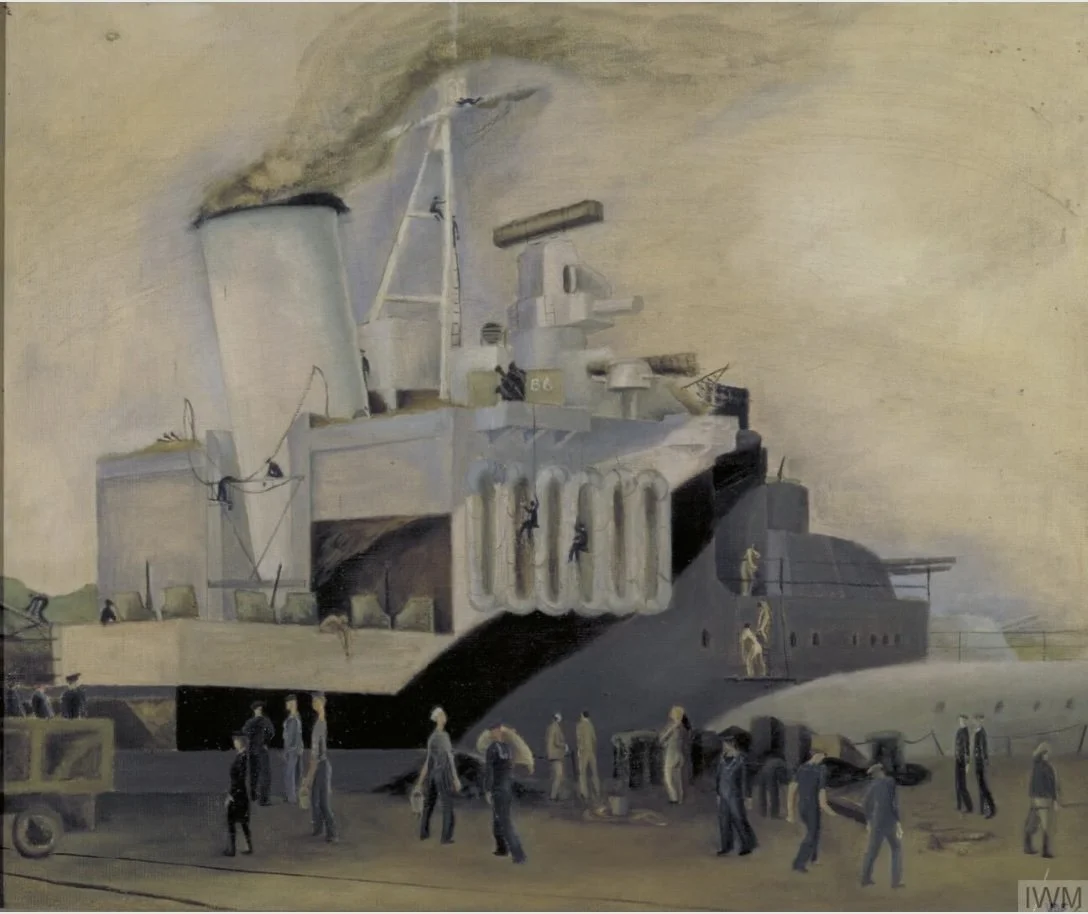
Victorine Foot, Camouflaging A Cruiser, oil on canvas, 51 x 61cm, 1943, Imperial War Museum Art. IWM ART LD 3016
Foot painted the navy cruiser on a gloomy wartime day, limiting her palette to black, white, greys, and muddy yellows. It is a surprise to see the bold camouflage scheme the team decided would work best at sea, probably in the North Atlantic; a black diagonal stripe runs across and divides the vessel, above this the top half of the ship is entirely white and is being worked on by two painters suspended from lines, a painting platform supported by ropes and pulleys hangs just below the funnel and a small figure is perched and painting halfway up the mast, just below a billowing sooty cloud of smoke from the ship's engines. Below the stripe, more painters work on a broad grey band which gives way to the white bows. The quayside is busy; a lorry has arrived, painters are replenishing their paint pots and reviewing the job; there are stacks of gear; and while painting goes on, other sailors equip the ship, a rating carries a heavy sack while two tall, uniformed and capped figures watch with authority, and a uniformed Wren walks towards the ship. Foot’s figures are erect and slightly attenuated; her focus is not on the individual but on the huge team effort involved in getting the ship ready to leave; steam is up, and there is no time to lose.
The sculptor Eric Schilsky (1898-1974) was an early member of the factory camouflage team and was also sent out from the CDCE to assess the effectiveness of their huge painted sheets of scrim placed on factory roofs outside Glasgow, making low flights in small planes. His wartime in Leamington Spa was far removed from his career as a portrait sculptor and teacher, but more creative than his First World War experiences in Palestine.(15)
Felicity Sutton again: “The most fascinating of all the Camouflage Officers was Eric Schilsky, who was married to an outstandingly beautiful woman, Bettina; (she) had an air of romantic strangeness about her… Eric Schilsky was a superb artist and sculptor. He was also a charming companion and raconteur… Eric had the most arresting good looks, and a head of pale hair standing out like a halo round his head. He used to play us classical music on his gramophone and was immensely encouraging to us both in our adolescent artistic careers. We both adored him. In fact, we adored them both.”
Bettina Schilsky “became increasingly sad and frail. I remember massaging her feet because they were cold: they were the thinnest and frailest feet I had ever seen. Eric hated having to leave her alone on the nights he was fire-watching at the Rink, the enormous studio used by the factory Camouflagers.”
Fire-watching on the roof was usually done in pairs; Foot’s diary records nights talking with Schilsky, who began to take an interest in her art. Sutton remembered:
“Victorine had embarked upon modelling a figure of Michelangelo’s ‘David’ in plasticine. Eric set up the armature for her and helped her considerably. I can’t recall if it was at this time that she began to sit for Eric and Bettina. If the now-famous and beautiful ‘Back’ drawing which appeared in his retrospective exhibition in Broad Street was Victorine’s, it was one of the most sensitive and beautiful works of art ever.”
Foot and Schilsky were both members of the Leamington Artists and Designers Group, founded in June 1942 and affiliated with the left-leaning Artists International Association (AIA), which opposed fascism, war, and the suppression of culture. The Leamington Group became the largest and most active, beginning a programme of mural decoration in the town which the AIA had already identified as an appropriate way to disseminate their ideals. Led by the sculptor and designer, Trevor Tennant, the established mural painter Mary Adshead, another Central-trained painter Dorothy Annan, and Brian Thomas, who studied Renaissance and Baroque frescos at the British School in Rome, they began a programme of murals in public buildings depicting the activities of Leamington in wartime. A few photographs of the results survive,(16) and clearly these techniques and compositions were key to the development of Foot’s painting style and the narrative approach she adopted in her later work.(17)
Schilsky was also a competent painter and shared the group's political ideals. He was working on a figure, possibly for a mural, and asked if he could draw Foot’s legs from life. This was during a party and she thought he was “gently intoxicated” but, in a moment of bravado, she agreed. A date was set and she went to the Schilsky’s flat in February 1942, only realising as she arrived that both the Schilskys wanted to draw her, and not just her legs; they expected her to sit nude. Her daily diary writing stopped around this time, but she wrote catch-up entries some months later, recalling her anxieties: “My first reactions had been anger at finding myself in such a position, but I soon realised I was honoured to be of so much use to an artist and a great one…. I decided I could not possibly tell Mummy - which was the crux, as it was the first thing I had kept from her.”
Bettina Schilsky was not wrong in her suspicions; her husband had a history of flirtations and infidelities. But with Foot, this was limited to the former; she was a romantic, shockable and deeply traditional in her values, which Schilsky seems to have respected. Bettina Schilsky was already depressed and lonely in Leamington without her family, London friends and their young son, whom they had sent to the US for the duration of the war. She had attempted suicide in 1941, then Felicity Sutton recalled that in February 1943: "... one terrible morning, when Victorine and I were taking our jackets off in the cloakroom, Janna Bruce … burst into the place saying 'I'm sorry to have to tell you that Bettina died last night.' Poor darling, she had gassed herself…” (18)
This tragedy brought Foot and Schilsky closer together. He fell into a deep trough of guilt-induced depression, but Foot felt she could support, and possibly heal him emotionally and give him practical help at home. They corresponded daily when apart, and she kept all his letters from this time; he did not, but from letters Foot exchanged with her parents it appears that their initial reservations over her relationship with someone twenty-one years older were quickly dispelled on meeting Schilsky; they found him interesting and charming, clearly smitten and devoted to their daughter. (19)
After the war, Foot returned to her studies, this time at Chelsea School of Art. She moved into digs with girlfriends and wrote cheerful letters to Eric, who, unable to find a post at the London art schools, had accepted one in Scotland. His daily letters to her are gloomy about his job, and he missed her. Foot wrote a short account of Eric’s life after he died in 1974:
“The war ended and so did Camouflage. In October 1945 Eric was appointed Head of the School of Sculpture at the Edinburgh College of Art. This meant that he had a wonderful big studio looking out onto Edinburgh Castle. During the Christmas vacation Eric came to London, and stayed with his stepmother in St John's Wood. I was a student at the Chelsea School of Art, living in Paulton Square - one evening we were standing on the Albert Bridge, having had dinner at the Blue Cockatoo, and he gave me an ultimatum - either we would get married or our relationship would end. We were married (in Chelsea) on January 5, 1946. We returned to Edinburgh, and I enrolled in the College of Art.”
Initially, she enrolled in only a few classes, and it took some persuasion from Schilsky for her to complete her Diploma from ECA, which she received in 1949. Four of her works are held by the University of Edinburgh: three studies from life and a haunting symbolist vision in oil.(20) 1949 was a successful year; Foot exhibited with the London Group and was well reviewed in the Art News and Review in December. She also had her first Edinburgh exhibition with two other young Edinburgh artists at the Institut Français, which The Scotsman reviewed:
“The new show of paintings in the rooms of the French Institute, 13 Randolph Crescent, is by three young artists, either resident in Edinburgh, or trained here. Each of them is obviously talented, and their very different outlooks and methods provide a constantly stimulating exhibition. The most personal, expressive, and often exciting purveyor of ideas is Miss Victorine Foot… That she is an original artist in the true sense is apparent at once; in the sense, that is, of possessing an individual colour of mind for which she frequently finds completely successful equivalents in form. Also, though she can be high-minded and serious enough, she has the too rare faculty of being humorous or witty in paint.” (21)
Foot’s symbolism draws on the work of John Maxwell, one of her ECA tutors. Maxwell and William Gillies, ECA colleagues, became close family friends. There are photographs of weekend outings together, and Chiara Schilska remembers “Sunday trips to the seaside with Gillies, Maxwell, the Cooks or the Clarkes.” They went to sketch and picnic in ports and villages where Foot would have enjoyed working with these older masters of oil and watercolour. She was fascinated by deep colour but less interested in texture than Maxwell. An early critic said “the most general defect in Miss Foot’s work is a certain poverty of quality in the paint (by which I do not mean lack of heavy pigment).”(22) This sparing application and colour washes were her homage to the early Renaissance paintings that she so admired.
Foot’s 1963 portrait of Maxwell is now in the collection of the National Galleries of Scotland, and the Aberdeen Archives, Gallery and Museum hold a pencil sketch for the painting. (23)
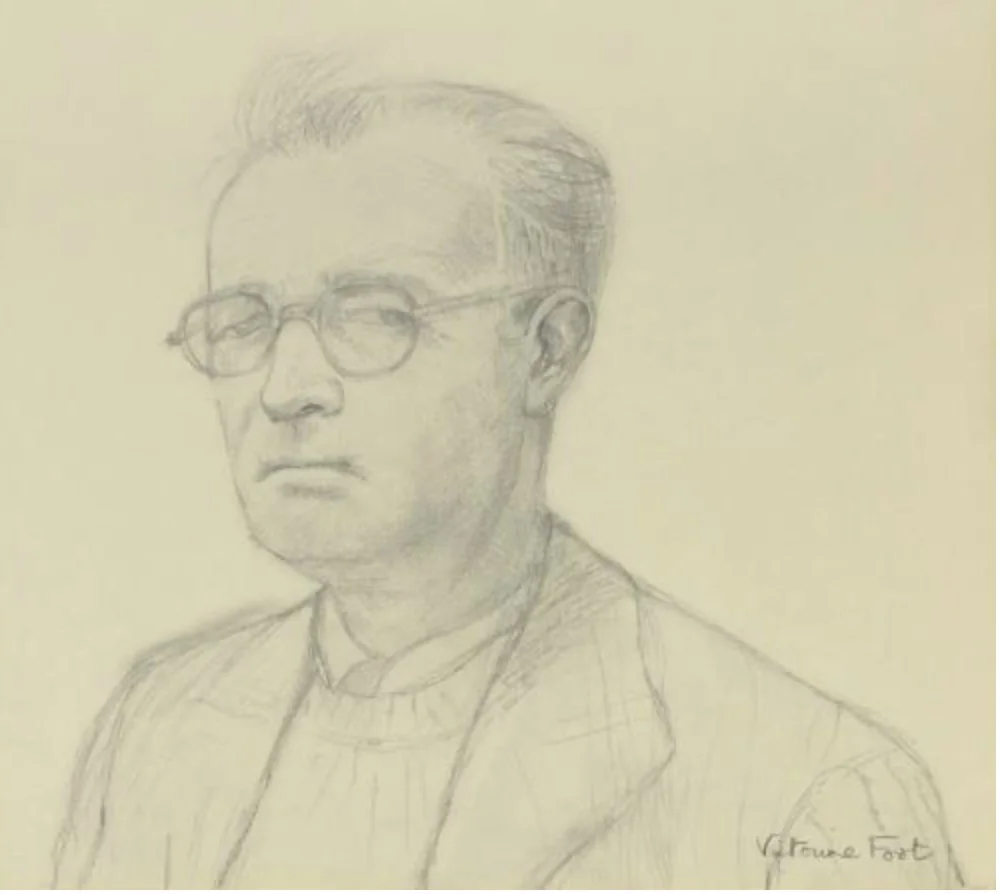
Victorine Foot, John Maxwell. Pencil on paper. Dimensions unknown. 1963. Aberdeen Museums and Galleries, purchased in 1992. Accession number ABDAG010649)
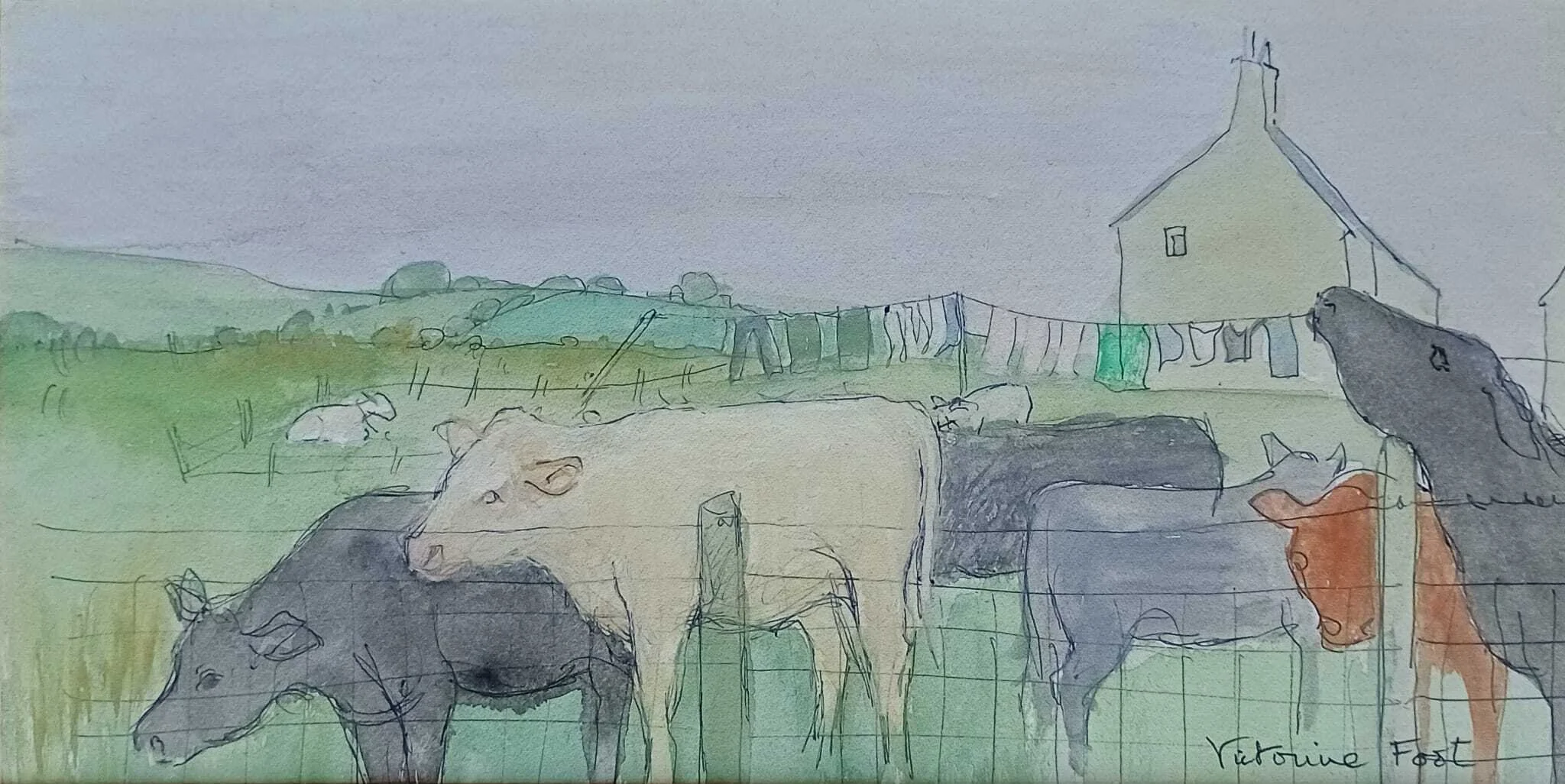
Victorine Foot, Calves Grazing. Pen and watercolour on paper. 54 x 31cm. c.1960, private collection
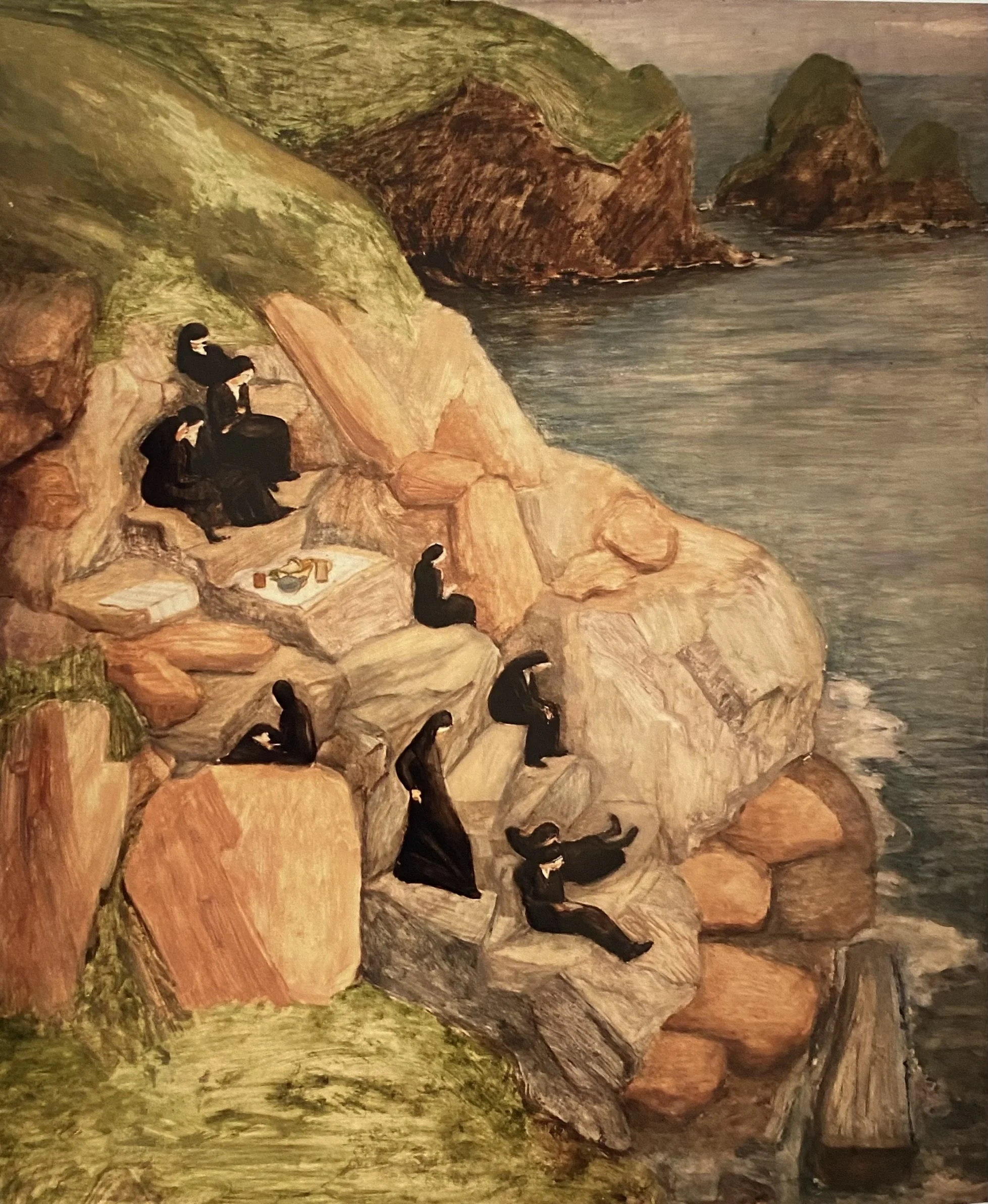
Victorine Foot, Nuns’ Picnic. Oil on board. Dimensions unknown. 1970s. Private collection (from an image in artist’s archive)
Foot sometimes worked from photographs to help with details later; her 1972 portrait of another close friend, Anne Redpath, is based on a photo (now in a family album) that she took of the painter wearing a fringed shawl at a dinner party in the Schilsky’s Marchmont studio.(24) She loved observing people eating with friends at a table, snoozing in a chair, running on the beach, playing with a dog in the park, hanging out their washing, and also animals grazing in a field. She conveys joy, exuberance, and movement. She preferred to draw and sketch in ink, sometimes adding watercolour, on Cramond Beach, at the Meadows, in the small ports in the Highlands, in Italian cities and the parks and cafés of Paris. Many of her works resonate with our own memories or images of these places, and consequently, sold well at her exhibitions. The Schilskys always travelled during their long summer holiday: “We visited Paris as soon as travelling abroad was permitted, after the war, when we were only allowed to take £25 each out of the country and butter was white there. We spent many mornings at the Jeu de Paume among the Impressionists and then we painted in the Tuileries Gardens… Visits to Florence, Arezzo, Assisi, Venice, Padua and Rome were also an inspiration.”(25)
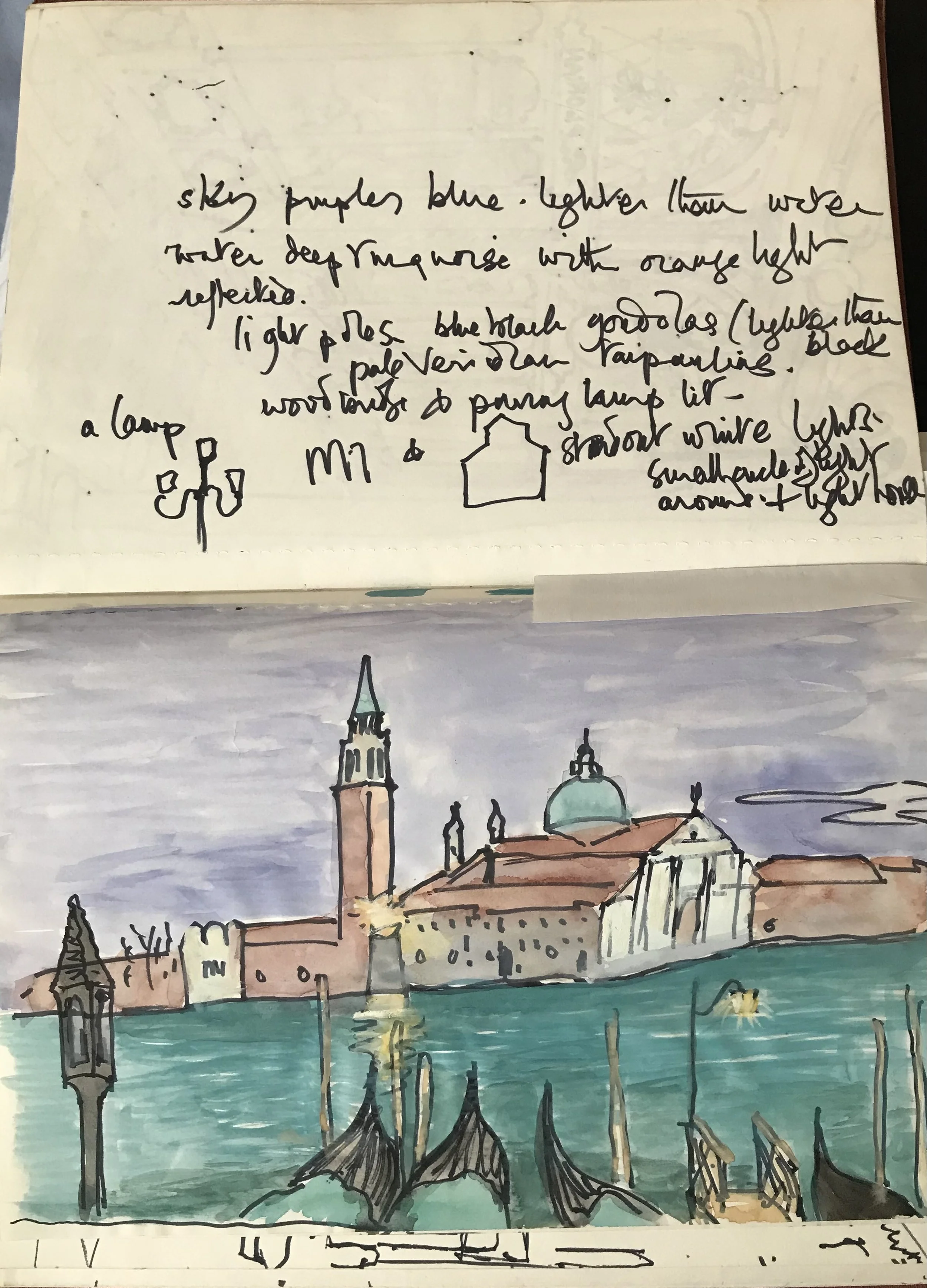
Victorine Foot, San Giorgio di Maggiore from Piazza San Marco, Venice. Pages from the artist’s sketchbook. Ink and watercolour. c.1965
In an interview with Christopher Andreae for The Christian Science Monitor in 1987, Foot spoke about her paintings: “You have to be taken by surprise!… A moment of life: it has to be painted because once seen, it is so startling and surprising that I have to do something about it. It cannot just go. It must be recorded. Not as a camera can snap it, but as an event in colour, form and light”.
Foot’s many sketchbooks attest to numerous hours spent drawing people, anywhere there was a spot to sit and observe, and contain rapid pen-and-ink captures of scenes and careful pencil observations of poses. She added watercolour, working up her ink drawings with sparing colour washes. Figures are deftly drawn with a practised economy of line, a block of colour for a skirt or trousers. The perspective is that of a theatre set. Foot’s actors are naturally but carefully placed to give depth to her stage, which has houses painted almost flat in panels of colour as a backcloth, with a church or a fountain in the wings. Her painting “Piazza San Barnabas, Venice”,(26) (Campo San Barnaba) is framed by a stone archway or proscenium. Colour and movement within the scene are more important than accurate perspective. We are sitting with her in the café or on the beach; we also have front row seats.
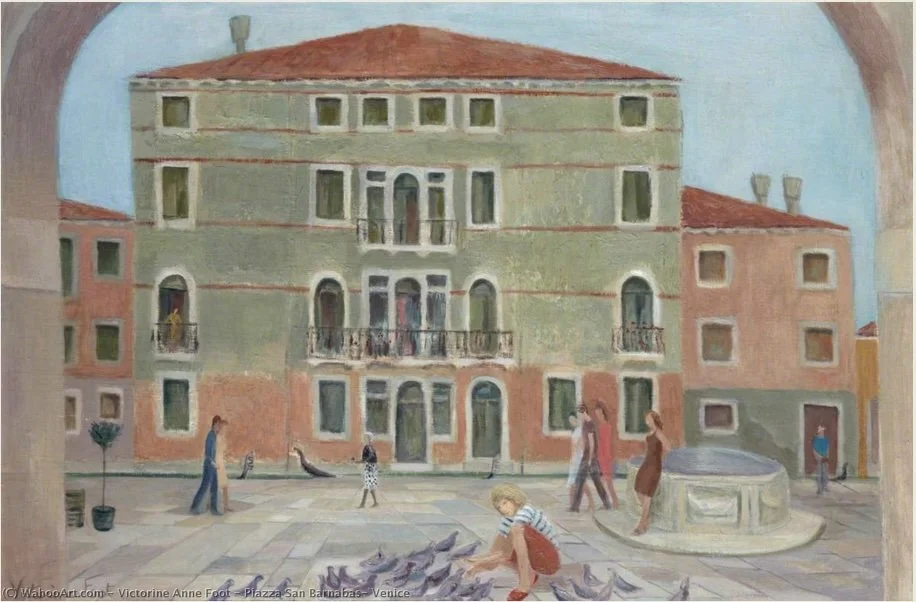
Victorine Foot, Piazza San Barnabas, Venice. Oil on board, 47 x 75cm. c.1965,.Royal Scottish Academy (exhibited at the RSA’s 139th Exhibition, 1965)
Christopher Andreae again: ”In Italy, Tuscany's special meaning for her is certainly intertwined with the fact that this region was the home ground of some of her favourite painters of the past, particularly Giotto and Piero della Francesca. The early, primitive Italian artists appeal to her much more than the later Renaissance ones. After a travelling scholarship (The ECA’s Andrew Grant Bequest) to Italy some years ago, her report included the verdict: “The rot set in with Perugino.”’ She infinitely prefers the slightly earlier Piero della Francesca's tranquil geometry and calm light to the mannerisms of Perugino. The thing about Piero's works, she says, is that “there is only the right place'' for everything in them. Though she would never compare her own work with his… Placing is a crucial part of her paintings. Her painting The Piazza, San Gimignano (a Tuscan hill town remarkably unchanged since the 13th and 14th centuries) shows this. It is the composite result of much drawing on the spot. She watched the piazza one Sunday as it filled up with people, becoming a stage for movement, chat, grouping, socialising. As they came and went, she sketched (she draws in pen and ink very fast), enjoying the undistracted opportunity to do this when she is away from home.”(27)
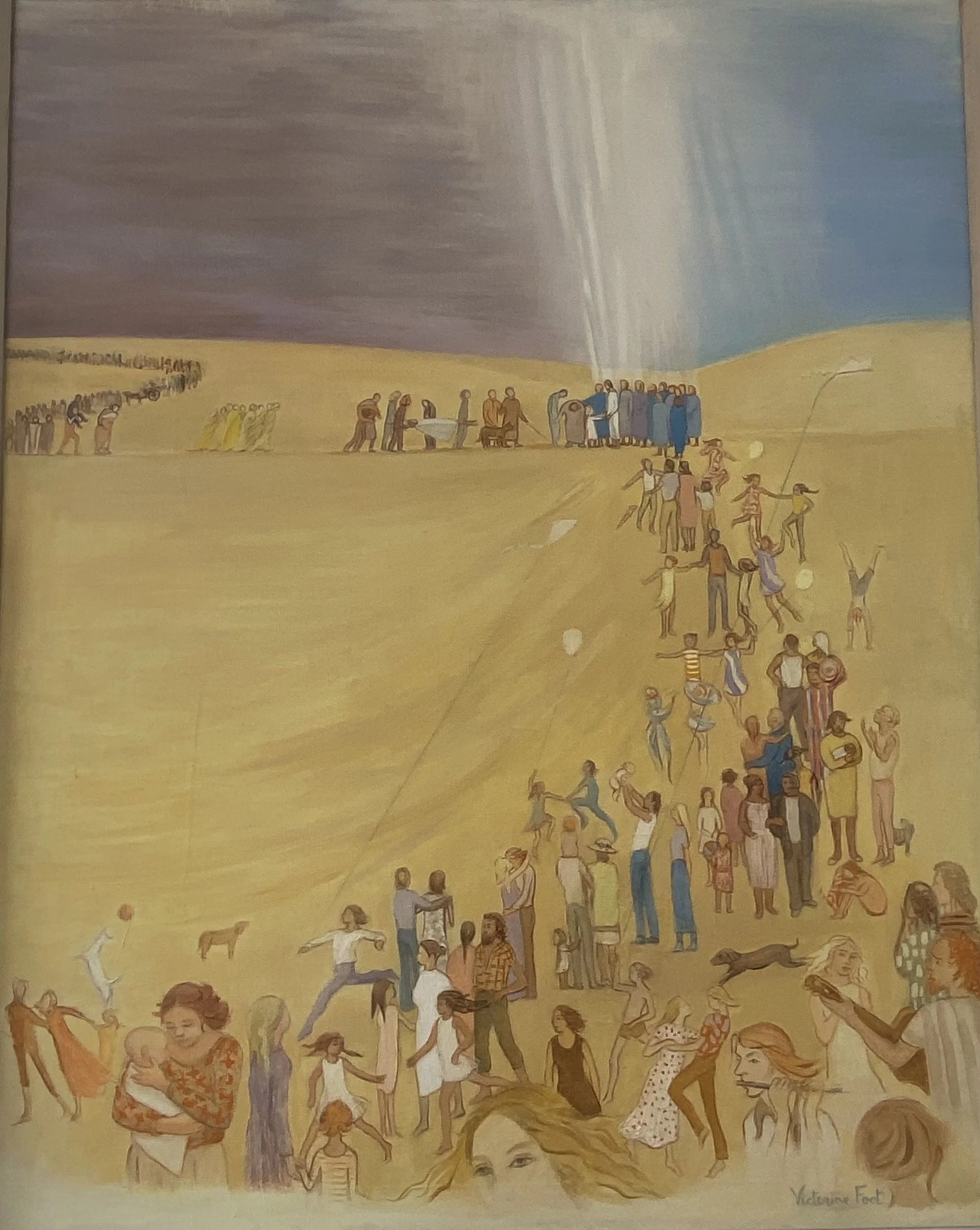
Christian Science encourages evangelism, and Victorine liked her work to tell a story and carry a deeper meaning. Her numerous religious paintings are usually scenes from the New Testament, and she would often paint another version of the same miracle. She set her figures in a Holy Land landscape, wholly imagined until her trip to North Africa late in life:
“Morocco is absolutely wonderful. It's the only place, apart from America, that I have been which is outside the European continent... “Here she felt taken back into a different era. Although it was definitely foreign, she felt strangely at home… “I’ve been painting my idea of the Bible for years - and I discovered I'd been painting Morocco before I'd ever been there! I seemed to recognise it, the colour of the soil and everything.’'(28)
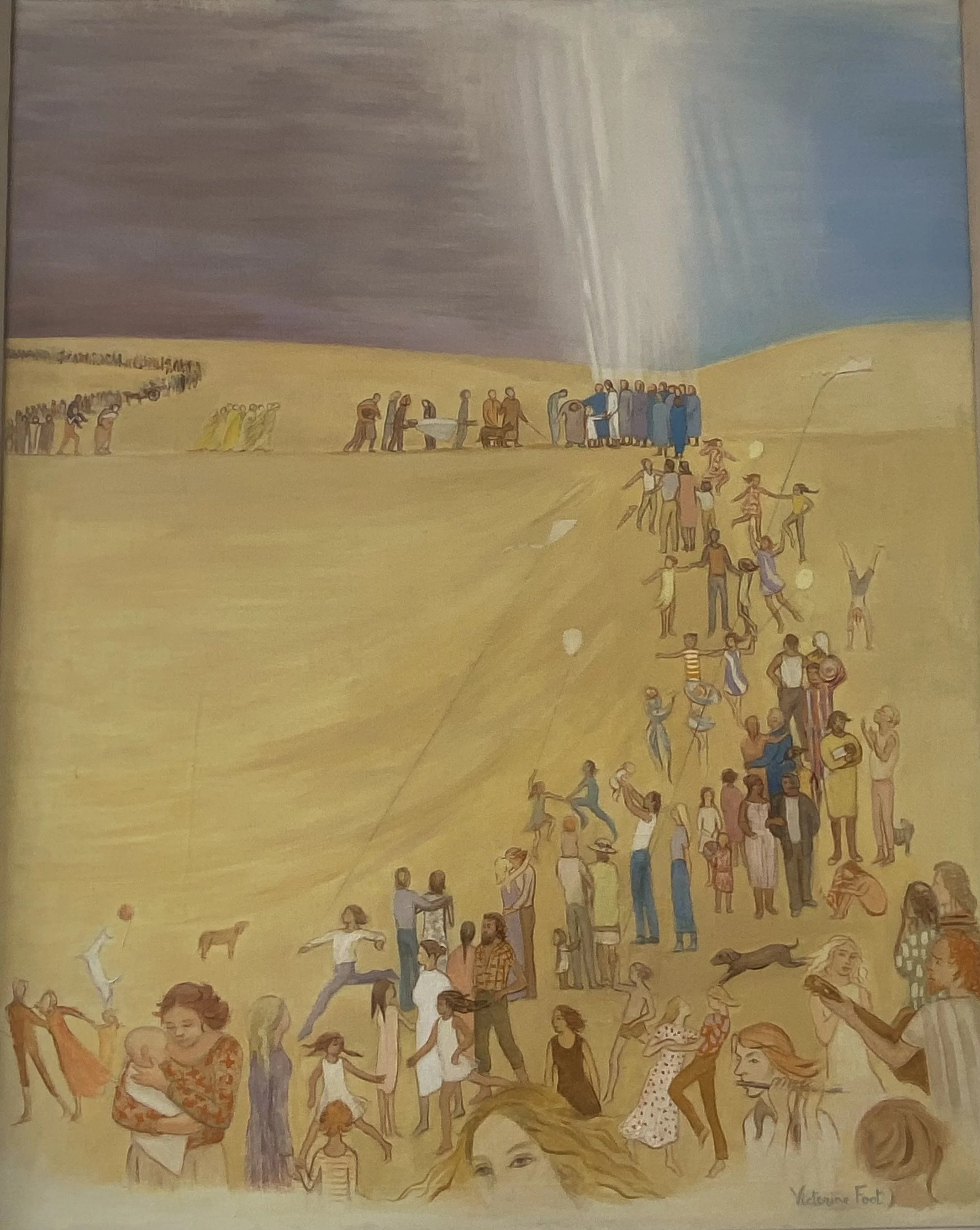
Victorine Foot, The Healing of The Multitude. Oil on canvas. 62 x 93cm. no date, Private collection
Foot’s large oils, The Healing of the Multitude, were painted in the 1970s. There are at least two versions; Chiara Schilska’s film of the landscape composition is available on YouTube. They are large narrative paintings that tell the story of Christ’s miracle. Family groups picnic in the foreground, and with them we watch Christ in the middle distance as he heals a long, snaking queue of the sick and dying. The landscape is a golden desert bathed in rays of mystical light. In both works, those Christ has healed dance for joy; they are coming to celebrate with us. Foot uses costume to symbolise the timelessness of this story; the sick and their families are dressed in robes of Biblical times, whereas the healed dance towards us wearing 20th-century dress.
Foot transports us to the Royal Opera House in her painting of their production of Romeo and Juliet with Rudolph Nureyev and Margot Fonteyn, which debuted in London in 1965 (a video of the production is available on YouTube). She uses a favourite deep red throughout the composition, which includes elements of the set, and places the couple dancing across the stage, adding outlines of limbs and a raking spotlight to give a strong sense of movement. To stage left is another of Foot’s preferred devices; a large, haunting portrait of Nureyev’s face looks out at us, engaging and drawing us into the drama. On the death of Nureyev in 1993, Foot wrote to a journalist and a gallery owner in the hope that they might buy the painting:
“I am enclosing a photograph of a painting I did of Rudi Nureyev and Margot Fonteyn dancing Romeo and Juliet… It is seen from the wings - I was fortunate in getting backstage, where I sketched throughout the performance. This was in about 1972, but I feel it is of current interest… It should be somewhere other than in my studio, so I am willing to sell it.” (29)
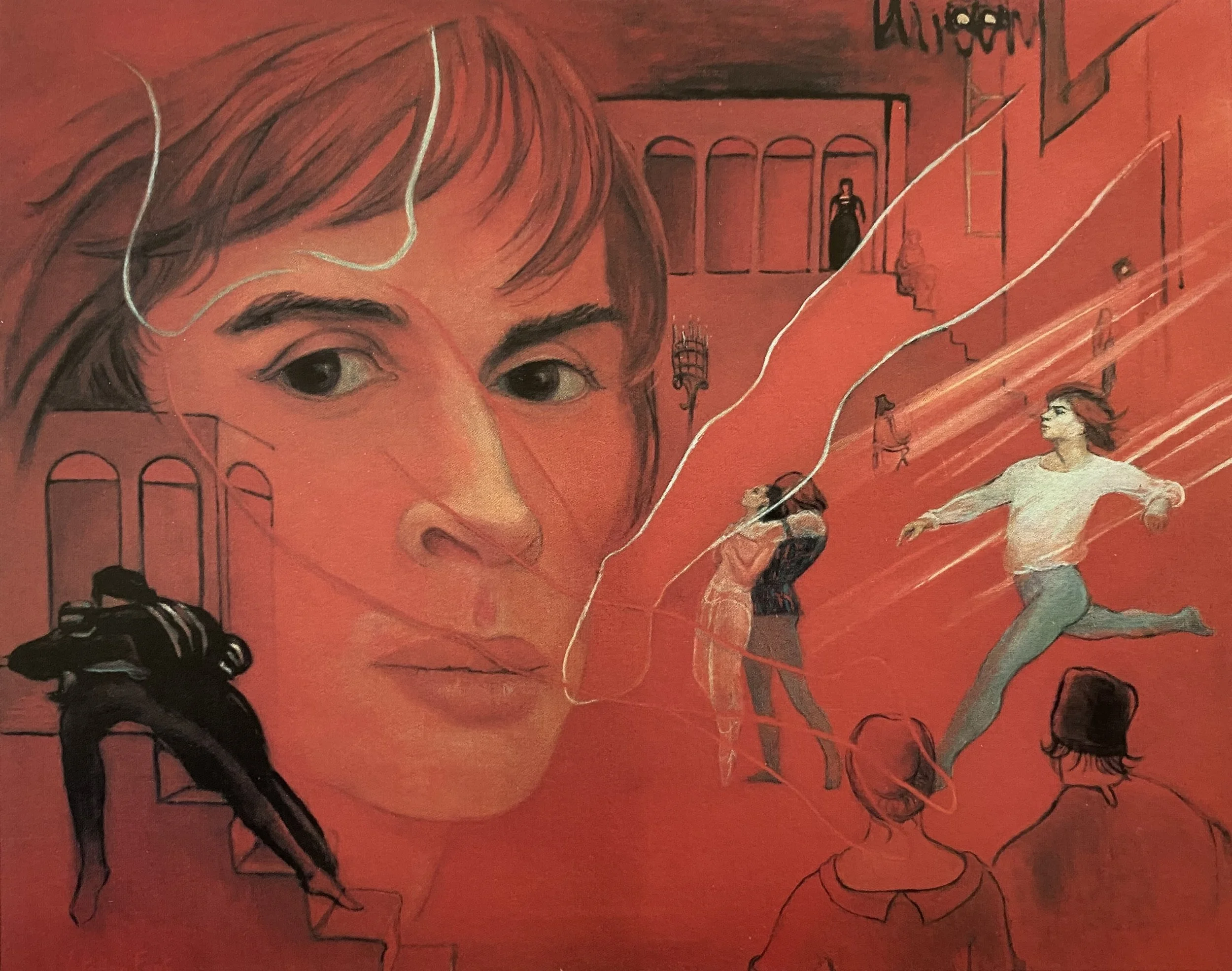
Victorine Foot, Nureyev and Fonteyn 1972. Oil on canvas. 127 x 101cm. c.1972. Private Collection.Image taken from a postcard of the painting c1993; artist’s archive
Finding suitable, permanent homes for the couple’s work became a preoccupation for Foot after Schilsky died in 1974, and she devoted much of her time to preserving his legacy, organising and promoting exhibitions of his work, arranging for bronzes to be recast and finished, and finding permanent homes for them in public collections [30]. She kept and carefully filed all her correspondence, together with the couple’s letters and photographs, as well as their paints, easels, sketchbooks, and remaining artworks. It is a remarkable archive, curated and added to by the Schilsky’s daughter, who conducted original research and interviews to document her parents' lives further.
There are gaps in the archive; Foot spent some years at home caring for her daughter, who was born in 1951, before becoming an art teacher at Oxenfoord Castle School, Midlothian, throughout the 1960s and 70s. This was a private boarding school for girls, much like the school Foot had attended herself. There are very few records or memoirs of this period in the archive, so if any readers were taught by Victorine Foot, it would be wonderful to know more about her approach. Like many women artists, she said she had found it difficult, but not impossible, to continue painting while caring for her family, and she continued to exhibit in Edinburgh until shortly before her death in 2000.
Foot was elected to the Society of Scottish Artists on 8th October 1946, exhibiting regularly with them, the Society of Scottish Women Painters and the Royal Scottish Academy. She had six solo exhibitions with Edinburgh galleries, three of these at the Scottish Gallery. She maintained strong links with London, visiting family and friends there, the Summer Exhibition at the Royal Academy and the theatre. She exhibited at the Royal Society of Arts and the New English Art Club. Her works are held by the National Galleries of Scotland, the University of Edinburgh, Aberdeen Art Gallery, the Royal Scottish Academy, the Scottish Arts Council and the Imperial War Museum. Her exhibitions sold well to private collectors, and her family still has many works, as she painted and drew them constantly, at rest and at play and loved spending time with her two grandsons.
Anne Emerson
Acknowledgements:
I am grateful to Chiara Schilska, who has generously given me access to Foot’s work, to her family archive, and permissions for this article. Copyright for all images is with Chiara Schilska.
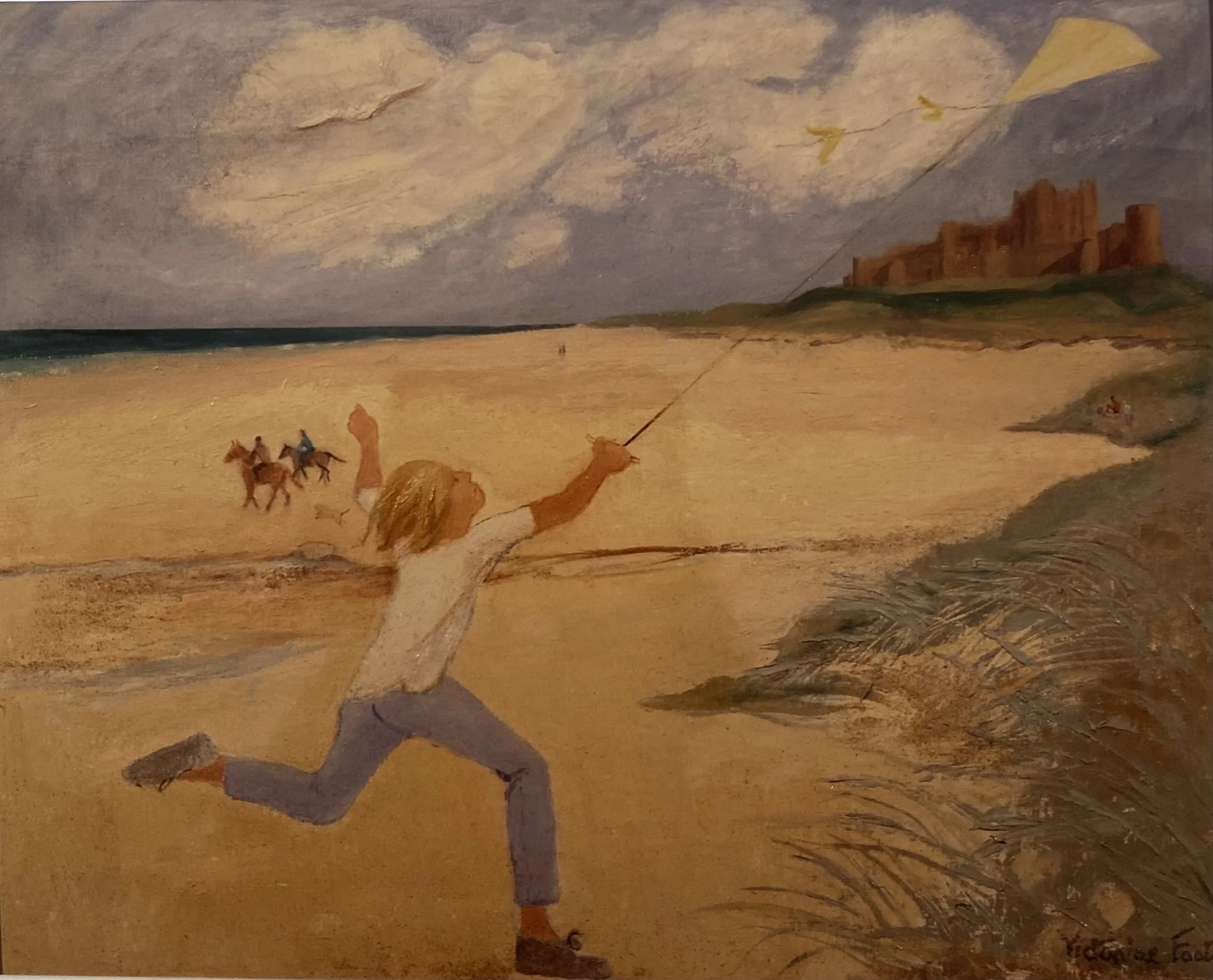
Victorine Foot, Kite Flying on Tantallon Beach. Oil on canvas. Dimensions unknown. c.1960. Image from artist’s archive.
Footnotes:
1. Foot kept a daily diary through her late teens and early twenties which includes detailed accounts of her time at the Central School of Art (the Central). Late in life, she spoke about it with her daughter Chiara who transcribed their conversations, adding it to the extensive archive of her parents’ papers to which she has generously given me access.
2. Extract from a handwritten memoir of her time at The Central by Foot c.1980s, artist’s archive.
3. Extract from a handwritten memoir of her time at The Central by Foot c. 1980s, artist’s archive: “asked Gerald whether the painting on the wall had been the one he had brought up into the life-room at the Central with (illegible) the rest, and we had all stood around looking at it. He said yes, it was. It depicted Jesus throwing the money-lenders etc out of the temple. I was so impressed that one could do such a thing with paint, that I said aloud “I want to paint!” Morris Kestelman, our teacher, who was standing by said: “You do? Come with me” and he there and then marched me through, along corridors and through the sculpture school to the painting school, where the scent of oil paint and turps filled the air. There was a long table, like a stage bacchanalian orgy with plaster heads, draperies and fruit, and Kirkland Jamieson in a blue smock, and before I knew what was happening, we had changed my timetable from Costume Design to Painting.”
4. Stefan Zweig wrote a short, critical essay on the life and work of Baker Eddy in “Mental Healers” (available in English by 1932). For a discussion of this work see: The Mary Baker Eddy Library https://www.marybakereddylibrary.org/research/what-is-the-background-on-stefan-zweigs-biography-of-eddy-in-mental-healers/. Foot was a lifelong Christian Scientist and her paintings were often of religious subjects. She wrote a testimonial in the March 1973 issue of The Christian Science Journal: “Every day I have reason to be grateful for Christian Science, grateful, too, that my mother and father accepted and demonstrated it from the time I was a small child. As I grew up, my search for the truth led me to accept Christian Science for myself.”
5. VF Diary entry from 20th May 1941. A central belief of Christian Scientists is that reality is purely spiritual and the material world is an illusion. By extension, illness is an illusion and should be treated by a form of prayer. Foot was brought up in this Church and remained devout throughout her life. She preferred not to visit doctors, and her beliefs may have postponed treatment for her grumbling appendix during the war, which resulted in a serious health crisis in 1943. Her quiet conviction that illness, mental or physical, could be healed spiritually enabled her to commit to and support Eric Schilsky who suffered from severe depression and health problems throughout their long marriage. In the early days of their relationship, she tried to interest him in reading the Bible, but he remained a staunch agnostic. Although not a Christian Scientist, their daughter Chiara has inherited her parents’ talents and her mother’s commitment to spiritual healing, practising as a counsellor and therapist in Chinese and Indian meditation, music and colour therapy, Chi Hara Centering Awareness and as a teacher of Tao Yin Fa as well as being a successful fashion knitwear designer in the 1980s.
6. VF in a letter to her mother 16th May 1941 in artist’s archive.
7. Extract from a handwritten memoir of her time at The Central by Foot c.1980s, artist’s archive: “There was very little to do in the evenings (in Northampton, 1941) so I used to go along with them to Communist meetings. I didn’t sing the Internationale and drew the line at volunteering to go out at night and write slogans on the city walls! Gerald always rushed out when the film ended because in those days we all stood to sing “God Save the King””.
8. Extract from a handwritten memoir by Foot c.1980s, artist’s archive.
9. Felicity Sutton in conversation with Chiara Schilska in 8.9.00 and 15.10.02 transcripts in the artist’s archive.
10. Felicity Sutton also wrote a memoir, extracts of which are published on the Leamington Camouflage 2016 blog website: www.leamington-camo.co.uk. Virginia Ironside’s book ‘Janey and Me, Growing Up with my Mother’, also describes the artists working at Leamington Spa: “The Camouflage Unit teemed with men who would become huge artistic cheeses in the years after the war. They were the painter Tom Monnington (future President of the Royal Academy); Richard Guyatt, the graphic designer (future rector of the Royal College of Art); Eric Schilsky, the sculptor…” Others included Henry Hoyland, Christopher Ironside, Colin Moss, Trevor Tennant and his wife Dorothy Annan, Stephen Bone and Edwin La Dell.
11. For a thorough study of the work of the CDCE see the exhibition catalogue “Concealment and Deception: The Art of the Camoufleurs of Leamington Spa 1939-1945” (ISBN978-1-872940-08-3) which accompanied the exhibition at Leamington Spa Art Gallery and Museum in 2016. Also see the Colin Moss website https://colinmoss.info/tag/world-war-ii/ and the online History Archive of the Imperial War Museum.
12. Felicity Sutton, ibid.
13. This painting was acquired by the War Office (War Artist Archive IWM: ART LD 3016) in June 1943 for 10 guineas (letter from Ministry of Information to VF). It can be viewed here: https://www.iwm.org.uk/collections/item/object/9665 Foot later donated this and her sketches from her time in Leamington Spa to the Imperial War Museum. These have now been digitised, providing a fascinating and accessible record of the CDCE: https://www.iwm.org.uk/collections/search?query=Victorine Foot. The file also includes a copy of the leaflet for the IWM’s exhibition “Some Women Artists” October 1958-Feb 1959.
14. VF’s IWM interview is available to listen to online at: https://www.iwm.org.uk/collections/item object/80013230
15. See article “Eric Schilsky: Sculptor, Teacher” by Anne Emerson in art-scot Issue 11, February 2025
16. “Concealment and Deception: The Art of the Camoufleurs of Leamington Spa 1939-1945”, 2016. p81 & 83, Exhibition Catalogue compiled by Jeff Watkin, (ISBN13 9781872940250)
17. For more context on the renewed interest in classicism and mural techniques at this date see Simon Martin, The Mystic Method, Classicism in British Art 1920-1950, Exhibition Catalogue, Pallant House 2017 (ISBN 978-1-869827-89-2)
18. Bettina Schilsky’s suicide was reported in detail in The Coventry Evening Telegraph, 20th February 1943 and the Leamington Spa Courier, 26th February 1943. There was an inquest at which Schilsky was questioned as to why he had destroyed the letter his wife had left for him. The coroner ruled that she had died from gas poisoning while in a disturbed mental state.
19. Letters from VF to her parents, early 1940s, artist’s archive
20. Oil painting in the University of Edinburgh Collection: Mythical Composition with Four Figures and Coastal Cliffs. (https://collections.ed.ac.uk/art/record/22656).
21. Press cutting of Review, The Scotsman, 11th October 1949
22. The Scotsman, ibid.
23. Portrait of John Maxwell, 1963, oil on canvas, 40.6 x 50.8cm, National Galleries of Scotland. Accession No: PG2841 Given by James Coxson (composer). In storage.
24. Portrait of Anne Redpath, oil on canvas board, signed, 55cm x 69cm, framed, labels verso, exhibited at Royal Scottish Academy 1972. Sold by McTears, Glasgow, 30th September 2018, Lot 253 for £160 (https://www.mctears.co.uk/auction/lot/253-portrait-of-anne-redpath-by-victorine-foot/?lot=114358&sd=1)
25. VF’s account of the life of ES written in the late 1970s.
26. “Piazza San Barnabas, Venice”, oil, 48.9cm x 74.6cm, c.1965. RSA Collection.Accession number: 1992.024. Purchased with Thorburn Ross Memorial Fund
27. CSM, ibid.
28. CSM, ibid.
29. Drafts of letters to journalists in artist’s archive.
30. Two London exhibitions, The Fine Art Society’s “Eric Schilsky, Sculptures and Drawings” of October 1977, The Bourne Fine Art and Bruce Fine Art exhibition “Eric Schilsky, RA, RSA 1898-1974” in June 1998 and also The Scottish Arts Council’s touring exhibition “Eric Schilsky Sculptures and Drawings” February to March 1976 were largely due to Foot’s dedicated efforts.