
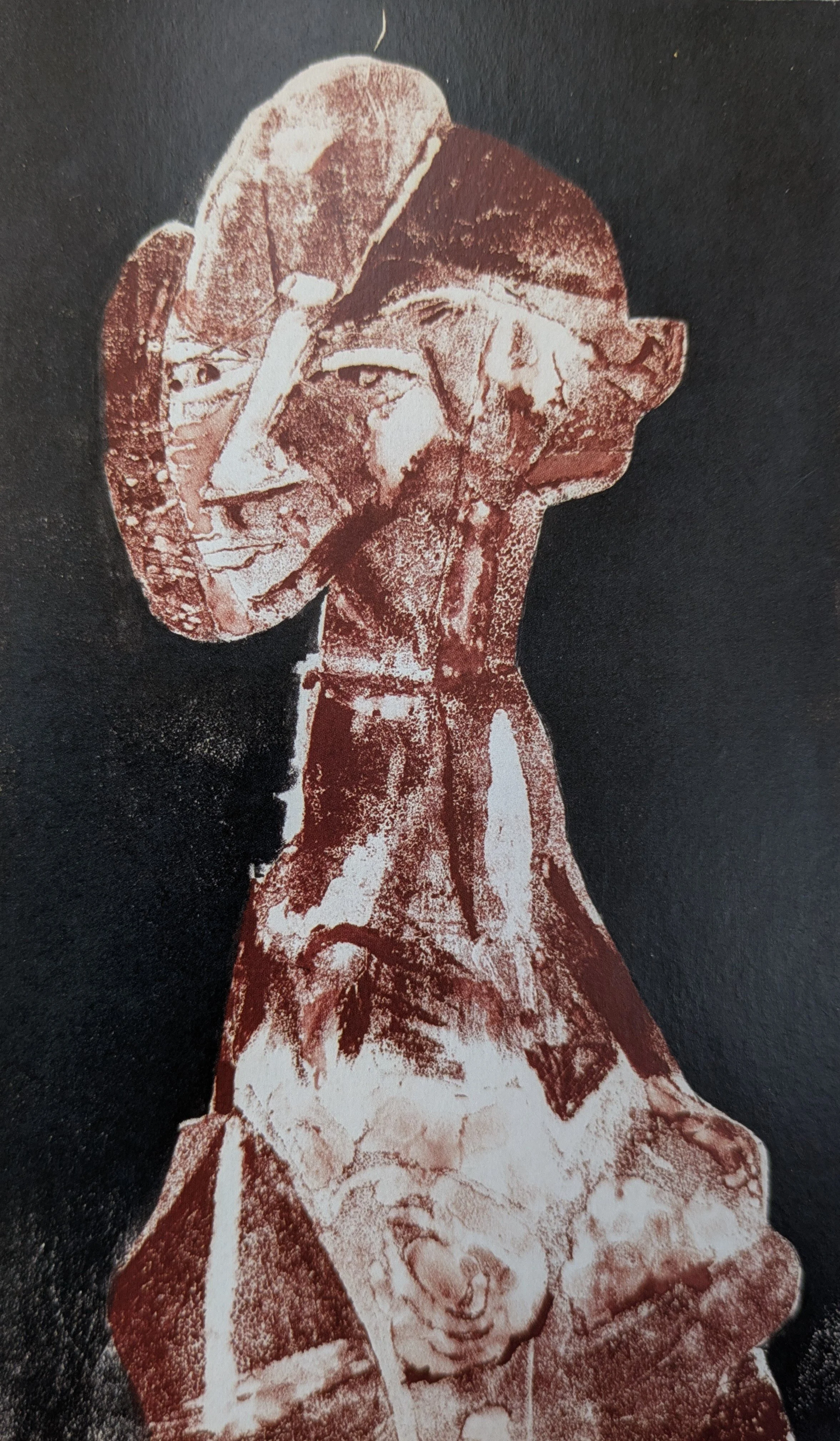
Robert Colquhoun: The Monotypes
The air of legend which surrounds the story of Robert Colquhoun (1914-1962), who left his native Ayrshire for artistic stardom in the bohemian ferment of 1940s London, sometimes threatens to overshadow his extraordinary body of work. His story is tied inextricably to the life and work of Robert MacBryde (1913-1966), Colquhoun’s lover and lifelong artistic companion; so much so that “The Two Roberts” are quite rarely discussed as independent figures. In this article, Davy Brown, authority on Colquhoun and MacBryde, focusses his attention on Colquhoun alone, giving special attention to the artist’s monotypes; as he writes, these works stand up as some of the finest in twentieth century British art.
If one’s view of the Two Roberts, Robert Colquhoun and Robert MacBryde, has been gleaned from the media, then it will be of two drunken louts hellbent on causing mayhem wherever they went.
Sadly, such views are not confined to the so-called “gutter press”. In 1960, towards the end of their lives, both Roberts were commissioned by Robert Erskine of London’s St George’s Gallery, the first gallery to specialise in modern limited-edition prints, to create a series of lithographs. These lithographs were made under the direction of the master printmaker, Stanley Jones.
In a book published jointly by the Curwen Press and the Tate, one paragraph of approximately 200 words is devoted to the Two Roberts. Most of that paragraph is concerned with their problems with alcohol and very little mention is made of their work. Mention is made of MacBryde’s “strange, Fuseli-like Head” – which is, in fact, Colquhoun’s Head of Absalom, illustrated in the book as plate 19, “Robert MacBryde, Head, 1960”. In yet another book published by the Tate, Art and Print: The Curwen Story by Alan Powers, Colquhoun’s Two Horsemen is illustrated on p.92. But on p.94, it is stated that “they settled to work, in 1960, making two prints each in one or two colours”. Colquhoun and MacBryde made three lithographs each at the Curwen Press and copies of all six are in the Tate.
When reputable institutions such as the Curwen Press and the Tate fail to check the facts, it is little wonder that much of the truth concerning the Two Roberts is concealed. How has this situation arisen? How could two painters, known as “The Darlings of Bond Street” in 1946, and considered by many to be the finest artists of their generation, become destitute within ten years and become the targets of a philistine press? Painters who captured so eloquently the spirit of the immediate postwar years and whose work was purchased by the most prestigious collectors of the time, such as Sir Colin Anderson, Sir Kenneth Clark and Frances Byng-Stamper, and acquired by the major art institutions of the day including CEMA (the precursor to the Arts Council), the British Council, the Tate and even the Museum of Modern Art in New York?
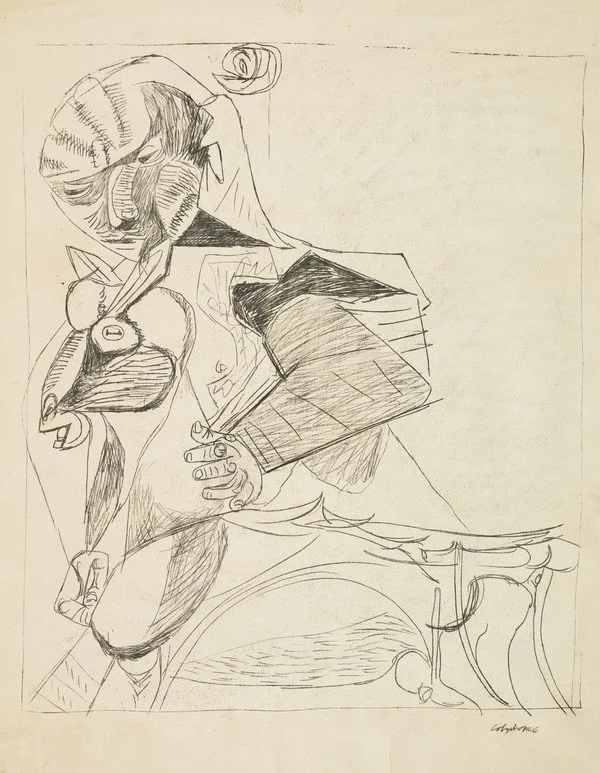
Robert Colquhoun, Woman and Goat. Carbon transfer drawing on paper. 55.8 x 45cm. 1948. Collection of National Galleries of Scotland. Courtesy of NGS.
Certain factors in the decline of the Roberts’ fortunes were external. Firstly, the death of Duncan MacDonald of the Lefevre Gallery in 1949 was a severe blow. He had not only been a friend and admirer of their work, but had looked after their finances during their years with the Lefevre Gallery.
Secondly, Colquhoun’s final show at the Lefevre Gallery in 1950 was a financial flop and ties were severed. Thirdly, their work was becoming eclipsed by the Abstract Expressionism from across the Atlantic, and the postwar paintings and prints of war widows, grieving sisters and maimed peddlers were no longer fashionable.
Finally, in 1951, they were evicted from their custom-built studio at 77 Bedford Gardens near Notting Hill Gate, which had been the magnet for the artistic elite of London from 1942. Regular guests at the infamous parties included Francis Bacon, Lucien Freud, John Minton, John Craxton, Keith Vaughan, Prunella Clough, Jankel Adler (whose studio was upstairs), Benjamin Creme and Robert Frame, as well as writers and poets like Dylan Thomas, David Gascoigne, Sydney Graham and Hugh MacDiarmid. This was probably the worst blow to Colquhoun, whose pride was irreparably damaged by the eviction.
There can be no disguising the fact that, by the time they became homeless at the start of 1955, they were tiresome, troublesome and an unpleasant nuisance to many, and consequently easy targets to a hostile press disinterested in their artistic achievements.
But it must be said that other factors in their decline were inherent in the natures of the two artists themselves. They were over-generous with their considerable income from 1944 to 1950. Everyone had to share in their success. Danny Ferguson, who was a lecturer at the Glasgow School of Art, described how he was with the Two Roberts in London in 1951, when they were handed an envelope containing £200 as payment for the designs for Donald of the Burthens. They hit Soho on the Friday evening and by the Sunday night the money had all been spent. More prudent handling of their considerable income might have provided them with greater security. But that, in turn, begs the question: where were the recipients of the Two Roberts’ generosity in the later 1950s when their luck had run out? Little is ever mentioned of the fact that most of their peers, whose work commands greater prices in today’s salerooms, came from affluent backgrounds. The Two Roberts, coming from poor, working-class families, had nothing to fall back on.
The roots of Colquhoun’s demise lay, in part, deep within the artist himself. His tragedy lay in the fact that he was unable to deny the despair and unhappiness of life. As in the writing of Sartre and Camus, he faced up to the bleaker side of existence and came to terms with it. He found some degree of solace in the consideration of those conditions that most people choose to ignore or avoid. The ultimate tragedy of Robert Colquhoun was that the very things he saw and experienced and was prepared to confront as an artist became part of his life, and finally helped to shorten it.
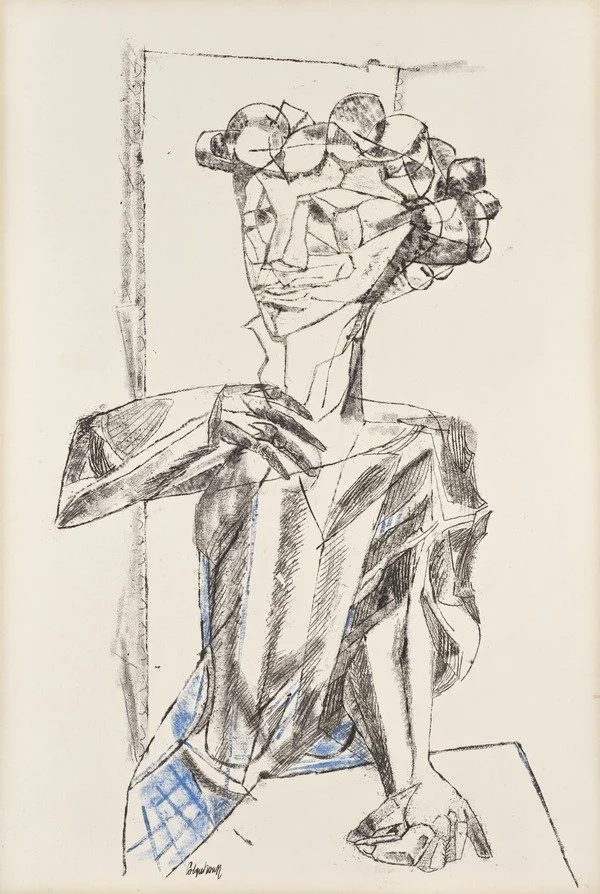
Robert Colquhoun, Figure at a Table. Monotype on paper. 103.7 x 70cm. c.1957. Collection of National Galleries of Scotland. Courtesy of NGS.
Out of this came the great and highly acclaimed paintings of the mid-forties; the victims of war exemplified in Grieving Woman (private collection), Woman with Leaping Cat (Tate), The Fortune Teller (Tate), Woman with Bird Cage (Bradford City Art Gallery), Two Scotswomen (Gallery of Modern Art, New York) and the series of Irish peasants created after a visit to Dublin, Cork and Crosshaven in late 1946, which included Dubliners (SNGMA) and Potato Pickers (Coleg Harlech, Wales).
However, alongside these great paintings, Colquhoun was at work creating monoprints of equal quality, and although smaller in scale, these works often gave greater expression to his tragic vision of humanity than the paintings.
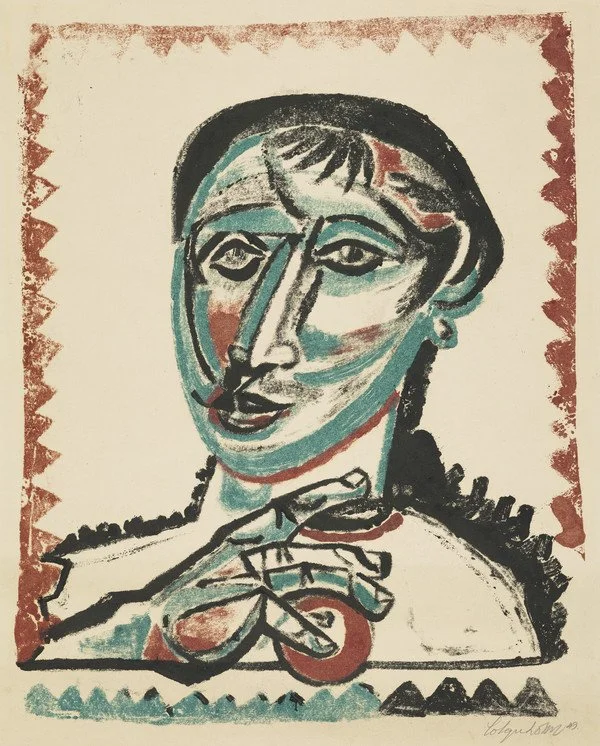
Robert Colquhoun, Head of a Woman. Monotype on paper. 47.6 x 41.1cm. 1949. Collection of National Galleries of Scotland. Courtesy of NGS.
Before examining Colquhoun’s monoprints in detail, it is important to understand what constitutes a monoprint, or monotype. To begin with, monoprints are nothing new. The monoprint was allegedly first used in the seventeenth century by Giovanni Battista Castiglioni (1610-65). One was created by Samuel Palmer and William Blake created a group of 12 in 1795. In more recent times, the greatest exponent of this medium was Edgar Degas, who produced around 250 between 1874-84, and again in 1890-92. Many others experimented with monoprints including Cassatt, Pissarro, Munch and Gauguin. Toulouse-Lautrec also made monoprints in the late 1890s with added oil paint.
The most succinct definition of the monoprint comes from Modern British Printmakers, 1855-1955, in which Gordon Samuel writes “the monoprint, by its very nature, is notoriously difficult to classify in that it falls into the category of neither print nor drawing. Strictly speaking, it cannot be a print because it does not have the qualities inherent in a printed surface, and is evidently not a multiple. The American art historian Carl Zigrosser describes it as “a drawing with printed features”. On the other hand a monotype apparently cannot be a drawing, because a drawing is not printed. Moreover, neither can it be a painting, because the finished work does not have the presence or feel of a directly painted surface” [1].
To create a monoprint, the artist must first select a clean, dust-free surface. Colquhoun used lithographic stones, but mostly glass. The chosen medium, whether paint or printer’s ink, is applied to the plate usually by a brush or roller. The image is then created by the removal and addition of further pigment. White areas are created by the removal of ink or paint with such devices as cloth, paintbrushes, scribers or even fingertips. When manipulation of the medium is complete, the artist presses paper over the plate and transfers the image onto the paper by rolling, rubbing or by use of a printer’s press.
The other technique, employed continuously throughout Colquhoun’s career from 1945 until the very moment of his death, is “carbon transfer drawing” or “offset drawing”. Here, a preparatory drawing is traced on to another sheet. An intermediate sheet which has been coated on the underside with oil paint or printer’s ink is used as a “carbon paper”, hence the oft-used term, “carbon transfer drawing”. The artist traces over the drawing with a sharp stylus or scriber and the image is offset onto the paper below, enriched by a soft blurring of the line inherent in the tracing process, and by tonal areas picked up accidentally by the pressure of the hand. This had been imparted to Colquhoun, MacBryde and John Minton by Jankel Adler, who had settled into 77 Bedford Gardens in 1943 and occupied a studio above them.
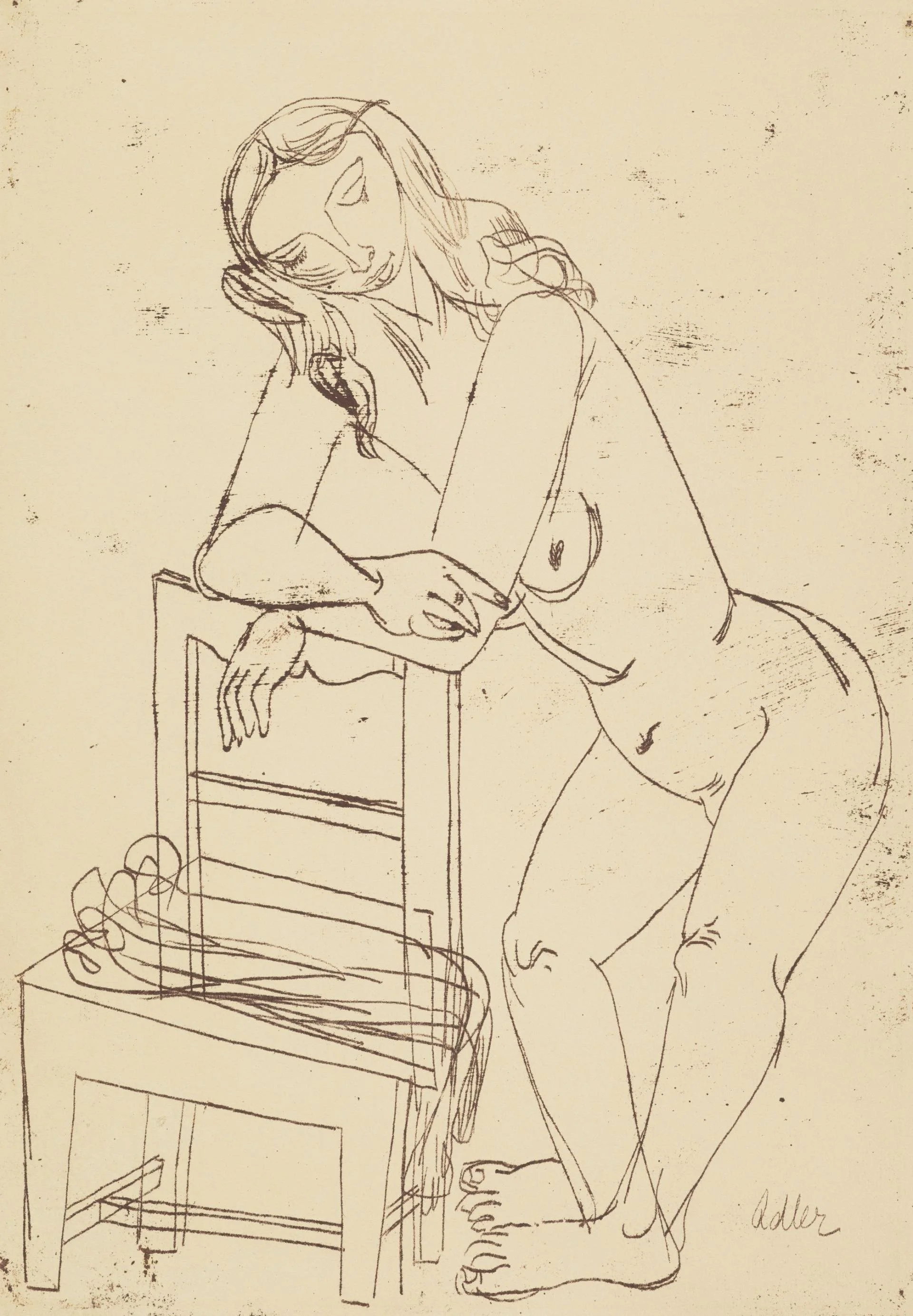
Jankel Adler, Woman Leaning on a Chair. Carbon transfer drawing on paper. 39.5 x 28.3 cm. Collection of National Galleries of Scotland. Courtesy of NGS.
Adler had been born into a Jewish family in 1895 near the Polish city of Lodz. While still in his twenties he had settled in Germany and became a close friend of Otto Dix and later was befriended by Paul Klee at the Dusseldorf Academy of Modern Art. However, banished by the Nazis in 1933 as “racially inferior” and his work labelled as “degenerate”, he relocated to Paris, moving between there and Poland till the outbreak of the War. In Paris he became acquainted with Picasso and worked in Hayter’s famous Atelier 17. He joined the Polish army and was evacuated from Dunkirk in May 1940. After his demobilisation in 1941, he settled in Glasgow, where he became an integral part of David Archer’s Art Centre in Scott Street, close to the Glasgow School of Art. Although the Roberts knew of Adler at this point, it is unclear as to whether or not they had actually met. Colquhoun had also been invalided out of the army in 1941 and had returned to Glasgow before moving to London with MacBryde in 1942.
Adler had thus brought with him from Europe an antidote to the parochial nature of art in Glasgow and the insularity of London. His influence over a generation of British artists was immense, not only on the group of artists who were labelled the “Neo-Romantics” but consequently on the younger artists of the St Ives School, such as Wilhelmina Barns-Graham, Terry Frost, Patrick Heron, Peter Lanyon and Bryan Wynter. To his proteges, he was known as “The Master” or “The Wise Old Man”, but of all of them Colquhoun was, by far, the most attentive.
Another source of inspiration for Colquhoun and for the development of his monoprints was the work of John Kashdan. The Two Roberts were introduced to him in 1945 by Adler, who had become friendly with Kashdan after meeting him at the Redfern Gallery during Kashdan’s one-man show there. The Roberts were greatly impressed by Kashdan’s monoprints and by the techniques which he employed. Just as Adler had learned many of his techniques from Klee, Kashdan had learned the transfer drawing process from Richard Zeigler, who was a German refugee artist living in Cambridge and had developed his own print-making process using “transfer drawing” and duplicator paper to make editions of his own prints. There is little doubt that Colquhoun’s early monoprints from 1946 were influenced not only by Adler but also by Kashdan. It appears to have developed into a two-way traffic system, however, because Kashdan’s monoprints of 1949, such as Woman with Canaries, display much of Colquhoun not only in subject matter but in the quality of his technique.
An important factor in Colquhoun’s neglect since his death in 1962 and his decline into relative obscurity lies in the fact that his monoprints, of which there are many, have never been fully examined. Although painting mostly ceased between the Roberts’ departure from Tilty Mill in Essex in late 1954 and his retrospective exhibition at the Whitechapel Gallery in 1958, Colquhoun did continue to produce monoprints. In fact, Colquhoun’s obsession with the monoprint meant that it was his major means of expression during the sixteen years prior to his untimely death in 1962. Another reason is that, after his final exhibition with the Redfern in November and December 1954, there were no official records of his monoprints.
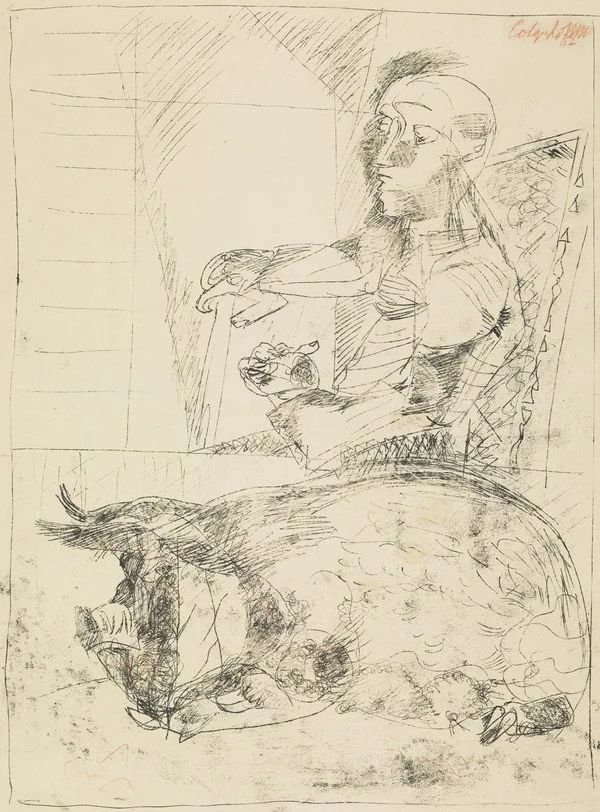
Robert Colquhoun, Man and Pig. Carbon transfer drawing on paper. 46.2 x 34.3cm. 1952. Collection of National Galleries of Scotland. Courtesy of NGS.
The monoprint suited Colquhoun for a number of reasons. Firstly, in order to achieve the best results, the artist must be a highly competent and confident draughtsman. In Colquhoun’s case, that was undisputed, having been feted by staff and students alike at the Glasgow School of Art, and admired by his peers and clients alike in London. Secondly, for Colquhoun, it was an inexpensive medium, especially important to him during his years of decline with no regular income. Thirdly, it suited him because of his ability to retreat into a small space, and despite the chaos surrounding him, be capable of producing work of the finest quality. His brother John once described how, in Bedford Gardens with the party in full swing, Colquhoun produced three monoprints.
Finally, and most importantly, the monoprint suited his vision. The medium of monoprint lent itself entirely to achieving the highly emotional or psychological charge which he created between figure and figure, between figure and animal or between figure and object. The huge range of textural effects, gleaned from Adler in the great paintings of the mid-forties, could be achieved quickly and economically in the monoprints.
There is a strong possibility that Colquhoun’s first monoprints were created following a trip to Cornwall in the early summer of 1944 when, along with MacBryde and John Minton, they visited Sydney Graham and Nessie Dunsmuir, who rented two gypsy caravans near Penzance. Sven Berlin claimed to have “met the painters Colquhoun and MacBryde looking into a sprouting ivy bush, which they said was like a city, and made little drawings of its streets and houses”. They are collectively called Nine Prints of Vegetation, are all carbon-transfer drawings and are in the collection of the British Museum [2]. Prior to their acquisition in 1987, they were in the possession of Sir Colin and Lady Anderson, probably Colquhoun’s greatest patrons. Their date is uncertain, although 1945 has been suggested. This would suggest that they were developed from sketches made in Cornwall.
1945 was a year of considerable experiment for Colquhoun under the intense direction of Jankel Adler. This is demonstrated clearly in the drawings section of the Whitechapel retrospective catalogue. The media used in these works include “pastel and watercolour”, “crayon and wash”, “red ink and crayon”, etc. Amid all of this emerge some of his great, early monoprints, which echo the subject matter of the great paintings of the period: Woman and Cat, Wounded Scotsman and Match Seller, Toy Vendor and the Woman, Study for the Whistle Seller, etc. Wounded Scotsman and Match Seller is a powerful and masterful work in the collection of the British Museum, and concerns two variations of figures used extensively in his work of the mid-forties, namely the beggar and the vendor. The latter appears to have been a one-legged pedlar whom Colquhoun saw frequently in a lane off Oxford Street, and saw him as a symbol of universal suffering. The two are often interchanged and appear in many important works of the period: The Toy Seller, The Whistle Seller and Beggar and Dog, for example. Bryan Robertson of the Whitechapel Gallery wrote “many of the delicate, thin, rather scratchy pen and pink drawings are masterpieces of their kind”. He was clearly referring to offset drawings like Toy Vendor and the Woman and Wounded Scotswoman and Match Seller. In the production of these two early monoprints, Colquhoun has used the two carbon sheets, one in black and the other in a rusty red. When the black motif had been traced on to the “print” paper, the red sheet was placed over it and carefully registered before the second part was drawn over the first. Here is an early masterpiece where Colquhoun’s tragic vision of humanity is reconciled with his empathy for the lost, the poor, the bereaved, the wounded and the victims of life.
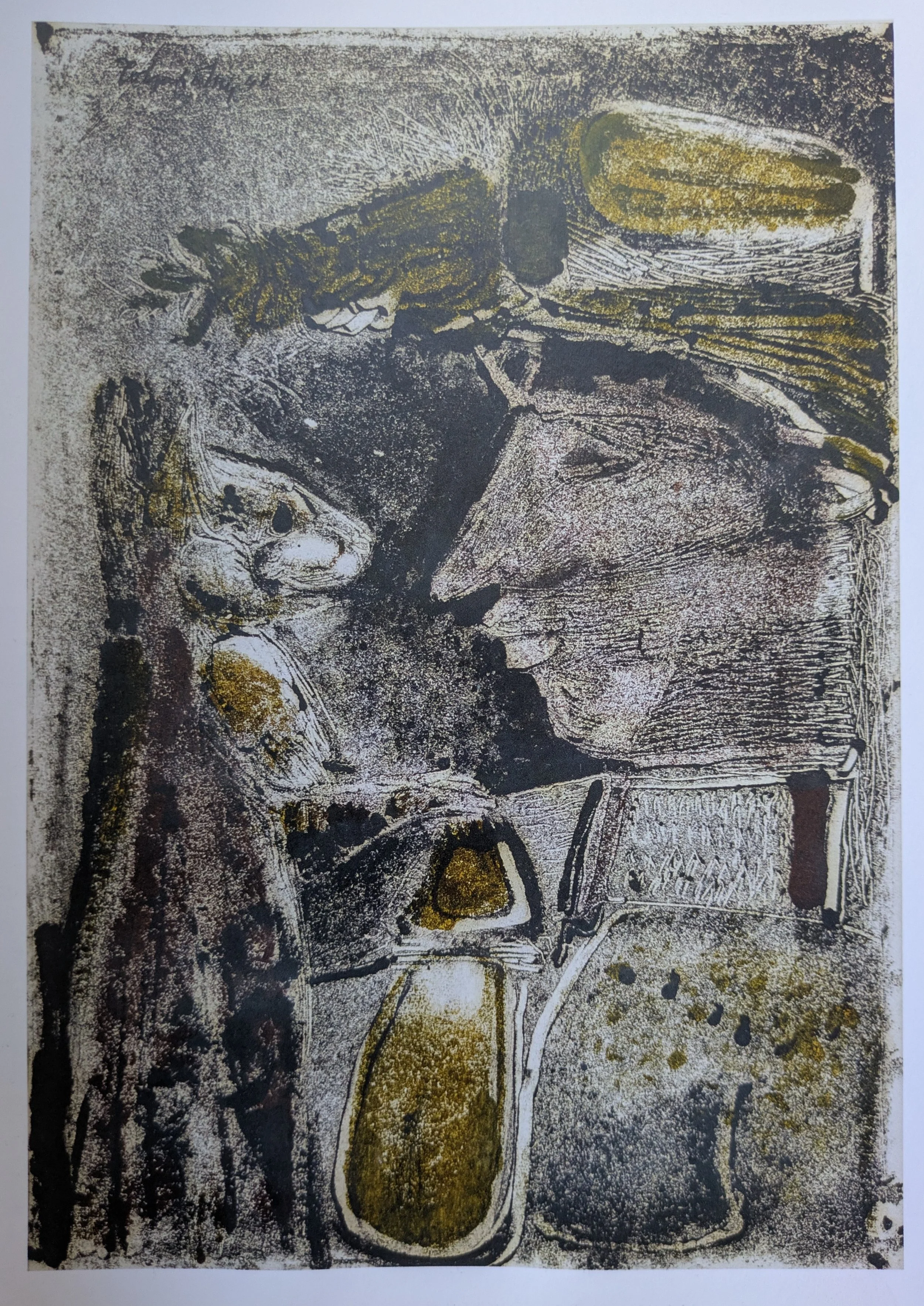
Robert Colquhoun, Young Woman with Cat. Monotype on paper. 33 x 23cm. 1946. Private collection.
The cat appears in numerous works, in both paintings and monoprints between 1945 and the end of 1946, as a symbol of the very life that has been drained from its protagonist. In numerous monoprints the cat represents energy, determination, youthfulness and positivity, qualities no longer characterised in the melancholy vendor, the broken cripple or the lonely war widow.
Colquhoun’s first monoprints (as opposed to his offset drawings) appear to have been created towards the end of 1945. One of the Woman and Cat monoprints was purchased by Frances Byng-Stamper who, along with her sister Caroline Lucas, set up Miller’s Press in Lewes, East Sussex, which produced top quality lithographs by some of the greatest artists of the day. Colquhoun and MacBryde lived in Lewes at their invitation from 1948 to 1950. An ardent supporter, Byng-Stamper also acquired an offset drawing, Self Portrait, in the same year as she acquired Woman and Cat.
A distinctive group of monoprints, some of which included the motif of the cat, was created early in 1946, characterised by their small scale, their colour and relatively unsophisticated technique. They all appear to have been created on the same plate, around 14 x 10 inches. A few are in black and white, but most are printed in black, ochre and umber. These works include two versions of Two Country People, one of which was purchased by Fred Urquhart, the Scottish writer and friend of the Two Roberts, and Woman and Kitten, purchased by one Richard Walker. Two of this group are in Aberdeen Art Gallery, Woman in Straw Hat and Woman with Feathered Hat. Young Woman with Cat is in a private collection in Scotland and the whereabouts of Head of a Young Woman are unknown. This early group of monoprints gives expression to the gentler, warmer and more sensitive side to Colquhoun’s nature. Two Country People and Young Woman with Cat face each other intimately and lovingly.
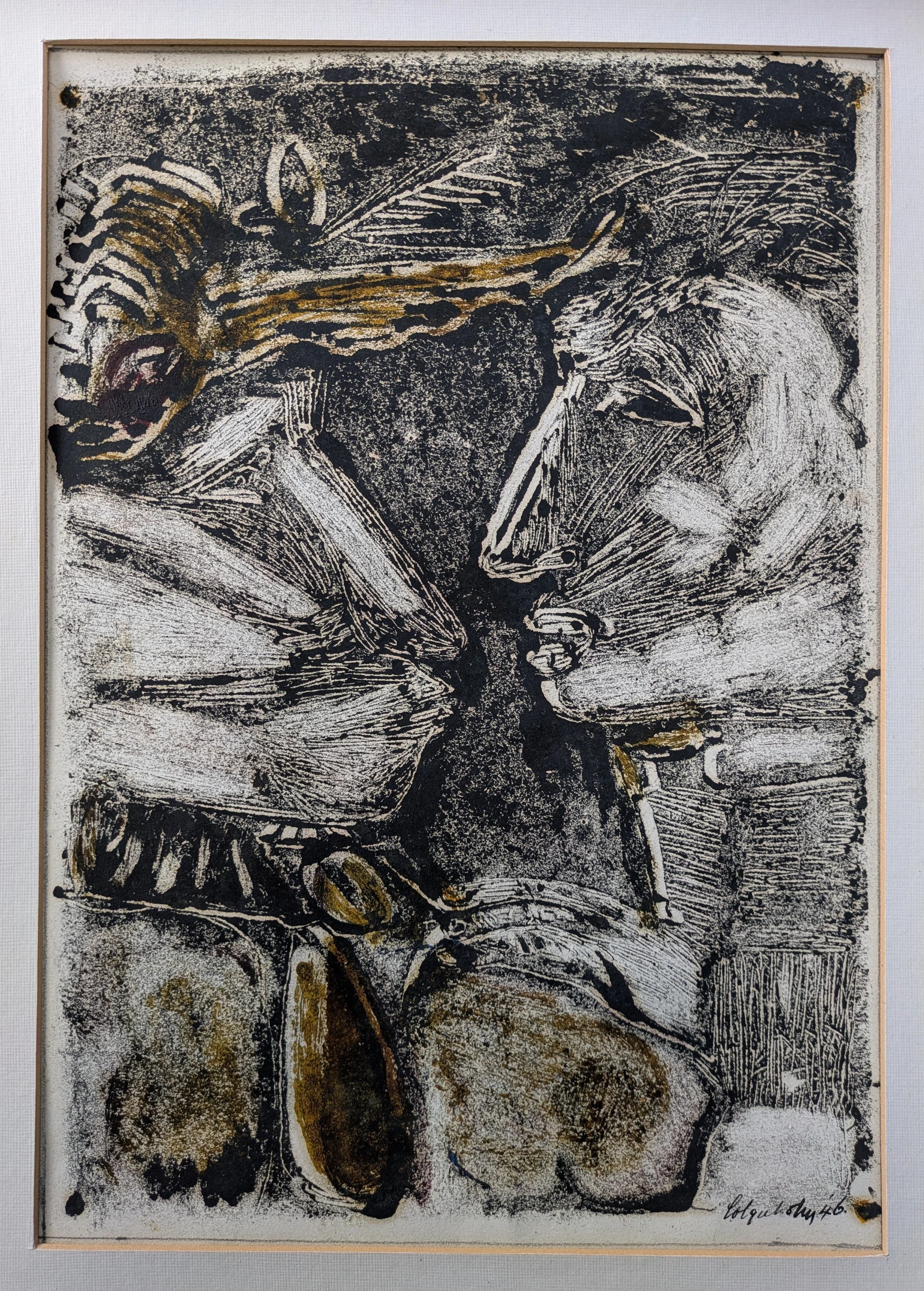
Robert Colquhoun, Two Country People No. 1. Monotype on paper. 35 x 27cm. 1946. Private collection.
From this point on, throughout 1946, Colquhoun perfected his technique in monoprinting. The subject matter included a group based on women and stoves, women dancing and numerous versions of figures talking, such as Two Women Talking, in the Laing Art Gallery, Newcastle, Figures Talking in the Moray House College Collection, Edinburgh, and Two Figures in the Hepworth Gallery, Wakefield.
But the best was yet to come. During a visit to Ireland in late 1946, the Roberts encountered a poverty much greater than they had experienced in Ayrshire during the Depression. This large group of monoprints of Irish peasants are among the finest and most powerful monoprints ever produced in this country. They were exhibited to great acclaim in Colquhoun’s Lefevre exhibition of 1947, and included works such as Irish Peasants, Two Irish Women, Irish Peasants at Church Gate, Dubliners, as well as the exquisite Beggar and Dog, illustrated in Penguin New Writers. Many of the young artists of the day were commissioned to illustrate the Penguin New Writers series, including Minton, Vaughan and Craxton, as well as both Colquhoun and MacBryde. It is fortunate that Beggar and Dog appears as an illustration in No. 30 of the series: the print itself has sadly faded over time, but its full impact is preserved in the illustration.
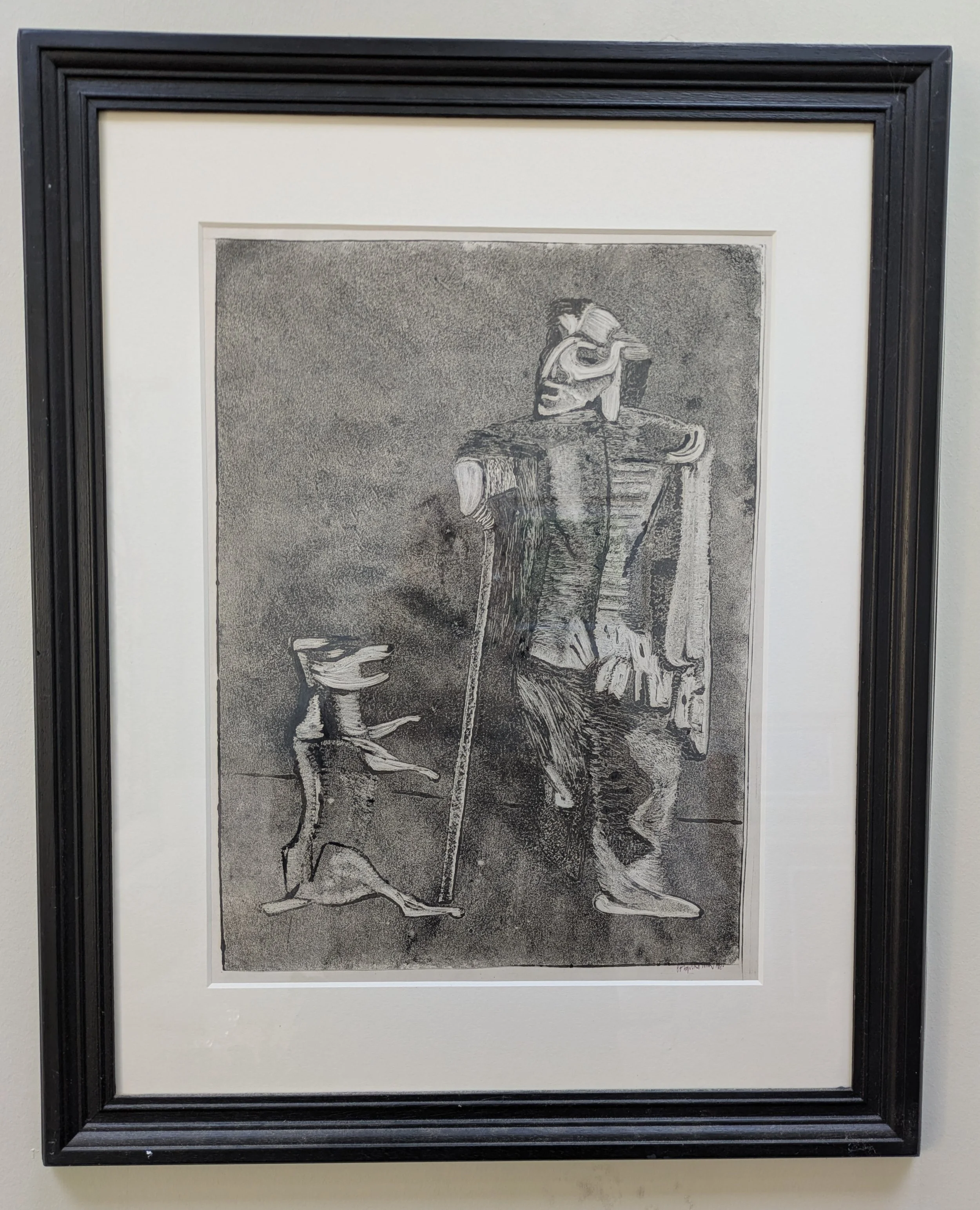
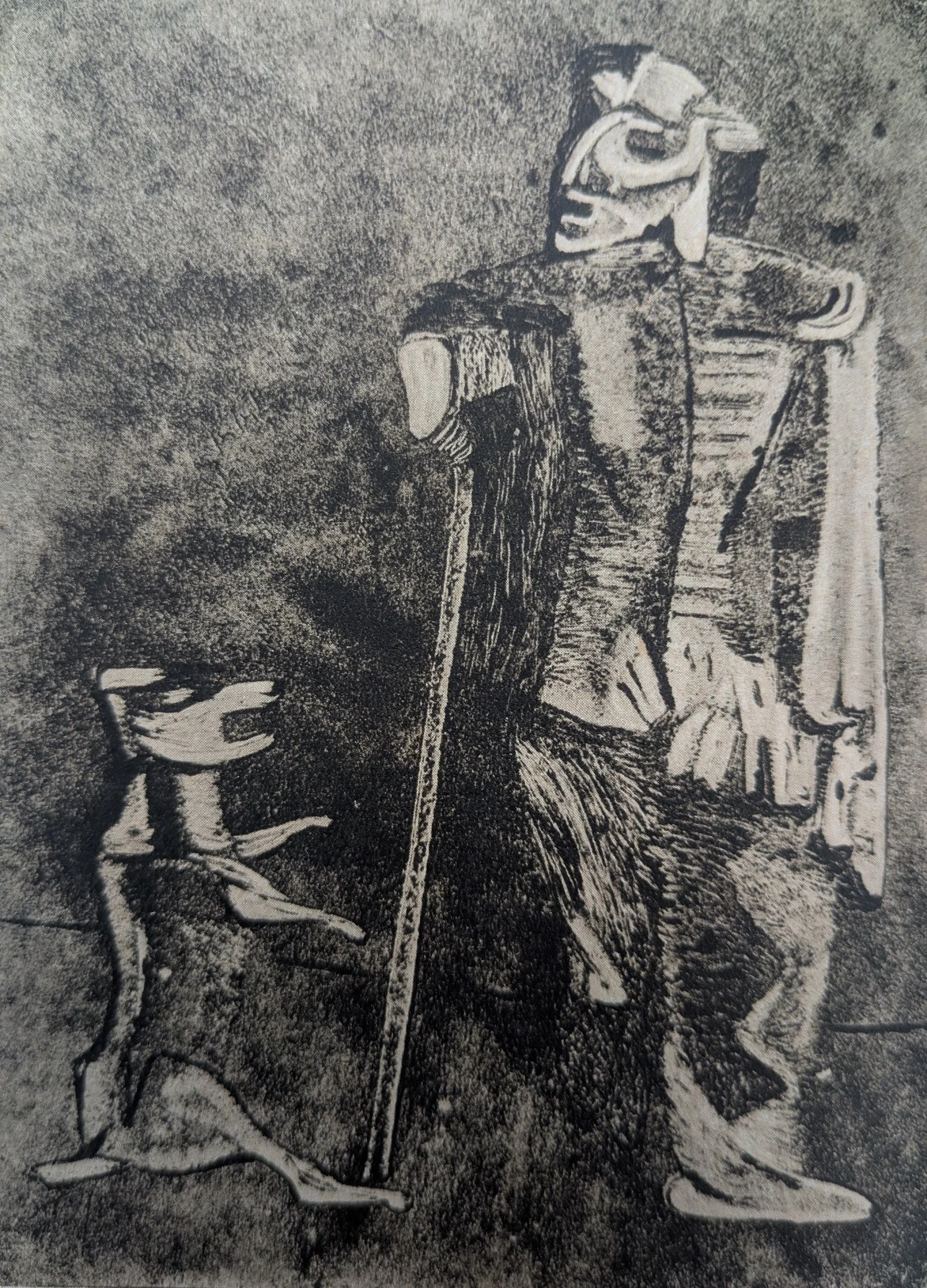
Robert Colquhoun, Beggar and Dog. Monotype on paper. Dimensions unknown. Private collection.
Left, an image of Beggar and Dog in its current condition, slighted faded. Right, an image of the work as pictured in 1947, its full impact stronger, as illustrated in Penguin New Writers No. 30.
After the Irish visit of 1946, Colquhoun appears to have been emotionally exhausted, because few monoprints were produced in 1947. However, in 1946, the Two Roberts moved to Lewes in East Sussex at the invitation of the two eccentric sisters Frances Byng-Stamper and Caroline Lucas, who ran Miller’s Press. Apart from the many lithographs they produced there, Colquhoun produced his large series of Women with Goats, developed from the drawings he made in Cornwall of Nessie Dunsmuir’s pet goat, Leah. In Lewes, Colquhoun and MacBryde also began work on the costume and set designs for the Scottish opera, Donald of the Burthens, to be staged at Covent Garden in 1951. These designs, of which around 250 were produced, were essentially coloured monoprints. Colquhoun, being the greater draughtsman, would create offset drawings and MacBryde, the more adventurous colourist, would add oil paint to the carbon transfer drawings. All were signed and mostly titled by both artists, and the best of these, 66 in total, were exhibited in the Redfern Gallery in January 1952 with a catalogue introduction by Sir Colin Anderson.
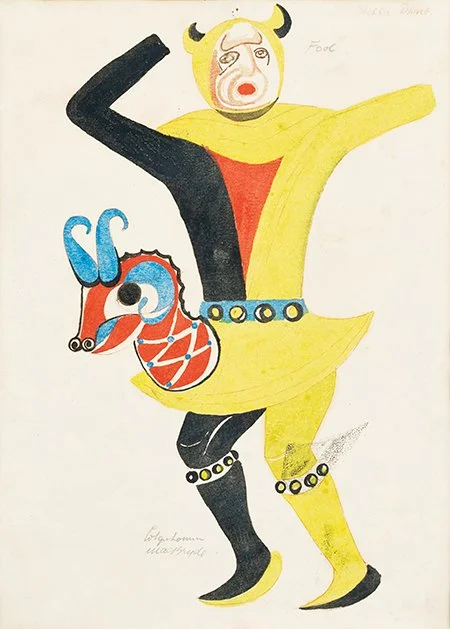
Robert Colquhoun, The Hobby Horse (from the Donald of the Burthens series). Carbon transfer drawing, ink and gouache on paper. 38 x 26cm. 1951. Private collection.
The eviction from their London studio in 1951 was a severe blow to the Two Roberts, particularly for Colquhoun, and represented the beginning of the gradual decline in their fortunes. However, help came in the most unconventional way. Elizabeth Smart, the partner of their friend the poet George Barker, was looking for child-minders to look after their four children while she worked in London for Vogue magazine. She not only knew and admired the Roberts, but crucially knew how to handle them. And so, they became child-minders to the Barker children at Tilty Mill near Great Dunmow in Essex. They remained there for four years, during which time Colquhoun produced what many consider to be his finest masterpiece, the large canvas called Figures in a Farmyard. The composition is set in the farmyard at Tilty Mill and consists of a statuesque woman on the left, a seated, broken man on the right and in the foreground, a massive, ferocious, Cubist pig. Colquhoun created hundreds of monoprints relating to this painting, as well as numerous monoprints of men with horses and pigs and compositions of two male figures inhabiting the usual claustrophobic space. Several of these monoprints are in the Scottish National Gallery of Modern Art in Edinburgh, and others are emerging for the first time, since there was no official record of Colquhoun’s work after his 1954 show at the Redfern.
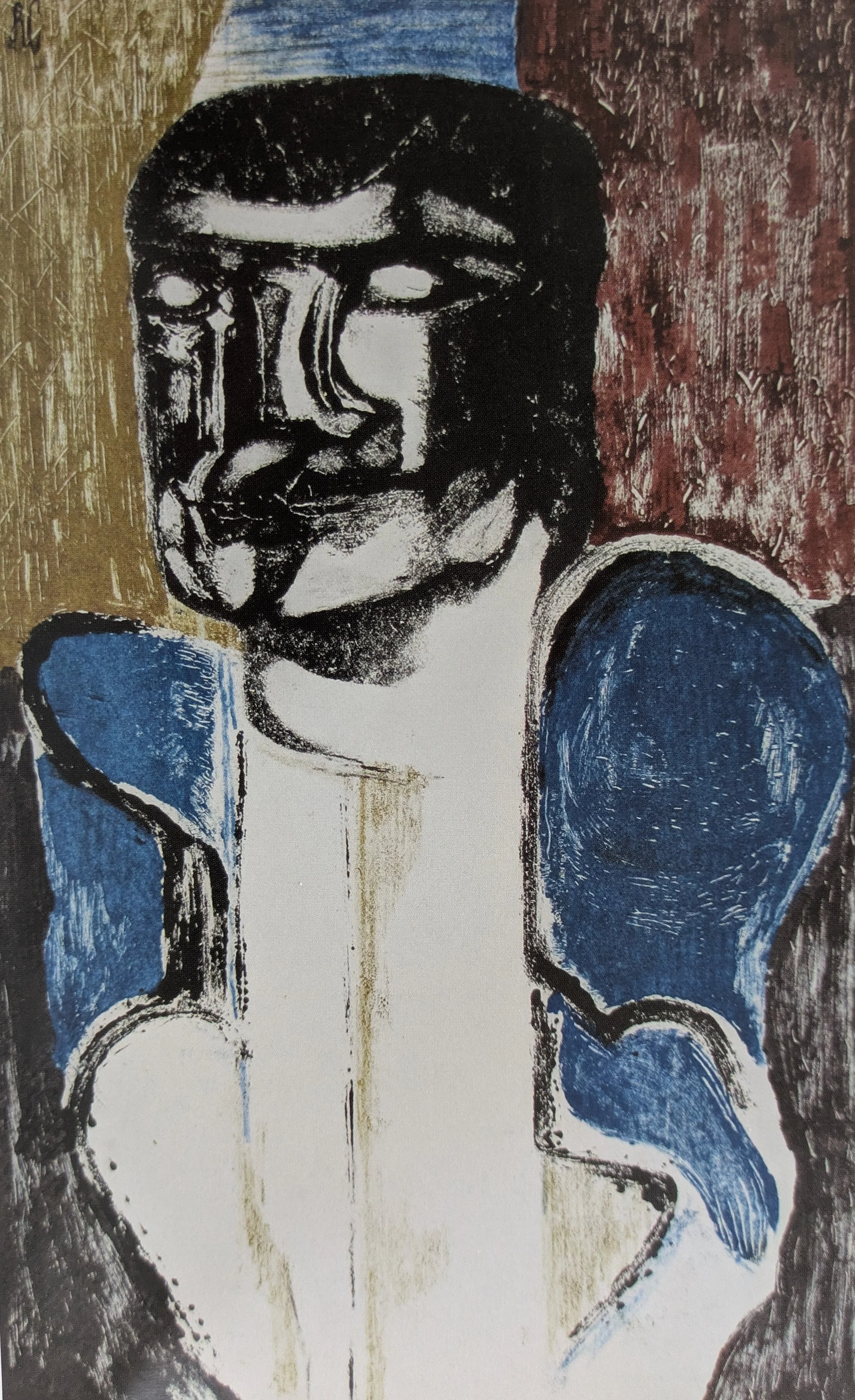
Robert Colquhoun, The Farmer. Monotype on paper. 53 x 33.5. Private collection.
Their departure from Tilty Mill at the start of 1955 meant that they were now homeless for the first time since their arrival in London fourteen years earlier. By this time they would probably have been officially classed as alcoholics. From then on, they relied on the charity of friends for accommodation. Few monoprints, indeed few works in any medium, were produced in 1955 and 1956. However, some fine monoprints appears in the Parton Gallery in October/November 1957, in an exhibition of 23 works described as “Drawings”.
56 monoprints were included in Colquhoun’s large retrospective exhibition at the Whitechapel Gallery in 1958, although many of the works in the “Drawing” section were in fact monoprints. All were lent to the retrospective either by collectors or by the artist himself. The director of the Whitechapel Gallery, Bryan Robertson, requested that he paint between 20 and 30 new paintings for the exhibition and even provided the funds to create them. In the end, Colquhoun produced 11 large canvases, the importance of which lies in the fact that they were mostly developed from earlier monoprints. For example, Two Women in Ireland (Dick Institute, Kilmarnock) was developed from the 1946 monotype Two Irish Women (private collection) and Bitch and Pup (City of Edinburgh Art Gallery) was developed from Sir Colin Anderson’s monoprint of the same title.
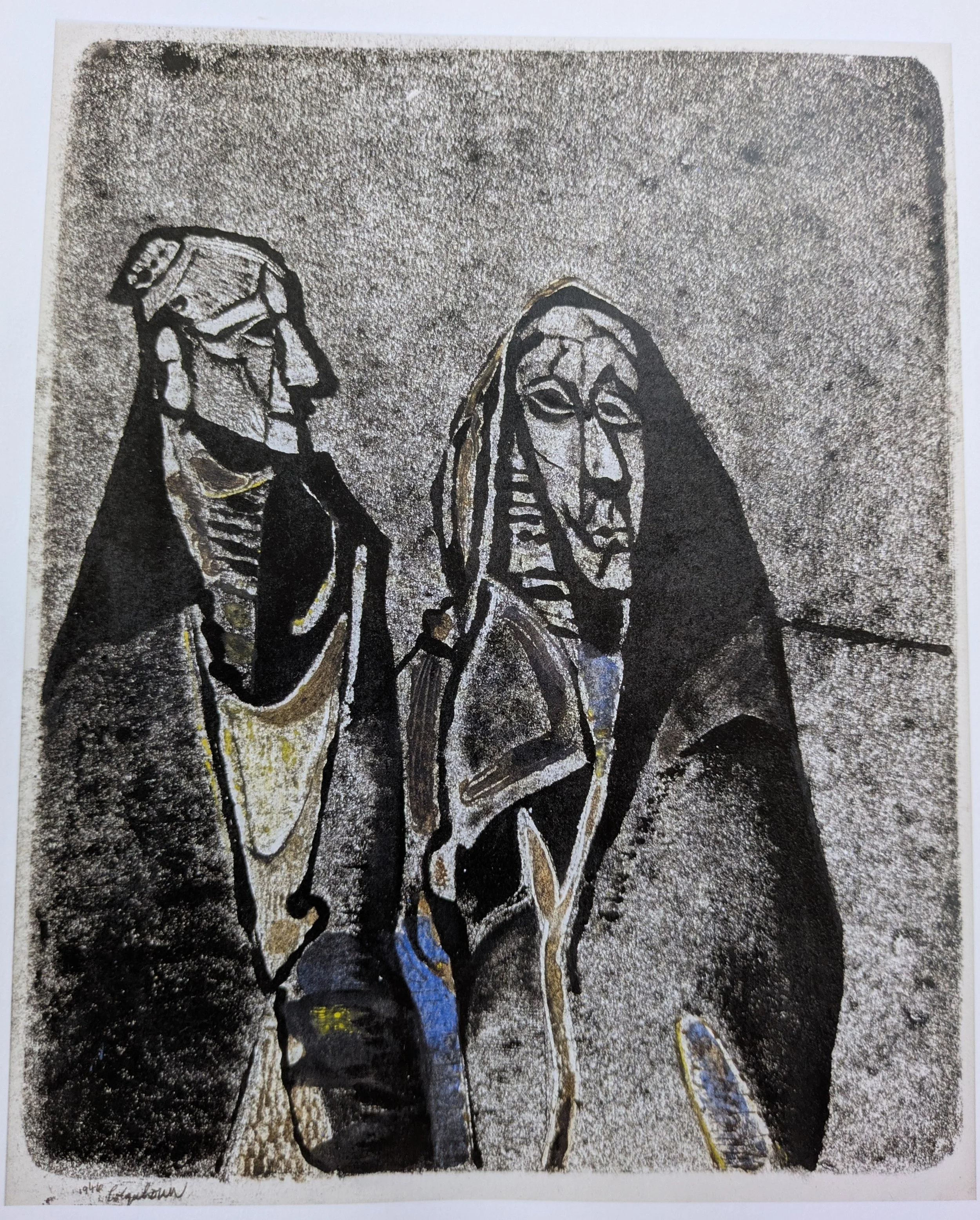
Robert Colquhoun, Two Irish Women. Monotype on paper. 52 x 42cm. 1946. Private collection.
It was in the village of Kersey in 1959 that Ken Russell made his first film, Scottish Painters, showing Colquhoun and MacBryde at work in their studio there. The rent was inexpensive and provided Colquhoun with the stability he needed in order to work. Despite severe personal hardships at this late stage in Colquhoun’s career, he produced many monoprints of the finest quality; monoprints which have rarely been seen, let alone examined or discussed.
24 of them were exhibited in the Kaplan Gallery in April 1960, along with 28 fine still lifes by MacBryde. Of these excellent monoprints, Man on Horseback is now in Aberdeen Art Gallery, Man on Horse is in the Scottish National Gallery of Modern Art, and Two Sisters (private collection) was illustrated in the quarterly journal of the visual arts, The Painter and the Sculptor, in Spring 1963. Yet another Seated Woman was given by Colquhoun to Georgina Barker. She called it Dancer. This exhibition proved beyond doubt that the creative powers of the Two Roberts were by no means exhausted. Sadly, the whereabouts of most of these monotypes are unknown.
It was in 1962 that the Two Roberts made the acquaintance of two London booksellers Fred Read and Bobby Katz who ran a bookshop and gallery in Museum Street, close to the British Museum. Colquhoun was given the opportunity to produce forty new monoprints for an exhibition to be staged in the gallery above the bookshop from 3rd October to 3rd November. As always, when given a target to which to aim and a degree of stability in his domestic circumstances, Colquhoun set about his new work with considerable enthusiasm and commitment. Accommodation as well as an advance in anticipation of sales was provided, and with his lover, MacBryde, providing his constant support, work began on these new monoprints.
However, in the early hours of 20th September, while working on the offset drawing which was to be called Still Figure, Colquhoun collapsed and died of a heart attack. The years of neglect and lack of proper nourishment had finally taken their toll. The exhibition went ahead as planned as were the wishes of MacBryde and of Colquhoun’s family. Forty works were listed in the catalogue, but only 34 were completed and exhibited.
The visual impact of these new monoprints must have been considerable. Many were on a scale much larger than he had previously created. Although several revisited old themes such as Man with a Goat (private collection) and Dancers, the subject matter of most of them was new. There can be little doubt that, given the close proximity to the British Museum, several of these new works were influenced by visits there; Figure in Black and Yellow, Woman in a Straw Hat, and Bust of Poet (all in the Print Department of the British Museum) as well as Head of Brutus and Nigerian (both in private collections) demonstrate the influence of Roman, Assyrian and African sculpture. Furthermore, the skeletal, dancing structure of Still Figure was undoubtedly influenced by Dance of Death (1493) by Michael Wolgemut; the two images are uncannily similar. Little wonder, then, that his friend George Barker, who initially inherited Still Figure, described Colquhoun as “drawing his own death”.
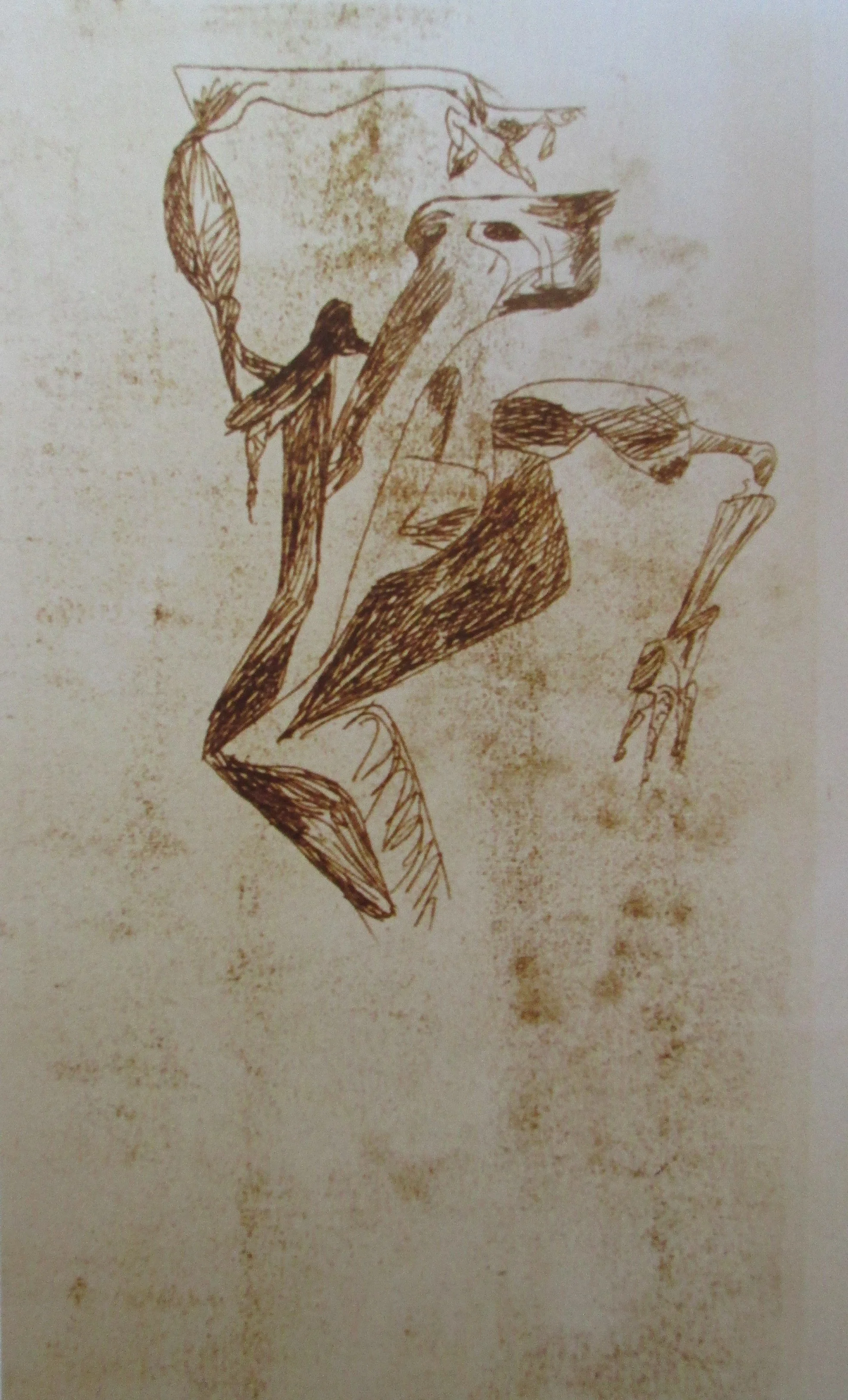
Robert Colquhoun, Still Figure. Carbon transfer drawing on paper. 63.5 x 33.5cm. 1962. Private collection.
There were many reviews of the exhibition, some of which doubled as obituaries. The consensus was that this exhibition on Museum Street represented an artist whose work was far from exhausted; some even suggested that Colquhoun was on the brink of a new beginning. Neville Wallis in the Observer noted “in him, then, a period has departed as well as the most nervously expressive draughtsman in contemporary English art… At the heart of high romantic art lies a conflict. Colquhoun’s characters, frigidly aloof yet vulnerable, fiercely stylised yet as tender as his memory of his sister, have a haunting intensity of feeling. A man on a fallen horse, or with a goat or a perching owl; a snout-nosed woman, alone or communing with an impassive partner, are all heavy with subjective meaning… His drawings in Bloomsbury belong to the last months of his life when his awareness of psychological stresses became even more intensified. A print of an astronaut under high pressure is one of a series of gnarled stratiform effigies of primitive man enclued [sic] with a troubled emotion concerning our origin and fate. Colquhoun’s apprehensions will long outlive his period”. [3]
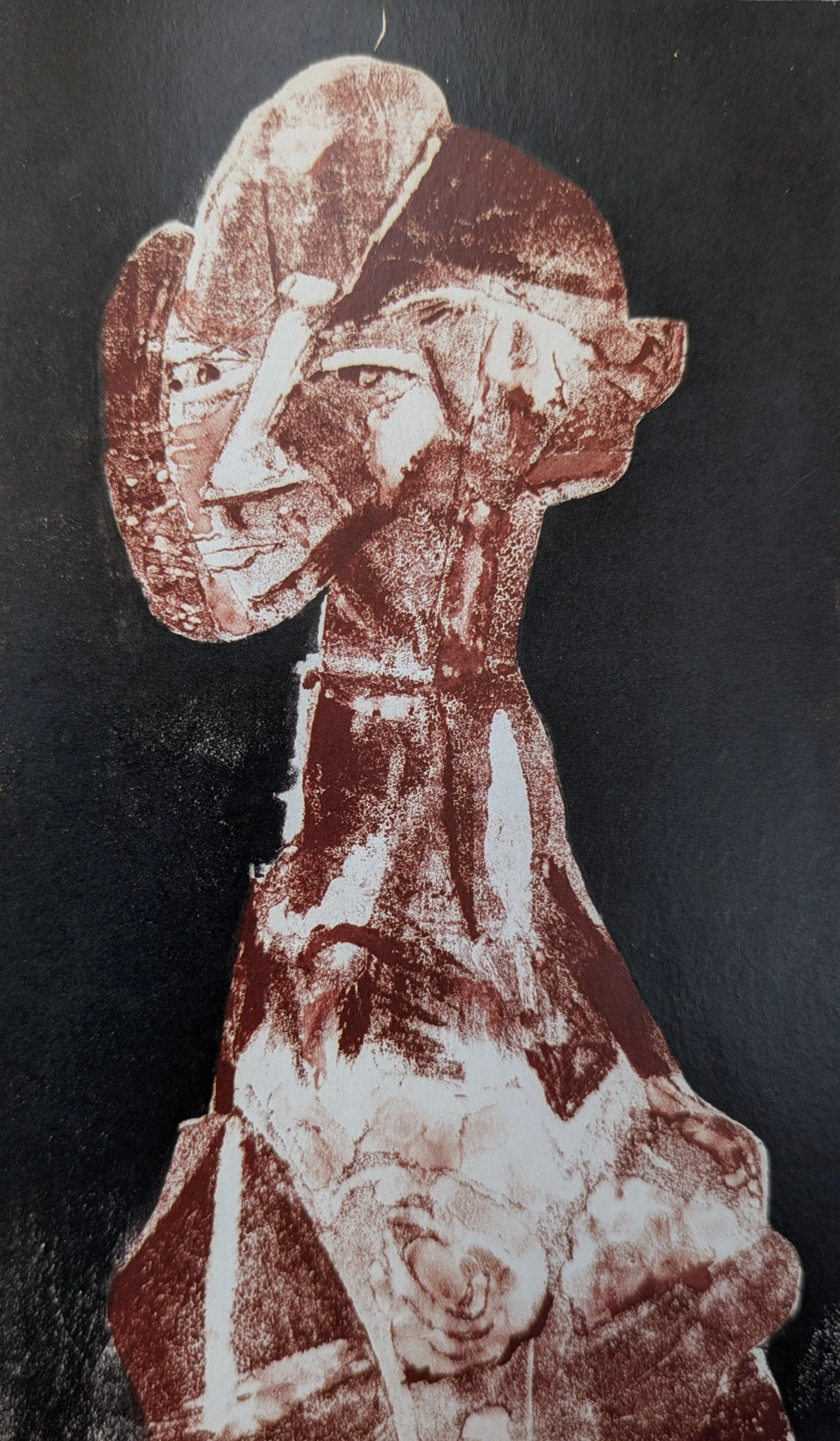
Robert Colquhoun, Astronaut. Monotype on paper. 70 x 41cm. 1962. Private collection
The 34 works in the Museum Street Gallery were dispersed among family members, friends and other purchasers. Only three of them have found their way into the collection of the British Museum. And herein lies part of the problem concerning Colquhoun’s monoprints. His final monoprints were among his finest, and among the best ever produced in twentieth century British art. Yet only five of them have ever been seen together since his death in 1962, in the Scottish National Gallery of Modern Art exhibition, The Two Roberts, of 2014, when Black and Red, Astronaut, Bust of a Poet, Woman in a Straw Hat and Figure in Black and Yellow were exhibited together. The whereabouts of fifteen are presently unknown and the remainder are in private collections.
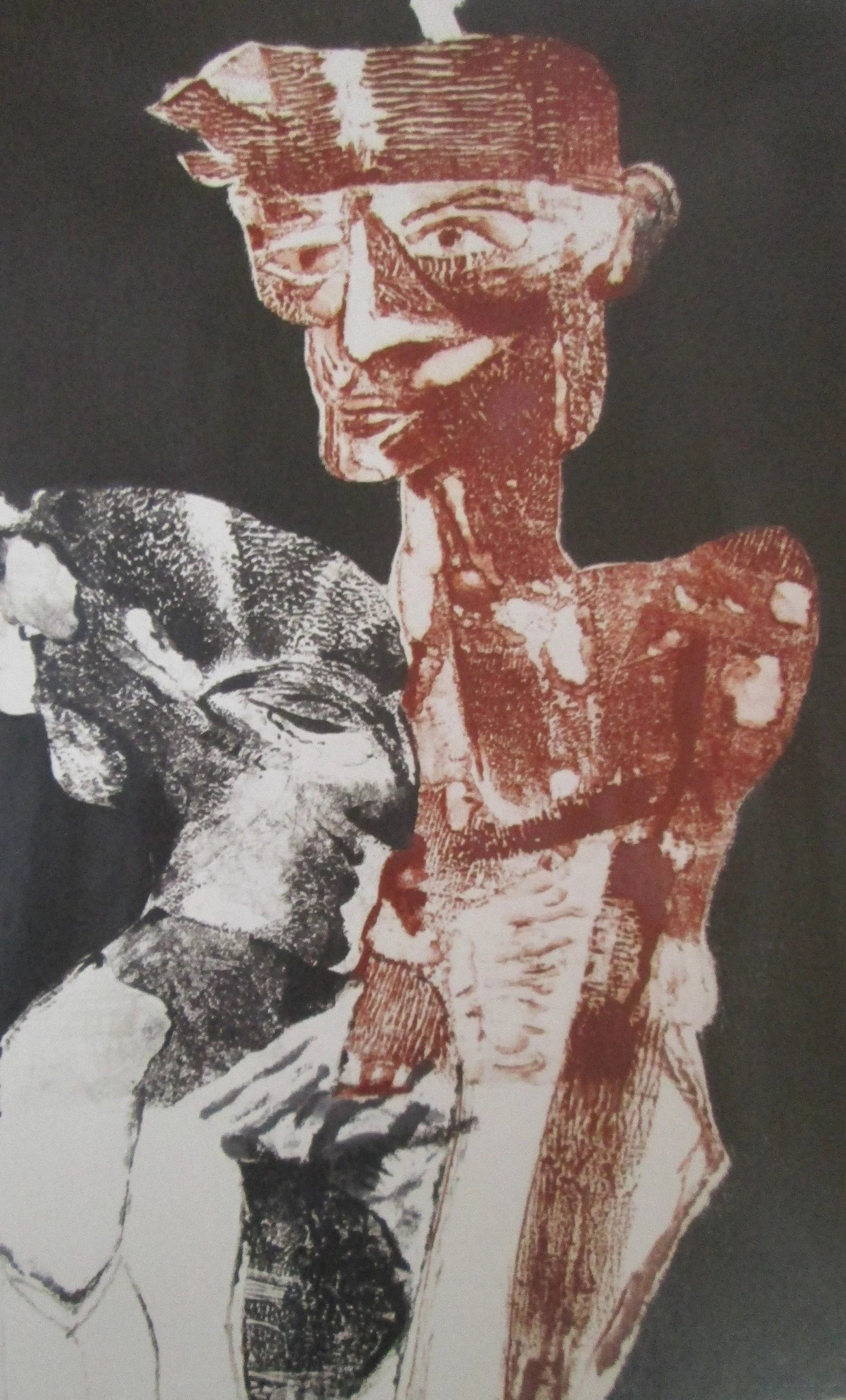
Robert Colquhoun, Black and Red. Monotype on paper. 70 x 44cm. 1962. Private collection.
All of Colquhoun’s mature work was created in twenty years. His monoprints represent, by far, the most prolific part of his output. Some of the poorer ones, it has to be said, were dashed off in haste in the mid-to-late 1950s as currency for rent or for alcohol. But the majority of them, particularly those from 1946 and 1962, are among the most accomplished and the most highly expressive ever produced.
It is only when the ignorance concerning the monoprint as a unique work of art is dispelled and the prejudice surrounding it by galleries, auction houses and the art-buying public alike have disappeared, Colquhoun’s rightful place as one of Europe’s most significant artists will at last be realised.
Davy Brown
Notes
[1] – Gordon Samuel, “The Monotype 1900-1955” in Robin Garton (ed.), British Printmakers 1855-1955: A Century of Printmaking from the Etching Revival to St Ives (London, 1992) p.287.
[2] – The British Museum holds a considerable number of fine monotypes by Colquhoun, including several from his final show in 1962. It is unfortunate that they are accessible by appointment only and are not currently digitised; sadly, it has not been possible to reproduce images of the work here.
[3] - Neville Wallis, Robert Colquhoun obituary, The Observer, October 1962.
Acknowledgements
Several images courtesy of National Galleries of Scotland.