
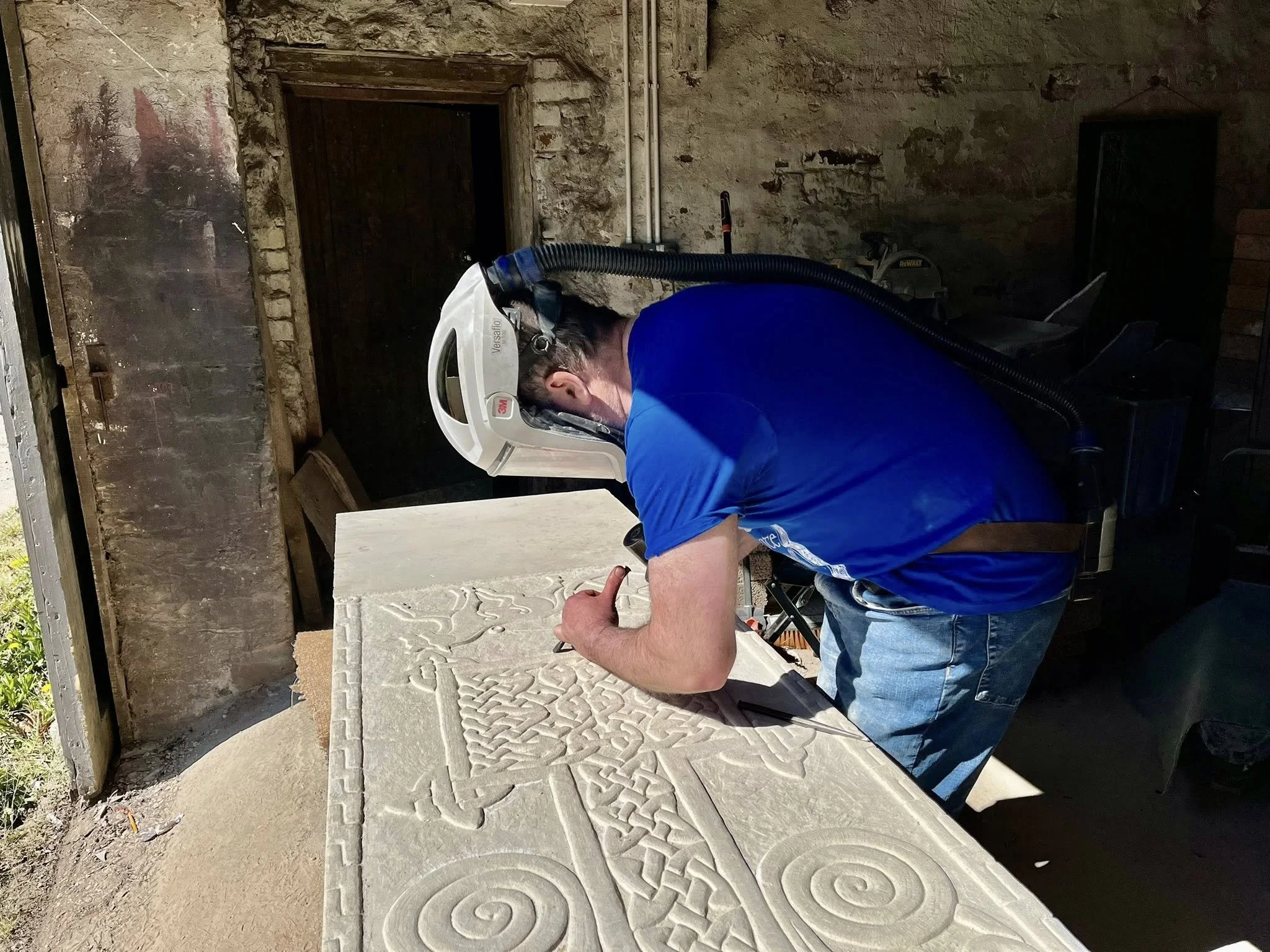
Pictish Art: David McGovern
Gillian Zealand visits a studio where new art emerges from the shadows of an ancient landscape.
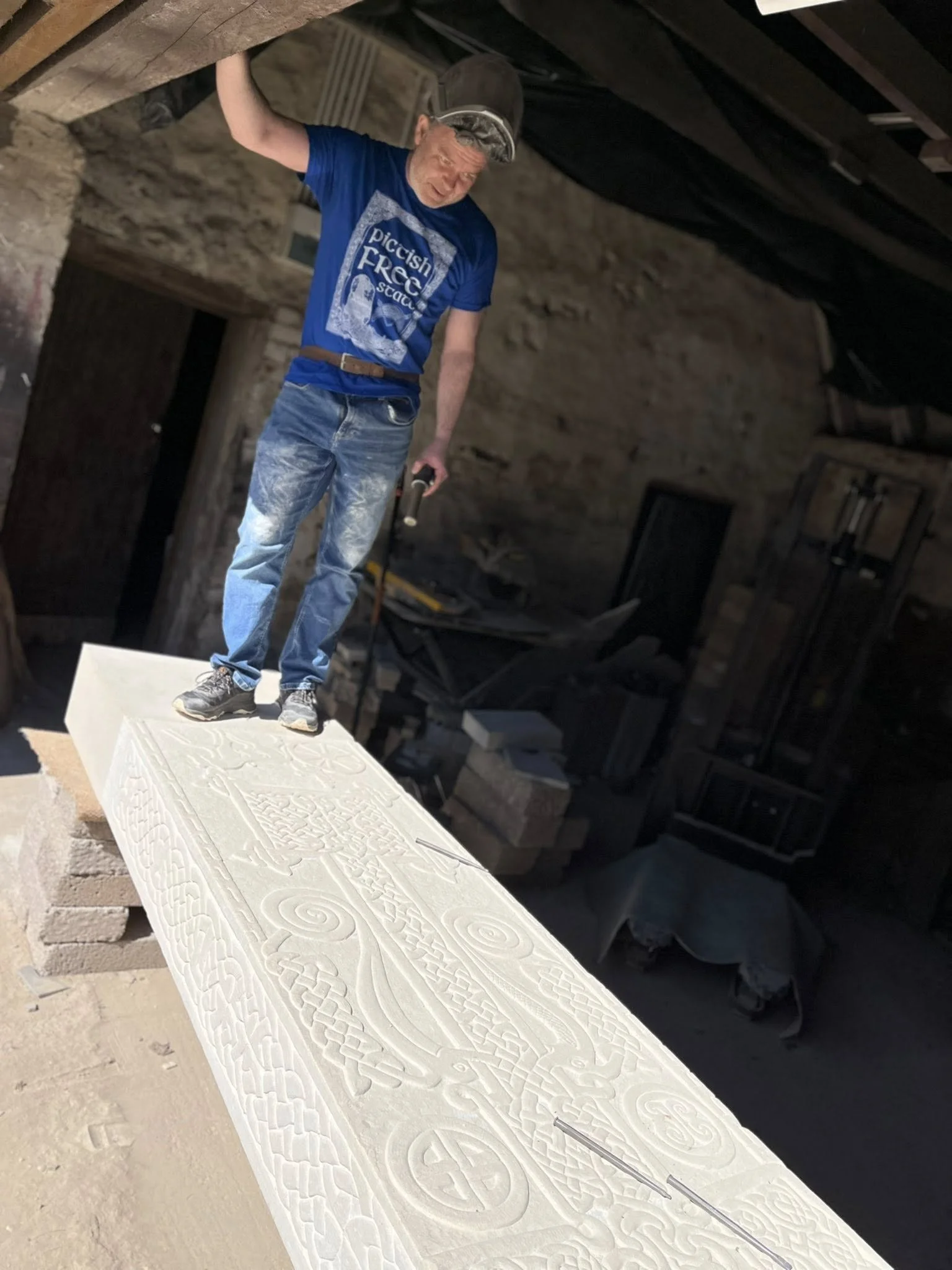
David McGovern standing on one of his Pictish art carvings
If you’re looking for a studio that perfectly suits its surroundings, it would be hard to beat that of David McGovern, a man steeped in the sculpture of the Picts. The first thing he does when I arrive at Monikie Rock Art, his farm-steading base in South-east Angus, is to turn me round to face the landscape. The view from this high vantage point, which encompasses the fields and woods of south-west Angus, the Tay estuary, Fife and the distant Lothians, is not only spectacular, he says, but a window onto early Christian Scotland. “Coming over the brow of the hill from the north, this is the first point from which you can see St. Andrews. Everyone knows about the pilgrim route from the south and Queen Margaret’s ferry, but travellers to St. Andrews must have come this way too, and this sudden view of their goal would have stopped them in their tracks.” He points out the sites of two more ancient shrines: St Bride’s (Bridget), at Panbride, over to the left, and St. Rule’s, just below us at Monifieth; it was St. Rule of course who fled from Greece with the relics of St. Andrew and gave Scotland her patron saint. It’s also a rich landscape archaeologically, with Iron Age souterrains and the Laws hill fort, not forgetting the Pictish cross-carved stones from Monifieth, now in the Museum of Scotland.
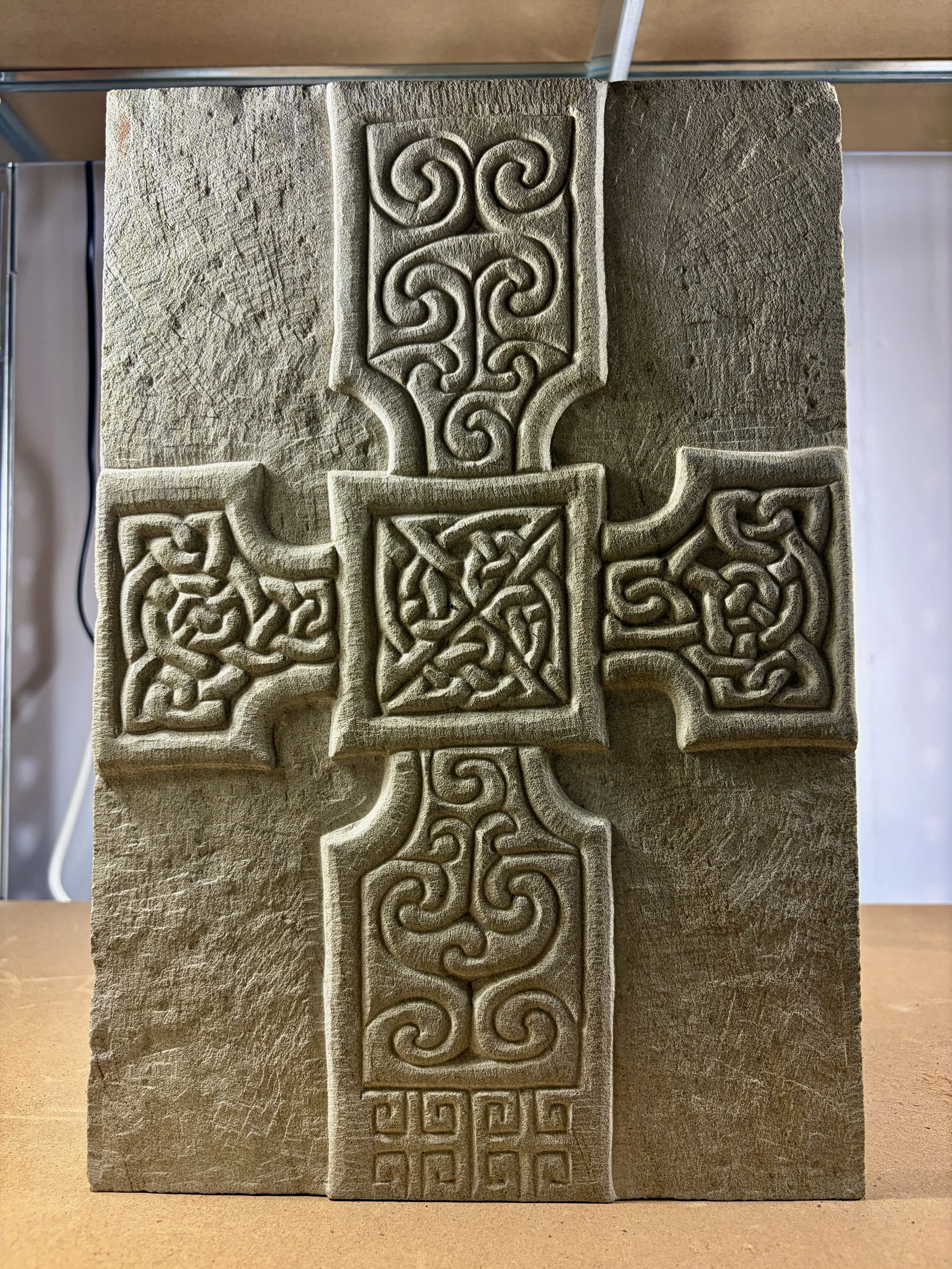
Caption required
That’s not all. Just across the road lies Denfind Quarry, a source of beautiful, fine-grained, soft-coloured sandstone, perfect, as it happens, for stone-carving Pictish style. This too has a link with the past, for it has re-invigorated an industry for which this part of Angus was once world famous. What catapulted the small-scale quarrying of stone for farm buildings, roof-slates and dykes into an industry whose products went all over the world was the invention by a local entrepreneur, Hunter of Leysmill, of a ‘stone-planing machine’, which gave the natural bedding planes a smooth and polished finish perfect for paving. Fittingly, Hunter’s invention features on one of David’s sandstone carvings: the sculptor’s homage to his own patron saint, creator of the perfect sandstone slab.
Finally, suitably impressed, I turn back and enter the workshop.
Stones: on workbenches and propped up against walls. Stacks of un-worked slabs in the soft reds, greys and fawns of Denfind sandstone and sea-worn boulders. On the back wall a Celtic cross and a sliver of dark schist flecked with mica, more like a West Highland grave slab. On one bench, a partly-finished house-name in beautiful script (I discover later that David’s McGovern’s forebears include a printer, a signwriter and an artisan blacksmith who made farm signs). In a corner, a curious roughed-out slab, very different from everything else. The tools of the trade, broad-bladed chisels in all sizes, points and mallets, are arranged on a side table, others lie on the workbenches as if the sculptor has just put them down. Which he probably has - he clearly has several pieces on the go. The one I make for first is impressive and - to me - unmistakable: it’s one of the famous ‘Burghead bulls’ from the great Pictish promontory fort on the Moray Firth. He’s carving it for the Burghead Visitor Centre.
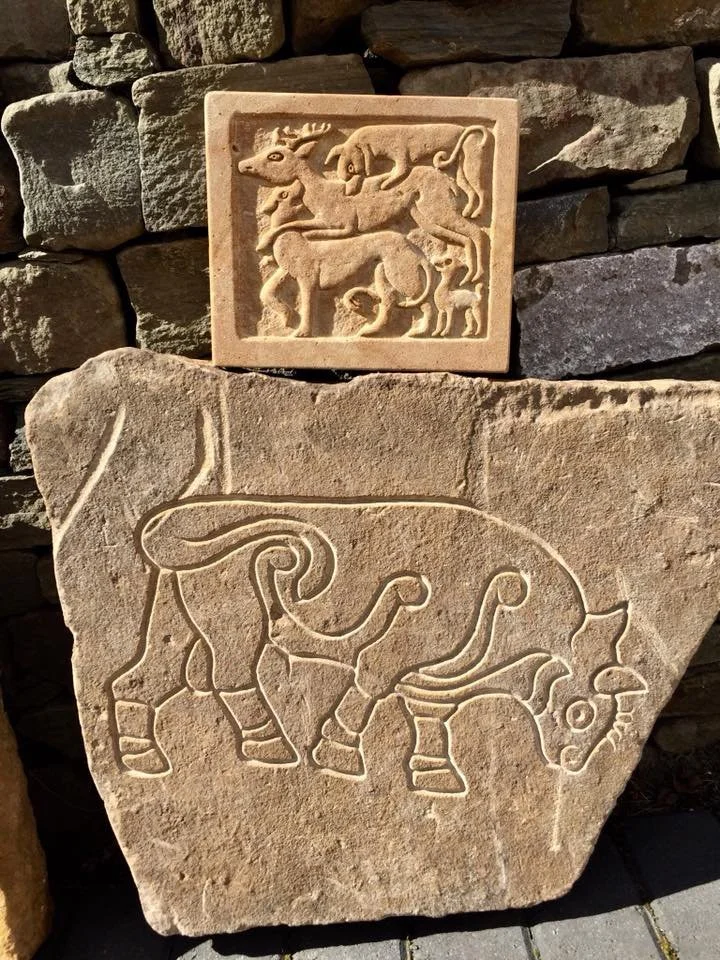
Caption required: ?David McGovern, Burghead panel and Bull, Materials, Dimensions, Date, Courtesy of xxx,yyy
David and I share a passion for the Picts, the people who in the first millennium AD occupied eastern Scotland north of the Forth. Possibly this interest has been fostered by our common background (I am from Monifieth, he from nearby Broughty Ferry, and both of us regard St Rule’s as our ‘local’ Pictish site). But David’s grasp of Pictish and early Christian history (there’s a big overlap) goes far deeper than mine and as Vice-president of the Pictish Arts Society he is well-versed and fully up to date in all things Pictish. He is in fact in a unique position, because he has also made a name for himself as a practitioner of ‘Pictish’ sculpture. This total immersion has enabled him to learn the techniques of Pictish carving and also to acquire a deep knowledge and understanding of the art of the Picts. It’s this that we’re here to talk about today.
The Picts have been called the darkest of Dark Age peoples. Unlike the Anglo-Saxons and the Irish, they kept no written records of their own. What we do know about them is based mostly on the opinions of others, starting with the Romans around 400AD. The Romans called them ‘Picti’ (the painted ones), possibly from their habit of tattooing their bodies, and to them they were simply barbarians, scourge of ‘civilised’ Britannia south of the Wall. Current scholarship is somewhat kinder, preferring to place them among the peoples of Early Medieval Scotland.
Place names, names on their king lists and rare and hard-to-interpret inscriptions in ogham* and Roman lettering seem to indicate that the Picts spoke a dialect of Celtic akin to Welsh, as opposed to the Gaelic of their western neighbours, the Scots of Dalriada. They started out as groups of loose confederacies bound by tribute, gift-giving and loyalty to a particular leader, though they banded together in times of stress. Sub-kings gradually deferred to those of higher status, until, by the later 7th c, a High King of Pictland emerged to claim the throne. Christianity, when it came, was a further unifying force. Later kings were keen to show themselves as monarchs in the tradition of Old Testament heroes like David.
*Ogham: a Celtic alphabet comprising parallel strokes across or on either side of a vertical line
Caption Required
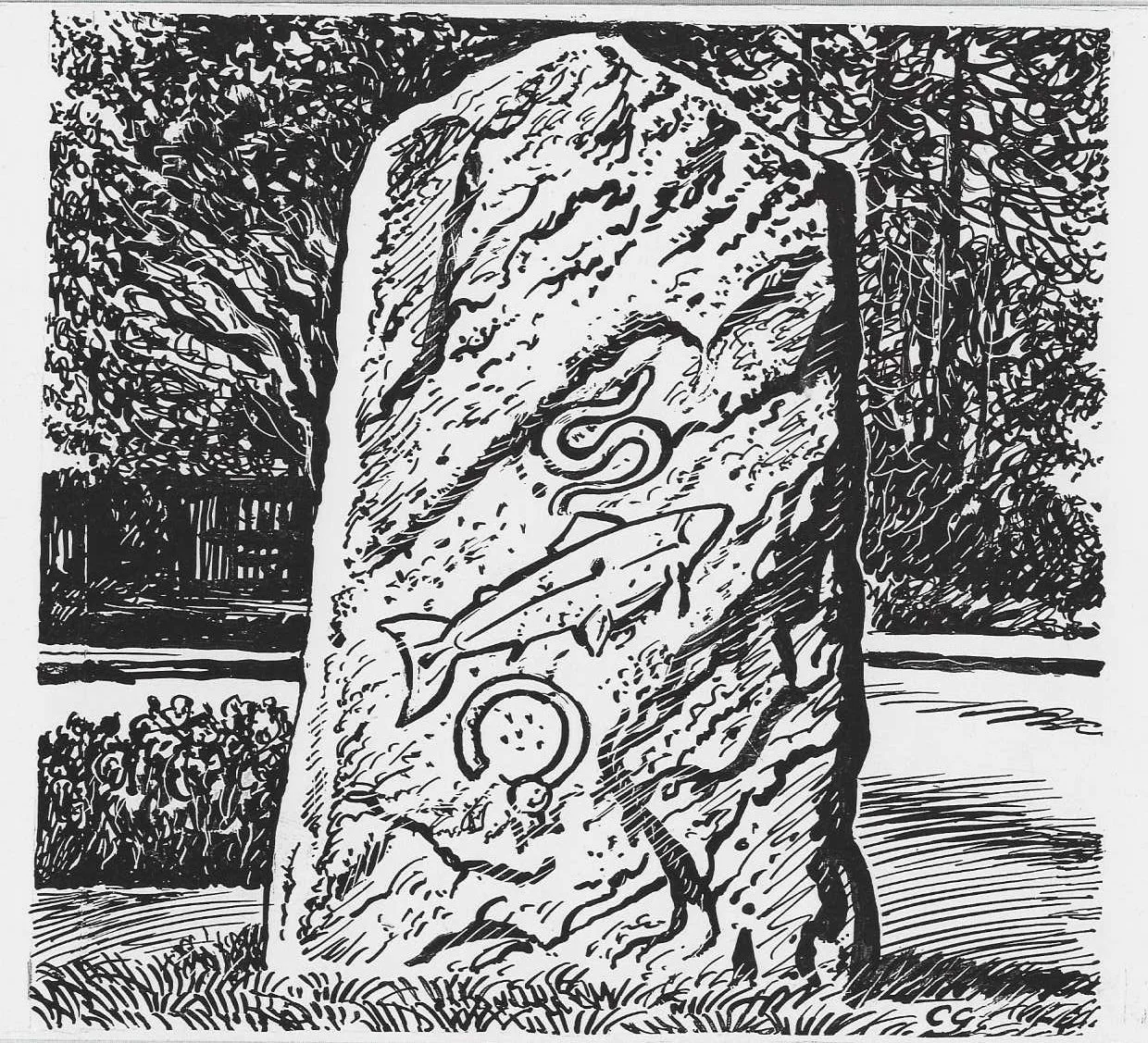
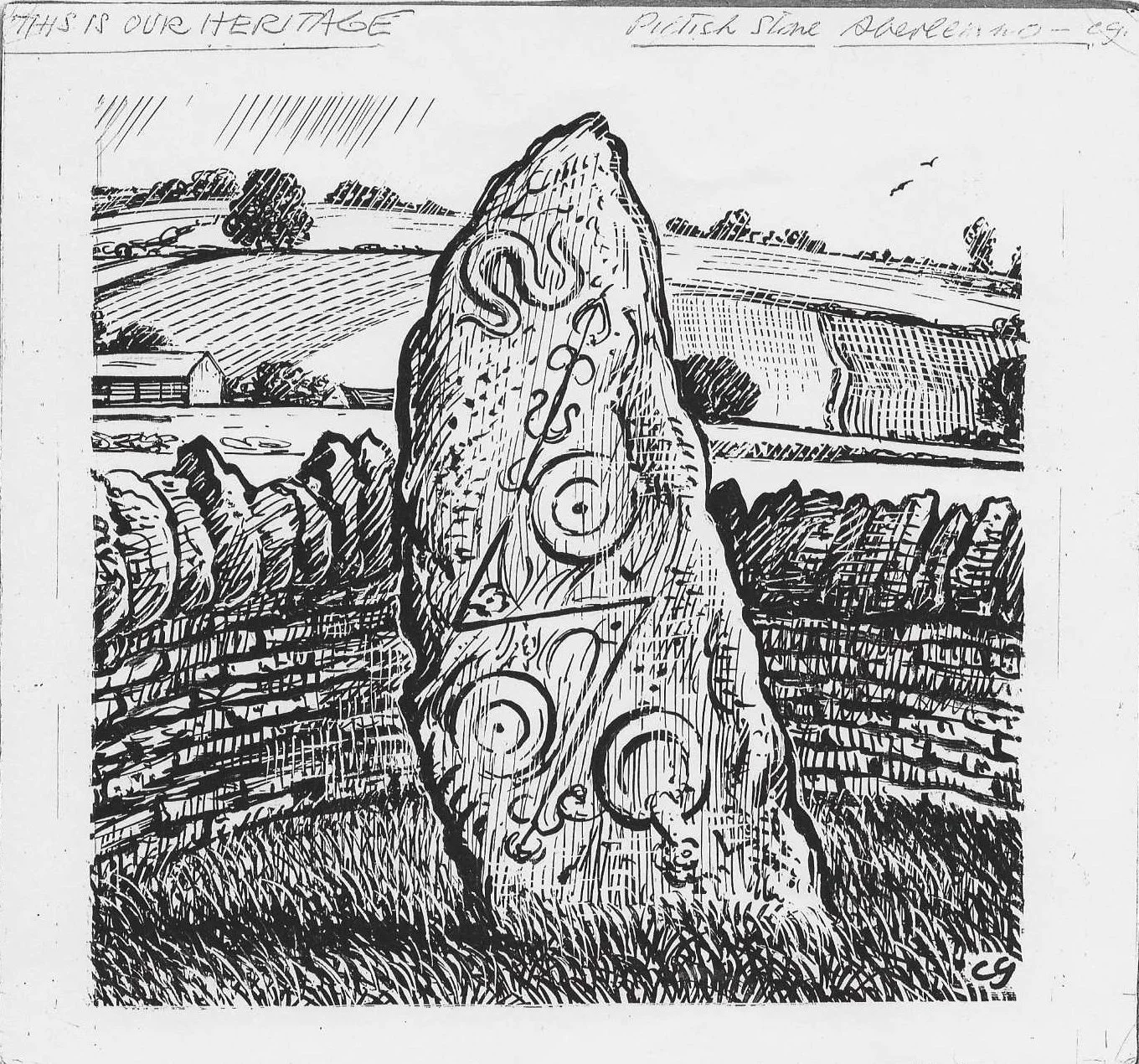
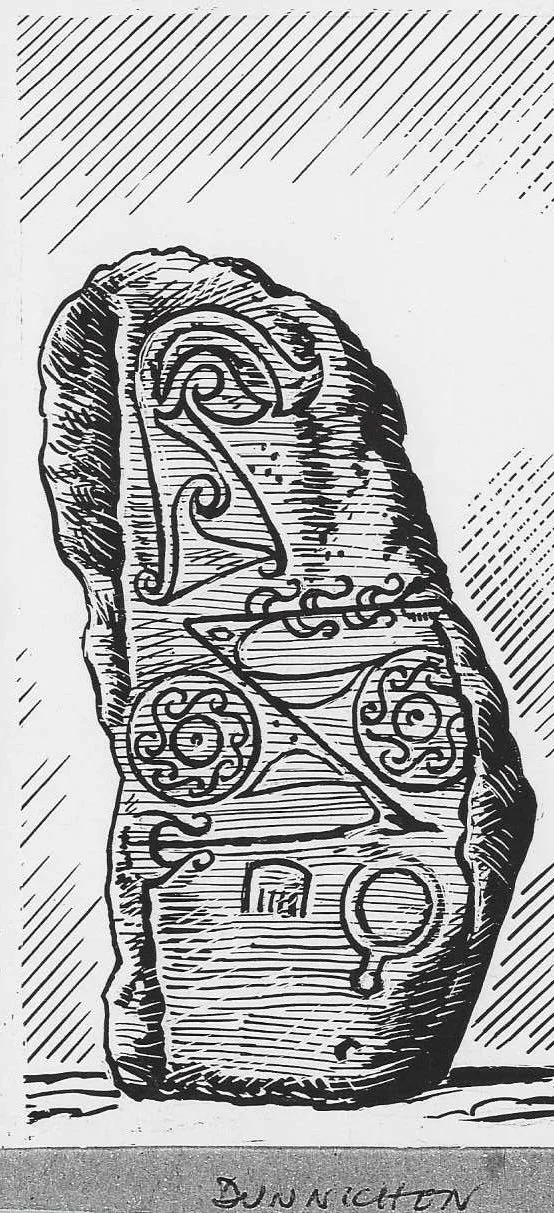
These people left one unique and enduring legacy: their symbol stones. These are found all over Pictland – indeed their distribution defines its borders. They date from the 5th - 7th cs AD and usually take the form of natural boulders incised with strikingly graphic designs, generally in pairs. These include birds and animals (stag, wolf, boar, eagle, goose, salmon, serpent and a strange dolphin-like hybrid known as the ‘Pictish beast’), drawn in profile and usually moving from left to right. A few symbols are recognisable objects like the mirror and comb. The rest are abstract in concept, and bear such names (given by scholars) as the ‘double disc and Z-rod’, the ‘crescent and V-rod’ and the ‘notched rectangle’. Within their distinctive outlines, which are literally ‘set in stone’, is a varying pattern of spirals, scrolls, trumpets and kidney-shaped peltas which seems to have its origin in the Celtic Iron Age. How this was transmitted from the 1st c BC to the 6th c Picts is something of a mystery; their tradition of tattooing is one, quite serious, contender along with wood-carving and textiles. Gallons of ink have been expended on the meaning of these symbols. Are they spiritual? Cosmological? Do they mark graves, boundaries or marriage alliances? Indicate rank or kindred? Commemorate events? Are they a form of writing? What is certain is that in their day they formed an instantly recognisable system of communication and that their message was understood all over Pictland.
Caption required
They are also extraordinarily beautiful. The abstract symbols – surely in their purest form the product of a genius hand and mind – are elegant, balanced and stylish. Whoever designed the magnificent bull that David McGovern is currently re-creating captured its might and masculinity with great deftness, assurance and powers of observation. ‘Body scrolls’ - a Pictish hallmark –trace the curve of an eagle’s wing or the set of a shoulder and emphasise muscles and sinews - seen to perfection in the Burghead bull or the small but exquisite ‘Stittenham wolf’ that lopes, tongue lolling, across a large beach pebble. (This stone ‘instantly spoke to him’, David says, during a coastal walk. Random finds like this often spark off ideas and individual elements of Pictish art lend themselves to such small-scale designs. They also take David back to his early days spent ‘chappin’ rocks’.)
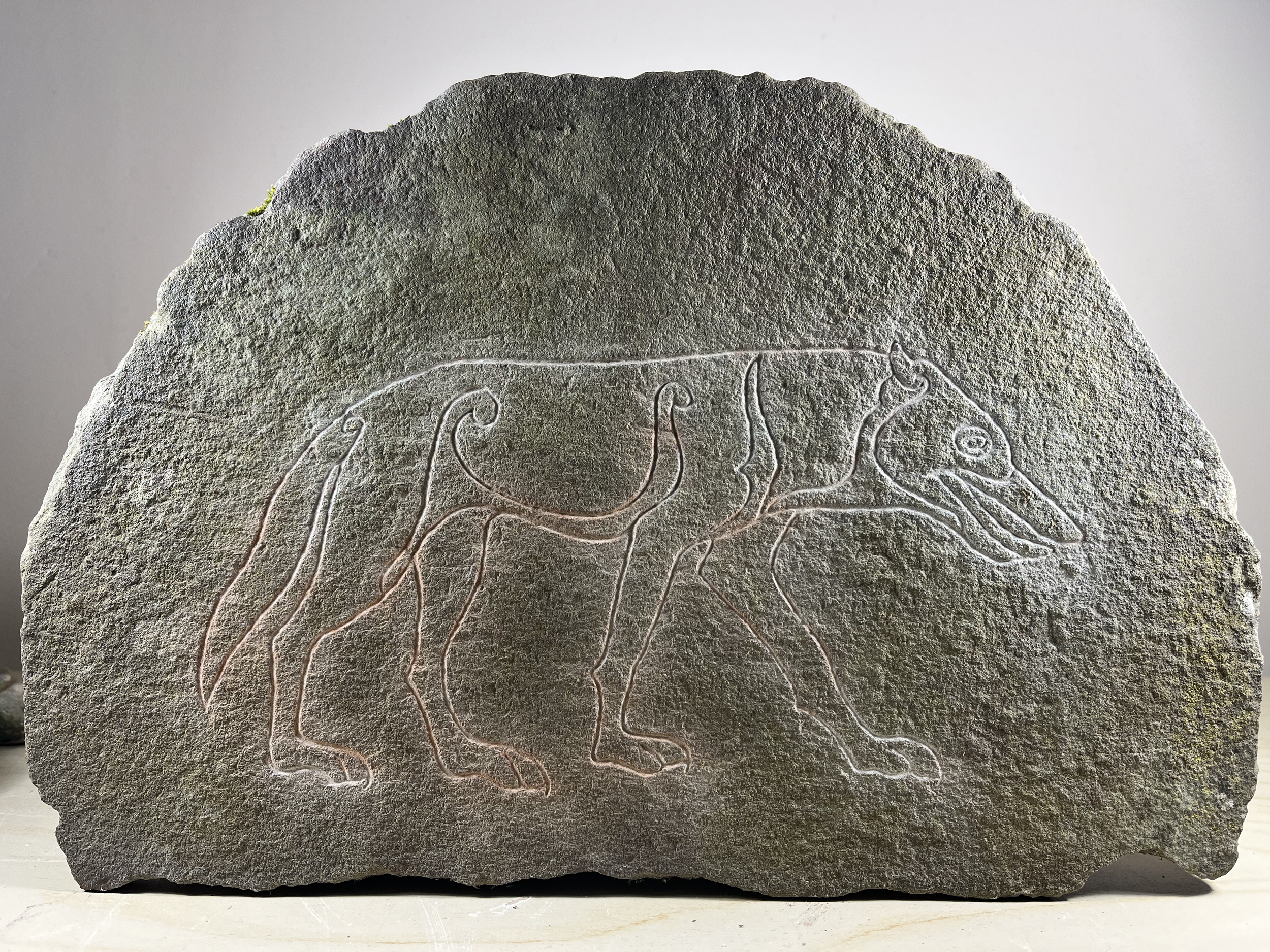
Caption required: ? David McGovern, Ardross Wolf, Materials, Dimensions, Date
Early missionaries from the Celtic West first brought the Christian message to Pictland. It was a later king, Nechtan, however, who around the year 710 decided that the Church of Rome, rather than Iona, was the way forward and approached the Abbot of Monkwearmouth and Jarrow, in the Anglo-Saxon kingdom of Northumbria, for advice and for masons to ‘build a church of stone’.
The Roman Church brought the Picts into contact with mainstream European culture. They also adopted – and embraced with boundless enthusiasm - the art style common throughout Britain and Ireland and known as Insular Art. This was a glorious amalgam of ribbon, key and fretwork patterns (often ingeniously merging into one another), the trumpets and spirals familiar from symbol stones, and riots of biting beasts and intertwined animals. It’s seen at its height in the Book of Kells and the Lindisfarne Gospels. The Word of God, in the form of books, would have been introduced to the Picts - at least those in holy orders - with their new Christian status. The question of whether they themselves were capable of producing such splendid artworks was answered with a resounding “Yes!” by the discovery at Portmahomack, a monastic site in Easter Ross, of indisputable evidence of parchment production and fragments of Latin inscriptions in highly sophisticated ‘display’ lettering.
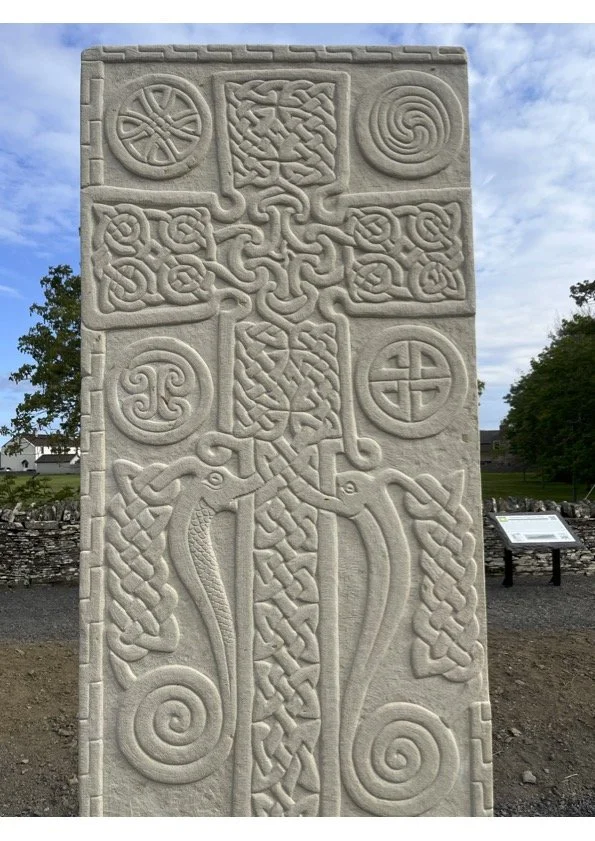
Pictish stones, meantime, had set off in a completely new direction. Dressed slabs replaced natural boulders, with a formal cross on one side and the traditional symbols on the reverse. Even today, many cross slabs form conspicuous features in the landscape
Caption required
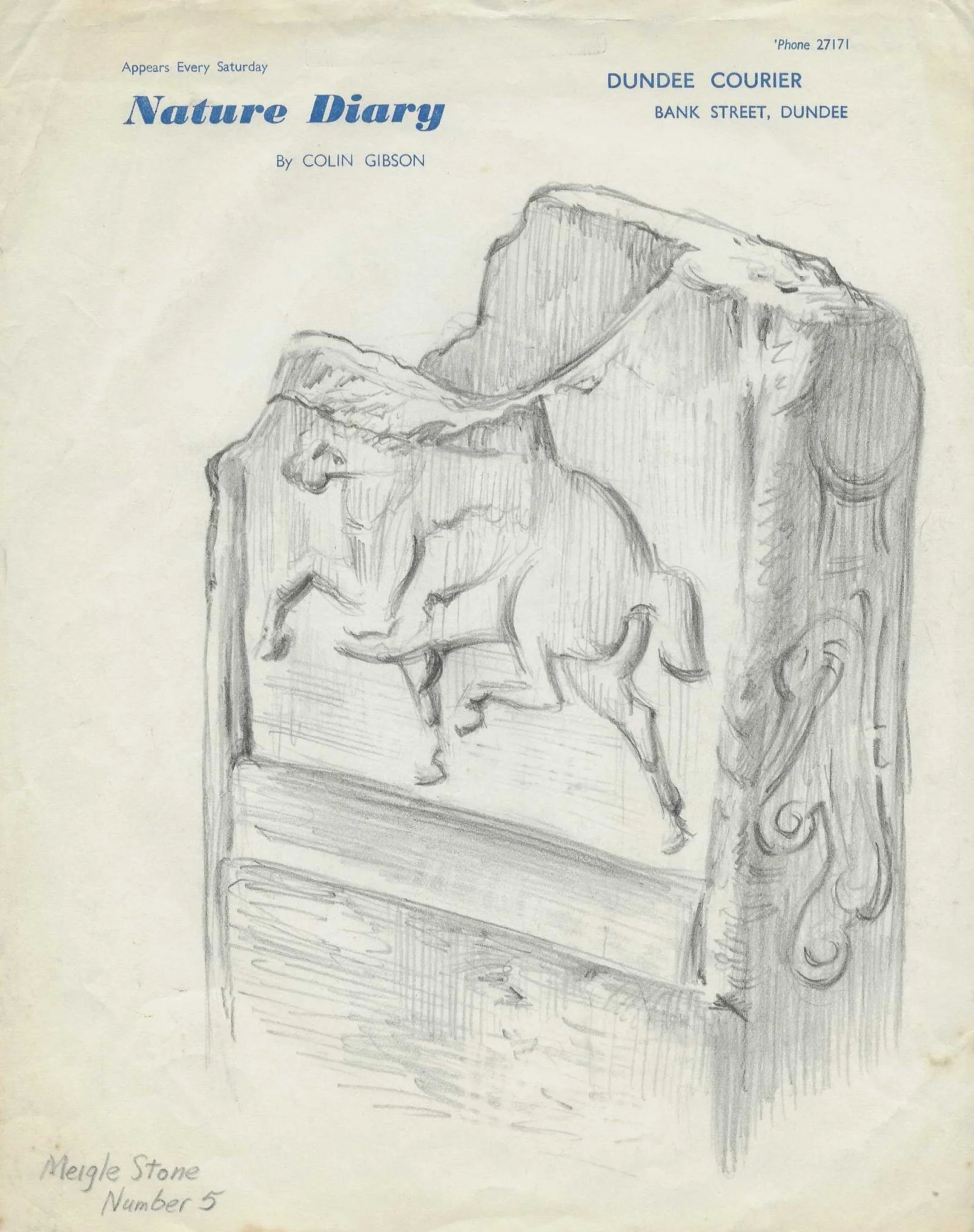
The rectangular shape, as opposed to the free-standing and wheel-headed crosses found at Iona and elsewhere, provided Pictish sculptors with a broader canvas on which their imaginations could soar. While the cross stands aloof, geometrically decorated with interlace and key, and the symbols, carved in relief now, still proclaim their message, the space around them is likely to be filled with life. Animals (real and fanciful) and hunting scenes (symbolic of the aristocratic lifestyle) keep company with striding warriors, dog-headed swordsmen and crouching archers – surely characters from long-lost legends. Grotesque beasts from folklore - or Hell - fight others of their kind - or humans; the sculptors of the Meigle school, in particular, seem to have revelled in this stuff of nightmares. Clerics and warlords, imps and angels and even Classical imagery from the Mediterranean mingle with figures from the Old Testament, and, as with Late Medieval church art, there are often layers of meaning for those in the know. For a 21st c Pictish sculptor, there is a mighty ‘back catalogue’ to draw on for inspiration!
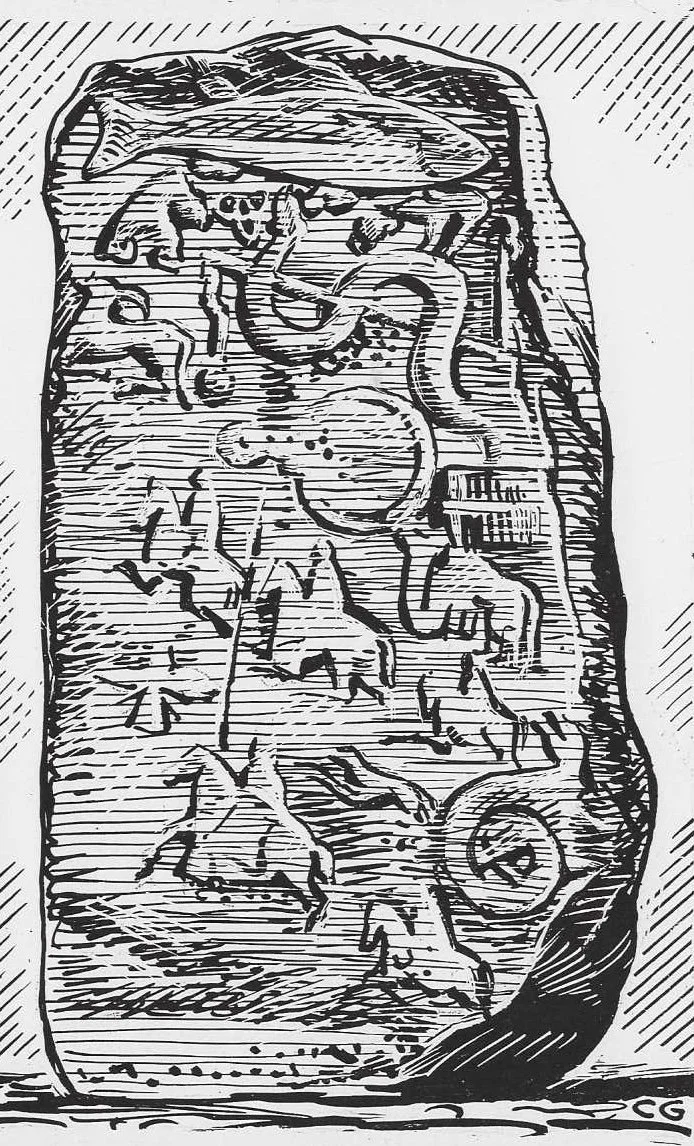
Caption required: Coin Gibson, Meigle 2, Materials, Dimensions, Date.
But I want to know more about how to carve like a Pict.
“Firstly,” says David, “I’m convinced that Early Medieval blacksmiths knew how to make steel. Only steel could give the required cutting edges and points. The incisions are so finely carved – like this.” And he turns to his partly completed wolf and gives me a demonstration. “This is a modern scriving tool, used for precision drawing on hard surfaces. The Picts must have had something like this: its sharp point is perfect for small-scale work, like the beautiful line that connects the jaw with the delicate curl of the ear.” He grasps the tool firmly near its point, rests the heel of his hand on the stone, takes up his mallet and in the blink of an eye a series of tiny pecks starts to appear, marking out the creature’s flank.
For bolder outlines, or when cutting a background, David uses a straight-edged chisel. This he demonstrates on the Burghead bull, a much more robust carving altogether. He places the chisel on a ready-drawn line, picks up the mallet, and sets off at what seems to me an astonishing rate. Slivers of stone pare off like cheese.
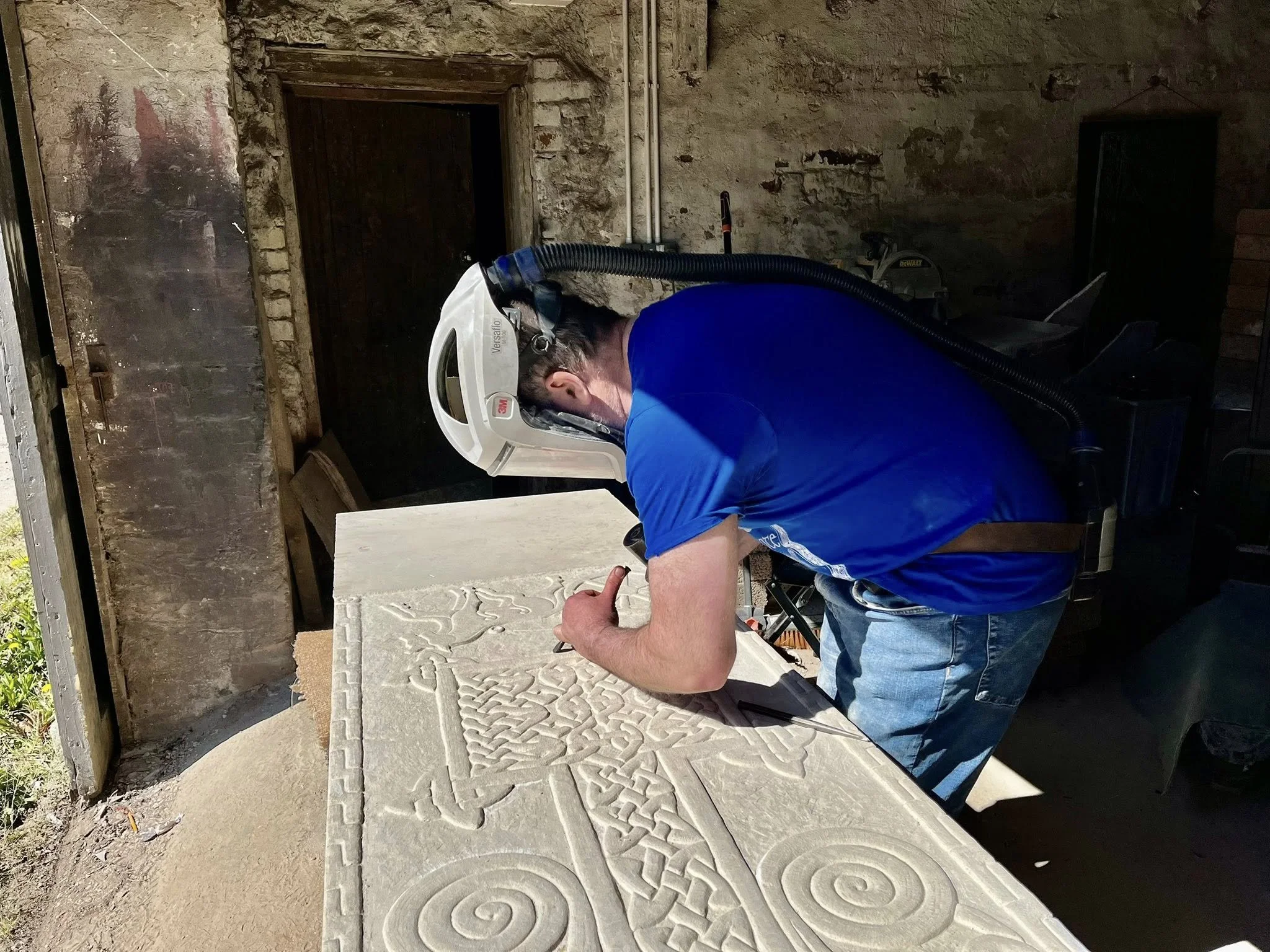
David McGovern carving stone
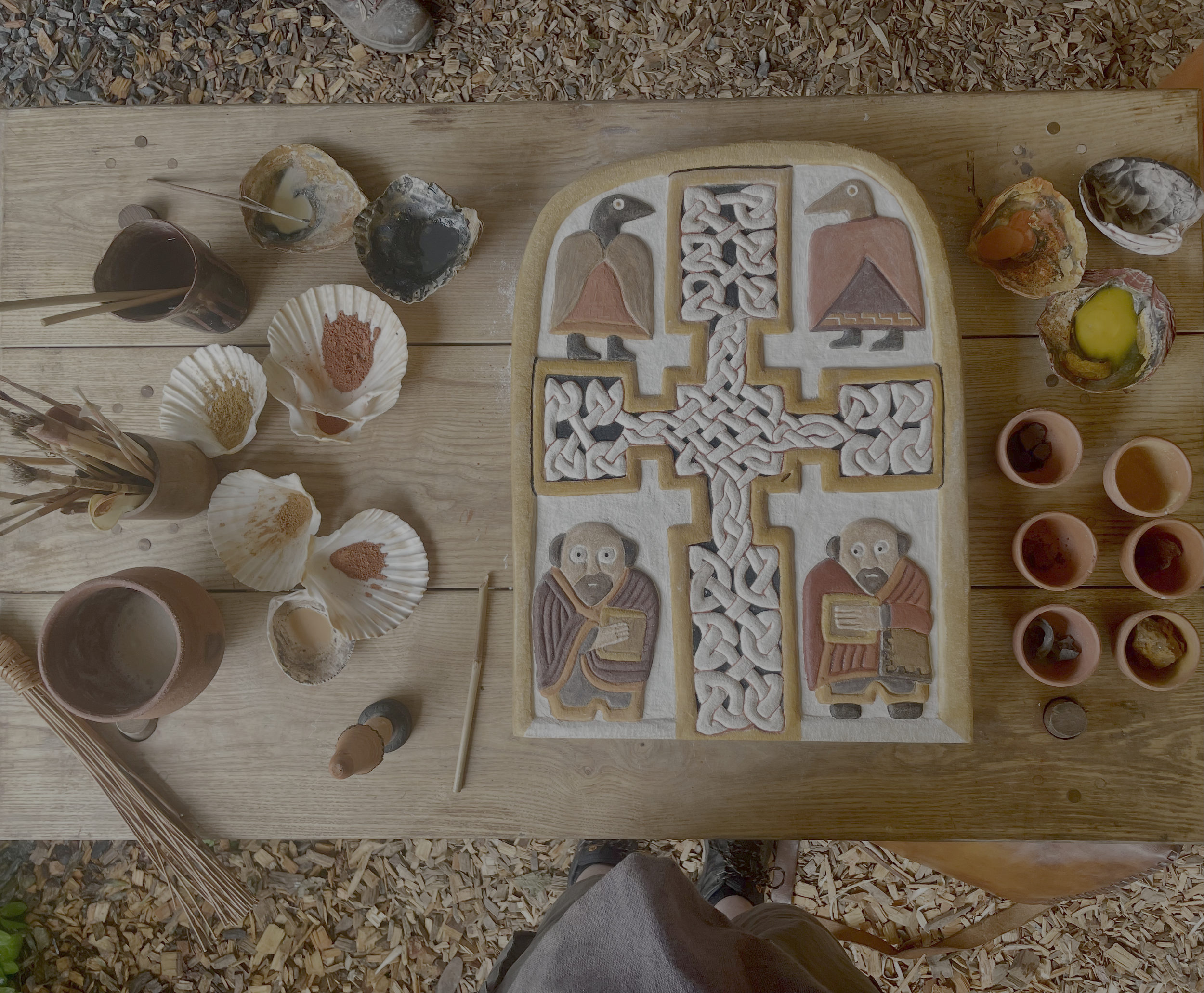
“I don’t believe in the usual claim that those masons from Northumbria introduced the concept of relief carving to Pictland. It’s a natural progression. With a deep, wide incision like this, all I have to do is smooth off the inner edge and pare down the outer, and it gives the impression that the animal is standing proud of the surface. The stone in the garden of Glamis Manse (thought to be a particularly early cross slab) is a good example of this ‘half-way house’.” The similarity to the cross and ‘carpet’ pages of Northumbrian illuminated manuscripts, however, prompts another question: were the stones originally painted? David determined to test this out. He began by carving a ‘real’ (replica) stone as a template. Then, working with experts in ancient pigments, they applied a soft and subtle palette of burnt wood and ground minerals, with egg for binding. “It looked terrific! Unfortunately the chalk undercoat proved unstable and the ‘paint’ flaked off. But it was just an experiment: we’ll try again!”
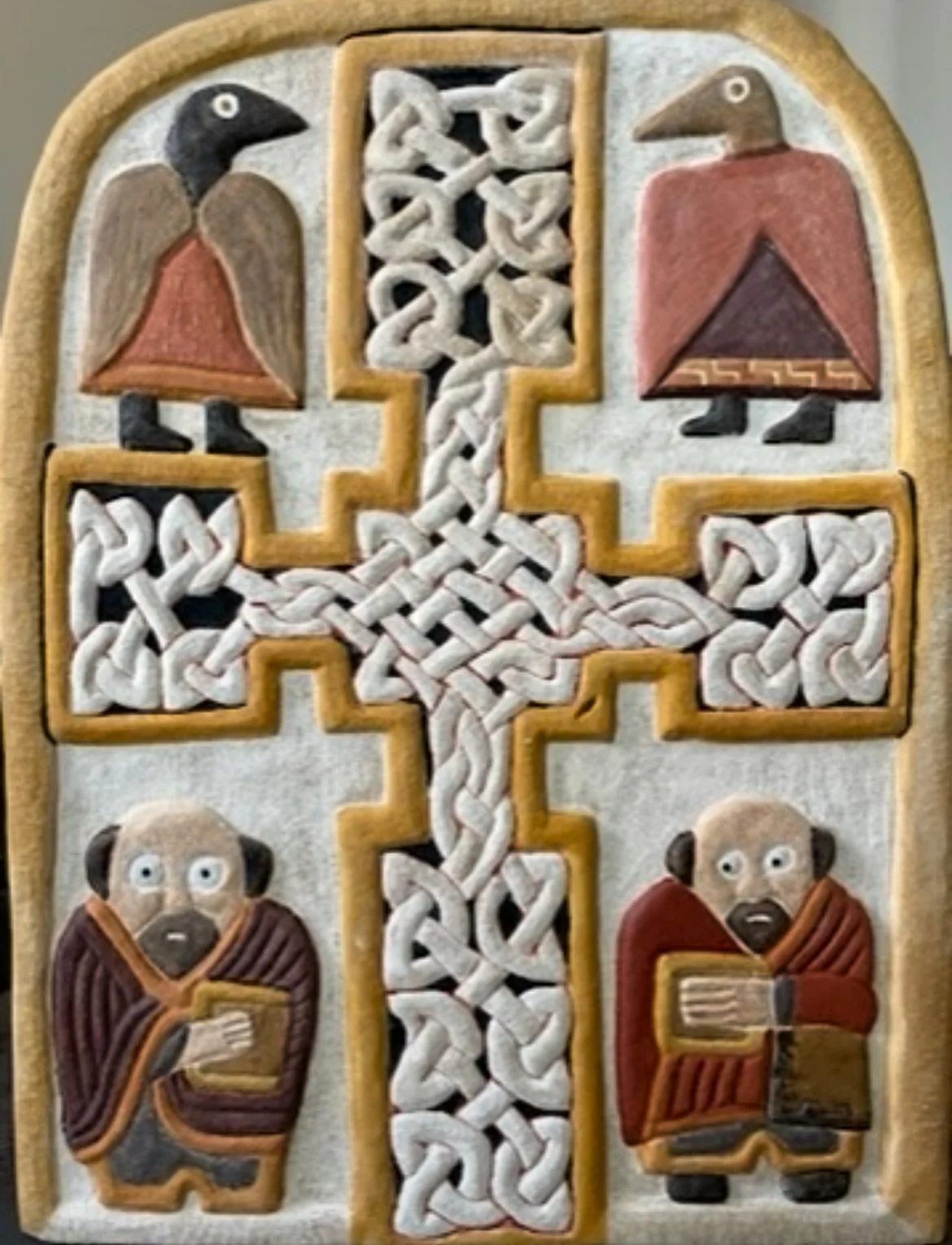
Caption required: ? David McGovern, Kirrie Painted. Materials. Dimensions. Date
He draws my attention to the very rough slab leaning in a corner. “This is a treasure! It’s an unfinished slab, abandoned by its Pictish carver. It comes from the Burghead fort, where they’ve been excavating the inner face of the rampart. The diagonal scorings are his first go at levelling the surface, but here” – pointing – “there’s a great gouge, presumably an accident, which has cloured off part of the corner.” I can almost hear the swearing (in Pictish).
I’m intrigued to know how the Picts physically man-handled these weighty, yet vulnerable, blocks of stone. David (whose answer to this problem is to use a lot of padding and call up a couple of fork lifts) has an interesting theory about this. He points me to the slender shaft of mica-schist that I’d noticed earlier. “This came from an abandoned quarry in Argyll that provided stone for these beautiful West Highland grave-slabs. It lies near the sea, so transport up and down the coast or to the islands was easy. The problem was how to get the blocks down to the shore.
“When I visited the quarry I noticed some slabs that had been partly prised from the rock face and then left, still in their upright position. It struck me that it would be much easier to move them by keeping them upright and ‘walking’ them, perhaps within a wooden frame. One or two Pictish slabs have tenons sticking out from the sides. I wonder if the function of these has been to take the weight of the stone as it leans against an A-frame. When one face of the carving was completed it would be relatively straightforward to tilt it the other way – much easier than carving the first side on the flat and having to turn the entire stone over.” It’s an interesting point. Some of these stones are extremely large: Sueno’s Stone, near Forres, the daddy of them all, stands at over 6m.
The mica-schist in David’s workshop, incidentally, now bearing a beautiful foliate motif, originates from that same quarry. Not having a birlinn (or an A-frame) to hand, it was the largest he could manage to carry out overland.
From what I’ve seen, much of David’s work seems utterly spontaneous: a joyous coming together of hand, eye and expertise in his subject. But of course, since giving up a career in IT (many years ago now) he has a living to make, and an order book to fill. Fortunately, this does not seem too difficult. If you want a Pictish stone, David McGovern is your man.
His commissions take two forms: recreations of existing monuments which – usually for their own protection - have been moved from their original sites, and entirely new monuments, often for commemorative purposes. Though the techniques are the same, they present very different challenges.
The first stone David carved was one of his old friends from Monifieth, for the McManus Galleries in Dundee. It’s a good example of a relatively small-scale cross-slab: on one side a simple cross infilled with peltas and interlace, on the other, the crescent and deer’s head symbols, human and animal figures, and two elongated birds which frame the edges and who meet face to face at the top. It’s quite a thought that the original of this may have been seen by those pilgrims we’ve just been talking about, passing on their way to St. Andrews. Monifieth 2.jpg if not already used The Skinnet Stone comes from the opposite end of Pictland, from Halkirk in Caithness, but may well have witnessed the same scenario. It’s now under cover in the North Coast Visitor Centre in Thurso but at one time it stood at St. Thomas’s Chapel on another pilgrims’ route, this time from Tain to Orkney. This trail has been resurrected as the Northern Pilgrims Way, and David was asked to carve a new version on site for modern pilgrims to visit.
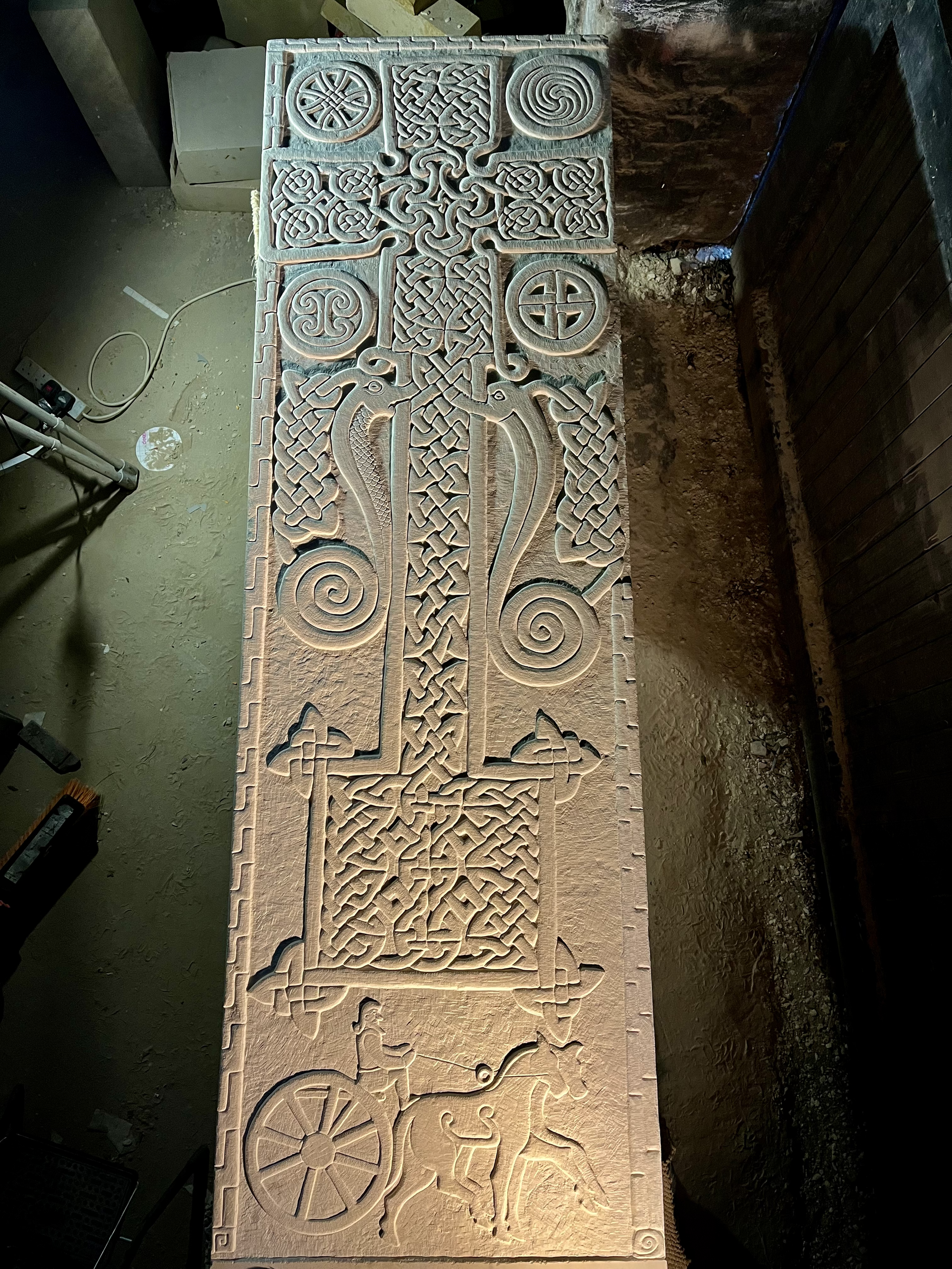
Caption required: ? David McGovern, Skinnet Stone, Materials, Dimensions, Date
Recreating a heavily weathered and damaged cross-slab like this requires a bit of preliminary spadework. There are a number of different avenues to follow. Carved stones have attracted the attentions of antiquaries since at least the 18th c and their sketches and drawings may preserve features no longer identifiable, though allowance has to be made for artistic licence. The value of early photographs can vary, depending as they do on the angle and quality of the light. Specialised artists and draftsmen, from Romilly Allen a century ago (who, with Joseph Anderson, Keeper of the National Museum of Antiquities of Scotland, produced the monumental Early Christian Monuments of Scotland), to John Borland and the late Ian Scott from the Royal Commission on the Ancient and Historical Monuments of Scotland, can bring out features and patterns not obvious to the less practised observer. Finally there’s modern technology. Today, computer programmes can identify interlace patterns from the merest dimples on an eroded surface, and photogrammetry (which builds up overlapping photographs to create a 3D effect) can reveal far more than the naked eye. Using the latter on a particularly worn part of the Skinnet stone, David suddenly found he was looking at a pair of hippocamps (sea-horses) intertwined in a dance – something no one else had seen.
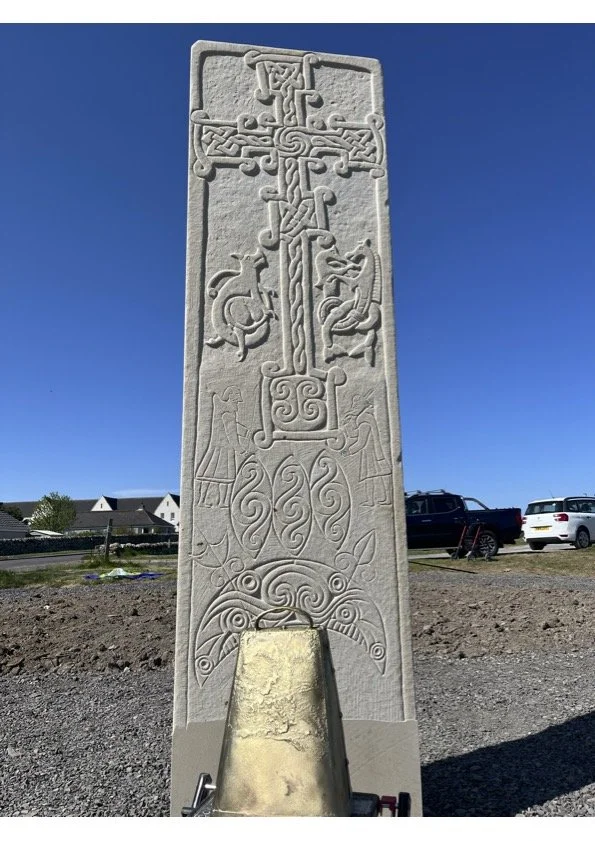
Caption required: ? David McGovern, Halkirk stone. Materials. Dimensions. Date
Re-creating the Conan Stone, found in a graveyard near Dingwall, for Highland Council posed a different problem, for its lower part was missing altogether. What would a Pict have done? David’s intuitive response, a deer hunt and a pair of mythical beasts, looks perfect in a scene already bursting with life in the form of a Classical centaur, a dog-headed man, other hybrids unknown to science, two (perfectly normal) cows and the serpent and double disc symbols. The cross and its background, by contrast, is intricate, disciplined and very beautiful; the only living creatures on this face are a pair of guard dogs whose tongues, emerging from between their jaws, cleverly morph into panels of interlace.
Some of these stones, which meant so much to the Picts, haven’t always been appreciated by their successors. They’ve been reused for buildings and dykes, repurposed as footbridges and commandeered as ready-made gravestones (one pretentious landowner stripped off an entire face of the magnificent Hilton of Cadboll stone - originally from Easter Ross, but now in the Royal Museum of Scotland - to make space for his own memorial; interestingly he chose to preserve the side with the symbols and splendid hunting scene rather than the cross). So it’s heartening to hear the story of the Fiskavaig Stone. This originally stood on the edge of a small township on Skye (Pictish territory once extended to the Hebrides). In the early 19th c the Clearances reached Fiskavaig, and the people, with their ancient way of life and their memories, were moved off the land. Eventually the old township was re-populated with crofters from Lewis. Not long afterwards, in the aftermath of a storm, the stone was revealed lying on the beach. It’s now protected in Edinburgh, but, thanks to David’s replica, the current residents, who include the descendants of the Lewis settlers, are proud to have this symbol of resilience and solidarity back in their midst.
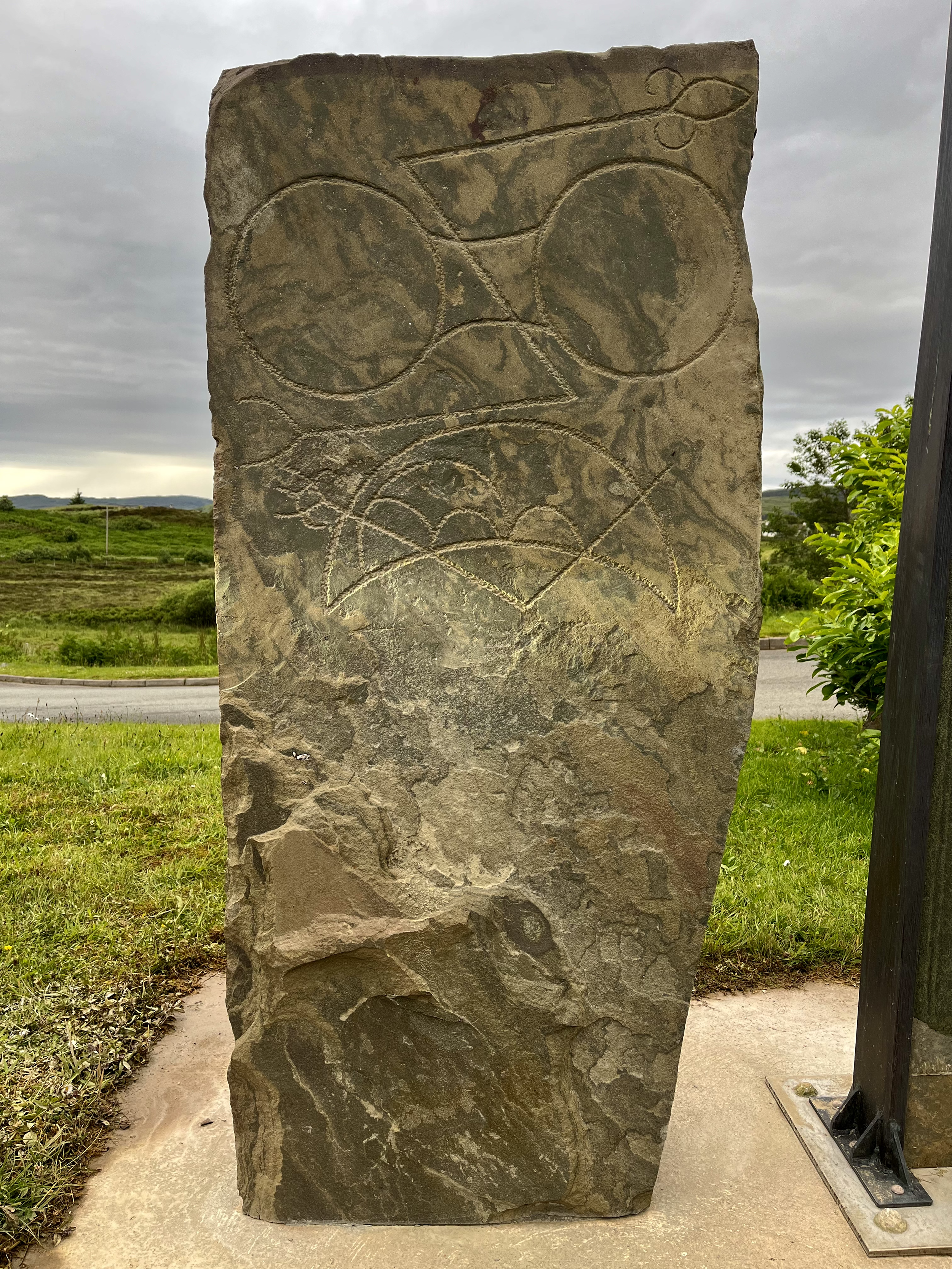
Caption Required: ?David McGovern, Fiskavaig Stone, Materials. Dimensions. Date.
Next to nothing is recordedrof the working practices of Pictish sculptors. Presumably they were trained in schools or workshops, perhaps under lay patrons or attached to monasteries like Portmahomack, and served time as apprentices – a practice that David has kept up with his own apprentice schemes and workshops. There was clearly opportunity for travel and a free exchange of ideas as specific motifs can occur at opposite ends of the country. They also had access to ecclesiastical treasures and objets d’art from the Roman world, as echoes of these, fully integrated with the native canon, appear on the stones and inform the carving. Add to this their sheer verve and enthusiasm and it’s not surprising that David McGovern, so immersed in all things Pictish, tackles his new creations in the same way.
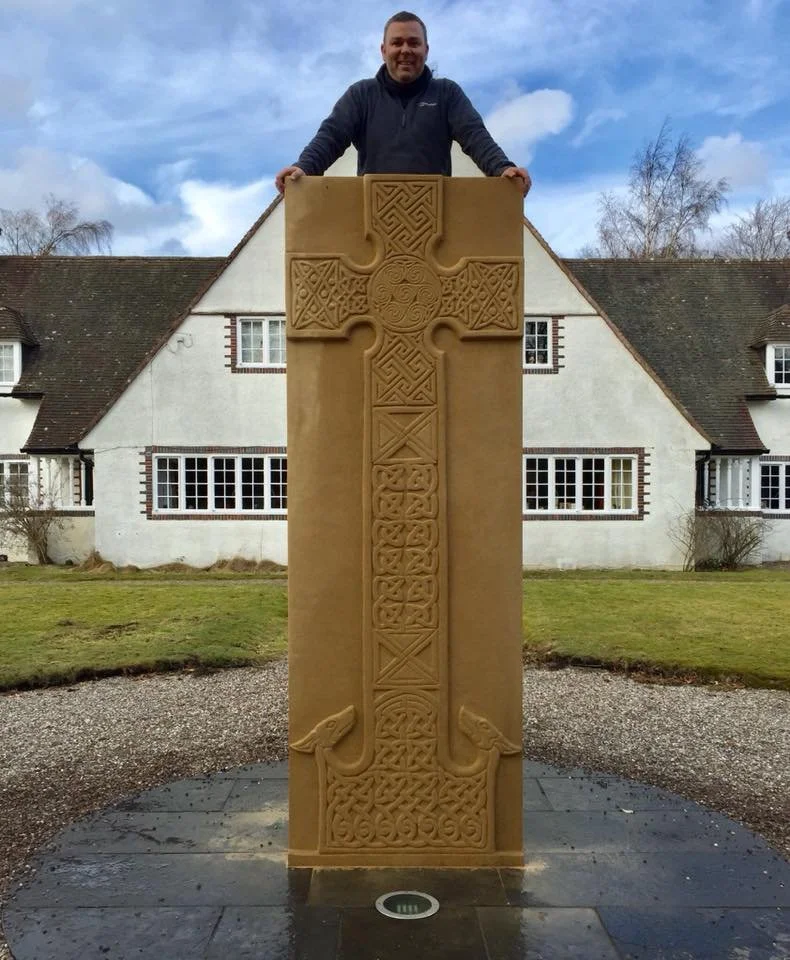
David McGovern and his carved cross, Forteviot, Perthshire
One of his most challenging commissions was for a brand-new, ten-foot-high cross slab for Forteviot, in Strathearn. This attractive arts and craft-style village was once the centre of a Pictish kingdom, which has gradually been revealed through years of excavation by the SERF Project (Strathearn Environs and Royal Forteviot). It is known for its association with Cinaed mac Ailpin (the Kenneth MacAlpin of history books), but prior to this another mighty king, Constantine son of Fergus, set up a monument to his own prowess in the form of a splendid free-standing cross. Originally sited on a ridge overlooking the strath (it’s now in Dunning Church), it bears the only known ‘portrait’ of a Pictish monarch. Constantine is huge and majestic. He sits proudly on his mount, his great head (in Pictish art the size of head reflects the importance of the individual) enhanced by a magnificent moustache. He has eschewed the traditional image of the hunt, barring a token hound or two, for a display of military might in the form of a troop of foot soldiers. David’s remit was to complement this with an equally powerful tribute to Kenneth.
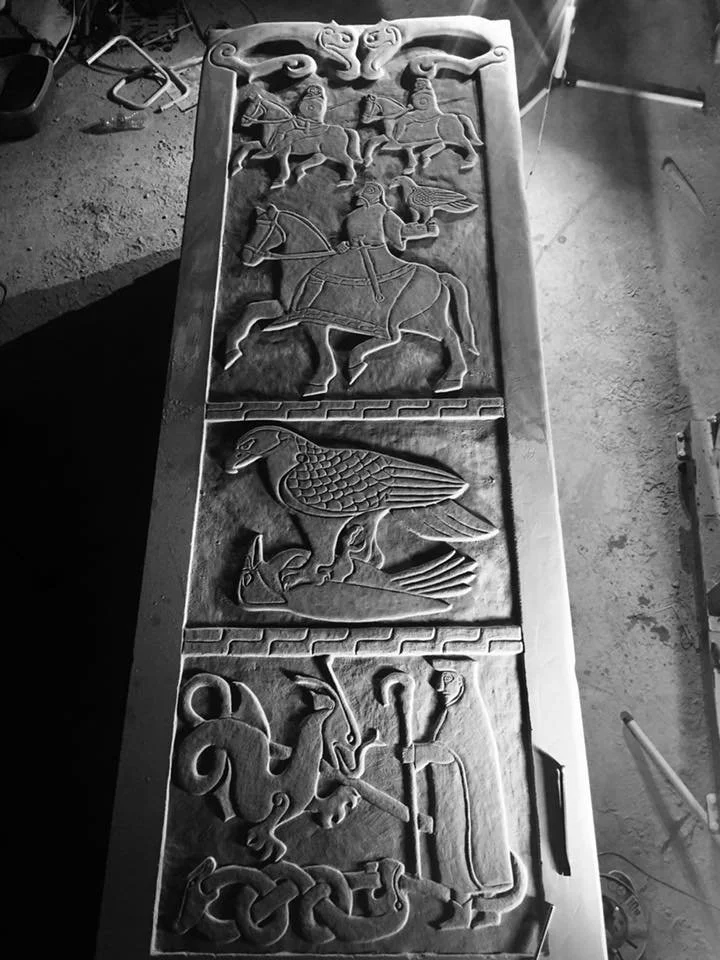
Caption required: ? Forteviot Cross on banker. Materials. Dimensions. Date
The result is inspired by stones from Monifieth and St Vigeans but everything on the new stone is symbolic and relevant to Strathearn. One face bears a beautiful interlaced cross (Kenneth was devout; and gave relics of St. Columba to the newly-founded church at Dunkeld). On the reverse, he takes centre stage as both warlord and huntsman. He rides not with a hawk but an eagle on his arm; his retainers are former rivals who have given him their allegiance. Another eagle straddles a downed but struggling raven, symbol of death but also of the Vikings, who are about to launch their own brand of power-politics on this landscape. The scene at the foot is a clever play on a local legend while also acknowledging the inspiration behind the project, for it shows St SERF defeating a dragon.
Similar thoughtfulness imbues all of David’s ‘modern’ sculptures. The tribute to Hunter of Burnside has already been mentioned (this chunky four-sided stone, at the start of central Arbroath’s new cycleway, also bears the serpent and eagle symbols and two engaging Picts who stomp along with staffs, processing round the bounds, while a lion’s tail morphs, Pictish style, into an elongated beast and tussles in turn with an intertwined serpent). The old village of St Vigeans, near Arbroath is home to a remarkable assemblage of Pictish sculpture which grew around the shrine of St Fechin. It’s also the setting for a touching memorial by David to a much-loved local resident. Its inscription, ‘Protect this place always’, is in Roman ‘half-uncial’ lettering, a type of book-hand familiar from gospels like Lindisfarne but which in this context refers directly to the Drosten Stone in the nearby museum, which bears one of the few inscriptions from Pictland. A nice touch.
Earlier in this article I listed ‘commemoration’ as one of the possible functions of the Pictish stones. One side of the cross-slab in Aberlemno kirkyard, near Forfar, is almost fully taken up with a battle scene. In four registers, almost comic strip fashion, we seen the progress and outcome of a battle which ends with one of the leaders lying dead on the field, prey to ravens. The fact that the soldiers of the losing side appear to be wearing Anglo-Saxon helmets has led to the suggestion that this stone commemorates the Battle of Nechtansmere in 685AD, at which the Picts repulsed the invading forces of King Ecgfrith of Northumbria and sent them, kingless, back over the Forth. The year 2020 was the 700th anniversary of another event remembered by every patriotic Scot: the signing of the Declaration of Arbroath by the barons of Scotland in support of their king, Robert the Bruce. It was also the year that David McGovern became a recipient of the Angus Artists Fund.
Arbroath is already well served with reminders of the Declaration (including David Annand’s statue of the jubilant King Robert). Our David chose instead to focus on St Fechin and to link St Vigeans with that other ancient shrine, that of St Bride at Panbride.
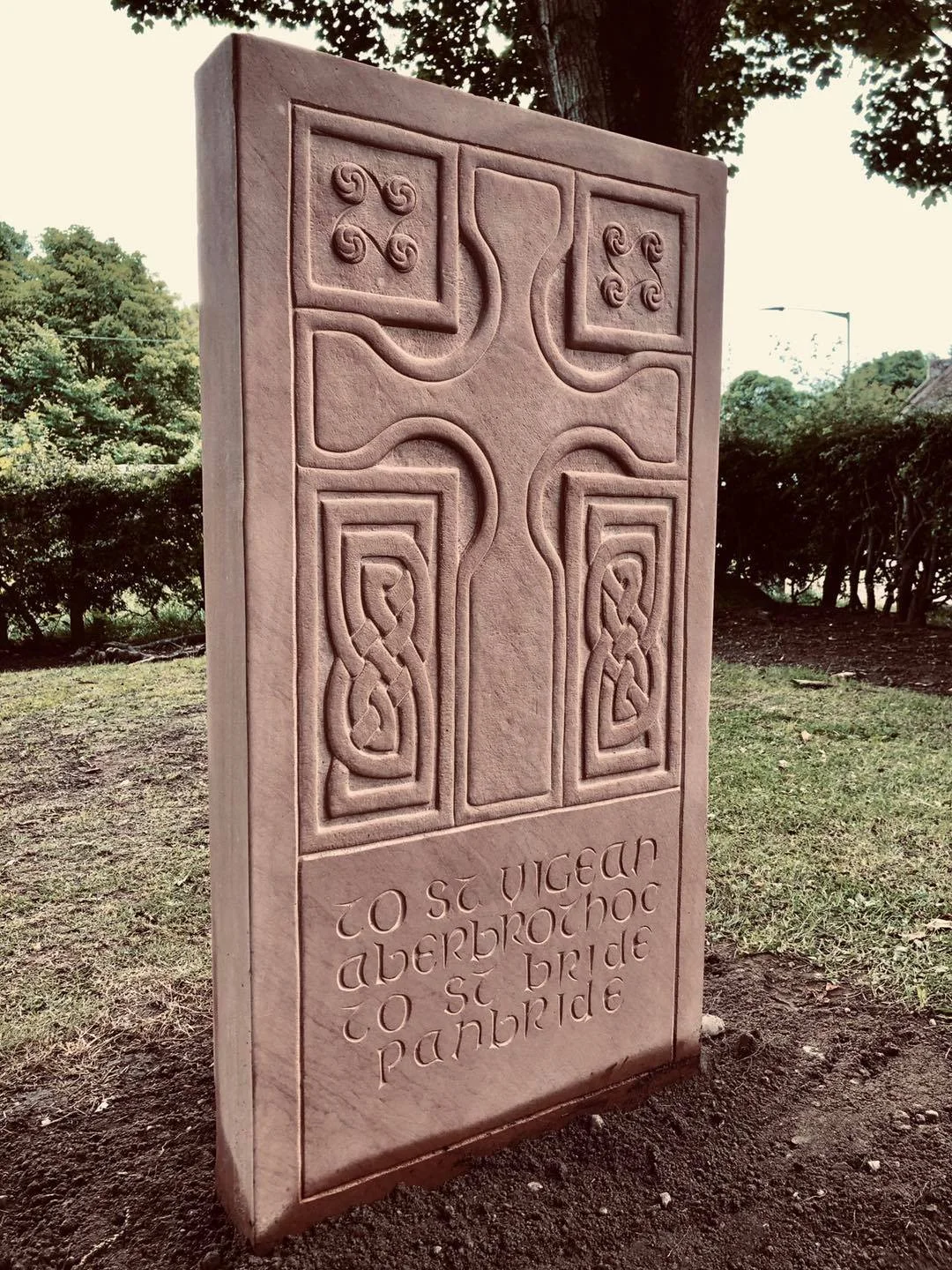
Caption required: ? David McGovern, St Vigeans stone. Materials. Dimensions. Date
This he did in a beautiful and eloquent manner, drawing on motifs from the ‘Drosten’ collection but, as at Forteviot, imbuing these with his own vision and stories. St Fechin on his horse, coming to spread the Word, rides among the unmistakable symbols of his Pictish flock but, in an inspiring blend of ancient and contemporary, the otter and cock salmon at the foot of the stone also belong in the real countryside of this lovely part of Scotland.
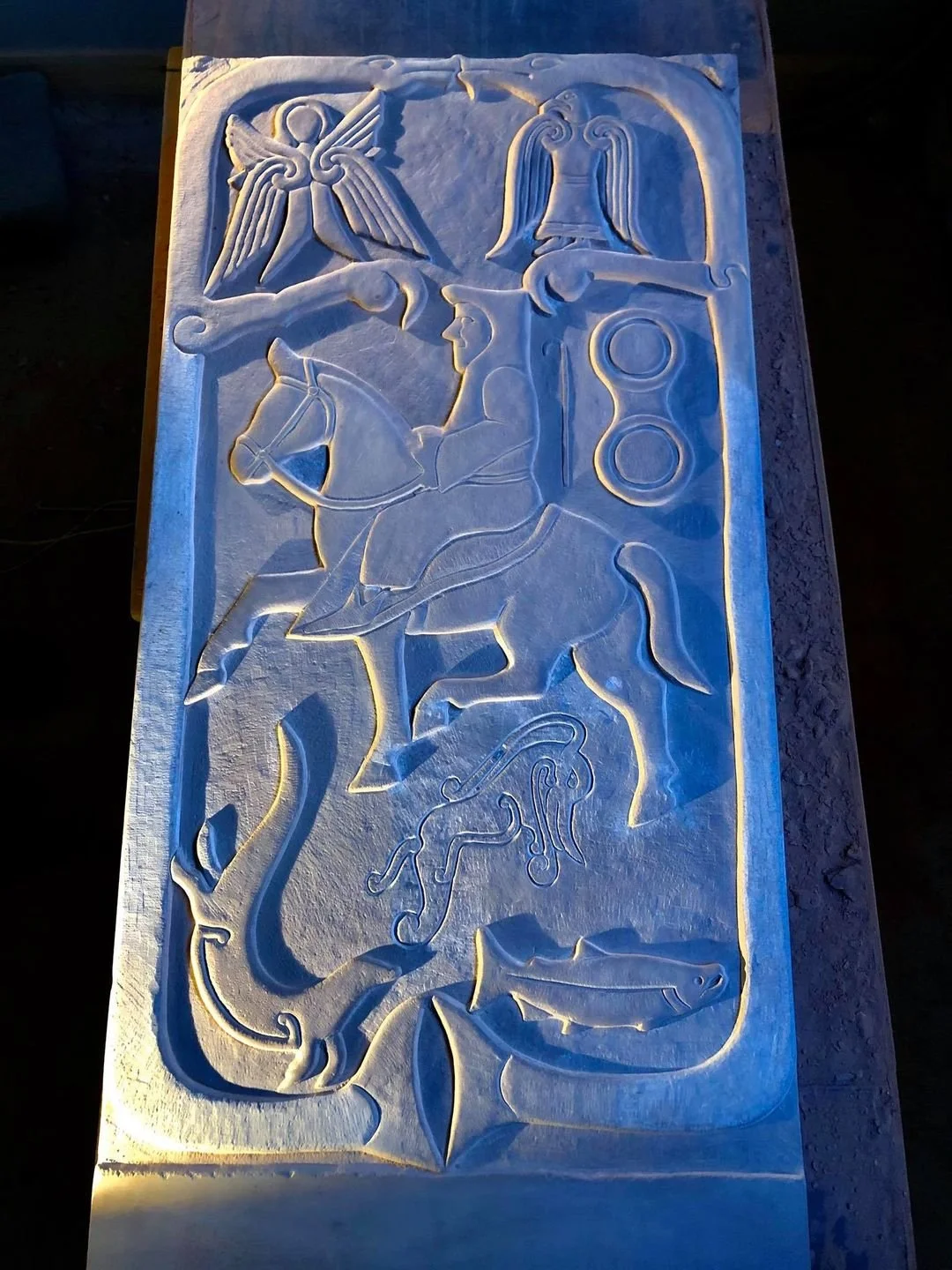
Caption required: David McGovern, St Vigeans Stone, Materials. Dimensions. Date
It’s been remarked that David McGovern is helping to recreate Scotland’s Early Medieval landscape (and if his new, pristine monuments come as something of a shock to those of us used to seeing stones that are old, lichened and weathered, we have to remember that they also were new once). But with his unquenchable inspiration and seemingly unstoppable output David seems bent on enhancing our modern land- and townscapes too. In years to come, our descendants may equally cherish the remarkable output of this 21st c master craftsman.
Gillian Zealand
Appendices:
Brief Biography [DG to supply]
Where to see Pictish stones
The museums at Meigle and St Vigeans (HES) are dedicated to Pictish stones and both house magnificent collections. Fine examples in a museum context are also to be found at Dingwall, Dundee, Edinburgh (also superb examples of Pictish metalwork), Forfar, Perth, St Andrews, Portmahomack and Thurso, as well as many other places from Lerwick to Strathearn.
For an appreciation of the Pictish landscape visit the original stones at Aberlemno, Burghead, Glamis and Easter Ross (there are many other examples) – or seek out David McGovern’s ever-growing re-creations.
[The above is an attempt to make a more condensed version of the following list. I’m assuming it wouldn’t be hard to search out these places on line]
Aberlemno
Arbroath [DM]
Burghead, Moray, Headland Trust Visitor Centre [+DM]
Conon Bridge [DM]
Dingwall Museum
Dundee, McManus Galleries
Dunning, Perthshire
Edinburgh, Museum of Scotland (also superb examples of Pictish metalwork)
Forfar, The Meffan
Forteviot, Perthshire [DM]
Glamis, Angus
Meigle Museum, Perthshire
Perth Museum
St Andrews Cathedral Museum
St Vigeans Sculptured Stones Museum, nr Arbroath [DM]
Tarbat Discovery Centre, Portmahomack and the Tarbat peninsula, Easter Ross
Thurso, North Coast Visitor Centre [+DM]
[These are all places mentioned in the text; it’s not a definitive list. [DM] means there’s one of David’s stones]
Further reading:
Historic Scotland’s The Picts (Discover Scotland’s History Series, 2025) is an excellent introduction and includes lists of sites and Guides to the important collections at St Vigeans and Meigle Museums
Geddes, J Hunting Picts (Historic Scotland 2017, 2 vols.) is a deep and fascinating study of the St Vigeans stones and their influences and interpretation
Henderson, G and Henderson, I The Art of the Picts (London 2004) is a masterly overview of all aspects of Pictish art (including metalwork) in its Insular and European context.
The Pictish Arts Society thepictishartssociety.org.uk
Promotes awareness of the Picts and their art while helping to fund the rescue, conservation and display of Pictish sculpture. Members enjoy lectures and an annual conference, field trips and a regular newsletter.
[I’ve asked David to approve / amend this but there’s been no response so far. Speaking as a member, it seems fine to me]
Monikie Rock Art See: www.monikierockart.co.uk
[Again I’ve asked David to supply, but no response. This seems to say it all anyway]
Illustrations:
Captions may include details not mentioned in the text, e.g.
Painted stone: The original stone is known as Kirriemuir 1 and is one of a number of finds from this Angus town now in the Meffan, Forfar
Skinnet Stone: a sufficiently-sized slab of the original creamy-grey sandstone proved hard to get locally and the nearest source was the North of England
Forteviot: David’s first big original commission. While the local Denfind Quarry can provide stone for most purposes, huge blocks like this one (3 x 1m) have to be sought from elsewhere, including the north of England.
Further illustrations: see ‘CG and GZ drawings’ folder for choice if required. These are all of original Pictish stones. / Possible captions [these are roughly in the order in which they could be slotted into the text if required]:
20260925(3) Double disc symbol, Meigle
20260916 (3) ‘Aberlemno Roadside’, a classic early symbol stone of the type known as Class I: a natural boulder carved with the serpent, double disc and Z-rod and mirror and comb symbols. [CG]
20260916 (2) L.: the Dunnichen Stone, now in the Meffan, Forfar; R.: Meigle No. 2 (unless the latter is separated and used below as an example of ‘exuberance’)[CG]
20260916 Glamis Manse: an early cross slab of the type known as Class II, with a cross on one side (not shown) and the serpent, salmon and mirror symbols on the reverse [CG]
202609 (2) R.: Meigle No. 2: a typically Pictish riot of beasts [CG]
20260925 A high-stepping horse from Meigle, accompanied by the Pictish beast and mirror case symbols (the badges of the rider?) [CG]
20260925 (2) Pictish cavalcade, Meigle. Note the skilful 3-D carving of the dogs and horses [CG]
20260925_112234_526 Pictish huntsmen, Meigle. The Picts were far and away the best carvers of realistic animals of their time [GZ]
20260925 (4) A crossbow-man faces his formidable quarry on this stone from St. Vigeans. Clearly a meaningful figure – though his significance is lost to us - as he appears elsewhere in Pictland [GZ]
20260925 (5) A crossbow-man faces his formidable quarry on this stone from St. Vigeans. Clearly a meaningful figure – though his significance is lost to us - as he appears elsewhere in Pictland [GZ]
20260925_111849_328 ‘Vine scroll’ border, St Vigeans, a motif borrowed from Anglo-Saxon art. The juice of the berry symbolises the blood of Christ [GZ] [N.b .this drawing is inexplicably reversed – c.f. lettering – not that it matters]