
Dreamers, Knights, and Souls: Narrative Drama in the Art of Phoebe Anna Traquair
In visionary worlds and symbolic interiors, Phoebe Anna Traquair explores spiritual enlightenment. Medievalism, for her, was not merely antiquarian fantasy. It became a symbolic language through which masculinity could be aestheticised and softened, femininity spiritualised and empowered, and identity itself rendered fluid and progressive.
Traquair’s artistry is filled with people who exist on thresholds. Women pause in moments of musing silence, their faces illuminated with wonder and devotion. Knights charge through ethereal landscapes adorned with billowing clouds, blooming flowers and twittering birds, all in a trance of heraldic colour. Lovers, saints, and allegorical souls drift through embroidered worlds where narrative unfolds less through action, and rather through atmospheric expression.
Recently, the Royal Scottish Academy has loaned two works by Traquair to Fundación Mapfre, Madrid, for an expansive exhibition celebrating the involvement and innovation of women artists throughout the Pre-Raphaelite movement. In recent decades, scholarship on Pre-Raphaelitism has broadly flourished, and new perspectives and analyses have revealed the historically overlooked contributions of women. Parallel to this academic evolution, the Arts and Crafts movement has also received a revival of interest, and particularly the number of creative women who pioneered a great deal of craft.
Within the intersection of these movements, Traquair interwove media, literature, and symbolism with extraordinary sophistication, pulling inspiration from medievalism, literature, and indeed her fellow contemporaries in both Pre-Raphaelitism and the Arts and Crafts. Scholarship has rightly celebrated her achievements within the Arts and Crafts movement and recovered her significance as a pioneering woman artist. Yet her work also reveals a profound fascination with inward transformation and gendered embodiment.

Phoebe Anna Traquair, Study of a Girl’s Head. Oil on canvas on board. 34.2 x 26.5cm. c.1907 Courtesy of Royal Scottish Academy of Art & Architecture.
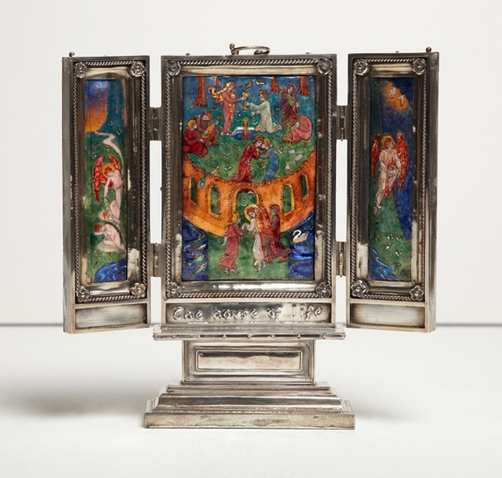
Phoebe Anna Traquair, The House of Life. Enamel in silver mount. 18.9 x 19 x 4cm. c.1903. Courtesy of Royal Scottish Academy of Art & Architecture.
The two works, Study of a Girl’s Head (1909-1911) and The House of Life (c. 1903), initially appear to be of great narrative and stylistic contrast. One offers an unusually intimate image of feminine subjectivity, poised between portrait, allegory, and psychological study. The House of Life, inspired by Dante Gabriel Rossetti’s sonnet sequence, transforms literary symbolism into a densely theatrical meditation upon desire, memory, and spiritual longing. Despite their vastly different scale and function, both reveal a defining preoccupation within the art of Traquair: the staging of identity through symbolic and emotional performance.
Rather than thinking of Traquair's work mainly as decorative craft, I suggest we see it as a sustained exploration of femininity and faith. Across her manuscripts, tapestries, portraits, and symbolic interiors, Traquair presents identity as something dramatically shifting and transformative. Across manuscripts, tapestries, portraits, and symbolic interiors. Her figures rarely function as straightforward narrative illustrations or historical revivals. Rather, they unfold, face conflicts and progress within emotionally charged spaces, where identity is explored through our connection to religion, nature, and each other.
Judith Butler's idea of gender as a "stylised repetition of acts" helps us interpret the expressions of gender that appear throughout Traquair's work (1). Such an approach is especially useful when looking at her medievalism. For many Victorian and turn-of-the-century artists, medieval imagery offered an alternative to modern industrial life. For Traquair, it also provided a kind of symbolic stage where femininity could be made beautiful, divine, and gently unsettled. This article uses ideas about spiritualism, narrative dramaturgy, and symbolism to reconsider the theatrical journey of the soul in Traquair's art.
From an early age, Traquair’s artistic interest was rooted in poetic ideas (2). Born in Dublin, 1852, Traquair’s childhood was coloured with family visits to the Trinity College library’s local collections (3). In particular, Traquair was drawn to the medieval manuscripts, and often visited just to see the Book of Kells (4). The memory of this illumination would fundamentally shape Traquair’s career and artistic interests, inspiring her to pursue art. Traquair began her training at the Department of Science and Art of the Royal Dublin Society during the 1860s, which focused on figure drawing, ornament, and modelling, all of which would influence the development of her symbolic language. After meeting the Scottish palaeontologist Dr Ramsay Heatley Traquair, who sought an illustrator for his research, the two married and relocated to Edinburgh (5). The 1870s were a marked period of domesticity for Traquair. She supported Mr Traquair’s work, illustrating fossils, and engaged in arts and crafts that were generally seen as feminine, such as embroidery, watercolour and fan painting. Traquair began to broaden her knowledge of embroidery, experimenting with colour, pattern and style, and whilst Pre-Raphaelitism dominated her visual codes, she was also attracted to European and Middle Eastern stitches.
Scottish national identity in the nineteenth century was shifting. Whilst the nation was in the midst of a confident partnership with the British Empire, there was an equal amount of pride for Scottishness itself, exaggerated by the level of semi-independence that was achieved through industrial and economic growth (6). Art museum development thus became a method of developing the increasingly patriotic national identity (7).The Royal Scottish Academy, established in 1826, dominated Scotland’s artistic scene, and predominantly exhibited works of portraiture, landscapes, and narrative scenes. Catering to Edinburgh’s bourgeoisie clientele, the Academy altogether prioritised “high” art.
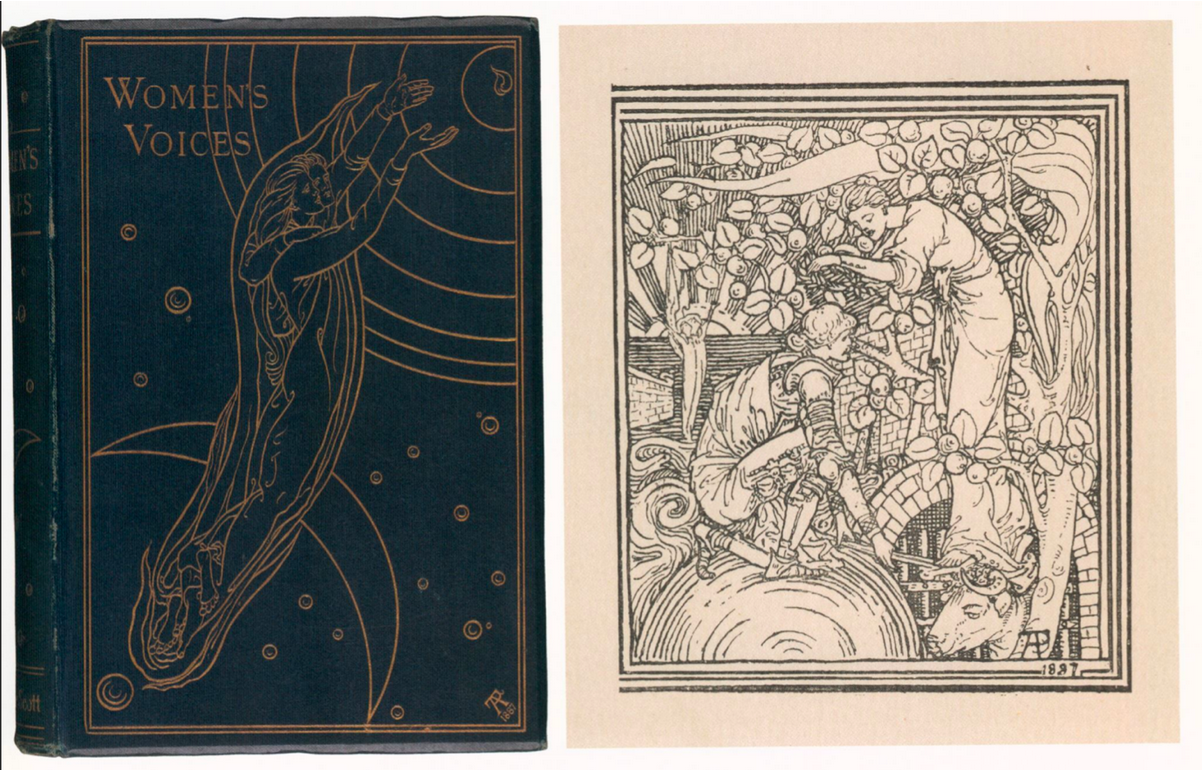
Phoebe Anna Traquair, Cover and Frontispiece of Women’s Voices. Book engraving and illumination. 19 x 12.5cm. 1887. Private collection.
Yet in the 1880s, concurrent to the influence of Impressionistic experimentation on the continent, a growing number of contemporaries around Princes Street began to flourish. This circle included John Miller Gray, the first curator of the Scottish National Portrait Gallery, who became a close friend of Traquair (8). This friendship crucially influenced Traquair’s poetic interests (Dante, Wordsworth, Blake, etc), and introduced her to a great deal of her Pre-Raphaelite inspirations, such as Dante Gabriel Rossetti, William Holman Hunt, and Edward Burne-Jones (9). Traquair, becoming increasingly intertwined with Edinburgh’s literary and intellectual scene, began turning to literature for her artistic inspiration, and began to experiment more extensively with illumination and illustration.
Traquair’s design for the cover of the 1887 anthology Women’s Voices exemplifies her visual exploration of spiritual themes in a symbolic theatrical landscape. The anthology itself sought to give women poets collective recognition, and Traquair’s design reinforces that aim visually. Two feminine (although arguably androgynous) figures ascend through a celestial realm, their heavenly bodies surrounded by orbital rings and cosmic flames. By placing women within a cosmic setting, Traquair elevates female poetic voices from the domestic sphere to something timeless and universal. Their transcendence comes to imply creative freedom and spiritual expansion. The figures are elongated and sinuous, emphasised by flowing contours, spiritualised and dreamlike. A lyrical quality appropriate for a poetry anthology is established through their graceful and ethereal personification.
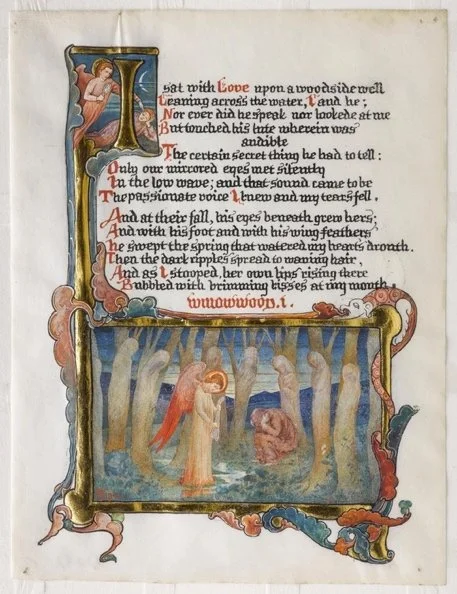
Phoebe Anna Traquair, Willowwood I, page from an illuminated manuscript of the first Willowwood sonnet by Dante Gabriel Rossetti. Ink, watercolour and gold leaf on vellum. Dimensions unknown. 1890. Courtesy of National Museums Scotland.
The decorative design becomes an argument about women’s creativity and spiritual authority, reflecting both the anthology’s feminist literary purpose and Traquair’s wider interest in symbolic literary figures. The interior frontispiece also reflects her visual interest in nature, and its connotations of harmony and spiritual connection. In a world blossoming with swirling leaves and branches, the elongated figures, decorative drapery, and emotional restraint are evocative of Pre-Raphaelitism and medieval aesthetics. The knight is less a hardened warrior than a spiritualised, dutiful figure, conjuring ideals of courtly devotion and spiritual union. Traquair designs a moment of narrative pause, emphasising a dreamlike, theatrical scene of chivalric admiration, poetic expression and spiritual harmony before the reader enters the text.
Throughout the later 1880s, Traquair established herself as a mural painter and illustrator in Edinburgh, and forged important connections amongst its literary and artistic circles. Increasingly, Traquair found herself at odds with the modern ideals of art, striving to produce art that championed spiritual value and emotional experience (10). As her illustrations progressed, Traquair’s interpretations became increasingly imaginative. A rising narrative theme was the moment of awakening or devotion, often representing the soul’s journey. Traquair’s 1890 Willowwood manuscripts similarly mark her development of decorative art into a theatre of spiritual and emotional development.
From Rossetti’s 1881 The House of Life, Willowwood is overflowing with passion and spiritual ideals. In this series of manuscripts, Traquair experiments with Italianate gold embossing, introducing golden leaves that flutter and unfurl across the page. Traquair’s illustration embodies the themes of love and passion that characterise Rossetti’s text, establishing a language of spiritual growth and awakened desire.
Traquair continued to develop this symbolic visual language throughout her illuminations of Sonnets for the Portuguese, by Elizabeth Barrett Browning. Completed across almost five years (1892-1897), Traquair heightens Browning’s explorations of feminine desire and expression through decorative motifs.
Browning’s sonnets crucially reinvented the literary form, swapping female passivity for an active female poet who addresses her male beloved (11). Drawing upon the Petrarchan sonnet structure and rhyme scheme, Browning developed a language of idealised love whilst also disrupting convention through conversational diction and intimate syntax, establishing a realistic feminine voice and openly articulating erotic longing.
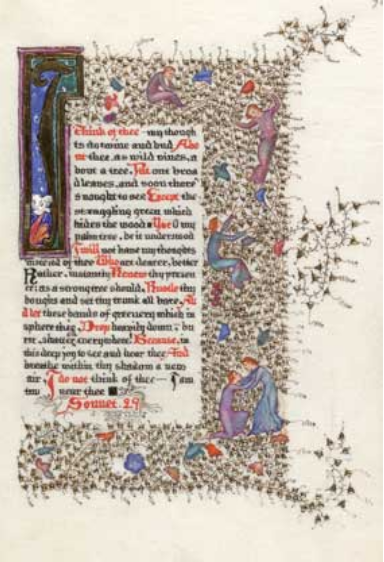
Phoebe Anna Traquair, Sonnet 29 of Sonnets from the Portuguese. Ink, watercolour and gold leaf on vellum. 18.6 x 14.8cm. 1892-1897. Courtesy of National Library of Scotland.
The innovation of the erotic love sonnet sequence tradition is heightened by Traquair’s illustrations. The excesses of nature are likened to the entanglement and eroticism of love that the poet speaks to. Each page varies in composition and scale, revealing Traquair’s engagement with medieval manuscript traditions that she had studied after John Ruskin loaned her several thirteenth-century manuscripts in 1887. Her visual interpretations echo the fluidity of Browning’s poetic form and resist rigid structures through dynamic compositions and rich decorative motifs.
Themes of growth, entanglement, and natural abundance dominate Sonnet XXIX, where Browning compares her thoughts to “wild vines” twisting around a tree. Traquair translates this metaphor into an intricate composition of interwoven golden vines that consume the page. Hidden among the foliage, the lovers search for one another through the dense vegetation, symbolising love’s capacity to overcome obstacles and achieve emotional union.
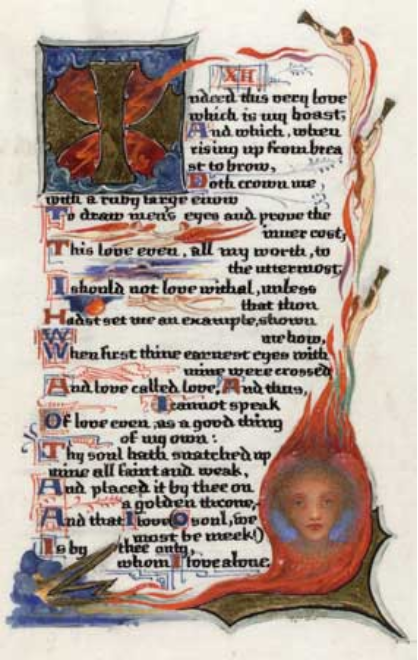
Phoebe Anna Traquair, Sonnet 6 of Sonnets from the Portuguese. Ink, watercolour and gold leaf on vellum. 18.6 x 14.8cm. 1892-1897. Courtesy of National Library of Scotland.
Similarly, Sonnet XII demonstrates Traquair’s use of vivid colour and ornamental excess to visualise love and desire. The lover is framed within a heart-shaped border formed by crimson flames, while delicate angelic musicians emerge from the ascending fire and play trumpets above the figures. As elsewhere in the series, the faces of both the lovers and the miniature musicians remain deliberately androgynous. This recurring androgyny visually conveys ideas of spiritual and emotional equality between the lovers. Rather than reinforcing fixed gender distinctions, Traquair’s imagery instead emphasises mutuality and interconnectedness, presenting love as an experience that transcends rigid binaries.
In Sonnet VI, Traquair visualises the speaker’s overwhelming emotional attachment through the lines, “doom takes to part us, leaves thy heart in mine / with pulses that beat double.” (12). The embracing lovers appear enveloped in vivid crimson flames set against a deep indigo background, their forms flowing into one another until they become almost indistinguishable. Their union represents a spiritual transcendence that can only be achieved through emotional vulnerability and connection.
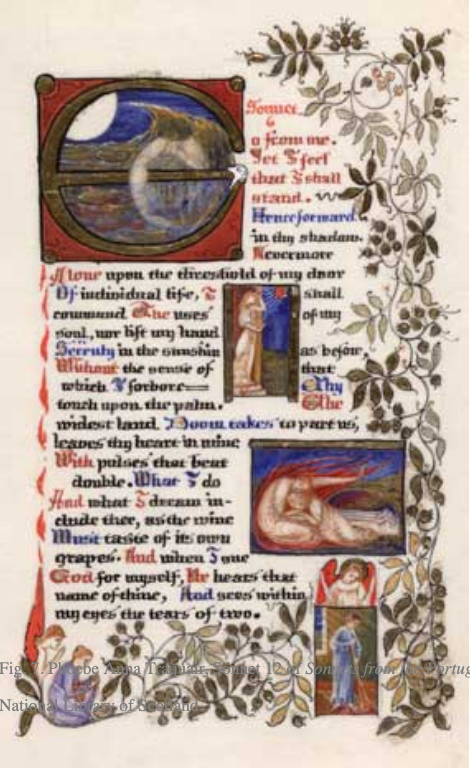
Phoebe Anna Traquair, Sonnet 12 of Sonnets from the Portuguese. Ink, watercolour and gold leaf on vellum. 18.6 x 14.8cm. 1892-1897. Courtesy of National Library of Scotland.
Traquair believed all art to be inherently decorative, but most importantly, always “subordinate to narrative”(13). These dual elements, decorative experimentation and narrative drama, display Traquair’s desire to explore the full potential of art. Moving towards the early 1900s, Traquair’s art also showed an increasing influence of Italianate and Renaissance values and style. Given Traquair’s personal interest in poetic passion, desire for love, and natural beauty, her own ideals aligned closely with the Renaissance period’s appreciation for intellect and imagination.
In 1889, Phoebe Anna Traquair travelled to Florence, where she immersed herself in the artistic traditions of the Italian Renaissance (14). During this time, she closely studied the works of painters and sculptors, particularly the paintings of Sandro Botticelli, whose flowing lines, spiritual symbolism, and delicate treatment of the human figure left a lasting impression on her artistic style. Exposure to Renaissance frescoes, religious imagery, and medieval Italian art deepened Traquair’s fascination with decorative form and emotional expression. Following this visit, her work adopted a richer and more luminous palette, with vivid reds, purples, and golds increasingly used to visualise narrative intensity, human passion, and the transcendence of the soul.
This heightened use of colour and symbolism is especially evident in Traquair’s The Progress of a Soul series (1893-1902). Across the four embroidered panels, rich colour and decorative detail become increasingly intense, reflecting the spiritual transformation of the central figure. This work is likewise among the most overt expressions of her gendered exploration, in which androgyny becomes a means of expressing identity as a state of continual transformation.
Traquair again pulls from literary drama, inspired by Walter Pater’s text ‘Denys l’Auxerrois’ from Imaginary Portraits.(15) Pater’s work, combining classical narrative with Symbolist themes, tells the story of the beautiful and mysterious Denys, a figure strongly associated with Dionysian sensuality, aesthetic excess, and otherworldly ambiguity. Existing outside stable categories of morality, religion, and even gendered identity, Denys becomes a disruptive presence through whom questions of beauty, desire, ritual, and transcendence are explored.
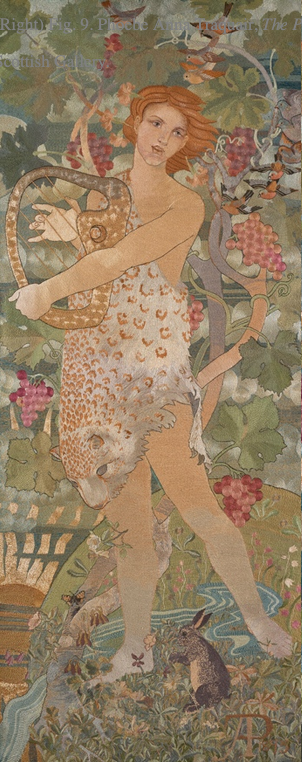
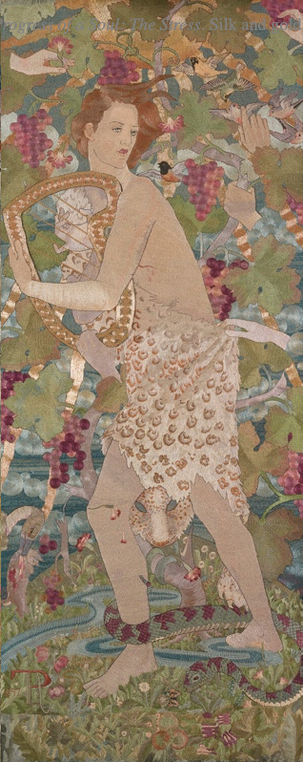
(Left) Phoebe Anna Traquair, The Progress of a Soul: The Entrance. Silk and gold thread embroidered on linen. 180.67 x 71.20cm. 1895. Courtesy of National Galleries of Scotland.
(Right) Phoebe Anna Traquair, The Progress of a Soul: The Stress. Silk and gold thread embroidered on linen. 180.67 x 71.20cm. 1897. Courtesy of National Galleries of Scotland.
The opening panel, The Entrance, depicts a richly ornamented world, with its central figure appearing youthful and carefree. Denys appears in perfect unity with the natural world. Surrounded by foliage that caresses and twirls, Denys sings as he strums his golden harp. However, the seemingly innocent rabbit signifies that the youthful Denys is equally a figure of hedonistic pleasure as he is one of purity, as a traditional motif of lust. Importantly, the body itself resists rigid gender definition. Cloth softens his physicality, and gesture becomes more expressive and fluid than rigidly anatomical. Ornamentation and the human figure exist in a naïve harmony: flowing drapery, rhythmic line, and luminous colour emphasise an atmosphere of luxuriance and naivety.
In The Stress, the scene becomes increasingly charged and unstable. Denys has aged, and he clutches his harp to his bloodied torso, referencing Crucifixion. The central panels intensify in their decorative richness and charged atmosphere, surrounding the figure with dense symbolic foliage and heightened colour. The rabbit now lies dead, limply hanging from a bird’s unforgiving beak. Disembodied hands reach out to claw at the surrounding nature, and tear Denys’ animal pelt from his body. Here, Traquair’s imagery comes closest to the bacchanalian sensuality of ‘Denys l’Auxerrois,’ where rituals, music, and religious spectacle blur the distinctions between sacred devotion and aesthetic ecstasy. Gesture becomes more animated, and as hands tear at Denys, he is progressively less anchored to a fixed physical identity.
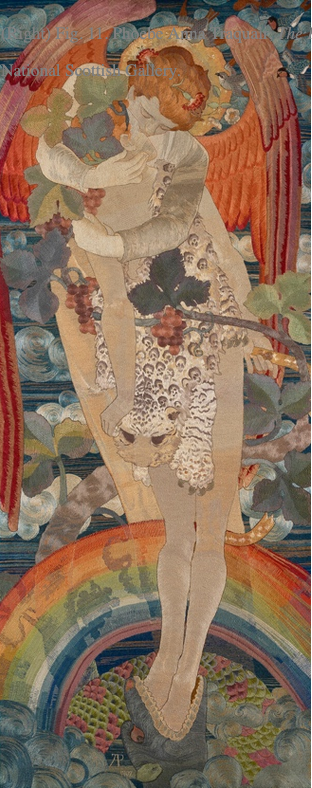
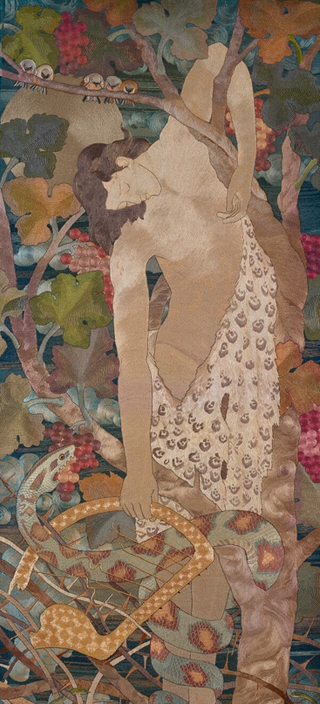
(Left) Phoebe Anna Traquair, The Progress of a Soul: Despair. Silk and gold thread embroidered on linen. 184.70 x 74.90cm. 1899. Courtesy of National Galleries of Scotland.
(Right) Phoebe Anna Traquair, The Progress of a Soul: The Victory. Silk and gold thread embroidered on linen. 188.20 x 74.20cm. 1902. Courtesy of National Galleries of Scotland.
The next panel, Despair, stages a profound surrender to spiritual hardship. Ornament no longer exists in harmony, but visually dominates Denys, dissolving distinctions between figure and environment. Exhausted and defeated, Denys is suspended lifelessly between branches. The landscape has grown more chaotic, and the palette has darkened into hues of twilight. The serpent now tightens around Denys’ body, winding through his broken harp: conflict has obscured harmony.
The conclusive panel The Victory functions as the emotional and symbolic culmination of the entire sequence, and is the most richly decorated and elaborately embroidered. Denys has emerged from disillusionment, and with this, vibrancy and growth have returned to the world. Yet its sense of triumph is notably more contemplative rather than valiant. Traquair avoids the narrative finality typical of Victorian religious allegory; instead of staging victory through conquest or physical action, transcendence is suggested as a reward to spiritual and psychological transformation.
Unlike earlier panels in the sequence, where the figure moves through states of yearning, vulnerability, or emotional searching, The Victory presents a remarkable serenity. The body no longer strains or reaches outward but appears harmonised with the decorative space surrounding it, in a state of calm. Denys’ soul has not conquered through force, but through an embracement of companionship and connection.
Pulling from a fairytale-like ending, Denys is saved with an ethereal kiss, and welcomed into everlasting life by a liberating angel, equally androgynous. With lavish, fiery wings, the angel embraces Denys’ soul. The bodily contours of Denys have become increasingly more intricate in Traquair’s embroidery, and his figure more fluid. Traquair challenges rigid, hyper-masculine representations of the hero's journey, instead embracing a softer, more fluid physical aesthetic. This union echoes that of the lovers in Sonnets from the Portuguese, further considering intimacy as a crucial part of spiritual companionship, where emotional reciprocity replaces hierarchical gender roles. Androgyny becomes a symbol of transcendence, an expansion beyond binary definition into a shared realm of emotional, religious experience.
Blinding sunlight returns in force, animated by gold threads that catch the light. This recalls the eruptions of gold foliage in Traquair’s Sonnets from the Portuguese, where the feminine voice merges with decorative form to visualise emotional expression beyond verbal articulation. The soul’s final state transcends rigid structure. Identity becomes fluid, contemplative, and symbolic. This is especially significant in relation to Traquair’s broader treatment of female subjectivity. Much like the feminised speaker explored in her Barrett Browning illustrations, The Victory transforms emotional openness and intimacy into expressions of religious enlightenment and a connection with divinity. Victorian religious imagery frequently coded transcendence through masculine struggle, discipline, and triumph, yet Traquair offers a radically different vision. Her angelic figures communicate through stillness, shared gazes, and loving caresses. In this sense, the panel aligns closely with Traquair’s recurring visualisation of what might be called feminised spiritual power: inward, relational, emotionally expressive, and resistant to hierarchical structures.
A recurring theme throughout Traquair’s work is a connection between the charismatic and sensual with spiritual and religious themes (16). The House of Life turns inward still further, in an intensely concentrated meditation upon desire, memory, and psychological intimacy. Derived from Dante Gabriel Rossetti’s sonnet sequence of the same title, the work encapsulates many of Traquair’s recurring concerns: narrative drama, femininity, and spiritual enlightenment. Yet unlike the expansive narrative worlds of the tapestries, The House of Life compresses these themes into the intimate scale of enamelwork, creating an object whose emotional intensity depends precisely upon its condensed, jewel-like form. The work marks Traquair’s developing interest in jewellery and enamelwork, which increasingly became her favoured medium in the early 1900s.
Rossetti’s The House of Life is itself deeply preoccupied with the instability of selfhood, presenting love as an experience in which memory, sensuality, spirituality, and artistic creation become inseparable. Many sonnets celebrate intimacy and sensual beauty. Rossetti’s lovers experience moments of perfect unity, but these moments are fragile. Traquair carries out these themes across three main panels. The outer panels both illustrate journeying angels, guiding souls with their crimson wings. The central panel is almost evocative of The Garden of Earthly Delights in its diverse congregation of figures, all existing separately and yet in total balance. The figures represent all manner of human experiences, from the tender embrace of lovers, to sharing drinks, playing music (Traquair depicts a lute, commonly used in the medieval era). One figure hunches over in despair, weeping into their palms. Each seems wholly absorbed in their own emotional experience.
Traquair’s use of medieval aesthetics transforms the enamel into something resembling a precious devotional relic or illuminated object. Rather than adopting medievalism as simple historical revival, Traquair employs medieval visual language as a means of spiritual and emotional intensity. Traquair flattens perspective, and as a result, the figures ethereally glide across a compressed plane, reduced of any illusionistic depth. The use of medieval perspective creates an atmosphere of contemplative intimacy, encouraging the viewer to read gesture, colour, and ornament in a devotional tone.
Floral motifs, flowing lines, and luminous colour surround the figures, recalling the immersive decorative worlds of medieval manuscript borders and religious metalwork. Ornament does not merely embellish the composition, but functions as a visual extension of emotional and spiritual experience. The enamel medium intensifies this effect further. Its polished, luminous surface emanates jewel-like colour and radiant light effects reminiscent of stained glass, enamels, and liturgical objects. Alongside Traquair’s continuous employment of gold, vivid colour again communicates a strong expressive atmosphere. Deep reds and golds evoke passion, spiritual radiance, and medieval richness. Blue and green accents introduce melancholy and contemplation. The palette resembles illuminated manuscripts or Byzantine icons, linking sensual beauty with religious reverence, the embodiment of spiritual intensity.
Light seems to emanate from within the image itself, heightening the spiritualised atmosphere and reinforcing the sense that desire operates here as both sensual and transcendent experience. Enamelling on silver enhances the colour palette further by producing the ethereal glow of moonshine. Illumination often signified divine presence or visionary revelation in medieval objects. In Traquair’s hands, however, light also becomes deeply psychological, externalising the emotional intensity of longing, memory, and intimate connection. Looking itself becomes part of the drama: the viewer is invited not simply to observe the scene, but to enter its atmosphere of suspended desire and contemplative longing.
Traquair’s figures possess the elongated grace and stylised drapery associated with Gothic and early Renaissance art, but these aesthetic choices simultaneously destabilise bodily specificity. Masculinity becomes softened and contemplative, femininity spiritually authoritative and psychologically interiorised. Rather than presenting a binary opposition between active male subject and passive female object, Traquair stages desire as reciprocal and relational. The figures mirror one another, creating a subtle androgynous tension that destabilises conventional Victorian hierarchies of gender.
Traquair’s enamelling visualises desire as a spiritual and psychological condition that continuously changes who we are, and who we might become. The result is not simply an illustration of a literary tale, but a medieval vision in which love, memory, gender, and spirituality dissolve into a luminous, dreamlike haven. Traquair’s Red Cross Knight tapestries further extend this dramatic language into the realm of companionship and expressions of femininity and masculinity. Drawing upon Edmund Spenser’s The Faerie Queene, Traquair approaches the medieval romance tradition not as historical reconstruction, but as a spiritual progression. The knight becomes less a military hero than a symbolic figure through whom spiritual transcendence, harmonious connection and the realisation of the “self” are explored.
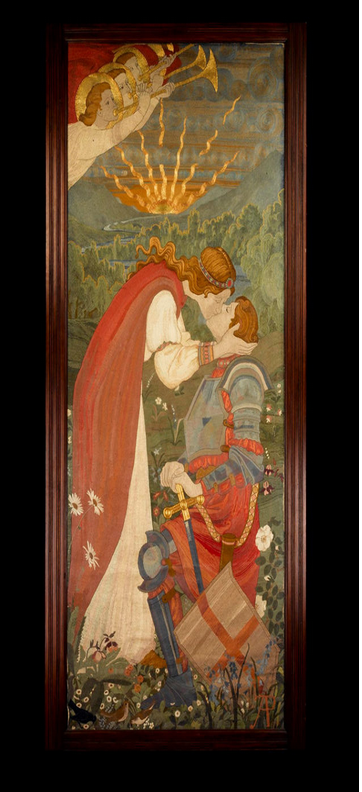
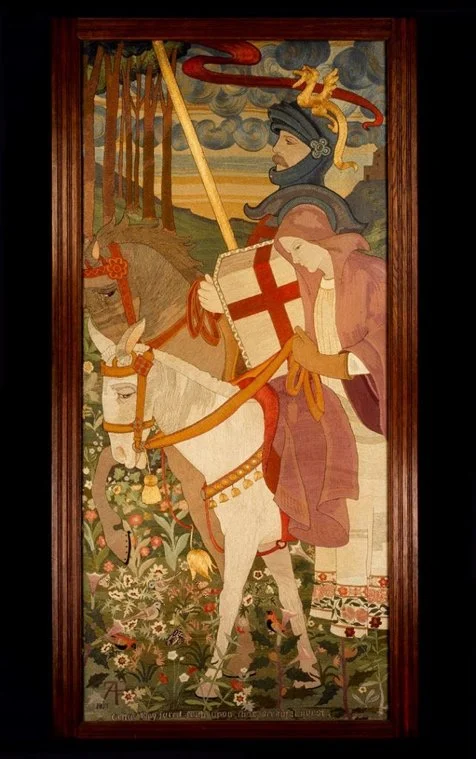
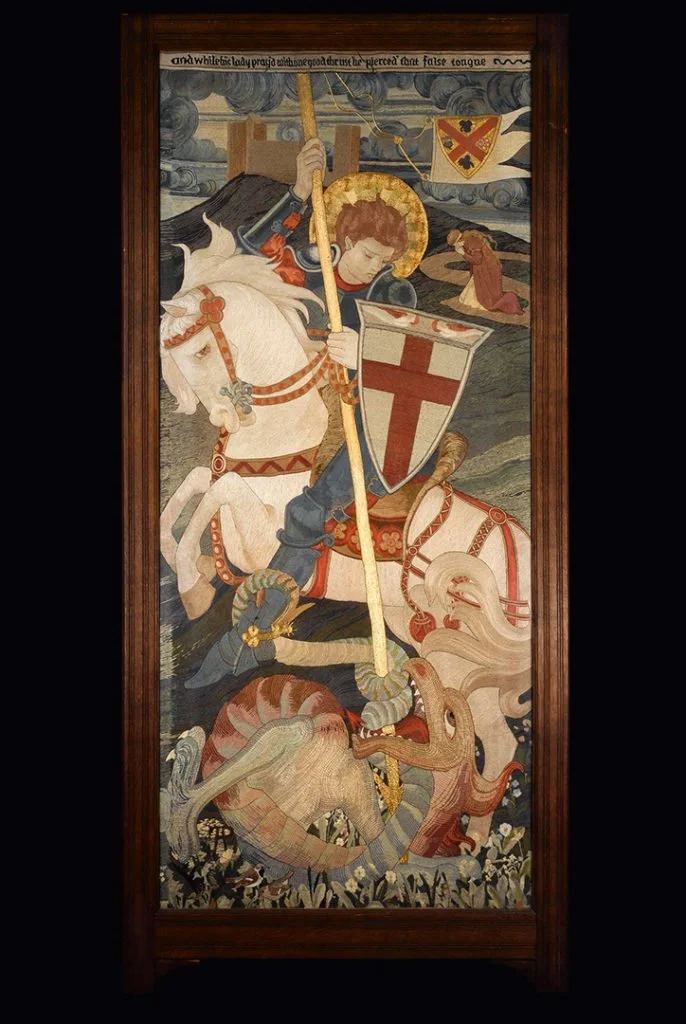
(Centre) Phoebe Anna Traquair, The Red Cross Knight. Silk and gold thread embroidered on linen. 191.7 x 82.3cm. 1904. Courtesy of National Galleries of Scotland.
(Left) Phoebe Anna Traquair, The Red Cross Knight and his Lady Riding. Silk and gold thread embroidered on linen. 191.7 x 82.3cm. 1904-1907. Courtesy of the National Galleries of Scotland.
(Right) Phoebe Anna Traquair, The Red Cross Knight and his Lady. Silk and gold thread embroidered on linen. 191.7 x 82.3cm. 1907-1914. Courtesy of the National Galleries of Scotland.
Within Spenser’s original text, Traquair was deeply drawn to the Red Cross Knight’s epic narrative, a symbolic voyage regarding the pursuit of truth (17). Traquair completed the central panel first, depicting St. George slaying the dragon and piercing its “false tongue”, as Lady Una prays in the distant background. The dragon is distinctly serpentine, attacking St. George atop his valiant white horse in a spiralling frenzy. Red and white dominate the triptych’s palette, emphasising the symbolic battle of deception, betrayal, and temptation against truth, love and virtue. The composition is distinctly dense and claustrophobic, accentuating the highest point of narrative drama in the journey.
The right-hand panel, The Red Cross Knight, and his Lady Riding, seemingly illustrates the beginning of their quest through life: once again, Traquair’s work is not concerned with realism or linear storytelling in any conventional sense. Mounted together upon horseback, the knight and Lady Una move through an ethereal medieval landscape animated by rhythmic movement and decorative richness. Even here, the image resists the momentum of traditional romance narrative. The horse advances, but the figures themselves remain curiously introspective, absorbed within their own contemplative suspension. Lady Una rides alongside the knight not as a decorative accessory, but as an emotional counterpart and spiritual companion. Yet by the events of the central panel, as in Spenser’s tale, St. George has been deceived and doubts Lady Una’s virtue.
In the narrative’s conclusion at The Red Cross Knight, and his Lady, redemptive love is celebrated, their trust in one another renewed, and a harmonious connection is restored, bringing about the transcendence of St. George. With his helmet removed, kneeling before Lady Una in devotion, the knight surrenders himself to spiritual harmony, merely himself. Rather than emphasising bodily strength or climactic action, Traquair constructs a knight defined through introspection, grace, and emotional presence. Victorian medievalism often framed women within chivalric imagery as passive ideals or rewards for masculine achievement. Traquair subtly unsettles this hierarchy; Lady Una possesses extraordinary symbolic authority, guiding, witnessing, and spiritually bearing the knight’s journey. To an extent, Traquair exposes masculinity itself as an aesthetic construction: performed, impressionable, and emotionally contingent.
Across the panels, flowers bloom in dense ornate patterns, rounded clouds drift sumptuously across the sky, and colour radiates with heraldic luminosity. Ornament is never merely embellishment, but externalises inward states of longing, devotion, and spiritual transformation. The landscape itself seems emotionally charged, participating in the psychological journey of the figures. Passion and desire are aligned as experiences crucial to harmony and religious revelation.
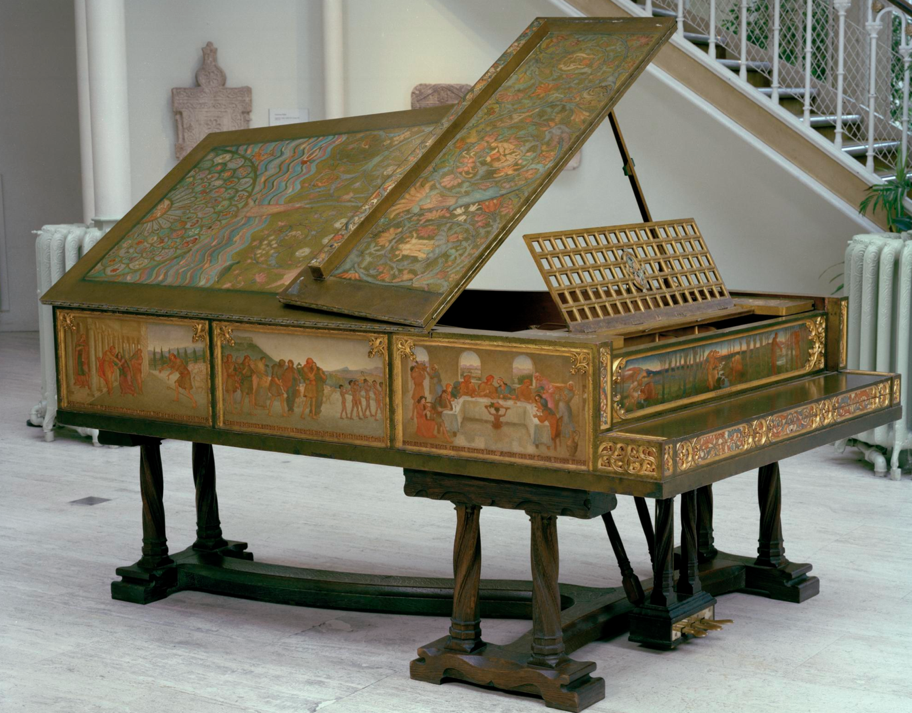
(Above) Phoebe Anna Traquair, Grand Piano for Lympe Castle, Kent. Oil on gesso on wood. Decorated 1909-1911. Courtesy of National Museum of Scotland.
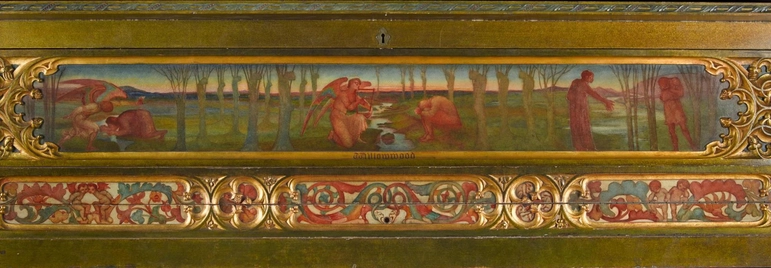
(Below) Phoebe Anna Traquair, Grand Piano for Lympe Castle, Detail of panel above keyboard depicting a scene from Willowwood. Oil on gesso on wood. Decorated 1909-1911. Courtesy of National Museum of Scotland.
Among the most theatrically ambitious of Phoebe Anna Traquair’s decorative works is her painted Steinway grand piano for Lympne Castle in Kent, begun in 1909 for Frank Tennant. More than an ornamental domestic object, the piano becomes in Traquair’s hands a symbolic stage upon which literature, music, religion and feminine expression converge. Throughout the Victorian period, the piano occupied a highly gendered cultural position within the home, associated with feminine accomplishment, courtship, emotional expression, and sensual performance. Traquair subverts these associations deliberately, transforming the instrument into a dramatic site through which music becomes a language of spiritual and emotional awakening.
The piano draws together three literary and mythological sources united by themes of desire, harmony, and transcendence. Above the keyboard, Traquair illustrates Dante Gabriel Rossetti’s Willowwood sonnets, whose dreamlike meditations upon love, grief, and memory unfold across barren symbolic landscapes inhabited by spectral lovers and visionary figures. Rossetti’s poetry operates within a suspended emotional register in which desire becomes inseparable from loss and longing. Traquair intensifies this atmosphere visually through panoramic scenes, a symbolic unfolding drama of the spirit. As elsewhere in her work, narrative progresses through mood and atmosphere rather than action alone.
The side panels turn to The Song of Solomon, perhaps the most erotically charged text of the Old Testament, long interpreted both as a celebration of mutual human desire and as an allegory of spiritual union between the human soul and divinity. Traquair situates this sacred romantic poetry within landscapes inspired by the Scottish countryside, moving through symbolic cycles of dawn, daylight, evening, and renewal. These shifting temporal states create a theatrical progression of emotional transformation, where light itself becomes symbolic of desire’s spiritual force. Traquair emphasises the text’s sensual qualities through the piano’s domestic and performative context. The instrument, historically associated with flirtation, intimacy, and feminine display, becomes a vehicle through which erotic desire is not condemned, but openly expressed and transfigured.
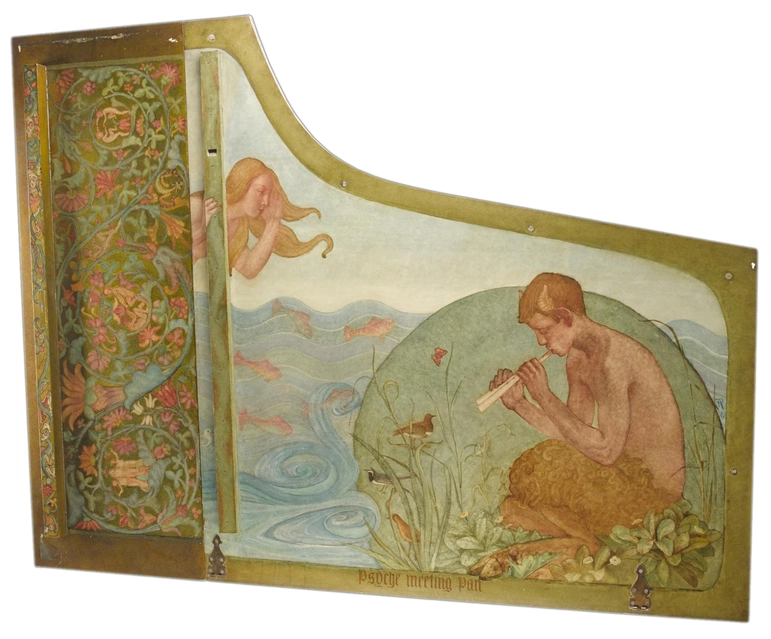
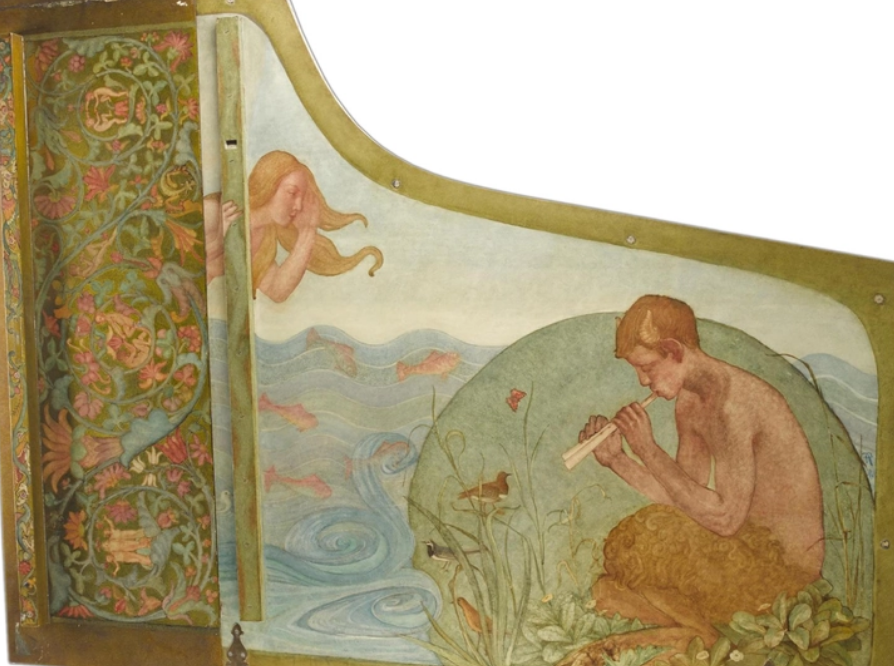
Phoebe Anna Traquair, Grand Piano for Lympe Castle, Inner lid: Psyche Meeting Pan. Oil on gesso on wood. Decorated 1909-1911. Courtesy of National Museum of Scotland.
The most revealing imagery, however, appears beneath the piano lid in Traquair’s depiction of Psyche Meeting Pan. Here, literature and mythology become tools for exploring feminine identity and autonomy. In the Greek myth, Psyche, the embodiment of the soul, encounters Pan after being abandoned by Cupid, lamenting the loss of her beloved. Traditionally, Pan often appears as a threatening or overtly sensual figure, associated with a mature masculine sexuality and pagan excess. Traquair radically softens this dynamic. Her Pan is youthful, musical, and strangely tender, seated within an enchanted pastoral world animated by birds, flowing water, fruiting vines, and dreamlike vegetation. Rather than consoling Psyche physically, he captures her intrigue through music. Desire emerges through emotional and spiritual attraction, as opposed to passive femininity accepting authoritative consolation.
This shift is crucial to Traquair’s wider exploration of gender performance. Psyche is neither passive muse nor endangered victim. Leaning towards Pan’s music, she becomes an active participant within the scene’s emotional drama, expressing curiosity, longing, and agency. Music itself functions as a transformative force, dissolving boundaries between body, nature, and spirit. The surrounding imagery of spiralling vines, miniature fauns, centaurs, flowering branches, and abundant fruit creates an atmosphere of symbolic fertility and emotional intoxication, yet the scene remains harmonious. Traquair avoids the violent eroticism and masculine domination frequently associated with fin-de-siècle depictions of female sensuality. She imagines desire as reciprocal, immersive, and spiritually connective.
Two portraits from Traquair’s later career demonstrate both her continuous artistic evolution and her own expression of identity. Self Portrait (1909–11) and Study of a Girl’s Head (c.1907) offer a more direct and psychologically concentrated meditation upon identity and religious contemplation. Stripped of expansive literary narrative and decorative theatricality, these works confront the viewer with the human face itself as a site of emotional exploration, unadorned identity, and feminine expression.
In Study of a Girl’s Head, the young sitter emerges slowly from darkness; her face is veiled in shadow as she rises from a moment of pensive inward concentration. Hands clasped delicately, light catching in her eyes just so, the girl appears devotional, and yet her expression brings contradiction, resisting interpretation. The dramatic use of shadow produces a sense of inward enclosure, yet the face itself remains luminous, animated by subtle contradictions of melancholy, wonder, and self-possession. Unlike the idealised female figures that populate much Victorian art, Traquair’s girl is neither passive object nor sentimental emblem. Her expression is psychologically unresolved. The viewer is denied narrative certainty and instead confronted with an image of suspended emotional becoming.
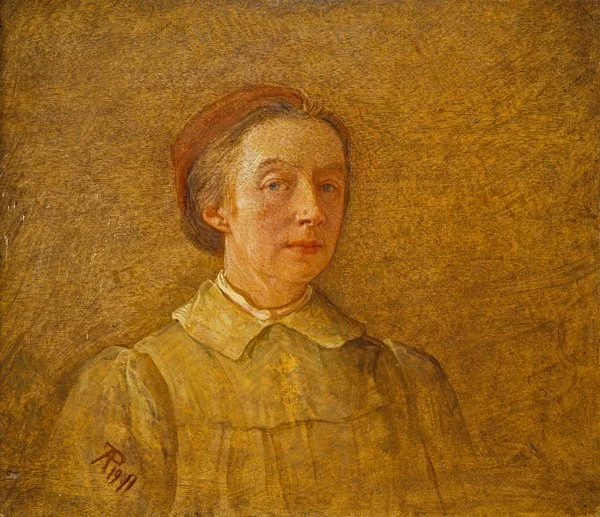
Phoebe Anna Traquair, Self-Portrait. 29.90 x 34.10cm. Oil on panel. 1911. Courtesy of Scottish National Portrait Gallery.
This ambiguity is central to the work’s exploration of gender and spectatorship. Victorian portraiture frequently constructed young women as legible embodiments of innocence, morality, or beauty, but Traquair destabilises these expectations through a sober, restrained atmosphere. Spiritual harmony emerges not through overt symbolism, but through emotional strength itself. The portrait becomes a space in which femininity is not simply displayed, but negotiated.
This psychological complexity deepens further in Traquair’s Self Portrait (1909–11), where this searching gaze is turned upon herself. Unlike the mythical women, allegorical souls, and medieval lovers that populate her decorative work, this self-portrait confronts the viewer with a more austere and direct form of presence. Even here, identity is represented in a state of evolution, creation and change. Traquair depicts herself in her artist smock and hat, subtly emphasising her professional status and artistic mastery. Rather than a symbolic costume or a medieval setting, drama unfolds through subtle shifts of light, shadow, direct gaze, and physical stillness.
While retaining the contemplative softness characteristic of her visual language, she simultaneously presents herself as psychologically self-aware and spiritually autonomous. The image neither rejects femininity nor conforms passively to it. Traquair’s self-identification expresses a state where emotional openness and artistic authority coexist.
Seen together, Study of a Girl’s Head and Self Portrait bring Traquair’s wider artistic concerns into their most concentrated form. Across manuscripts, enamels, tapestries, and symbolic interiors, she repeatedly transformed medievalism and literary allegory into theatres of gendered and religious becoming. In these later portraits, however, the symbolic drama becomes quieter, more intimate, and more psychologically exposed. Ornament recedes, but the central questions remain: how is the soul expressed? How might religious enlightenment coexist with our journey of self discovery? And how can femininity be represented outside rigid binaries?
Traquair’s work ultimately speaks to the human experience, encapsulating life’s delights and challenges with equal care and devotion, always seeking to capture the harmony of life. Traquair repeatedly explored how literature, medievalism, and decorative form could visualise states of longing, devotion, desire, and spiritual transformation. Medieval aesthetics provided Traquair with more than stylistic inspiration; they offered a symbolic language through which feminine and religious expression could be connected, aestheticised and subtly destabilised.
Throughout these works, Traquair repeatedly privileges emotional reciprocity over traditional hierarchies, meditative stillness over dramatic action, and symbolic transformation over stable identity. Her androgynous angels, visionary knights, introspective women, and spiritually charged lovers occupy liminal spaces between masculine and feminine, earthly and transcendent, decorative and psychological. Drawing upon literary sources from Dante Gabriel Rossetti, Edmund Spenser, Elizabeth Barrett Browning, biblical poetry, and myth, Traquair constructs worlds in which the soul is constantly in fluidity.
Isabella Nicoletti
Notes
Judith Butler, Gender Trouble: Feminism and the Subversion of Identity (Hoboken: Taylor and Francis, 2011).
Elizabeth Cumming, Phoebe Anna Traquair (National Galleries of Scotland, 2022), p.10.
Duc Dau, “Violence, Eroticism, and Art: Edward Burne-Jones and Phoebe Anna Traquair”, in Sex, Celibacy, and Deviance: The Victorians and the Song of Songs (Ohio State University Press, 2024), p.55.
Clare Broome Saunders, “‘A Larger Vision’: William Blake, Phoebe Anna Traquair, and the Visual Imagination in EBB’s Sonnets from the Portuguese”, in Victorian Poetry 60, no. 4 (2022), p.521.
Cumming, Phoebe Anna Traquair, p.15.
Jenny Macleod, “‘By Scottish Hands, with Scottish Money, on Scottish Soil’: The Scottish National War Memorial and National Identity”, in Journal of British Studies 49 (1) (2010), p.75.
Marleen Rensen and Christopher Wiley, “Writing Artists’ Lives Across Nations and Cultures: Biography, Biofiction and Transnationality”, in Transnational Perspectives on Artists’ Lives, ed. Christopher Wiley and Marleen Rensen (Springer International Publishing AG, 2020), p.8.
Dau, “Violence, Eroticism, and Art,” p.55.
Cumming, Phoebe Anna Traquair, p.17.
Ibid., p.35.
Saunders, “‘A Larger Vision’”, p.527.
Ibid., p.542.
National Library of Scotland (NLS) MS 8122 fol. 15: letter of 13 January 1892 to William Edward Moss.
F. Coluzzi, “Illuminating the Vita Nuova: Phoebe Anna Traquair, Evelyn Paul, and Medievalist Practices of Visual Mediation,” Italian Studies, 77 (2) (2022), p. 195.
Saunders, “‘A Larger Vision,’” p. 529.
Cumming, Phoebe Anna Traquair, p.66.
Ibid., p.57.