
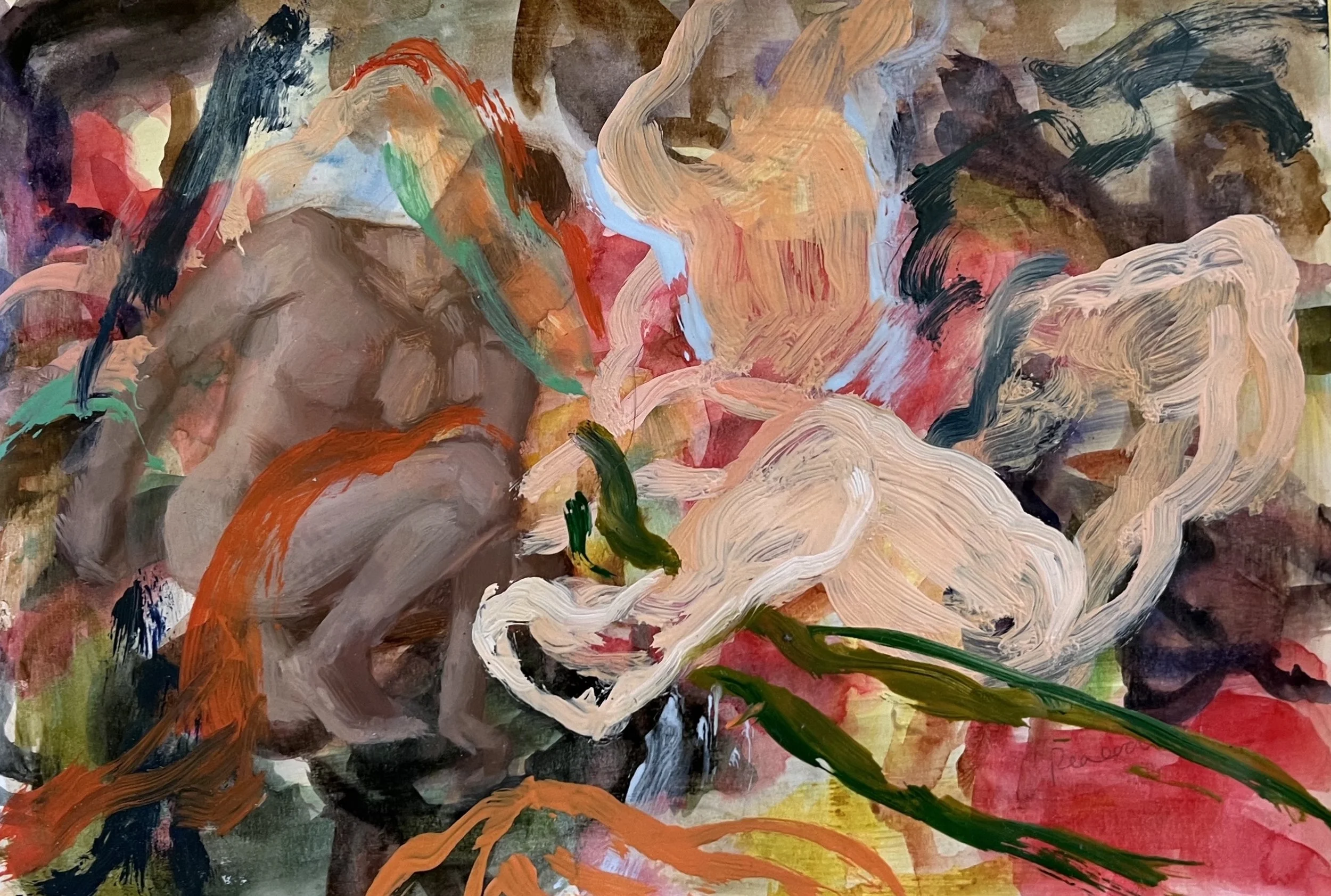
Le Liu and Sharon Thomas: The Garden of Eden interview
This feature describes a collaborative project between Le Liu and Sharon Thomas, both working in Glasgow. A period of intensive work led to the exhibition of 24 paintings on the Saltmarket, Glasgow, in June 2024; the event was separate from but coincided with the Glasgow International Festival of Contemporary Art. The concept of the series represents a simultaneous celebration of, and a challenge towards Western Classicism, combining a subversion of traditional themes with an affirmative philosophy and aesthetic.
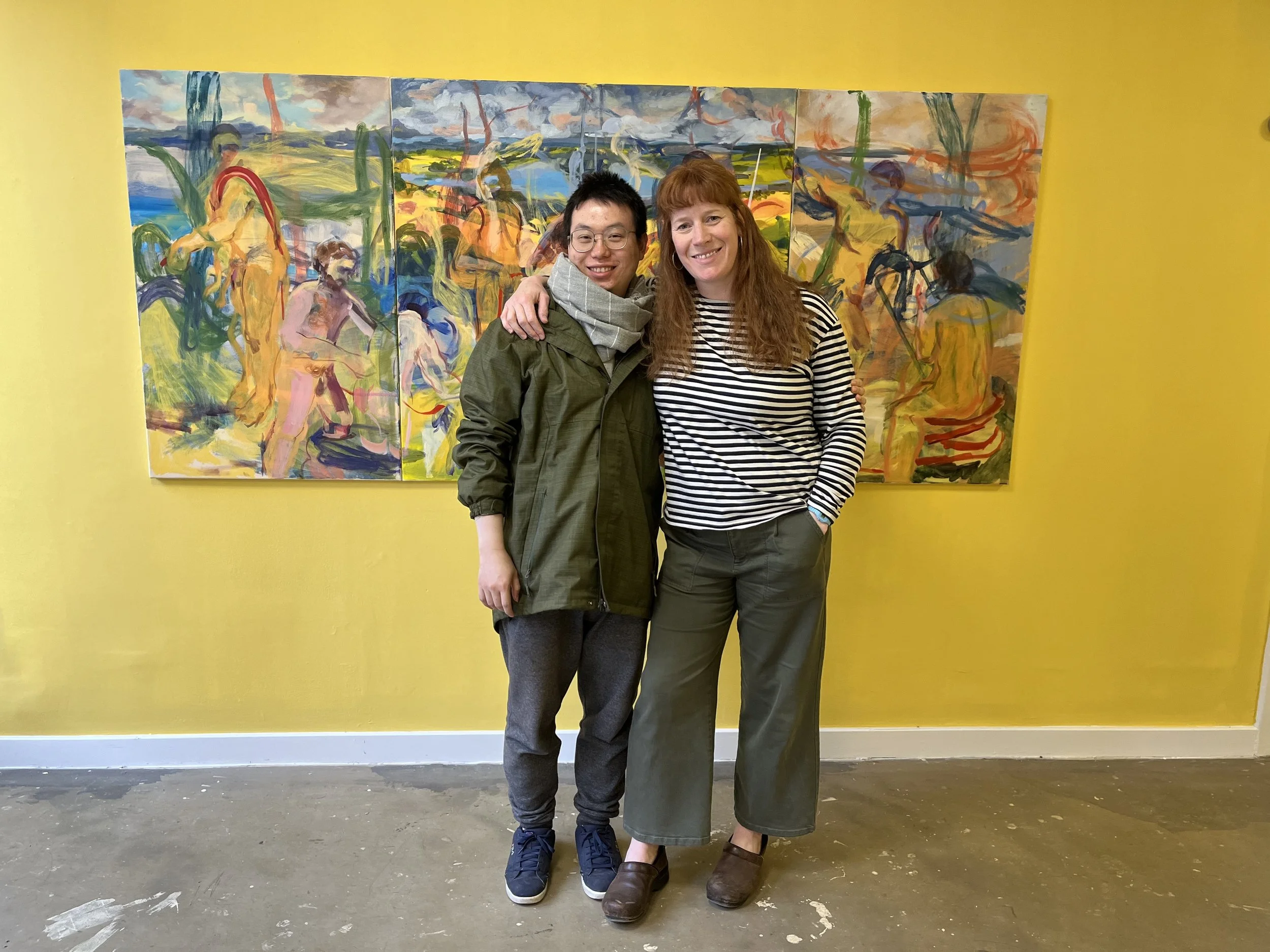
Le Liu and Sharon Thomas standing before En Route, 2024.
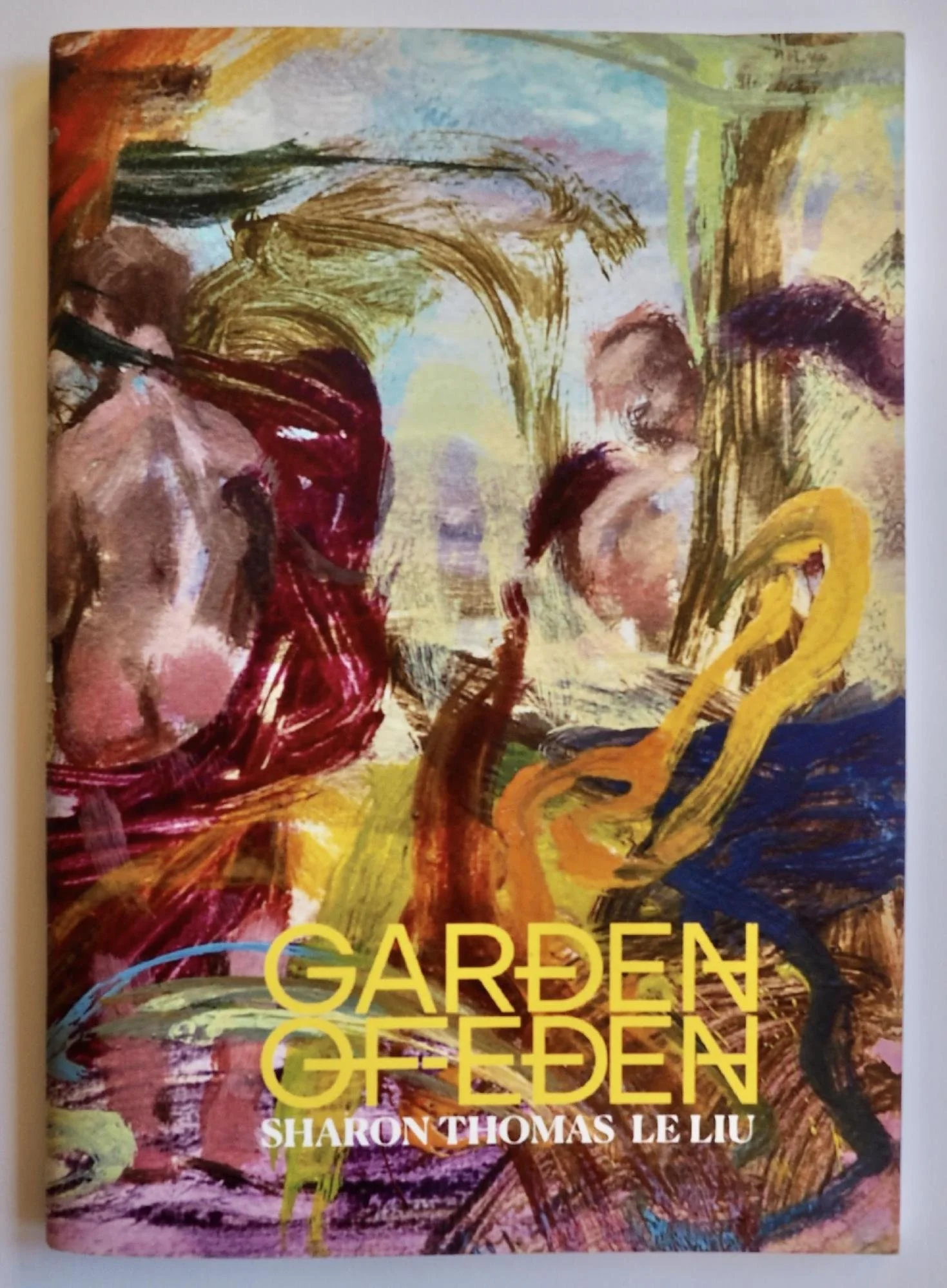
Garden Of Eden catalogue cover, 2024.
I was fortunate enough to attend the Garden of Eden exhibition in 2024, which took place in a pop-up space on the Saltmarket. I was struck by the energy and expressiveness of the artworks and of their creators. The artists had carried out detailed research for several months then prepared the works feverishly for six months prior to the exhibition, with some paintings still in the drying stage on the night before the opening. Thomas and Le Liu were responsible not only for the artworks, but for the exhibition’s curation, transport of the works, venue preparation (including painting the entire wall space an ochre-yellow, and back to white at the end of the exhibition), catalogue writing, installation, and staffing the venue - although they would be the first to say that they had occasional but crucial help along the way. The collaboration took place in the form of each artist taking turns in preparing a drawing or background, then serially swapping works to create several layers, up to five in some instances. The source inspiration was transparently shared, but all else took place in the mind of the artists, with weekly reviews of progress. Media included biro, watercolour, and oils.
The title of the series was inspired by Garden of Eden, with the Fall of Man (1615), a painting which was collaboratively produced by Peter Paul Rubens and Jan Breughel the Elder. Beyond this direct inspiration, the series references the classical grand narrative style of painting over the past 500 years. All of the sources had some connection to Classicism, or the male figure; and most, but not all, had some reference to religious themes or to Greek mythology. Classical structured narratives are transformed into quotidian scenes of nude male figures, relating to each other and to nature; structure and chaos are held in balance, resolving the Apollonian /Dionysian tension described by Nietzsche [references 1, 2].
Le Liu describes his Chinese classical training, and his extensive research of Western tradition; he majors in figurative abstraction, colour, and the presentation of an Eastern male queer perspective. Sharon Thomas has for much of her career focussed on championing the role of women in society. For this series, she reports taking pleasure in depicting the male body as a sensual entity, but also innocently upending the prevailing male gaze. The artists teach various groups, and Sharon Thomas lectures at the University of Glasgow.
Both artists celebrate the male body, within a Sylvian setting. Through the use of exuberant colour and abstraction, and channelling a subversive yet transcendent narrative, they have created a renewed vision for hope, and for peaceful co-existence.
Robert De Mey © 2026
Interview
LL: Le Liu, artist
ST: Sharon Thomas, artist
RDM: Robert De Mey, interviewer
RDM: So thank-you, Le Liu and Sharon Thomas. We are here to talk about the Garden of Eden series, which was part of the Glasgow International Festival in 2024. Some works have been exhibited again at the Glasgow Art Club, in 2025.
ST: It was a small selection for the Art Club, but the vigorous full exhibition was at the Saltmarket for the Glasgow International. We made the work knowing there was going to be an exhibition and we had a deadline.
RDM: So let’s talk about this collaboration, where you were working sequentially on the paintings and trading them, and they were criss-crossing the city.
I had thought it was very unusual for artists to collaborate on jointly produced work, but you've educated me since, that it’s far from a rarity. Of course, we have had Jake and Dinos Chapman, and Gilbert and George, and others. But then you told me of the collaboration between Peter Paul Rubens and Jan Breughel the Elder.
But first, I want to take you right back and just find out about your individual journeys in art. So, first of all, Le, about your early life, what was your first introduction to art? What switched you on to the visual arts?
LL: Well, I liked to draw comic book images when I was little. It just gave my parents a chance to understand that I could learn art. During high school, all of our age group needed to prepare for the college entrance exam, and my aunt thought it was a good opportunity for me to go to the art school, so I chose art.
RDM: So you had that idea very early on.
LL: I think it started from the age of 15, but I started to draw by myself from 13. Yes.
RDM: And your art school in China? Where was that?
LL: It was in Wuhan. First, we were trained in a studio. We trained very traditionally. Yes, just very boring, actually. And that's one of the reasons I don't want to paint heads right now; portraits really bore me, and the rules are very restrictive. But after I went to Hubei University, we had art school there also. We were training, but the teacher wouldn’t say too much. They just want you to develop your own style. But we still focussed on the traditional realistic style of the portrait, the figures, and it was interesting to me, that the moment I started to paint from the nude life figure drawing style, I decided that for the rest of my life, I would paint nudes. Yes.
RDM: And then you went to Glasgow School of Art in which year?
LL: From 2019, until 2021.
RDM: And you took a specialised Master’s degree there.
LL: A Master of Letters in Practice. Yeah. My pathway was print media, but I didn't just focus on prints. I liked sculpture, and I liked to do installations. I never stopped painting, and it was a combination of all kinds of art.
RDM: Can you tell me more about the crossover between Western and Chinese painting traditions?
LL: Well in China, we still promote the traditional realistic style. If you are a painter, and you paint things just exactly like the photo, they will think “wow, you're a really good painter, you can manage everything”. But for more conceptual, more bold work, it is just hard for them to accept, like my style, like the figurative and the colours being really vivid and the strong brush strokes. That's quite hard for them to accept, especially the middle-aged people, yeah.
RDM: But what would Chinese classicism represent, do you think?
LL: Well half of the Chinese paintings are landscape and Chinese calligraphy, which is a little bit boring to me, because I think Chinese classical painting is dead nowadays, yes. And the Western style, oil or watercolours landscapes, and portraits, I don't want to say like Sargent because they can't do Sargent, but it's quite commercial, to be honest.
RDM: Sharon was telling me you became very interested in Western classicism, and that you researched that tradition extensively.
LL: Yes, I was always into Western paintings from the beginning of my training. I like to develop by myself, I buy books, one source was 500 years of Western Paintings [reference 3]. I just browse them, and it really refreshes my mind.
RDM: It seems that you have the best of both worlds, because you have the two traditions to draw on.
LL: Yeah, I think it's important to get the skills and then to develop something different, like Picasso. Yeah, he's really good at it, although I'm not sure it is true when he said that he painted like Raphael when he was 13. I just mean a very strong basic technique is really important for a painter.
RDM: Your language of colour represents a radical departure from the classical tradition. How did that language develop?
LL: I came to the UK to study work from the 20th century, and I followed Willem De Kooning: his textures are very thick, with big brush strokes; he is also unconventional, he adds water into oil paints with oil, then mixes them. I love his colours, they are fantastic, I feel like that is the colour I want to achieve, the movement of paint on the canvas, paintings with big brushes, and layers. Cecily Brown is a British born Abstract Expressionist artist who moved to New York. She developed the use of Old Masters references, like Rubens, Poussin, then Goya, and so on. Cecily Brown taught me that myth can be presented in this way, with a fusion of old and contemporary, and she can paint thin colour layers, adding them perfectly.
RDM: You have an excellent source book for Chinese Art here [reference 4]. I saw a strong classical figure with a man on horseback, and also this one interested me, I don't know what's going on there.
ST: Let me have a look. Oh, is it a nude archer? An archer, yes.
RDM: Is that very old?
LL: Yes, it's from the Han Dynasty. I think it is around 200 BC.
RDM: It reminded me a little of classical Greek sculpture..
LL: Well, I have to say, in olden times, before the Qin Dynasty or even before the Han Dynasty, the culture and the mind were quite open in ancient China, especially during the Tang dynasty. Yeah, we were embracing of all sort of artworks. But from 100 years later, you know, the rulers wanted to control the people more.
RDM: That’s a good answer, yes. And Sharon, can you tell me about your early life and what first switched you on to the arts? What first popped up in your vision when you were a child?
ST: Well, I grew up in Cheshire in England. I was from a working-class family, no art involved at all. I first got an interest in art was when I was at primary school, and I was six or seven, or something like that. I remember being introduced to Gainsborough, because I was a nerd. I had a great teacher at primary school, who was lovely.
We had to do a lot of work in nature, because we got out to the countryside. We used to do natural paintings from materials like flowers and things that we collected, to make little journals. I found that I easily got bored. So the teachers said, “go off, there is some Gainsborough, go and copy some of these”. So I went to the quiet part of the room away from the others, and I kind of liked working on them. I just realised I liked visual images. When I went into high school, you study a bit more, and I got introduced to Picasso, who bores me, but I had to look at abstraction at that point. I realised I was interested in not just the image, but also in other subjects, because I love literature too. I realised that I needed to draw all the time.
RDM: And where did you go for your undergraduate studies?
ST: To the Glasgow School of Art. From 1997, and I graduated in 2001. I did the General Drawing and Painting course. I found that art school was an interesting world, but I realised that there were issues of class, in terms of privilege. I realised I was very working-class, which annoyed me, in terms of divides of people, but I was there to paint.
So I liked the experience; we had some really nice professors, and we had an opportunity to go to America. I was just seeing things in the States, and I liked the paintings I was seeing there. I found it far more interesting than the UK art world. And I realised that at the art school, painting wasn't giving proper respect. There was a lot of attention on site-specific work and sculpture, which I respect. But my medium was paint, and I wasn't getting enough support in it. So basically I was going back and forth across to America. I had friends who were in New York and basically I wanted to graduate and get away from art school, as it was just doing my head in.
Then the Head of Department at Glasgow, Sandy Moffat, said “I hear you're going to New York in the Spring”, I was like, “Yes”; I was going over for a week or so to see a friend.
He was like, “well, go look at some schools”. I was like, “why?” He said “well, just have a look”. And I was like, “okay”. So I saw the New York Studio School, then I went to the Academy in Tribeca. There's a massive building. And the head of Academy took me on a tour. I was like, “what's going on here?” And then I realised that they wanted me to make a connection, and I said, “do you offer scholarships?”, and they said “yes, sometimes we do”. So I went off to New York in 2001 to a very hardcore academic training, which is more like Le Liu’s early training. I had not had that type of training previously, and it drove me insane.
I hated most of it, but I was there to meet people and I actually did learn from it, which altered my practice. I had an education in anatomy, which helped me in the end to have more control of what I was producing.
RDM: And then you caught up in the World Trade Centre attack?
ST: Yeah, that was not a nice period. I arrived in the August 2001, early, and the schools had a big fire and no one told me, so I arrived, and the school was boarded up. I had to use a pay phone to say, “where are you?”
So they had relocated into an old building in Mercer Street, which is in Soho. It's where the space is. Then on my first day of classes, it was 9/11. So I was there underneath the Towers as they fell. So that had a big impact, I think, on my art. It was a big downer, the reality of this American dream, et cetera, compared with the reality.
RDM: A huge collective trauma and very difficult for you personally.
ST: Yeah, it took a long time till that came out, though as was the case for many of us at that time, you just dealt with it, because we lived, and we saw people who didn't live. We were grieving for a long period of time. So a lot of us kind of put screens up, ironically, to block things out, because we survived.
RDM: How do you think it changed your artwork, in the end?
ST: I became more defiant. I've always been quite cocky anyway, but seeing things, I got really angry when the War began. So I was anti-war and I got more angry when Bush did his speech about the War on Iraq; he did it from the White House and he had some of the most beautiful landscape paintings by Bierstadt, an American painter, who I adore. Bush used them as brainwashing tools to fight in Iraq against Osama Bin Laden, who was in Afghanistan, a completely different situation. The brainwashing made me angry and then started me thinking, “I've been in these situations, I have been a witness of murder, and then my country is going to support that, to do it to somebody else”.
So then I got more political, and thinking, “my painting is relevant, a landscape painting is relevant, and a figure in a landscape is very important”. Sometimes it's played as something which is bourgeois and pretty. It's used politically, all the time.
So that's when I got my anger, which started to come out in my painting. But my paintings aren't so angrily painted, because I love painting. I love what paint can do. And I see it as something which redeems people, as a beautiful thing that brings us together as a collective, not something to scare people and to force people to do things, because I don't believe in that; I believe in democracy.
RDM: And that's hugely relevant to today's polarisation, and what we’re seeing with angry opposites on social media that will never meet. Partly because of the style of the communication. And I would agree that your collaboration is about bringing people together,
LL: Yeah.
ST: Absolutely.
LL: Yeah, because lots of the figures in the painting, we combine them by ourselves. We try to make a story in different characters and in different postures.
RDM: Yes, what could be very oppositional becomes very peaceful, and takes us back to a real Arcadia or Garden of Eden.
ST: Yes, it was this kind of concept. But the idea I think with me and Le Liu, we're not in a fight; I really wanted to know more about your culture. I see that as a positive thing in life, that you reach out to cultures you don't know. When you explore you might actually find you have a connection; and I believe in peace. I understand why war comes around, but sometimes it comes out of ignorance and a desire for power, and I don't feel that need when I'm making paintings. I'm on a journey to explore, and that's why I like working with Le. We’re on a journey, and we don't know where we're going to go.
RDM: Well, what better example of collaboration than this? And can you just take us back to your first meeting and what came about?
ST (to Le Liu): We met at the Gallery, didn’t we? You came to the Rough Rides exhibition, in the High Street. And I got a photograph of you dancing.
LL: Oh yeah.
ST: Because I saw the pose of the painting, and you did this amazing dancing in front. Iwas like, “you're mental” [laughs].
LL: I liked one of your drawings of the dancing people.
ST: So you copied the ballerina one.
LL: And then I came to your talk also.
ST: Oh, in the gallery, yes. We basically started chatting, and then I realised you were doing your Masters. And I became friends with the group of people that you were studying with, who I hadn’t met before. People like Penny, and some of the guys that you were studying with were really nice, and I’ve become friends through you. So it's through an exhibition basically then sort of chatting, going to more exhibitions, yes.
RDM: So you were drawn into so many conversations about art, and you discovered you had common interests.
LL: Yeah, yeah, and eventually, before the last the Glasgow International, I think it was 2023, I approached Sharon to say, “how about we have a collaboration for the next Glasgow International?” And then we started to meet with each other and we talked. I don't really remember the first day, what we talked about, but I just remember we talked a lot, we talked about the artists that we like, we introduced our practice to each other. Yes, we had a lot of common topics.
RDM: And when you hit the green button for go and you decided to do this series, did you talk much in advance about the process, about who is doing what?
LL: No. It felt like it went by itself, yes…
RDM: But you had the structured weekly roundups?
ST: Yes, we had that. We had some deadlines because we needed to be able to swap. So that gave us structure. We knew we were going towards an exhibition. So we had markers that we were interested in, but we didn't quite know what we were going to do. And you print out images that you're interested in, and I had printouts.
And then we spent the day at the Burrell Collection, for example. Also Kelvingrove.
We would go to different galleries in the city, just to talk, and you'd see things with paintings that I didn't necessarily see, and then we would talk about things, and then I talked about British culture that you're still learning about. So I'd be sharing my own background a little bit and I learned more about British painters of a certain period. So I did like your training on Italy, a lot of European classical art, as opposed to Gainsborough. You wouldn't be looking at those kind of artists, it would have been more in the background. Also Scottish paintings in the Kelvingrove. So we just kept on having these conversations, and then characters were starting to emerge. So basically you started finding characters and sharing them with me, I was thinking, where that character could go. So we didn't really know where it was going, but we knew we were being slightly, not surreal - we were just seeing and making stories. We didn't know where the story was going to go.
RDM: Where did the title Garden of Eden come from?
ST: Well, it came from looking at a lot of those classical works, didn’t it?
LL: Yeah, like, we use lots of Adam and Eve references.
ST: So it's classical images that we were aware of, that we wanted to play with, to see where we take it. But for me, I was not interested in the female figure. So I was interested what Le was picking up on. And I’m interested in the male form, because that's something I want to explore. We’ve got thousands of years of women constantly being painted, but we were interested in the male form.
When I'm talking about the male form, with yourself, Le, you were really open minded, in the sense that you're not intimidated by a figure of any kind. So I can explore, get more of the male form, and I think you appreciate the male form as well.
LL: Yeah.
ST: So in that sense, I think that a common thing that was we both find men… [laughs].
RDM: And it's completely upending the patriarchal male gaze. The female gaze?
ST: Yeah. Well again, it’s not about the female gaze, because Le has a different perspective. A lot of the ideas were about the sexualised form, the idea of what is sexual and the idea of the Garden of Eden, is the fact that if you eat the fruit, you get bitten, and then everything turns bad, which we found to be an interesting idea. We were interested in what the figure is doing in the landscape and what happens if Christian ideas or the idea of going to hell, is taken away, because that's something I question. In that sense, it has been looking at symbols and what the symbols mean. So we're looking at paintings which are influenced by Christianity, and the Catholic church; the need for redemption, and punishment, things like that; which was removed.
RDM: Can I ask if the idea for the theme of the Garden of Eden, did that come before or after the discovery about Jan Breughel and Peter Paul Rubens collaborating on the Fall of Man?
ST: We had talked about these artists before, so we knew that they had collaborated.
The Garden of Eden had a theme, so that we could bind the work towards an end. But before that we were just making paintings and seeing what would happen. We were just playing, and then they were starting to form as we were making the work. The Garden of Eden was the most sensible framework to set it within, but when you look at the works, you realise that we are not necessarily looking at apples and trees. There are different characters from different places, all entering.
LL: Yeah, they're not typical of the story of Adam and Eve, and they're not very religious.
ST: No, no.
RDM: It's very striking that you've taken the drama of classical painting, the idea of heroes, and hubris, the Fall, and sin and redemption, and you've kind of smashed that down and evened it out. But there is obviously a lot of drama in life. I wanted to ask you both; if your personal life is going well, does your work flourish and take new directions, or conversely, do challenges in your life lead to fresh creative direction?
ST: For me, it's the opposite, often when I am most stressed is when I make the most interesting work.
RDM: Right.
ST: I paint more when I'm stressed. So this exhibition work with Le Liu, I enjoyed it, because it's not been propelled by anxiety. I feel more fluid when I'm collaborating with Le. It's art talking for art’s sake. Not necessarily because I'm having to fight. In connection with feminism, I was pushing the female form, and I felt a lot of responsibility on my shoulders. With Le it’s a different conversation, where actually I feel like I'm talking more as me. Going off on a journey, which is what I make art for.
There's a responsibility, within my lifetime, that a lot of change still needs to happen and I feel a responsibility as a mother and as a woman to plough ahead. So I've got one kind of work in that area, but my painting practice with Le is where I'm happiest, because I'm painting. The painting is talking.
RDM: You have obviously formed a deep connection that's quite healing for both of you, but for your own part, Le Liu, do you feel that personal difficulties stop you from working or do they lead on to new discoveries?
LL: I was in my comfort zone when I was painting. I never feel stressed or worry about how I should do it. I just always go with my feelings.
RDM: Le, are there any references to Greek mythology in this series?
LL: Yes, Dionysus is an important figure in our paintings. I am particularly drawn to the Dionysian spirit described by Nietzsche, which I deeply admire. We draw on many Dionysian sources, including depictions of the Triumph of Dionysus on the wine cooler, Titian’s paintings of Bacchus, and references from ancient Greek reliefs at the British Museum, such as figures of Venus, Apollo, and Mars.
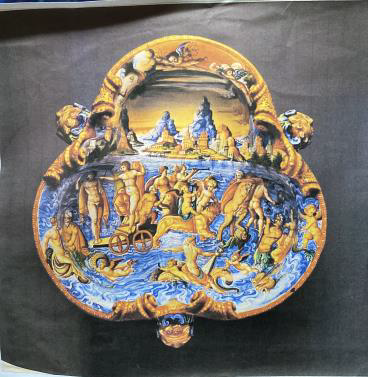
Workshop of Guido Durantino, Wine Cooler with a Marine Triumph of Bacchus. c.1570. Collection of the Metropolitan Museum of Art, New York.
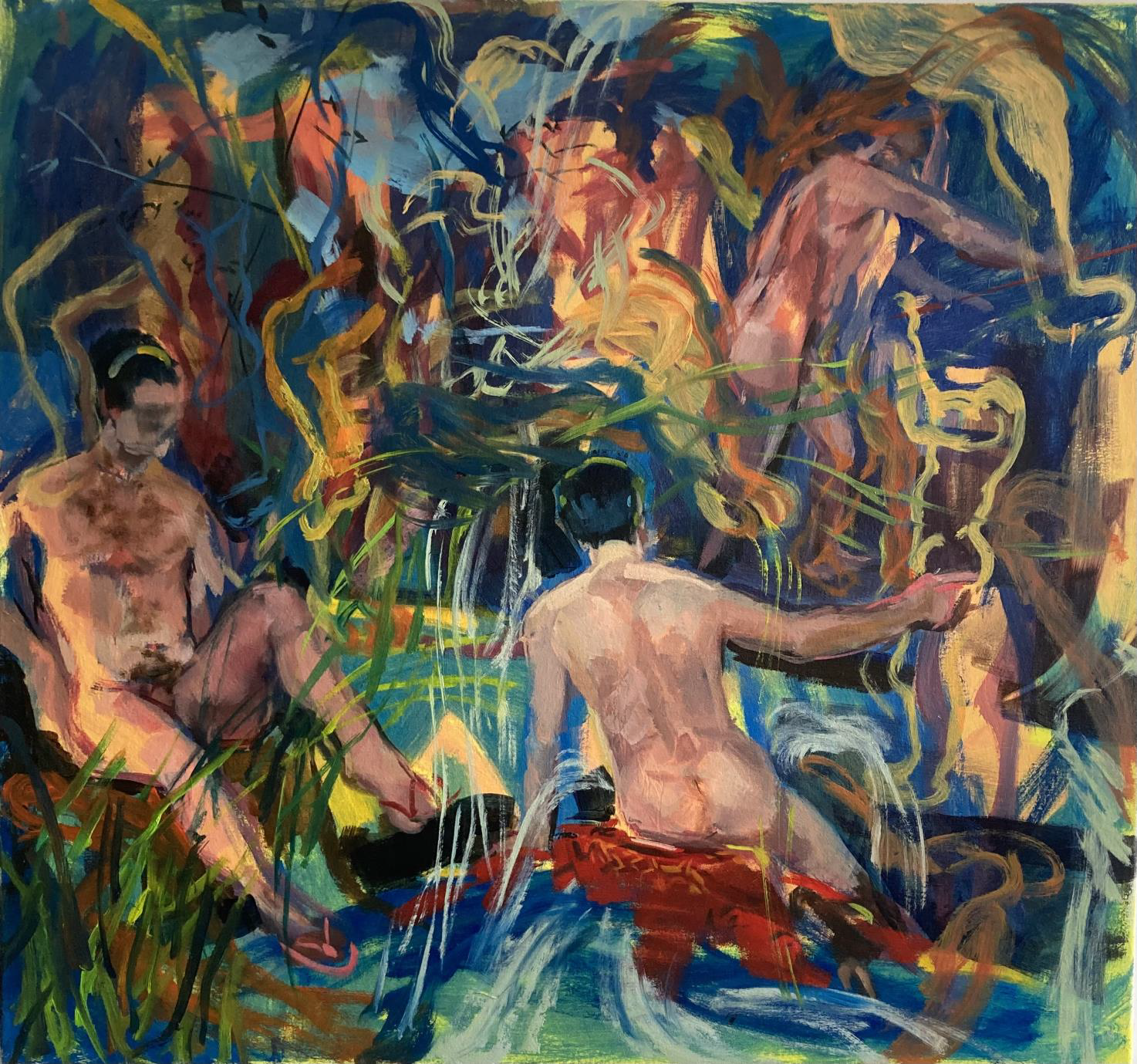
Le Liu and Sharon Thomas, Roughing It. Oil on canvas. 99 x 97cm. 2024.
RDM: Le, what is your reflection on the place of this collaboration in terms of your own development?
LL: I think this collaboration taught me how to stop drawing, which I think is very important. My training in China required me to keep drawing, to a certain point, until the teacher was satisfied. So I would keep drawing and revising, until I was satisfied. But Sharon knew how to finish a painting; she knew how to stop. Later, I would start drawing first, quickly applying colours with my large brush, without thinking, using strong contrasting colours. Then I would give it to Sharon, and she would work with the composition.
RDM: So moving on to the process of the collaboration, you've got several sketch or preliminary drawings that are actually quite important, some of the smaller watercolours and drawings. Can you say something about the place of the sketches in the formation of the series, and where this sits?
ST: Well a lot of sketches, we had to start somewhere, and we worked on paper, because paper is quick and small. I had never collaborated this way before, so we were working on smallpieces, swapping them and seeing what happened. So for me, I love landscape. So I was working old school, in blue washes, fusing references from Breughel and Rubens, and sometimes Eakins’ little classical landscapes, making washpaintings with watercolour. And then I gave them to Le Liu to see what he would do. I had no idea what Le was going to do.
LL: Yeah, and after several times of swapping, we found out where to stop, and what the painting is going to be like. Then after the small drawings were swapped a couple of times, we realised, “okay, that's it, we don't need to continue any more”. Yeah, and it give us a good fundamental for the oil paintings.
RDM: I’m thinking about the beautiful bodies on the grey paper with the black drawing in the background, they certainly shine.
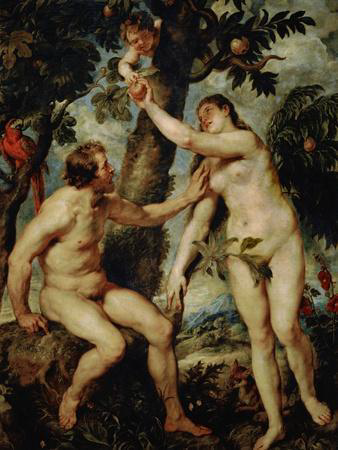
Peter Paul Rubens, The Fall of Man. 1629. Collection of the Prado, Madrid.
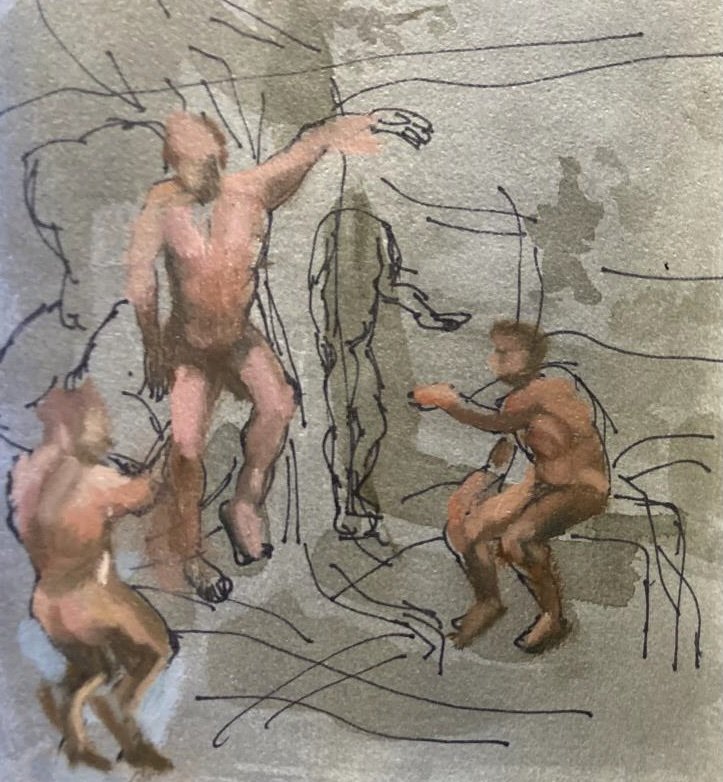
Le Liu and Sharon Thomas, Gathering. Oil on paper. 14 x 11.5cm. 2024
ST: Yeah, they were the early ones, weren't they? Again, I used ink, and then I gave them all to you and then Le made a drawing as well. There are a lot of drawing elements in Le’s work. So you then went for ballpoint pen, and I went “eh?”
So basically I didn't “retaliate” but, okay, then I wanted to bring in tone. So I went over them with PVA and then went in with oil paint on top. So it was like an ink wash with ink with ballpoint pen, and then oil on top, it was a complete mash of different media. But I was seeing what happened with these later, because they are all in very different media.
So Le has a different approach. And again, I think line is important to Le.
LL: Yes. Outlines, all kinds of movement lines are important.
ST: Yes, which is a different energy to me.
RDM: And how did you both achieve the best outcome, because a collaboration requires some compromise and understanding, but you're also trying to create a unified work. How did you arrive at a balance between abstraction and figuration, between you?
LL: Well, I am always more abstract than Sharon. Yeah. I think most of the oil on canvas, I start with these, because I like to use large brushes with very deep colours. My canvas always starts with a yellow background, so I have to use very deep purple and very deep blue to cover it, and then I gave to Sharon, which she felt was a little bit. How do you say it?
ST: Extreme?
LL: Yes…
ST: But I understand what you're doing though. You apply the yellow and I understand why you have to use those colours in conjunction with the yellow in order to give a sense of contrast.
RDM: So you have to meet strength with strength, as it were.
ST: Certainly, yes. I approach it in a different way. So I can, if I want to, if I was going to be evil, I could annihilate what's happened by, well, I could put black over it, which I don't do, but you work with glazes, which is interesting looking at Whistlers, the idea of putting a veil of colour on top of another colour,it alters it but doesn't destroy it. I’m not going to destroy Le Liu's paintings, because I'm liking where he's going, but then my part of the conversation comes in, so the figure might enter in a particular way.
So I'm talking to you in that sense, but we're not talking, having a chat about the weather. I'm just reacting to a line or to colour. And what will come in against the yellow are the peachy flesh tones, which really jar against the yellows. But I'm curious as to what happens if it sneaks in, and what you'll do back to it. And sometimes you've completely destroyed it, I want to cry [laughs], but sometimes I have to stop. I leave it, because I can't alter it. Whereas at some points I can definitely see a way in,so I can do something as well.
LL: Yeah.
ST: So it's a bit nerve-wracking as well. It's like, “how do I do this?” I have to spend a lot of time looking and thinking before I pick up a paintbrush. So it's a kind of crossword; no, it’s more like a Sudoku thing going on.
RDM: A lot of mutual trust involved there.
ST: Definitely, yes.
RDM: The titles, I think, are quite symbolic of the whole philosophy because they're very neutral and comforting, relating to everyday life. So we have, for example, Picnic, Gathering, Holding You, all very comforting. Serving, Slumber Party, great titles. How did you arrive at the titles and what do they tell us about your intentions with the series?
ST: Well, Le is very good with titles.
LL: Yeah, I remember that night when we when we were deciding the titles, we were just talking about what's happening in the image, and we're trying to describe it. We don't want it too definite, but we want to describe what's happening. Yeah, so most of the titles just come out of our conversations.
RDM: So they capture the narrative within.
ST: And then when we need to give it a label, to connect to it, we do it together and Le is usually on fire with titles, and I'm like, “yep yep”, because you're hitting it, interesting in English, knocking out all these kinds of phrases. So you're ahead of me in that respect. An example, what's that one called? Messengers, is the idea of Greek and Roman, the idea of messengers who were cherubs or were sent off to give news to other characters. Actually some of them have got really odd titles; some of them have a North American connection. Holding You was a sensual work. I saw them as being more erotic, and yourself, Le, as being more gentle.
LL: Yeah. gentle. I think most of our characters, they're sort of gentle, and maybe a little bit holy, but not very much.
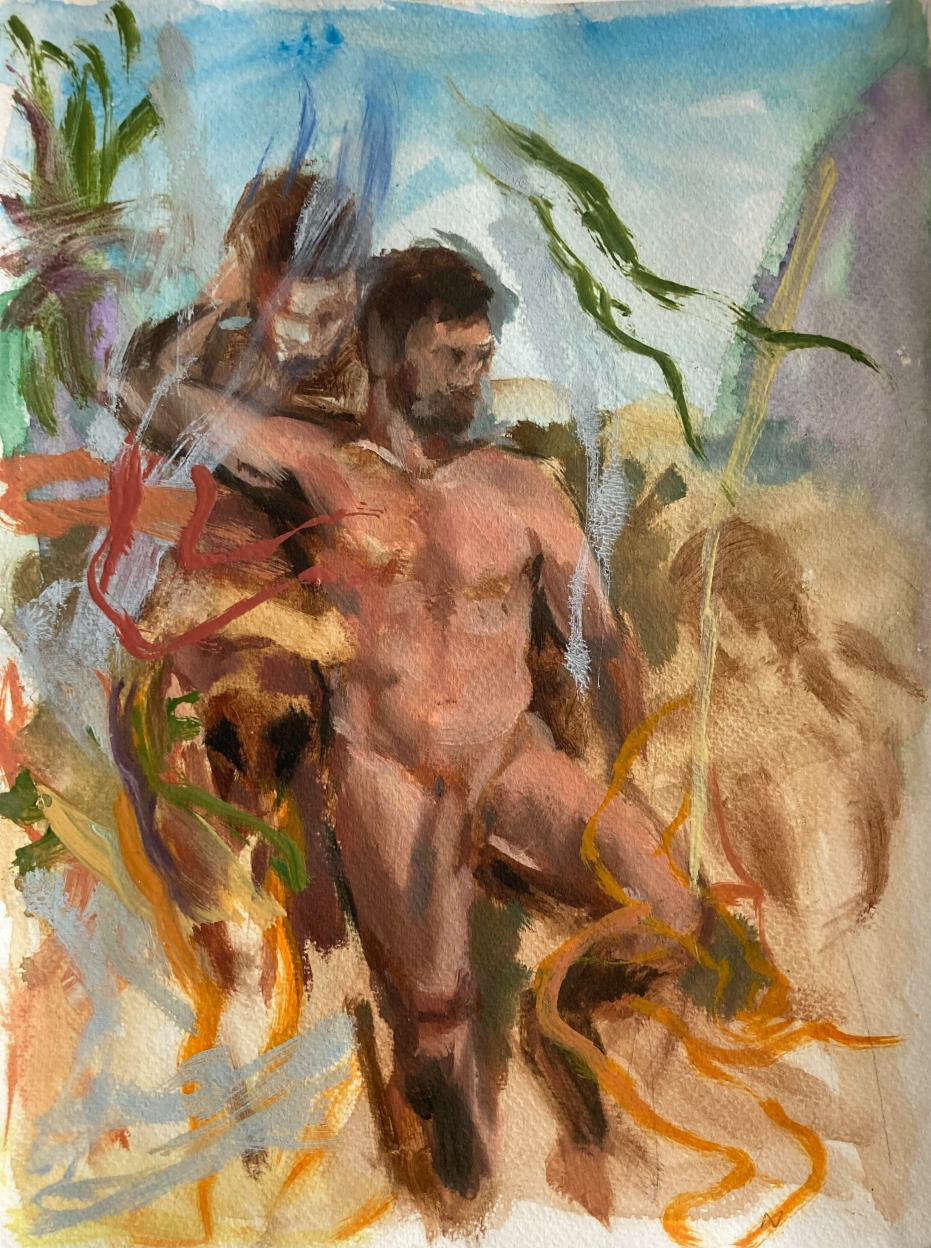
Le Liu and Sharon Thomas, Holding You. Oil on A4 paper. 21 x 30cm. 2024.
Quote from Sharon Thomas on Holding You: “… This started as an intimate photographic group scene of men, where the intimacy is clear and not hidden. I like its composition and lighting. We began with a warm underpainting depicting three of the figures, which Le altered, adding lines and connecting colour. I never know what Le will do to one of my compositions and it’s the same the other way round. The work has four layers, two layers each.”
RDM: So we've got the discussion about the power structures; classical mythology portrays heroes in a position of power, associated with somebody else's downfall, and conflict. It seems that you're challenging that narrative. The subversion is implied, but still very powerful. I'm interested in your positive statements about society and what society we could realise, with the peaceful scenes that we are seeing.
ST: Again, with the painting, we're sharing a journey as we're going. There's not necessarily a set agenda. Essentially, in order to be able to collaborate, we have to get on. We have to listen and watch what we're doing, and not trample over someone's work, because then it's not a collaboration anymore.
RDM: So how much is it about challenge by rendering a peaceful society, people resting amongst the trees? And how much is it just about being joyful and playful, in relation to the collaboration?
ST: With me, I feel it is about being respectful with each other. In our work we are playing with humour. We are laughing a lot, and there are certain things which we see which make us laugh.
LL: Yeah. I think being playful is very important in our collaboration. All of our stories are fused with daily life, because we don't want to be so clichéd as to represent, for example, big love. We also don't want to make it like a utopia. Yeah, we're just trying to be normal and also playful.
RDM: Is it quite close to utopia?
ST: It’s playing, we’re looking at utopia, but that’s a kind of concept in itself. But we don't actually know what utopia is.
RDM: Yes, with utopia, the original idea of it was of a highly structured society, which isn’t the case here, because we don’t see these flaws with structure and power.
ST: Essentially I think we're playing with the symbolism, which has already been set. But the old symbolism isn’t necessarily correct. Hopefully we think society's evolving. I’m not sure if it is to be honest, I don’t think that we've actually changed much in several thousand years. But I think people forget that as well. We think we're always brand new, we hear Trump talking as if he is the new God figure, he thinks he has figured it all out. These things have happened repeatedly for thousands of years. And if you actually look into history, you'll realise these things.
RDM: Well, you're exploding the classical narrative by what you're doing.
Just one final thing, because I know you have to go. Can you tell us about your Whistler Project, which you are researching through the Whistler archives at the Hunterian, and your future directions in terms of collaboration?
LL: I hope we can make not just painting, but also combine them with installations. Yes, and we're trying to use some Chinese materials like silk to combine with painting also.
RDM: So are you branching into different media?
LL: Yeah, yeah, definitely. And we don't exactly know the content of what we're going to draw, but we still are going to follow our feelings and yeah, talk more and consider more.
RDM: So to summarise, it’s all about conversations. The collaboration started with a simple conversation in a gallery and you've arrived at this point, and you're making conversations with audiences, between the present and the past, and the connections are amazing. So thank you so much for this interview.
ST and LL: Thank you.
DESCRIPTION OF SELECTED WORKS
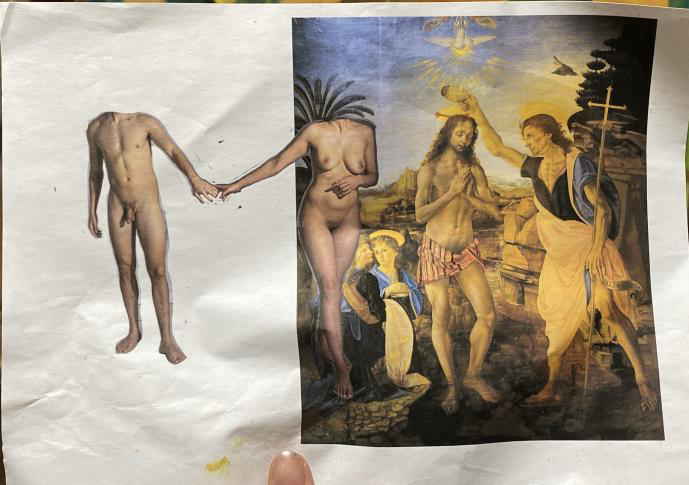
Andrea del Verrochio and Leonardo da Vinci, Found data with Baptism of Christ. 1478.
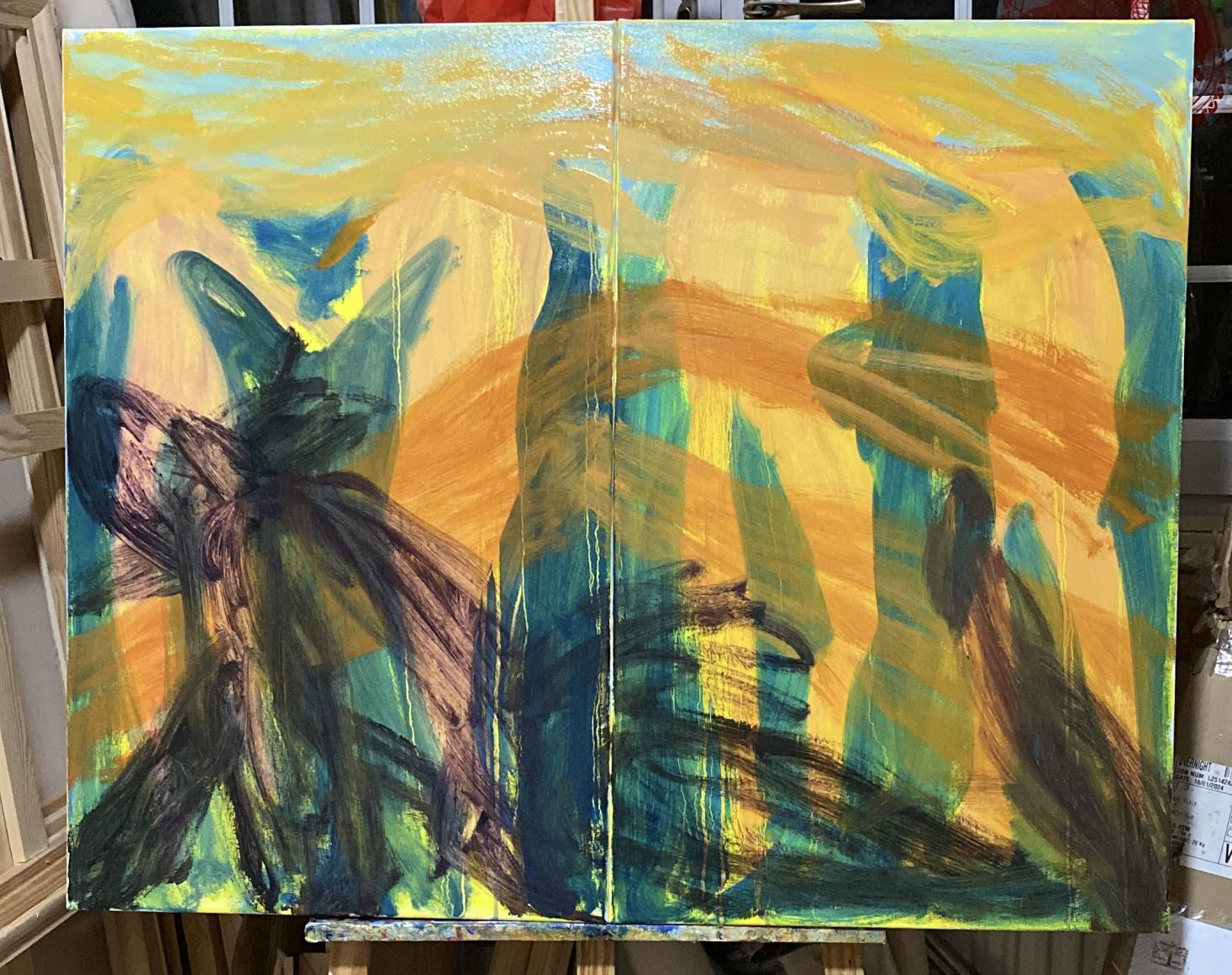
Blowing, Stage 1: Le Liu.

Blowing, Stage 2: Sharon Thomas.
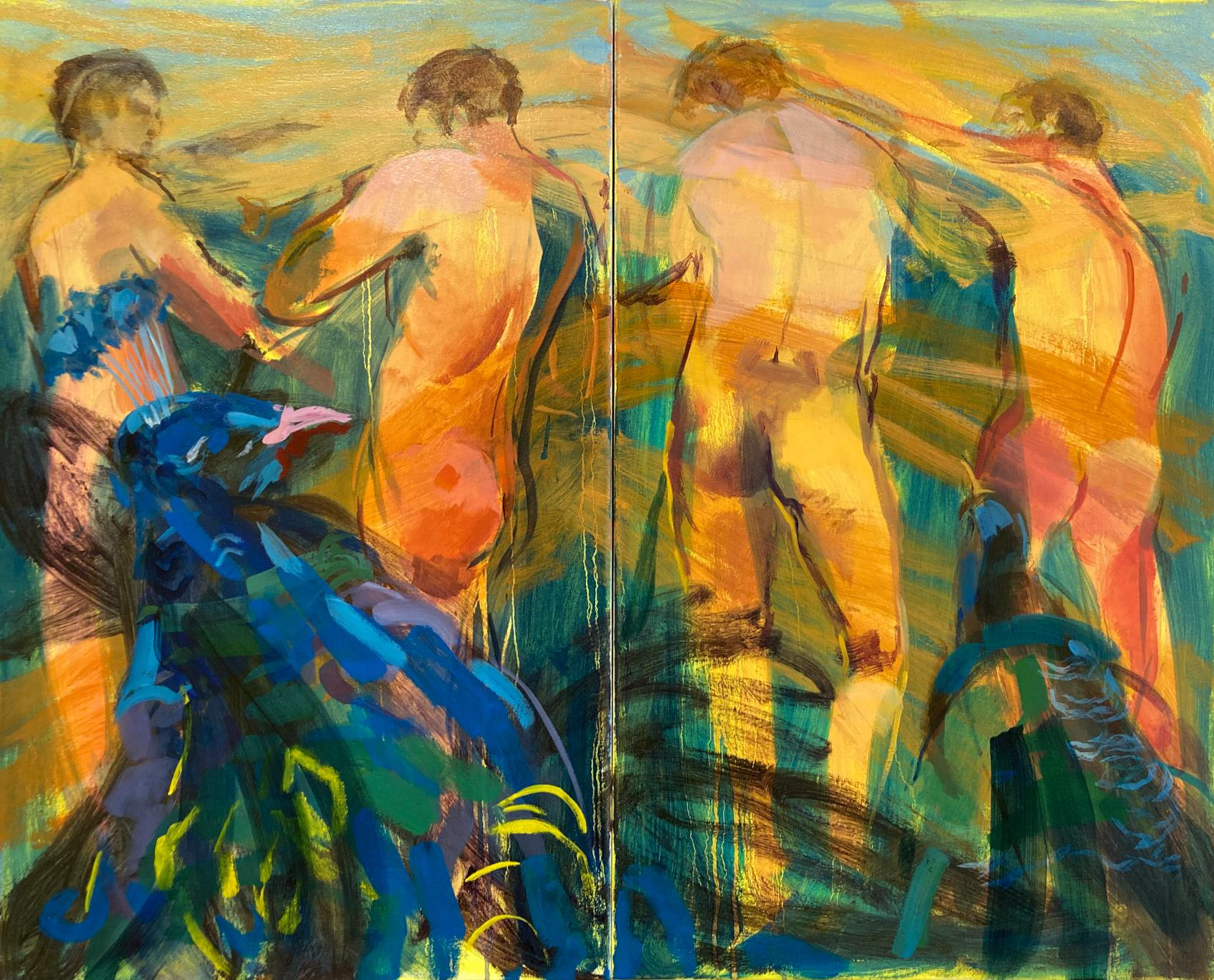
Le Liu and Sharon Thomas, Blowing. Dipytch Oil on canvas. 80 x 100cm, 2024.
ST: The abstract figures became a group of musicians, such as Rubens’ figures blowing horns (Drunken Silenus Supported by Satyrs). The peacocks arrived curious to see what was going on. They are voyeurs... with their colours on show, intrigued as to what the meaning is. The peacock feathers are powerful and compete with the background, but the yellow has power also. There is a battle of colour and noise happening, which I can hear - the troupe of men playing their horns and dancing along.
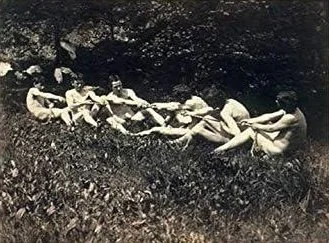
Thomas Eakins (1844-1916), Tug of War. Photograph. No date.
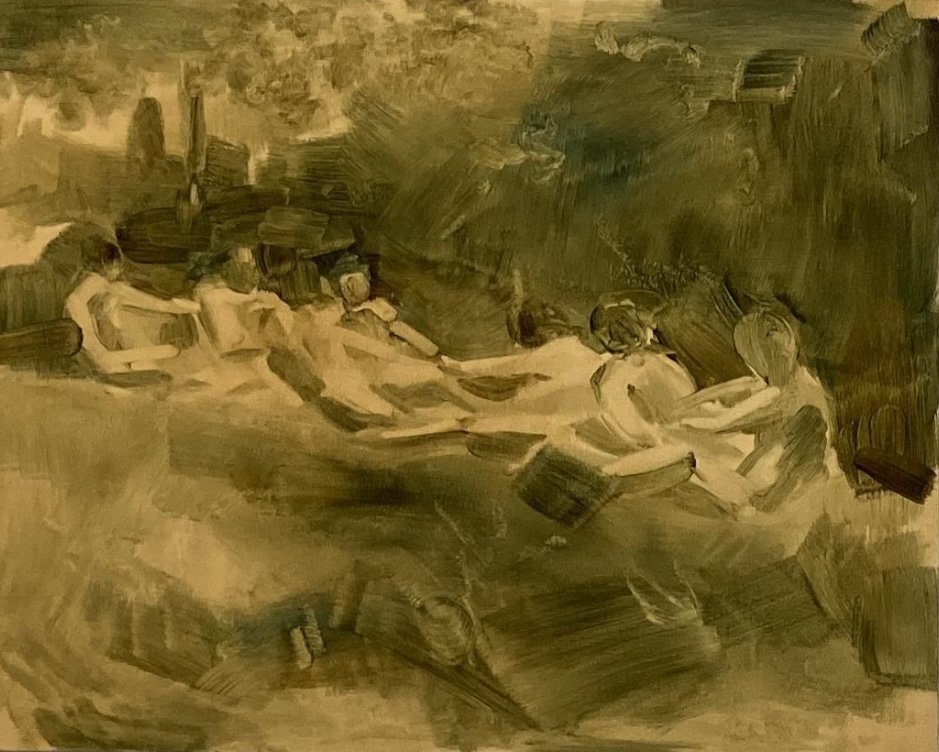
Two sides, Stage 1: Sharon Thomas.

Two sides, Stage 2: Le Liu.
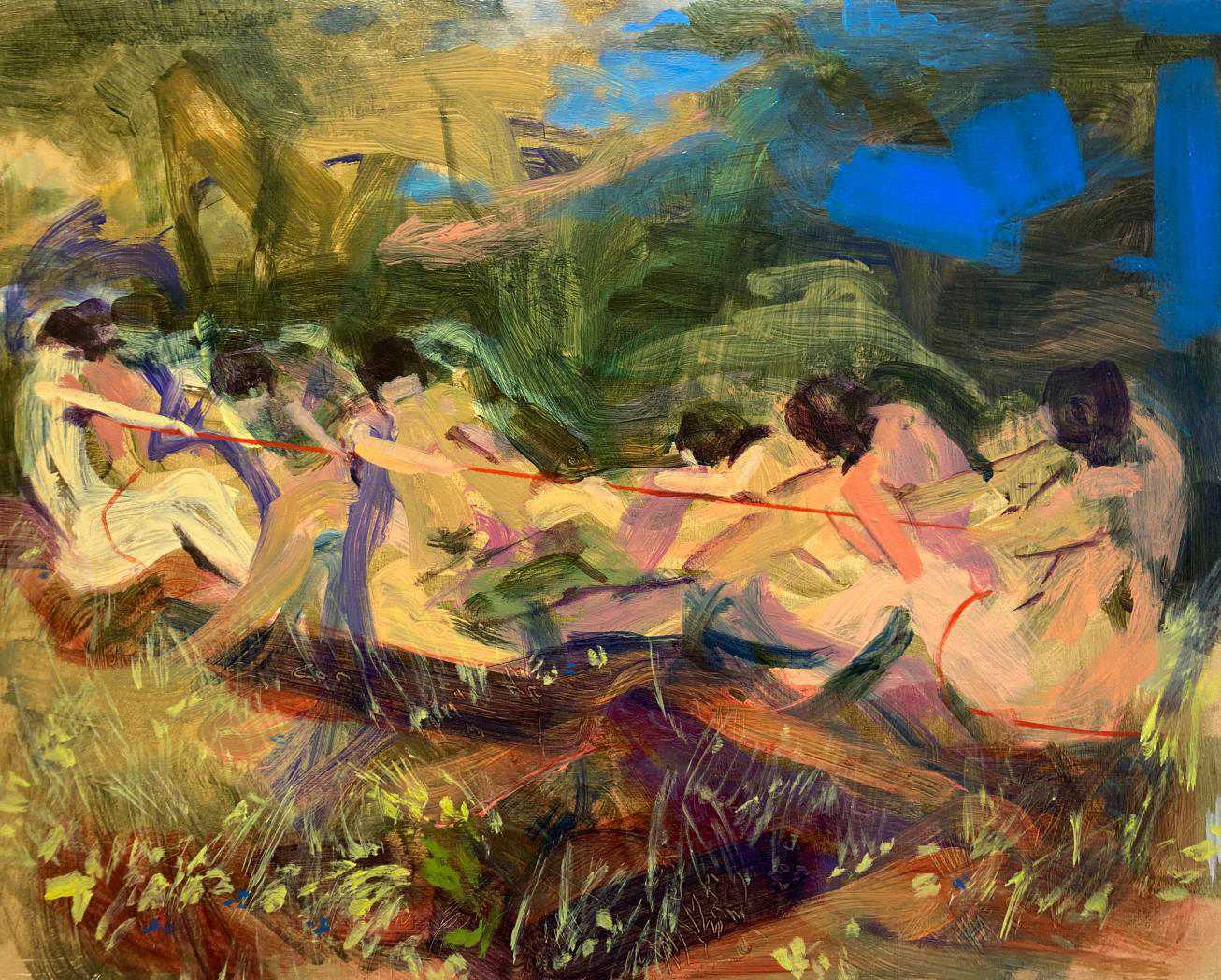
Le Liu and Sharon Thomas, Two sides. Oil on board. 40 x 40cm. 2024.
LL: The painting was initiated by Sharon and then passed on to me. She explained her idea as two opposing groups arranged as a tug of war, and showed me her reference, from the American artist Thomas Eakins. From there, I continued the painting intuitively. We wanted to present a relationship of correspondence and tension between the two groups. At the same time, I did not want to anchor the image to a specific event; I preferred to keep it more ambiguous and open-ended.
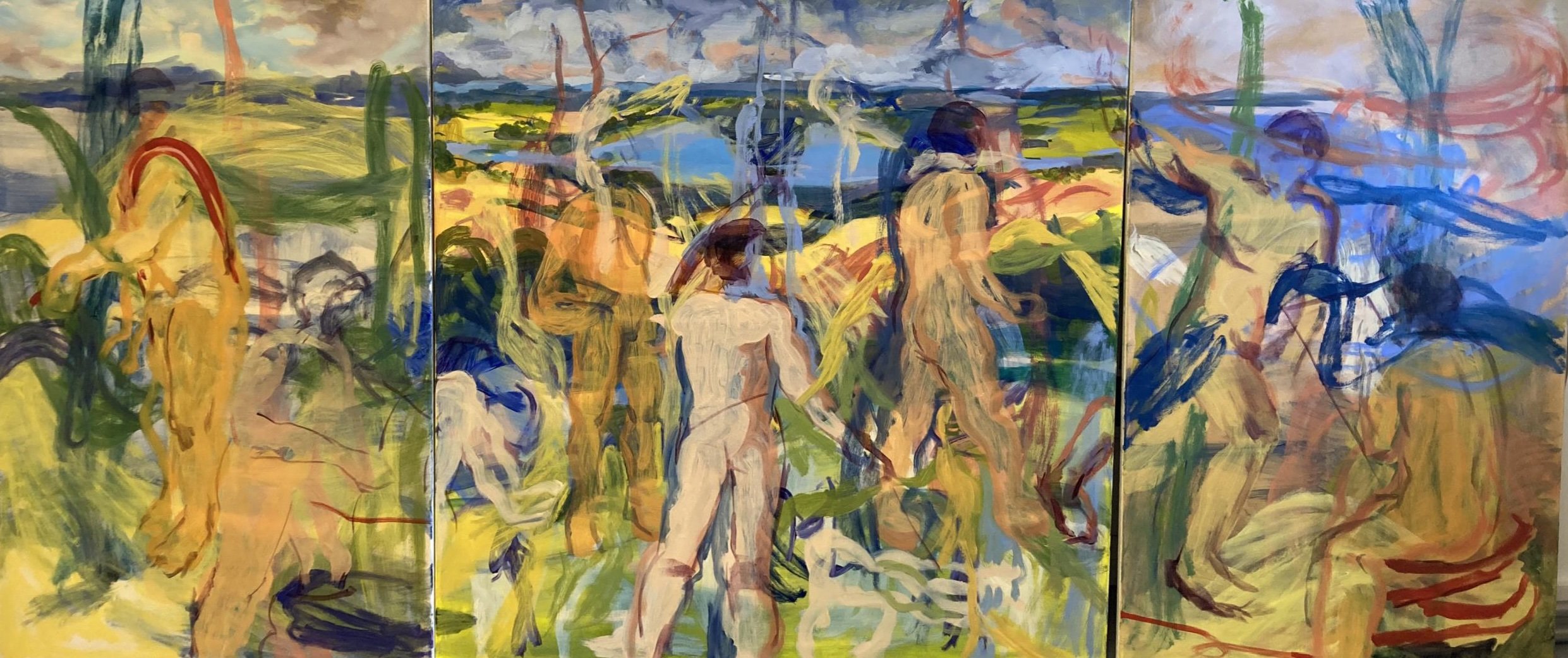
Le Liu and Sharon Thomas, En route. Oil on canvas triptych. 110 x 250cm. 2024. (Inspired by Hieronymous Bosch, The Garden of Earthly Delights. 1510.)
ST: I started the outer panels and Le the central panel. We set the horizon line to connect the works. Landscape, as usual, calls my attention before the figures. Le brought in all kinds of figures, as the painting is all about delights! We had decided that Hell did not exist. So, for me, it was license to have the male figures do as they wish. I manipulated Le's figures to do what I wanted them to do, then Le brought in more!
In Bosch’s work, absurdity, the macabre, the holy, and perspective are all at odds. His work is disturbing, but entrancing. This offered a license to let the narrative go wild…
Eric Fischl was in my head when I saw what Le was contributing to the work. Eric was a lecturer at NYAA where I studied, and his commentary on the “American way” makes me howl with laughter.
With freedom to play, the first figure became a man watering his garden. Bosch played with the surreal, so the mundane can enter too. The central figure walks a dog, which needed to sniff the floor. A classical figure in the far-right panel mows his lawn, whist the lower figure could sit on the water hose reel. The mower driver is waving back to his neighbour out watering his lawn, shouting across the gardens. Everyone is getting on. I am sure you know the songs of Talking Heads: Road to Nowhere. I think you get the picture…
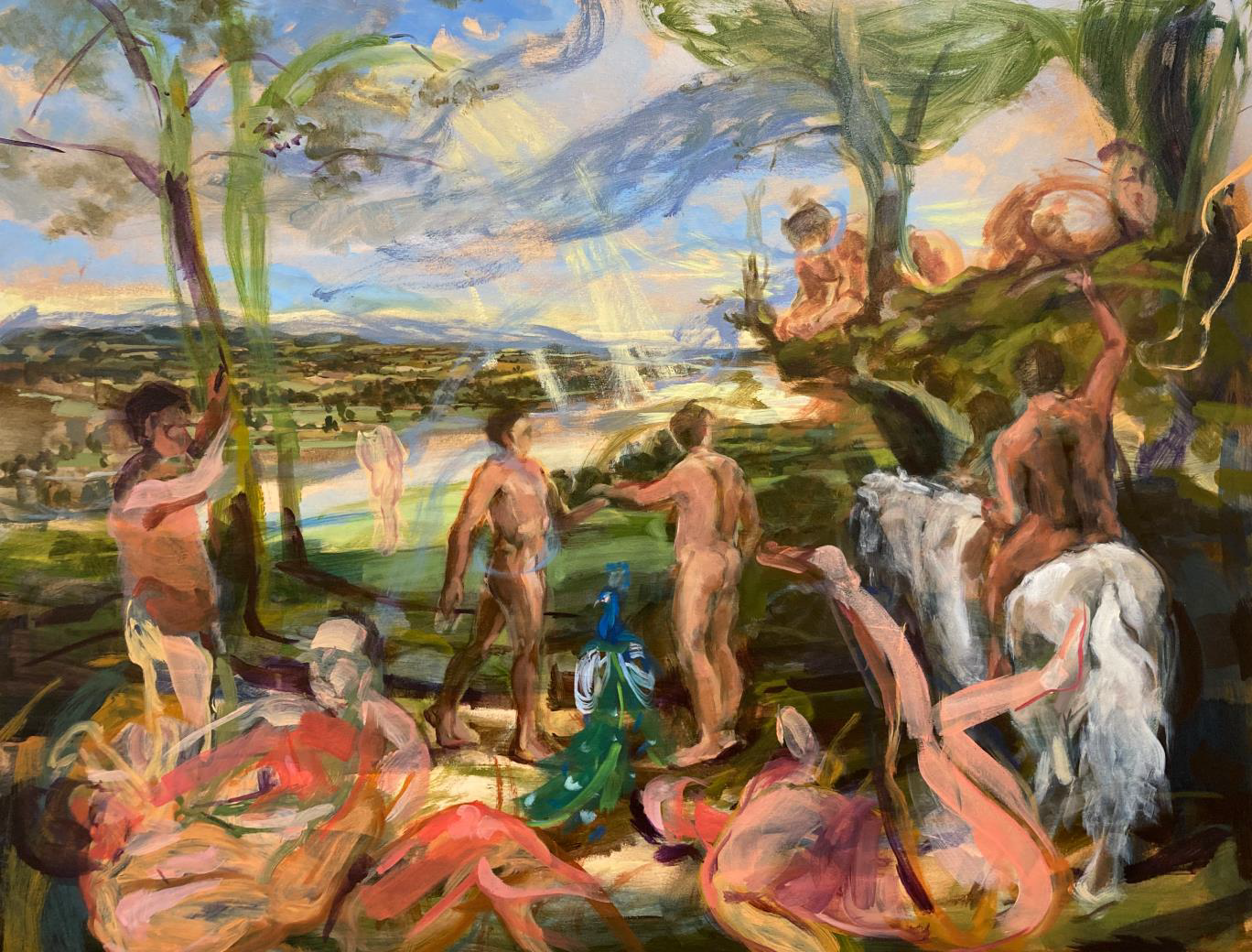
Le Liu and Sharon Thomas, What are you looking at? Oil on canvas. 89 x 115cm. 2024. (Inspired by Landscape with St George and the Dragon, Peter Paul Rubens, 1610, and The Peasant and the Nest Robber, Peter Brueghel the Elder, 1568.
ST: This painting is one of the freest of the series. I offered a warm underpainting of the scene which I then layered with colour. Le took on this work and a foreground arrived including figures and trees. I think the dragon disappeared! I developed a few of the figures. The men in the trees morphed into a scene from a Brueghel painting of men climbing in trees eating apples. For me it became a scene of “witnessing”. The story became about the central figures, which became a noisy space with the figure all talking to each other. I wanted the peacock to enter to create calm. He sits in the centre, possibly making peace. There has been no killing or presentation of 'manhood' or 'the divine', though Le presented a holy glow from the skies onto the right figure…
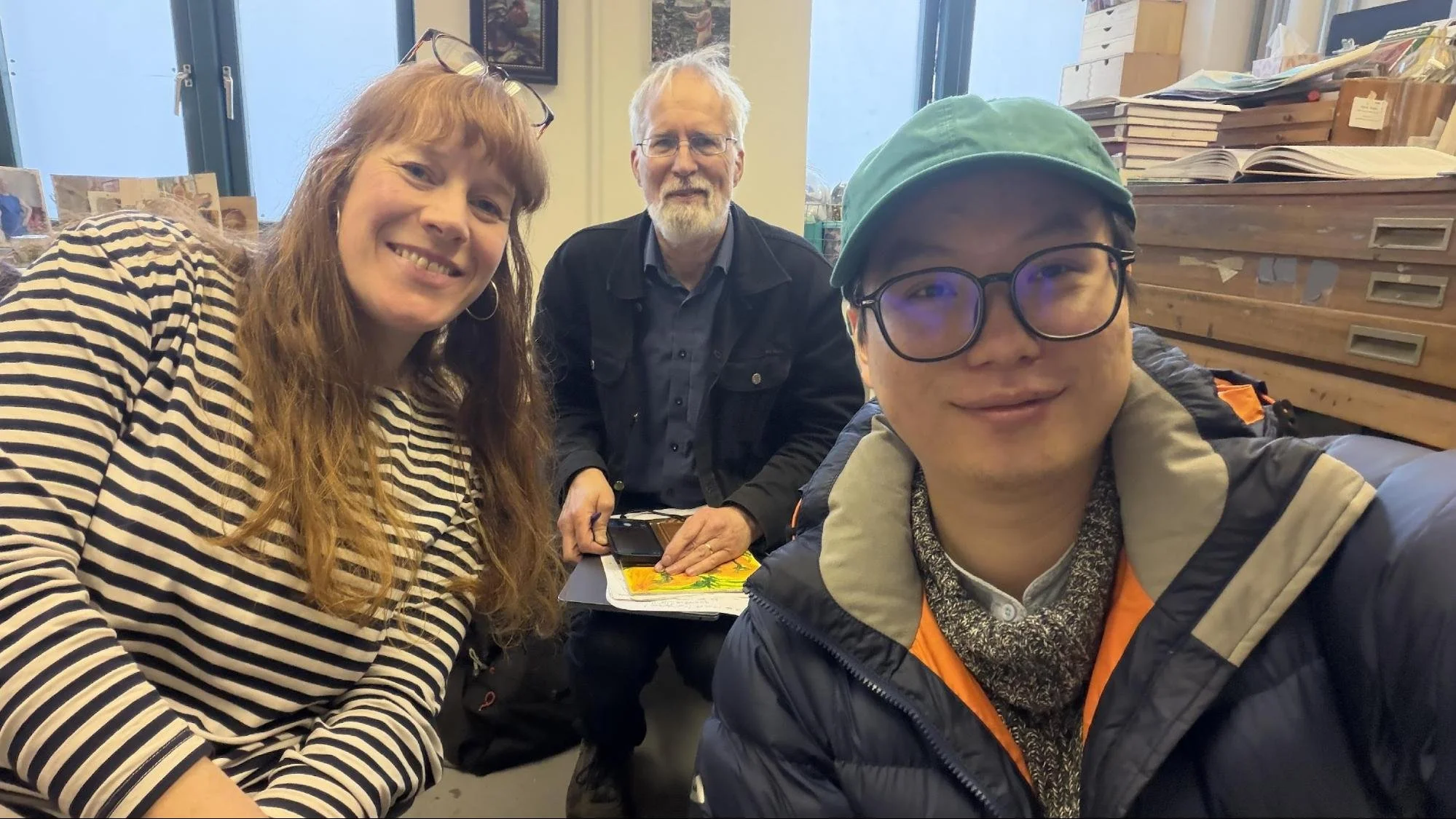
Sharon Thomas, Robert De Mey, Le Liu, Trongate, Glasgow, 15th January, 2026.
The above interview was constricted in terms of the available time, and a small number of conversations outside of the core interview have been incorporated.
REFERENCES
1. Apollonion/Dionysian dichotomy as described by Friedrich Nietzsche in The Birth of Tragedy - described in an article by Antonis Chaliakopolous in The Collector, 13/01/2022.
https://www.thecollector.com/nietzsche-philosophy-apollonian-dionysian/
2. The Apollonian and Dionysian: Nietzsche on Art and the Psyche, in Philosophy Break, by Jack Maden, March 2024.
https://philosophybreak.com/articles/apollonian-and-dionysian-nietzsche-on-art-and-the-psyche/
3. 500 Years of Western Painting, Sichuan Fine Arts Publishing House Company Limited.
4. Michael Sullivan, The Arts of China. First published 1961. 6th Edition published by California University Press, 2018.
Le Liu
Artist website: https://www.leliugallery.com/portfolio
Instagram: @leliu
Sharon Thomas
Entry on the Alumni Association of the New York Academy of Art:
https://www.aanyaa.org/online-members/sharon-thomas
Artist website: https://sharonthomas.co.uk
Instagram: @sharonthomasart
The Garden of Eden Exhibition Catalogue is available from Sharon Thomas via https://sharonthomas.co.uk/contact-2/
£5 including P&P for the UK - other rates apply for international postage.
All images of artworks by Sharon Thomas and Le Liu are copyright of the artists.
Garden of Eden - complete list of works
Grab it, oil on paper, 16x11cm
Blowing, oil on canvas, 80x100cm
Gee Up, oil on paper, A4
Ruby (ST), oil on canvas board, 12x10cm
Revealing (LL), oil on canvas, 101x71cm
What Are You Looking At? oil on canvas, 89x115cm
Picnic, oil on board, 40x50cm
Gathering, oil on paper, 14x11.5cm
Holding You, oil on paper, A4
En Route, oil on canvas, 110x250cm
Washing, oil on wood, 25x20cm
Get Set, Go, oil on wood, 25x20cm
Serving, oil on wood, 25x20cm
I’ve Got You, oil on wood, 25x20cm
Disturbance, oil on paper, A4
Slumber Party, oil on paper, A4
Messengers (Two), oil on board, 40x25cm each
Roughing It, oil on canvas, 99x97cm
Do It, oil on board, 40x50cm
The Wrestlers, oil on paper, A6
Head Turner, oil on paper, A5
Dive, oil on board, 40x50cm
Two Sides, oil on board, 40x50cm
After You, oil on paper, A4