
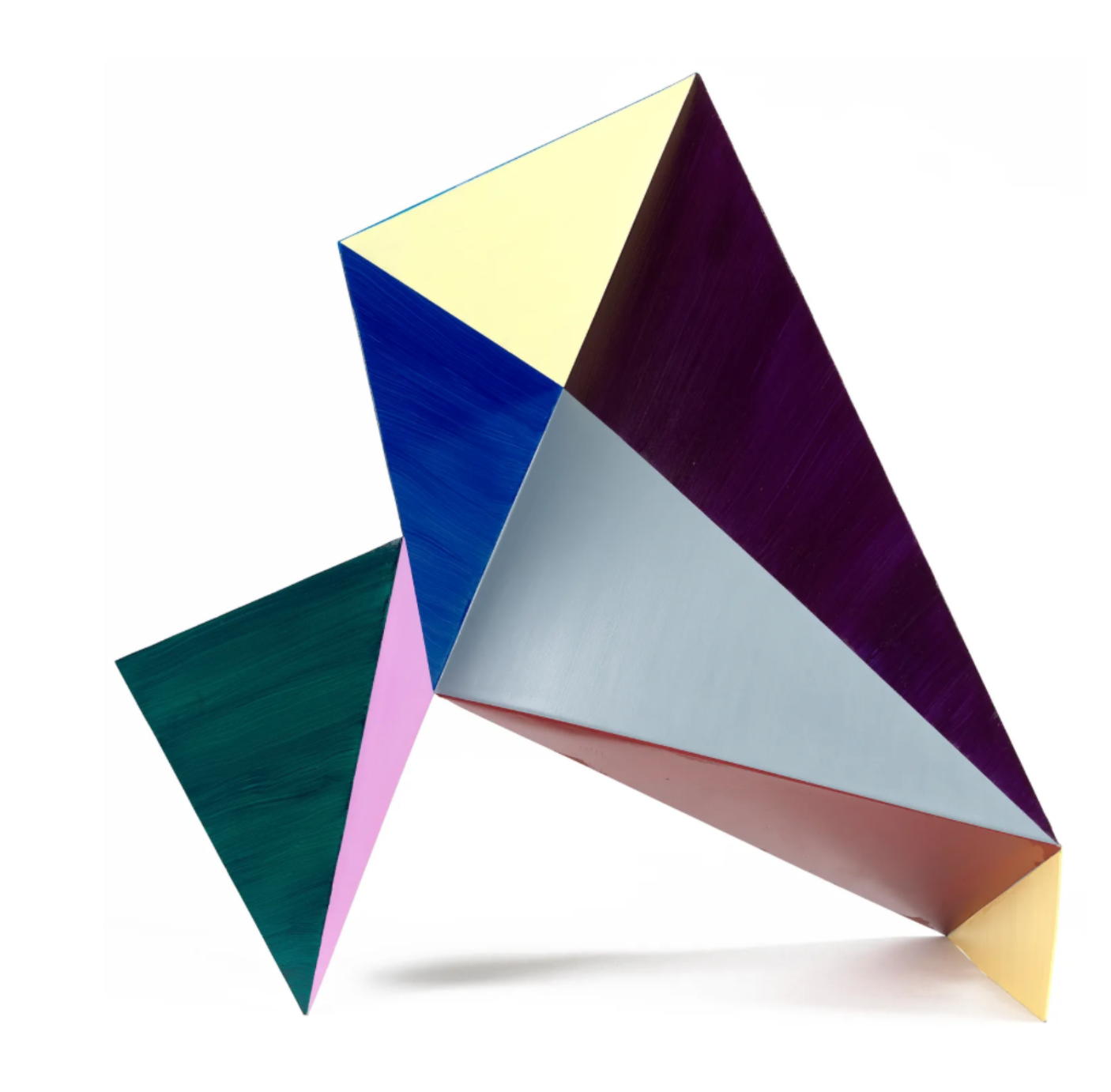
John McLean: Abstraction Through Dimensions
While assisting The Fine Art Society in cataloguing John McLean’s estate, I first encountered the artist’s few sculptures as deconstructed fragments; sheets of thin, vividly coloured metal stored flat and upright, easily overlooked in a storage room overwhelmed by portfolios of prints and boxes of ephemera. Standing whole, each form revealed itself to be a geometric puzzle, unpeeled from the flat surface of McLean’s canvas and folding together like origami: dancing, animated, alive.
John McLean, son of painter, illustrator, and educator Talbert McLean, was born in Liverpool in 1939 (1). Raised in Arbroath, McLean was educated first at St. Andrews in English before studying Art History in London at the Courtauld, though he never received formal artistic training. Talbert, well-acquainted with the artist’s struggle to make a living, discouraged his son from pursuing education in fine art. However, he maintained a close circle of friends comprised of fellow artists and former students: fertile ground for McLean’s informal creative education (2).
Art historian Duncan Macmillan named Talbert “a pioneer among Scottish abstract artists” (3). This exposure, alongside McLean’s engagement with London’s Stockwell Depot throughout the 1960s and 70s—an internationally recognised centre for abstraction in the United Kingdom—likely shaped the artist’s interest in non-objectivity (4). It was at Stockwell that McLean first experimented with sculpture, learning to weld and cut steel while working among former students of English sculptor Anthony Caro. Interestingly, this would not be McLean’s only intersection with Caro. McLean’s lyrical, painterly approach to abstraction was deeply informed by time spent at Saskatchewan, Canada’s Emma Lake artist’s workshop, beginning in 1981; Caro himself undertook a residency at the 1977 summer session (5).
Investigations of Emma Lake’s impact on McLean’s two-dimensional work connect the artist’s approach to abstraction in painting with his later experiments with sculpture. At Emma Lake, McLean connected with some of modern art’s most radical creatives and critics, citing the influence of Clement Greenberg to his work in painting at this time (6). Greenberg was profoundly important to the development and aesthetic sensibilities of Emma Lake, with his arrival called the workshop’s “most pivotal moment” (7).
This essential critic of the twentieth century avant-garde was, in this new stage, interested in a more formal approach to modernism which deviated from Abstract Expressionism: “Abstract Expressionism was dense and compact; the new style is clear and open. Abstract Expressionism used accents of dark and light; the new style employs colour” (8). Clarity, expansiveness, colour: these qualities defined the Canadian prairies and affected McLean profoundly, qualities which Greenberg’s Emma Lake saw as the crux of this post-Pollock, post-painterly abstraction (9). The prairies of Western Canada possess a light stronger, brighter and clearer than the subtle illumination of Scotland and England. For McLean, this environmental shift entirely changed his approach to colour, inspiring a boldness which deviated from the close tonality of his early pictures (10).
Art critic Tim Hilton underscores an essential aerial quality imparted by the Canadian prairie onto McLean’s work; John Elderfield agrees. For Elderfield, the interplay of Canada’s vivid light on the flat prairie landscape “induces mirages,” producing in McLean's painting “unlocatable forms floating in a shimmering ether” (11). This is most obvious in works like Paint Box where McLean sets his boldly coloured forms against a flickering ground of Translucent peach, pink, orange, and purple.
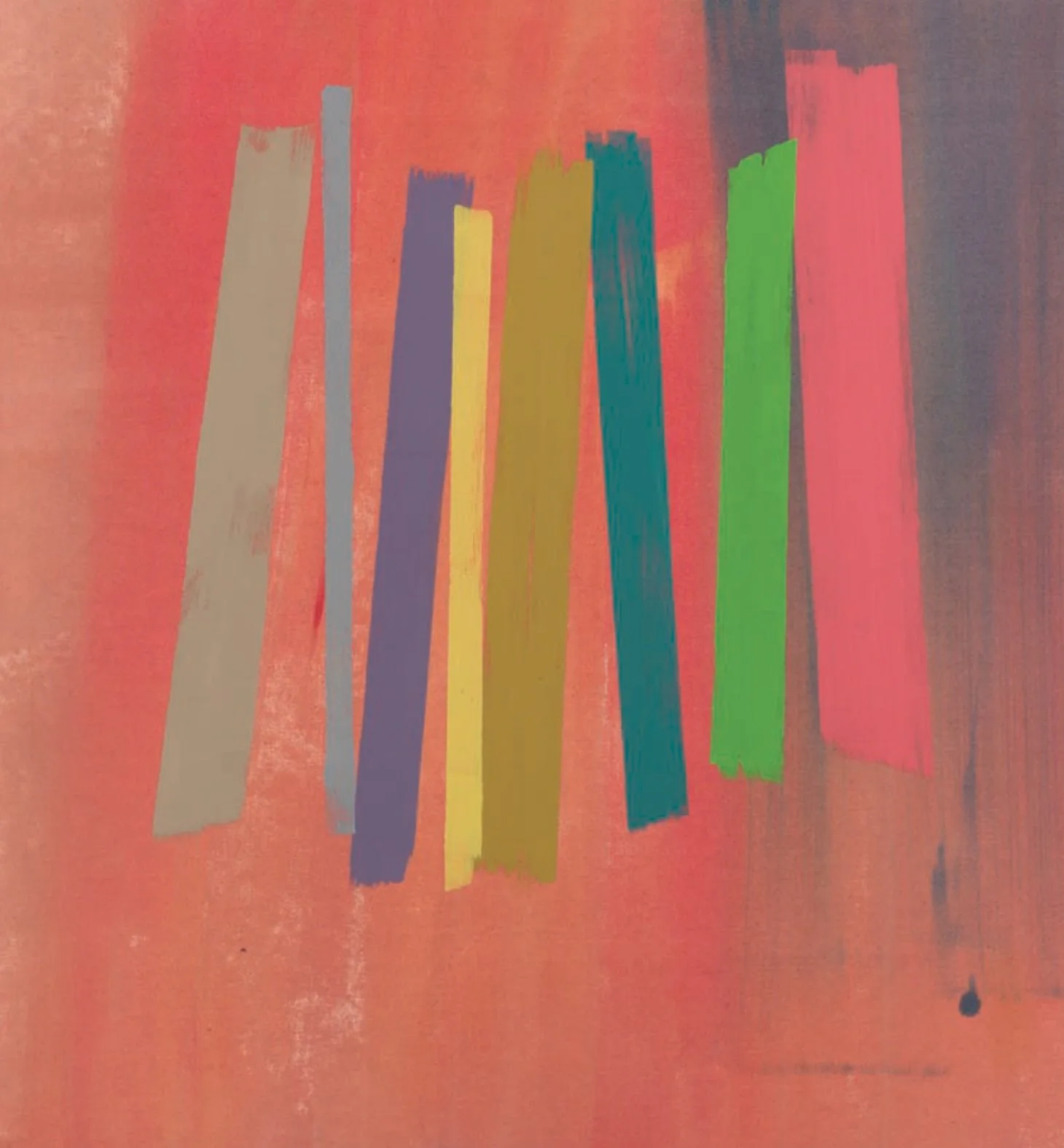
John McLean, Paint Box. Acrylic on canvas. 103.5 x 109.8cm. 1988. Courtesy of The Fine Art Society.
In this ether dance eight strokes of opaque paint in vivid colours, forming rectangles of varying thicknesses which lean on each other for balance, rhythmic in their intersection. Suspended in a dusky sky, viewers might recall evening light refracting through clouds, rainbows reflected through mist. McLean himself remembers watching the sun set as he descended into Saskatoon, light “scintillating off every drop of water from the distant horizon, right to my eyes” (12). Paint Box illustrates this brilliance.
Like many abstract artists, John McLean’s two-dimensional compositions rely on the relationships which develop between juxtaposing forms as colours interplay and lines intersect. The resulting picture records a conversation exchanged by formal elements, evocative of Wassily Kandinsky’s aesthetic theory of composition outlined in his book Concerning the Spiritual in Art, a text crucial to twentieth century geometric abstraction and cited by McLean as particularly influential to his artistic practice (13). For Kandinsky, it is the relationship of one form to another which decides the whole work’s composition, a harmonic arrangement recalling the artist’s view of abstraction as an application of music’s methods to art (14). McLean, too, underscores music’s relevance to abstract visual expression. He sees each element of a completed work as interdependent, forming an absolute which joins the eye and spirit through observation as the ear and soul are unified in music (15). This sentiment is echoed by Piet Mondrian, another figure vital to geometric abstraction’s genesis and who, like McLean, sees universality - the absolute - arise “in a composition from the mutual relations of forms” (16). Across McLean’s oeuvre, there is something of Kandinsky’s liquid, lyrical line, as well as Mondrian’s rhythmic rigidity of shape and colour. These crucial elements are present not just in his paintings, prints, and collages, but in the sculptures which translate those pictures through dimensions.
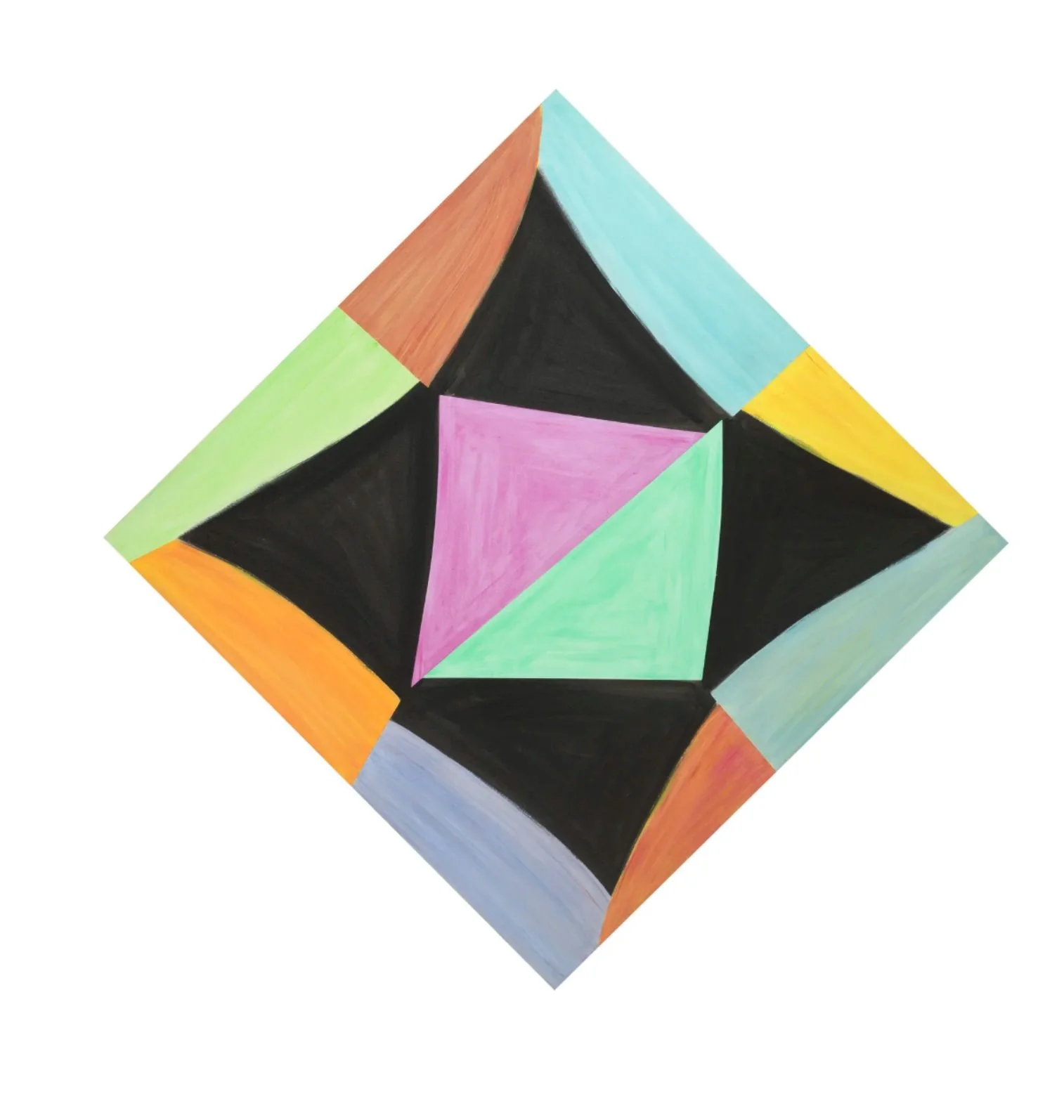
John McLean, Untitled (2008). Acrylic on canvas. 172.75 x 172.75cm. 2008. Courtesy of The Fine Art Society.
Untitled, 2008 is almost sculptural in itself. McLean turns his square canvas to stand defiantly en pointe, and at over 170 centimetres, the painting has all the presence of a Calder mobile spinning in space. It is a picture which plays with angles and jagged corners, refracting the diamond shape of its body in shards across the canvas. At centre, a square is bisected—pink at left, green at right—and hastily reconstituted, no corner flush with the other. This splintered shape sits atop a black diamond similarly shattered and irregular, each of its points reaching to its corresponding corner of the canvas. Framing these forms are tiles in many colours, each overlapping, with corners and joints visible. The gentle texture of McLean’s brush leaves guiding lines which gesture to each shape’s edge. A year later, Giocoliere folds Untitled, 2008 along the seams of these forms to balance arabesque à terre . As a viewer circles this aluminium sculpture, it shifts, kaleidoscopic. The work is comprised of triangles brightly coloured by paint, its brushed texture undisguised and deviating from the smooth finish of most modernist polychrome sculptures. The varied effect is deliberate: this sculpture’s painterly surface connects it to the visual language and technique displayed by two-dimensional works like Untitled, 2008 (17).
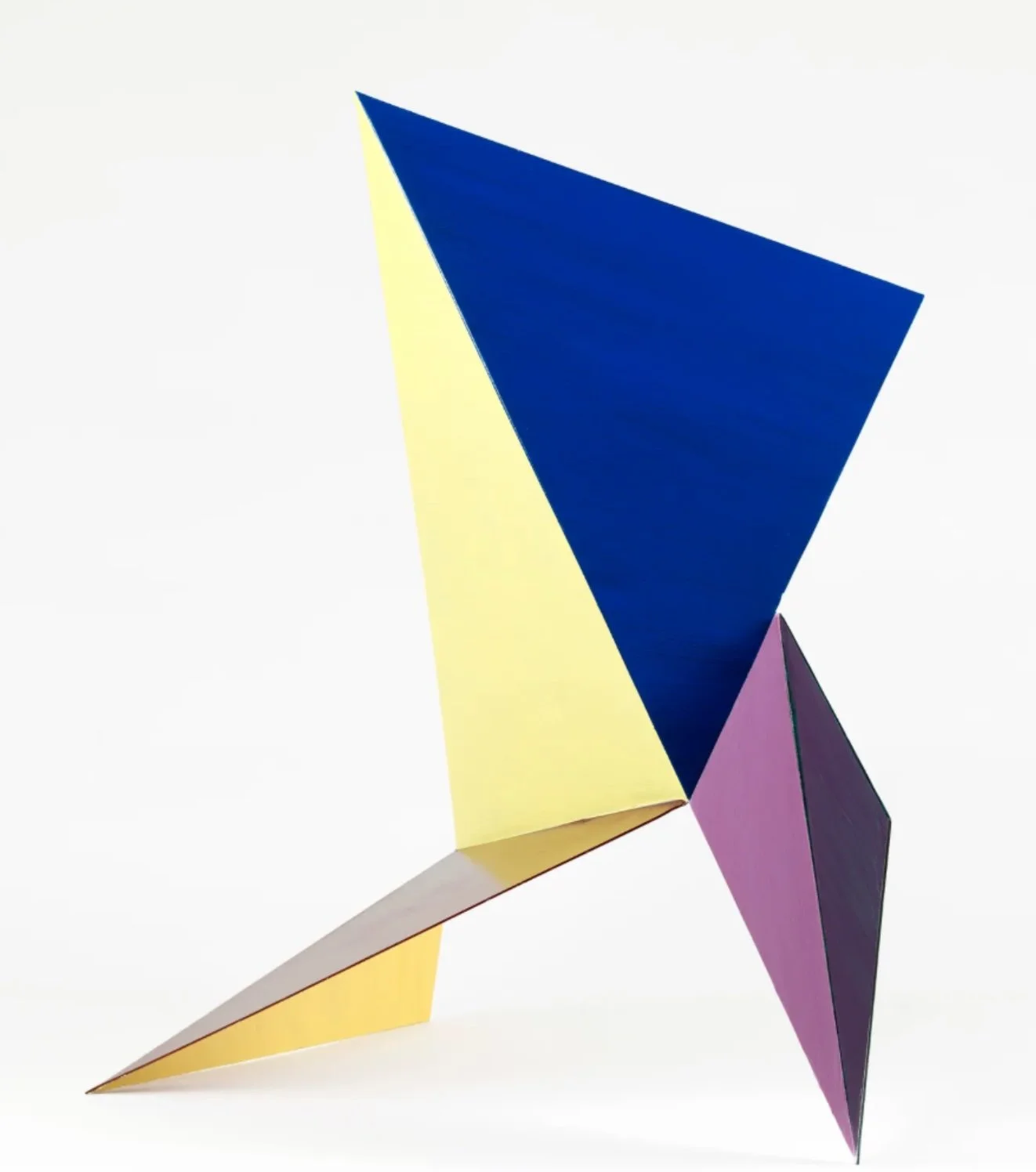
John McLean, view of Giocoliere. Acrylic on etch printed aluminium. 80 x 80 × 63.5cm. 2009. Courtesy of The Fine Art Society.
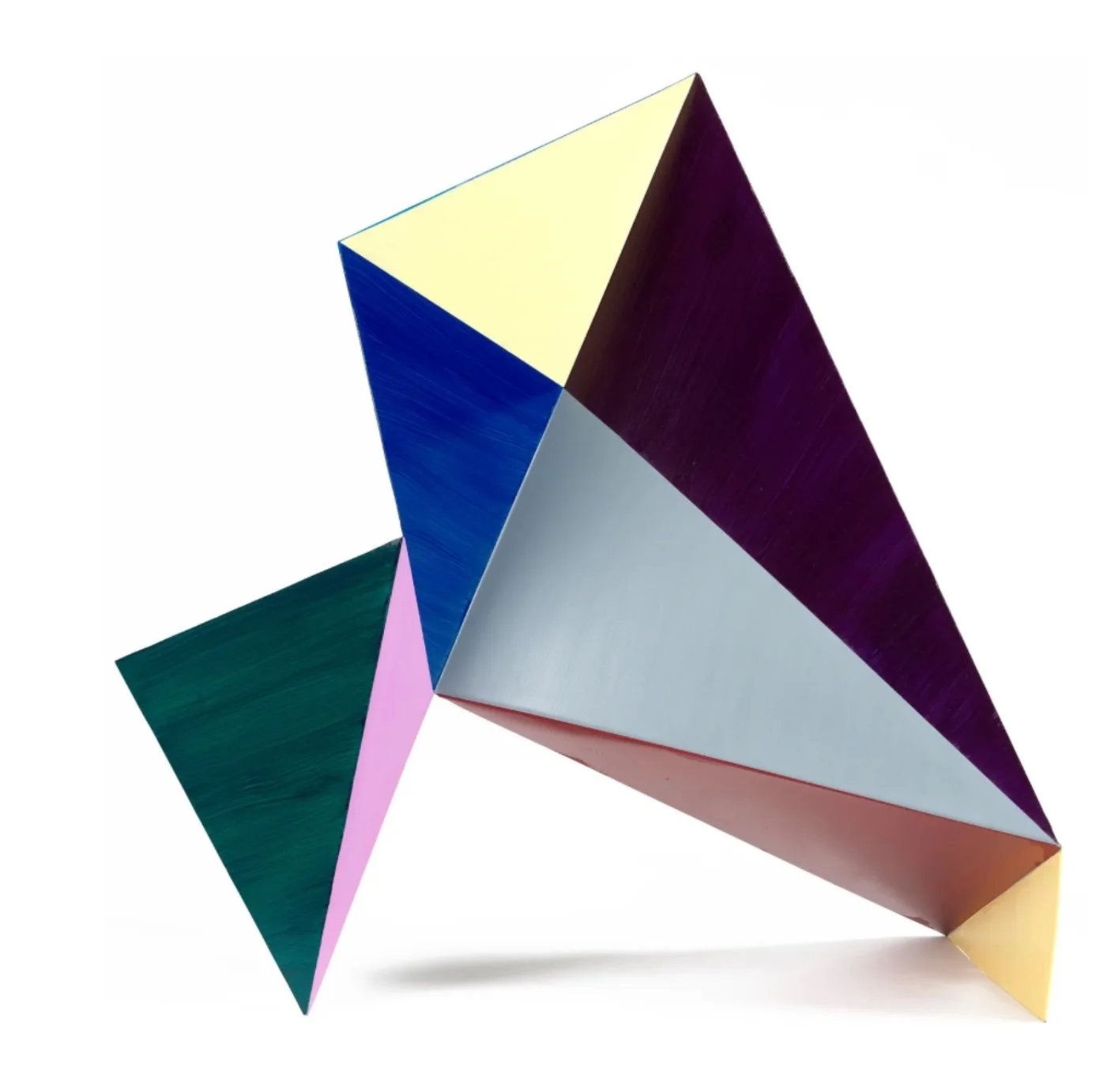
John McLean, view of Giocoliere. Acrylic on etch printed aluminium. 80 x 80 x 63.5cm. 2009. Courtesy of The Fine Art Society.
McLean recognises the vocabulary shared by his free-standing sculptures, paintings, and collages, noting explicitly their simple shapes and reliance on colour (18). His two-dimensional work, though considered, was the product of instinct and spontaneity; similarly, McLean saw making sculpture as “more an impulse than an idea” (19).
In particular, works like Giocoliere and its siblings emerged as the artist played with scraps of heavy watercolour paper, cutting and gluing. McLean underscored the importance of retaining paper’s lightness: what he called “making [the sculptures] dance” (20).
As a result, each sculpture balances delicately on no more than three points—or one point and one line—ready to spring into grand jeté, with all the lightness and energy of his Emma Lake pictures. Crucially, it was at Emma Lake that McLean re-discovered sculpture by returning to welding, which he found gave him “the freedom of collage and the fluency of drawing in space” (21).
The sculpture he produced was lost after a single exhibition at Saskatoon’s Art Placement gallery. Like McLean, Anthony Caro was meaningfully influenced by the American avant-garde and in particular Clement Greenberg, who he encountered during a visit to the United States in 1959 rather than through Emma Lake. After this trip, Caro began painting his sculptures in vivid primary colours. This surface treatment deviated from twentieth-century polychromic sculpture’s tendency to favour cleanly fused glazes fired on ceramic; instead, Caro brushed his metal with paint.
Importantly, McLean names Caro as one of the artists which inspired his own use of this atypical method employed in Giocoliere and its siblings (22).
Hilton affirms a personal connection between McLean and Caro, calling them “long-time friends,” which further underscores the influence Caro likely had to McLean’s sculptural practice, beyond the artist’s connection with Caro’s students (23).
McLean and Caro both produced work informed by Emma Lake’s rural prairie environment, though for Caro this was more practical than philosophical. The sculptor found himself “200 miles north of Saskatoon on a gravel area with only a crane lift from the back of a truck” (24). Consequently, Caro’s Emma Lake sculptures utilise light, easily transportable and workable materials like steel tube and angle irons, producing skeletal, linear sculptures which experiment with negative space.
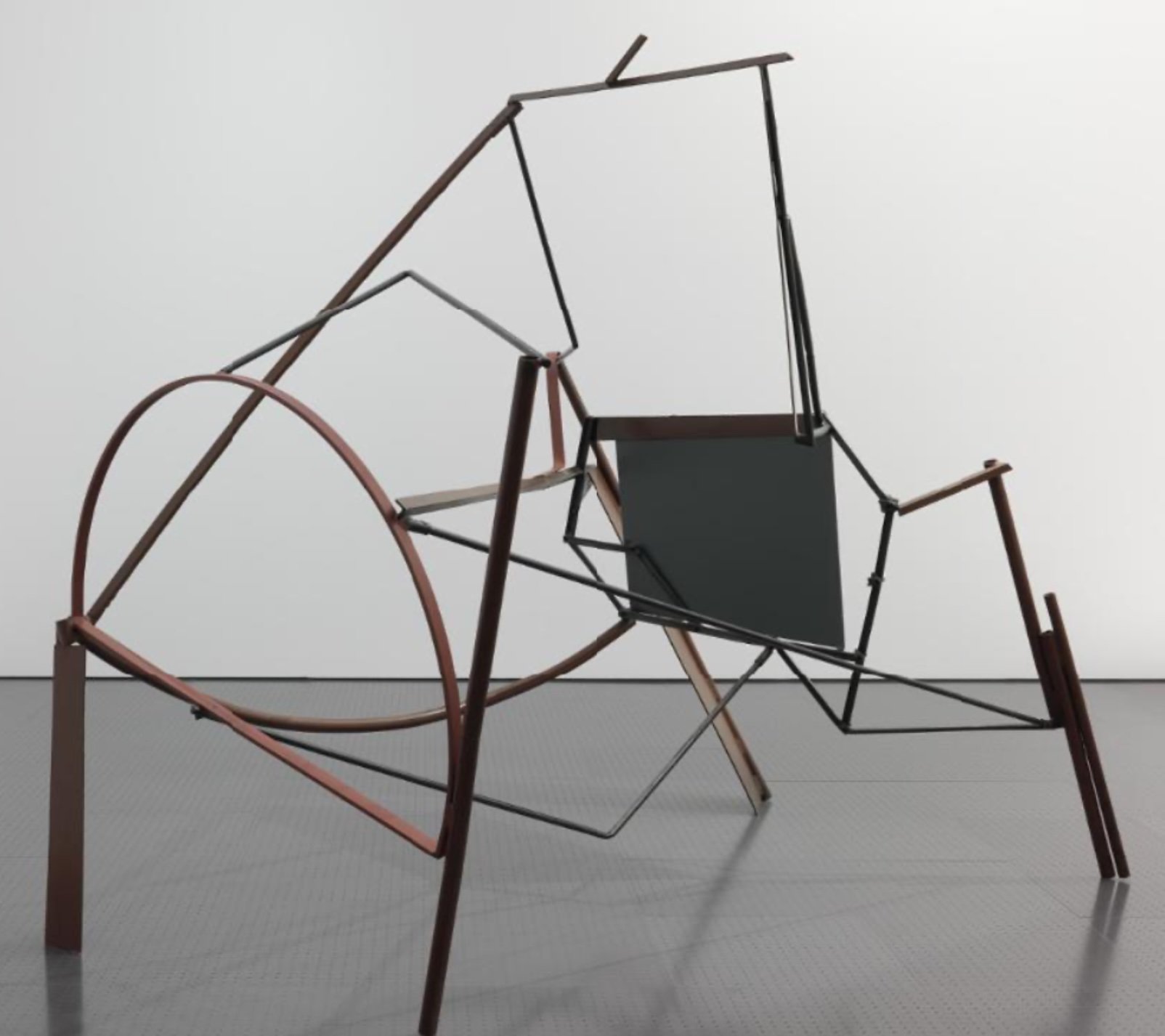
Anthony Caro, view of Emma Dance. Welded and rusted steel with red paint. 240 x 249 × 282cm. 1977—1978. Courtesy of Centre Pompidou.
In Emma Dance, joints jut and intersect. Gesticulating appendages form shapes which themselves intertwine and overlap as Caro abstracts the movement and action of dance, evoking Giocoliere’s irregular legs. Like Caro, McLean uses imbalance and asymmetry to lend his sculptures lightness, make them move. With only two opaque surfaces and its remaining planes outlined in bent steel—implied rather than realised—Emma Dance complicates ideas of interiority and exteriority. Space becomes permeable: the sculpture’s shape and structure forces inside and outside to twist, interact, unify. Balancing on four legs, leaning perilously in defiance of gravity’s pull, each line of the sculpture is interdependent.
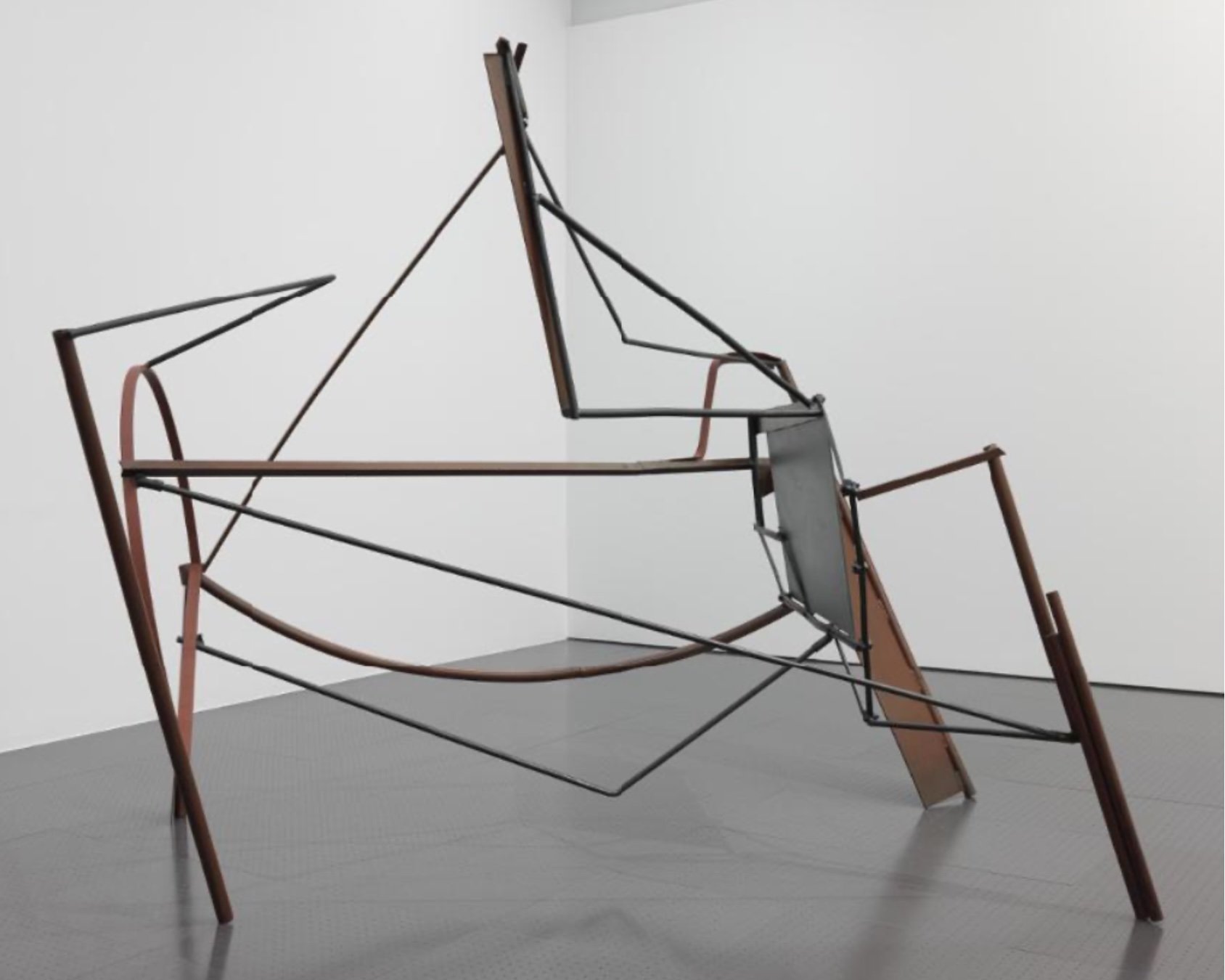
Anthony Caro, view of Emma Dance. Welded and rusted steel with red paint. 240 x 249 × 282cm. 1977—1978. Courtesy of Centre Pompidou.
This sense of unity resulting from the mutual relation of parts recalls McLean’s interest in creating “a kind of absolute” in his work (25). Hilton agrees, noting that the artists share an attitude which he sees manifest in the aerial quality of both Caro’s Emma Lake sculptures and McLean’s Emma Lake paintings (26).
McLean’s Untitled, c.1981 exemplifies this. Likely painted at Emma Lake, McLean’s forms drift across his canvas, dancing through air like leaves - etheric.
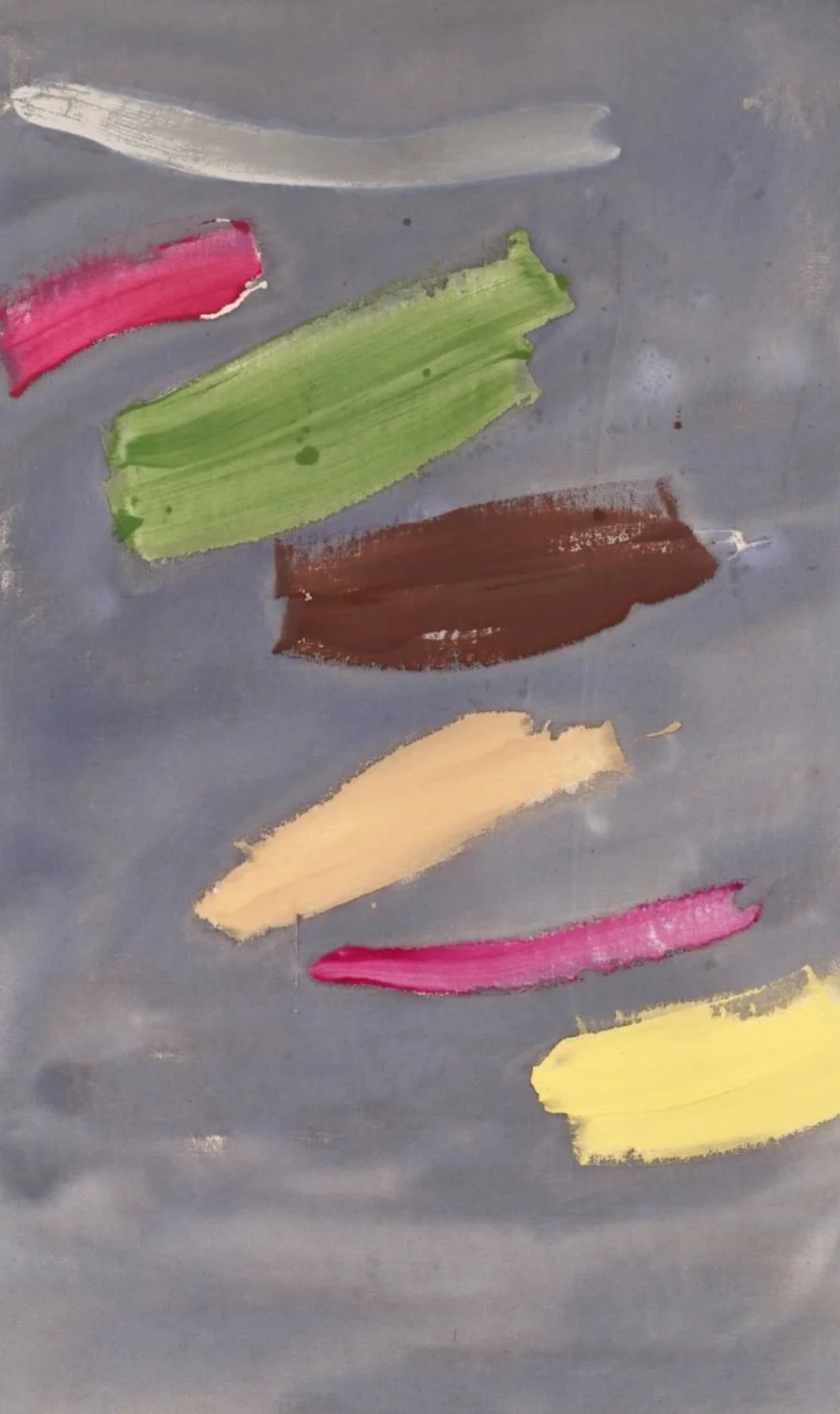
John McLean, Untitled c. 1981. Acrylic on canvas. 157.5 x 97cm. C. 1981. Courtesy of The Fine Art Society.
Though works like Giocoliere and its siblings have a balance and movement evocative of dance, it is Traffic Yellow which most clearly connects Caro’s interest in space to McLean’s exploration of the third dimension. Traffic Yellow is an outlier among McLean’s sculptures not just for its size, being far larger than any of his earlier sculptural work. Unlike Giocoliere, which is composed of geometric aluminium planes, the architectural Traffic Yellow employs a steel armature evocative of Caro’s, which forms sharp right angles and creates free-standing legs in irregular proximity. These disparate limbs are connected by smooth sheets of powder-coated aluminium, though no side is fully sealed. Each sheet is sharply cut and irregular, evoking hastily sliced scraps of paper, and coloured vividly in red, blue, and yellow. McLean’s use of these three essential pigments reveals the sculpture’s smooth surface—another deviation from his previous three-dimensional works, which are toned in brushed acrylic. When viewing this sculpture in the round, steel and aluminium intersect and overlap, collapsing together and retaining Giocoliere’s dizzying, kaleidoscopic effect. Traffic Yellow cuts and reconstitutes the planes of earlier sculptures to stretch and suspend them within an undisguised steel frame. Again underscoring abstraction’s musicality, McLean asserts that the negative shapes which perforate each aluminium surface “make the tune, while the big sheets make the harmony” (27). This work is a play of negative shapes; absent triangles and circles make solid planes literally permeable, each flowing into the next (28). These negative shapes become portals, allowing the sculpture to breathe and demonstrating the same blurring of interiority and exteriority essential to Caro’s Emma Dance (29).
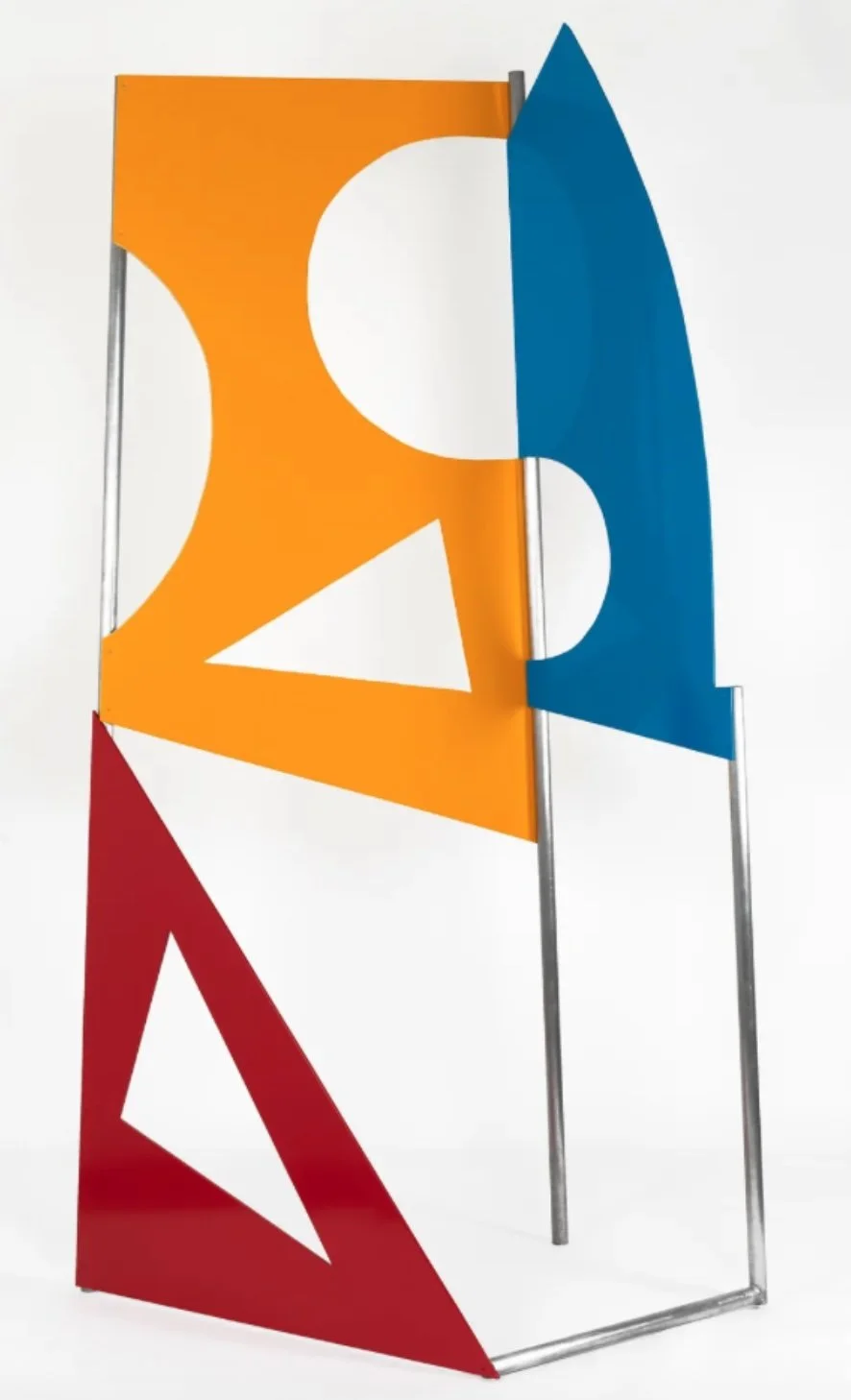
John McLean, Traffic Yellow. Steel, powder coated steel and powder coated aluminium. 240 x 140 × 85cm. 2009. Courtesy of The Fine Art Society.
Interestingly, the triangles and interrupted-half-moon circles of Traffic Yellow float atop an abstract ground, not unlike the unlocatable forms of McLean’s Emma Lake paintings. The interplay of smaller geometric forms with larger swathes of colour is common across McLean’s work from Paint Box to Untitled, 2008. This interest reveals itself in his prints, as well, which experiment more with negative space. Calm, a screenprinted monoprint, demonstrates this clearly. The print presents a white rectangle, warped and wavering, atop which rests three petal-like triangles of orange and yellow. These shapes are suspended amid a dark ground visible through the body of this curving quadrilateral, punctured by a series of four irregular triangles which undermine the shape’s solidity through careful use of negative space. Each of these triangles seamlessly connect at their lowermost point, merging background with foreground and evoking Traffic Yellow’s complication of inner and outer.
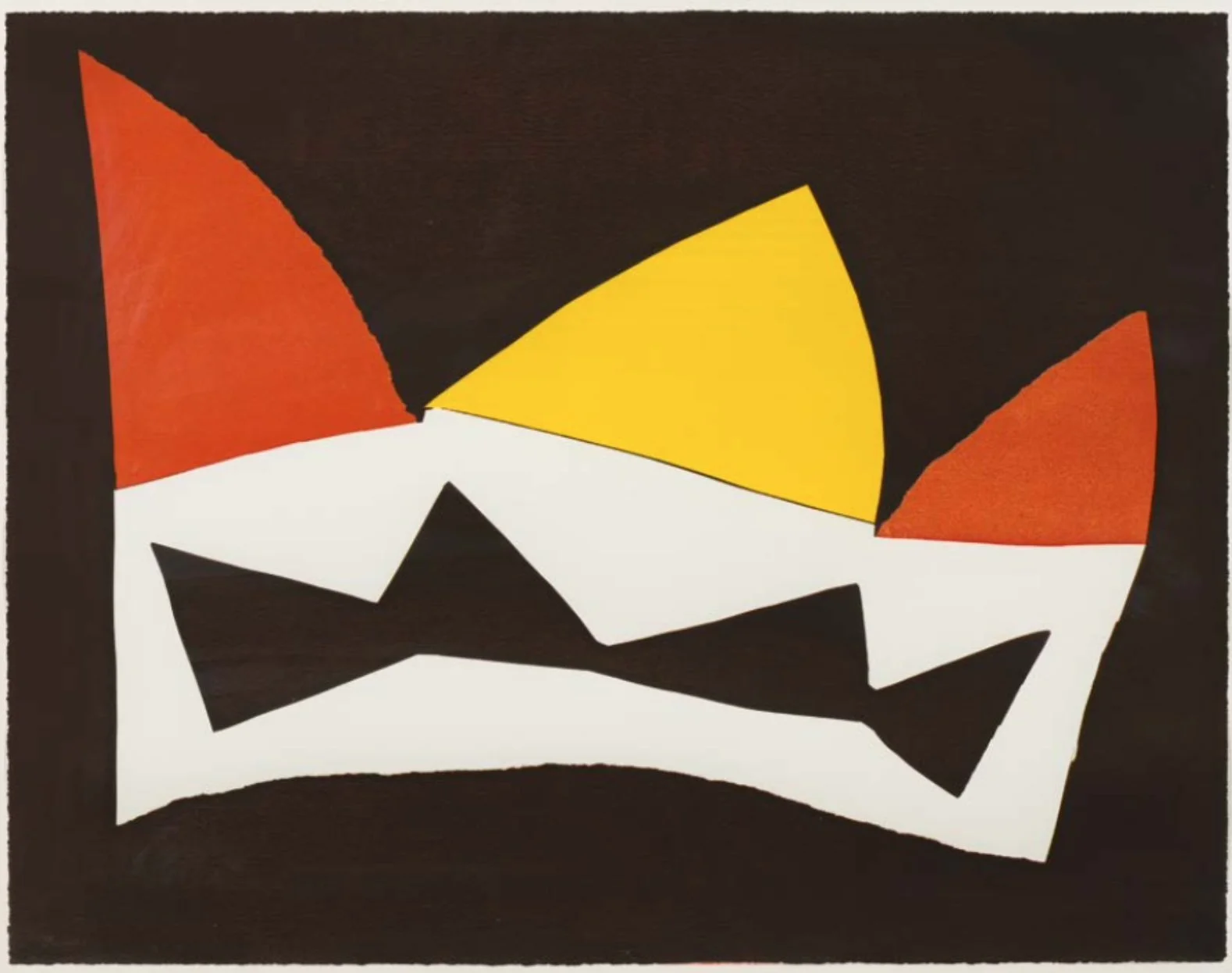
John McLean, Calm. Screenprinted monoprint. 64.5 x 83cm. 2003. Courtesy of The Fine Art Society.
McLean saw the boundaries between painting, sculpture, and architecture as indefinite, his free-standing sculptures “close to [his] paintings and collages” (30). It is the relationship of one shape and one colour to another which McLean explores, and though his sculptures are few, each provides vital insight into how the artist considered these elements and their intersection. Observing Giocoliere, viewers experience a shape’s transformation as it intersects with another form and its colour shifts, the sculpture infolding. Circling Traffic Yellow, viewers understand how forms are altered by the space which surrounds and permeates them, solid mass becoming flexible. Each part is unified. Observation becomes action, revealing clearly McLean’s abstraction as an investigation of relationships between form and colour to create a coherent whole. By applying his techniques of painting, printing, drawing and collage to the third dimension, McLean distills and clarifies his aesthetic philosophy. Abstraction is materialised as a physical encounter with line, shape, colour, and space: an experience as embodied as singing and dancing.
Astrid Bridgwood
Notes
‘John McLean: Artist in Focus,’ The Fine Art Society, https://www.thefineartsociety.com/journal/issue-2/
john-mclean-artist-in-focus/, accessed 03/05/26.
Duncan Macmillan, ‘John McLean: Flare, The Fine Art Society (2022), p. 3.
Ibid.
‘John McLean: About,’ from the artist’s own website, https://johnmcleanart.com/about, accessed 03/05/26.
‘John McLean: Artist in Focus,’ The Fine Art Society; Ian Collins, ‘Another Dimension,’ in John
McLean (Lund Humphries, 2009), p. 117-120.
‘John McLean: Artist in Focus,’ The Fine Art Society.
Lee Henderson, ‘The Legacy of Saskatchewan’s Most Controversial—and Impactful—Artist Program,’ The Walrus, https://thewalrus.ca/the-legacy-of-saskatchewans-most-controversial-and-impactful-artist-program/, accessed 05/05/26.
Ibid.
Ibid.
John McLean, ‘Another Light: Prairie Journey,’ The Fine Art Society (2013).
Tim Hilton, John Elderfield, ‘Another Light: Prairie Journey,’ The Fine Art Society (2013).
McLean, ‘Another Light: Prairie Journey.’
Almaz Ohene, ‘John McLean: Parkinson’s has exposed me to new painting technique (interview),’ 13
Parkinsons Europe, https://parkinsonseurope.org/parkinsonslife/john-mclean-artist-parkinsons-interview/, accessed 05/05/26.
Wassily Kandinsky, Concerning the Spiritual in Art (New York, 1977), p. 45, p. 38.
John McLean, ‘Sculpture from Painting,’ Bourne Fine Art (2010).
Piet Mondrian, ‘Plastic Art and Pure Plastic Art, Pt. 1,’ in The New Art, The New Life: The Collected
Writings of Piet Mondrian (Boston, 1986), unpaginated.
Ibid.
Ibid.
‘John McLean: About,’ from the artist’s own website, https://johnmcleanart.com/about, accessed 03/05/26; McLean, ‘Sculpture from Painting.’
McLean, ‘Sculpture from Painting.’
Collins, ‘Another Dimension,’ John McLean, p. 117-120.
Ibid.
Hilton, ‘Another Light: Prairie Journey.’
‘Emma Dipper,’ in The Tate Gallery 1982-84: Illustrated Catalogue of Acquisitions (London, 1986),
unpaginated, accessed via https://www.tate.org.uk/art/artworks/caro-emma-dipper-t03455, 15/05/26;
‘Anthony Caro: Emma Dance,’ Centre Pompidou, https://www.centrepompidou.fr/en/ressources/oeuvre/
c4r57zG, accessed 15/05/26.
McLean, ‘Sculpture from Painting.’
Hilton, ‘Another Light: Prairie Journey.’
McLean, ‘Sculpture from Painting.’
Ibid.
Ibid.
Ibid.