
Ilana Halperin: Rock Ritual
Glasgow-based artist Ilana Halperin, who was celebrated this year with a mid-career retrospective at the Fruitmarket Gallery, Edinburgh, is an artist who actively collaborates with the earth itself. After a summer of wildfires and eclipses, Rosie Shackleton explores how Halperin’s practice can help us navigate our own landscape, and place within it, in a kinder way, ultimately blurring the line between the earth and ourselves.
It seems no mistake that a mid-career retrospective of Ilana Halperin’s work should take place in Edinburgh in 2026. What is Us and What is Earth, exhibited at Fruitmarket, almost exactly coincided with geologist James Hutton’s 300th birthday, and, as I write this, a hard summer of incessant wildfires on Edinburgh’s volcanic sentient, Arthur’s Seat. The cruel irony of seeing a former volcano burning is clear, and exploring Halperin’s way of viewing the world around us can offer a necessary balm to existential crisis. As in the name of her Fruitmarket showcase, the line can, and arguably must, be blurred between us and the earth, for us to more gently navigate our increasingly hostile landscape. What Halperin offers, beyond her own practice, is a toolkit for engaging with the earth, as an extension of ourselves.
New York-born, but Glasgow-based artist Illana Halperin takes on the role of mediator and therapist between us and the earth. At the heart of her practice, she offers ways of viewing geological and celestial bodies as extensions of our own bodies; both able to create, to celebrate, to remember and be remembered in equal measure. Halperin’s most well-known body of work is her collaboration with the Eldflell (which aptly translated to Hill of Fire) volcano in Iceland. And I say collaboration in the truest sense of the word. Both artist and Vulkan were born in 1973, an exciting connection for Halperin which has resulted in multiple visits to Eldfell at important birthdays and life events. Here Halperin is interacting with something in deep time; time beyond human comprehension. Rock, space, stars have all been here more thousands, millions and billions of years and we are a mere speck of dust in comparison. When we are dealing in millions of years, it is hard to understand how and where humans fit into this timeline. It is with connections like those Halperin makes, that allow us to begin to understand these immense timescales. She notes that this collaboration between herself and rock almost has a half-life; one day she'll be gone but the volcano, the rock, the diamond, the planet will still exist. She leaves a mark that might very well be carried into millennia.

Ilana Halperin, Eldfell is 40, field photograph, 2013, Courtesy of Ilana Halperin.
The idea that we as humans can share a birthday with something as seemingly ‘old’ or ‘inanimate’ as a volcano is hard to comprehend. As I look out to the old, long-quenched volcanic outcrop of Arthur’s Seat, it is initially difficult to find a comradery between us. The notion of an active, or at least, not long-douses volcano can be a pilgrimage destination is also tricky. The image of the fiery, almost biblical volcanos, raining disaster and ash upon towns casts a long shadow, and has long been a popular subject in art for centuries. The likes of Turner and Lacroix have immortalised, maybe the most famous volcano, Vesuvius, both showing fiery, brimstone-demons, wreaking havoc on small Pompeii.
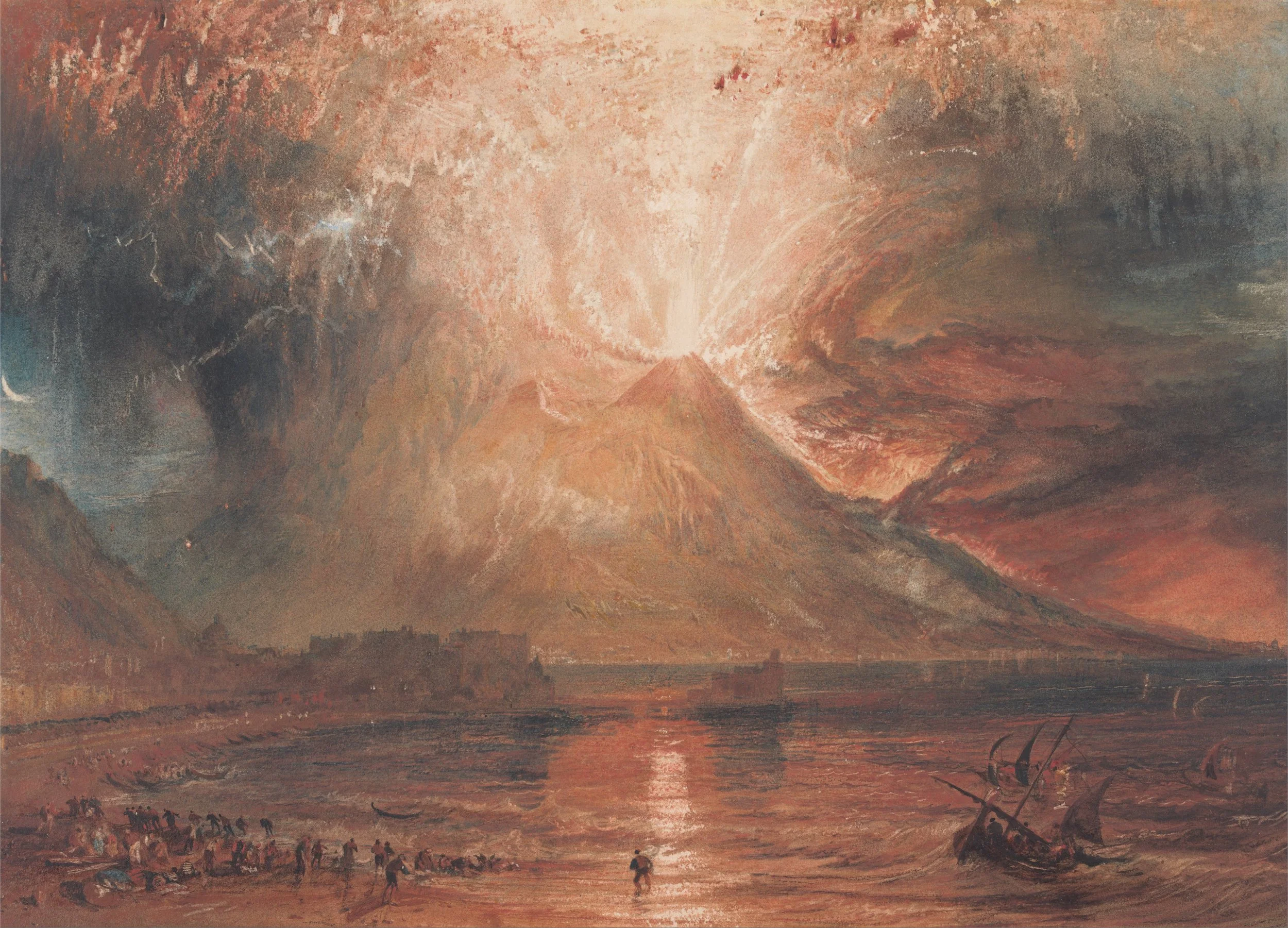
J.M.W. Turner, Vesuvius in Eruption. Watercolour, gum, and scraping out on paper, 28.6 x 39.7 cm. 1817-1820. Courtesy of Yale Center for British Art, Paul Mellon Collection: public domain via Wikimedia Commons.
Turner’s depiction aims to convey earthly devastation; that we are small, soft beings at the whim of powerful forces; at risk of being wiped away at any second. Pompeii is a lesson to be learned about the dangers of the things we don’t understand, the wrath of the gods, and the lack of control we have over nature. Instead, Halperin looks kindlier upon the volcano as a subject. Eldfell; this child-volcano, a newborn and twin, is shown to be deserving of attention, understanding, and reverence. It is interesting here to explore how Halperin plays with memory and ritual in her work. The majority of memory theory is inherently place-based. Pierre Nora’s classic Lieux de Memoire (Places of Memory) is useful when we explore man-made landmarks, such as war memorials. Cultures gather around temples, churches, and memorials, as well as bigger ideas like nations. But the theory in itself doesn’t easily allow for decentralised, intangible memorials or modes of remembering, such as poetry or anniversaries. Jan Assmann is useful here, with his theory of Cultural and Communicative Memory; the idea that remembering is linked to everyday communication such as “…festivals, rites, epics [and] poetry” – it is in interpersonal communication and ritual, that we remember, beyond physical built structure. Where then, does a volcano fit in here? Or any other natural landmarks for that matter? Again, the idea is difficult to grasp initially. Indeed, if we look back to the example of Eldfell, the volcano itself is not really seen as a new memorial in the land itself. A cross was erected by locals to remember the when the volcano erupted in 1973, and ostensibly this is the memorial there, not the new hill of fire.

Basalt volcanic bomb from Eldfell. Photo: Andoni Alvarez, Smithsonian Institution, via Wikipedia Commons.
Halperin’s treaty with the volcano; a friend who shares a birthday with her, a pilgrimage goal makes the volcano into a monument; somewhere to remember, deal with grief, celebrate, and connect. Being un-built by human hands, the volcano is not tethered or inherently imbued with preconceived ideas on how it can be used as a memorial. Instead, it is a vessel for memory, one Halperin chooses to fill. In an interview conducted with Susan Mansfield, she says she had the urge to travel to Eldfell on her 30th birthday:
“I want[ed] to go there…. I didn’t know why. Afterwards I understood that it was to do with the impending death of my father (who was terminally ill with cancer at the time). It grew out of grief and a desire to think about new possibilities of what family means, trying to think more expansively about time and mortality and how we're situated in this cycle of life, whether earth, human, animal or mineral.”
Here Halperin is expanding the ways we remember; not by purpose-built memorials, but by finding connection with something seemingly inanimate, distant and potentially dangerous. Rock is made animate and a confident, and memory is made permanent, tangible, heavy, grounded. Eldfell becomes a receptacle for and carrier of grief.
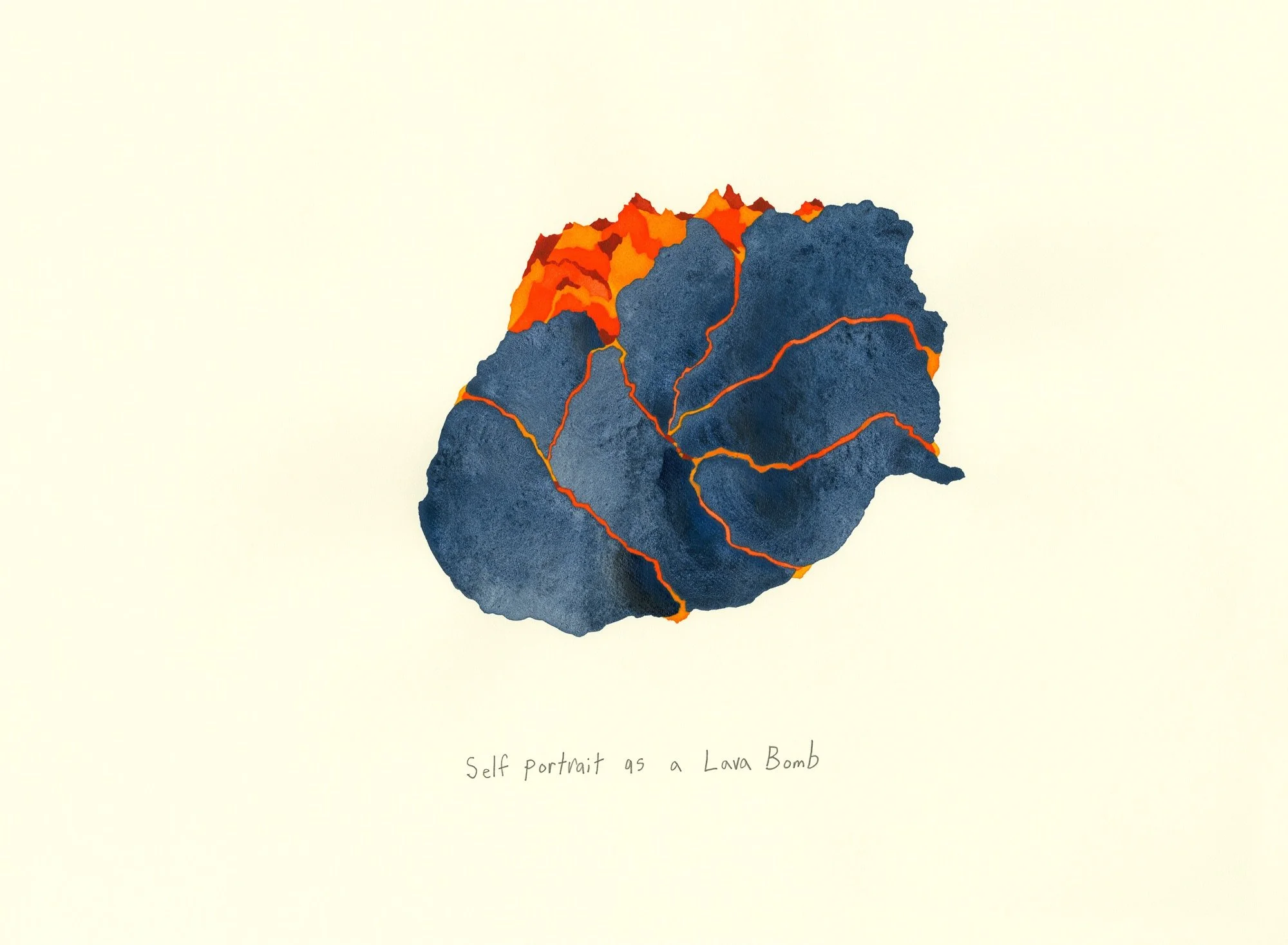
Ilana Halperin, Self Portrait as a Lava Bomb, Twenty Years with Eldfell. Watercolour on paper. c. 2023. Courtesy of the artist.
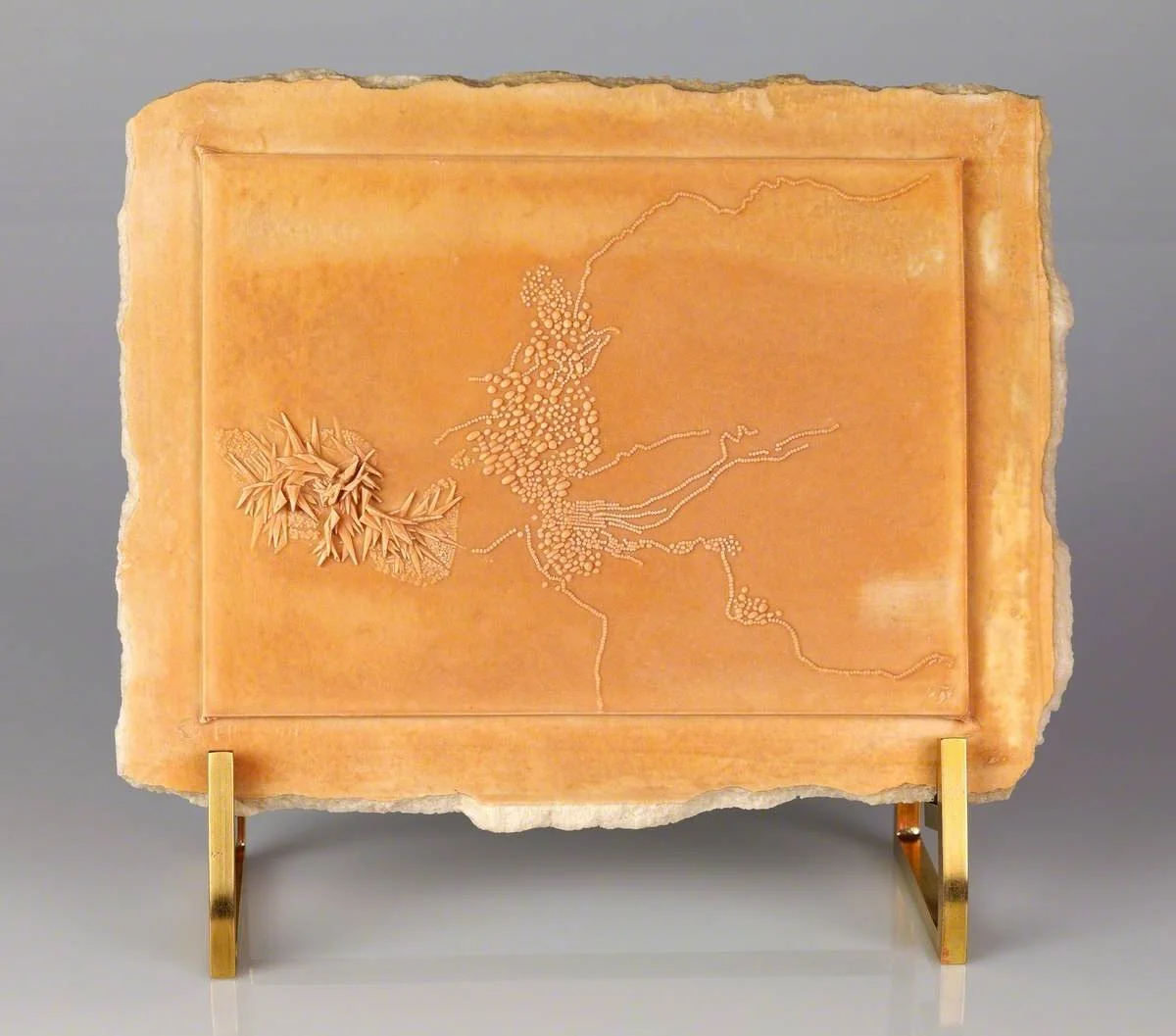
The ways Halperin works with the earth also suggests folkloric realms to my mind. One of Halperin’s most compelling works are her Cave Casts, sculptural pieces cast from the Fontaines Pétrifiantes de Saint-Nectaire, a cave where limestone grows ten times faster than normal. Again, we are forced to think differently about the qualities and indeed abilities of rock. Halperin first creates moulds, and then lets the cave do its work. Here the cave is both material and craftworker. For this series, Halperin also found a uniquely perfect collaborator in the Fontaines Pétrifiantes de Saint-Nectaire, who describe themselves as an atelier in petrification craftmanship! Operating as a family business since 1821, their website states they have been using volcanic springs to make decorative calcium artworks for two centuries.
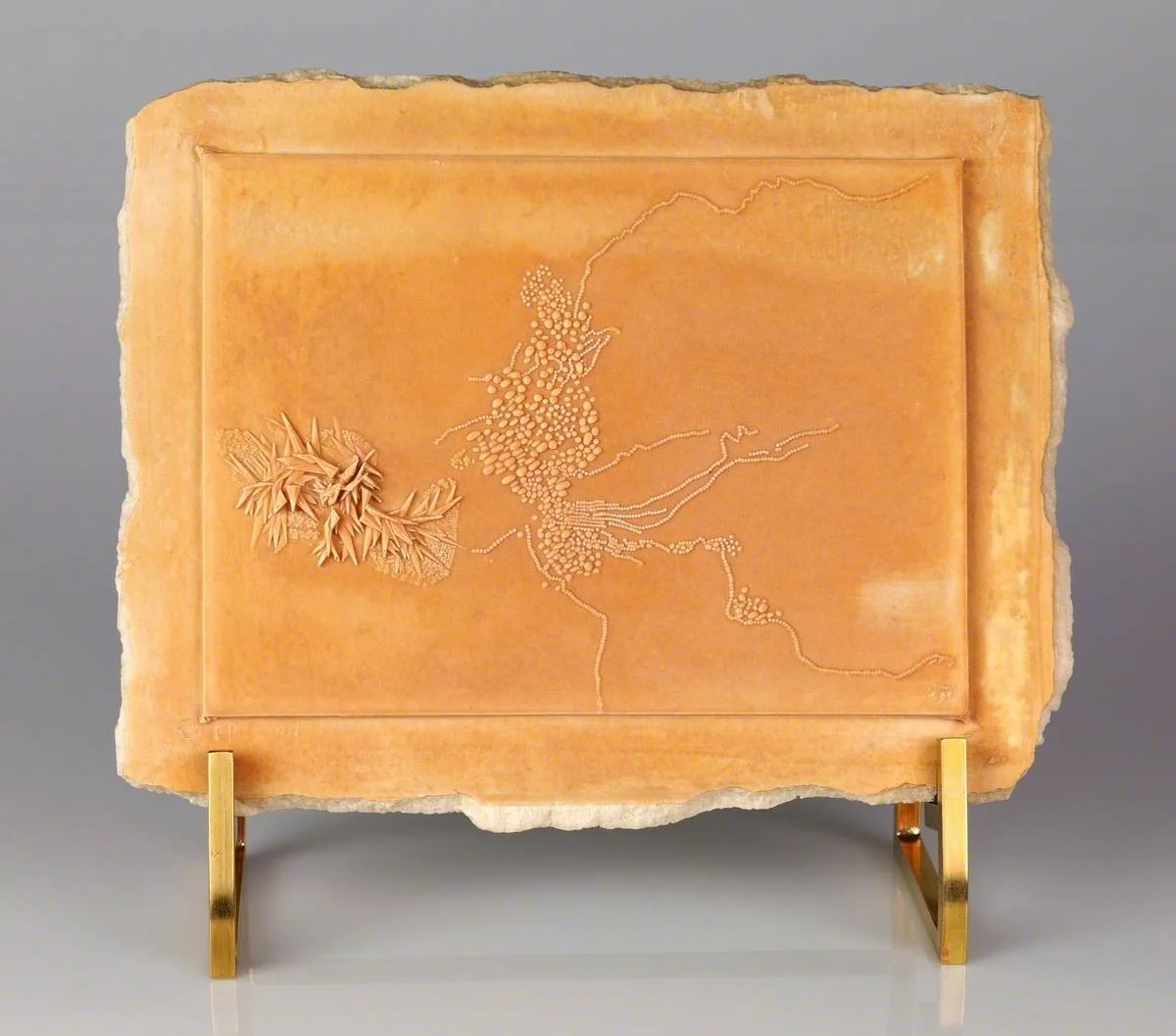
Ilana Halperin, Physical Geology (Cave Cast/Slow Time). Limestone. 2008-2009. Photo courtesy of University of Edinburgh Cultural Heritage Digitisation Service,
The works themselves appear unassuming, muted compared to her other works. Almost the colour of tights or raw latex, it is their detail and how they were produced that adds the colour. Firstly, as sculptural pieces they are unique; a stone piece made without chipping away, reducing or carving rock but actually making new material as part of the process. The cast frames the design, almost reminiscent of the embossed paper of a print. The central shapes dance across the surface; both abstract and geological. They feel free-form and wild. The University of Edinburgh describes the casts as “unique objects of pure geography” but I think it is clear there is still inherently a human hand at work here. Cave Casts/Slow Time pose exciting questions which don’t have easy answers; can a rock be more than a material? Can something non-”living” create or collaborate? Again, Halperin blurs the line between us and earth.
Much of Halperin’s other works are on paper. A major part of this are her written pieces; poetic reflection akin to pen-pal letters to volcanos, and celestial bodies. Often written in coloured pencil, mirroring the colour palette of the rock, mountain, or mineral she is writing to, they appear as technicolour guides to her bigger ideas that expand beyond the gallery space. As I read them, I feel like a child grappling with profound ideas, and the way she writes feels fresh, urgent, necessary. One such letter reads:
Why on earth think about how Mars and I are alike,
Are different?
Because how else to know another.
Mars is covered in a vast sea of salt.
After the last few years, I am also covered in dried plains of salt.
On Mars you can find Epsom salt.
My grandparents and my father soaked in Epsom salt
To ease their aching bones (I do too)
Mars is an older sibling
My older sibling is named Samara.
If there is life on Mars, likely they are extremophiles –
Life forms that can live and adapt to extreme environments.
As a queer kid, I also learned how to survive in extreme environments.
We know how old mars is from counting the number of impact craters across its surface.
What if we determined our age through accumulated moments of contact?
What if we determine our age through accumulated moments of contact? it is another stunning question from Halperin’s practice that proves her way of working. The lines blur inherently between earth and us.
It is perhaps clear that I leave Ilana Halperin’s work with more questions than answers. But these are questions that feel urgent in the current world. Can we see geological and celestial bodies as equals? Can they and do they make art? Can they truly be our collaborators? As someone who currently works up on Calton Hill, another volcanic outcrop seeped in history and drenched in monument, I also ask the question about how much agency rocks can have? Can they be complicit? Can they be monument too? For most of these questions, I think Ilana Halperin would answer in the positive. She treats the rock as a collaborator, a studio assistant, a friend, a confident and a memorial. Considering what is below our feet, or floating above our heads in this kind and curious way might well help us as we continue to navigate a crumbling world. Not long after Arthur’s Seat, my own friendly neighbourhood volcano, burned with wildfires for almost two days straight, what lessons could we learn from Halperin’s way of viewing the world around us? Would we feel the sting more keenly? Would we do more to prevent it? Would we better understand how much the lines are truly blurred between us and the earth?
Rosie Shackleton