
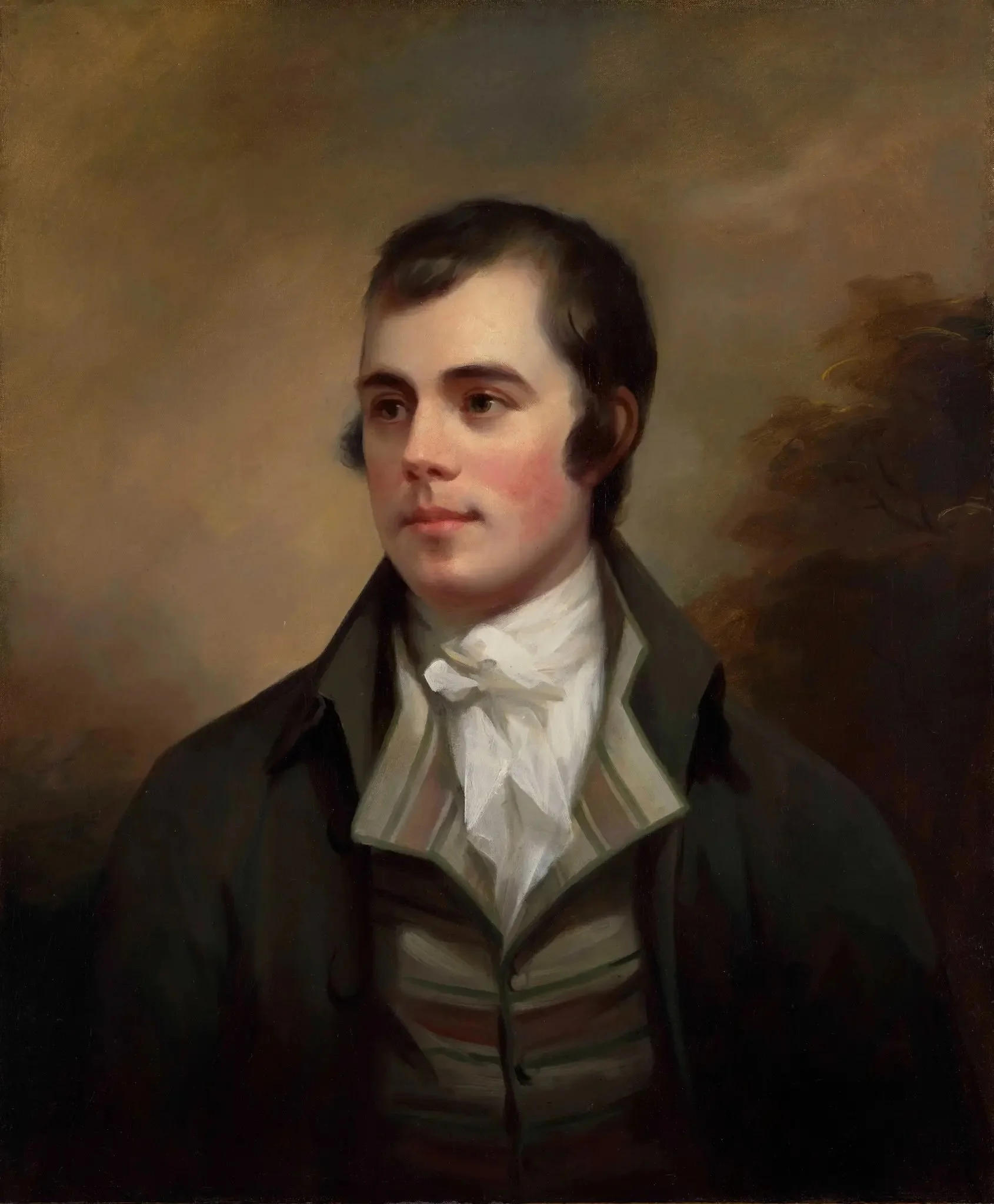
Henry Raeburn: The Lost Portrait of Robert Burns
During the Edinburgh Festival in August 2025, a chance encounter with my friend William Zachs led me to Blackie House, the museum and library he has directed for some years. It was the first time I’d seen Bill in several months. In fact, we hadn’t spoken since he called me on a Sunday afternoon in March, excitedly saying something about a painting he was pursuing. It was nothing out of the ordinary for Bill, a serious book collector and enthusiastic art collector. The call was short and mysterious. I quickly forgot about it until August.
Then, upstairs in Blackie House, I was privileged to have a private view of the painting which had been the object of Bill’s affections since the sale in March. “I’m going to wake up and it’ll all be a dream”, he declared, gesturing to a portrait resting on an easel in his sitting room. It was a spectacular sight indeed. I was sorry to have let the intervening months slip by after that initial call; and it tickled me to remember that when Bill had called me in March, the day before he bought the painting, I’d been sitting in a pub called The Raeburn.
In Spring 2025, a portrait was offered for sale in a small auction house in Wimbledon, south-west London. It was an oil on canvas and it measured 75 x 62cm. It was unsigned, undated and a little uncared-for. It had arrived at auction from a house clearance in the south of England, though interestingly the portrait depicted a distinctly Scottish figure. Its subject’s resemblance to Scotland’s national poet was so striking that nobody seriously doubted the sitter’s identity: it was a portrait of Robert Burns.
Lot 100 carried an unsensational estimate of £300-500, the sort of sum that might buy a half-decent copy painted after Alexander Nasmyth’s world-famous image of The Bard. Many such copies exist. Bill Zachs has two on the walls of Blackie House and a number of other iterations after the Nasmyth in what he describes at the Burns Shrine Room. Nasmyth-inspired works are currently displayed alongside many other pieces of "Burnsiana" in Face to Face: Imagining and Re-Imagining Robert Burns, the exhibition now on show at Blackie House. The format of the Wimbledon portrait certainly bore a memory of Nasmyth’s work. But the auction house ventured that the work might be in the “manner of” Sir Henry Raeburn.
Many artists worked in the manner of Raeburn, who enjoyed a reputation as the greatest Scottish portrait painter of his day across a period which spanned from 1786, when Raeburn returned to Edinburgh after a study tour in Europe, until his death in 1827. Indeed, Raeburn’s bravura handling of paint and his powers of perception have fostered his reputation as perhaps the greatest of all Scottish portraitists. The cast of sitters who populate his portraits make up a Who’s Who of Scotland in the late Enlightenment.
But among the social and cultural elite, one sitter in particular is missing: Robert Burns, we know, was painted by Raeburn, but the portrait was lost. It was a work known from archival records to have been modelled on the Nasmyth. The portrait of Burns in the National Portrait Gallery in London (currently on a travelling tour in Asia) has at times been conflated with this missing work.
The Wimbledon painting came to the attention of Bill Zachs, an American-born scholar and collector who has lived in Edinburgh since the 1980s. A devout Burns enthusiast, the sight of the portrait stopped him in his tracks. Without even having seen the portrait in the flesh, aided by the advice of expert friends, Bill took the auction house’s ambitious attribution to Raeburn very seriously indeed. No expert on Raeburn himself, prior to the sale he sought the advice of art historians Duncan Thomson and Bendor Grosvenor. When the hammer came down after a ten-minute bidding battle, settling on a price which very significantly exceeded the estimate, Bill was awash with excitement.
Unanimous agreement among all Raeburn experts, not to mention Bill’s generosity, has brought the now fully-authenticated painting to the walls of Edinburgh’s National Gallery. Nearly one year after its rediscovery, it hangs alongside Nasmyth’s portrait of Burns [1]. This summer, the Lost Portrait of Burns by Henry Raeburn will visit Alloway in Ayr, to hang in The Burns’ Birthplace Museum, run by the National Trust for Scotland and adjacent to the cottage where the poet was born in 1759. The reappearance of the portrait of arguably Scotland’s finest poet by Scotland’s finest portrait painter, lost for 200 years, has been called a “once in a generation discovery” [2]. For Bill it is the peak of a collecting career of many decades, with a front-page story in The Scotsman and a prominent article in the New York Times.
It is a hugely exciting moment which has raised some intriguing questions: principally among them, we have found the painting, but where has it been? But perhaps more interestingly, the portrait was painted after Burns’ death; it shows Raeburn “copying” the work of another artist, Alexander Nasmyth. Does the painting really embody, as Bill Zachs has said, “a new immortal visual memory?” [3]
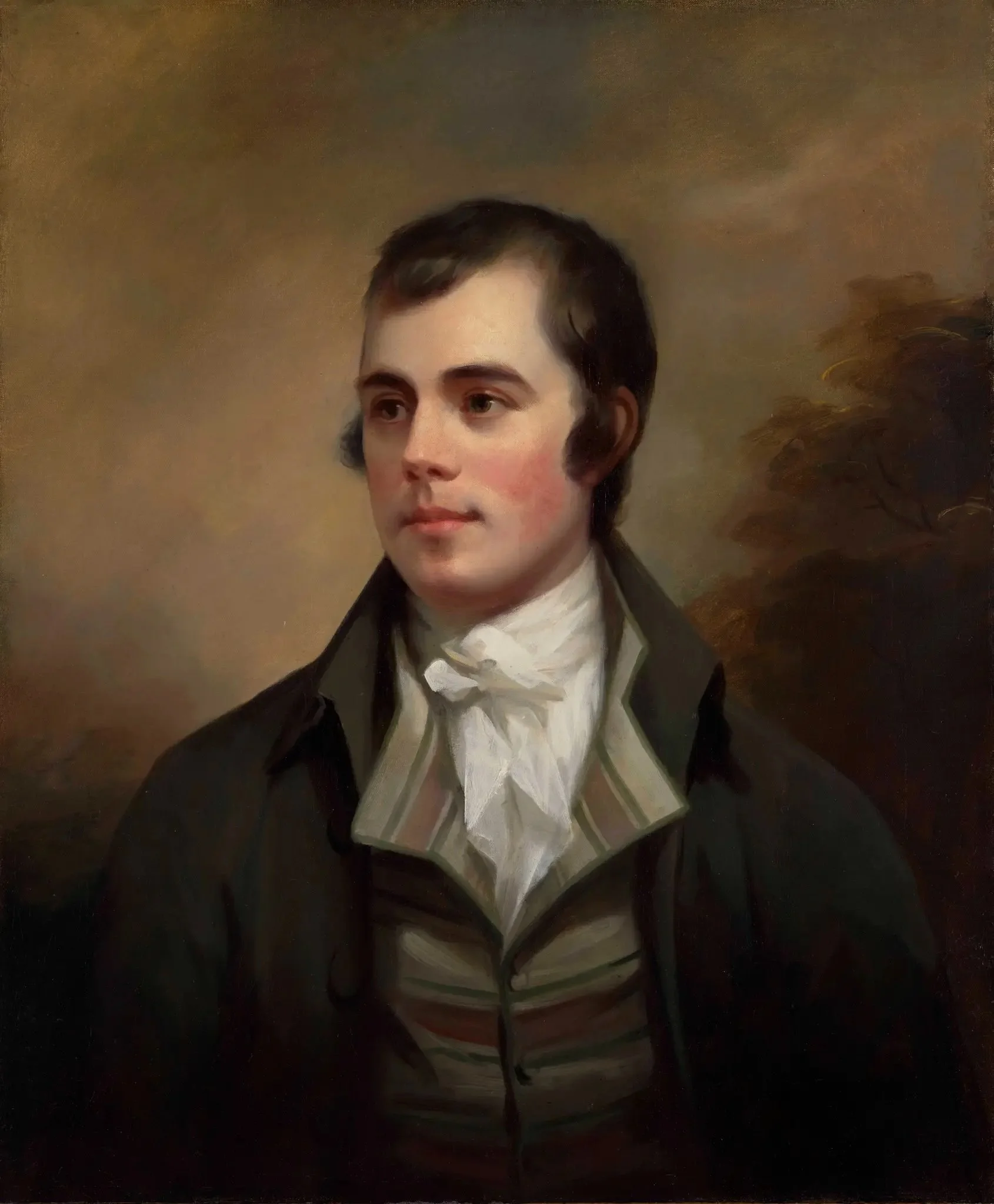
Henry Raeburn, Robert Burns. Oil on canvas. 75 x 62cm. 1803.
The “Ploughman Poet”, born into a farming family in Ayrshire in 1759, shot to irreversible fame at the age of 27 years old. The publication in Kilmarnock of Poems Chiefly in the Scottish Dialect announced Burns’ arrival as a hero of the common man, a champion of Scots dialect in poetry. His debut included poems such as To a Louse, The Cotter's Saturday Night and To a Mouse; further classics Tam O’ Shanter, Auld Lang Syne and A Red, Red Rose would follow. In his short but prolific life, Burns produced a body of work which secured his reputation as the most important and influential of all Scottish poets.
The appetite for Burns’ work spread quickly, particularly as the poet spent long spells in Edinburgh from 1786. Here, Burns established a relationship with the influential Edinburgh publisher William Creech, who set out to print a second edition of his Poems. The Edinburgh edition, as it would become known, would feature a portrait of Burns as the frontispiece. The process of engraving and printing the frontispiece demanded the creation of an oil portrait, the best source of reference for the engraver tasked with producing a likeness.
Creech approached Alexander Nasmyth, the painter whose landscapes would go on to become some of the most recognisable images in Scottish art. Nasmyth was reluctant to accept any portrait commission, but produced a fine image of Burns – handsome, lean, bright and fashionable – showing him at the height of his powers at the age of only 28. It is one of surprisingly very few contemporary images of the poet. More than any other work, it is this image which has informed the collective visual memory of Burns. The original is now in the collection of the Scottish National Portrait Gallery, but the face in the painting has appeared on everything from coins to commemorative plates to Coca Cola bottles.
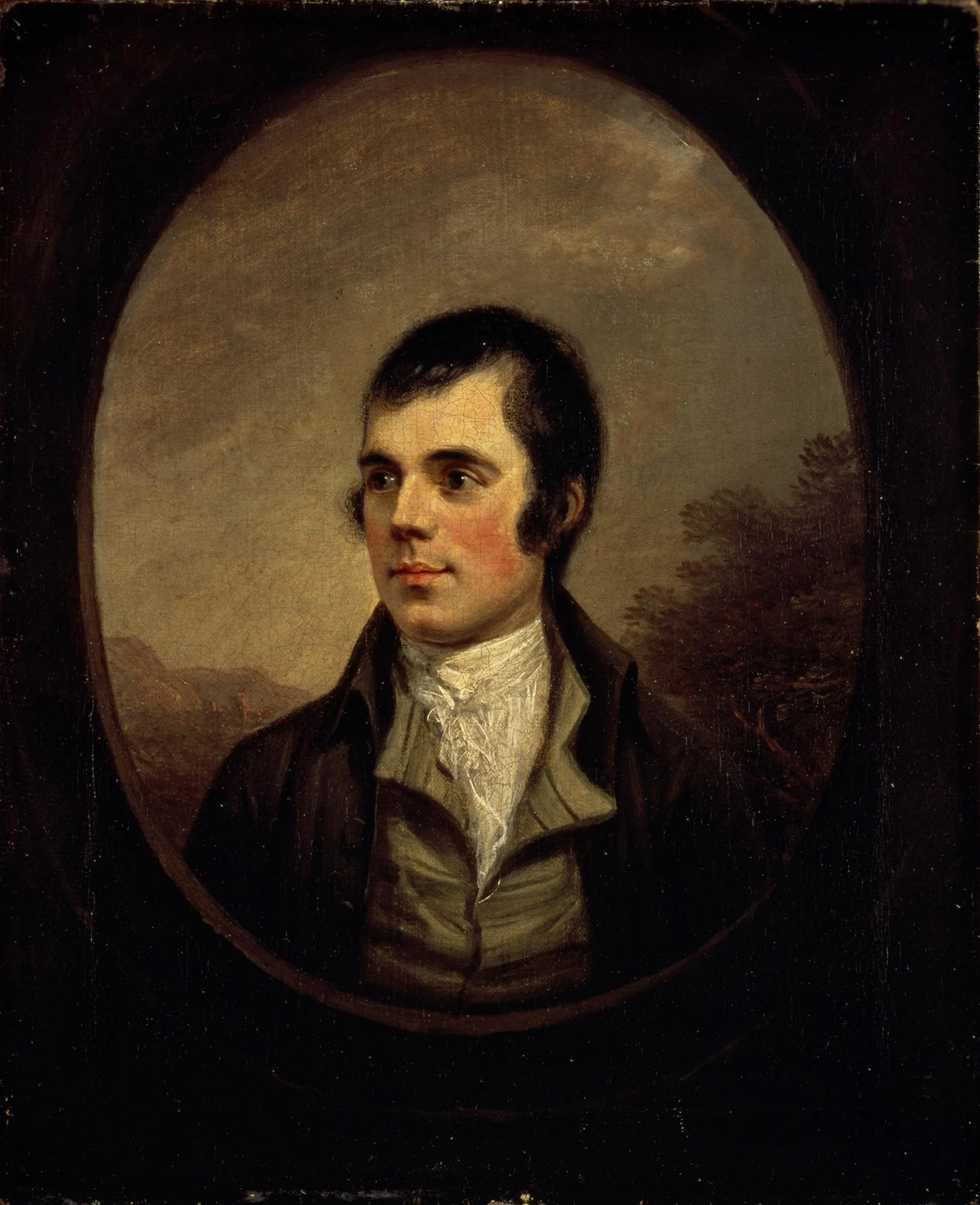
Alexander Nasmyth, Robert Burns. Oil on canvas. 38.40 x 32.40cm. 1787. Collection of National Galleries of Scotland.
Concerns about the likeness in Nasmyth’s portrait were raised very soon after the portrait’s completion. The engraver John Beugo, who befriended Burns while transferring the image of the portrait onto the printing plate, did not feel that Nasmyth had properly caught his sitter’s appearance. Burns appears to have agreed that the Nasmyth portrait was not quite up to par because he sat for Beugo himself on three occasions; the engraved portrait which was printed in the Edinburgh edition was informed by sittings from life as well as Nasmyth’s painted image, which involved no fewer than six sittings. Apparently Nasmyth himself praised Beugo’s finished work.
After Burns’ untimely death at the age of 37 in 1796, his Edinburgh and London publishers began to plan a new, authoritative edition of his poetry. For this, they commissioned a new portrait. The London publisher Thomas Cadell sought out the Nasmyth picture: as an oil portrait painted from life, it was thought to be an invaluable starting point for a new likeness. The painting was by then in the hands of Burns’ friend and literary executor Alexander Cunningham, an Edinburgh lawyer turned jeweller. In a letter to Cadell from April 1803, Cunningham recommends Raeburn as the best artist to produce a new image of the late poet.
By the year 1803, Raeburn was the most respected portrait painter in Edinburgh, his one serious rival David Martin having died in 1797. Raeburn appears to have readily accepted the commission to paint the late Burns. The Nasmyth painting was sent to Raeburn’s studio on York Place to inform the new portrait, which Raeburn painted on a much larger, life-size scale in the summer of 1803. Upon completion, it was shipped off to London. The portrait was studied by William Fry, who later produced a copperplate engraving which was then printed in the new edition, eventually published in 1820. Until the rediscovery of the Raeburn painting in 2025, Fry’s engraving was the one tantalising visual clue to point to its existence.
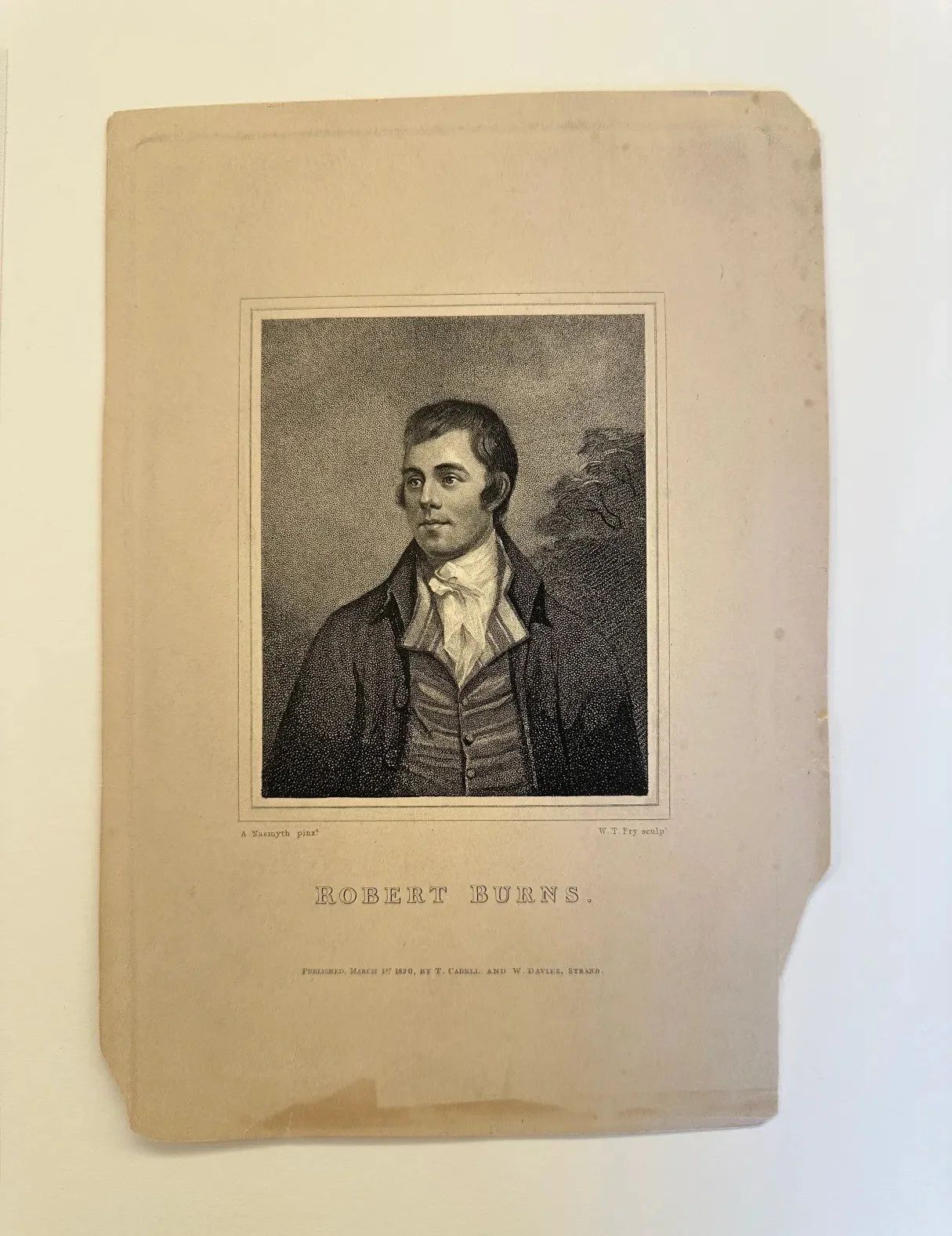
William Fry, Robert Burns. Copperplate engraving on paper. 7.62 x 6.35cm. Collection of Blackie House Library and Museum.
With the engraving completed, the painting by Raeburn is thought to have been quietly consigned to a wall in Cadell and Davies’ London offices. It probably remained there until the firm’s closure in 1840. Thereafter, the trail goes cold. Sir Arthur Conan Doyle, well-known as a spiritualist, reported on a séance held by one Edward Barrington Nash, who hoped that Burns’ spirit would lead him to the portrait via a medium. Unfortunately for Nash and the “Burns Portrait Society” which he founded, Raeburn’s work was only tracked down when it appeared in Wimbledon in 2025. The details of its journey through private hands are still being pieced together by Bill Zachs and his colleagues.
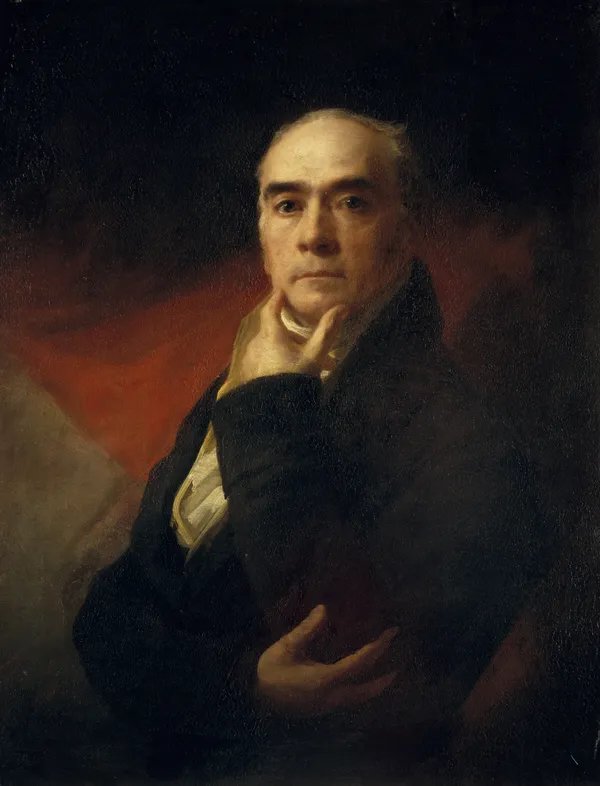
Henry Raeburn, Self Portrait. Oil on canvas. 89 x 69.5cm. c.1815. Collection of National Galleries of Scotland.
Henry Raeburn’s reputation as a painter of bravura set him far apart from his contemporaries. His bold alla prima manner, which saw him arrest an observed subject in paint with brilliant immediacy, gave his portraits a freshness suggestive of a living human presence. This ability to engage a personality on canvas owed little to the art of drawing. Unlike his younger contemporary David Wilkie, who could paint hands from a carefully-composed under-drawing, Raeburn was not formally trained as a draughtsman. Instead, he handled his brush with speed and spontaneity to find painterly equivalents for observed physical facts; in a Raeburn painting, the hands are captured convincingly through gestural use of paint, not detailed drawing. Raeburn’s ability to grasp his subject through his power of perception and express the truth of what he saw in painterly terms, intuitively and immediately, secured the patronage of Scotland’s elite and his reputation as an artistic great of the day.
As well as its dazzling virtuosity, Raeburn’s handling is characterised by its delicacy and precision. Raeburn’s early years honed his outstanding technical facility; apprenticed to the Edinburgh goldsmith James Gilliland, the young artist helped to produce elegant works in precious metals. Raeburn’s ability to manipulate paint on a minute scale appears in his famous painting The Skating Minister, which for all of its formal severity (in the figure) and great freedom (the background), includes passages of finely-wrought detail: the blades of the minister’s skates are rendered with extreme care and the remarkably fine scores in the ice have been applied with a masterful touch. The very loose dark brushstrokes which make up the winter sky help to direct the eye to those areas of delicious detail, and stress the breadth of skill involved in Raeburn’s wholly distinctive handling.
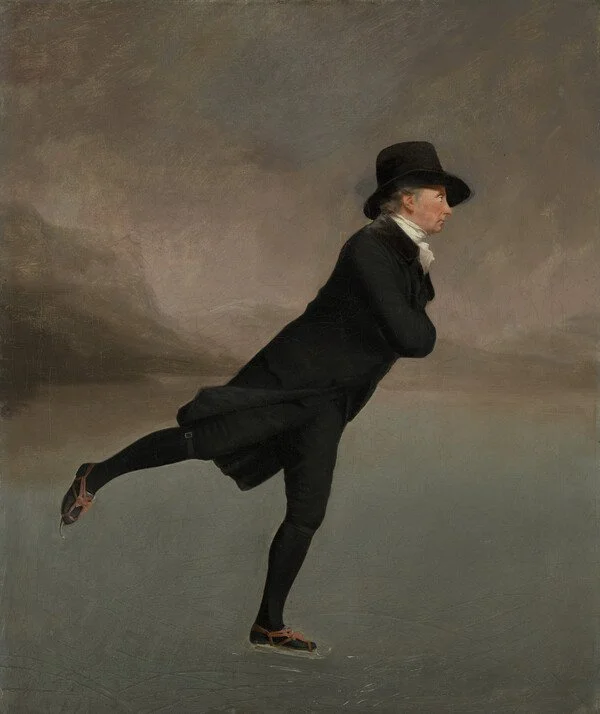
Henry Raeburn, Reverend Robert Walker Skating on Duddingston Loch (The Skating Minister). Oil on canvas. 76.2 x 63.50 cm. c.1795. Collection of National Galleries of Scotland.
The 1803 portrait of Burns has Raeburn’s artistic personality encapsulated on canvas. He expresses an understanding of observed reality through painterly intuition, recording Burns’ appearance with virtuoso handling, not a slavish imitation of reality. The paint is undisguised: it is there in the creamy impasto which suggests a highlight above Burns’ eyebrow; the swirl of dark pigment which makes up the sideburn; the grey-blue hue which indicates the temple. Yet Raeburn has applied himself to the detail of the work with great care: the sitter’s eyelashes are as sharp as a blade, and the division between his iris and the white of his eye is so clean that the paint might still be wet. Raeburn’s signature is written all over Burns’ face: it is a portrait which no other artist could have painted.
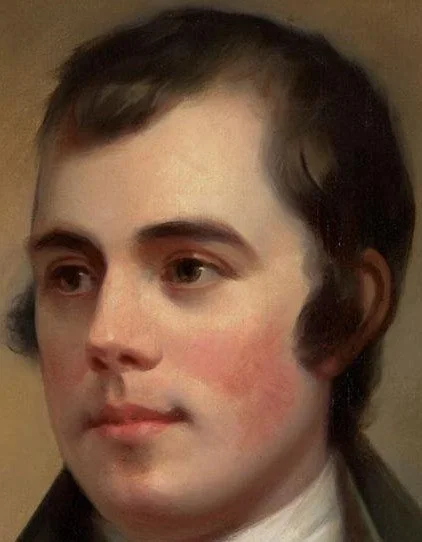
Henry Raeburn, Robert Burns (detail).
Raeburn’s handling might be at its most distinctive in his treatment of the clothing, and is particularly assured in the work around Burns’ neckcloth. The brushwork is adventurous, but the loose network of freely-painted strokes which make up the cravat reads as an incredibly fine, semi-transparent piece of cloth. The mechanics of picture-making are on full view: close to the canvas, we can sense the weight behind one stroke over another; we can imagine how a twist of the brush or the arm might affect the strength of the effect; we can see how the quantity of pigment applied in a given stroke, whether white or grey, brightens or dulls its tone. But standing back, the abstract brushstrokes, so absorbing in themselves, amount to the wholly convincing appearance of a tissue-like material, tied with all the idiosyncrasy of a real cravat. It is no coincidence that the knot across Burns’ neck occupies the very centre of the picture: more than a fine piece of description, it shows the best of Raeburn, balancing observation from life and painterly expression on the canvas.
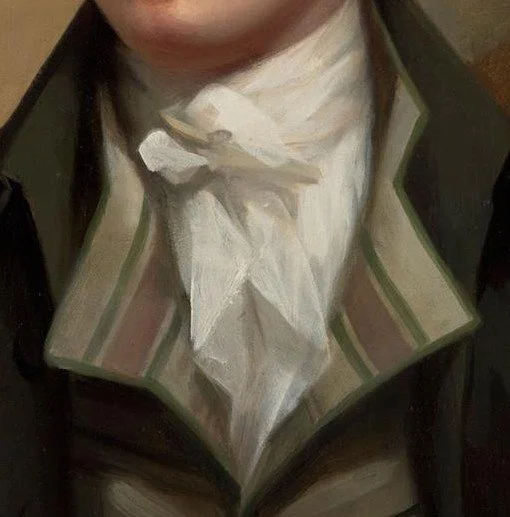
Henry Raeburn, Robert Burns (detail).
The harmony between Raeburn’s hand and eye has summoned what appears to be a living, breathing presence on canvas. We might be struck by Raburn’s wonderful brushwork, but we are much more likely struck, first, by an immediate and instinctive sense of the sitter’s personality. Raeburn invites us to imagine what Burns’ voice might have sounded like; how his stare might have settled on his companion; how every quirk in his manner and nuance in his body language might have reflected his personality; so resolved and fully-formed is the character before us.
Given its fantastic strength, it is surprising to note that Raeburn did not paint his portrait of Burns from life; rather, that breathing presence in the portrait was actually informed by Nasmyth’s work. Seen side by side in Edinburgh’s National Gallery, the similarities in format and in the sitter’s physical appearance and clothing are plain to see. But the differences are also obvious. Nasmyth’s portrait is dwarfed by Raeburn’s version in scale – the latter being over four times its size – and in distinction. Nasmyth’s image shows Burns looking lean, alert, handsome but somehow unduly boyish. The figure in Raeburn’s portrait, on the other hand, seems to tower over his rather peely-wally counterpart. Raeburn shows a robust character, broad-shouldered, ruddy-cheeked and full in the face. His silhouette is large, not to say inelegant, as if to suggest a body strengthened by years of labour on the farm: perhaps a truer image of the “heaven-taught ploughman” [4]. Yet the softness in Burns’ expression suggests his mind is far from the realities of his farming background and fixed, perhaps, on something higher and mightier. In this sense, the Burns portrait sits comfortably alongside Raeburn’s image of that other great Scottish writer, Sir Walter Scott, as a fine, compelling portrait in a Romantic mode. The essence of Burns’ character in the Raeburn portrait is not obscured by the picture’s Romantic flavour, just as Raeburn clearly did not let Nasmyth’s version affect his own distinct conception of Burns.
While Raeburn certainly used Nasmyth’s famous painting to guide and inform his portrait, the painting is so characteristic of the artist’s best work that the portrait cannot possibly be written off as a mere “copy” in the traditional sense; his image offers something entirely new. Perhaps Raeburn, like the engraver John Beugo before him, was not wholly convinced by the Nasmyth portrait; and like Beugo, whose relationship with Burns afforded him plenty of important insights, Raeburn may have felt he had the licence to alter the image of the poet to accommodate something more personal and at the same time more universal. Raeburn’s aims were in harmony with the aims of the publishers, who set out to commission a new image of the poet which would reflect something of his genius and inform his unfolding legacy. The resultant portrait, as Duncan Thomson indicates, is a resounding success. It is a striking, recognisable likeness of the man which also “speaks in an entirely new way of the warmth, the sensuality and the profound intelligence that we find in Burns’s poetry” [5]. It is a wholly fitting visual exemplar to support the Immortal Memory of Burns.
Thus far, no concrete evidence to suggest that Burns and Raeburn crossed paths has come to light. We could easily speculate that Raeburn and Burns met through one of several mutual friends, such as Alexander Cunningham. It might be naïve to think that Burns and Raeburn could simply have bumped into one another in the Edinburgh of the late eighteenth century, but in a densely populated city, the prospect of two members of the artistic elite crossing paths hardly seems impossible. Certainly, Raeburn’s portrait has that unmistakable glimmer of a true personality; perhaps a memory of a chance meeting, some years prior to the portrait’s commission, has made its way into the painting. We can be quite sure that none of the players of the day would forget an encounter with Burns, however brief.
The rediscovery of Raeburn’s lost portrait invites many questions, and although Bill continues his research to find evidence, many of them may not ever be answered. We may never find anything to suggest that Raeburn and Burns met, and it is early days in the search to discover the full history of the painting, between its departure from Cadell and Davies and its appearance at Wimbledon Auctions. It is clear, however, that its position as a “once in a generation discovery” is very fitting indeed. The virtuosity of Raeburn’s handling and his gifts of observation which have together created the almost magical effect of true presence mark this work out as a serious addition to the Raeburn catalogue raisonne, irrespective of this sitter’s identity. The work is so replete with the evidence of Raeburn’s genius that it cannot be taken as a traditional “copy”, but as a distinct work which extends a new, extremely exciting invitation to engage with Scotland’s national hero: a new Immortal Visual Memory indeed.
Douglas Erskine
Notes
[1] – Details of the display currently on show at the National Gallery can be found here:
https://www.nationalgalleries.org/exhibition/found-raeburns-lost-portrait-robert-burns
[2] – James Holloway, former director of the Scottish National Portrait Gallery, 1997-2012, described the rediscovery of the portrait: “this is a once in a generation discovery: thrilling for lovers of both Burns and Raeburn”. He is quoted in the feature which appears on the Blackie House website, linked below:
https://blackiehouse.org/the-lost-portrait/
[3] – See Bill Zachs quote in the above feature.
[4] – The famous phrase was apparently coined by Henry Mackenzie in an issue of the Kilmarnock Edition, 1786. See Blackie House feature.
[5] – Duncan Thomson, former director of the Scottish National Portrait Gallery, 1982-1997, describes the portrait: “The rediscovery of this portrait of Burns, after having disappeared for two hundred years, is of enormous significance, linking the poet with Scotland’s greatest artist. Although Raeburn was working from an image made by another painter, the portrait has that wonderful freshness of observation that marks Raeburn’s work at its best. It is more than likely that Raeburn had seen Burns in his heyday in Edinburgh a decade earlier, and had observed that glowing eye that had so impressed the young Walter Scott. The result is a portrait that speaks in an entirely new way of the warmth, the sensuality and the profound intelligence that we find in Burns’s poetry”. See Blackie House feature.
Acknowledgements
I’m sincerely grateful to my friend Bill Zachs, whose advice and support has enriched this article greatly. I’m also thankful to Bill and his colleagues at Blackie House for allowing me to reproduce several images from the collection.
I also gratefully acknowledge National Galleries of Scotland for allowing me to reproduce several images from the collection.
Further reading
The full story of the rediscovery of Raeburn’s Lost Portrait is told by Bill Zachs in a feature on the Blackie House website:
https://blackiehouse.org/the-lost-portrait/
Details of the Blackie House exhibition Face to Face: Imagining and Re-Imagining Robert Burns, which runs concurrently with the display at the National Gallery, can be found below:
https://blackiehouse.org/exhibitions/face-to-face-imagining-and-reimagining-robert-burns/
The above links to the Blackie House website also includes information about the library, museum and research centre, based in Edinburgh’s Old Town, which is open by appointment.
Further information on the rediscovery of the Raeburn portrait can be found in the below feature by the National Galleries:
Duncan Thomson’s writing on Raeburn has been extremely valuable to my research. Duncan’s catalogue Raeburn: The Art of Sir Henry Raeburn, 1756-1823, which accompanied the last major retrospective of Raeburn’s work in 1997, is an invaluable work.