
Gabrielle Keiller: An Appreciation, in Twenty Five Objects
OVERVIEW
Introduction to Gabrielle Keiller and the Collection
Biography
Selected List of Keiller’s Travels and of her work in the Arts
Selected list of works entering the Collection
Journey into Modernism
Selected Exhibition History, Donations, and Legacy
Memories of Gabrielle Keiller
Description of the Dada and Surrealist movements
An Appreciation in Twenty-five Objects
Summation
Acknowledgements
1. Introduction to Gabrielle Keiller and the Collection
Who was the person behind the name attached to the Keiller Library within the National Galleries of Scotland (NGS), and what were her achievements? Thousands of visitors from across the globe will have viewed the Dada and Surrealist collection in the Modern One or Modern Two Galleries at the NGS, and a good proportion of these will have entered the Keiller Library, which is located to the side of the Surrealist gallery on the ground floor of Modern Two. Few however will realise the central importance of the donor, Gabrielle Keiller, (10 August 1908 - 23 December 1995), in the formation and exhibition of one of the premier Dada and Surrealist public collections.
The importance of the collection extends far beyond the many excellent and now familiar paintings. It flings open the doors upon the world of Surrealist text - of poetry, artist book collaborations, Dada and Surrealist periodicals, correspondence; and on into the fertile world of interdisciplinary creations including film and music. Kerry Gledhill, Senior Librarian at the NGS, is firm in her opinion that Keiller was an ultra-disciplined collector, being highly systematic in terms of collecting a cross-section of important works, and in recording and storing them correctly.
I was already aware of the display portion of the Library, and I recall that a previous exhibition of an Edvard Munch print owned by Keiller (Eifersucht, 1896) had piqued my interest, but my true journey into the world of Gabrielle Keiller started in the window of the well-known Inverness bookseller in November 2025. The catalogue of the 1988 exhibition of Keiller’s collection was featured in the window display, and later appeared as a Christmas gift. This slim volume left me in no doubt as to the significance of the collection in terms of its quality and extent, and also introduced an air of mystery, as the entirety of the exhibited works were described only as a loan from ‘an important private collection’. The identity of the lender subsequently became clear, with later exhibitions and the major bequest to the National Galleries of Scotland, but this led me to an awareness of how little I knew of the person behind the Library bearing Keiller’s name.
My research led me to the National Galleries of Scotland archives, and to a network of source texts, articles and research papers. I must at this early stage describe my debt to two key sources for my research into Keiller and her collection. These were the catalogue referred to above, The Magic Mirror: Dada and Surrealism from a Private Collection, [1] which has an incisive and elegant introduction by Elizabeth Cowling; and the marvellous and detailed catalogue for the Surrealism and After exhibition of the Keiller collection, held at the National Galleries of Scotland, in Edinburgh in 1997. This 208 page text was the work of of Elizabeth Cowling, and included a biographical sketch by Richard Calvocoressi; with additional assistance from Patrick Elliott and Ann Simpson [2]. The catalogue details the full and magnificent extent of the collection, with 455 entries. Taking into consideration the fact that artist books will each contain several images, and that the printed materials are themselves works of art in terms of their text, design and layout, the true extent of the collection is far more extensive than the headline figure of 173 “works of art” described within the catalogue.
In preparation for this article, I have been privileged to spend three afternoons in the reading rooms at the Modern Two Gallery, Dean, in Edinburgh. The experience of viewing the source Dada and Surrealist publications at first hand was akin to being immersed in oxygen and fireworks, as the full force of this first wave of modernist thought and aesthetic hit home. My aim is to briefly explore Gabrielle Keiller’s life story, to contextualise the social and psychological milieu which underpinned the Dada and Surrealist movements, and to sample Keiller’s collecting within and beyond these movements. The presentation of ‘twenty-five objects’ will pay special attention to the printed materials within the collection; to inter-disciplinary collaboration; to examples illustrating philosophical discourse; and to work by female artists. Given the complexity of the subject matter, and with due deference to Louis Aragon’s principle of le merveilleux quotidien, I will take a non-linear approach to methodology, although following an approximate date order for the narrative.
Gabrielle Keiller had by 1985 built a large collection of Dada and Surrealist art, which included the rich hinterland of Dada and Surrealist collaborations, artist books, poetry, and correspondence. Andre Breton focussed on the written word within his 1924 Surrealist Manifesto, and this remained an important, even a central element of the movement. The rich world of visual representation within Surrealism with which we are familiar, evolved naturally from the vivid imagery within automatic writing, from the movement’s philosophical basis, and also from Dada. Keiller’s assiduous collection of textual, archival and visual elements over 25 years, was only matched by her foresight and generosity in making a bequest to the National Galleries of Scotland. The Keiller Library at the Modern Two Gallery, Dean, Edinburgh was named in her honour. We will go on to explore the formation of the collection, and its subsequent profile.
When viewing examples of Dada and Surrealism, we should keep in mind the interactive and tactile elements, and the central role of play within both movements’ overall output. This playfulness provides an essential check to our analytic and historical approach. In the spirit of Dada, I will ‘cheat’ extensively in presenting more than twenty-five objects, and in pursuing tangents from the main topic. I hope to capture an echo of Dada and Surrealism within the article - to form a collision of the incongruous, the coincidental, and the unconscious at work.
2. Biography
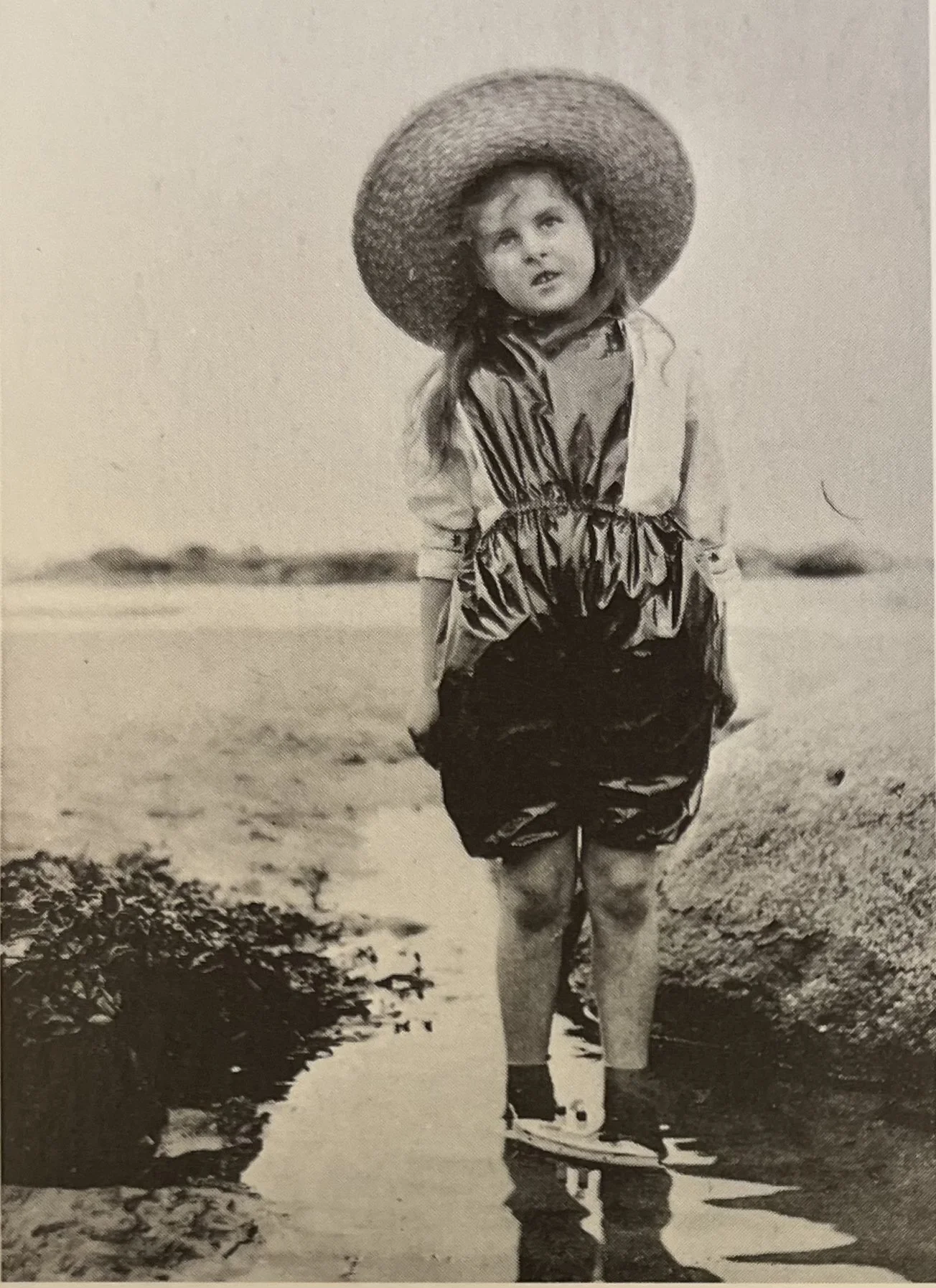
Gabrielle Keiller, Childhood photo, National Galleries of Scotland (NGS) archive
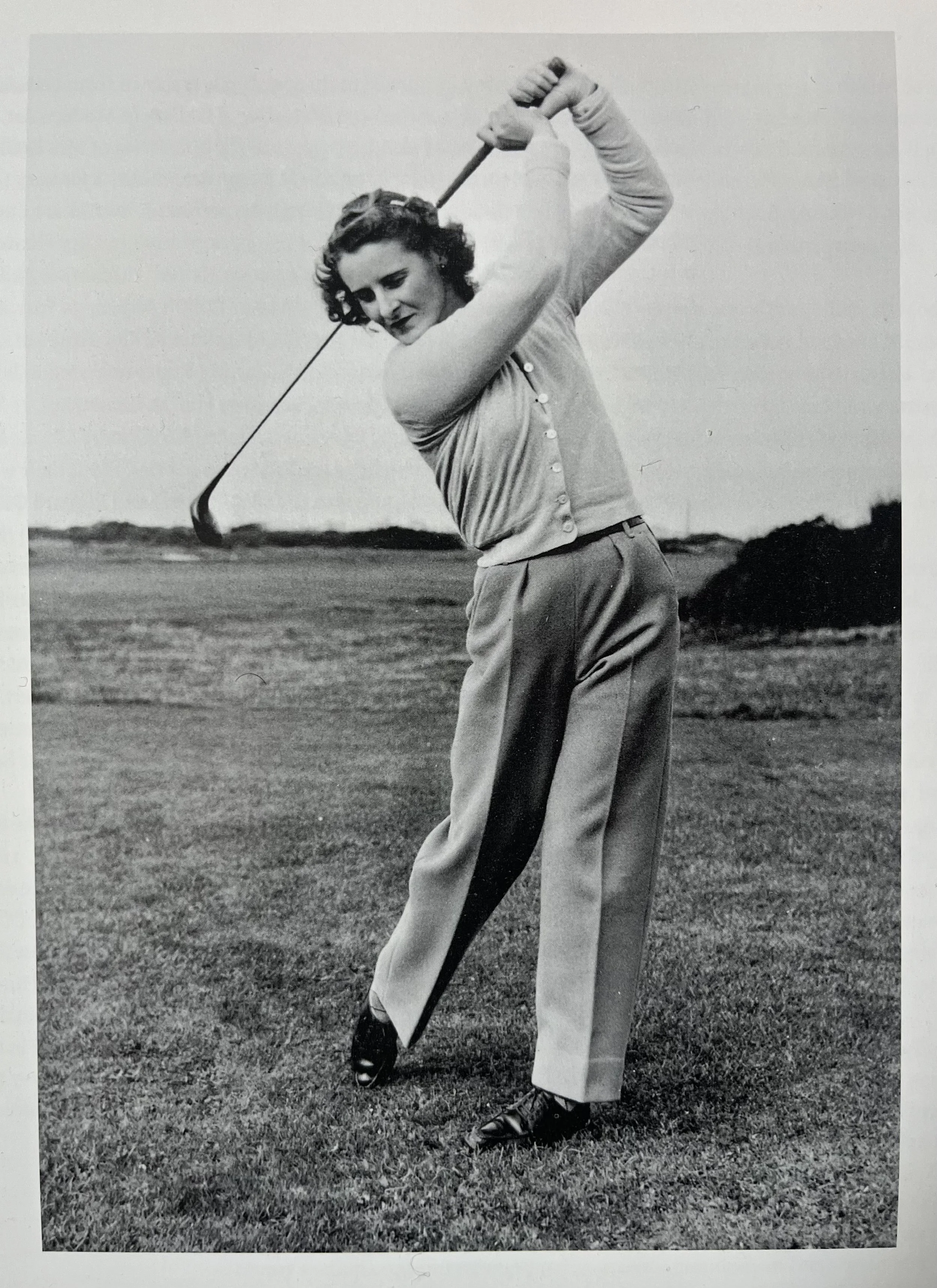
Gabrielle Keiller playing golf, NGS archive
Gabrielle Keiller’s life spanned the twentieth century. She was born Gabrielle Muriel Ritchie in North Berwick, Scotland, while her parents were taking a golfing holiday. There were two younger brothers; Montgomery (Monty) Wadsworth Ritchie, born 1910, and a her younger brother Richard (Dick), who died in his 20s. Her father, James Wadsworth Ritchie (1861-1924), was born in Geneseo, New York State, and her English mother, Daisy Muriel Hoare, came from a banking and brewing background. Keiller’s paternal Grandmother, Cornelia Wadsworth (1837-1921) had an interesting life. Originally from Philadelphia, Pennsylvania, she married Montgomery Ritchie in 1857, and the couple had one son, Gabrielle’s father. Montgomery Ritchie died of an illness contracted while serving during the American Civil War. Cornelia remarried age 30 in 1869 to John ‘Black Jack’ Adair (1823-85). Adair gathered 28,000 acres of land at Lough Veagh in Co. Donegal. Adair first travelled to the US in 1866, and he met Cornelia Wadsworth at a ball. The couple returned to Ireland and commissioned Glenveagh Castle; Cornelia Wadsworth was involved in the creation of its landscaped gardens. In 1877, Adair established the JA Ranch in Texas with Charles Goodnight, a cattle driver; Adair’s main role was as financier. He only ever visited the ranch three times, and died aged 62 on the way back from his third visit. At its peak the ranch extended to 1.3 million acres. After a long dispute with the Trustees over their management of the estate during the Great Depression and an associated drought, Montgomery (Gabrielle’s brother), took control of the JA Ranch in 1935. It took many years to turn it around, and to pay off debts [3]. Gabrielle’s niece, Cornelia Wadsworth Ritchie, continues to farm the ranch to this day [4]. In the post-World War II days, and once the JA Ranch was on a path to success, Montgomery became an avid art collector. It was Gabrielle’s share of the inheritance which helped to fund her own art collecting.
Keiller grew up in Ashwell, near Oakham, England. She was firstly educated by governesses but was later sent “unusually early” to a boarding school, which is likely to have led her to being deprived, to an extent, of parental nurturing. Keiller remembered spending her summer holidays at Glen Veagh Castle, and this sparked her interest in gardening.
Keiller became an enthusiast for Golf - and later won the Lady’s Open Championship in Luxembourg, Switzerland, and Monaco in 1948. Gabrielle first married John Edward Lorne Campbell Currie, on 22 April 1931, in Southampton. She had one son, Giles, to this marriage. Her second marriage was to Charles Richard Style, at Westminster, in the autumn of 1938. During the Second World War, Keiller drove an ambulance for the London Auxiliary Ambulance Service, and passed her exam for the Treatment of Air Raid Casualties, with distinction.
Gabrielle was happiest in her third marriage, to Alexander Keiller, a scion of the Dundee marmalade empire. They had met while playing golf. The couple married in 1951 and they shared all of their interests. They both golfed. Alexander Keiller had commenced researching ancient artefacts and civilisations, and he carried out and sponsored archaeological exploration at the prehistoric stone circle at Avebury, buying the site in 1934. The couple had gathered a large collection of witchcraft, demonology and erotic literature (433 books were gifted by Keiller to the National Library of Scotland in 1966); and they built a large collection of Cow Creamers. With the exception of golf, all of these interests are of relevance to the Surrealist movement (q.v.).

Keiller in the garden of Telegraph Cottage, NGS Archives
In 1954, Alexander and Gabrielle went to live at Telegraph Cottage Kingston upon Thames, but sadly Alexander died of cancer within one year of the move. Gabrielle retained a very strong attachment to the Cottage, and developed its four-acre garden, with help. She loved entertaining there, and it became a base for her art activities and collecting, and for social gatherings. Keiller’s sculpture collection grew, and was carefully sited within the gardens.
Although Keiller’s life may have been insulated to an extent by inherited wealth, there would have been challenges associated with her war service, the two divorces, and the early death of her third husband. After Alexander’s death, Keiller gave up golf, and directed her attention to cultural and intellectual exploration. Keiller commissioned documentation and archives of the work at Avebury. She later donated the site museum and its contents to Historic England, and the museum was re-named The Alexander Keiller Museum [5].
By a mysterious alignment of the planets, Paul Nash, one of the British Surrealists, had become fascinated by the pre-historic standing stones at Avebury, and some of his paintings from the 1920’s included depictions of the megaliths there. Nash later joined the committee for the preparation of the key 1936 British Surrealist Exhibition [6].
Between 1956-1970, Keiller volunteered her services to Rupert Bruce-Mitford, then Keeper of British and Medieval Antiquities at the British Museum. In this role, she contributed to the study of the Sutton Hoo Ship-Burial. Keiller undertook a careful photographic record, and these images were published in Bruce-Mitford’s book on Sutton-Hoo. A familiar pattern emerges: Keiller develops a fascination for a field of learning, then learns from every available source, acquires new skills, and documents the results. Keiller’s photography skills here included capturing images of archaeological fieldwork and of objects within a museum setting, then developing her own photographic negatives, and printing the results.
Keiller donated the couple’s collection of 667 cow cream jugs to the Stoke-on-Trent Museum and Art Gallery in 1962 - with the stipulation that two thirds should be on permanent display - surely a mixed blessing [7]. There is something surreal about such a collection, an intuition which is reinforced by some of the designs. Selected photos of the cow creamer collection appear in the National Galleries for Scotland archives, and I have included an example of a pair of pottery cows, which are in exuberant proto-Picasso style.

Photo of pottery cows from the Keiller Collection, NGS Archive.
In the late 1950s Keiller became a collector of art, initially of Impressionist, Old Masters and Cubist work. Soon after her 1960 introduction to Peggy Guggenheim, Keiller switched her collecting over to contemporary British art, and to Dada and Surrealism.
Sadly, there was a major fire at Telegraph Cottage, in the early hours of 12th June 1986. The night was dry however, and Gabrielle and her butler, Remo, managed to retrieve the great majority of the works and printed materials to the lawn. However, some of the collection did sustain smoke and water damage [8]. This catastrophic event was a great shock Keiller, and those who knew her said that her health started to deteriorate from that point forward. Initially she moved to an apartment in London. In the end, Keiller developed dementia, and in 1993 she entered a nursing home near Bath, where she died in 1995. Gabrielle Keiller’s ashes were buried alongside those of her husband, in Deeside, Scotland.
Keiller undoubtedly felt a strong attachment to Scotland - it was after all, her birthplace, and also the home of golf. It was in Scotland that she met Alexander Keiller; and it was there that she found recognition of her advisory and committee skills within the National Galleries of Scotland.
Gabrielle Keiller came late to collecting 20th Century Art, in 1962, but what an impression she made. Keiller was multi-talented, disciplined in her collecting, and had an unerring eye, all of which opened doors, propelling her into the centre of the British art world. Once the importance of Keiller’s collection became known, she was a generous lender, starting with the “Dada and Surrealism Reviewed” touring exhibition of 1978. Beyond oiling the wheels of art commerce, Keiller’s purchases and lending no doubt assisted the career of living artists such as Paolozzi. As Keiller’s health started to fade, her lending and giving developed further, firstly in the form of an anonymous loan of her entire collection to the National Galleries of Scotland for the “Magic Mirror” exhibition in 1988, and secondly in the form of the major bequest to the National Galleries of Scotland, which was realised upon her death in 1995.
Keiller sourced many important Dada and Surrealist paintings, mainly in the 1970s and 1980s, and these covered the main periods and styles from these movements. The paintings were often moderately sized, but they were important works nonetheless. Keiller was highly aware of the key role for text within Surrealism, hence her detailed attention to collecting artist books, Dada and Surrealist periodicals, Surrealist poetry, and a variety of artist collaborations. These works, inseparable as they are from more traditional art-forms, are one of the key strengths of the Keiller collection.
Obituaries appeared in several papers, and these celebrated her collection and gift to the Scottish nation, and noted her quiet but assured diligence in the field of collecting, public education via lectures, and advisory work [9].
3. Selected List of Keiller’s Travel and of her work in the Arts
1936 Visited New York (Immigration record)
1956 Volunteered at the British Museum (ten years)
1956 Bruce-Mitford engaged Gabrielle Keiller to study and document the archaeological work at Sutton Hoo
1959 Toured Italy - viewed Art and Architecture
In 1960, Keiller was introduced to Peggy Guggenheim by a mutual friend, Wyn Henderson (who had managed the Guggenheim Jeune Gallery in Cork Street, London, until its closure in 1939). Keiller visited Peggy Guggenheim at her home, the Palazzo Vernier dei Leoni in Venice, and saw her collection there. In the same year, she attended the Venice Bienniale, where she would have seen work by Eduardo Paolozzi.
1962 Travelled to Texas, visiting her brother Monty.
1963 Travelled to Mexico then Brazil - and attended the San Paolo Bienniale.
1976-86 Volunteer Guide at the Tate Gallery. Gave popular lectures on modern and contemporary - which were typed in full.
1978-85 Sat on the Scottish National Gallery of Modern Art Advisory Committee. Gabrielle Keiller wanted only outstanding examples. Recognised by Douglas Hall (the first Keeper of the Scottish National Gallery of Modern Art) for her “acerbity of eye which does not go to sleep ….. and for constantly applying a different and perhaps more rigorous sense of judgement” [10].
In 1979 Keiller was asked by the Contemporary Art Society to act as their buyer, and was given a budget of £11000, with which she purchased 19 works [11].
Gabrielle Keiller generously opened her house to visitors from various arts societies [12].
4. Selected list of works entering the Collection
As an entrée into Keiller’s development as a collector, I will focus here on some early acquisitions.
1959 Henri Rousseau - La Statue de Diane au Parc, oil on canvas, (c.1909), from the Arthur Tooth Gallery.
1962 Richard Lindner - Solitary III, oil on canvas, (1959/62), from Robert Fraser at his Grosvenor Square Gallery
1962 Eduardo Paolozzi gifted two early drawings to Keiller, now with the National Galleries for Scotland
1963 First purchase from Marlborough Fine Art - Francis Bacon, Pope no.2 (1960). Keiller sold this work in 1979 and purchased another work by Bacon - Figure Study I, oil on canvas (1945), which remains in the collection.
1963 Paolozzi / Kitaj - Work in Progress (1962), from Marlborough Fine Art.
1963 Max Ernst - Türme (1916) from Marlborough Fine Art.
1964 Edward Burra - Collage, (1930) from James Mayor of the Mayor Gallery.
1966 Work by Yves Tanguy and Francis Picabia, from the Robert Fraser Gallery.
1969 Max Ernst - montrant á une jeune fille la tête de son père, oil on canvas (1926 or 1927), from the Mayor Gallery
And, as an illustration of the rich connectivity of the Surrealist world:
1979 René Magritte - La Représentation, oil on canvas laid on plywood (1937). Purchased from Roland Penrose, who had bought it from Paul Éluard in 1938. Éluard had obtained the work directly from Magritte in exchange for a painting by Max Ernst.
Important sources for Periodicals and artist books included:
H.A. Landry (London), who sold books and periodicals.
Johnny Ambruster, a book dealer in Paris, both advised and sold Keiller rare periodicals and ephemera.
Tony Reichardt. Through the Marlborough Fine Art Gallery, Keiller came to know Reichardt, who sold her some important Surrealist books.
5. Journey into Modernism
Gabrielle Keiller, prior to her interest in Dada and Surrealism, had collected the Impressionists and some Old Masters. The question as to the precise origins of her interest in modernist movements is difficult to establish with certainty. However, we note that Keiller was well-travelled, including a journey to the USA in 1936 (based on a New York immigration record), where she may have viewed contemporary art in the major museums; she had money; and from the 1950s, she had an interest in the esoteric, with reference to the Keiller library of Witchcraft, Demonology, and the Erotic; and also a connection with the pre-historic via her interests in Avebury, Wiltshire. Elizabeth Cowling, who met Keiller in the context of planning for the first major exhibition of her collection in 1988, found that she was “very open to new areas of learning” [13].
In relation to her collecting, Keiller built up her knowledge, but also took advice from a range of sources, including the Galleries listed above, and their Directors.
Individual friends and advisers included Roland Penrose, also a Surrealist artist and well-connected with the key figures within the movement. Keiller acquired Magritte’s La Representation and Alberto Giacometti’s Objet Désagreable à Jeter, from Penrose. A source close to Roland Penrose suggests that despite being able to support Surrealist artists through purchases over many years, he needed in later years to sell work from his collection, as he was buying up agricultural land surrounding Farley farm to prevent development. In addition to buying paintings from the movement, Penrose collected Surrealist literature, artist books, and related correspondence.
Through the 1970s Keiller continued to build her collection, adding works by Jean Arp, André Breton, Edward Burra, Paul Delvaux, René Magritte, Salvador Dalí and Joan Miró. Keiller sold most of her earlier Old Master, Impressionist and Cubist paintings to help pay for her new acquisitions. An indication of Keiller’s growing knowledge and confidence was her delivery of popular lectures at the Tate Gallery on artists as varied as Jackson Pollock and Stubbs, and these talks were meticulously prepared.
David Brown, assistant keeper at the Tate Gallery, advised Keiller in the 1980s, in relation to purchases of works by contemporary British artists including Richard Long, Barry Flanagan, Hamish Fulton, Gilbert and George, Bruce McLean, John Davies, William Turnbull, and Ian Hamilton Finlay. Richard Long personally installed one of his Six Stone Circles (1981) in Keiller’s garden. Many of these works were sold after the fire at Telegraph Cottage, but the painting by Bruce McLean (Gucci Girls) was retained [14].
Dominique de Menil (1908-97), was a major US collector of Surrealist work. She visited Keiller at Telegraph Cottage in 1979. De Menil had an interest in the intersect between modern art and spirituality - and she was on friendly terms with Ernst, Magritte, Dorothea Tanning and many other Surrealists.
Gabrielle Keiller was introduced to Paolozzi by Wyn Henderson in 1960. Wyn Henderson’s son Nigel had studied beside Paolozzi at the Slade in London. Keiller started to collect Paolozzi’s work in 1962, and this developed to the extent that she became the most significant collector of Paolozzi’s work in the 1960s. Keiller had a close friendship with the artist between 1960 and 1975, and this is illustrated in the Keiller archives by the many postcards Paolozzi sent to Gabrielle, from all over the world.

Postcard from Eduardo Paolozzi to Gabrielle Keiller, dated 1964. NGS Archive.

Keiller and Paolozzi also travelled together, looking at the international art scene. There is some indication of a cooling of relations with Paolozzi in 1975, within a letter from Keiller to the artist, which is held in the National Galleries of Scotland archives.
Paolozzi advised Keiller on acquisitions; specifically, there is reference to advice on purchasing work by Francis Bacon, within the Frank Whitford interviews with Paolozzi recorded in the mid 1990’s, which are stored in the British Library Sound Archives [15].
Given the strength of this connection, and the extent of Keiller’s collecting of Paolozzi’s work, it is therefore germane to consider Paolozzi’s history and the context of his work within the overall collection.
Eduardo Paolozzi (1924 - 2005) was born in Leith, Edinburgh. His family, originally from Monte Cassino in Italy. opened an ice-cream shop and café. Paolozzi attended Holy Cross Academy, where he was a fellow pupil of artist and promoter, Richard Demarco. In 1940 Paolozzi was interned as an ‘enemy alien’ in HMP Edinburgh for 3 months, and his father, who was being deported simply for being of Italian nationality, died during the sinking of the SS Arandora Star by a German U-boat, in the same year.
Paolozzi started at Edinburgh College of Art in 1943, then went to St Martins in London in 1944 and the Slade School of Fine Art between 1944 and 1947. In 1947 he created a collage - I was a Rich Man’s Plaything - which is now recognised as being the earliest example of Pop Art. Paolozzi went to Paris, and benefitted greatly from the experience, meeting with Giacometti, Brancusi and others, but he was not formally recognised or represented there, and he returned to Britain in 1949. Paolozzi later taught in Hamburg (from 1960), Cologne, Berlin, and Munich.
Eduardo Paolozzi married Freda Elliot, a textile designer, in 1951, and they divorced in 1988. The couple had three daughters.
Paolozzi’s work fits well into the Surrealist mould, and he recognised his own allegiance to the movement. Within a documentary film held in the BBC Archive, [16] Paolozzi prefers the use of the term ‘Surrealism’ over ‘Pop Art’. And in an interview with J.G. Ballard in 1971, he says, “What I like to think I'm doing is an extension of radical Surrealism” [17]. Picabia’s machine / human drawings were echoed closely in Paolozzi’s later work, as will become apparent from their representative works, out of the twenty-five chosen examples. Paolozzi also quoted influences from ethnographic Oceanic and African Art, in line with the Surrealists. Finally, his development of Pop Art had common ground with Dada in representing a form of “anti-art”, pasting in random everyday objects; also with Surrealist ideas, through ‘impossible’ juxtapositions. In terms of his Pop Art output, Paolozzi seemed to thrive on acquiring the skills of a cultural magpie, albeit alongside his many other deeply emotional and complex sculptures.
Paolozzi’s London studio was recreated in the National Galleries of Scotland Modern Two in 1999, and his giant metal sculpture, Vulcan (1999), was installed in the café, which required significant architectural ingenuity. Paolozzi had a major stroke in 2001, following which he lost the power of speech, and was in need of care. He died in London at the age of 81, in 2005 [18].
6. The Keiller Collection: Selected Exhibition History, Donations and Legacy
1978 ‘Dada and Surrealism Reviewed’ - contribution to the Hayward exhibition.
1982 Donated a work by Roland Penrose, The Last Voyage of Captain Cook, (1936) to the Tate.
1985 Donated Gavin Scobie’s sculpture, Step (1974) to the National Galleries of Scotland
1985 Donated Paolozzi’s sculpture, Markoni Capital (1962) to the Art Gallery of New South Wales
1986 Donated Paolozzi’s sculpture, Rio, to the Hunterian Museum, Glasgow
1987 Exhibition: Paolozzi at the Serpentine. This solo exhibition was based on Keiller’s large Paolozzi sculpture collection.
1988 Exhibition of Paolozzi sculptures at the Glasgow Garden Festival.
1988 Exhibition: The Magic Mirror, curated by Elizabeth Cowling for the National Galleries of Scotland, and shown at the RSA. Gabrielle Keiller was the anonymous and sole lender for the exhibition.
1997 Surrealism and After, reviewed by William Packer in the Financial Times [19].
2016 Exhibition: contribution to Surreal Encounters: Collecting the Marvellous: Works from the Collections of Roland Penrose, Edward James, Gabrielle Keiller and Ulla and Heiner Pietzsch at the Scottish National Gallery of Modern Art, Edinburgh, also toured to the Hamburger Künsthalle and the Museum Boijmans Van Beuningen, Rotterdam.
Gabrielle Keiller’s first will in relation to her collection was in favour of the Glasgow Hunterian Museum, in 1971. However Keiller reconsidered when the University of Glasgow contemplated selling some important work by James McNeil Whistler. Elizabeth Cowling is of the belief that Keiller also considered a bequest to the Tate, but the risk was that her collection would have been “lost” within the vast extent of the Tate holdings. Roland Penrose had felt the same. Given Keiller’s close involvement with the National Galleries of Scotland from 1977, Douglas Hall had several conversations with Keiller, leading her to make a bequest to the National Galleries of Scotland in 1980. The gift was duly made following her death in 1995. In the press release for the Surrealism and After exhibition of 1997, the bequest was described as being “the largest ….. in the history of the National Galleries of Scotland” [20].
7. Memories of Gabrielle Keiller
Dawn Ades recalls Keiller’s humour and good grace. When preparing for an exhibition, Keiller had phoned to ask if Ades had her copy of The Blind Man, a Dada review periodical from 1917, as she couldn’t find it. A few days later, Keiller sent a message to Ades - “blind woman finds blind man”! [21].
Richard Calvocoressi spoke in his ‘biographical sketch’ for the Surrealism and After catalogue, of his recollection of Keiller as being someone who was a perfectionist, balanced with excellent good humour and a zest for life, and with an excellent sense of style.
Elizabeth Cowling described Keiller as being “modest, self-deprecating, and friendly”. Cowling had a very clear memory of the two of them opening Duchamp’s Bôite en Valise, pulling out the contents and arranging them in various playful formats, before the 1988 Magic Mirror exhibition. She also remembers seeing a surreal ‘sacred’ golf ball mounted on a plinth, above Keiller’s fireplace [22].
James Mayor of the Mayor Gallery remembers Keiller as being a very interesting and multifaceted person. He believes that Eduardo Paolozzi opened Keiller’s eyes to Surrealism, but she developed her own very sure eye for collecting [23].
Dominique de Menil said in a letter of thanks following her visit in 1979 - “… as time passes, the vision of your beautiful garden remains radiant. With it persists the memory of some great paintings, and more than anything else, of your lovely hospitality” [24].
William Packer, Art Critic, said in his article for the Financial Times review of the 1997 exhibition, (19 August 1997, see Ref. 19), that Keiller “was always lively, generous and engaging”.
Eduardo Paolozzi, in Night Waves, BBC Radio 3: “She [Keiller] had this incredible reasoning … a certain kind of imperial eccentricity. She found it very easy to like Surrealism as being quirky, naughty, and for her, marvellous” [25].
Antony Penrose (son of Roland) found Keiller to be “absolutely charming, kind and approachable. I liked her” [26].
8. Description of the Dada and Surrealist movements
Initial research into the Dada and Surrealist movements rapidly dissuaded me from attempting any systematic historical survey - their inherent complexity represents a veritable porridge of inspirations, philosophy, alliances and disputes. My purpose here is to provide a brief overview of Dada and Surrealism, sufficient to provide context to Gabrielle Keiller’s fascination for the movements, and to her collecting. For those interested in further researching the history, there is a seminal text, Dada and Surrealism Reviewed, which was prepared for the Hayward exhibition of 1978 [27].
Dada was born out of the chaos of World War I. In essence, it was an artistic response to the insanity of a world war which pitted farmer against farmer, peaceful worker against worker, in an orgy of destruction. The Western civilisation which permitted such madness was deconstructed by Dada’s nonsense verse, music and iconoclastic visual arts. Dada has been characterised as being nihilistic, but there is a sense that ‘nonsense’ could build something new from the ashes, through an absolute adherence to Truth. There were formal connections also with the Anarchist movement, which pursued the decentralisation of power: Hugo Ball, one of the earliest Dadaists, made translations of Bakunin, and Hans Richter had connections with anarchist groups in Zurich. In Germany, Dada was actively suppressed following its role in mocking the military during the Spartacus Revolution of 1919. Hitler was later to refer to Dada as “art Bolshevism”, a reference to an affiliation with Communism, which was carried forward through important figures within the Surrealist movement [28].
Dada also had strong representation in the USA, from Old World immigrants including Marcel Duchamp and the famous Baroness von Freytag-Loringhoven, who could not move without expressing her aesthetic and philosophical revolution: cross-dressing in public (radical for the time), wearing fantastical clothing and adopting bizarre postures. Keiller acquired a copy of the single issue New York Dada magazine of 1921, the cover featuring a perfume bottle and plastered with inverted text of “New York Dada 1921” [29].
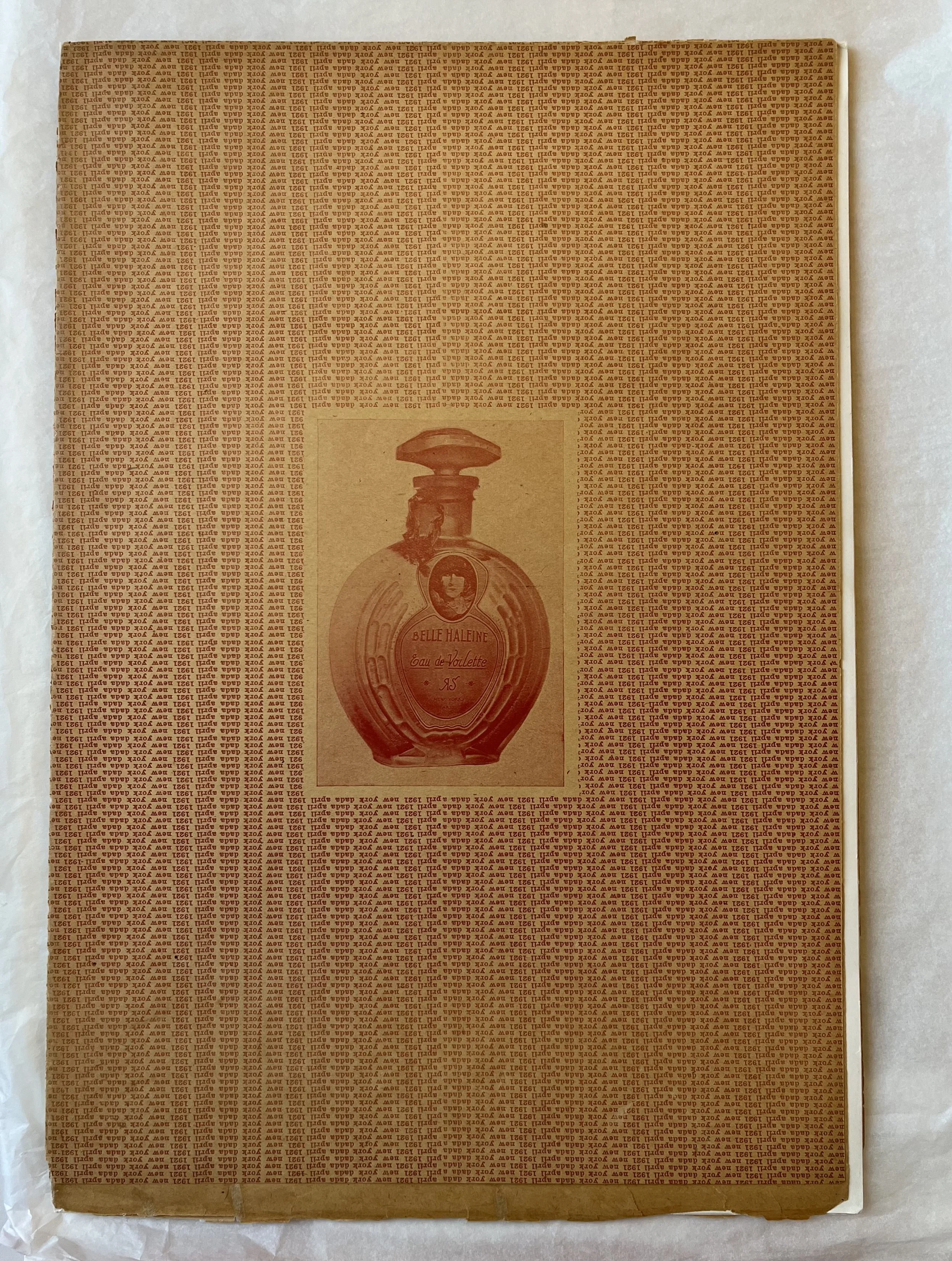
Cover of New York 1921, NGS Archive
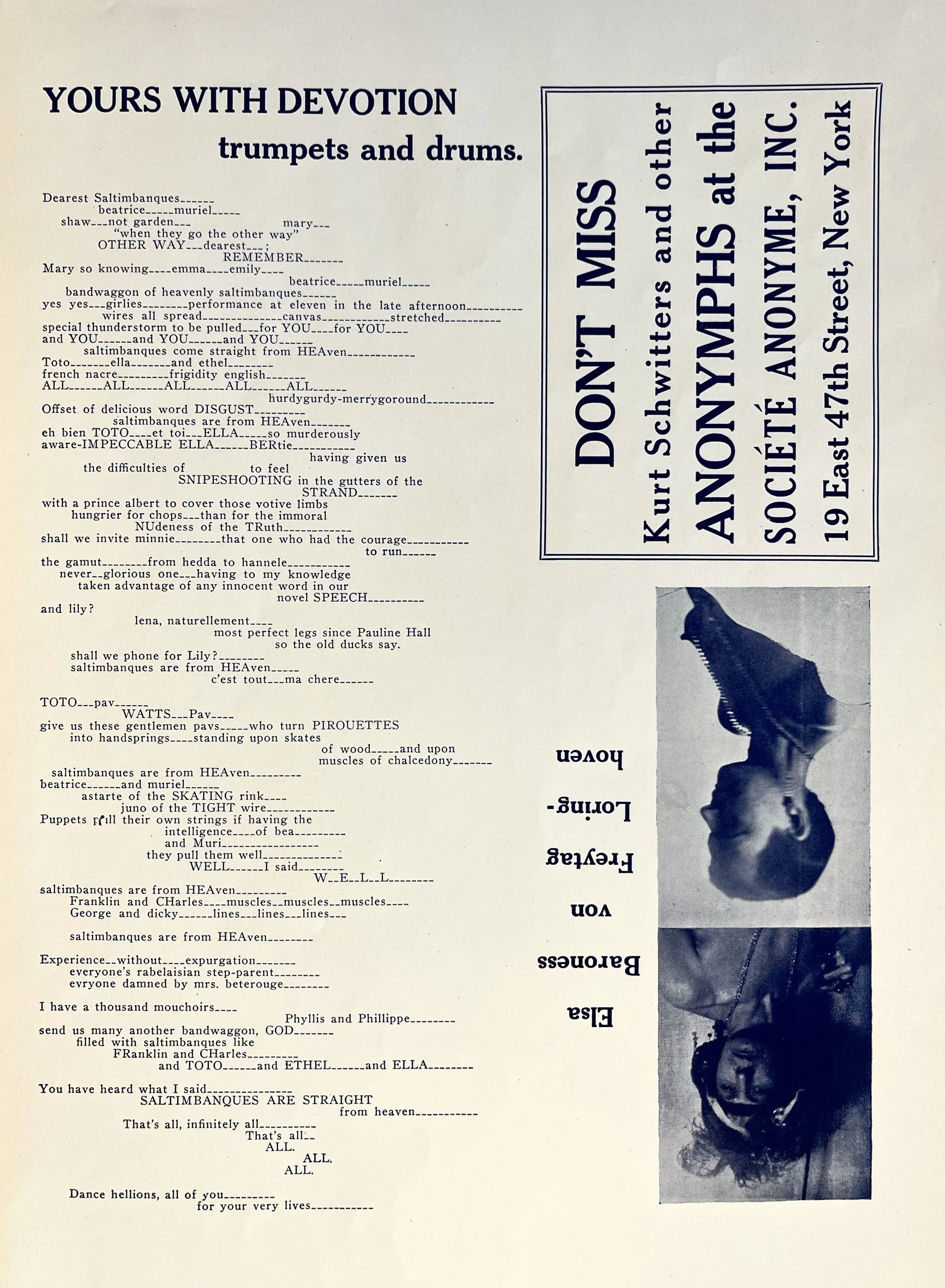
New York 1921, NGS Archive: The magazine featured a poem by von Freytag-Loringhoven
If you will permit a small diversion, the Baroness also published in The Little Review periodical, alongside James Joyce, whose Ulysses first appeared in serialised form in this journal between 1918 and 1920. Her first appearance in The Little Review was in the June 1918 edition[30]. The New York 1921 poem is relatively demure, presumably to avoid the obscenity laws which had hamstrung the later editions of The Little Review. For those who wish to experience the full force of the Baroness’ expression as poet, artist in found objects, and performance artist (she was a pioneer in all of these fields), I can commend the structured presentation and review of her life and poetry, within Body Sweats [31].
In the early 1920s, artists from all over the world, including the Dada artists who were returning from New York, began to congregate in Paris. One of the key figures was Max Ernst, who was one of several artists who moved seamlessly from Dada to Surrealism. Some members of both movements, including Louis Aragon, had affiliations to Communism, and the artists were certainly politically aware and engaged - members protested against acts of imperialism and oppression, including the invasion of Morocco during the Rif War of 1925. However, the movement’s core mission as expressed in Andre Breton’s Surrealist manifesto of 1924, was to pursue the power of dreams, through techniques such as Automatism (representing the unconscious generation of words, or the related use of any creative media). It remains a moot point as to the extent that the Surrealists pursued true automatism, as much of their poetry was highly grammatical, and many of their paintings appeared to be consciously composed and elaborated, as in a dream recalled.
The philosophical underpinnings of Surrealism incorporated a broad range of influences, including the concept of Esotericism (specifically; spiritualism, hermeticism, and alchemy). The Surrealists shared knowledge of key Romantic, Esoteric and modern texts on Psychology, within their libraries (likely shared between members). Breton and Apollinaire in particular had thoroughly researched proto-modernist writing by key French authors including Balzac, Rimbaud, and Victor Hugo, the latter author being widely read on early esoteric sources, including Swedenborg. The fact that Breton later openly acknowledged occultism as a source for Surrealist methodology and inspiration is however ironic, given that Ithell Colquhoun was expelled from the British group in 1940 by its leader, Edouard Mesens, for her refusal to renounce occultism. The Litterature Nouvelle Série (Paris, 1922-23), of which some issues appear in Keiller’s collection, explicitly references key texts from historic occult figures; Hermes Trismegistus, Flamel, Agrippa, and Péladan. 19th Century writers are also referenced, including Rimbaud, Lautréamont and De Sade. The explicit links between Surrealism and Esotericism were also confirmed through Breton’s documented study of Viatte’s Les Sources Occultes du Romantisme (1928), as described in Bauduin’s 2012 thesis [32].
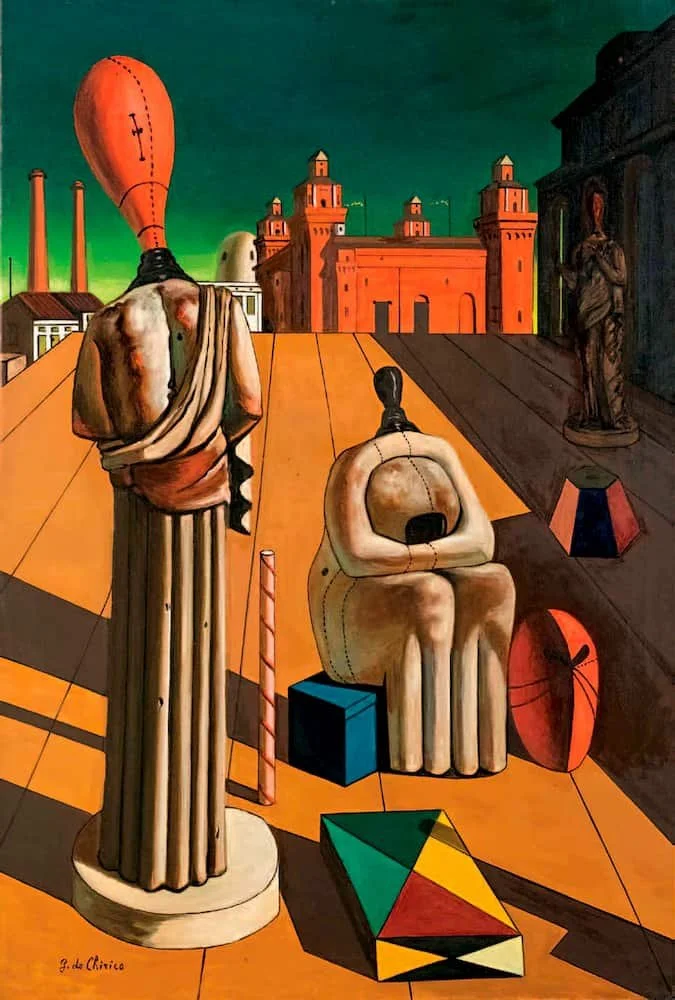
Breton, Aragon and Apollinaire referenced Rimbaud’s ‘Delire II - L’Alchimie du Verbe’ of 1873 - which could pass for being a foundational text for Surrealism [33]. And they developed their thinking on a ‘counter-mythos’, where the ordinary object takes the place of classical figures, noting the work of Giorgio de Chirico in conducting a metaphysical translation of classical statuary for a time of War, as seen in Le Muse Inquietanti.
Louis Aragon’s key text, Paysan de Paris, provided the ‘impossible’ contrast of peasant innocence with city sophisticate. Aragon’s concept of ‘le merveilleux quotidien’ represented the dedicated but unforced search for finding marvellous conjunctions and meanings within everyday scenes - exaggerated within the nocturnal cluttered streets of Paris [34]. Added to this, is Breton’s concept of the reconciliation of opposites, as illustrated by the idea of “l’amour fou”.
Breton, Aragon, Éluard, and Apollinaire had been witnesses of the horrors of the First World War and in essence, their fragmentation of human creativity into dreamscapes represented a continuation of the Dada reaction to the ‘rational’ world which could support mass destruction. The safe symbols of ordinary life in the midst of war, found voice in Louis Aragon’s appreciation of Apollinaire’s discovery of the ‘alchemy of the ordinary’, as in this quote from a paper by Abigail Susak: “Aragon, no stranger to the horrors of the Front, was astonished at how the rugged trappings of the life of a foot soldier, such as tattoos on biceps, graffiti on barrack walls, or photographs and postcards sent from home, could manifest as ‘les plus beaux témoinages de notre divinité’, (‘the most beautiful witnesses of our divinity’) for Apollinaire” [35].
André Breton had encountered shell-shock during his service at a Psychiatric Hospital in Nantes, and later in the French ambulance service at Verdun. This led Breton to take an interest in psychic phenomena, and onwards to the work of Pierre Janet, who encouraged automatic writing as a therapeutic technique. Breton was also interested in the relatively new discipline of Psychoanalysis through the work of Sigmund Freud, whose ideas provided rich material for the Surrealists in terms of the significance of psychic conflict and of dreams.
Through his work in the St. Dizier Hospital from August 1916 and later under Joseph Babinski at the Pitie Hospital in Paris, Breton became aware of techniques to measure the physiology of shell-shocked patients and those suffering from hysteria, using the sphygmometric oscillometer, and the myograph (an electrical recording of muscle activity). These studies later translate into the Surrealists’ depiction of the electro-physiological trace within their work.
Breton himself was careful to steer a path which avoided both scientific determinism, and its opposite, the purely subjective description of psychic experience. The exploration of the unconscious was regarded as being a subject for scientific exploration, but it also encouraged an opening of the mind to new artistic and poetic avenues. This explains how ‘psychic automatism’ became one of the defining characteristics of Surrealism [36].
The Surrealist development of these ideas, along with the incorporation of contemporary developments in psychology, is revealed in Antonin Artaud’s recollection of his 1924 visit to the ‘Bureau of Surrealist Research’. Artaud saw an exhibit of Freud’s text, The Interpretation of Dreams, which was framed with spoons and placed on an altarpiece. This must be a prime example of Surrealism intermixed with scientific study, and the influence of Dada!
The astonishing confluence of discovery and coincidence is illustrated by Marcel Duchamp’s prior use of the ‘graphic trace’, wherein he traced the curves produced by randomly dropped lengths of thread; he later re-created these precise curves in art works such as Stoppages Etalon (in MOMA, New York), noting the date of 1914. Max Ernst also used the graphic trace in his collaboration with Paul Éluard, Les Malheurs des Immortels, 1921. This spread of ideas demonstrates the close integration and common currency amongst early Dada and Surrealist artists, based on the fruitful dialogue between the scientific, the unconscious, and the poetic. These influences are well-described in a Tate Research paper, Becoming Machine: Surrealist Automatism and Some Contemporary Instances, by David Lomas, 2012 [37].
The Surrealists frequented the Ethnographic Museum in Paris in the 1920s, and as for some of their predecessors (notably Gauguin, and the Cubists), they took inspiration from Oceanic and African culture in the form of carvings of human and mythical figures. They understood that what had been previously termed ‘primitive culture’ contained very powerful expressions and archetypes, which were universally relevant.
The creativity of the times, drawing in truly innovative artists from many nations and creative fields to Paris, represented something of an enlightenment following the dark days of the First World War. Poets and artists met in Breton’s house or in cafés, and networked feverishly. Female artists were often but not always, partners of the male protagonists. Although women were subject to patriarchal and dismissive attitudes (they were strikingly absent from posters and writings on the work of the Surrealists), there were many women who became members of the movement and who were key innovators. Female Surrealists began to appear in exhibitions, including the London International Exhibition of Surrealism, in 1936. Elizabeth Cowling, Professor Emerita in the History of Art at The University of Edinburgh, considered that the female artists within Dada and Surrealism had a fair degree of autonomy and agency in terms of their creative output, within the historical context [38].
Aside from the philosophical basis of Dada and Surrealism, and the strength of the key personalities who drove their development, there was definitely ‘something in the air’ in relation to the sudden gathering of creative momentum, across different cultures and age-groups. The film-maker, Luis Buñuel, recalled childhood memories of his strong interest in dreams and the bizarre, within his autobiography, My Last Breath. When Buñuel presented a first screening of Un Chien Andalou, his joint project with Salvador Dalí, in Paris (1929), he was welcomed into the Surrealist fold within the week[39].
Disputes between Surrealists inevitably arose, sometimes through philosophical differences, or jealousies, whether personal or professional. Even more commonly, tensions arose through the sin of failure to adhere to the Surrealist creed, as strictly defined by Breton. The Breton/Dalí correspondence as collected by Keiller is one such instance of lingering tensions, although for much of the period in question, the 1930s, the two were careful not to fall out entirely.
We will now move onto the twenty-five objects chosen in appreciation of Keiller’s achievements.
9. An Appreciation in Twenty-five Objects
Giorgio de Chirico, Le Muse Inquietanti, oil on canvas, 99x65cm. 1917-18. © the estate of the artist.
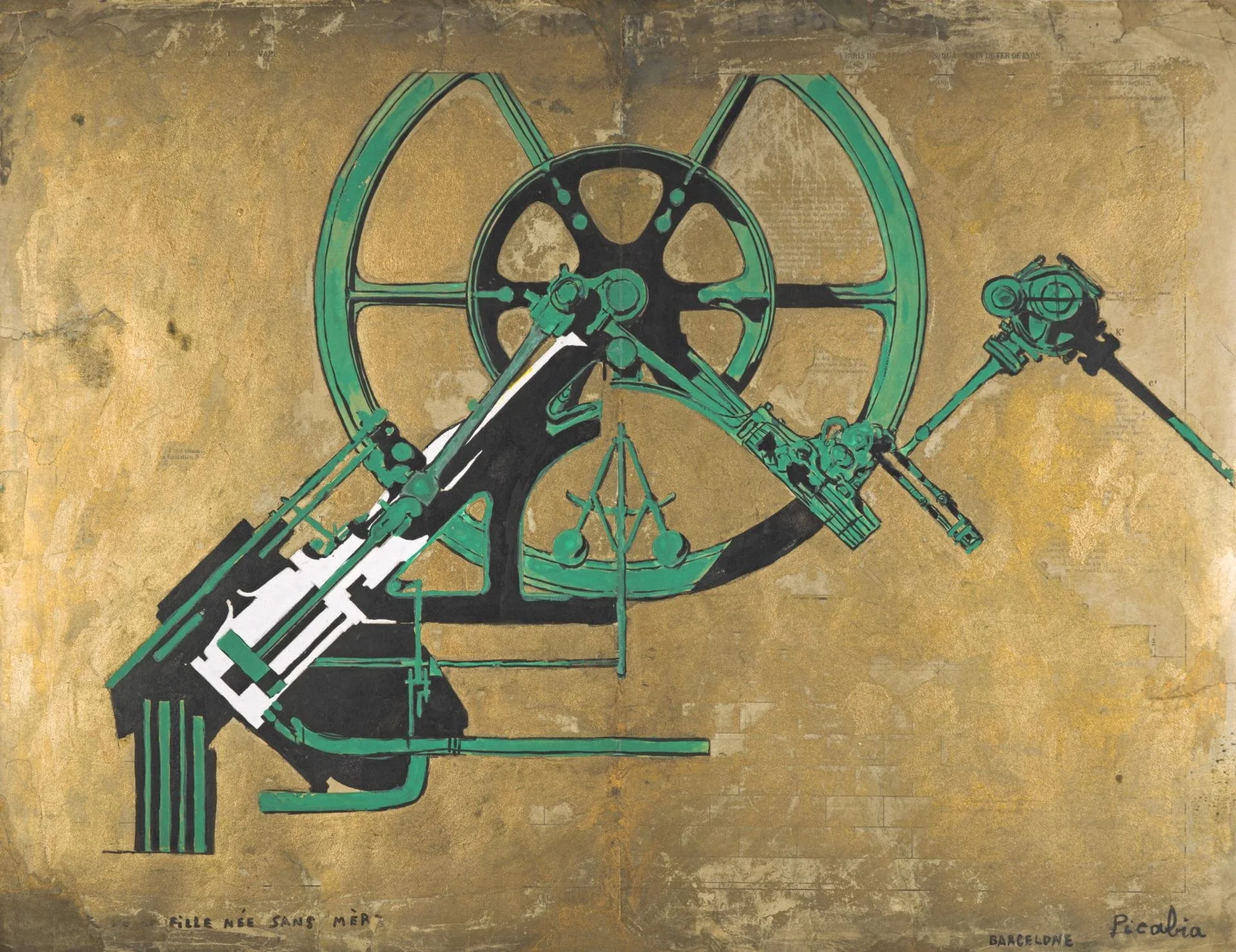
a. Francis Picabia (1879-1953) Fille née sans Mère, gouache and metallic paint on engineering drawing, 1916-17. Image Credit: The National Galleries of Scotland www.nationalgalleries.org © ADAGP, Paris and DACS, London.
The mechanistic characteristics of this work, an ‘altered’ engineering object rendered unbalanced and non-functional, also incorporates the human form. The concept of life as a utilitarian project in the service of capitalism, is echoed within the title, Girl born without a Mother. Alternative and equally valid readings, referenced in Surrealist literature, include the analogy between Picabia’s machine drawings and the mechanics of the sexual act. There is a third layer of meaning; the work appears to represent a deliberate puncturing of Christianity, through its referencing of the virgin birth within the title; this blasphemous interpretation is heightened by the use of gold ink, which mimics religious icons. Finally, the title can be traced back to Ovid’s Metamorphoses, meaning “I have no model for it” [40].
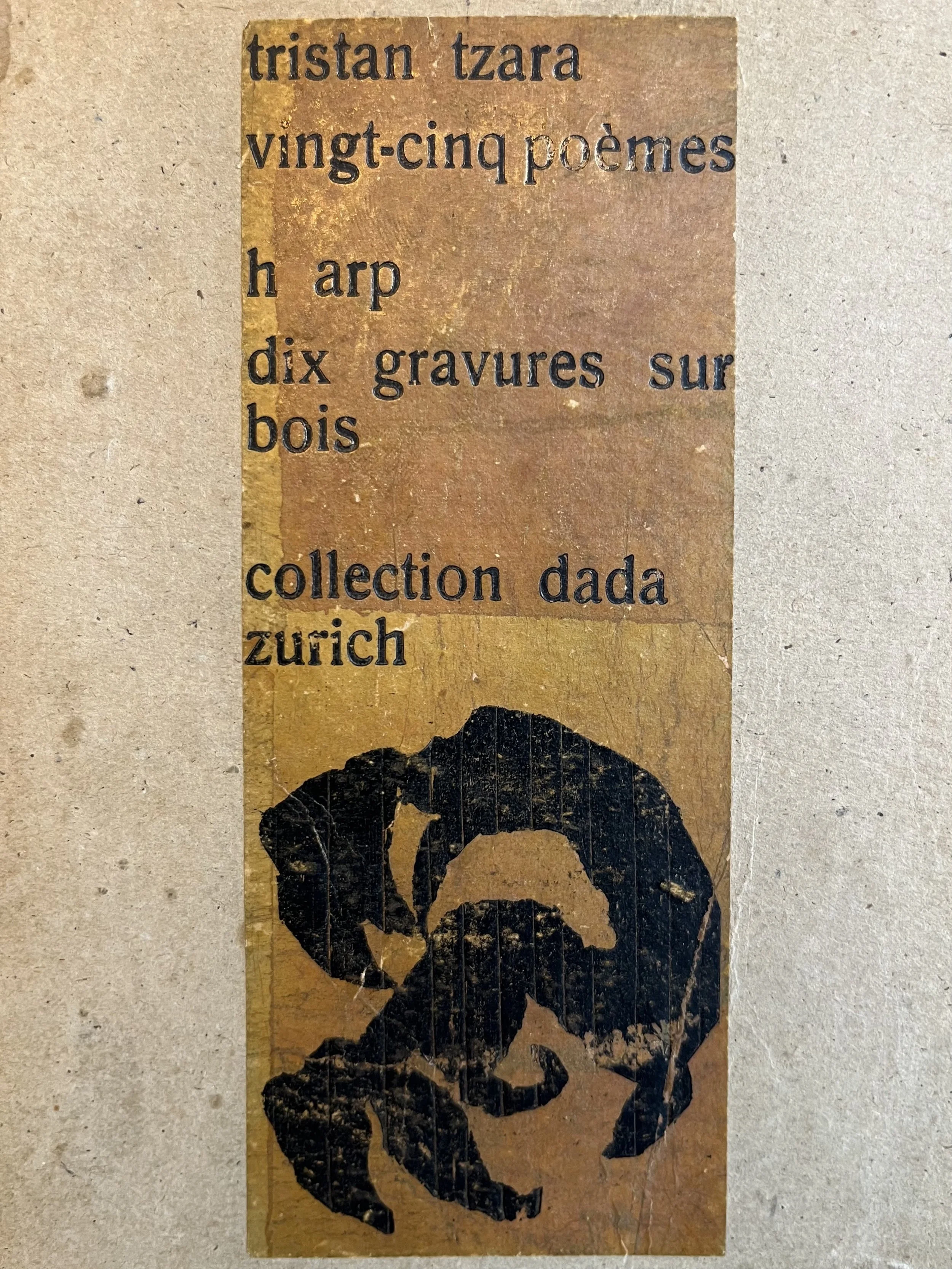
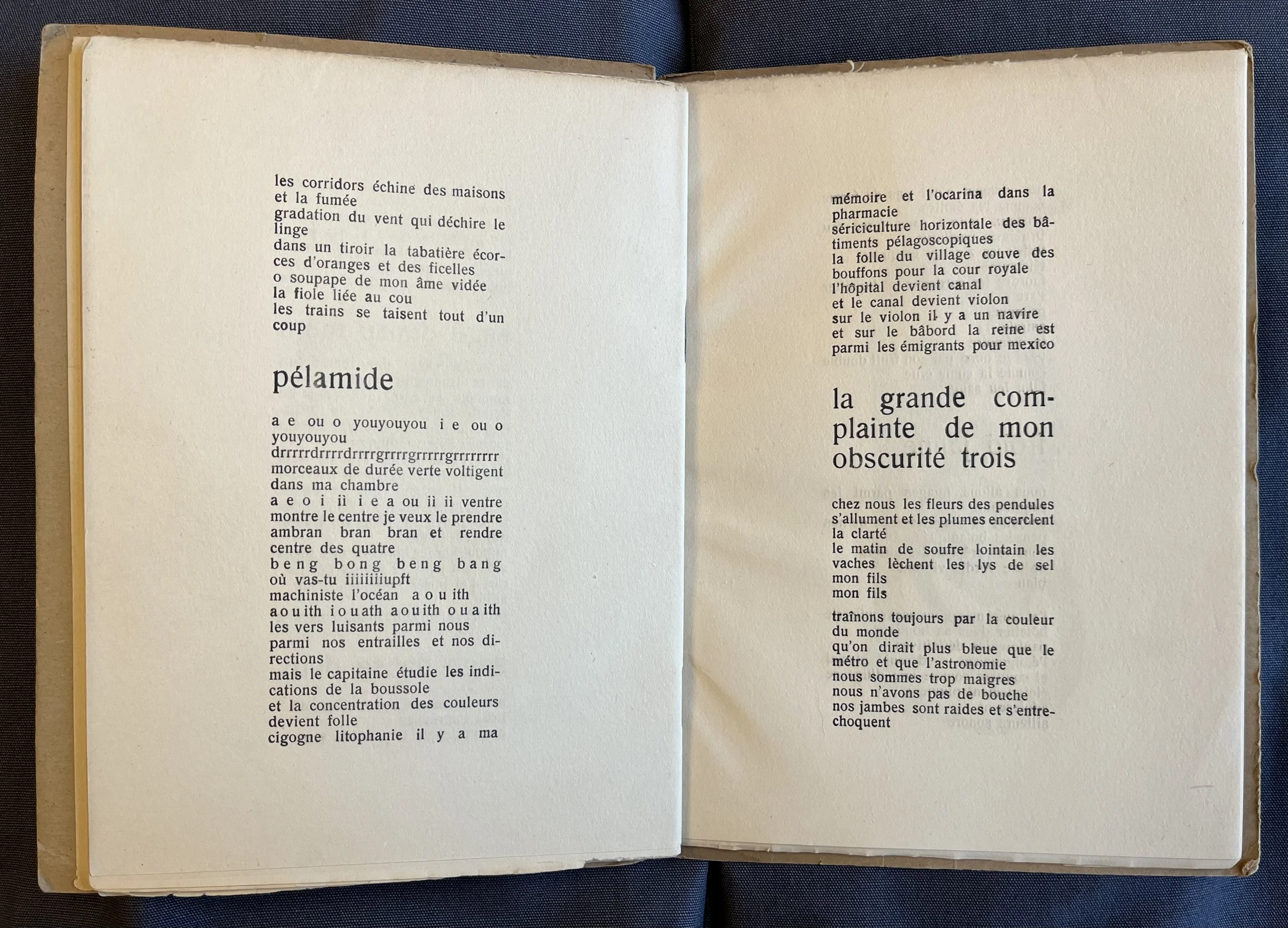
b. Tristan Tzara and Hans Arp, vingt-cinq poèmes. Pub. J. Heuberger, Collection Dada, Zurich, 1918. © the estates of the artists and Hans (Jean) Arp © DACS, London.
These early Dada poems, composed between 1915 and 1918, are accompanied by ten suitably modernist and abstract woodcut engravings by Hans Arp. Tzara, a Dada artist with a firm philosophical and literary background, here experimented with the atomisation of meaning, and sound effects. He also made use of his research into African and Oceanic poetry [41].
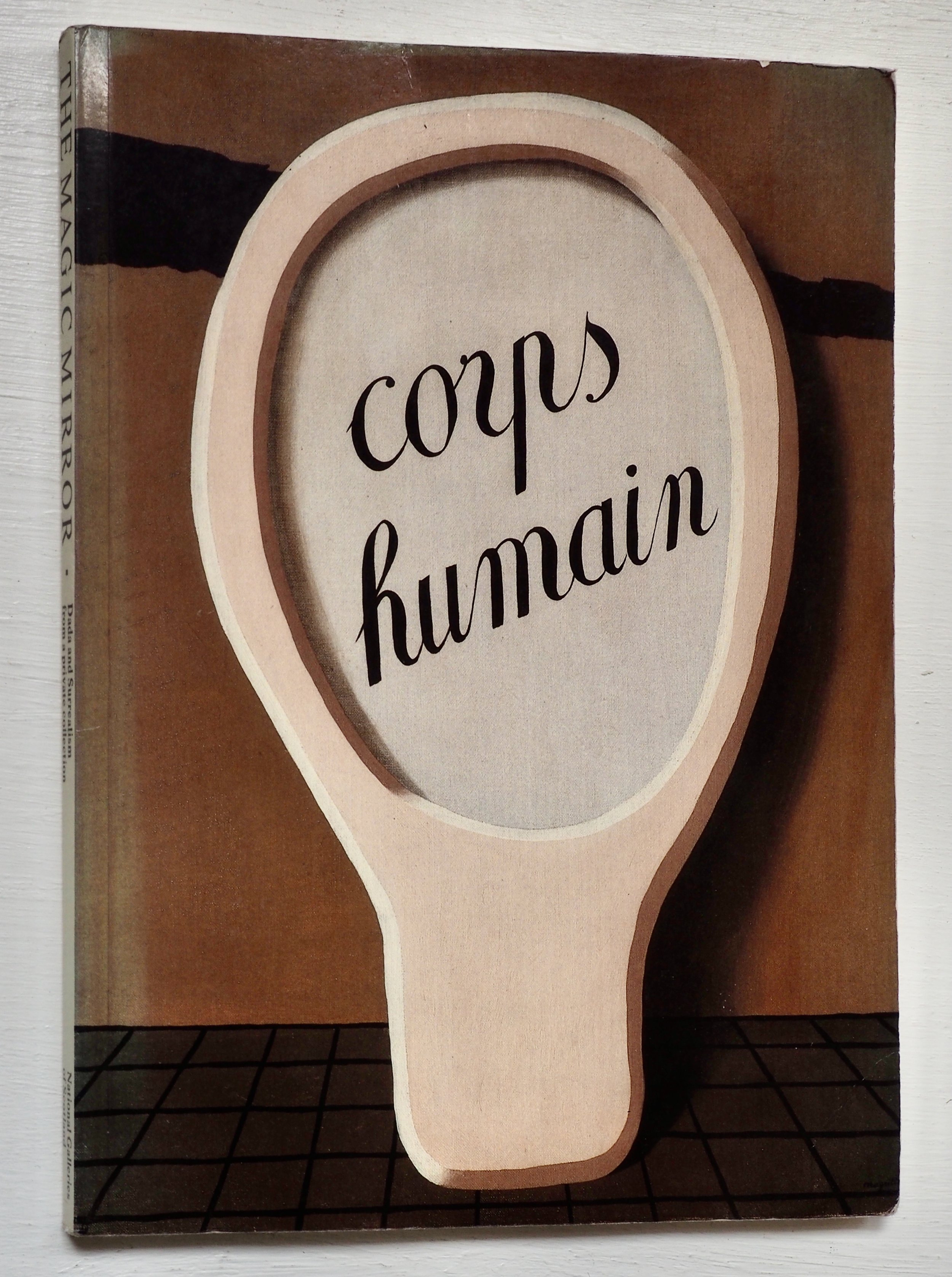
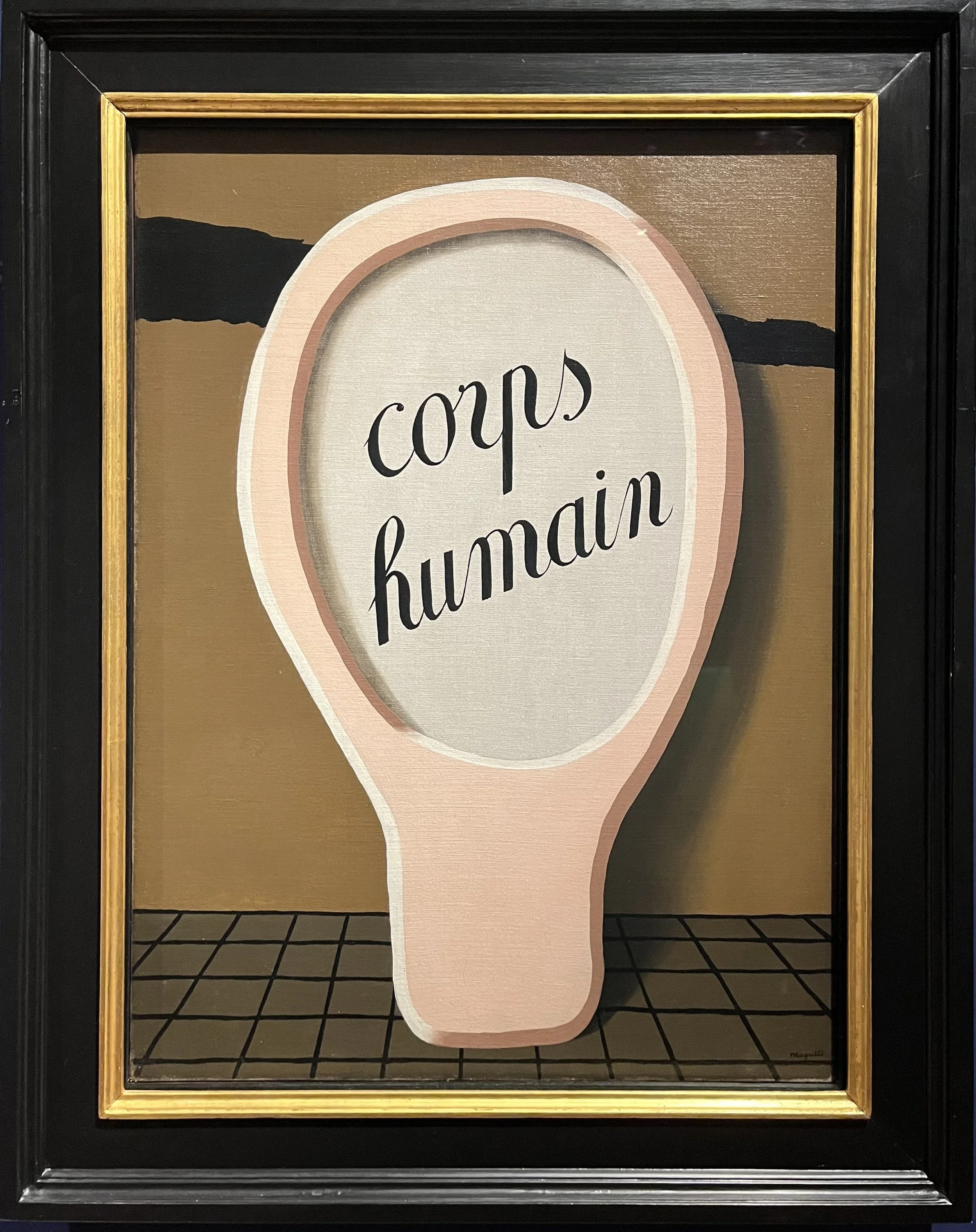
c. Cover of NGS catalogue for the 1988 exhibition of the same name. René Magritte, Le Miróir Magique, oil on canvas. 73x54cm. 1929. Image Credit: NGS, John Webb and Jack Mackenzie. Work by René Magritte © ADAGP, Paris and DACS, London.
This emblematic work by Magritte draws us in with its tactile and aesthetic qualities, but then challenges us through its wordplay and conceptual mirror to our sense of self. The shape of the mirror suggests a female shape, but the mirror appears to be composed of bare canvas, providing a tabula rasa, for the viewer to reflect on the relationship between the body, and concept of self. The shape of the mirror is also reminiscent of the Renaissance tondo.
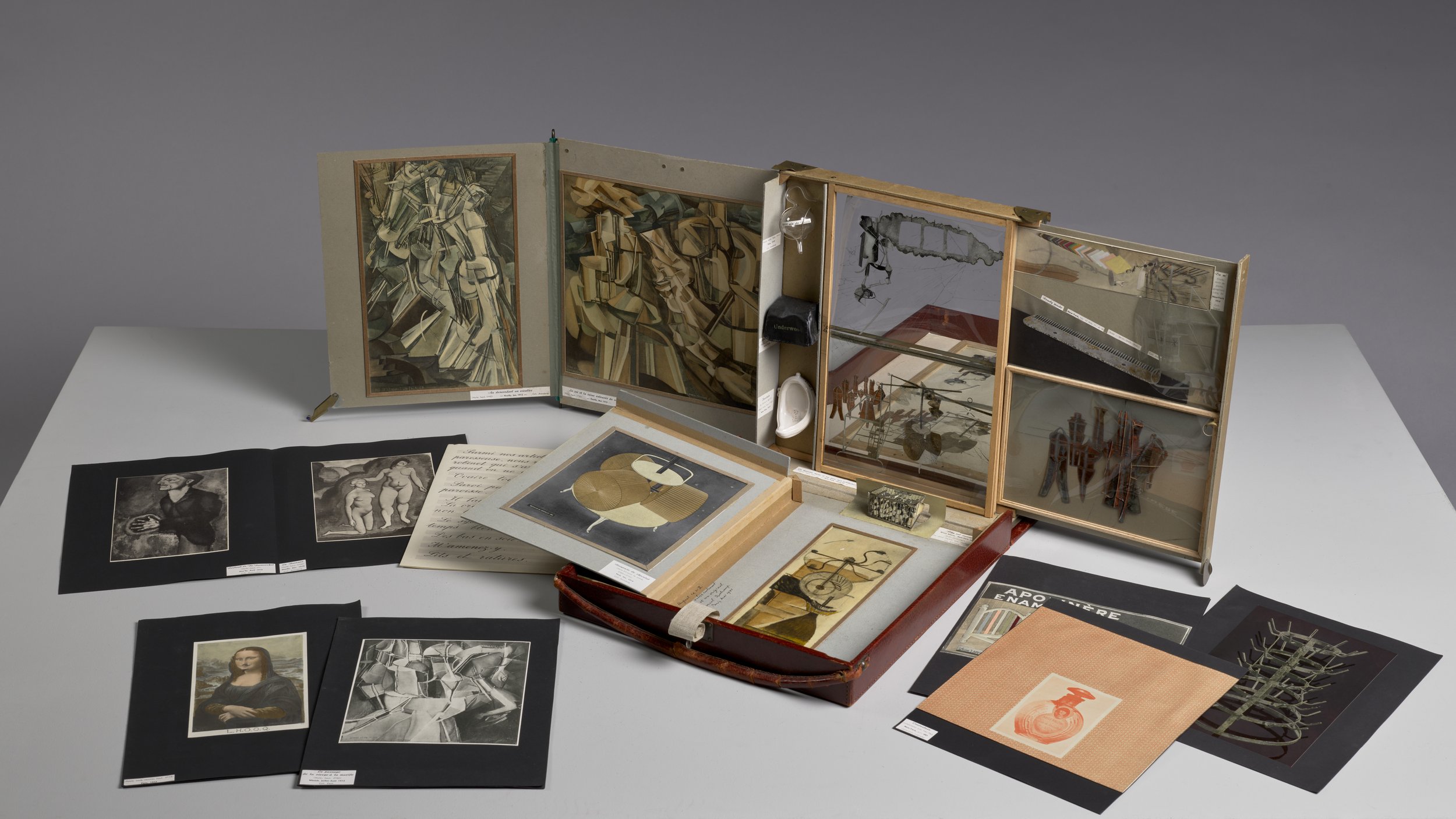
d. Marcel Duchamp La Bôite en Valise 1935-41. A collection of Duchamp’s earlier artworks made in miniature, and placed in a partitioned suitcase. Image Credit: The National Galleries of Scotland (NGS) www.nationalgalleries.org.
This work demonstrates the portability of Duchamp’s Dada concept, at a time of considerable flux in his life. Duchamp crafted a series of his earlier works in miniature, including the Fountain urinal, Nude Descending a Staircase, and the moustachioed Mona Lisa. For the times, Duchamp was strikingly modern in his attitude to gender fluidity, himself adopting the alter ego of Rrose Sélavy (sic - note that the surname is homophonic for ‘c’est la vie’!), which was a second signature added to the series of twenty suitcases he constructed between 1935 and 1941.
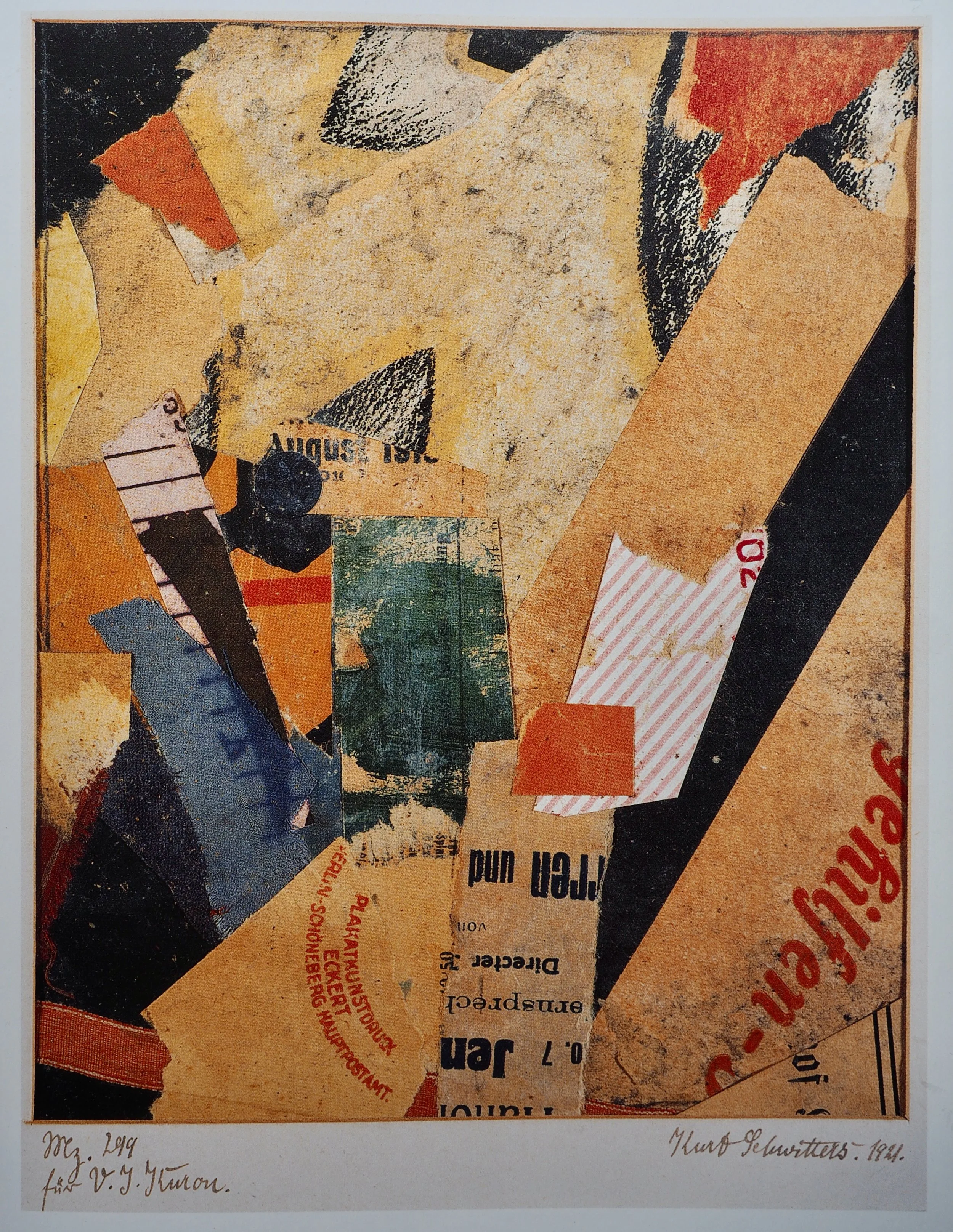
e. Kurt Schwitters, Mz 299, Collage on paper, 18x14.5cm. 1921. © DACS, London.
This ‘Merz’ piece is number 299 out of a series of around 2000 collages produced by Schwitters in his short lifetime. Schwitters was an important member of the Dada movement early in his career, and he also contributed to the origins of modernist sound poetry through his extended sound-cycle, Ursonate. While Tzara had initially constructed a destructive and nihilistic agenda for the Dada project, Schwitters was more interested in creating a human response to war. The present work illustrates Schwitters’ concept of Merz, the gathering of the detritus of civilisation, including randomly torn pieces of train tickets, news stories, etc, and assembled through a collage process into a metaphor for renewal from the ashes, as Germany recovered from the First World War. The series has resonance with the later Ursonate, in relation to its seemingly random if orchestrated progression.
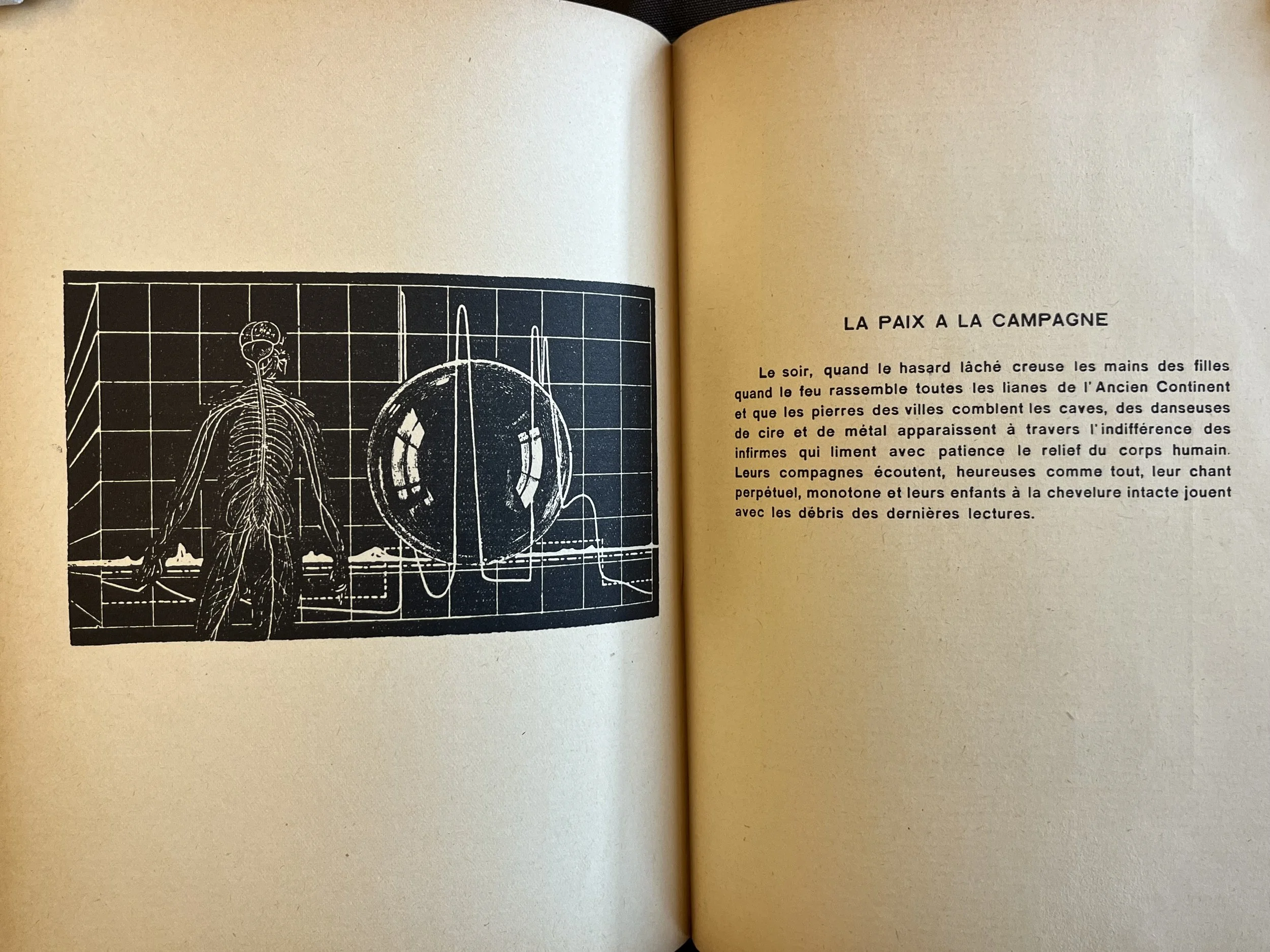
f. Paul Éluard / Max Ernst, Les Malheurs des Immortels. Pub. Librairie Six, Paris, 1922. © Paul Éluard, the estate of the artist. © Max Ernst, ADAGP, Paris and DACS, London.
Les Malheurs des Immortels is an artist book which embodies the ability of Surrealist artists to collaborate and experiment, in finding new modes of creation. The creative process involved Ernst supplying 21 images, by deploying a collage technique upon 19th Century engravings. Éluard and Ernst then sent fragments of text for each image to each other, in an iterative process, until the textual component was deemed complete. This particular page, Entre les Deux Poles de la Politesse, plays with divided space. The anatomical interrogation of the human form faces a sphere, the symbol of identity and completion. The trace refers directly to one of the origins of Surrealism, the graphic trace, as described in the section discussing Breton’s experience working in psychiatric hospitals, above. The background to this collaboration also reveals the destructive aspects of ‘living without rules’. Max Ernst became infatuated with Éluard’s wife, Gala, and they entered an unhappy ménage a trois. Gala later married Salvador Dalí, and became his manager and promoter; yet another illustration of just how close-knit the Surrealist community was [42].
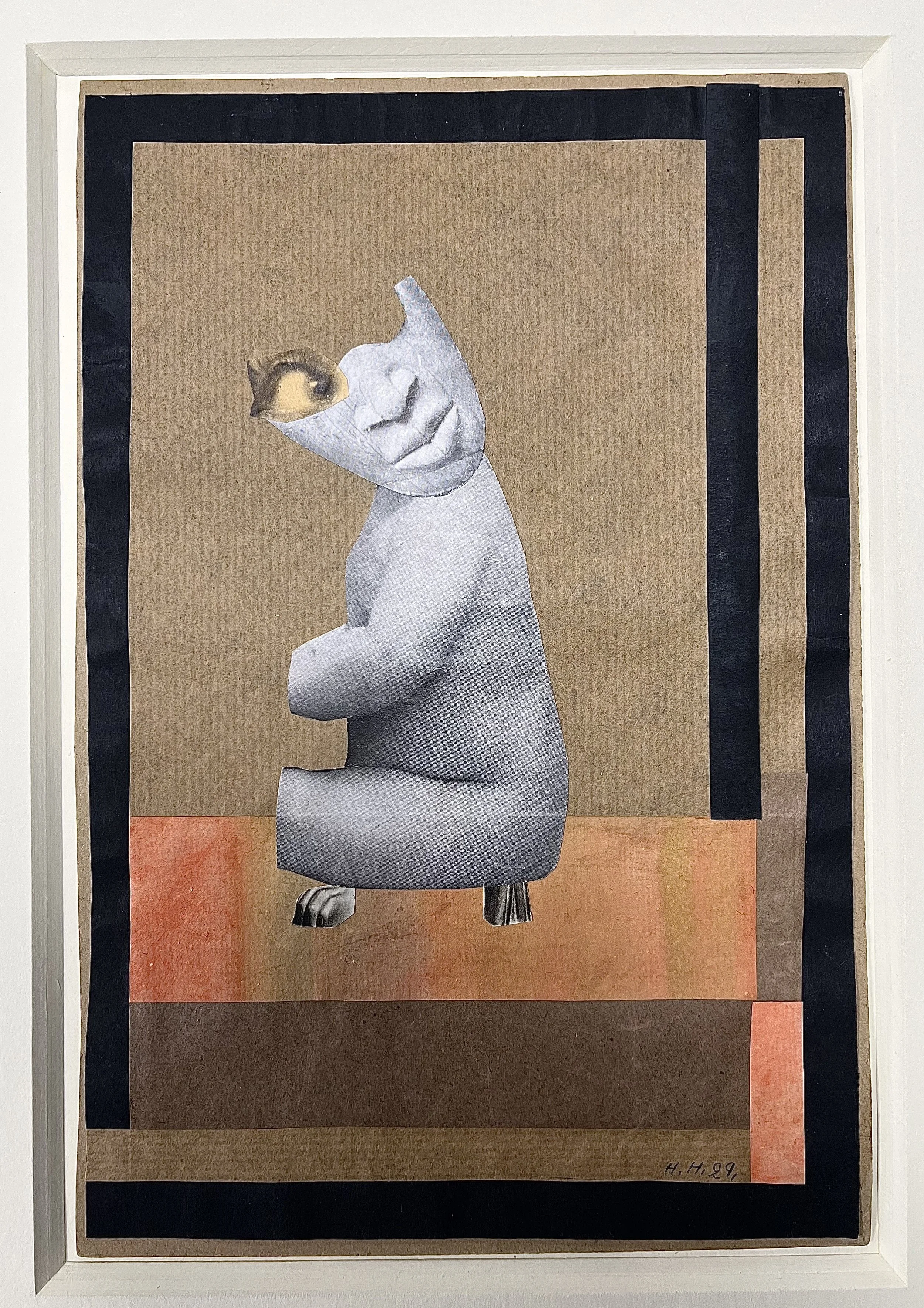
g. Hannah Höch (1889-1978), Aus Einem Ethnographischen Museum. Photo-montage collage on paper. 25.7x17.1cm. 1929. © DACS, London.
This work by Hannah Höch, the German Dada artist, is surprisingly small and delicate when seen in person. It carries important themes, paying tribute to depictions of the female form across cultures, in a typical collision of disparate elements. The figure is set on an abstract geometric background, influenced by the De Stijl movement. Höch had a stormy relationship with Raoul Hausmann for 7 years from 1915. She actively promoted a feminist agenda and also had a bisexual identity. Höch had the honour of being labelled as a ‘degenerate artist’ by the Nazis in 1932, which was a reliable signifier of being an important and progressive figure. For further background, I can recommend the short film, Becoming Hannah Höch, made at the Merz Gallery in Sanquhar, in 2025 [43].


h. Louis Aragon, Introductory essay for an exhibition at Galerie Goemans: La Peinture au defi Exposition de Collages, and image of a collage by Max Ernst. Pub. Librairie José Corti, Paris, 1930. © The estates of the artists, and Max Ernst © ADAGP, Paris and DACS, London.
This catalogue, in addition to providing images of several exhibits, also contains a detailed introduction by Louis Aragon, which describes the history of collage, and the opportunity for it to create a democratic revolution, whereby anyone can create art or afford to buy artworks. The title translates as ‘A Challenge to Painting’, and in the essay, Aragon states that “the marvellous must be made by all, and not one alone” [44].
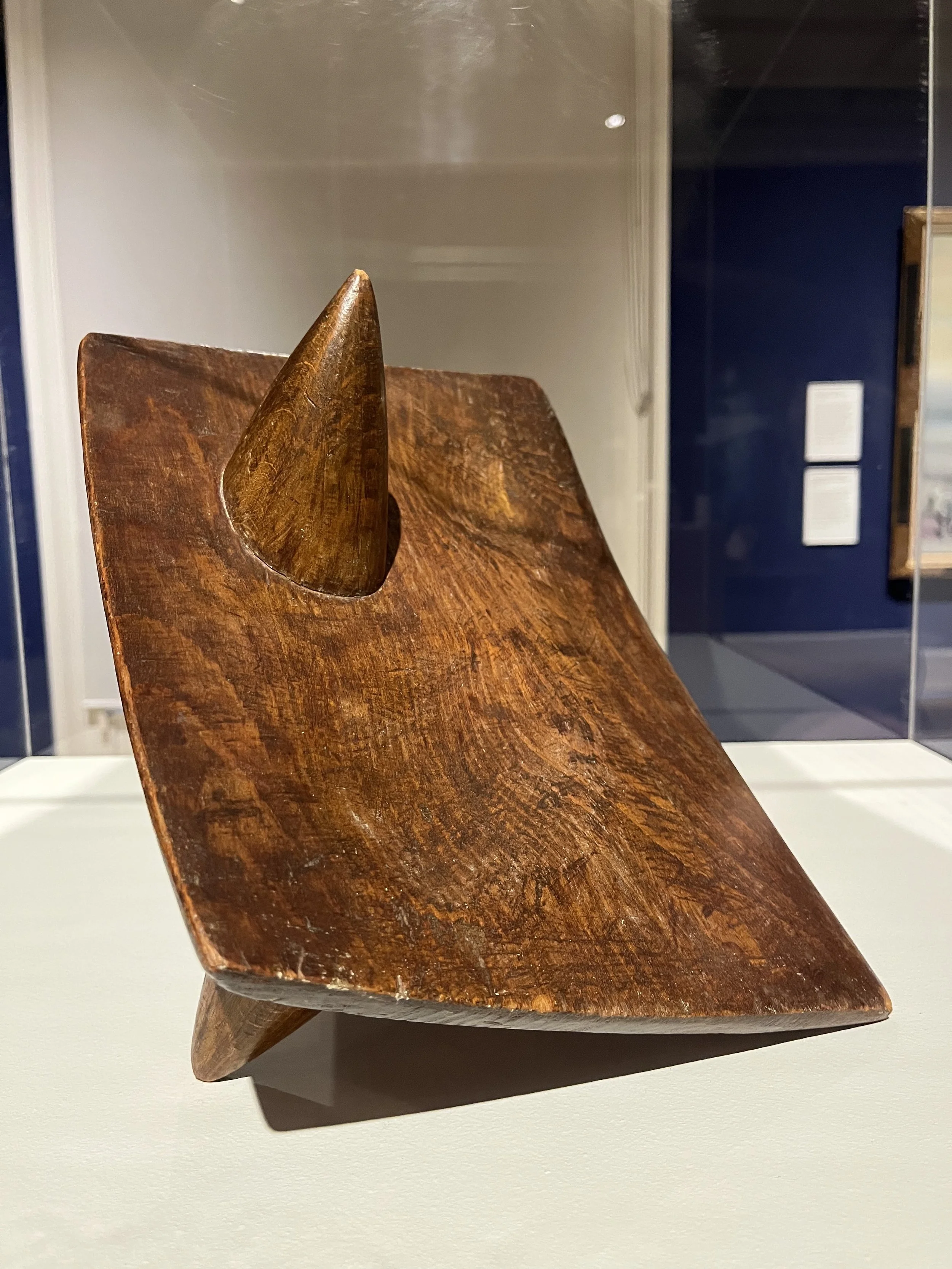
i. Alberto Giacometti (1901-66), Objet désagréable, à Jeter. Wood, 1931. © ADAGP, Paris and DACS, London.
Giacometti enthusiastically embraced the Surrealist ethos at this stage in his career, and the Disagreeable Object had origins in both Dada and Surrealist movements, with its antagonistic spikes set against gracious curves. The sculpture is a reprise of the concept of ‘found object’, in terms of it’s abstract qualities, and the potential for being placed in several different orientations. Keiller purchased this work in 1983, directly from Roland Penrose.
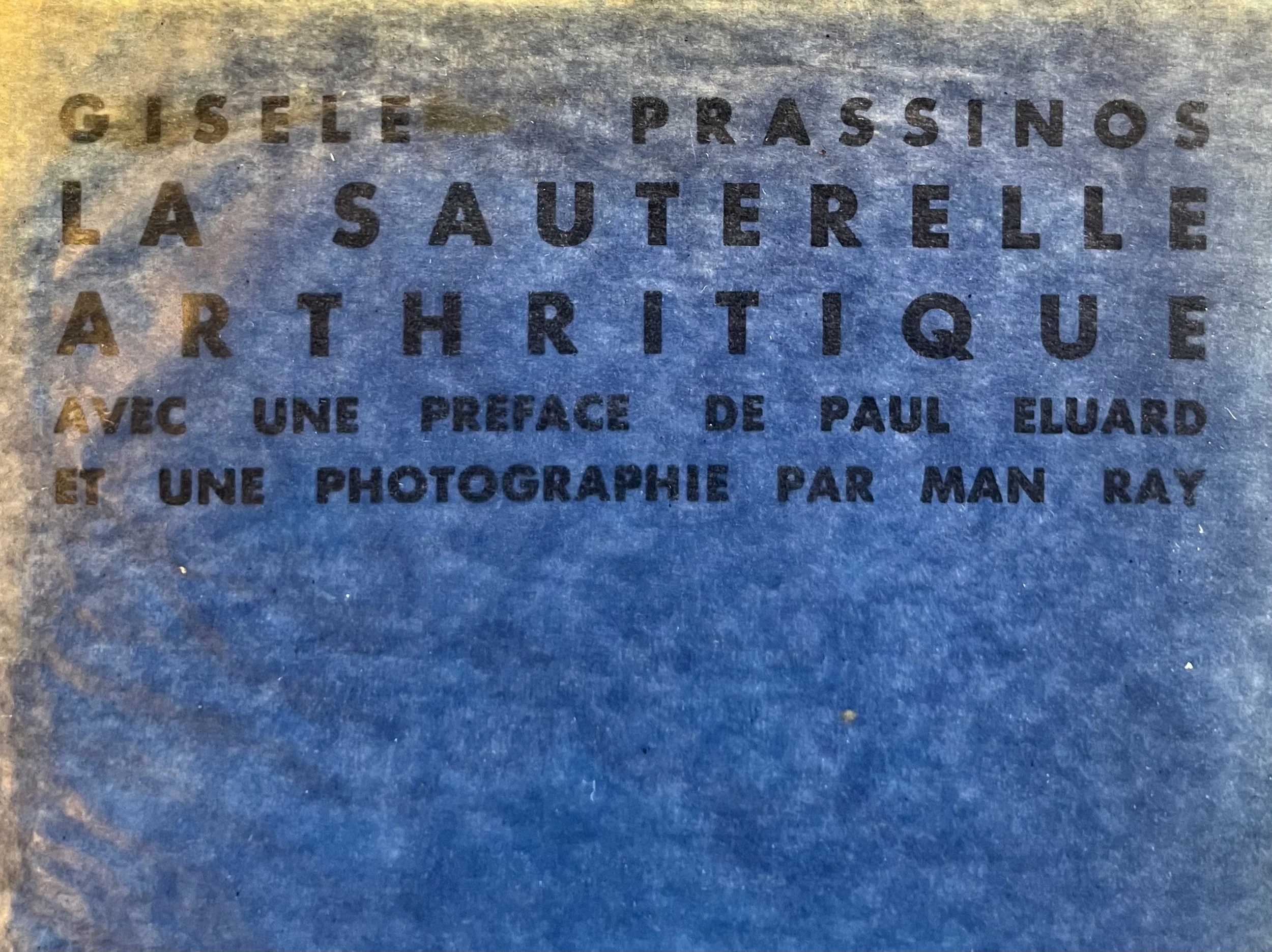
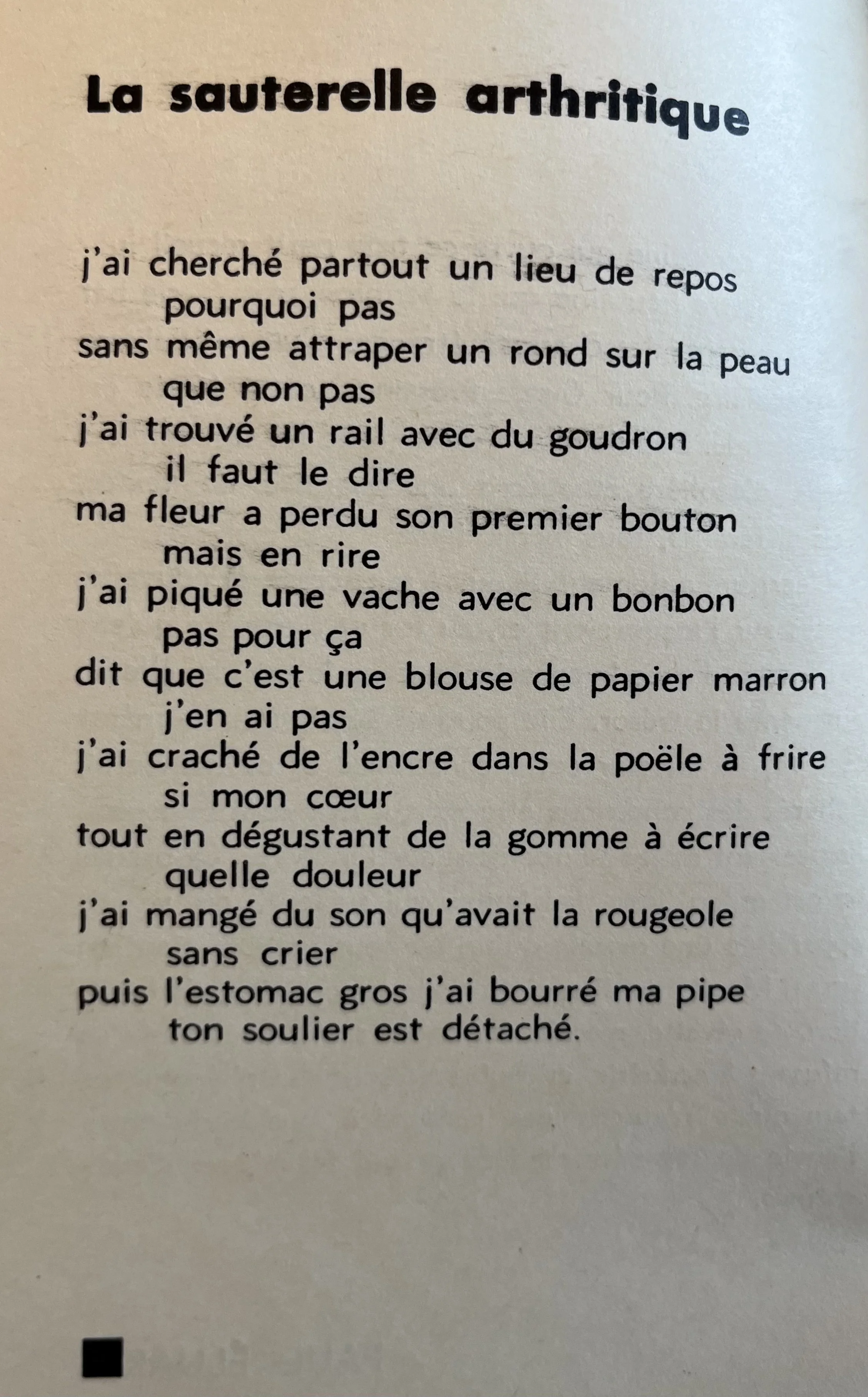

j. Giséle Prassinos, La Sauterelle Arthritique, with an introduction by Paul Éluard, and a photograph of a poetry reading by Man Ray. Pub. Editions G.L.M. Paris, 1935. © the estate of Giséle Prassinos. Photograph by Man Ray © The Man Ray Trust | ADAGP, Paris and DACS, London.
Gisele Prassinos (1920-2015) was a child prodigy who first met the Surrealist artists via her brother Mario, an artist. Prassinos was aged only 14 when she shared her automatic poems, and she enthralled the Surrealists in her childlike sophistication (contradictory and unlikely circumstances being prized by the group). Her ability to create ‘automatic prose’ was praised by Éluard in his introduction to this 1935 publication. Yet Prassinos later indicated that her ‘non-sense’ was not created through automatism, and subsequent analysis reveals an evocative collision of concept and premise which hints at issues of gender power imbalance, and the use of dark humour. Prassinos later renounced Surrealism [45] [46].
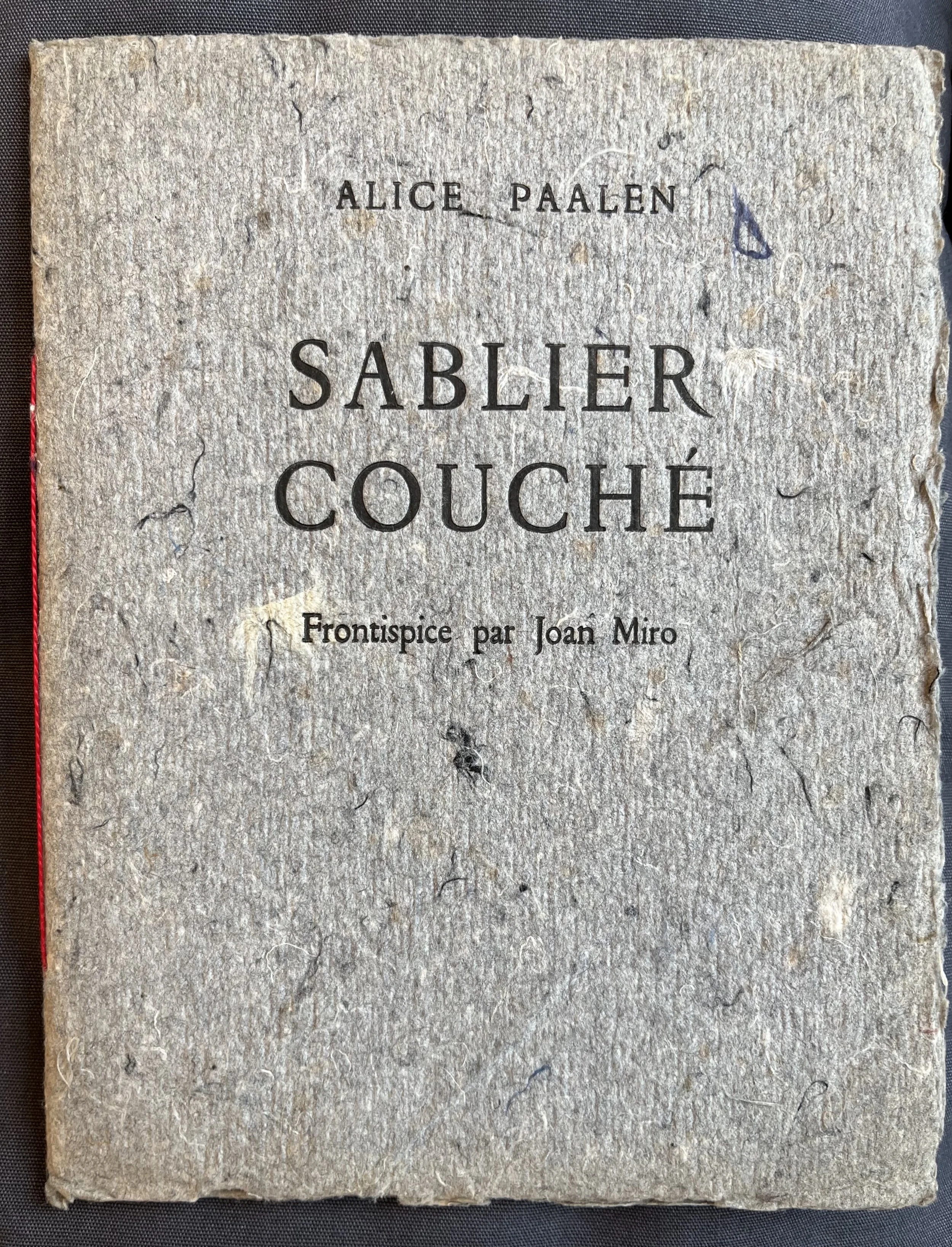
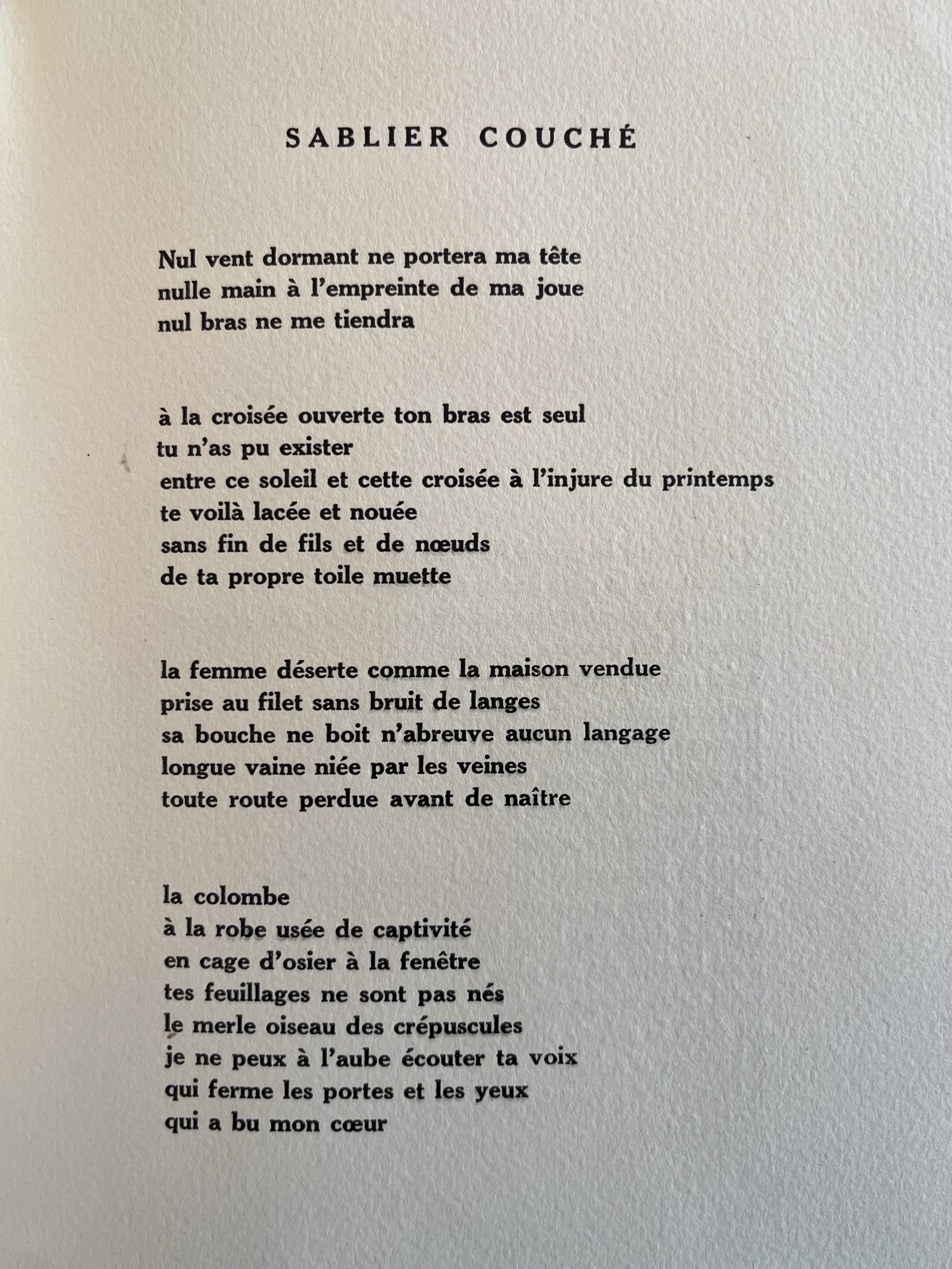
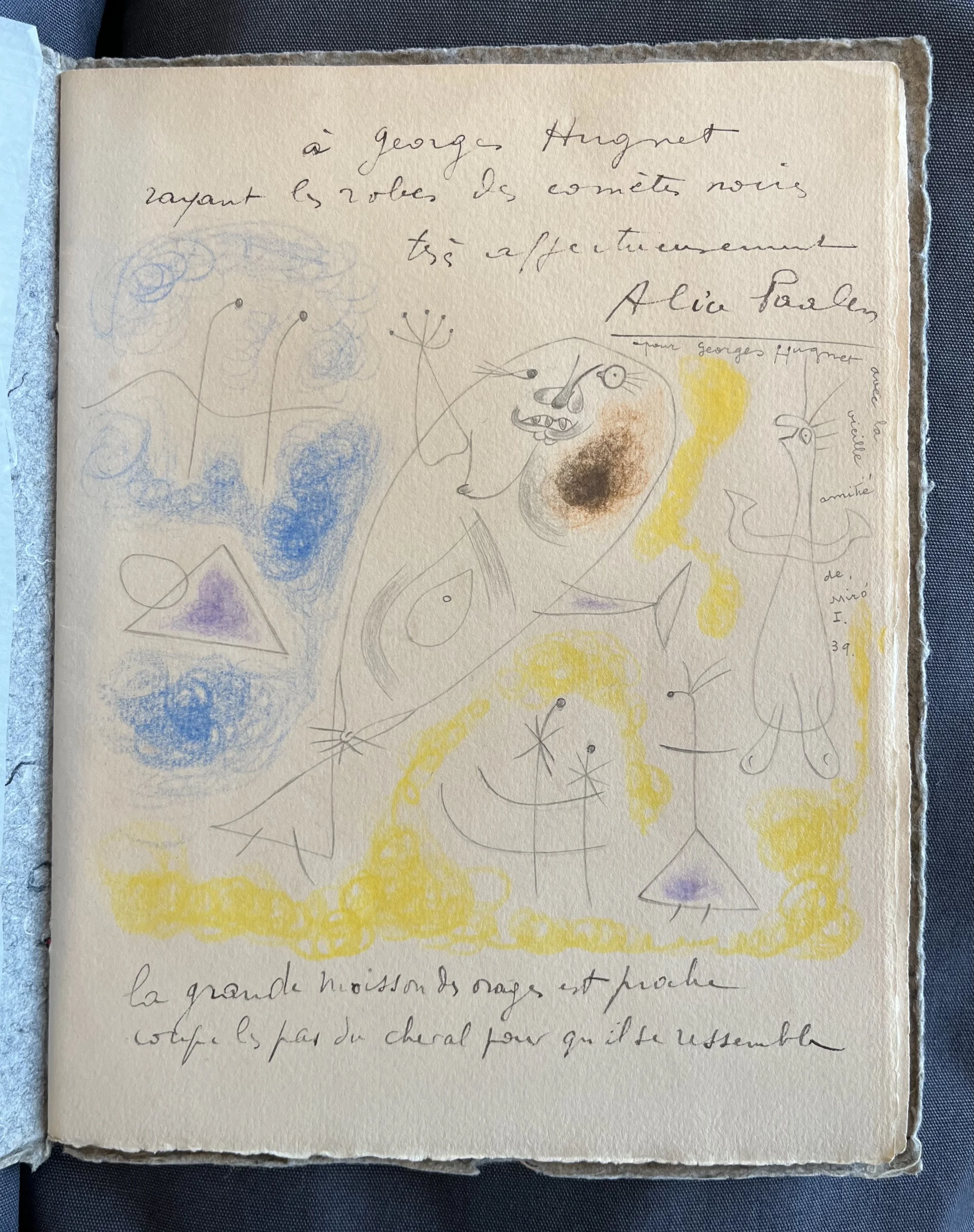
k. Alice Paalen / Frontispiece by Joan Miró, ‘Sablier Coucher’. Pub. Editions Sagesse, Paris, 1938. © Alice Paalen, the estate of the artist. Joan Miró, © ADAGP, Paris and DACS, London.
Alice Paalen (1904-87) was born Alice Marie Yvonne Philppot in the east of France. After marrying Wolfgang Paalen in 1934, she wrote Surrealist poetry, but after a move to Mexico (through which she became a friend of Frida Kahlo), she started painting. The beautiful handmade paper and printing of the cover belie the tristesse of the female experience of isolation and captivity. The high production values evident in the physical presence of the book, represent the Surrealist ideal of ‘le beau livre’.
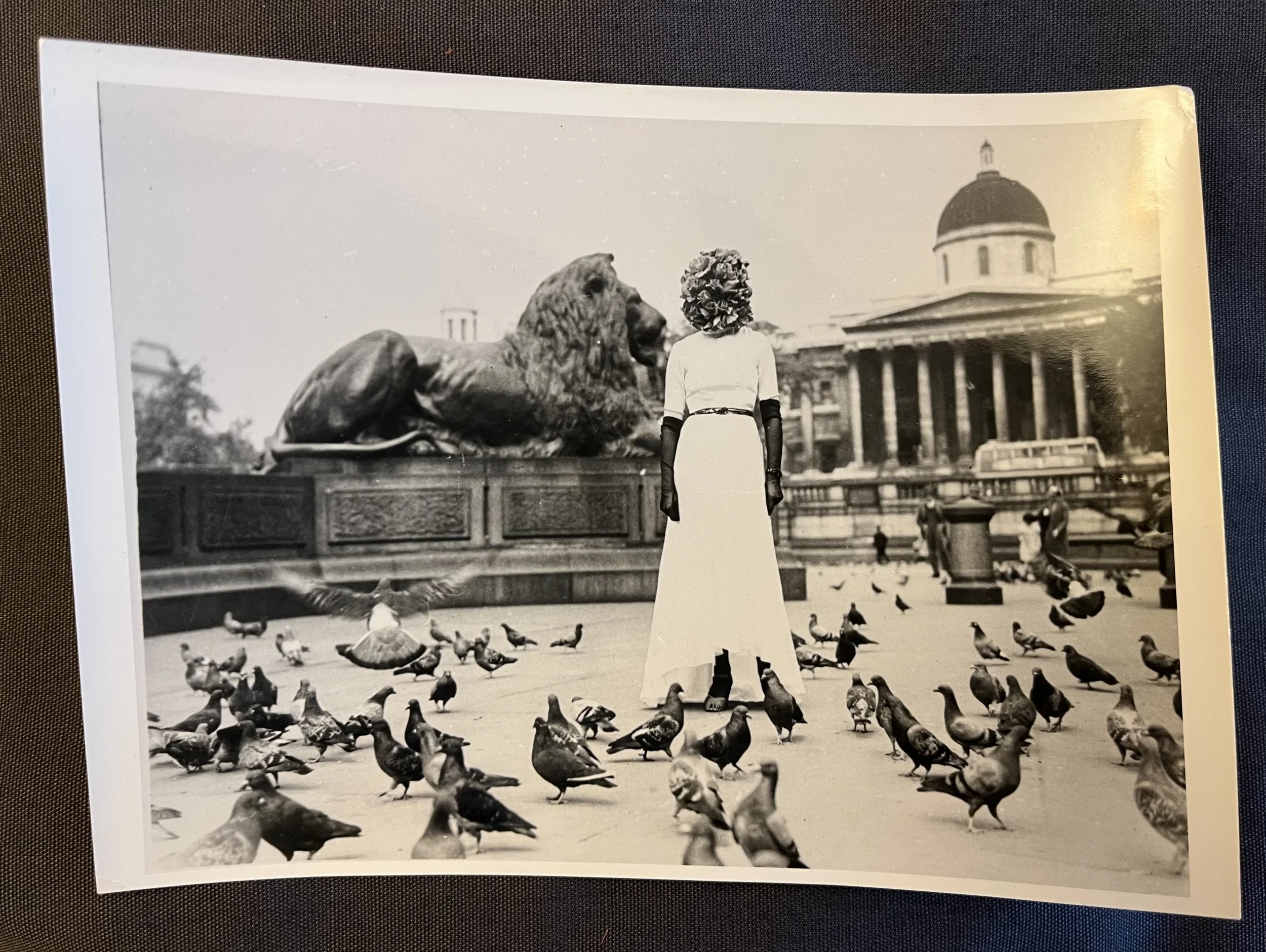
l. Sheila Legge 1911-49 (surrealist performance artist), photograph by Claude Cahun, 1936. Image credit: NGS. © the estates of the artists.
This photograph of Sheila Legge, the “Surrealist Phantom of the British International Surrealist Exhibition”, was one of a series taken in Trafalgar Square, London. Legge had written her own letter of introduction to David Gascoyne in 1935, to express her interest in the Surrealist movement. Gascoyne was said to have appreciated Legge for her intelligence, her flair, and excellent knowledge of the French language. For the photo, she is wearing a bouquet ‘mask’ made by a Mayfair florist, a long white wedding dress made by a theatre design group, black full length evening gloves, and coral shoes [47]. Some accounts have her carrying a pork chop for the exhibition opening, but reputedly this began to smell, so it was swapped out for another prop, a prosthetic leg. This image was part of a brilliant promotional photo-shoot, which was widely distributed, and effectively communicated the radical nature of Surrealist creation (with Dada at its shoulder). The image is also a precursor of our ubiquitous social media reels - a type of 1930s TikTok.
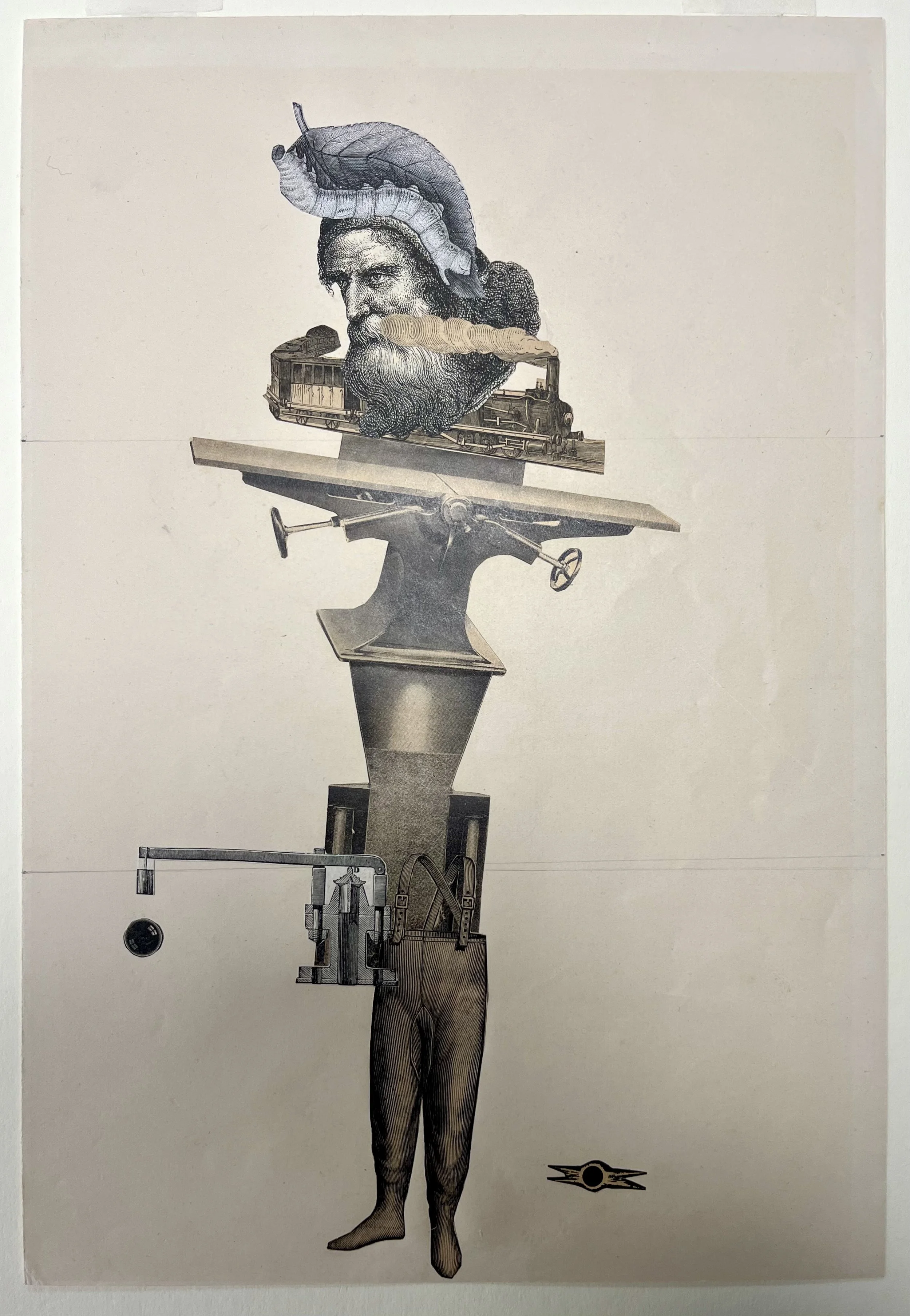
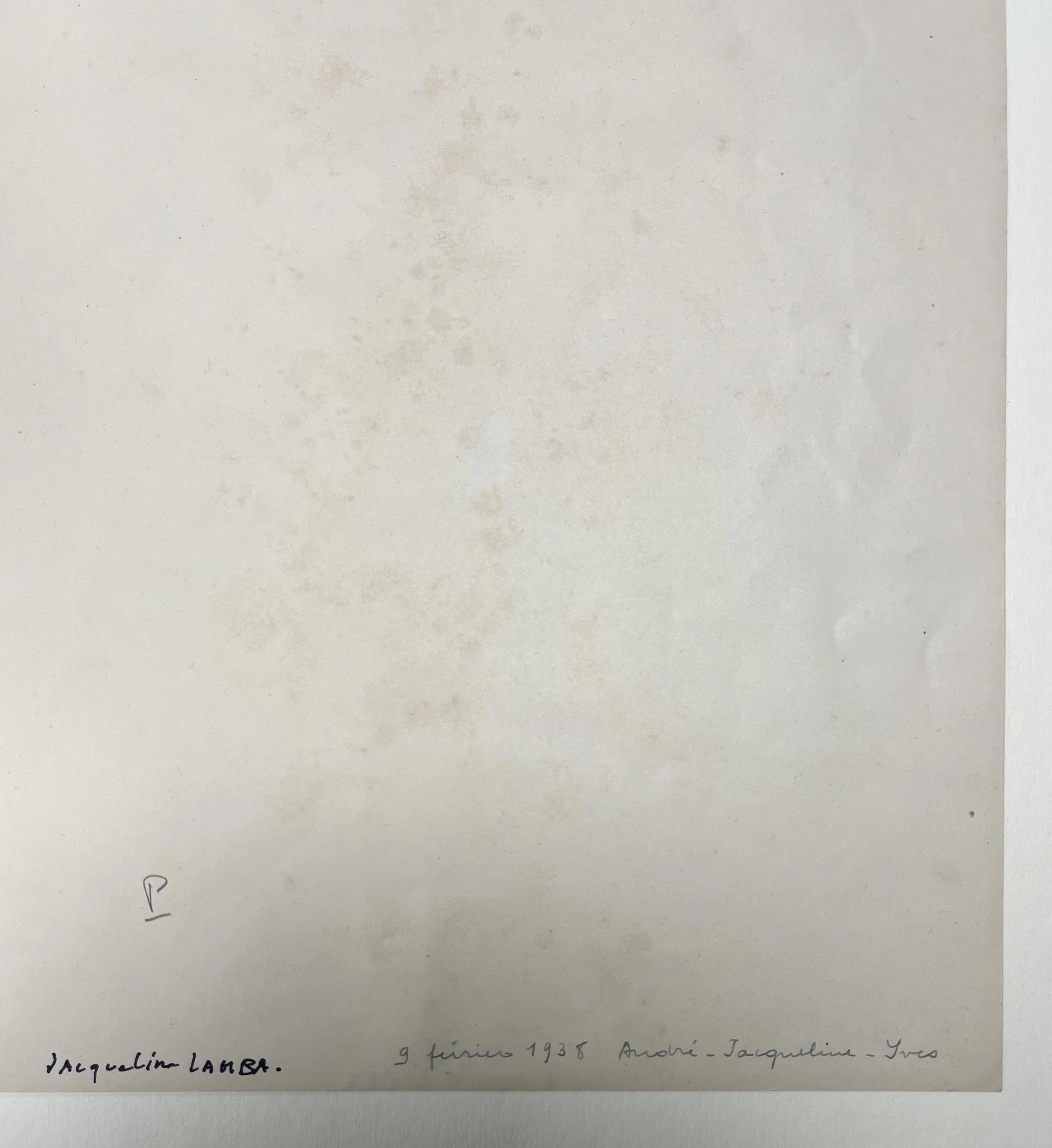
m. André Breton, Jacqueline Lamba, Yves Tanguy; Cadavre Exquis, Collage on paper, 31x21cm. 1938. © the estates of the artists.
Invented by the Surrealists in the 1920s, the “Exquisite Corpse” parlour game remained in practice within the group, and later spread into popular culture. The first person out of a group of three or four would draw or collage part of a figure, which they would then hide by folding it over, before the next person created their own section. In this example, three of key Surrealist figures created a collage while on holiday together, in February 1938. Jacqueline Lamba was Breton’s second wife, and the couple had a daughter, Aube. Lamba was also an artist; she spent time with Frieda Kahlo in Mexico, and was exhibited by Peggy Guggenheim in New York.
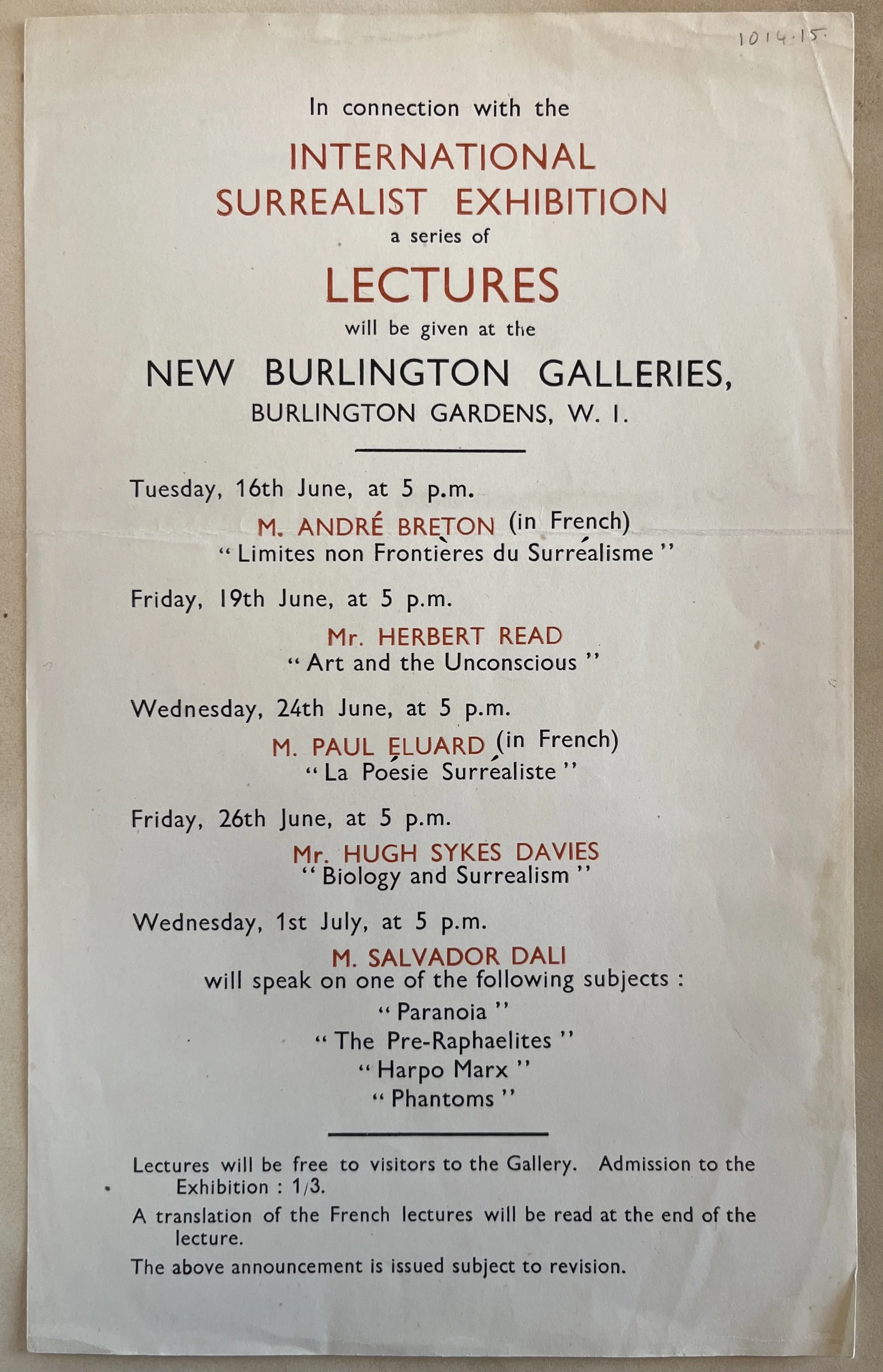
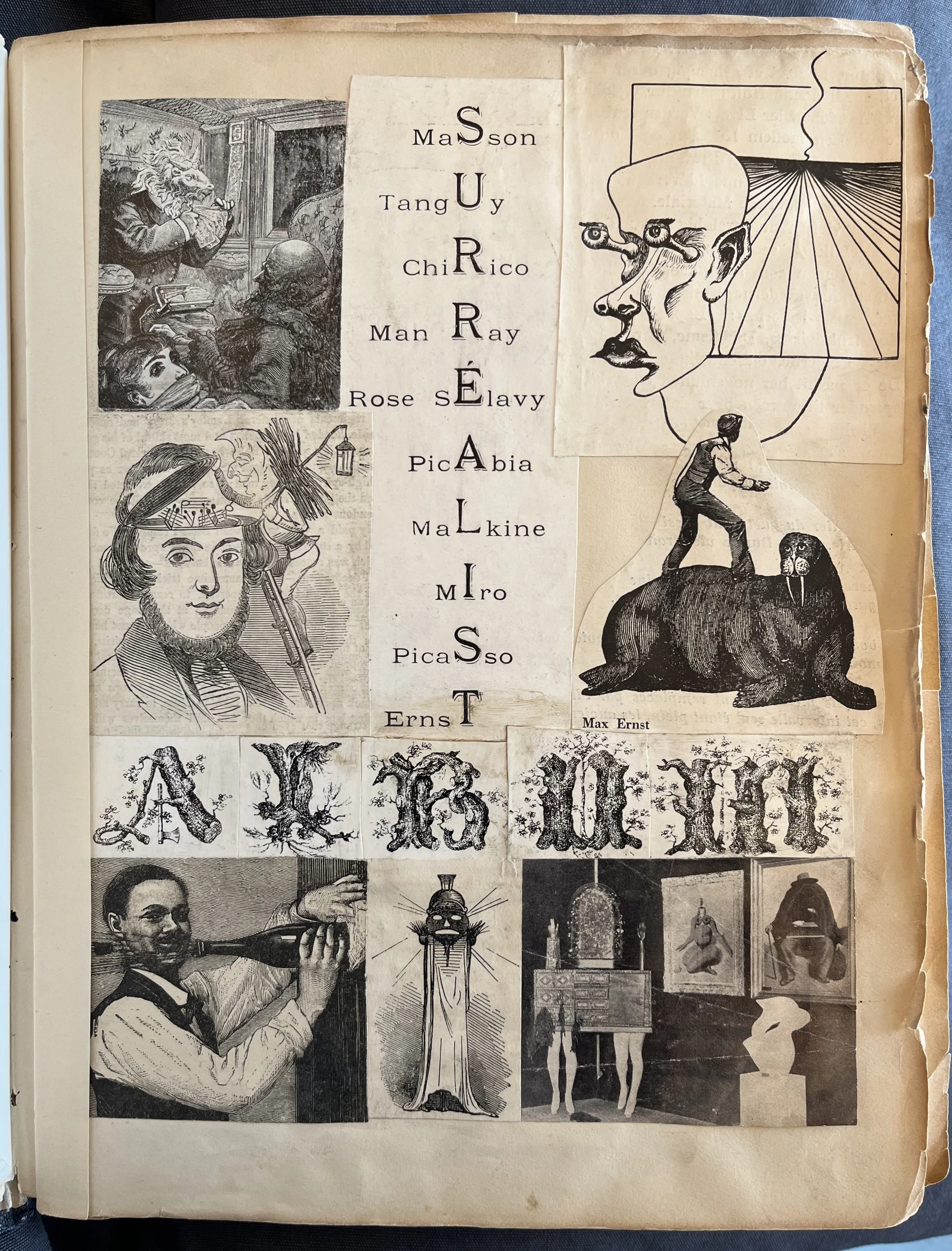
This scrapbook was created by Gascoyne between the war years of 1940-44; the book is a souvenir and celebration of earlier Surrealist achievements, undertaken in difficult and isolated circumstances during World War II. The contents provide an important summary of the early days of Surrealism, including the nascent British Surrealist movement, during the 1920’s and ’30’s. Gascoyne was a relatively young contributor to the movement, but he was highly active, being taken on as a committee member and organiser for the first British Surrealist Exhibition of 1936. This personal scrapbook was acquired via John Armbruster, Parisian bookseller, in the late 1970’s or early 1980’s. The image provided is only one page out of many delights within the covers.
n. David Gascoyne Scrapbook: Collages, catalogues, texts, photographs. © the estate of David Gascoyne.
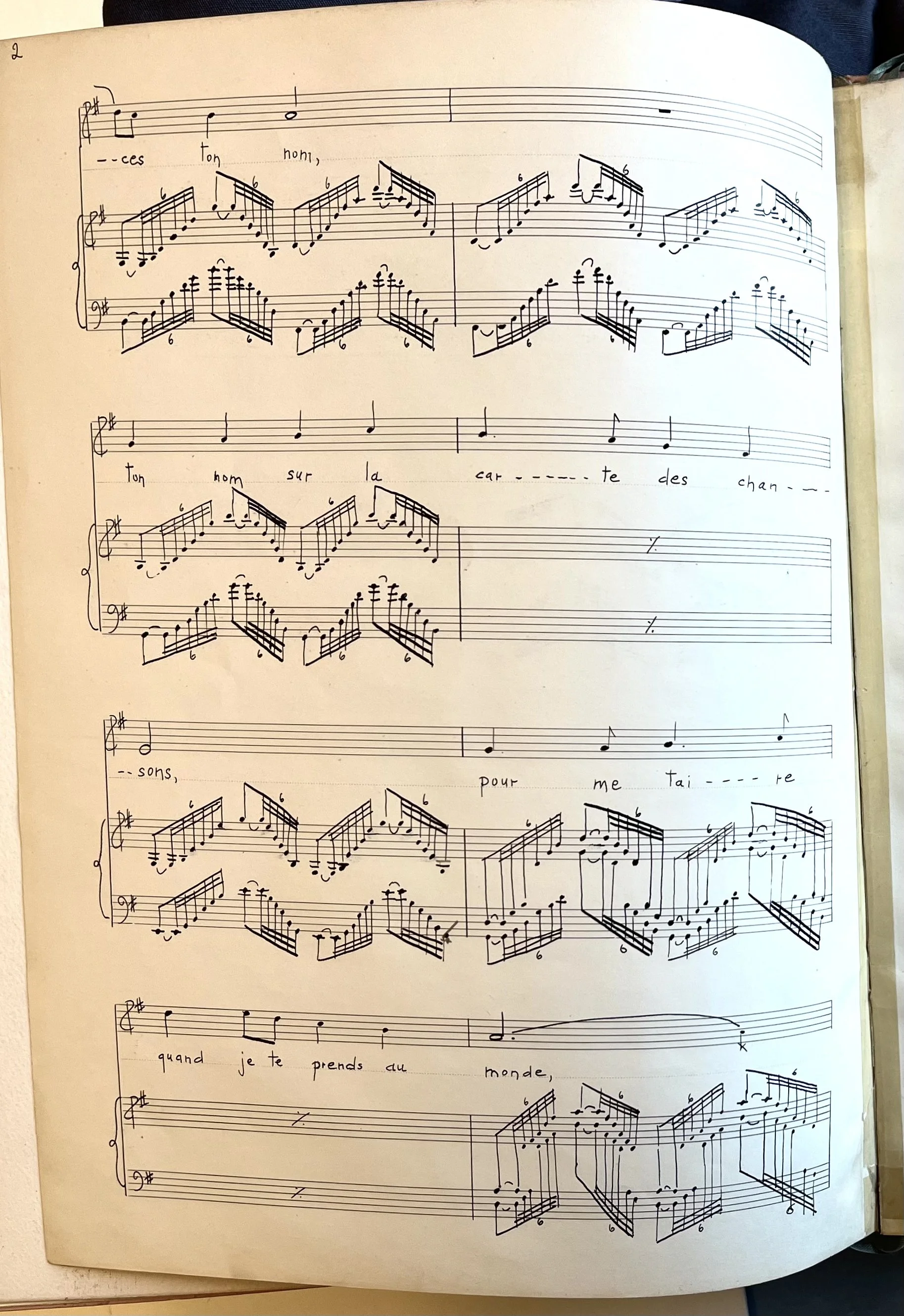
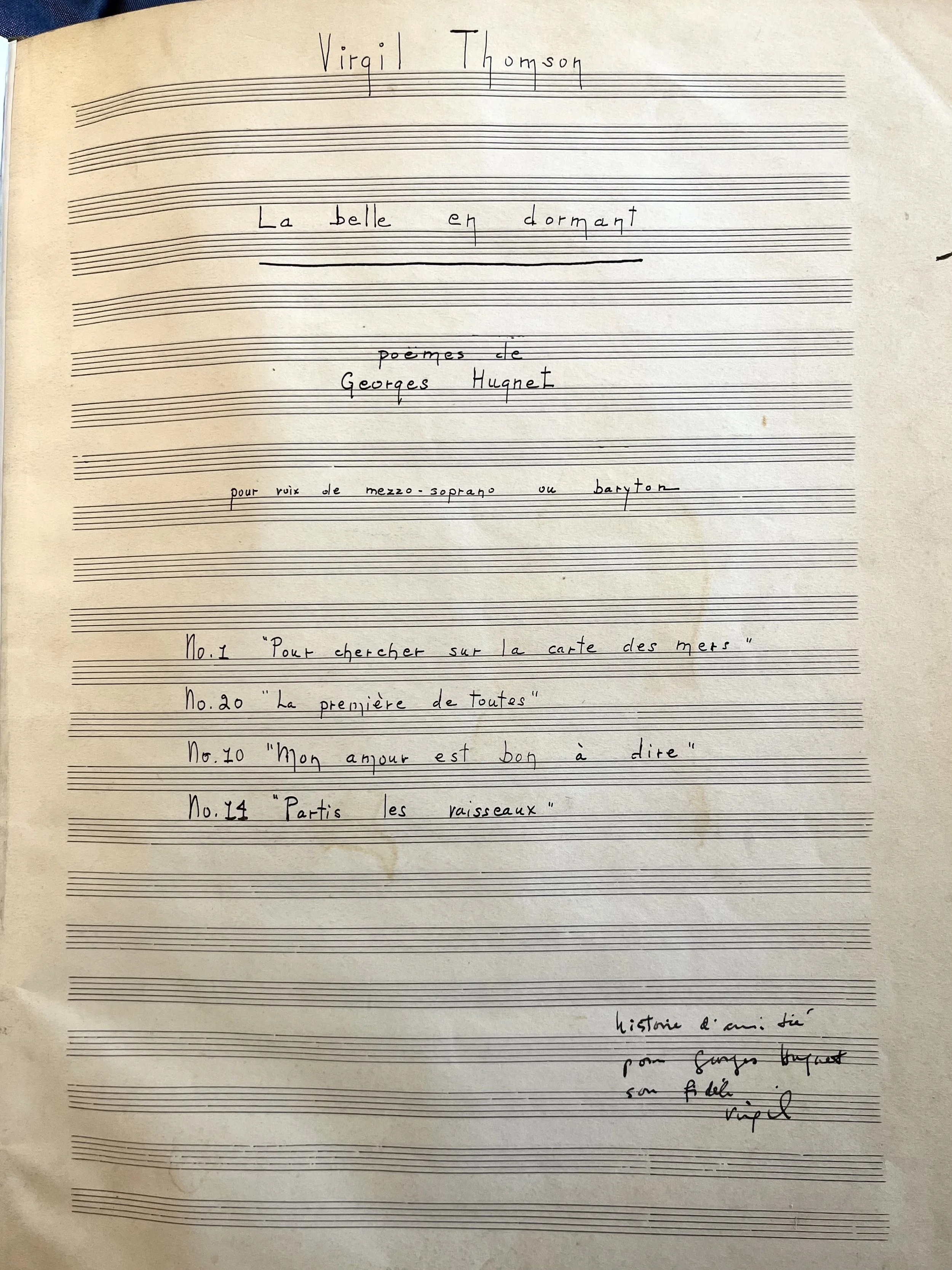
o. Poems by George Hugnet set to music by Virgil Thomson, La Belle en Dormant (Sleeping Beauty) - Frontispiece by L. Marcoussis, 1931. © the estates of the artists.
This collaborative composition by Thomson and Hugnet is a good illustration of the collaborative ethos of the Surrealists, and of the creative furnace that was Paris in the 1920s and 1930s. Looking back a little further, Erik Satie (1866-1925) was a midwife of the Surrealist movement, along with Jean Cocteau, who was aligned with the Dada movement. Satie and Cocteau had collaborated over a ballet production, Parade (1917), and the various elements came together through the now familiar Surrealist/Parisian café networks. Dhiagilev, who directed the Ballets Russes, was persuaded to put on the production via Misia Edwards, whom he trusted implicitly. Pablo Picasso created the set and costume designs, working alongside Giacomo Balla, an Italian Futurist artist. The outline plot involves a group of performers who perform in the street to try and gather an audience for their Circus. Cocteau added a variety of sound effects, a type of protypical ‘sound collage’, including sirens, a whistle, propellors, a pistol and memorably, a typewriter. Picasso’s cubist costumes were made from heavy cardboard in which some dancers could barely move. The result, was of course a sensation, met with either enthusiasm or condemnation. Guillaume Apollinaire composed a programme note, in which he described the work as “une sorte de surréalisme” (Apollinaire had coined the term in 1916, eight years before Bréton’s first Surrealist Manifesto). Satie was not formally deemed a Surrealist, but his dreamlike compositions certainly sparked admiration in a new generation of modernist French composers, called “Les Six”, and there was some networking between the Surrealists and composers. The later collaboration between Virgil Thomson (1896-1989) and Georges Hugnet, from 1931, is a somewhat tamer affair comprising a short song cycle. Georges Hugnet was a core member of the Surrealist group, as a poet. Virgil Thomson was an interesting figure. He was born in Kansas City, and studied the music of Satie at Harvard University; he then went to Paris for a year, before returning to Paris between 1925 and 1940, studying with Nadia Boulanger during this second period. Thomson was influenced by “Les Six”, referenced above. Thomson was part of a ‘gay salon’ at the Hotel Chelsea, and his entrée to the wider world of modernism was via Gertrude Stein, who became a close friend. The pictured collaboration, La Belle en Dormant, is set as a love-sick sea journey. The music is dreamy if relatively conventional, and the poem is distant and allusive, evocative of the call of the sea. I have appended an audio link for the first movement of the song cycle [48].


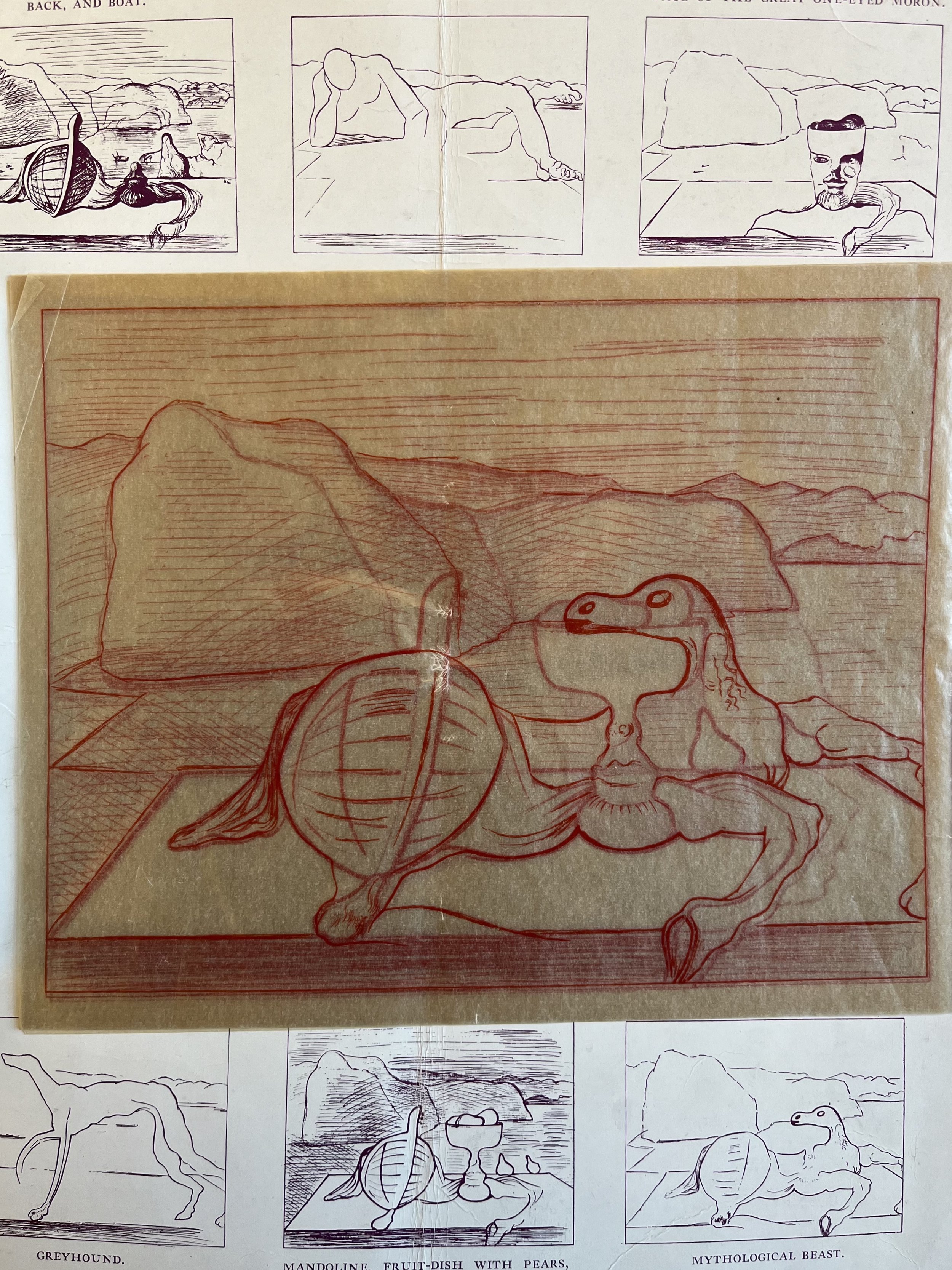
p. Salvador Dalí , Julien Levy Exhibition Catalogue, New York, 1939. © DEMART PRO ARTE BV and DACS, London.
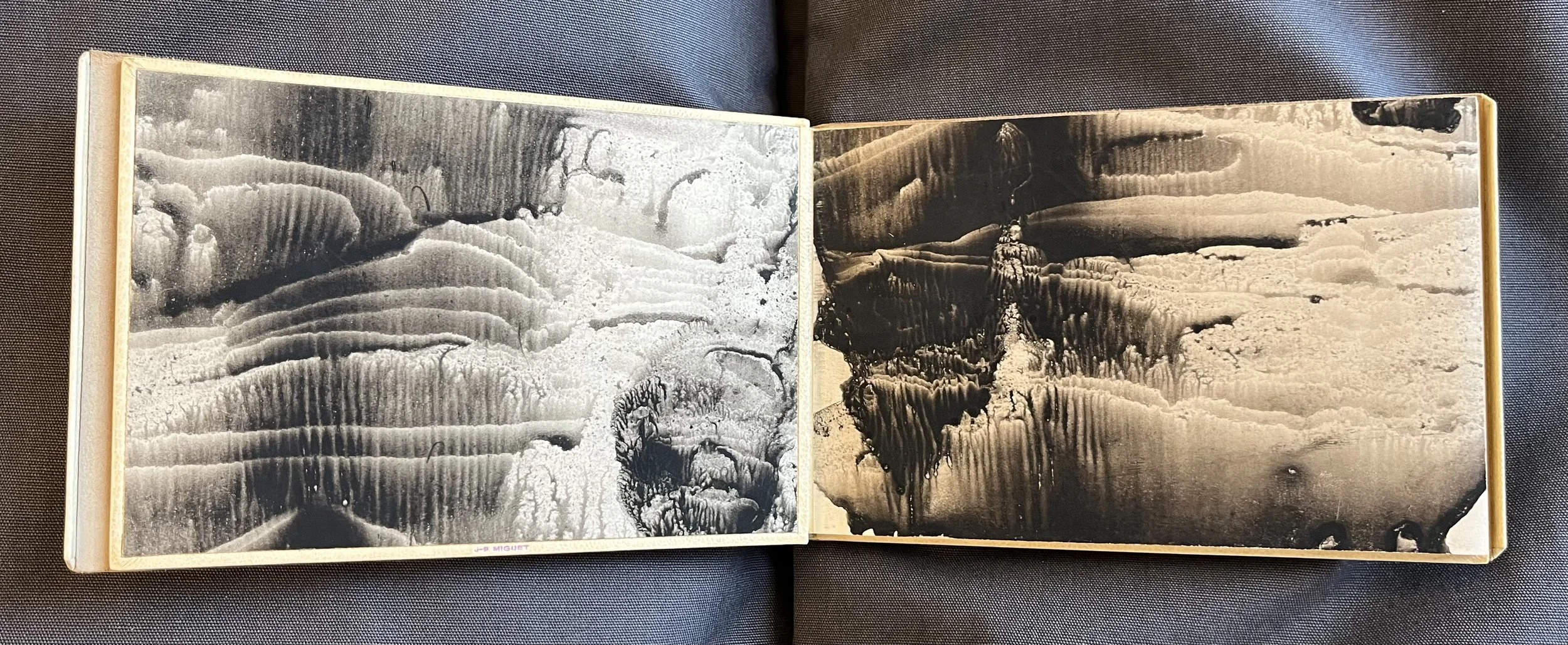
Dalí wrote a clear description of his “paranoic method” in the introduction to this catalogue, referencing cave art, Aristophanes’ The Clouds, and Leonardo da Vinci’s recommendation to his pupils, to study the cracks on plaster walls until they suggested forms for composition. With this clear understanding of Dalí ’s approach, we would now probably translate the loose concept of ‘paranoic’ to the more specific technical term of ‘pareidolia’. The ‘critical’ element of Dalí’s ‘paranoic-critical method’ is not addressed within the confines of the catalogue, but essentially this refers to the conscious mind taking over, developing dream-like ideas and images. The artist goes on to illustrate his methods through a beautifully constructed layered section, with surrounding windows which explain the development of the painting.
In the same year, 1939, Dalí reinforced his celebrity status, although inadvertently, through the Bonwit Teller department store incident. Dalí was commissioned to create a window display, but the design evidently went too far, and the store had altered the display, toning down the depiction of Narcissus, by day and night. When Dalí found out, he was furious, and in the course of taking the display apart he pushed the bath, which went straight through the window of the store - with Dalí close behind. The incident was covered in the New York Times of 17 March 1936 [49].
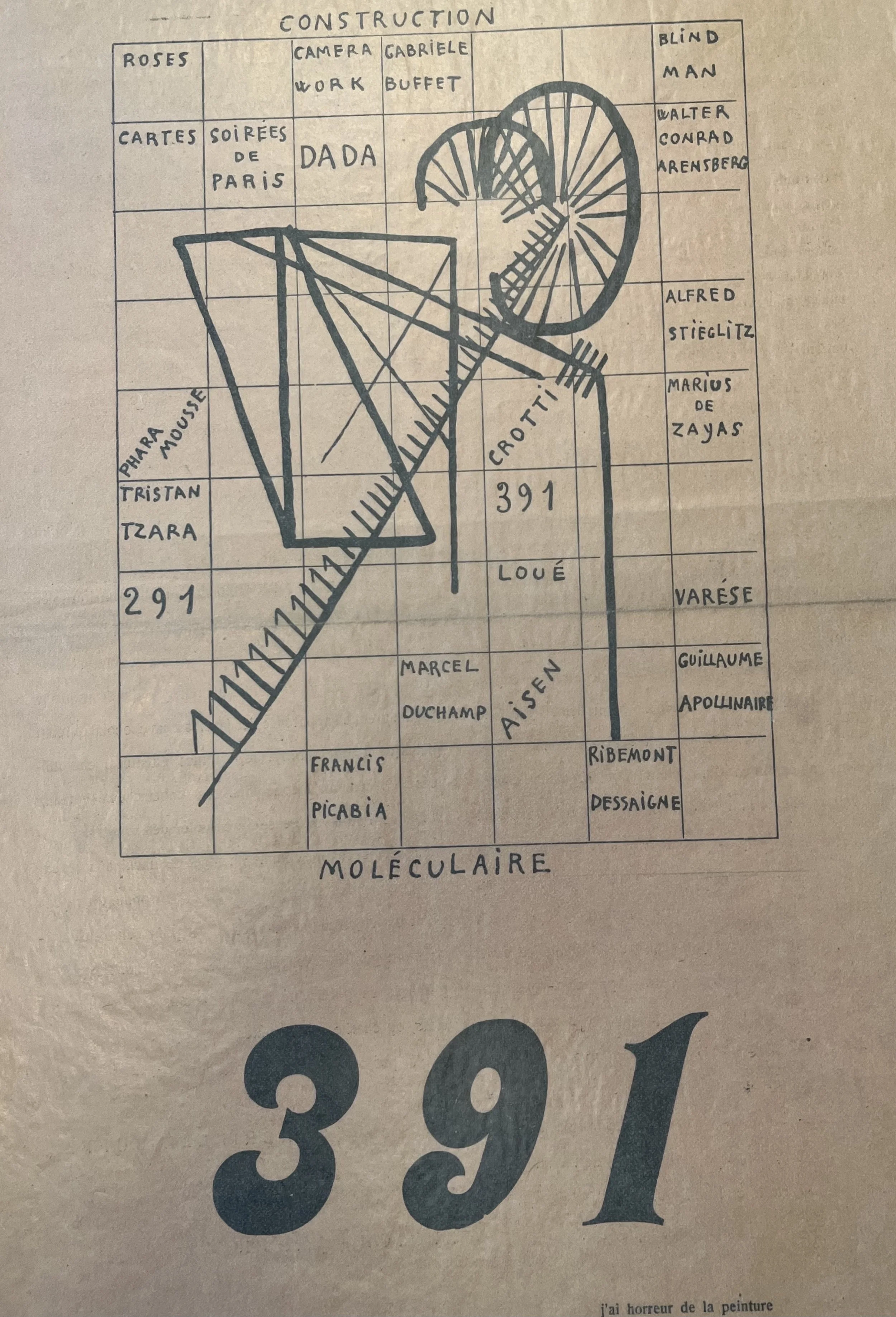
q. 391, Dada Periodical, Picabia image © ADAGP, Paris and DACS, London
391 was amongst the numerous periodicals acquired by Keiller, who took care to source both important and representative issues. 391’s predecessor, 291, was an arts and literary magazine published by Alfred Stieglitz in New York between 1915 and 1916. Stieglitz owned a contemporary art and photography gallery of the same name. 291 had introduced Francis Picabia’s ‘human as machine’ works to a wider public. Picabia went on to produce 391, and the periodical was published in Barcelona, Zurich and New York between 1917 and 1924. It had a strong literary focus, and we note the amusing footnote on the cover, “I have a horror of painting”.
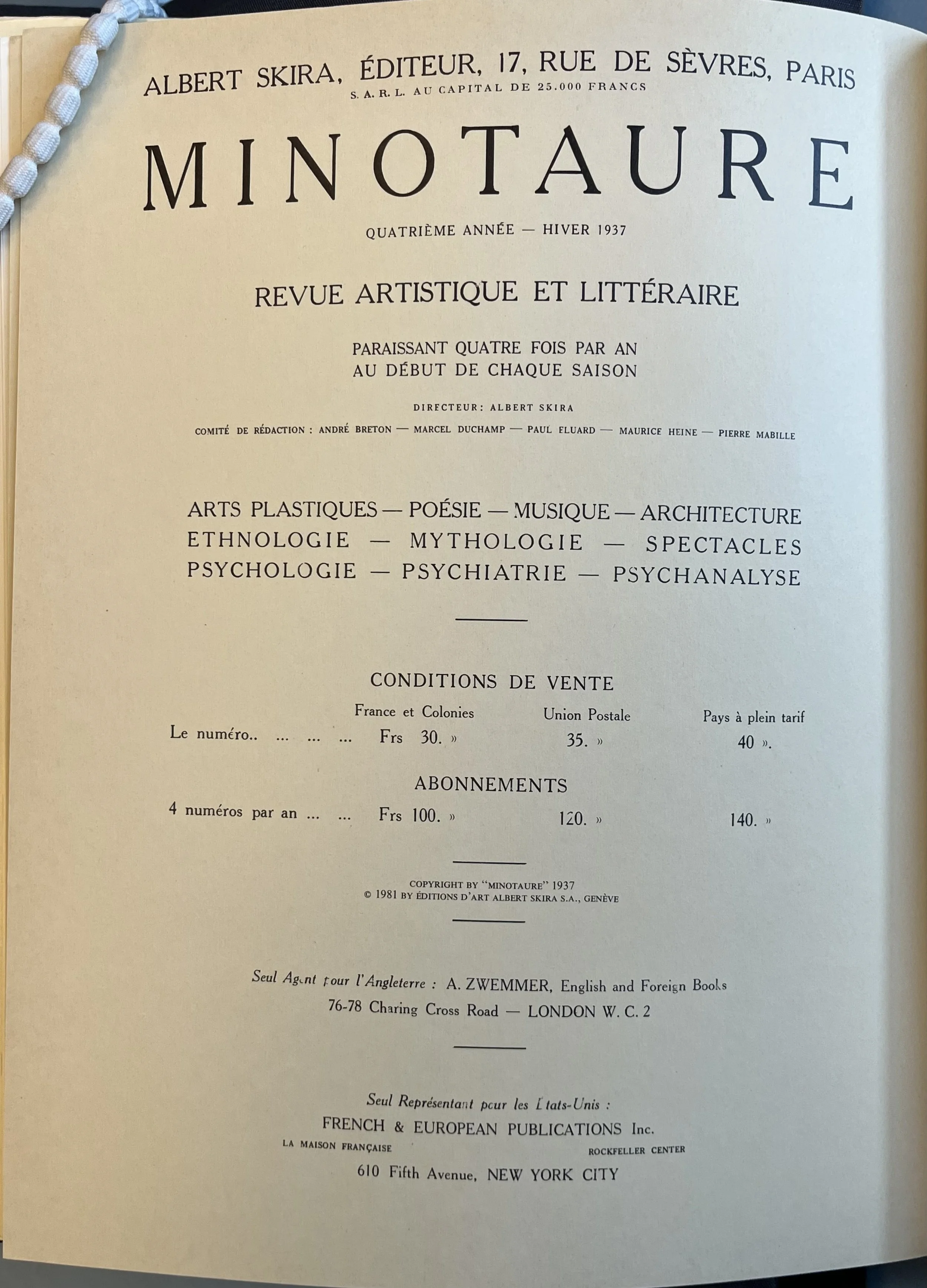
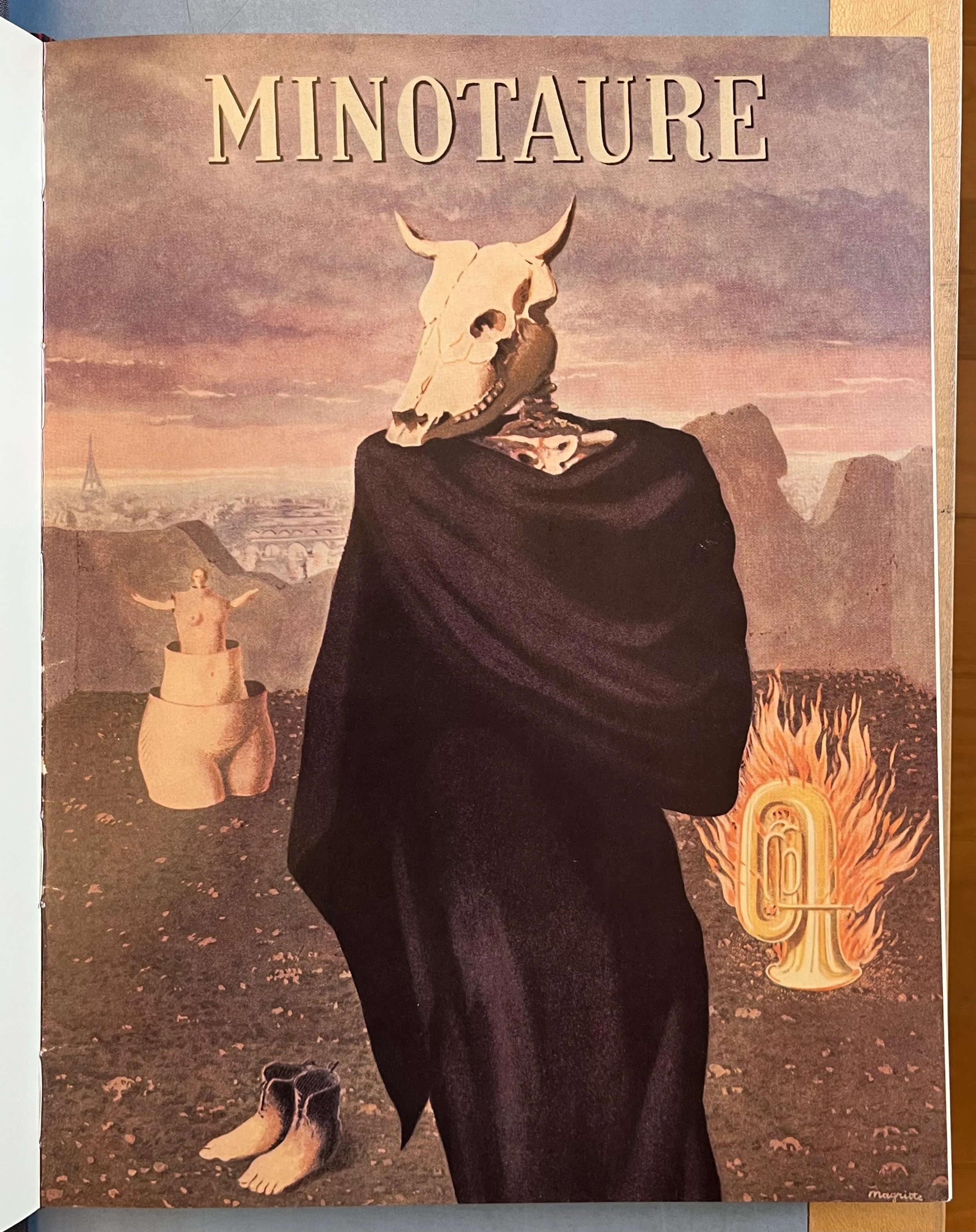
r. Minotaure, Surrealist Periodical, Directed by Albert Skira, Paris, Winter 1937.
Minotaure was a Surrealist periodical, extant between 1933 and 1939. The content included articles and images on the arts, poetry, literature, psychoanalysis, and anthropology. It was unusual in reproducing artworks to a high standard, and often in colour. Contributors included André Breton, Benjamin Péret (who later drew Octavio Paz into the movement), Paul Éluard, Georges Hugnet, Tristan Tzara, Edward James, and Salvador Dalí.
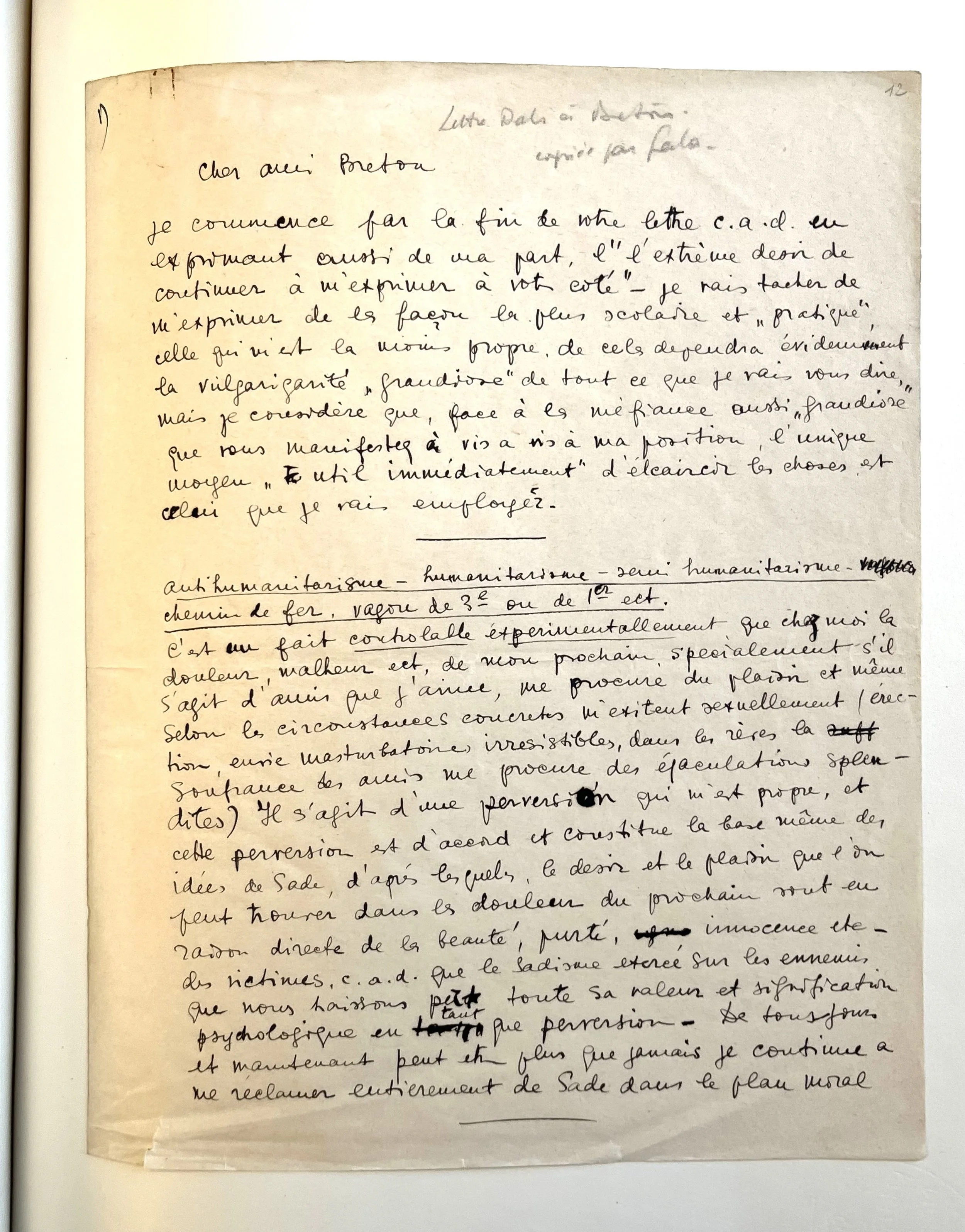

s. Breton-Dalí Correspondence, 1930-1939 © The estate of Salvador Dalí.
This scintillating correspondence contains a simmering divergence of approach between the two Surrealists. Breton took issue with some of Dalí’s more outré positions, for instance, his stated admiration of the early manifestations of Nazism. Dalí evidently prepared his responses to Breton in great detail, and on some occasions he asked his partner Gala to handwrite his draft response, running to multiple pages. Dalí defended his right to allow free reign to his instincts, controversy being a key to creativity, and the two did make up. However, they finally parted ways, after Breton deemed that Dalí had succumbed to commerce, and to pursuing outrage as a form of self-promotion.
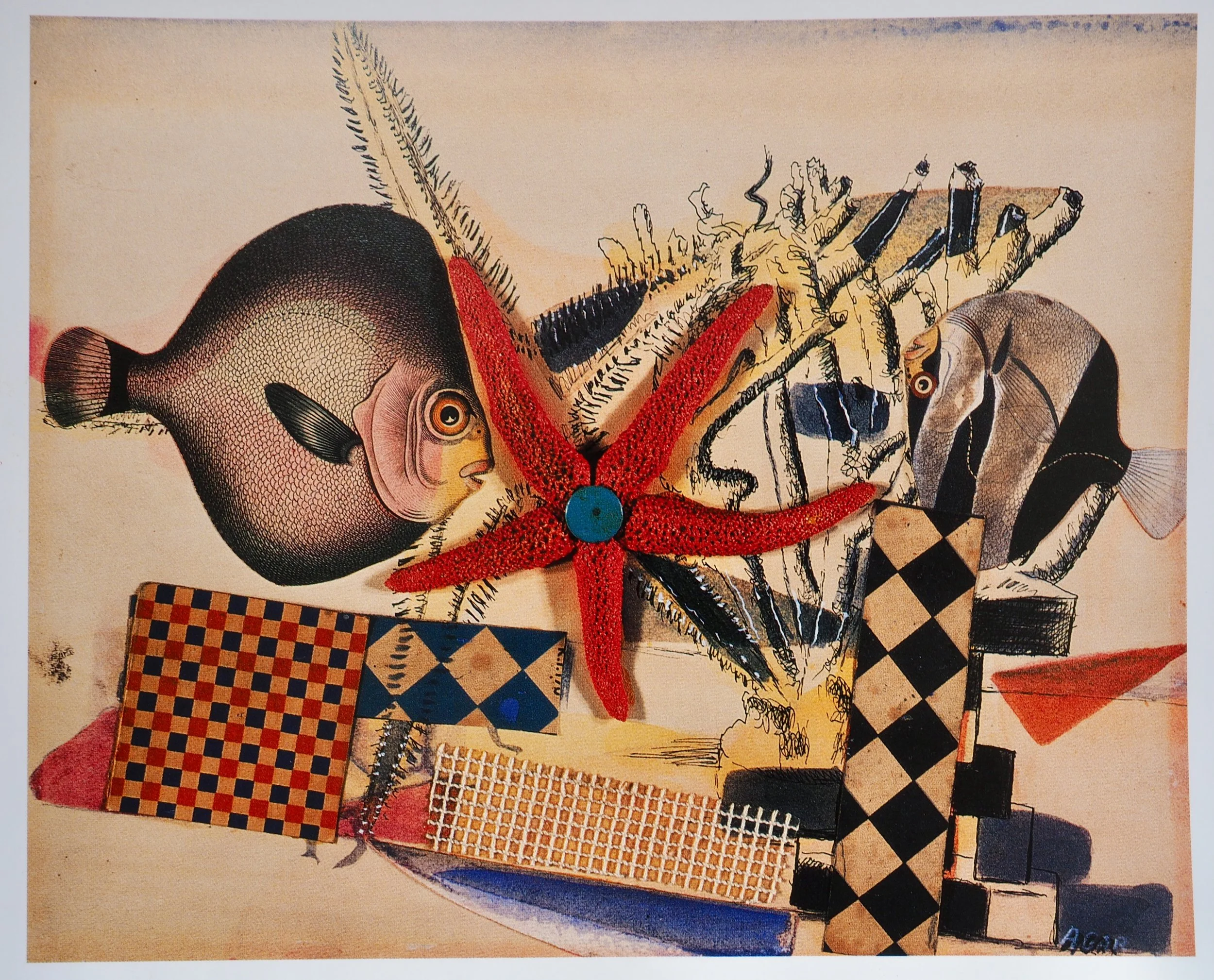
t. Eileen Agar (1899-1991), Fish Circus. Collage, found objects and mixed media on paper, 25x30cm, 1939. Image Credit: NGS. © the estate of Eileen Agar.
Eileen Agar was an enthusiastic early adopter of the British Surrealist movement. She was born in Argentina to an Anglo-American mother and a Scottish father, a seller of windmills. Agar’s childhood appears to have been marked by a tragic combination of wealth and emotional neglect, Agar, rebelling against her mother’s rules and strictures. She started her studies at the Slade School of Fine Art, aged 21. Soon after, there was an argument with her mother and Agar stormed out of the family home. She married Robin Bartlett but then became a partner of the Hungarian writer, Joseph Bard. The couple travelled to Italy and then to Paris, where they met the leading Surrealists. Agar later fell in love with Paul Nash, who encouraged her to collect flotsam and jetsam found on the beaches, which they explored on the South Coast of England. Nash and Penrose selected several of Agar’s works for the 1936 International Surrealist Exhibition in London. The present work acquired by Keiller from the Mayor Gallery in 1939, combines checkerboard geometry and organic forms with vivid extrusions, within a balanced-inverted marine composition [44].
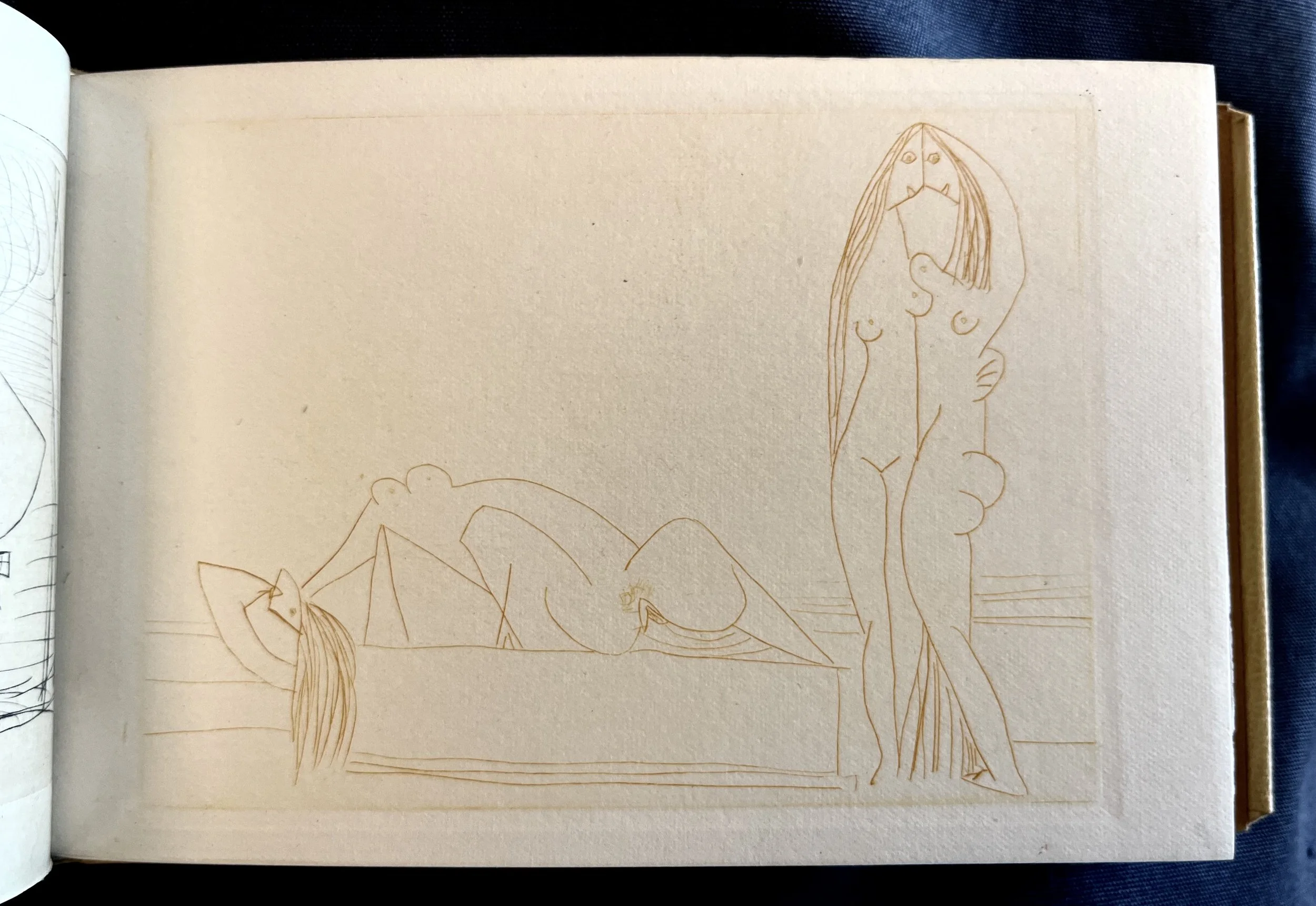

u. Georges Hugnet / Oscar Dominguez, Le Feu au Cul. Artist book, Paris, 1943. © ADAGP, Paris and DACS, London.
This hand-produced book, in a limited edition of 53 copies, comprised a series of etchings by Oscar Dominguez (who invented decalcomania), superimposed on widely spaced text composed by Hugnet. I have selected one of the less provocative images to show here, without text, but this image is nevertheless important for its positive depiction of gay female sex. This was Hugnet’s personal copy, and he was responsible for its beautiful presentation in a leather binding, and the finely crafted wooden slipcase.
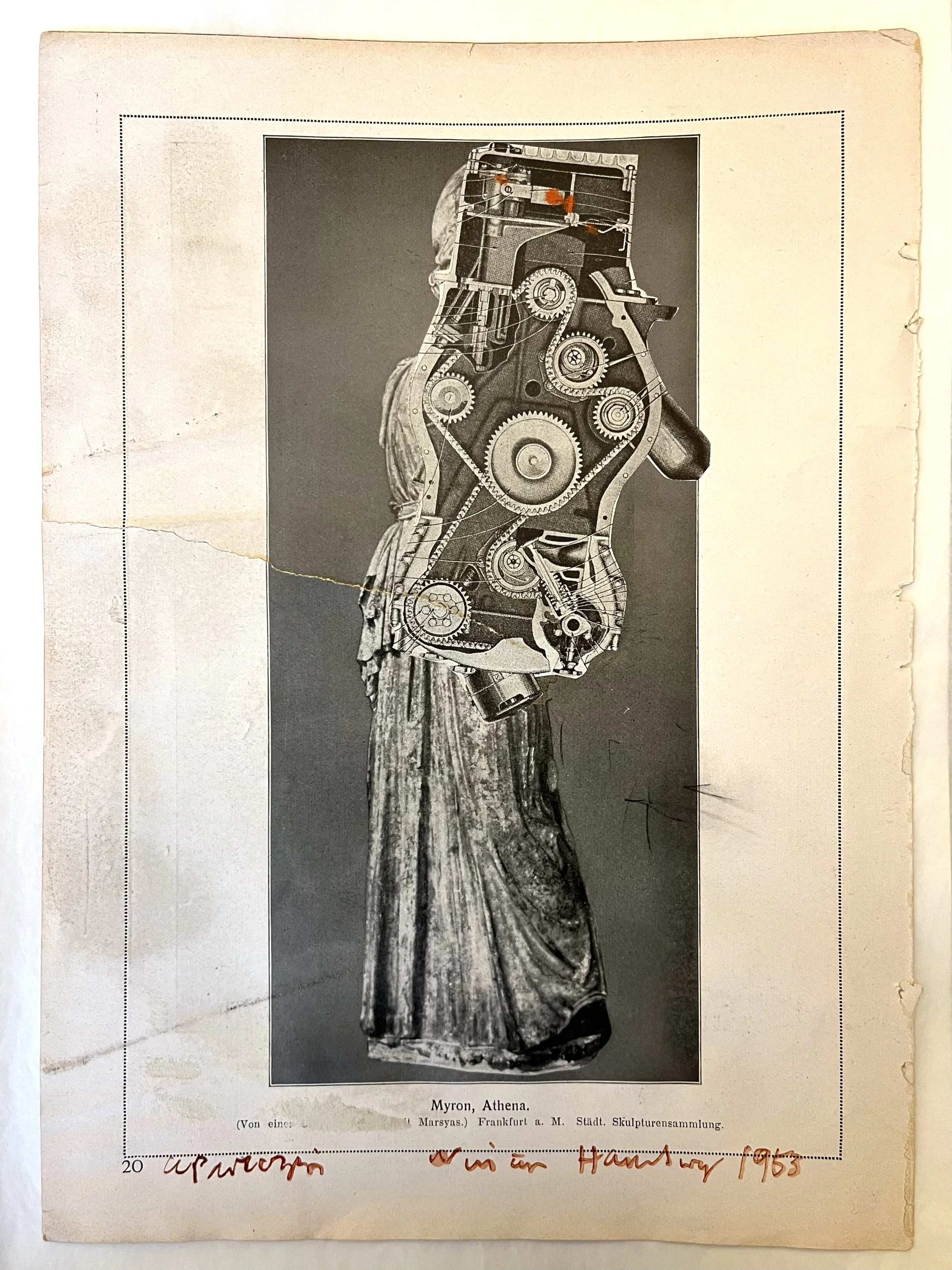
v. Eduardo Paolozzi, Myron, Athena. Collage on book illustration, 1953. © The estate of Eduardo Paolozzi.
There is a very clear continuity here between Picabia’s machine work, and Paolozzi’s later work in the identical mode of ‘machine-human’, or in this form, ‘machine-Greek God’. References to classical mythology stretch further back, to the proto-Surrealist artist Georgio de Chirico, who deconstructed classical statues with dream-like propositions.
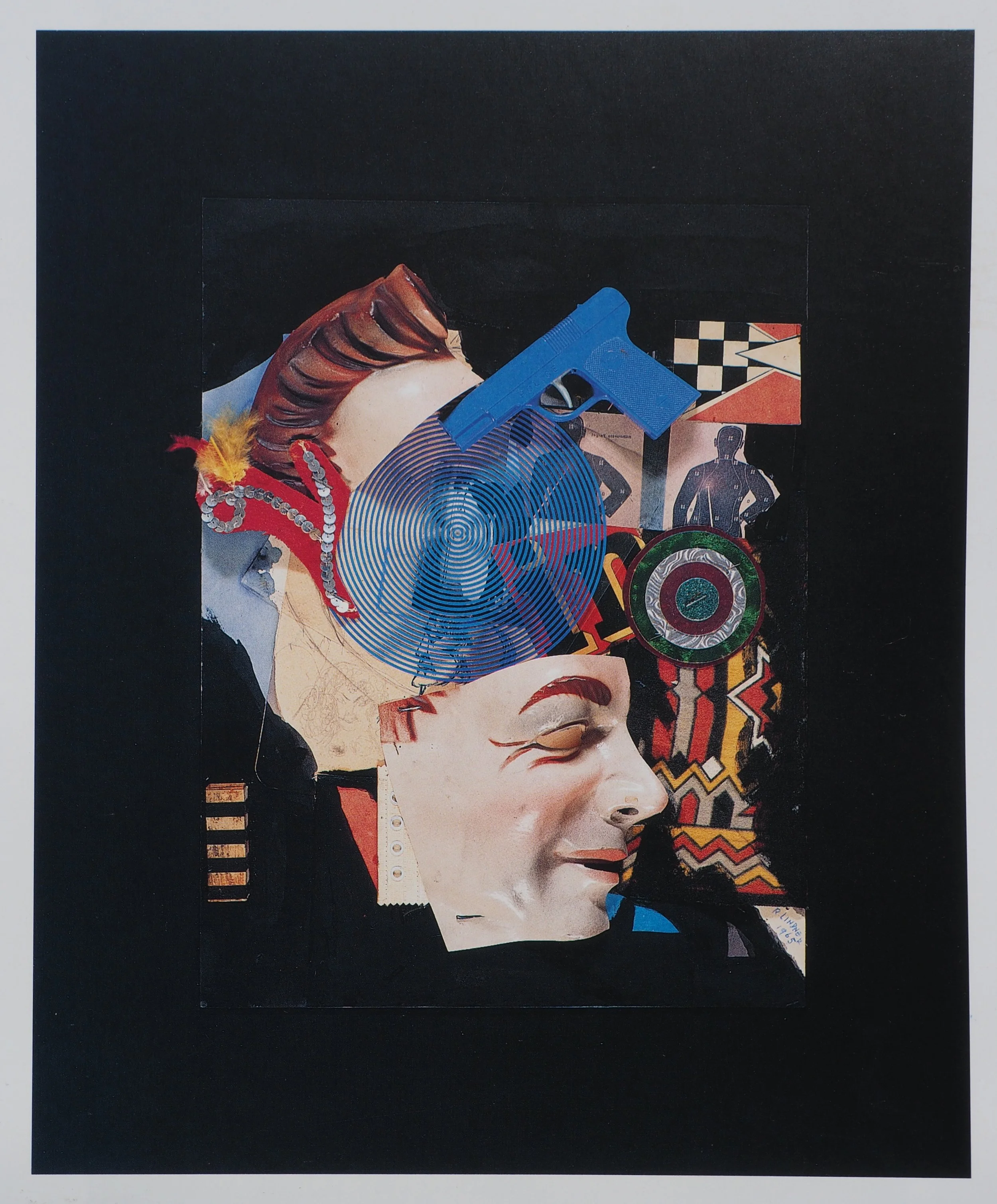
w. Richard Lindner, Untitled, 1965. Image credit: NGS. © ADAGP, Paris and DACS, London.
This work was purchased by Keiller in 1966 from the Robert Fraser Gallery, the year after it was created. This acquisition is representative of Keiller’s confidence to branch out into contemporary work, and is well chosen for having clear connections with Surrealism and it’s immediate successor, Pop Art. The work is composed of collage elements, and uses layered dimensions to construct a veiled narrative, hinting at comic-book violence, Greek tragedy, and more than a soupçon of sexuality.
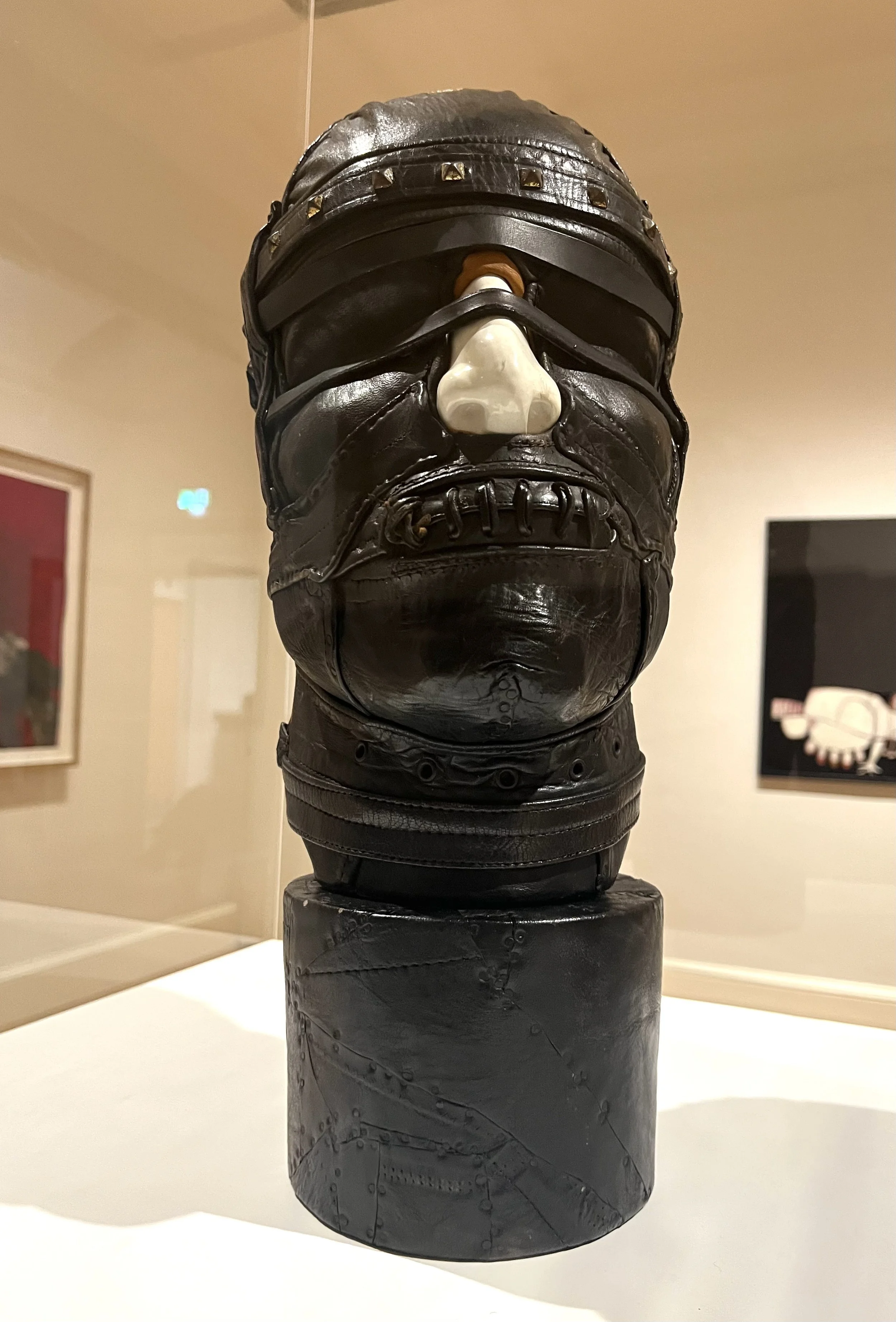
x. Nancy Grossman (1940-), Head. Sculpture, 1968. © DACS, London and VAGA, New York.
Nancy Grossman’s Head, although not strictly Surrealist, is such in spirit: the intent to surprise and disrupt merges with elements of expressionism, conceptual art and political protest. This work is thus a suitable tribute to the inspiration which Dada and Surrealism provided to future generations, and to the enduring relevance of Gabrielle Keiller’s gift.
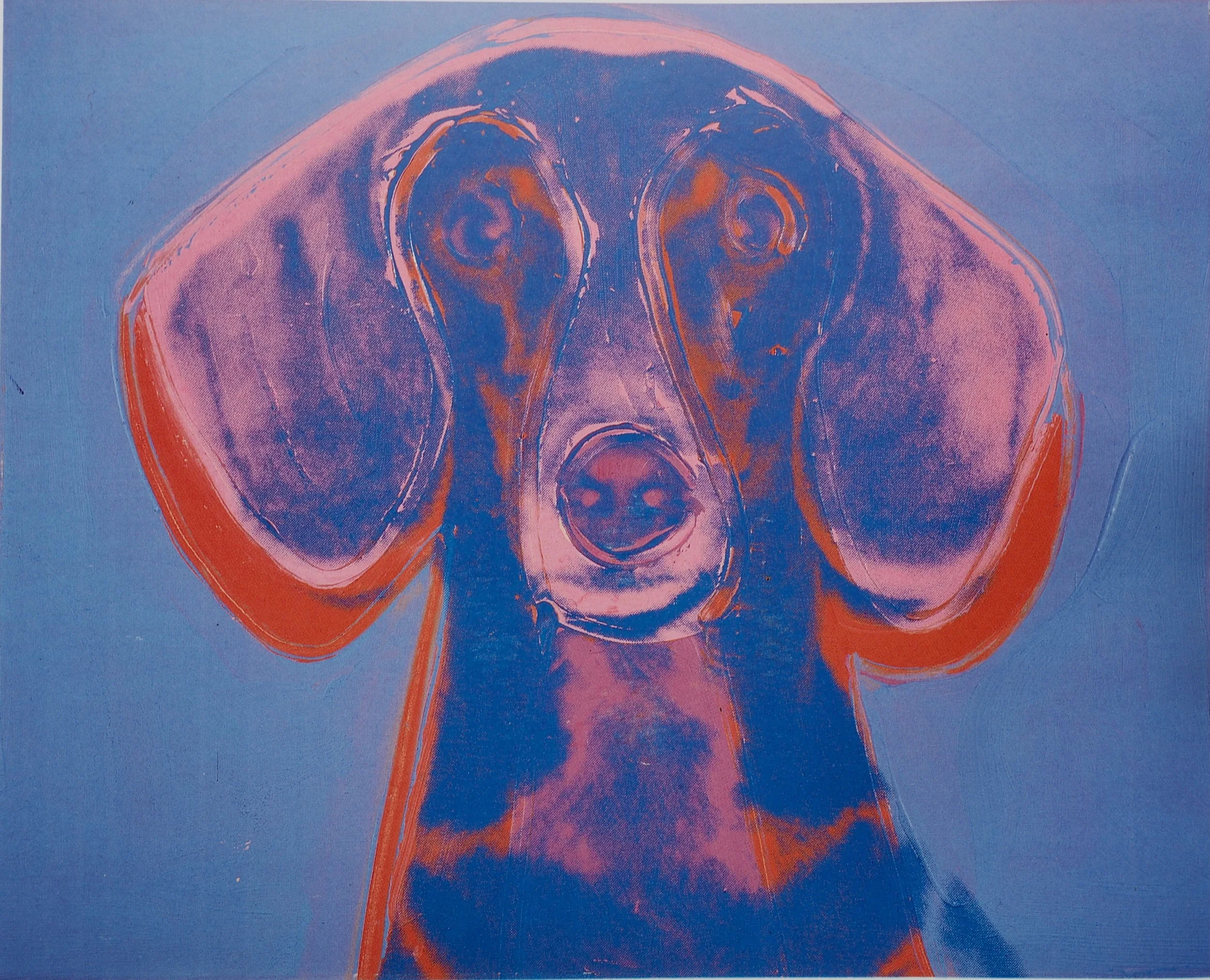
y. Andy Warhol, Portrait of Maurice. Screenprint, 66 × 81cm. 1976. Image credit: NGS, © ARS, New York and DACS, London.
Keiller commissioned this screenprint from Andy Warhol, via the Mayor Gallery. This print represents that most humane instinct within the world of artists and collectors; the tribute to a treasured animal companion, in this case, Keiller’s Daschund, Maurice. James Mayor of the Mayor Gallery offers this memory of Warhol’s efforts to achieve the starting point for the image: “Andy, Fred Hughes and I went to Gabrielle's house on Kingston Hill, where Maurice had no intention of behaving. So poor Andy, on all fours, ended up chasing Maurice around the fishpond trying to get a photograph. Finally he got one” [51]. Keiller treasured this screenprint, and kept it prominently displayed for the rest of her life. The Pop Art tradition, which Warhol championed vigorously, was just one of the successor movements springing from the Dada anti-art sentiment, and from the Surrealist depiction of ordinary scenes in an extraordinary style or context.
10. Summation
Gabrielle Keiller was a remarkable individual of many parts, who in mid-life developed a fascination for the Dada and Surrealist movements. Through her dedicated research, Keiller mirrored the Surrealists, in that she became immersed in an ecosystem of artists, collectors, dealers, art historians and public galleries. If there is a single underpinning philosophy to Dada and Surrealism, it would be the principle of alchemy, as applied to the transformation of the base elements and detritus of humanity, via the application of the unconscious, into a flowering creation. Keiller, as a collector, appears to have adopted this principle within her gathering of disparate works, many of which might otherwise have languished as ephemera within private collections, were it not for her organising passion and philanthropy. Keiller’s 25 years of research and collaboration in this diverse field was the formation of a highly important collection, created with care and not a little verve. Her unique collection of Dada and Surrealist literature, periodicals, artist books, and collaborations reflects her awareness that these were in themselves highly important artworks. They present a wonderful aesthetci, and reflect the deep literary roots of Surrealist creativity and philosophy.
Keiller contributed her wider knowledge of modern art through her long service to the Tate as a volunteer guide and lecturer, and to the National Galleries of Scotland as a valued committee member for acquisitions of modern art. Keiller’s generous bequest became a catalyst, along with the donations and acquisitions relating to the Penrose collection, for the National Galleries of Scotland becoming a globally significant centre for Dada and Surrealist art. Gabrielle Keiller’s bequest was and remains a truly remarkable gift to the Scottish nation, and to the world.
Recognition of the newly enhanced status of the Galleries on the global stage, and of the role of philanthropic giving, encouraged other donors to step forward. Henry Walton and Sula Wolff were Professors of Psychiatry who lived in Edinburgh from the 1960s, and on their death, they endowed part of their art collection, and a significant fund for the acquisition of contemporary art. This Fund has contributed to subsequent major acquisitions of Surrealist art, including Dalí’s famous Lobster Telephone, (from Edward James’ home), Dorothea Tanning’s Tableau Vivant, Remedios Varo’s Encounter’, and Leonora Carrington’s Portrait of Max Ernst.
Far from being a dusty, tired collection of documents, the text-based component of the Keiller collection represents a living revolution, with abundant resonance for today’s absurdist power-politics. The textual worlds within Dada and Surrealism, interwoven with other art forms, contained a protest, a celebration of life and of community, and a separate thread of exuberant and unashamed sexuality. The exploration of the unconscious took the whole world on a philosophical exploration of perception and of the creative potential within ourselves, the most descriptive manifestation of which was Louis Aragon’s concept of ‘le merveilleux quotidien’, the wonder contained within the ordinary. This alchemical phenomenon continues to inspire contemporary artists, and Surrealism has diversified into many art-forms, including Pop Art, Conceptual Art, the Theatre of the Absurd, the advertising industry, comedic forms such as Monty Python, and the art of the meme. The spirit of intellectual inquiry and emotional honesty represented within these artforms offers an essential balance, to the scientific and materialistic world we inhabit.
I will end with two calls: to promote the importance of Keiller’s work, and to highlight the role of text-based work within the Dada and Surrealist movements, as a key element of the melting pot of modernist ideas and collaboration, and as a toolbox to explore the role and power of the unconscious.
Firstly, I would propose that Gabrielle Keiller’s diligence and generosity are given a higher profile within the National Galleries of Scotland signage, and digital presence. In saying this, I fully recognise the role of all previous researchers, curators and writers in highlighting Keiller’s contribution and the importance of her collection.
Secondly, the Dada and Surrealist movements cannot be fully appreciated without access to the exuberant text-based artworks, collaborative productions and periodicals, which are so well represented in the Keiller Collection. These essential elements deserve to be integrated within Surrealist exhibitions, and would lend themselves to being digitised on the National Galleries for Scotland website, subject only to copyright considerations.
11.Acknowledgements
I have received invaluable assistance from the following people, in providing recollections of meetings with Gabrielle Keiller, at her home and within the context of her work with public galleries, and also in relation to their expert knowledge of the Dada and Surrealist movements. In alphabetical order, I would like to thank:
Dawn Ades, international expert in Surrealism, and author of Dada and Surrealism Reviewed.
Elizabeth Cowling, Professor Emerita in the History of Art, The University of Edinburgh; Author and Curator.
Kerry Gledhill, Senior Librarian at the National Galleries of Scotland, and her team.
Keith Hartley, Deputy Director of Modern and Contemporary Art, National Galleries of Scotland.
Mhairi Hepburn, member of the Scottish Society in the History of Medicine, and archival researcher.
Florian Kaplick, in relation to his detailed knowledge of Dada and Kurt Schwitters.
James Mayor, Director of the Mayor Gallery.
Antony Penrose, Director of the Lee Miller Archive and Penrose Collection.
Robert De Mey © June 2026
References
1. Elizabeth Cowling, The Magic Mirror - Dada and Surrealism from a Private Collection, Pub. by the Trustees of the National Galleries of Scotland, 1988. ISBN 0903148811
2. Richard Calvocoressi in Surrealism and After, Pub. National Galleries of Scotland, Edinburgh, 1997 pp. 9-19. ISBN 0 903598 68 X
3. A talk given by Alex Hunt: The JA Ranch and Montie Ritchie, 2017, inhttp://www.ranches.org/ja_ranch_and_montie_ritchie.html
4. In Cornelia Wadsworth Ritchie, website for the National Cowgirl Museum & Hall of Fame, https://www.cowgirl.net/portfolios/cornelia-wadsworth-ritchie/
5. In Alexander Keiller Museum, Avebury, website for English Heritage,https://www.english-heritage.org.uk/visit/places/alexander-keiller-museum-avebury/
6. Desmond Morris, The British Surrealists, (Pub.Thames and Hudson, London, 2022) ISBN13: 978-0500024881]
7. Cow Creamers, in the Stoke Museums website.https://www.stokemuseums.org.uk/pmag/wp-content/uploads/sites/2/2019/03/Cow-creamers.pdf
8. Calvocoressi, in Surrealism and After, 1997, p.19
9. David Brown, Obituary in The Independent, 12 January 1996. https://www.independent.co.uk/news/obituaries/obituary-gabrielle-keiller-1323603.html
10. Douglas Hill, quoted by Calvocoressi, in Surrealism and After, 1997, p.17
11. Ian S. McIntyre, thesis, Judgement by eye : the art collecting life of E.J. Power, 1950 to 1990, University of East Anglia, 2008 https://ueaeprints.uea.ac.uk/id/eprint/10628/ - from where the paper can be downloaded.
12. Calvocoressi, in Surrealism and After, 1997, p.16.
13. Personal communication, April 2026.
14. Ian S McIntyre. in Judgement By Eye - The Art Collecting Life Of E. J. Power, 1950 to 1990, 2008. https://ueaeprints.uea.ac.uk/id/eprint/10628/1/Dissertation_Complete_dissertation_mcintyre_2008.pdf
15. Frank Whitford interviews with Eduardo Paolozzi, on British Library Sound Archives website, p. 242. https://studylib.net/doc/8644812/eduardo-paolozzi-interviewed-by-frank-whitford--full-tran...?p=242
16. BBC Film, Eduardo Paolozzi (2000) https://www.bbc.co.uk/webarchive/https://www.bbc.co.uk/archive/eduardo-paolozzi/zd22cqt 23min30sec Link doesn’t work but can be searched for via google Search - ‘Film interview with Eduardo Paolozzi’ - First result (after AI section)
17. Speculative Illustrations. Eduardo Paolozzi in Conversation with J.G. Ballard and Frank Whitford. In Studio International – October 1971, Volume 183 Number 937, pp.136–143. https://www.studiointernational.com/eduardo-paolozzi-in-conversation-with-j-g-ballard-and-frank-whitford
18. Frank Whitford, Paolozzi Obituary in The Guardian 23 April 2005
19. William Packer, The Financial Times review of the Surrealism and After exhibition, 19 August 1997 https://archive.org/stream/FinancialTimes1997UKEnglish/Aug 19 1997, Financial Times, #33019, UK (en)_djvu.txt - This link doesn’t work but the page can be found then use Google search for ‘William Packer Financial Times Surrealism and After Keiller’ then the text of the article can be found by navigating to ‘File - Find - search term ‘Keiller’ within the webpage’.
20. Press release for Exhibition, in some copies of Surrealism and After, 1997.
21. Personal communication, April 2026.
22. Personal communication, March 2026.
23. Personal communication, May 2026.
24. Archive letter in the Keiller collection, National Galleries of Scotland, referred to by Calvocoressi in Surrealism and After, 1997 p.16.
25. Audio of Eduardo Paolozzi from Night Waves, BBC Radio 3 © BBC, as reproduced within a film presented by Richard Calvocoressi - Collector of Surrealism : Gabrielle Keiller, YouTube / National Galleries of Scotland, 9 June 2016, @1min35sec Link below, YouTube.
26. Personal communication, April 2026.
27. Dawn Ades, with contributions from Elizabeth Cowling and David Sylvester, Dada and Surrealism Reviewed, Pub. Arts Council of Great Britain, 1978. ISBN-13 : 978-0728701489
28. Nick Heath, Dada - a Short History, in the Anarchist Library, Nov 25 2009 https://theanarchistlibrary.org/library/nick-heath-dada
29. New York Dada, 1921. https://monoskop.org/New_York_Dada - below the image of the magazine cover there is a ‘Download’ link.
30. Elsa von Freytag-Loringhoven, in The Little Review, Volume 5 number 2, June 1918, p.58. https://modjourn.org/issue/bdr515083/
31. Irene Gammel and Suzanne Zelazo (eds.) Body Sweats, Pub. MIT Press, 2011. ISBN 978-0-262-01622-3
32. T.M. Bauduin, Thesis: The Occultation of Surrealism: a study of the relationship between Bretonian Surrealism and western esotericism, University of Amsterdam, 2012. https://pure.uva.nl/ws/files/1846999/115147_06.pdf
33. Arthur Rimbaud, Alchimie du verbe, 1873. In Ancient Texts website, https://www.alchemy-texts.com/book/alchemy-of-the-verb/
34. Louis Aragon ‘Paris Peasant’, Pub. Exact Change, Boston, 1994. ISBN 1-878972-10-3 First published as Le Paysan de Paris in 1926.
35. Louis Aragon “Calligrammes”, L’esprit nouveau, no. 1, 15 Oct. 1920, p. 106, as referenced in: Abigail Susik : Aragon’s Modern Mythology and Surrealist Détournement https://pubs.lib.uiowa.edu/dadasur/article/34877/galley/142888/view/
36. Patrick Meanor, André Breton, in EBSCO website, 2023. https://www.ebsco.com/research-starters/history/andre-breton
37. David Lomas in Tate Papers n.18; Becoming Machine: Surrealist Automatism and Some Contemporary Instances. Subtitle Involuntary Drawing, Autumn 2012. https://www.tate.org.uk/research/tate-papers/18/becoming-machine-surrealist-automatism-and-some-contemporary-instances
38. Personal communication, March 2026.
39. Luis Buñuel, My Last Breath, first Pub. in England by Jonathan Cape, 1984. ISBN 13: 9780224020732
40. Elizabeth Cowling, in Surrealism and After, 1997, p.121.
41. Tristan Tzara and Hans Arp, vingt-cinq poêmes, Pub. J. Heuberger, Collection Dada, Zurich, 1918, in Scribd website https://www.scribd.com/document/926203583/3-25-poems-tzara-manuel-doors-pdf
42. Daisy Sainsbury, Paul Éluard and Max Ernst’s Les Malheurs des Immortels (1922) in The Public Domain Review, 2024.https://publicdomainreview.org/collection/eluard-ernst-les-malheurs-des-immortels/
43. David Rushton, Raine Talley, Daria Alexandra Enache and Josie Liang, Becoming Hannah Höch, Sanquahar, 2025. Link below, Vimeo.
44. L. Lippard (ed.), Surrealists on Art, Englewood Cliffs, New Jersey, 1970, p.40]. The catalogue contains several black and white images of collages by artists including Duchamp, Picasso, Ernst and Lissitski.
45. Lucina Schell, Review of a new Translation of poetry by Prassinoshttps://readingintranslation.com/2014/02/25/bleak-fairy-tales-gisele-prassinoss-surrealist-texts-translated-by-ellen-nations/ - book reviewed: Gisèle Prassinos, Surrealist Texts, translated from the French by Ellen Nations, Pub. Black Scat Books, 2014.
46. Bonnie Ruberg, Introduction to Giséle Prassinos,Collected Stories, 1934-1944. Pub. Wakefield Press, Cambridge, Massachusetts. https://ourglasslake.com/wp-content/uploads/2018/03/Ruberg-intro-Prassinos-Arthritic-Grasshopper.pdf
47. Wikipedia entry on Sheila Legge https://en.wikipedia.org/wiki/Sheila_Legge
48. La Belle en dormant: I. Pour chercher sur la carte des mers · Virgil Thomson · Florestan Recital Project · William Hite · Linda Osborn ℗ 2016 Anthology of Recorded Music, Inc.
49. Tim McNeese, Salvador Dalí , Pub. Infobase Holdings, 2006. ISBN13 9780791088371
50. Morris, The British Surrealists, 2023, p.19.
51. Stories from the Mayor Gallery1976, Mayor Gallery website https://www.mayorgallery.com/news/87-stories-from-the-mayor-gallery-1976/