
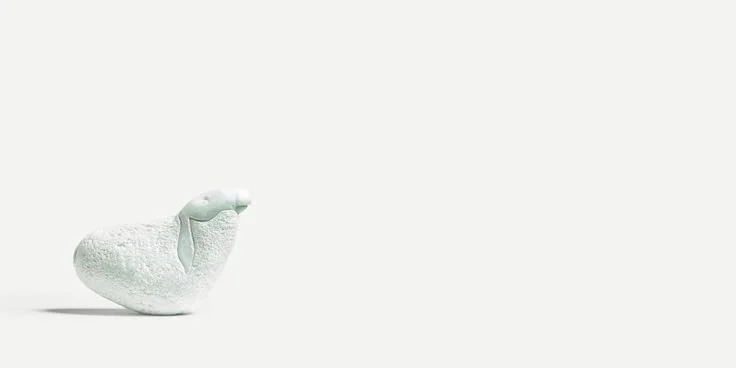
Frances Pelly: Belonging
Roger Spence travelled to Orkney twice to meet the sculptor, Frances Pelly, and talk about Scottie Sutherland, commissions, the heart, nousts and cheese, amongst many other matters.
It was my friend, the photographer, Sean Hudson, who first alerted me to the work of Frances Pelly. He had been asked to travel from Edinburgh to Orkney and spend a week photographing a sculptor in a distillery. He was excited to go, thrilled to be there, and on his return he was radiating joie-de-vivre. That was in 1987.
When art-scot was considering academicians who we might feature as partners in the RSA200 celebration, I immediately thought of Frances, associated with the Academy for nearly 50 years, and started re-establishing a remote connection, surveying her work as it intriguingly appeared in exhibitions and on-line.
A picture emerged of an artist able to still nature through an empathy that balances toughness with delicacy. Her work is quiet, refined, and embracing. It draws you in to a sheltered world of calmness. It speaks of a harmony with nature.
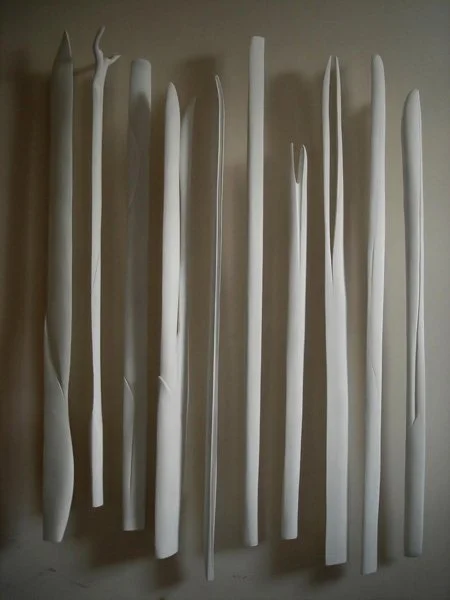
Frances Pelly, It’s The Light… Painted willow. Dimensions, Date.
And she seems to work simultaneously in a wide range of media: stone, clay, wood, plants, paper, ink, and print. In addition to making prints, and lettering in stone, she writes words in haiku.
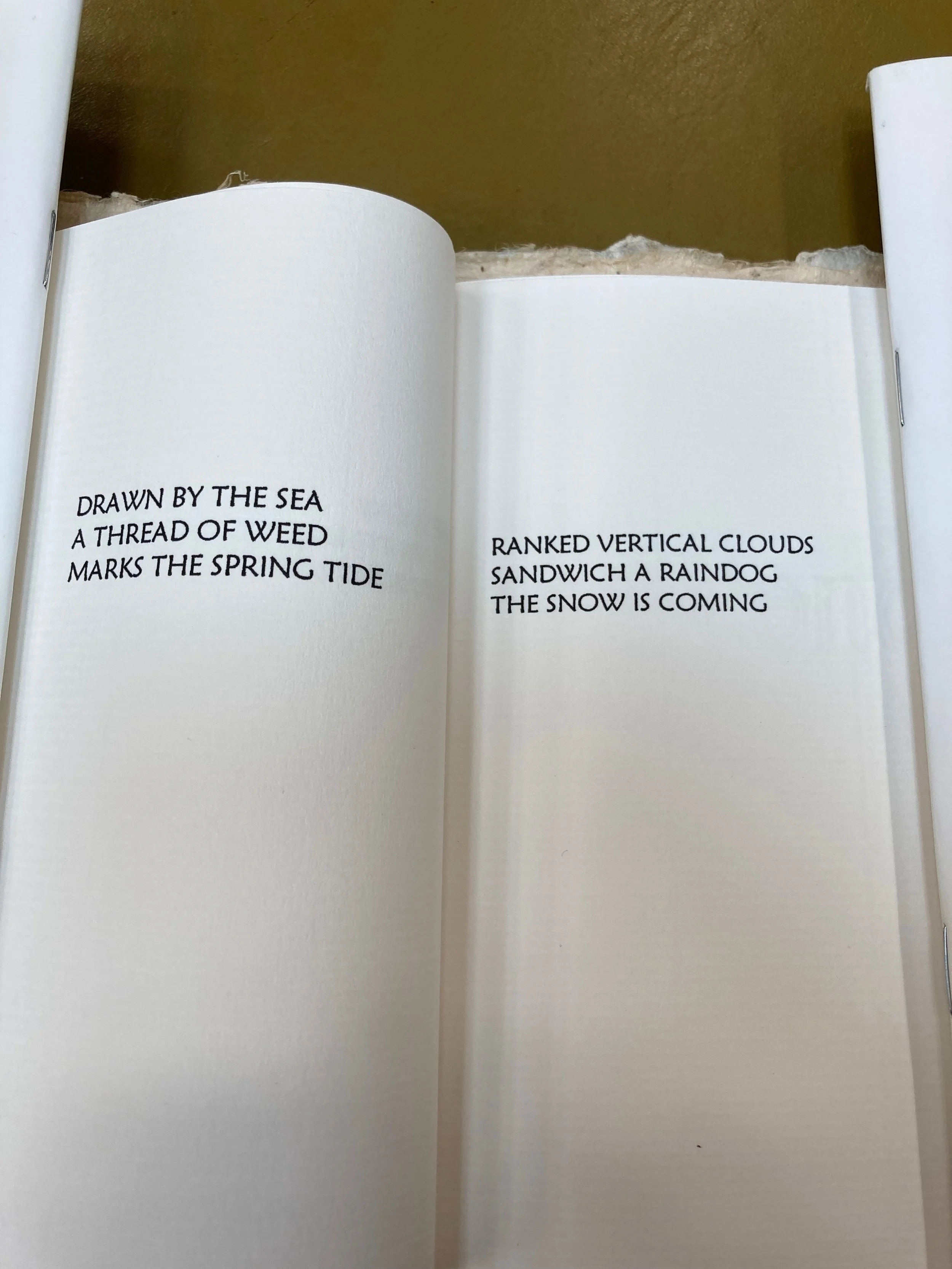
Frances Pelly, Page from Haiku Diary, Dimensions, Date
It’s clear that Frances observes with a steely eye. She looks for detail. She feels that is where she can find significance. And she connects her sensory science to her emotional responses. Later, I establish that she feels her subject matter with her hands and with her heart. She’s in love with rocks and dried wood and plants and animals; wind and rain and sea. She treasures their attributes, and she wonders at their beauty, inanimate as well as animate. She is a cloud watcher, fascinated by the constant flux of form.
Drawn by the sea. Turn that line over. Frances understands the power of nature to make art and beauty, and she’s ready to enshrine the simple twigs of willow or the smoothed pebble with little embellishment. Her assemblies of wood and stone are authored by her and by nature in a harmonious and symbiotic way.
She cradles, she polishes, she makes objects from nature in forms that seem elemental, that could have been made by wind or wave, or by ancient woman working with simple tools on what she found around her.
In Blue Moon Fishing 2, hard stone sits in a firm protection that depicts flux and movement, with shapes of boats and rudders and fins swirling in multiple directions above. Frances effects the movement of water in a current or a wave by enhancing the lip of the wood next to the stone and leaving a small cavity that turns the sculpture away from the base. The balancing of the piece is in itself a work of art.

Frances Pelly, Blue Moon Fishing 2. Mahogany, plywood, soapstone and acrylic paint. 27 x 14 x 9.5cm. 2024.
Her work can be highly polished, surfaces worked over and over to create (or re-create) the tactile pleasure of a naturally burnished feel. Her animates are often distinguishable from their surrounds by their fineness in touch and look, compared to the rougher environment that holds them, but she often wants to show her empathy by cradling the soft tissue with a caress that speaks of love and understanding.
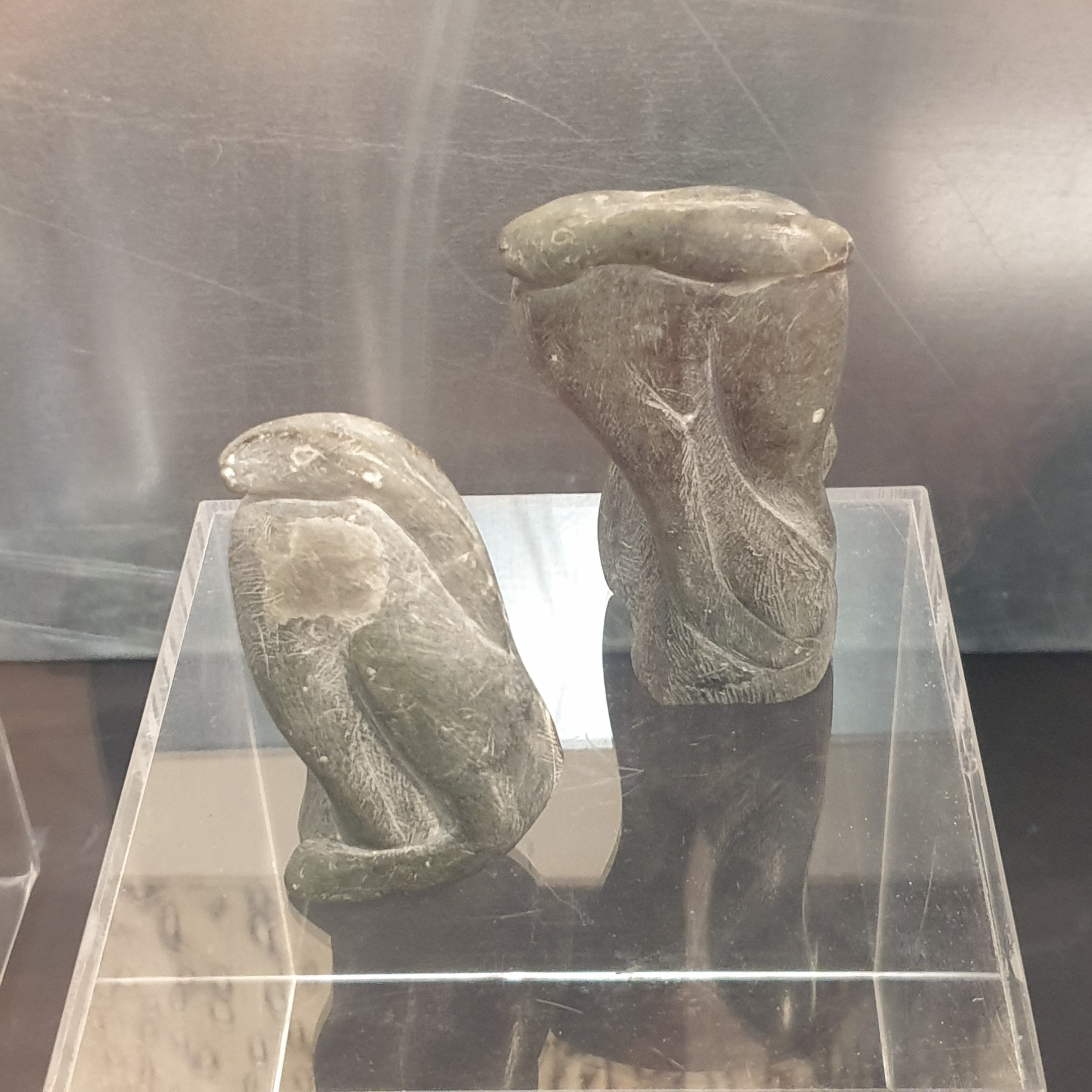
Frances Pelly, Hares. Soapstone. Dimensions. Date
One exhibit was a stool, well, a Peedie, Creepie Stool. It didn’t seem to involve any fixing. Tensions were clearly calculated and understood, the polishing and refinement seemed as loving as in her sculptures of animals and plants. Did she make furniture too? (1) If she did, her methods pre-dated iron age methods. The practice of balancing objects for all aspects of everyday life, including architecture, furniture, and storage is evidenced in Orkney in stone-age villages that pre-date pyramids by thousands of years. Of course, Frances’ stool’s cut and groove would be made with modern hammers and chisels and polishers.
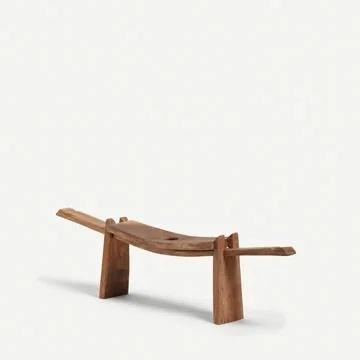
Frances Pelly, Peedie, Creepie Stool. Type of wood. Dimensions. Date.
The elemental aspect of her work threads through her prints and drawings. They abstract the essence of an idea into something that might have been painted on an Orcadian cave in 3500BC. Emperor’s Horses is a little triptych of animal perspectives that eschew detail in favour of feeling. The artist knows what the horse is doing and thinking and tells us in a simple drawing.
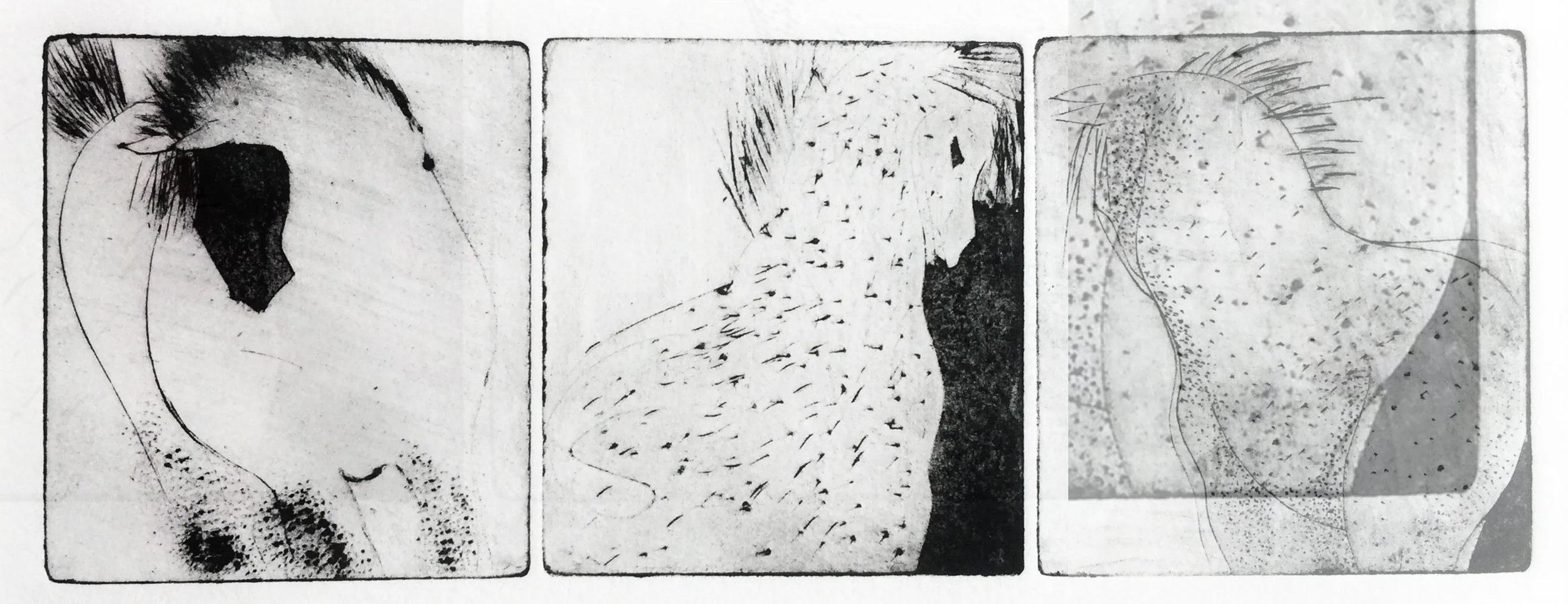
Frances Pelly, Emperor’s Horses. Media. Dimensions. Date.
And perhaps Frances can see representation in shapes that are produced by nature. Is she referencing a horse in her painted willow sculpture called Winter Beast? It is balanced and poised to move or be still. Looking at it, one starts to wonder whether the piece could balance in such a natural way if rotated on any one of its four cardinals.
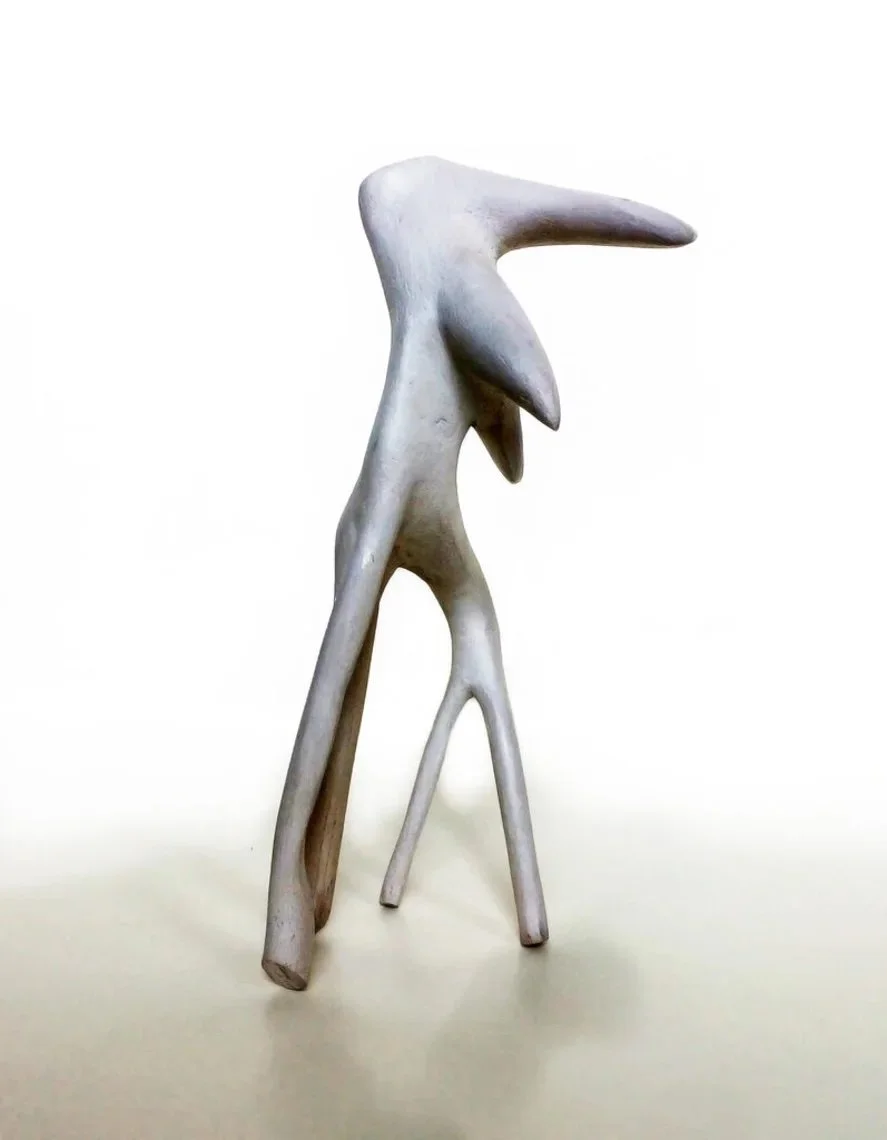
Frances Pelly, Winter Beast iii. Painted willow. 25 × 15 × 15cm. 2020
I got off the bus at Tingwall Ferry. There was just me and the bus driver, and then there was a small figure with close-cropped hair in dark knitted shirt and dungarees rolled up around her waist appearing from a parked van to greet me with cheer and purposefulness.
Frances Pelly immediately identifies as tough and friendly and courteous. Her face is tight-skinned and her smile hints of mischief. Her hands have spent a life working outdoors and sculpting. Her current vehicle is one of the boxy car/van types that I guess can carry farming equipment and cut wood and plant material and shopping and stray animals and artworks.
The sculptor’s house is nestled in the green Orcadian farming hillside above the ferry terminal. It’s a small grouping of single storey farm buildings hardened by a couple of centuries of wind, rain and snow. Unusually for Orkney, there is a little wood on the east side. Frances is a forester’s daughter and she’s proud to have planted and nourished a range of interesting species even in the reduced height versions that Orkney’s wind allows. The scale is ideal for her petite frame.
Off the single track road and along a farm track, the van pulls up on a hard stand amidst a grassy curtilage. The view to the sea is closed by a block of low woodland scrub: hazel, willow, alder. Frances says that it is riddled with voles, but there’s been a stoat about.
Before we go into the house, she suggests we look at her studio. It’s an austere barn built into the slope in a north-south alignment, at ninety degrees to the house. The roof is thick stone slabs and it leaks. The wind, she says, always finds a way through, and the water also comes down the slope and under the walls. There are no foundations. Outside, there are piles of neatly stacked cut branches.
There are two heavy metal bolts on the door, but today just the one needs opening. She only uses two when the wind is blowing. For most ‘sooth-moothers’ (arrivals from the South, like me) it was a fairly cauld blast on an April morning, but Frances regarded it as calm.
Stone walled, stone floored and stone roofed, the studio is benched around the perimeters with tools and machines arranged ready for use. There are neat stacks of found objects, some natural, some not: notably feathers and stones and pieces of driftwood. The shelves and cupboards have a sense of being full, and there are neat assemblages of overspill in all sorts of directions. Whilst there are a few small soapstone pieces that look as though they have had some recent attention, the larger equipment, including the massive red metal hoist leaning against a stanchion, has been placed into hibernation mode.
Frances explains that she hasn’t been able to use the studio for several months because of the cold. There is no heating. She’s also suffering from a very painful back.
High up, across the full width of the north gable end and pinned into the eaves is a timber framed storage box with a small aperture. Frances said that she slept there for the first eight months of living at Quoybackie. She must have a strong free-standing ladder… and a tough constitution.
‘Quoy’, Frances tells me, denotes a smallholding. This has been her home for coming on forty years. Small and holding are apt words.
We go into the house, turn right and into a long narrow room, a kitchen and everyday living space, through which I can see into a bigger room divided into different areas by freestanding storage shelving. The whole space is defined by work rather than leisure, although there is a wood burning stove at one end. Frances says there is heating from a ground source heat pump, but the temperatures in the house would challenge most 21st century British people. She puts the kettle on and we sit down at her kitchen table to talk, with tea and Westray Perkins.
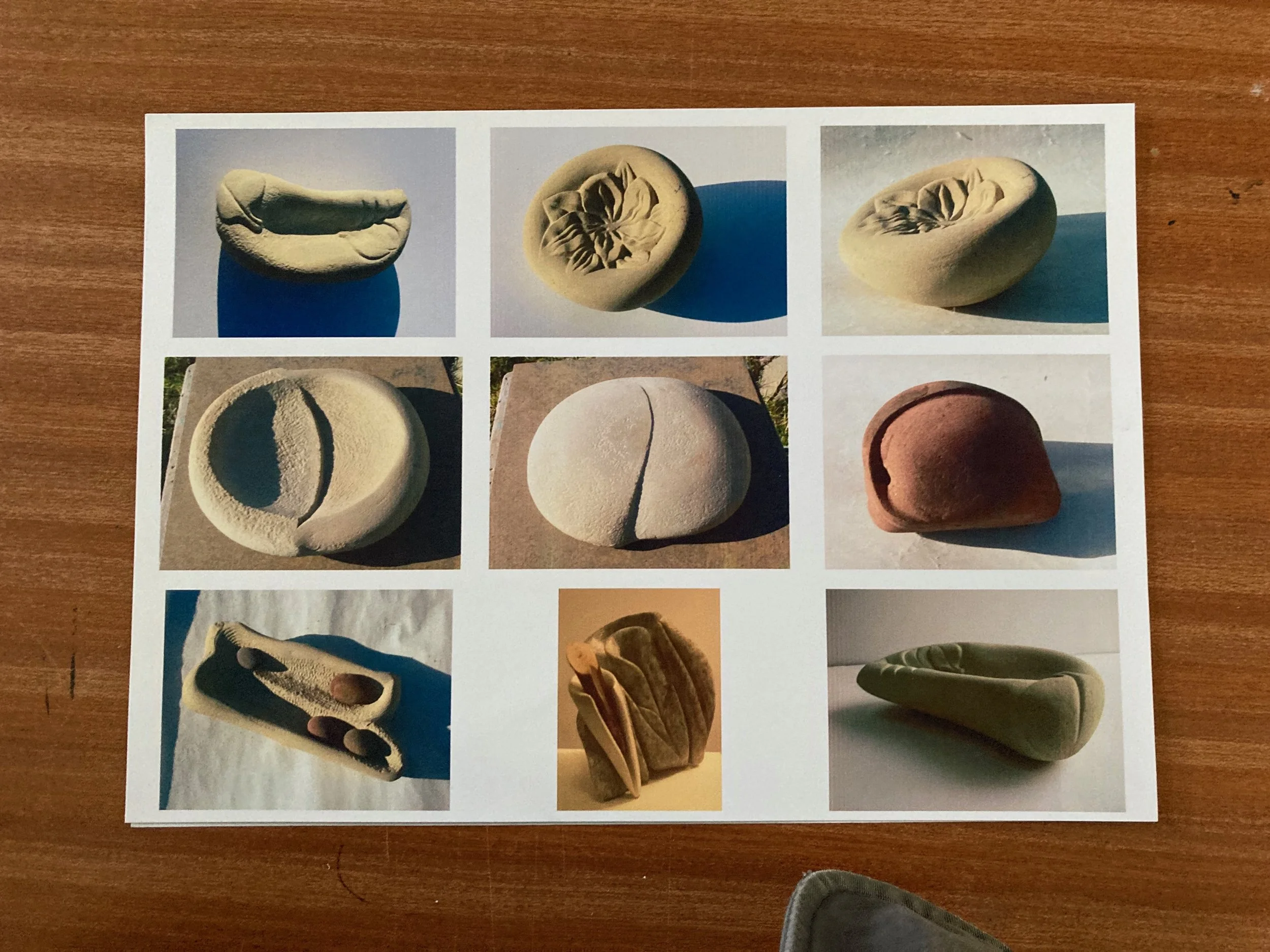
Frances Pelly, Photographs of small works in stone, set out on her table
Frances Pelly was born in Edinburgh on July 21,1947. Her parents had met in Sierra Leone where her father was the Chief Forestry Officer and her mother was a nurse. British women had to return ‘home’ to give birth. She spent her first four years in West Africa, being looked after by an African maid, but at aged four was sent to boarding school in Edinburgh. She loved the animals and birds in the Dr Doolittle stories before she could read. She remembered her father bringing animals (especially chameleons) back from the forest and putting them on to the dining room table. And she remembered the feeling of going into the forest with her father, the sense that he was at one with trees and handling wood. He sketched animals on the air mail letters she got at school from Africa. Woods and birds and animals were her father’s passion and they are hers, probably more so today than they were early in her life.
She hardly knew her two younger sisters until the family moved back to Scotland in the late 1950s. Frances’ father had set up a forestry business with an ex-African colleague in Dunblane, and then moved to Perth to manage their office there.
Frances went to Morrison’s Girls School in Crieff, travelling every day on the bus.
“I don’t think I was any better than the others… I maybe got slightly higher marks…I didn’t think about it. But art was the only thing I ever got any praise for. It just felt safe. It felt nice to get the odd prize or something…not that I was after that… you thought you belonged somewhere. I think that was important.”
“I always was scribbling things and I remember in the old Perth house they stripped a lot of the old wallpapers off and I used to draw on the old plaster. I was always doing drawings, and mother was always asking me to ‘Do a little card for Mrs so-and-so, dear”.
Ponies was her other youthful ‘thing”, she had a Highland pony, a gelding less than fourteen hands, and she loved riding. It is something that’s been with her all of her life, and until recently she was out and about on a pony on the quiet early-morning roads around Rendall.
Despite her mother’s negativity about art, Frances was offered places at Dundee, Edinburgh and Glasgow art colleges, and she chose Dundee partly to placate her mother’s wishes for her to be close to home and come back at weekends.
Her accommodation was the YWCA to start with, along with women who were regularly drunk “and often up to no good”. Then fellow students told her about a single end-tenement flat ten minutes walk from the school, a bedroom with a cooker, a coal bunker and a cupboard. The toilet was outside. Her mother was shocked, but she liked it.
She hadn’t done any sculpture before arriving at college. “I hadn’t handled clay before and I was always watching Dad and working with Dad when he was planing or sawing or making something and I was always picking up bits and pieces… but actually it was just liking to use my hands… “
“We had to do two years of general subjects. Art, design, a craft, jewellery or something like that. There were graphics. The design department was divided into graphics and printmaking. There was drawing and painting. There was architecture and art history. Eleven subjects all together. I seem to remember counting them. And you had to do that for a whole two years and it was a really good grounding, and then each department had an interview with you or put their hands up saying ‘we would like so-and-so’ and ‘we’re interested if you want to come to our department’ and I loved sculpture by then, two years of sculpture and I thought ‘this is what I’d really like to do’. The painting department said they would like to have me too and I thought about that, and I knew I could always paint in an attic, but I couldn’t do sculpture under those conditions. I needed to learn welding and all that sort of thing. So I opted for sculpture, and that was smashing. It was nice to be part of a wee close-knit family.”
The family included staff and students. And the interface between them? “Oh! All day and every day. There were three members of staff, or at least two every day. And the studio we had was probably from here to the window, it wasn’t very big, and Scottie had an office and there was a shed out the back for storing work, and woodwork. But we were right next door to ceramics, and we had access to a kiln and mixing with the potters. I think there were only about three of them, so ceramics and sculpture were very much a family. I remember we had to take our shoes off in the sculpture department if we were going to walk to the library, which was all the way through the college, because otherwise you left white hoof-prints all the way” she laughs.
The three staff were “Alistair Smart, Scott Sutherland and… Alistair Ross. He was sort of part-time. He didn’t teach me.” And the three students included Barbara Peffers, who Frances rated highly. The first two years were “basic techniques: modelling from plaster cast heads or hands or noses, something from some of the big sculptures, the David, for instance… We were copying exactly on the board. An eye or something would be hung on your board and you would have to build up that image in clay. And Scottie would come along and if he didn’t like it, he would go ‘oops’ and it would go all squidgy. I loved that. You couldn’t draw me away from that. And once we were doing the full course, we had to find some people to do head studies of, but Barbara and I were always sizing up the best looking architects, the Norwegian ones, to come and pose for heads. They were delicious. Don’t quote me on that, please.”
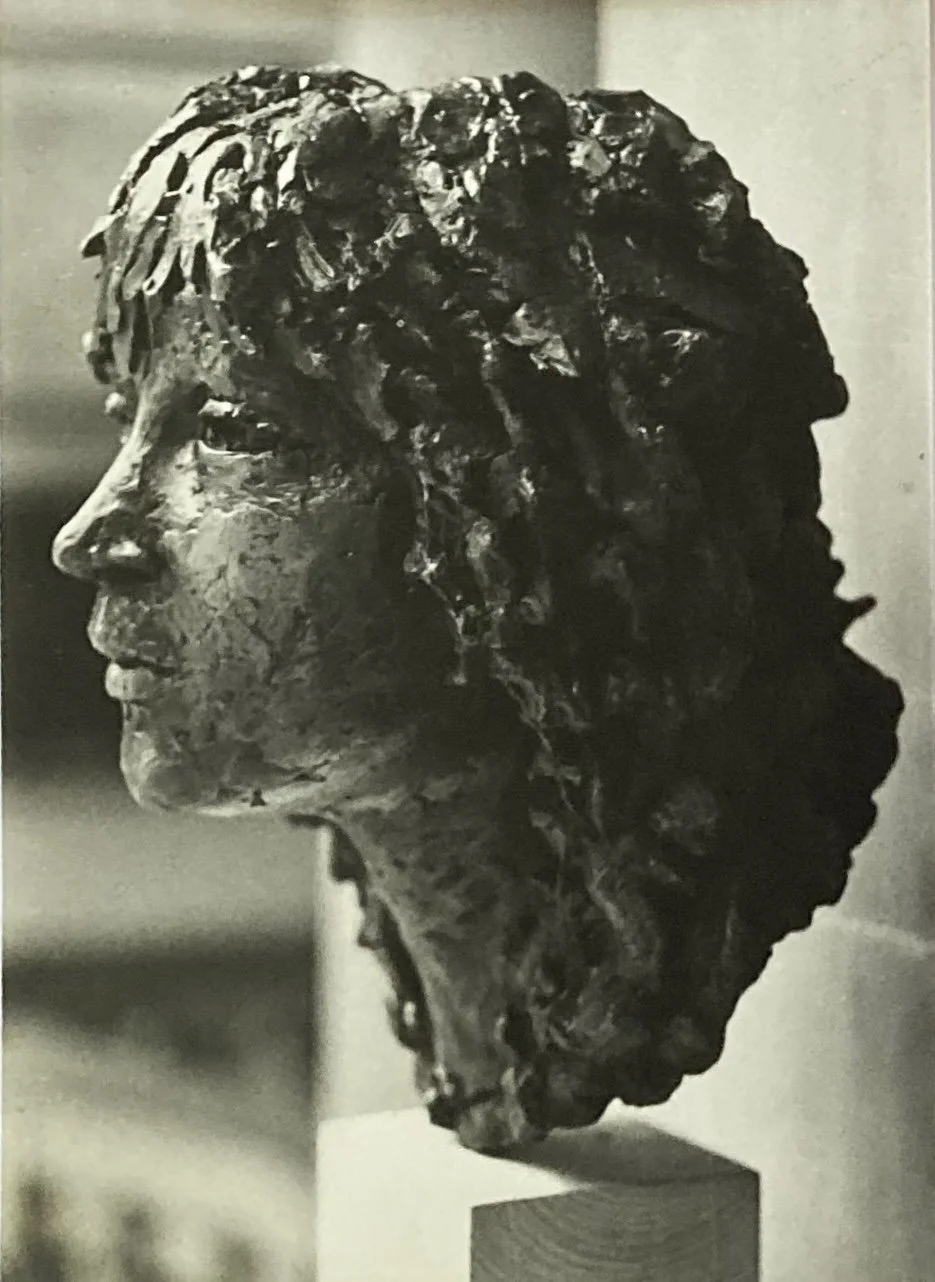
Frances Pelly, Head Study. Fired clay. Dimensions unknown. 1970
The sitters “would come to the studio at lunchtimes or at five o’clock in the afternoon when tutors left for the evening, and we had from then until half past nine before we were thrown out. Most students all went away. We didn’t mix much with the other students at all. No. We had tea and coffee and whatever we wanted. We could cook things up on the gas stove, and we could climb out of the window to go out to the pub and just climb back in again to save going along… and Scottie and that lot used to disappear to the tavern and that’s what happened in the afternoon. Tutors went up there. I never went up there.
“The tutors would be coming around every now and then. Just Scottie and Alistair. Alistair might have been coping with the other people on the first and second year course, so he’d be next door in the other studio with the beginners, and Scottie would be teaching us. We built up from the head studies we’d been doing in first and second year to proper life studies, but we had to learn welding to make our own armature first. And then we had models. We had a lovely girl with a baby, and she brought the baby in and just put it down on a mat whilst she posed. I’ve got photos of the portrait we did. I just loved working directly from the figure. It was just fantastic.”
Frances would be working on life size figures bigger than herself for weeks and weeks, and simultaneously on smaller pieces. “It could have been in clay, it could have been in wood, because we would obviously have had basics in wood carving and metalwork, and that wasn’t just electric welding, It was folding metal or wire and things…”
Did Scott Sutherland specialise in stone carving? I ask. “And clay modelling. All those pieces were done in clay, a lot of them. You know the monument at Spean Bridge, one of the second world war ones he did, the three soldiers, that wasn’t carved, that was cast from clay work. I’m pretty sure I’ve got photos of the models. He was quite a wee chap. It must have been months of work and then cast in bronze. He would work from making a maquette and then carving in stone, too. All with special dividers to get the proportions right and so on.”
And lettering? “Scottie taught us letter cutting. We had to make our own chisels as well… there were no tungsten chisels in those days… and he first started us off with granite sets…Scottie taught us forging and everything,… We had a proper forge in the studio. We had oxyacetylene tanks right next to it. No kidding. And a box of dry plaster in a big batch, and somebody would be casting something there and somebody else would be welding there, and there we were bagging away…It wouldn’t have passed nowadays, but it was alright! We were all sensible.”
Were they casting everything they did? “No, but sometimes Scottie would say ‘let’s see you cast that’ and then we had to. We did a head or something and you cast that. Scottie told us how to make proper moulds. And then how you filled them in with that special fine cement, cement fondue, which is a dark brown colour. That was easy to chip back out of the mould once it was set, but chipping plaster against plaster, if you used plaster rather than cement fondue, it was very difficult chipping away at your plaster casing. We learned how to do that. And then fibre glass came in and the smell of that was just overpowering and I really didn’t like doing that. But then you could put bronze powder into the fibre glass and you had a sort of bronze finish to it, and you could rub it with steel wool or something similar and that would bring the metal particles to the surface, and you could patinate that with chemicals and other things to make it go green or whatever you wanted. Equally, you could mock up the cement fondue to look like bronze, which I was quite happy to do. But we didn’t do much casting of stuff at all. I liked to do it. I had one or two pieces that were cast. Most things if they were small could be fired in the ceramic kiln. I did a lot of that, small figure studies as my extras, ideas for other things I wanted to do. I loved working directly in clay and getting it fired. I didn’t work in plastics. I did a lot proper welding. Not sheets of metal, but wire, using wire like a drawing. Barbara was doing similar kinds of things.”
Aged 21, she had her first piece of sculpture - titled Kit - accepted by the RSA and with it, she won that year’s Carnegie Travelling Scholarship. She went on a European grand tour. She was awarded a post-diploma year and shortly thereafter won the Royal Society of British Sculptors’ Gleichen Award.
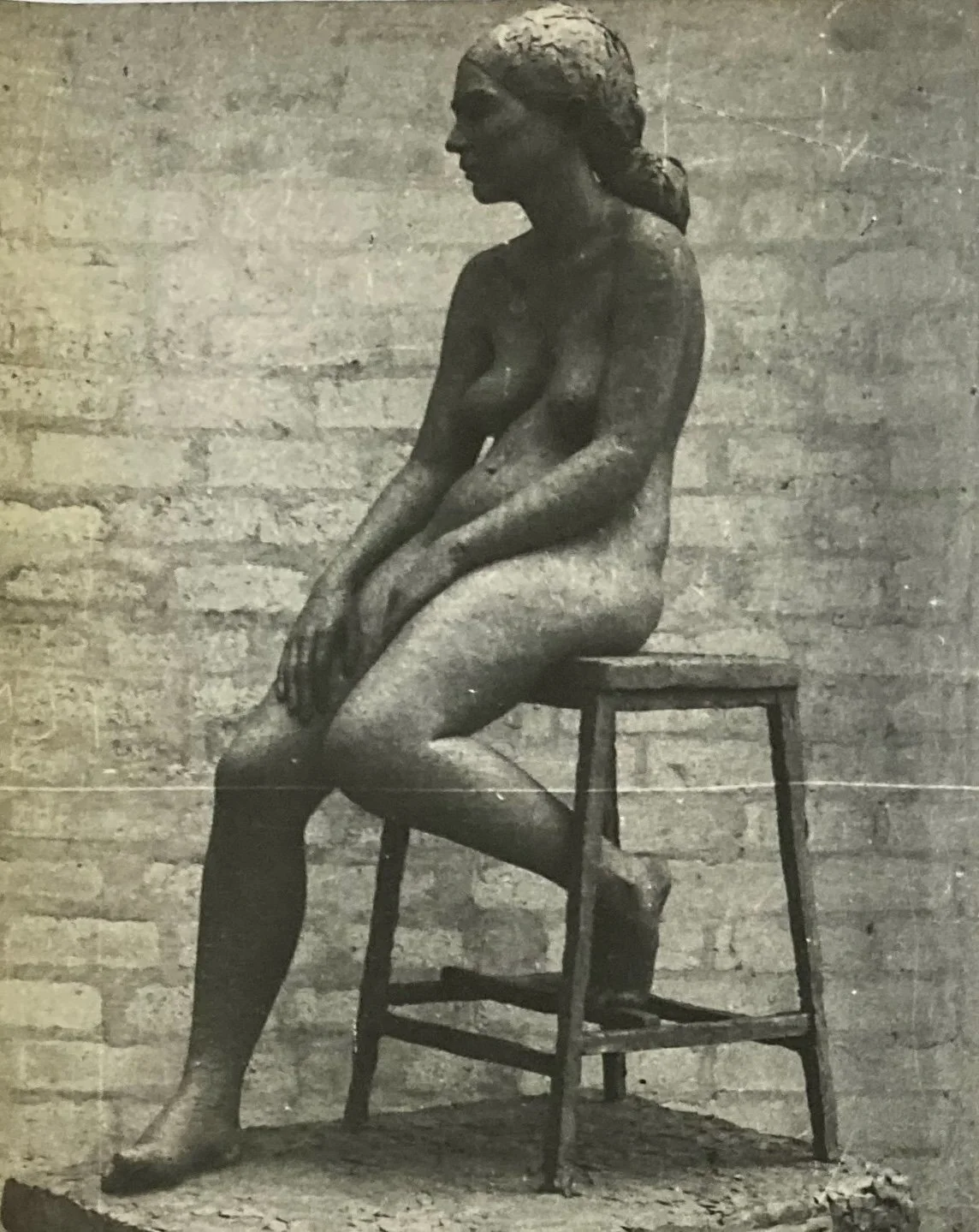
Frances Pelly, Life Study. Clay. Dimensions unknown-life size. 1970
Talking about the clay Life Study, Frances said: “Our sculpture training covered many practical skills; welding for making armatures, forging for tool & sculpture making, carving in stone, wood & plaster, modelling in clay, casting techniques to name a few. Our training was classical, working from the figure…Schilsky’s teaching methods, as noted by Anne Emerson in art-scot 13, were very closely related to Scottie’s background. This was a compulsory piece for our Diploma and one that I relished. I greatly miss working from the figure; I still create small figurative works; I love working with my hands and despair the detachment created between hand & material in much of today’s ‘sculpture’ …I’m just an oldie!”
In the Perthshire Art Association in the same year, 1970, Frances’ work made a very positive impression: “Outstanding. The free modelling of Frances Pelly in her Family Groups shows her ability to use the medium of clay to the full” said the Perthshire Advertiser’s art critic.
David McClure, eminent painting tutor at Duncan Of Jordanstone, bought her Christina, and loaned it to the RSA’s 1971 exhibition, helping her win a Scottish Education Department Travelling Scholarship. The brand new Dundee College of Commerce bought her greenheart oak carving, Woman.