
Elizabeth Blackadder: Nine Lives in Paint, Thread and Lines
Throughout decades of quiet conversation with flowers, cats and the myriad objects of domestic life, Elizabeth Blackadder taught the world to seek the extraordinary in the ordinary. Her studio became a kind of visual conversation between memory and observation, an exchange that would travel from canvas to loom to printmaker's press. Patient, precise, and delightfully attentive, she refused to let anything go unnoticed, least of all a well-placed bloom or a lounging feline. Isabella Nicoletti explores Blackadder’s work at a new exhibition in Dovecot Studios, Edinburgh.
Dovecot Studios after Elizabeth Blackadder, The Red Bouquet. Rug, gun tufted wool, linen, and canvas. 120 x 200cm. 2025. Courtesy of Dovecot Studios.
In Elizabeth Blackadder’s 1975 painting The Red Bouquet, the shock of crimson meets the electricity of cobalt, mingling in energetic harmony. Crinkled florist’s paper is made lively, anchoring itself in a sea of blue. The composition, flattened and concentrated, is orchestrated with the precision of a botanist cataloguing specimens, demonstrating how Blackadder quietly challenged conventions of space and arrangement through her handling of still life. This painting, created nearly fifty years ago, now finds new life as a hand-tufted rug at Dovecot Studios, speaking volumes about Blackadder's enduring influence on textile practice and the remarkable, enduring dialogue between her easel and the studio's looms.
Since her first collaboration with the workshop in 1967, the work of Elizabeth Blackadder, both in her lifetime and since, has been the inspiration for more than thirty tapestries and rugs. Painter and textile artists now meet across different media to realise fresh interpretations of her compositions, upholding a continuously evolving and developing narrative of innovation. This generative relationship now forms the centrepiece of a new exhibition at Dovecot, presented as part of the Royal Scottish Academy's bicentenary celebrations. Yet the significance of Blackadder's practice extends far beyond the gallery walls or the exhibition's run.
To examine Blackadder’s work through the lens of textile translation reveals her sensitive affection as an artist: her intuition, compositional intentionality, and her ability to express that universal experience – the fleeting beauty of mundane business – through her quietly intense contemplations. But it is also to trace a career shaped by artistic innovation, one in which a painter of rigorous intelligence reshaped what Scottish art could be.
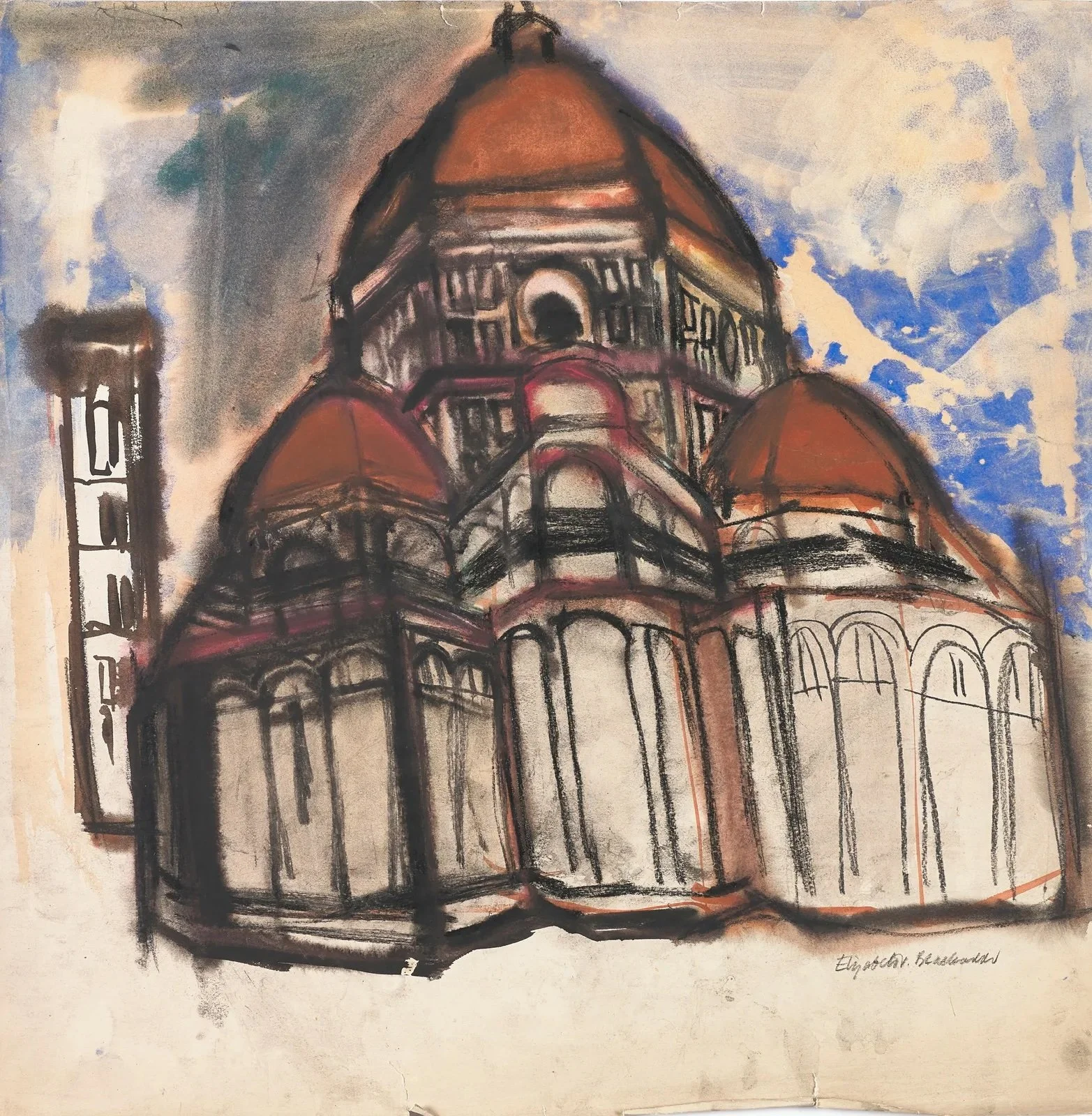
Left: Elizabeth Blackadder, Duomo di Firenze. Conté and gouache on paper. 56 x 56 cm. c.1955. Courtesy of the Royal Scottish Academy.
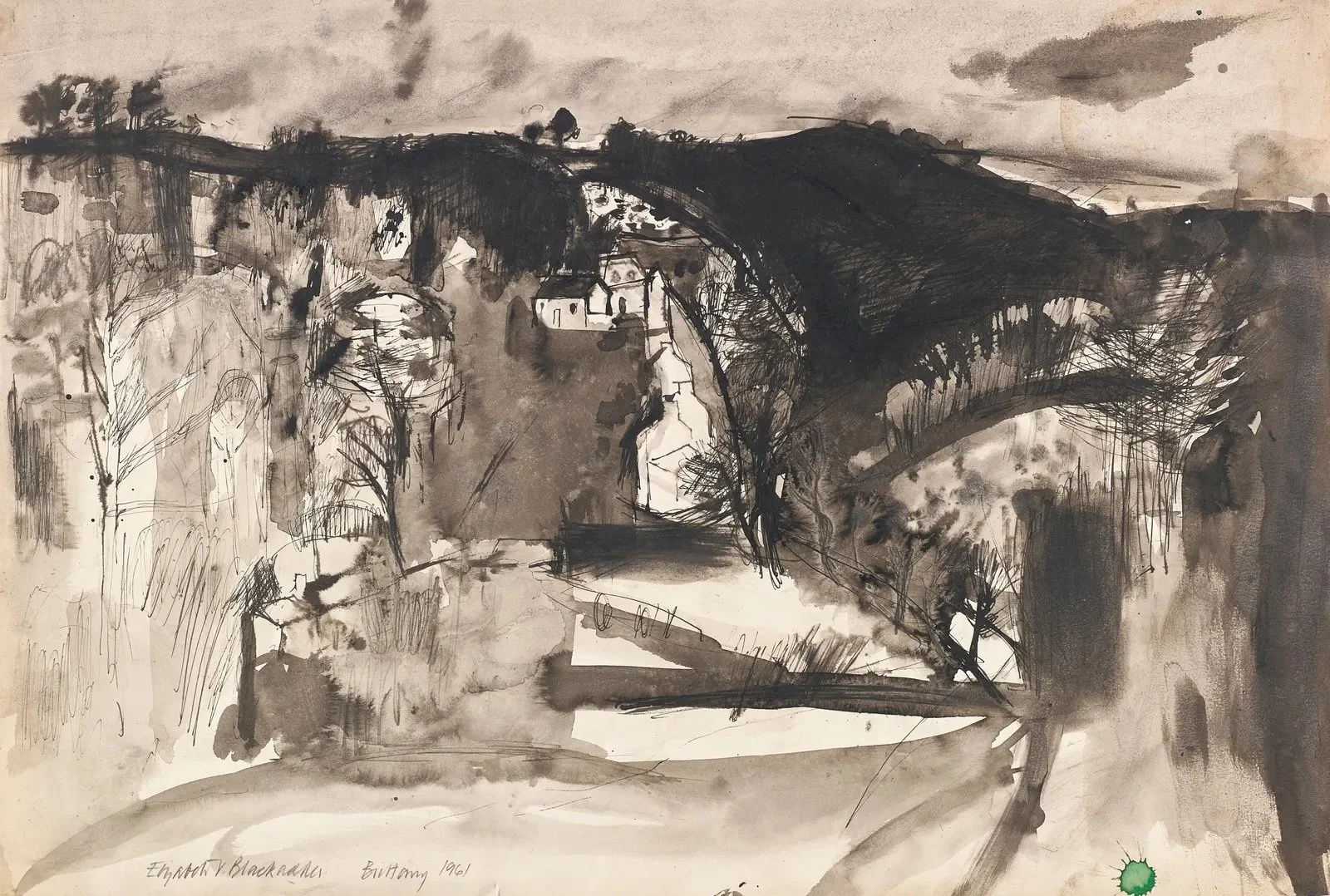
Right: Elizabeth Blackadder, Brittany. Ink and wash on paper. 34.5 x 52.5 cm. 1961. Courtesy of the Royal Scottish Academy.
Born in Falkirk, Blackadder’s youth was already intertwined with artistry and design; her grandfather, an avid traveller, often brought back collections from his travels, exposing her to a variety of obscure and exotic objects from far and wide [1]. Her interest in flowers too can be traced to her childhood, collecting local flowers as a child and drawing her collection. Blackadder went on to study Fine Arts at Edinburgh University. The Carnegie Scholarship allowed Blackadder to travel through Yugoslavia, Greece and Italy after her graduation, primarily to see the Byzantine works she had previously studied. The early paintings that survive from Blackadder’s student years are markedly darker and more sombre in comparison to what we associate her oeuvre with today. Blackadder painted a number of watercolour and drawing works in this period, lacking access to her oil paints or a studio. Duomo di Firenze (1955) and Brittany (1961) illustrate the temperament of her art at this time: stark and jagged strokes, sporadic colour and a heavy atmosphere of psychological remoteness.
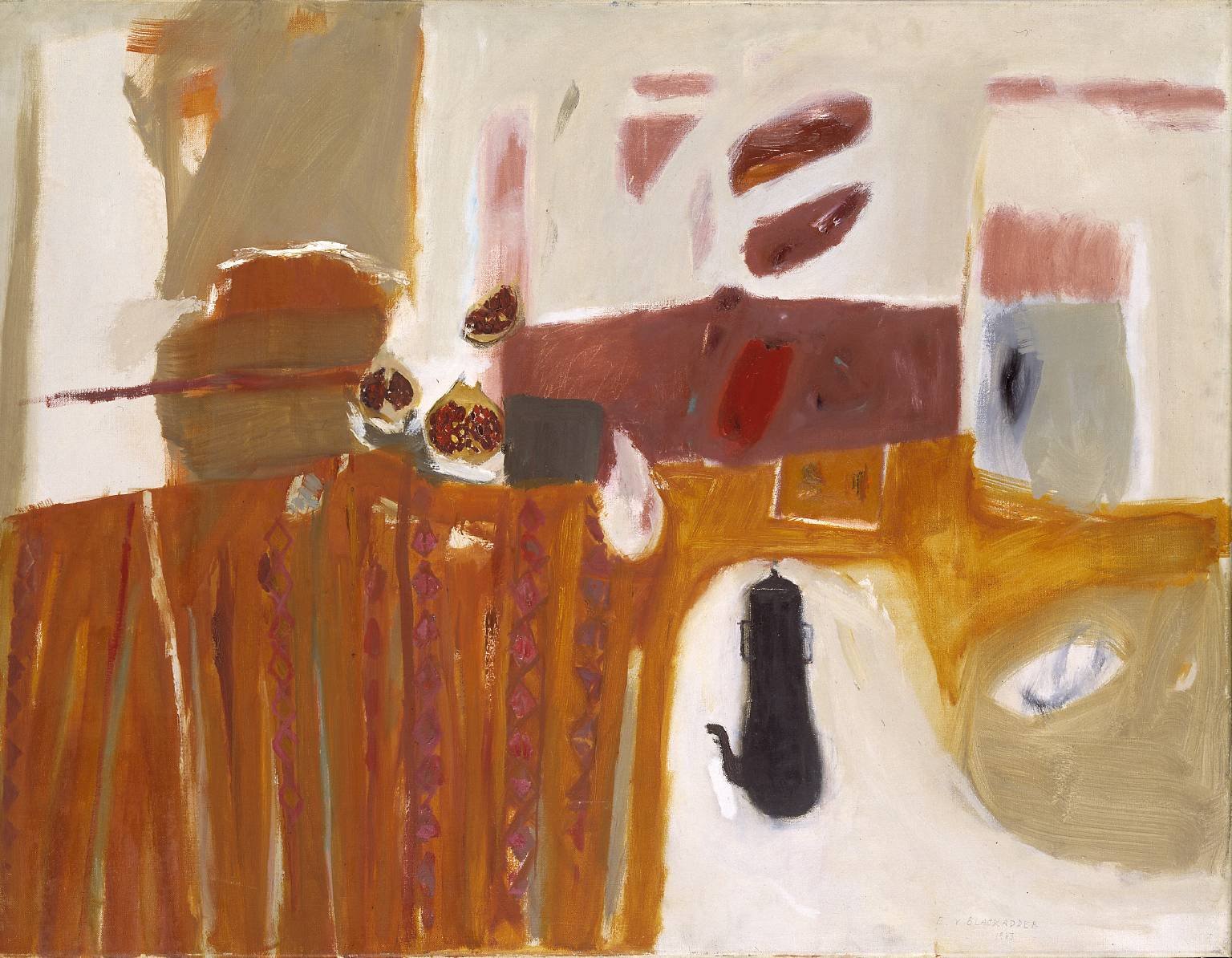
Elizabeth Blackadder, Still Life with Pomegranates. Oil on canvas. 86.3 x 111.7 cm. 1963. Courtesy of Tate.
Later into the 1960s, Blackadder’s work became more experimental with colour and composition, becoming less dependent on traditional structures of space and narrative. Still lifes became increasingly prominent in her work, and even in these early years the pictorial plane was used as an imaginative space, uninhibited by the constraints of perspective or linear narrative. Rather than situating flowers and objects within a convincingly illusionistic depth, Blackadder began to treat the canvas or paper as a flattened field upon which forms could be arranged with greater freedom. In Still Life with Pomegranates (1963), we see how the still life genre almost becomes an extension of Blackadder’s personality itself in the intimacy of domestic objects and possessions. It is a glimpse not only into her world, but also into the fondness of recalling a soft memory, of feeling at home, smelling coffee unhurriedly brewing, feeling the syrup of fruit on fingers. The objects remain in sharp clarity, and all else fades away from Blackadder’s purposeful brushstrokes, in the same way that memory washes away the details out of focus.
Each object in the haze of Still Life with Pomegranates and her works of the genre has some personal resonance or meaning to her, whether they were collected on travels – such as richly patterned oriental rugs – or objects of necessity – a coffee pot, a vase – laid out not merely for their colour and shape, but just as equally for their identities. The still life becomes a free-flowing field where objects come together by mood and memory rather than sight alone, creating the dreamscapes of misty memories that we now associate with her name.
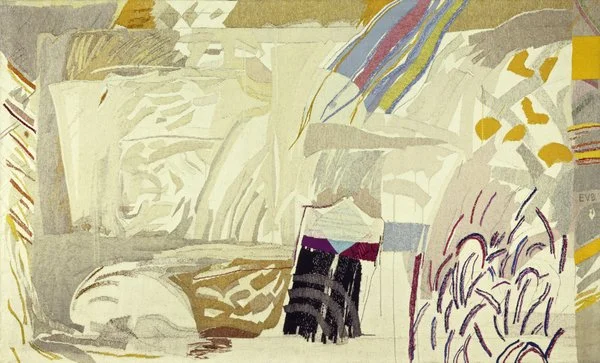
Elizabeth Blackadder, Untitled. Tapestry. 145 x 237 cm. 1967-1968. Courtesy of the National Galleries of Scotland.
Blackadder first collaborated with Dovecot Studios in 1966, creating a tapestry of her work titled Still Life (Tulips), shortly after the studio hired its first woman weaver, Maureen Hodge, in 1964. The work brings together objects and materials from her home and studio in a design made specifically for the tapestry, rather than a recreation of her painting. The use of different weaving styles for different elements creates a surface alive with texture and depth, reflecting Blackadder’s own exploration of a world in constant flux; our attention shifts and flits among purple gestural marks, folded patterns in tan, gold rectangles, and a patterned border. Blackadder regarded weaving as a medium that could hold the complexity of how we actually experience life, the beauty of coexistence; fractured, layered, never quite still.
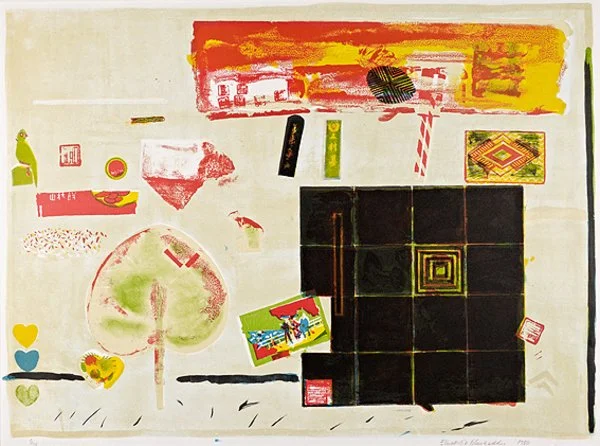
Elizabeth Blackadder, Still Life with Fan. Colour lithograph on paper. 63 x 86 cm. Dated 1980. Courtesy of the National Galleries of Scotland.
Blackadder’s commitment to celebrating the delicate beauty of the world brought her back to her interest in botany in the 1970s. Her time in New York exposed her to the work of Piet Mondrian, whose own flower paintings further inspired her exploration of the world in a way that was imaginative, sympathetic and austere [2]. Mondrian’s influence can be seen especially in Still Life with Fan of 1980, where objects are distributed in an indefinite plane, and squares of embroidered cloth appear as abstracted geometric shapes.
Whilst flowers previously appeared in Blackadder’s earlier still lifes, they were rarely the focus, melting into the broader composition. From the 70s onwards, Blackadder studied both flowers and cats with an almost scientific precision. Her drawings, unsentimental and analytical, were in many ways reflective of her deep appreciation and respect for the world, and the independence and freedom of its inhabitants. The cats stroll, sprawl and slink across the pages, as though languidly relishing the lines that grant them a free and autonomous existence on her paper. Flowers and cats became an increasing presence in her works, falling into their own position in the compositions with ease, as though they are precisely where they wish to be.
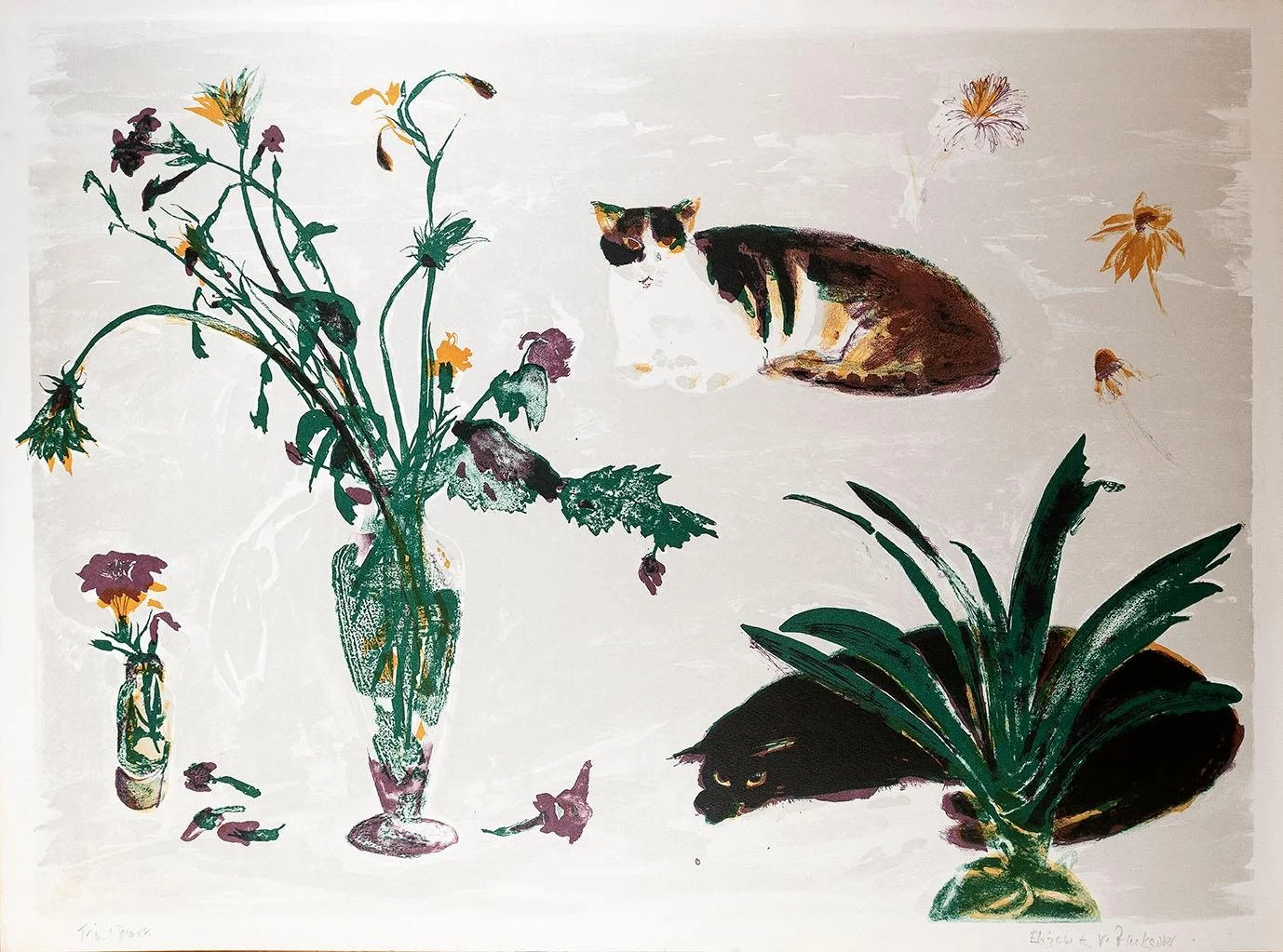
Elizabeth Blackadder, Cats and Flowers. Colour lithograph on paper. 62 x 83.7 cm. 1980. Courtesy of the National Galleries of Scotland.
Blackadder’s earlier flower pieces, now one of her most distinctive subjects, capture the vibrant energy of a flower’s growth in defined, swooping strokes. Against stark white paper, the saturated petals and luscious foliage of flowers in Cats and Flowers (1980) come alive, in some parts gliding across the pictorial space. The fluid movements of both the cats, stretching and loafing, and the flowers, drooping and reaching, are all that ground the pictorial space. Blackadder’s increasing use of an intangible space in her compositions can be understood as a representation of the hazy corner of the mind where our memories live; occurrences and objects enact their relationship to one another, guided by the steady hand of Blackadder’s memory.
Another collaboration with Dovecot Studios, the 1995 tapestry Cats at Play, further demonstrates how the medium could encapsulate the experience of a world always in flux. Your room where a cat moves past flowering plants, where your attention catches this and then that, where nothing is background, everything is present at once. What in painting reads as fragments of observation becomes in tapestry something more actual, these presences held together, coexisting, as they do in the lived world of her studio.
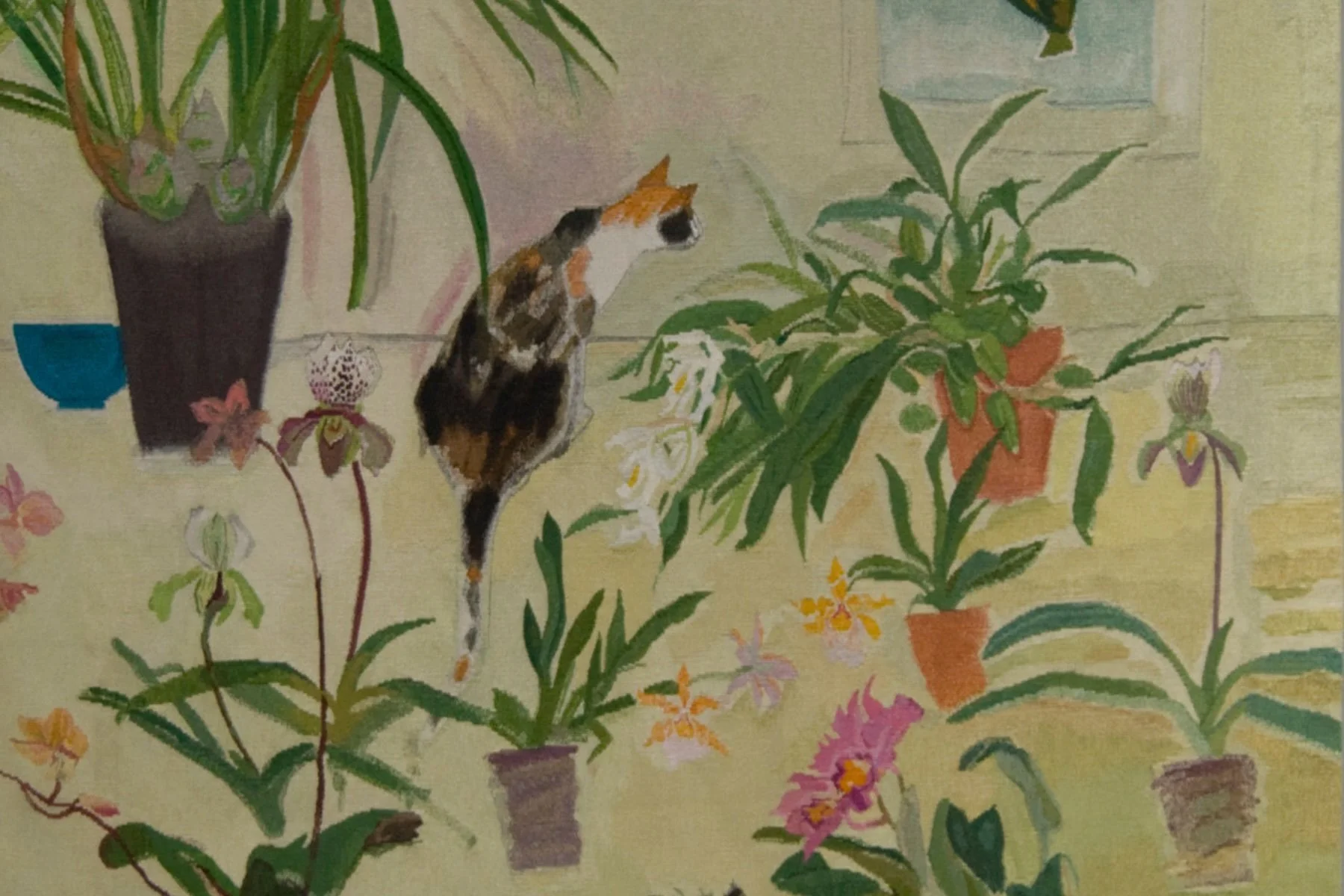
Elizabeth Blackadder, Cats at Play. Tapestry, handwoven wool, cotton and linen. 205 x 205 cm. 1995. Courtesy of Dovecot Studios.
Japanese painting would become increasingly influential to Blackadder’s work. Blackadder had already been experimenting with Japanese paper since the 1970s [3]. There was a shared affinity for the idea of space; both Blackadder and Japanese artists saw pictorial space as a more fluid continuum. By the 1980s, Blackadder's work had achieved a kind of luminous simplicity. Compositions of extraordinary refinement in which the relationship between object and emptiness became paramount. Foreground and background dissolved into a unified field where a flower, a cat, or a piece of crumpled paper could occupy the same visual plane as the blank paper surrounding it. In Japanese painting, space was not merely the absence of form but an active, generative presence. What was left unpainted carried as much weight as the brushstroke itself. For Blackadder, this philosophical approach confirmed what her practice had long been exploring, in that the picture plane need not be conquered through perspective, but rather inhabited.
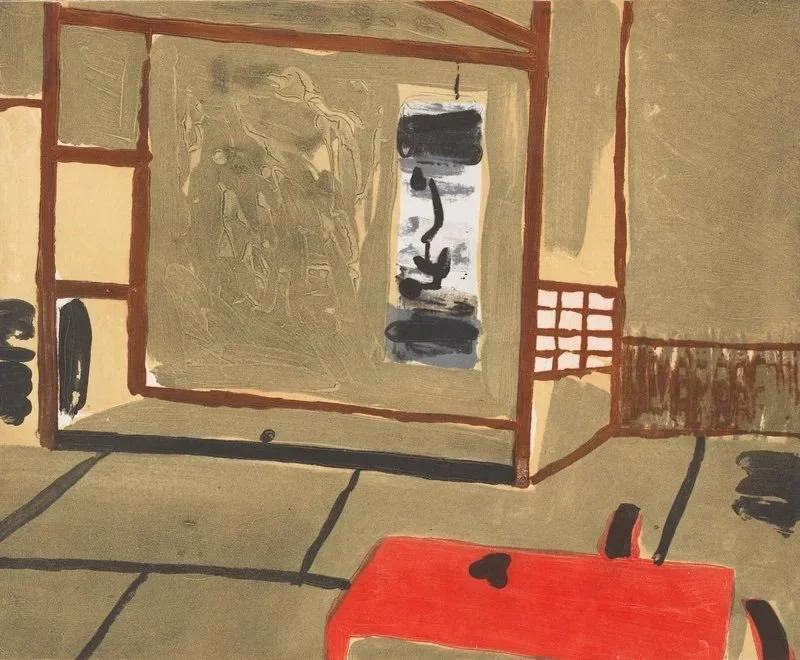
Elizabeth Blackadder, Japanese Interior, Kyoto. Carborundum print. 44 x 54.5 cm. 1999. Courtesy of the Royal Scottish Academy.
Blackadder would visit Japan a number of times during and after the 1980s, and these aesthetics of emptiness and presence found natural expression in printmaking. In 1985, she began working at Glasgow Print Studio, collaborating with master printmakers on etchings, screenprints, lithographs and woodcuts. Printmaking's relationship between line and blank paper, between the mark and the void, aligned perfectly with her evolving practice. Works like Japanese Interior, Kyoto (1999) demonstrate this synthesis. Architectural space is rendered with particular precision, the pale walls and red wooden framing holding their own weight against the blank ground, the composition distilled to essential structure and light. Her subjects of cats and flowers remained consistent, as well as landscapes from her European travels, and increasingly the refined simplicity she had discovered in Japan. For nearly thirty years, from 1985 until around 2014, printmaking became another dialogue between observation and abstraction, another way of asking what an object could become – or reveal – when reduced to its essential presence on a flat plane.
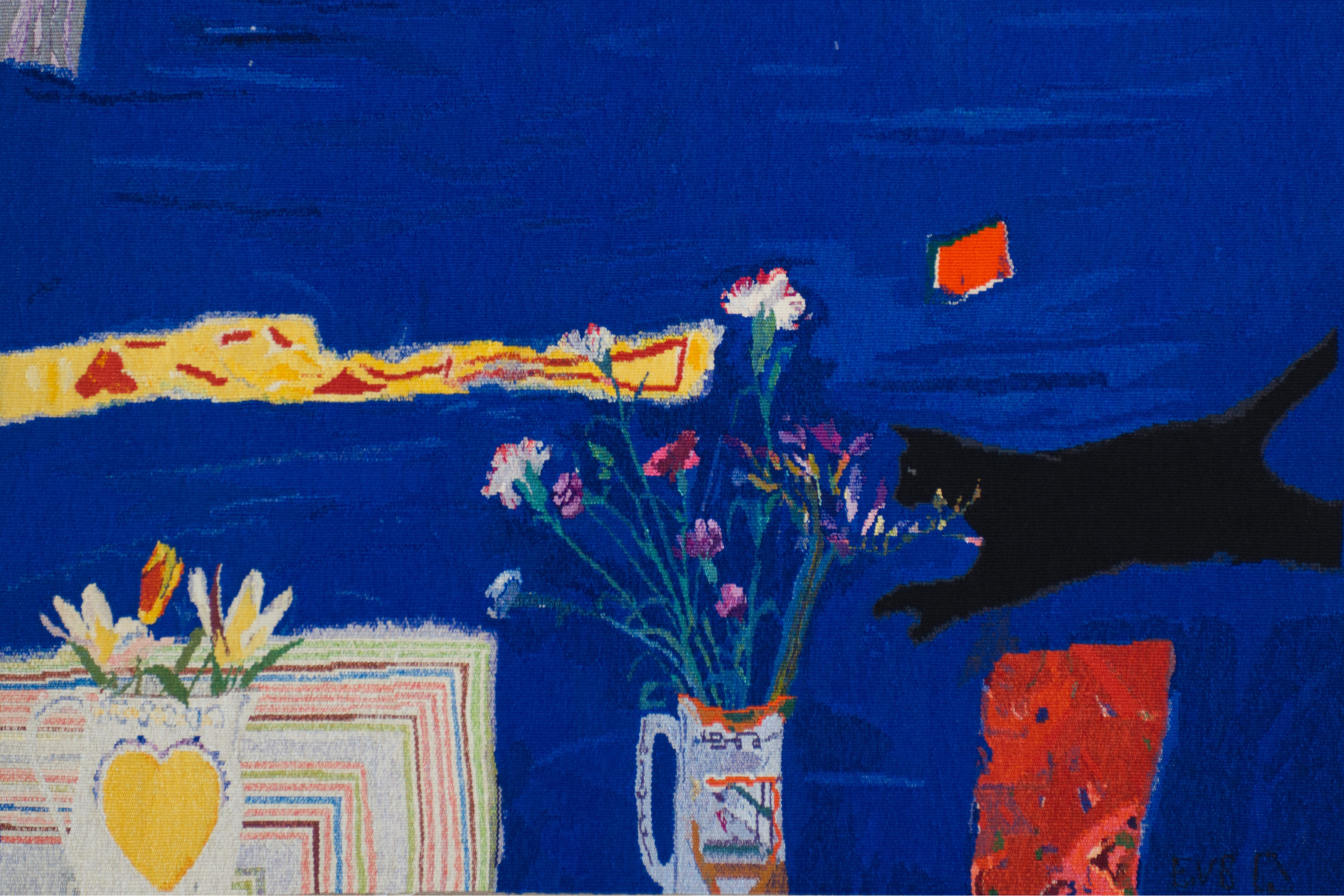
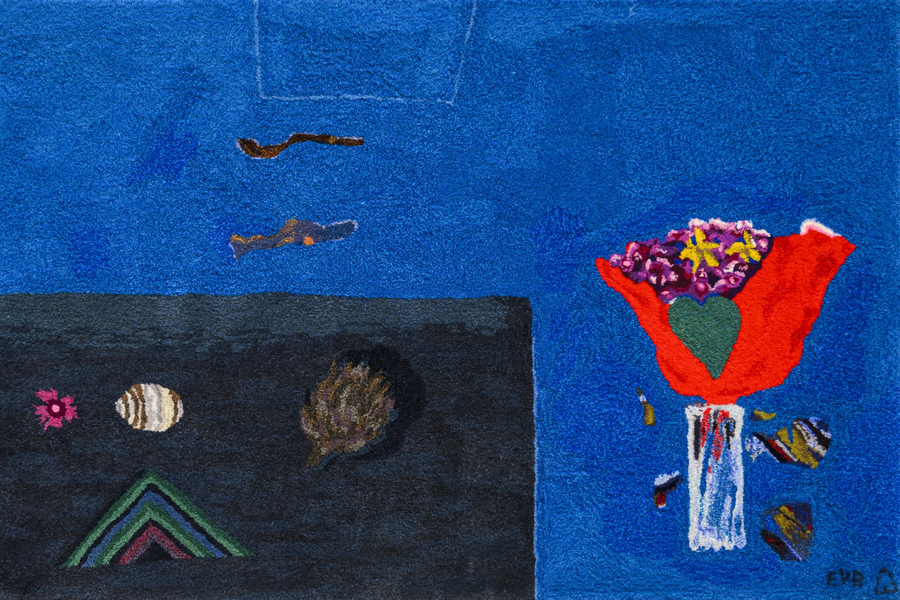
Left: After Elizabeth Blackadder, Flowers and Black Cat. Tapestry, handwoven wool and cotton. 107 x 126 cm. c.2023. Courtesy of Dovecot Studios.
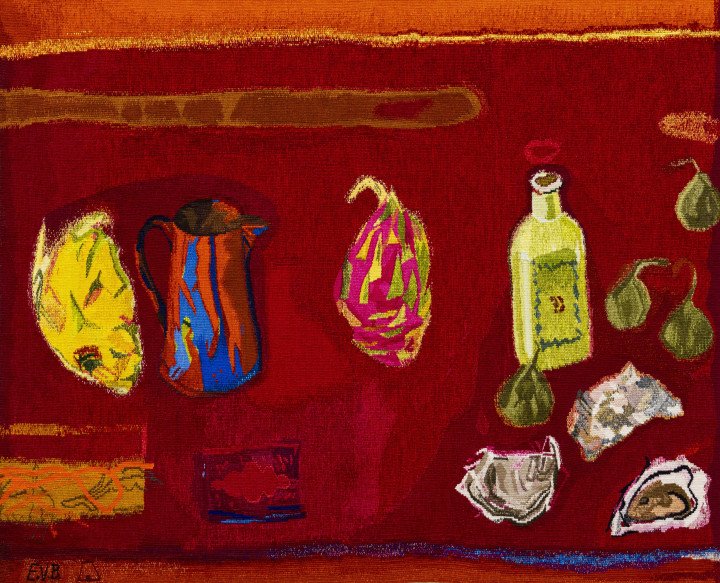
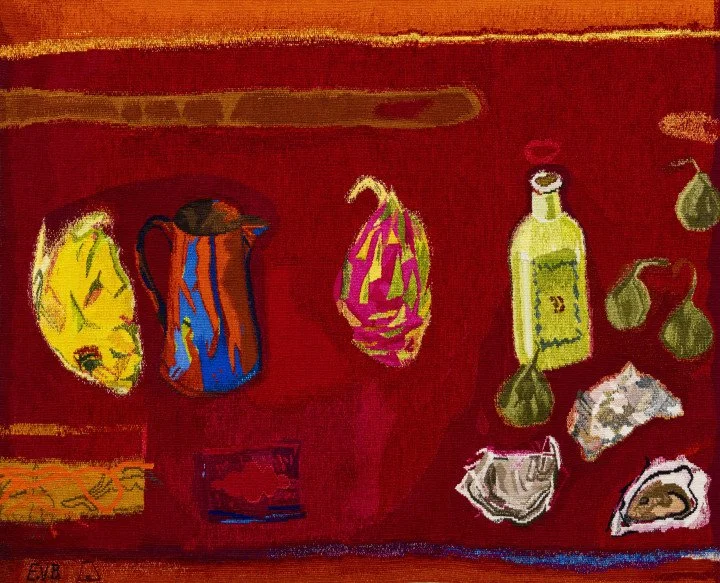
Right: After Elizabeth Blackadder, Red Still Life - Dragon Fruit and Oysters. Tapestry, handwoven wool and cotton. 106 x 131 cm. 2023. Courtesy of Dovecot Studios.
Following Blackadder’s passing in 2021, Dovecot created new tapestries: Flowers and Black Cat, Red Still Life - Dragon Fruit and Oysters, and Still Life with Chequered Box, completed in 2023. In Red Still Life, a commanding red ground holds scattered objects with clarity: a yellow lemon, a striped pitcher, a magenta dragon fruit, oysters rendered in precise white. Each element sits isolated, observed with botanical attention, yet the red space between them thrums with resonance. Similarly, Flowers and Black Cat uses a deep cobalt blue that functions as both subject and ground. A black cat floats across it, leaping from somewhere unknown but with unmistakable purpose. Flowers and patterned elements scatter in vivid colour, sunny yellows, soft pinks, oranges, vibrating – almost static – against the blue.
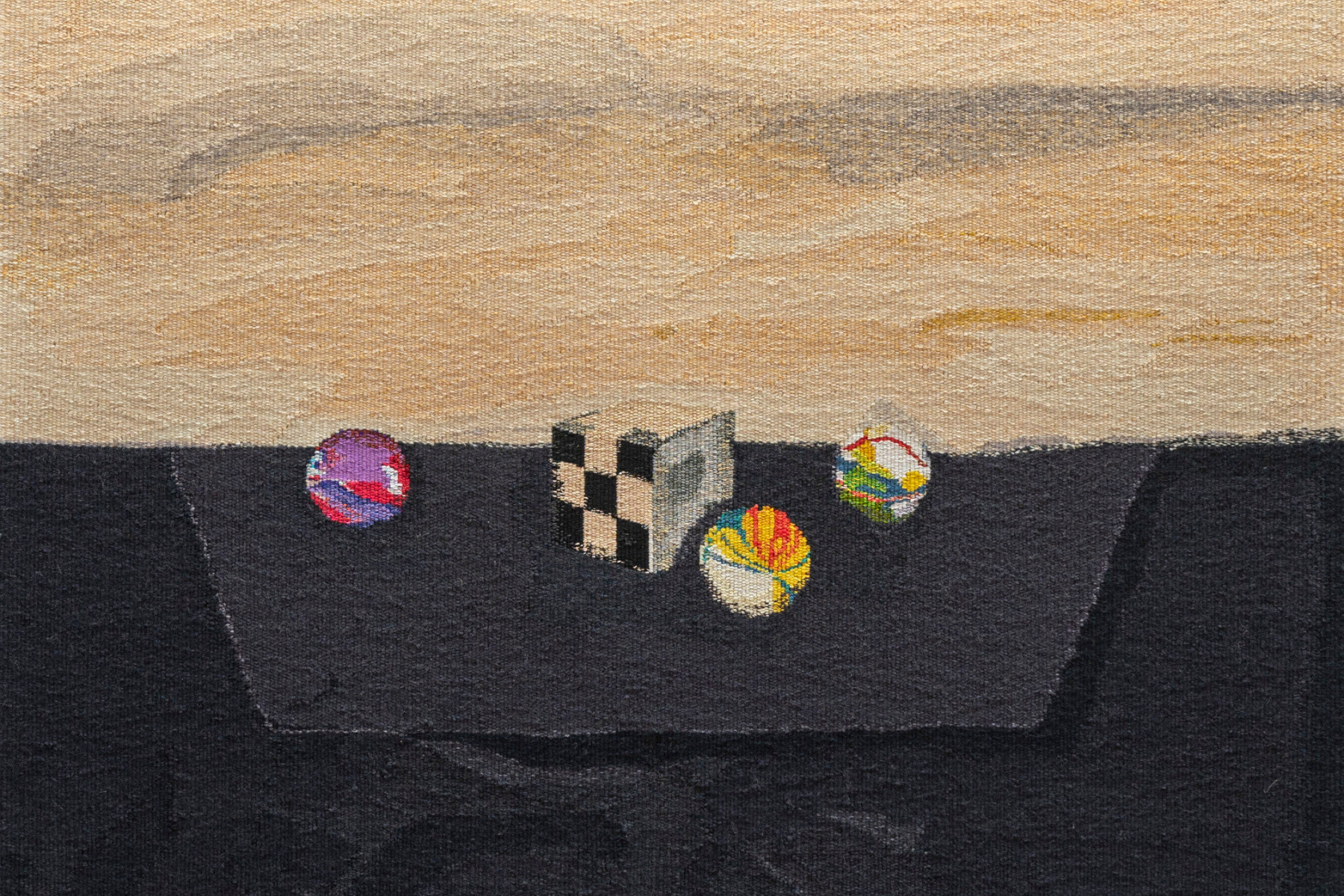
After Elizabeth Blackadder, Still Life with Chequered Box. Tapestry, handwoven wool and cotton. 107 x 107 cm. 2023. Courtesy of Dovecot Studios.
What emerges is Dovecot's interpretation of Blackadder's sensibility in her absence. The bold, commanding grounds, the isolation of objects, the refusal of spatial recession; these principles persist. The tapestries honour her language while acknowledging its own independent voice. They are not her work, but perhaps memories of her boldness and energetic sensibility. They are the studio's conversation with what she left behind.
In 1972, Blackadder was elected as a full member of the Royal Scottish Academy and a full member of the Royal Academy of Arts in 1976. [4] Not only was it rare for an artist to be elected as an Academician at both Academies, but Blackadder was also the first woman Academician to hold membership at both. By 1972, she had been working with serious intent for more than two decades. She had exhibited internationally, taught at Edinburgh College of Art, and established a generative partnership with Dovecot Studios that would ultimately yield more than thirty tapestries.
Blackadder demonstrated that rigorous observation and formal innovation were not opposing forces but complementary aspects of serious artistic inquiry. Her still lifes —whether in paint, thread, or print—revealed that domestic subjects could sustain intellectual depth. Flowers and cats, the materials of everyday life, were worthy of the same formal sophistication demanded by any ambitious artistic practice.
The Dovecot exhibition, presented as part of the RSA's bicentenary celebrations, honours Blackadder’s achievement. But it also asks us to reflect on the institutions themselves, on how long they took to recognise excellence when it arrived in an unexpected form, and on the work that continues, in the studio, in the loom, in the persistent attention to the small, observed world, after institutional recognition finally arrives.
Isabella Nicoletti
Notes
Note 1 - Duncan Macmillan, Elizabeth Blackadder (Aldershot, 1999).
Note 2 - Ibid.
Note 3 – Ibid.
Note 4 - Elizabeth Blackadder was elected as an associate of the Royal Scottish Academy (ARSA) in March 1963. At this time there was a cap of only 36 full Academicians and everyone else was an Associate until a space was made through the loss of an Academician
Acknowledgements
With thanks to the National Galleries of Scotland, the Royal Scottish Academy and the Tate.