
David Cook:
All At Seagreens
John Morrison, a native of the North East Coast, visited David Cook in his studio in Aberdeenshire to explore the symbiotic relationship between artist and environment.
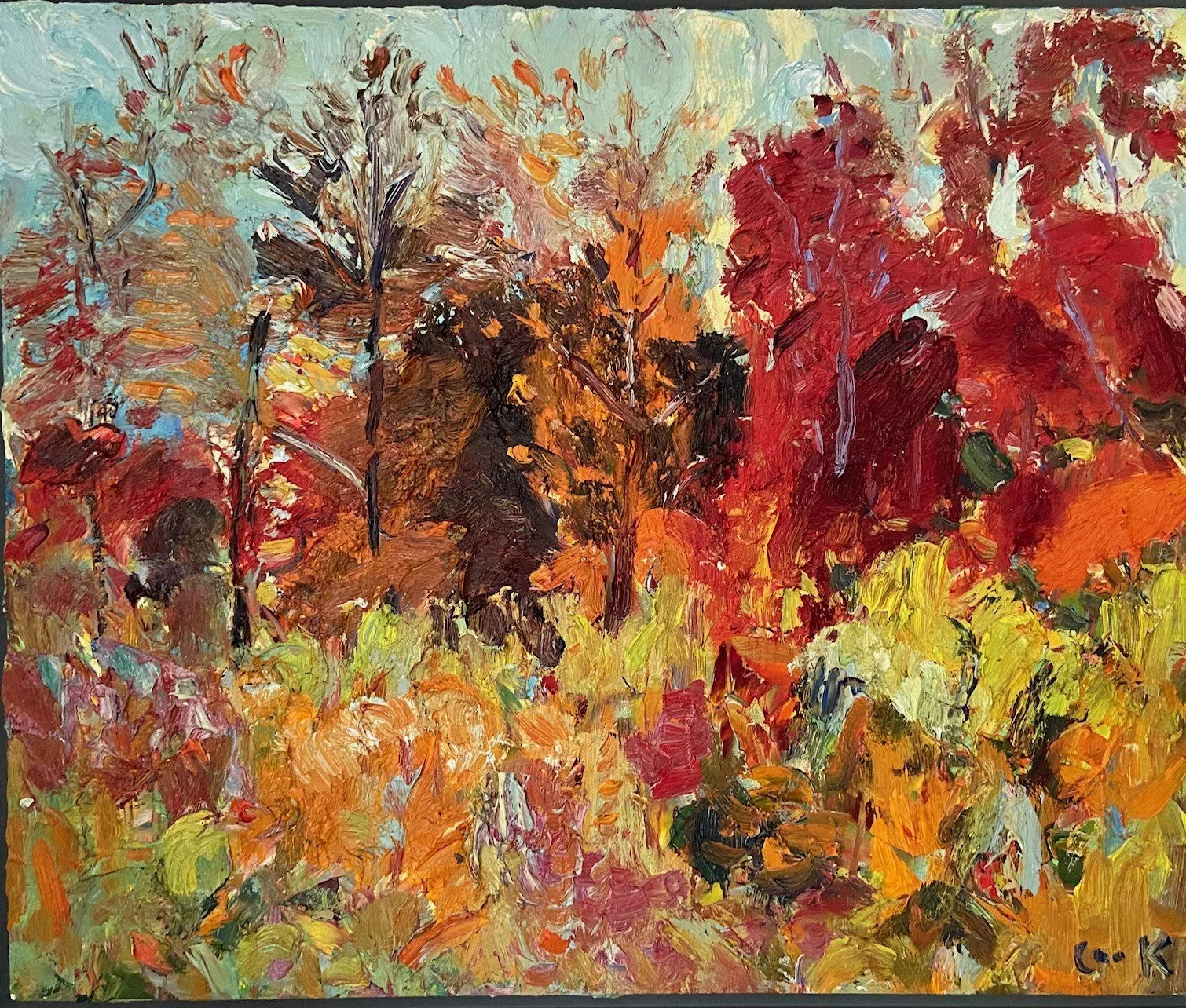
David Cook, Row of Autumn Trees. Oil on board. 57 × 67cm. 2025. Courtesy of The Scottish Gallery, Edinburgh.
Leaving St Cyrus on the A92 heading for Inverbervie and Stonehaven the road is straight and flat. The land is heavily farmed and there are few trees. Roads branch off left, inland, heading over the hill to Laurencekirk and the Howe of the Mearns. Right, towards the sea, small roads and tracks head off towards individual farms. Down one of these, marked only with the name of the farm it serves, one such lane twists round field boundaries and then drops downhill. The narrow road emerges from a blind gully and abruptly stops. Right on the coast, thirty feet short of the rocky shore and 10 feet above it. Looking south along the shore you can see the lighthouse of Scurdie Ness in the distance. To the north is the fishing village of Johnshaven. This is the home and studio of David Cook, one of Scotland’s premier landscape painters.
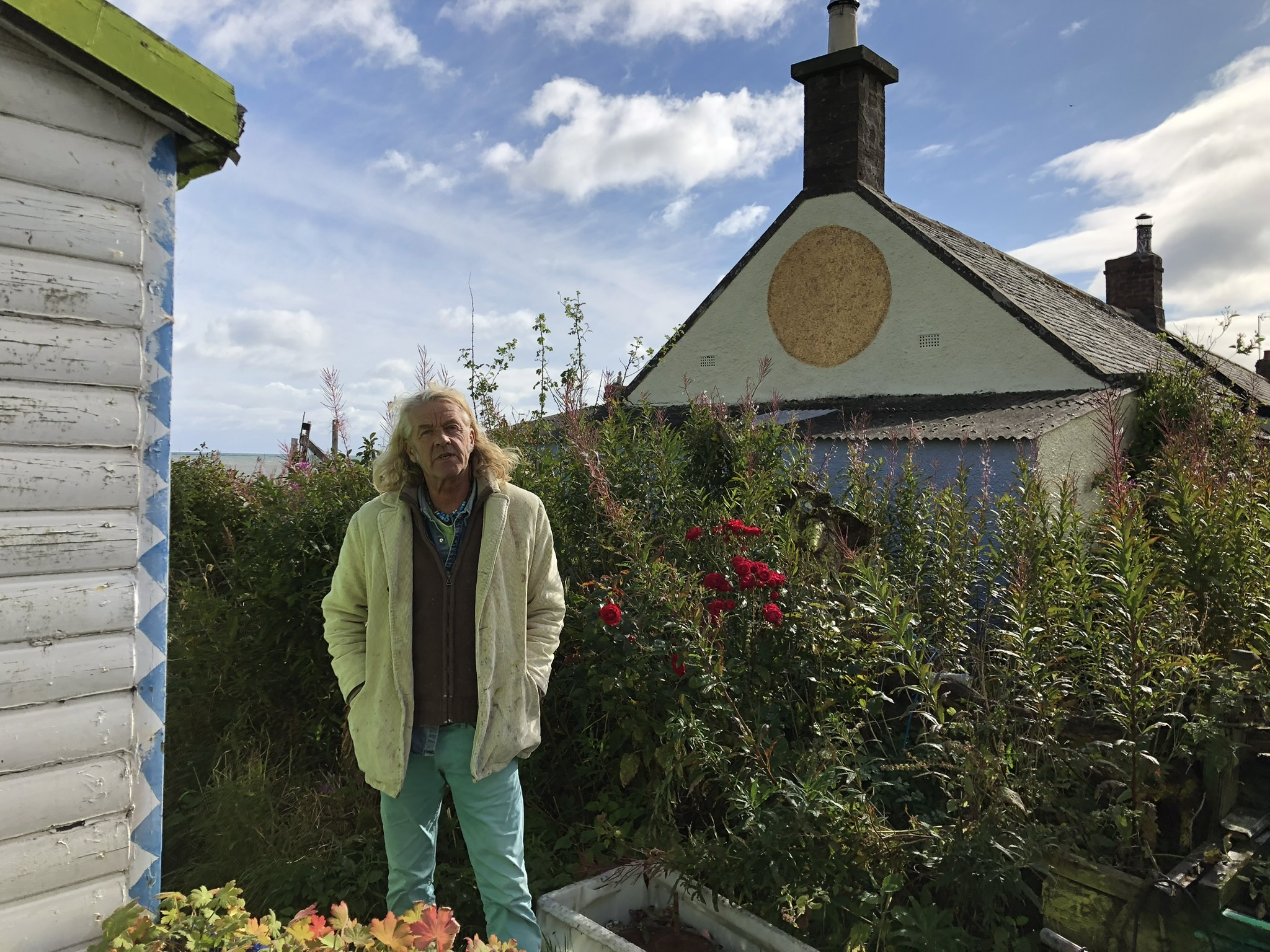
David Cook at Seagreens. Photo courtesy of The Scottish Gallery, Edinburgh.
Born in Dunfermline in 1957, David Cook attended Duncan of Jordanstone College of Art in Dundee from 1979 to 1984, under Alberto Morrocco, David McClure and Grant Clifford. “As a student though you want to rebel against everything” he says, and while the experience of art college was clearly fundamental to his life and practice as a painter, there is no standout influence on him from the tutors. When he talks about painting, it’s Chaim Soutine, Vincent van Gogh, James Ensor and Emile Nolde he mentions; expressive colour painters all. More surprisingly he cites Gustave Courbet and the mid-nineteenth century French Barbizon landscape painters as influential and admired figures. Cook is an artist of the environment. He is unequivocally a painter. Winner of the prestigious Guthrie Award at the Royal Scottish Academy in 1985 and the recipient of multiple Scottish Arts Council travelling awards, he exhibits mainly now at The Fraser Gallery in St Andrews and at The Scottish Gallery in Edinburgh. Having travelled extensively to paint in the past, most notably the Balearics and South Africa, he now paints the world that surrounds his home right on the north-sea coast just north of St Cyrus in Kincardine. He paints the landscape around him, his wild garden and the sea that breaks directly at the bottom that garden.
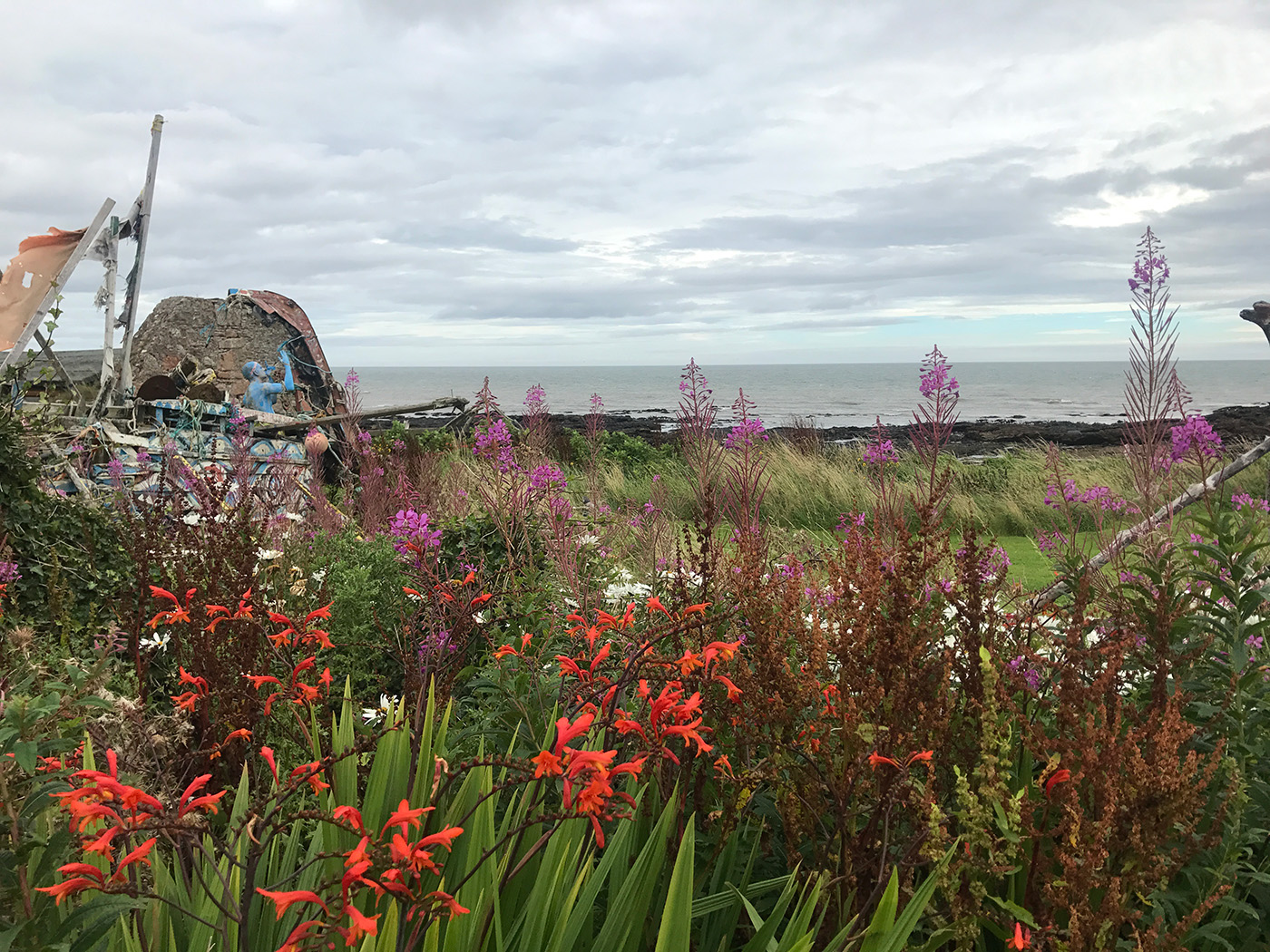
David Cook’s Garden at Seagreens. Photo courtesy of The Scottish Gallery, Edinburgh.
Cook’s paintings, though all individual, are frequently developed as suites of works, each mounted on the studio wall before the next is begun, the thought playing out, surging and retreating, evolving, as one painting feeds into the next and the next.
They are either painted entirely outside in front of the subject, begun outside and elaborated in the studio or painted entirely in the studio. The total immersion in the world of the paintings, the garden of his home and the surrounding land and sea scape produces work of great emotional power and intensity. Those painted away from the motif do not suffer at all from the absence of immediate visual stimuli. They are different though. He describes the works painted outside as “reacting to what’s in front” of him. Those created in the studio or worked on further after a period outside in the studio are “more cerebral”. This refers to the feedback from the painting – the artist considering now, not the subject but the object. The painting is considered in its own right and adjusted, amended, developed in relation to what it needs.
This opens the question of the significance of the subject at all. Cook has described the subject matter in his paintings as a scaffold on which to hang internal thought processes and emotions. It is far from irrelevant though. The totality of the painter’s environment, rather than simply the day’s chosen motif, is central to the process and the outcome. The weather, the sounds and sights all around directly feed the paintings, and without them there is no work. Frequently while painting in the studio, itself embedded in the garden, Cook breaks off from the canvas to walk in the garden, or out into the landscape or beach, the contact with the central stimuli feeding the next engagement with the painting.
The paintings are on canvas, or more recently on linen, primed with four coats of a white acrylic ground. They begin with a broadly painted colour gesturally painted onto the surface with well thinned paint and a broad brush. From that wholly abstract beginning something often emerges for the painter, an idea, a starting point and the painting proceeds from there. The early work applies the paint with brushes but relatively swiftly moves on to the application of thicker paint applied with a knife. The paint is worked and reworked with elements which are felt to be unsuccessful scraped out. The advice Glasgow painter William York Macgregor offered to artists undertaking work under his direction was “hack out the subject as you would were you using an axe, and try to realise it; get its bigness”. That seems apposite here. Cook’s surfaces are dramatic, often pulled and torn, violently gestural, revealing their hard-won form.
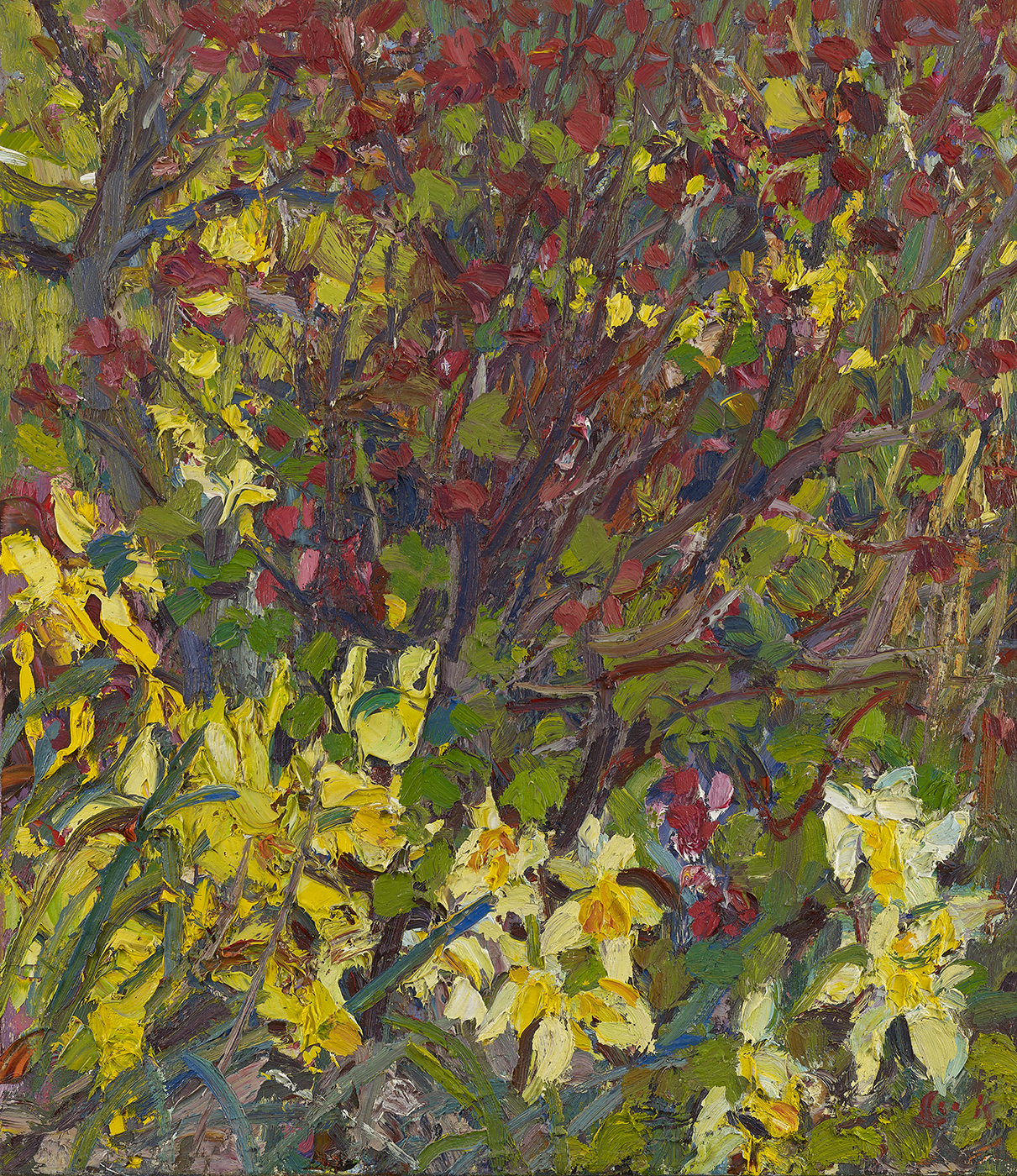
Despite the presence of realist elements, Cook’s gestural painterly instincts permeate everything, invoking a deeper, more introspective reflection beyond simple visual representation. This untitled work painted in April 2020 and exhibited as Catalogue Number 25 in his Earth Shaker exhibition at the Scottish Gallery in March the following year, has clearly identifiable plants.
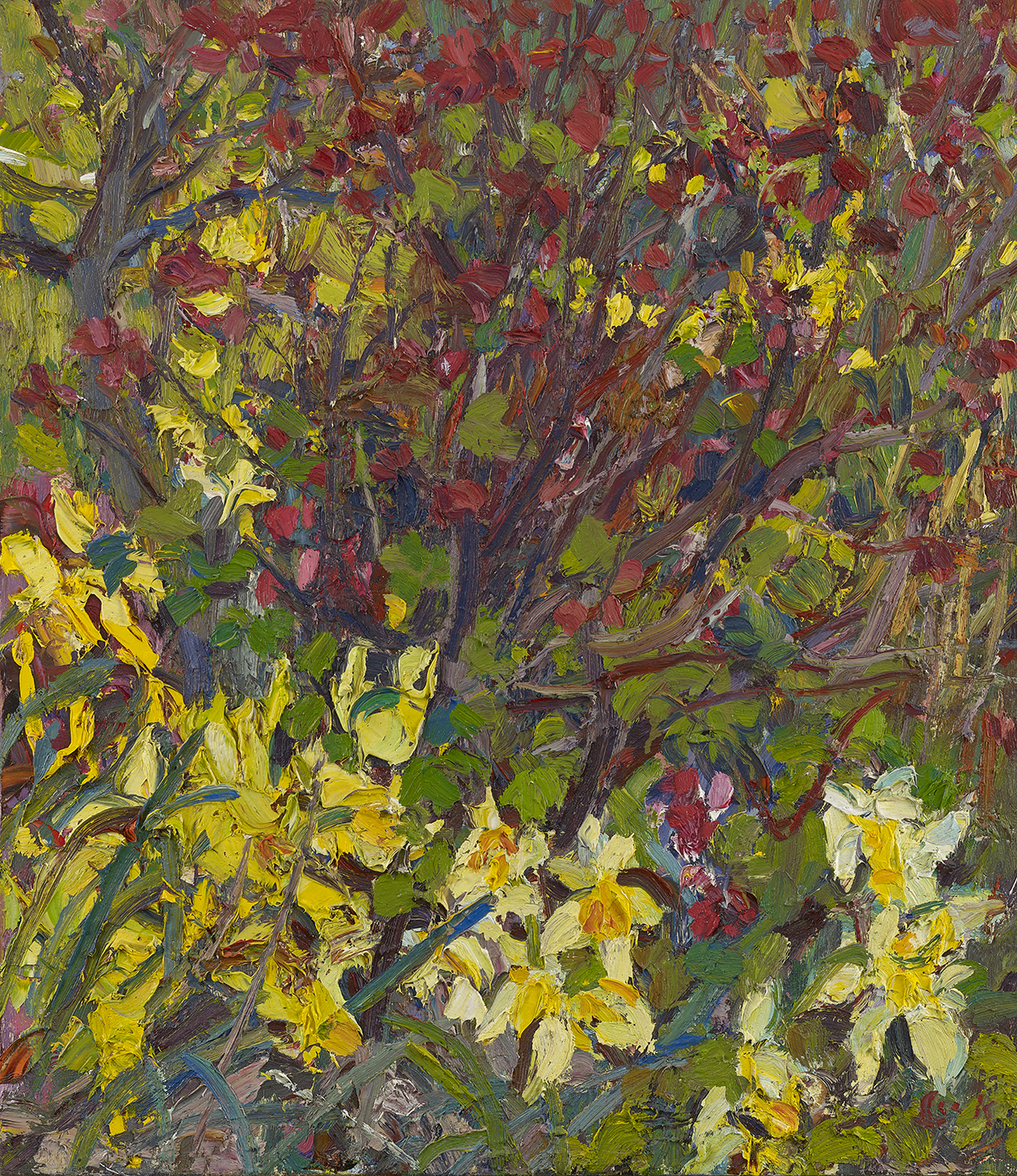
David Cook, Untitled (Earth Shaker Exhibition Catalogue 25, 23.4.20). Oil on canvas. 90.5 × 80cm. Courtesy of The Scottish Gallery, Edinburgh.
There are daffodils in the foreground and an abundance of grasses and leaves crowding the surface. In the middle of a tapestry of bursting life, a deep magenta bough occupies the mid-line of the composition, its more solid form juxtaposed against the brighter elements that surround it. The flowers, leaves and stems seem to spill out in an almost dreamlike profusion, indicative of the desire to convey not just the physical world, but the emotional and spiritual resonance it has evoked in the painter. The heavy paint stresses the surface of the canvas, limiting access to any space. It has been suggested that the painting and others of this period have a claustrophobic sense perhaps linked to the unprecedented “lockdown” and restriction of movement imposed during the Covid pandemic. In truth similar indications of space and denial of space occur across Cook’s recent painting. The struggle between the painting as illusion and as autonomous object is at the heart of his work. A critic credited Soutine with the power to translate life into paint and simultaneously paint into life. The same can be said here. There is a mastery of the physical properties of paint and its polar opposite characteristics. It is infinitely malleable and simultaneously aggressively assertive. The struggle to paint, to ‘get it to work’, in the painter's phrase, as both carrier of subject and bearer of independent emotional meaning, is everywhere present. The canvases are vibrant and unsettling, uninhibited and controlled. There is a powerful and intimate attachment to the subject but a strong indication that if all you see here are flowers, waves and landscapes then you have missed the point. The visceral energy ultimately is a conveyor of deep psychological insight hewn from the raw essence of his surroundings.
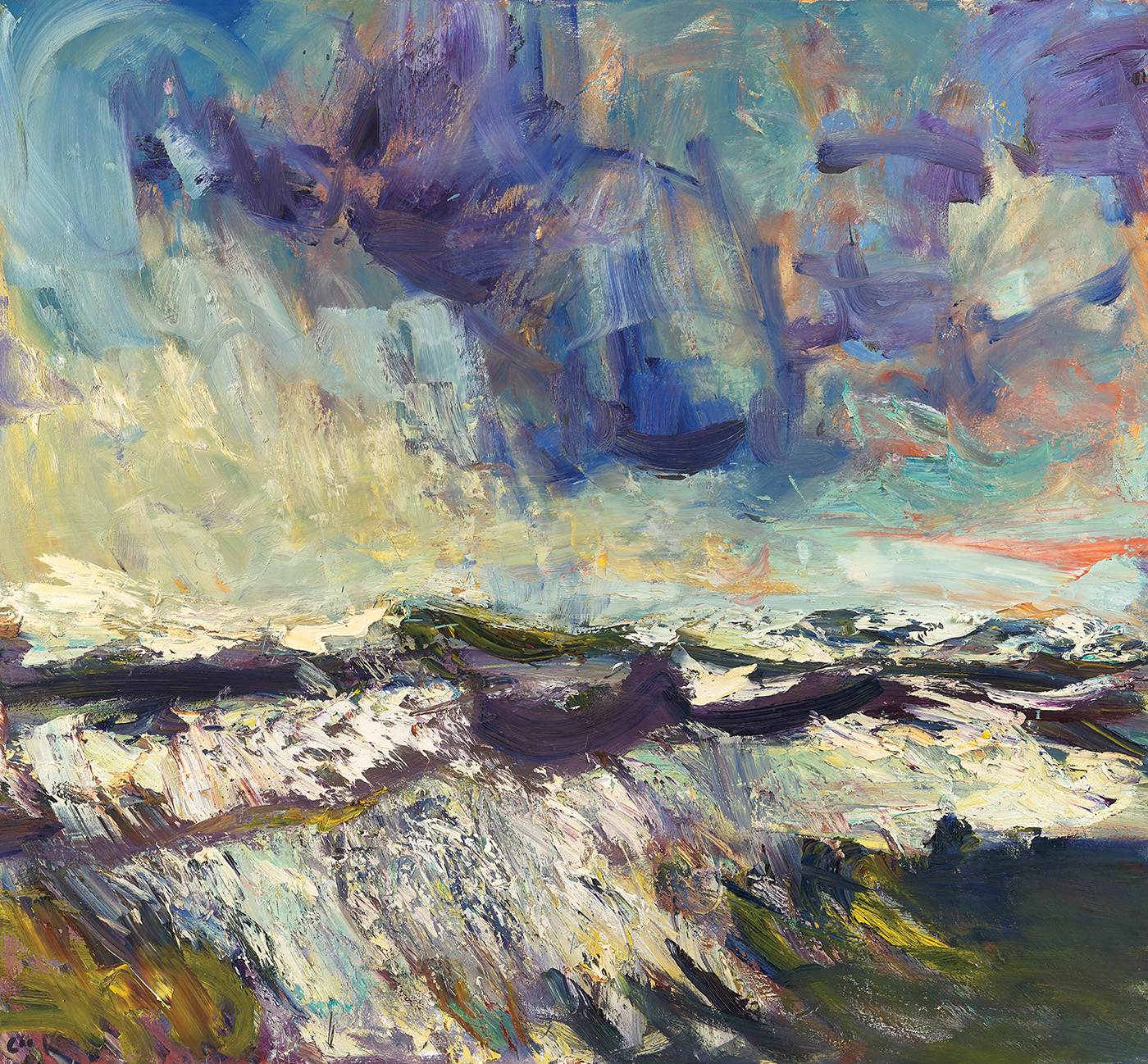
David Cook, The Sea XXVII. Oil on canvas. 120.5 × 130.5cm. 2023. Courtesy of The Scottish Gallery, Edinburgh.
In the winter, Cook paints the sea. The physical and internal emotional struggle emerges very clearly in the turbulent paintings of winter storms. The immediate temptation for any hook on which to hang a discussion of such paintings in Scotland is Joan Eardley. After all, she painted less than 15 miles away in Catterline. There is not a great deal of her presence here though. The paint surface is looser, the paintings less anchored to the world, the concern less overtly human. Commonly in Eardley’s coastal works there are cottages clinging to the hillside, a jetty for the sea to break against, a high angle viewpoint stressing the viewer looks from the land to the sea [1].
There are paintings simply of the sea but they are unusual. Equally, in Cook’s painting, while there are earlier paintings with elements of rocky shore there is no hint of a metaphor encouraging a human-centred narrative. If a synchronicity with other painters is sought then the better comparison is with William McTaggart, most particularly in those paintings free of human figures and foreground land. Those pictures painted after 1890, such as Mist and Rain Machrihanish of 1907 at the McLean Museum in Greenock for example [2], or All the Choral Waters Sang from five years previously and now in the Orchar Collection in Dundee Art Galleries are cases in point.
Both are quieter than Cook’s painting, particularly the Dundee painting, but the same sense that the artist’s own psyche is the driving force behind the work is present. The McTaggarts may be less overtly violent than the contemporary works but just as it would be a mistake to read Cook’s garden paintings as joyful pictures of pretty bright flowers, so too McTaggart’s sunlit sea paintings offer far more than a recollection of a pleasant breezy day at the beach. In both McTaggart paintings, as in Cook’s works, the spectator hangs uncomfortably over the water, unanchored to land and facing a shifting, unstable ocean. The need to impose that instability on his viewer led McTaggart to increase the width of the later painting by attaching strips of canvas to both edges, stretching the area his viewer has to scan and still find no place to stand.
Cook’s viewer hangs mid-ocean, no hint to land, and the heaving sea offers no stability. The sky, a violent, scumbled mass of colour and gesture, promises no respite. This is deeply unsettling painting.
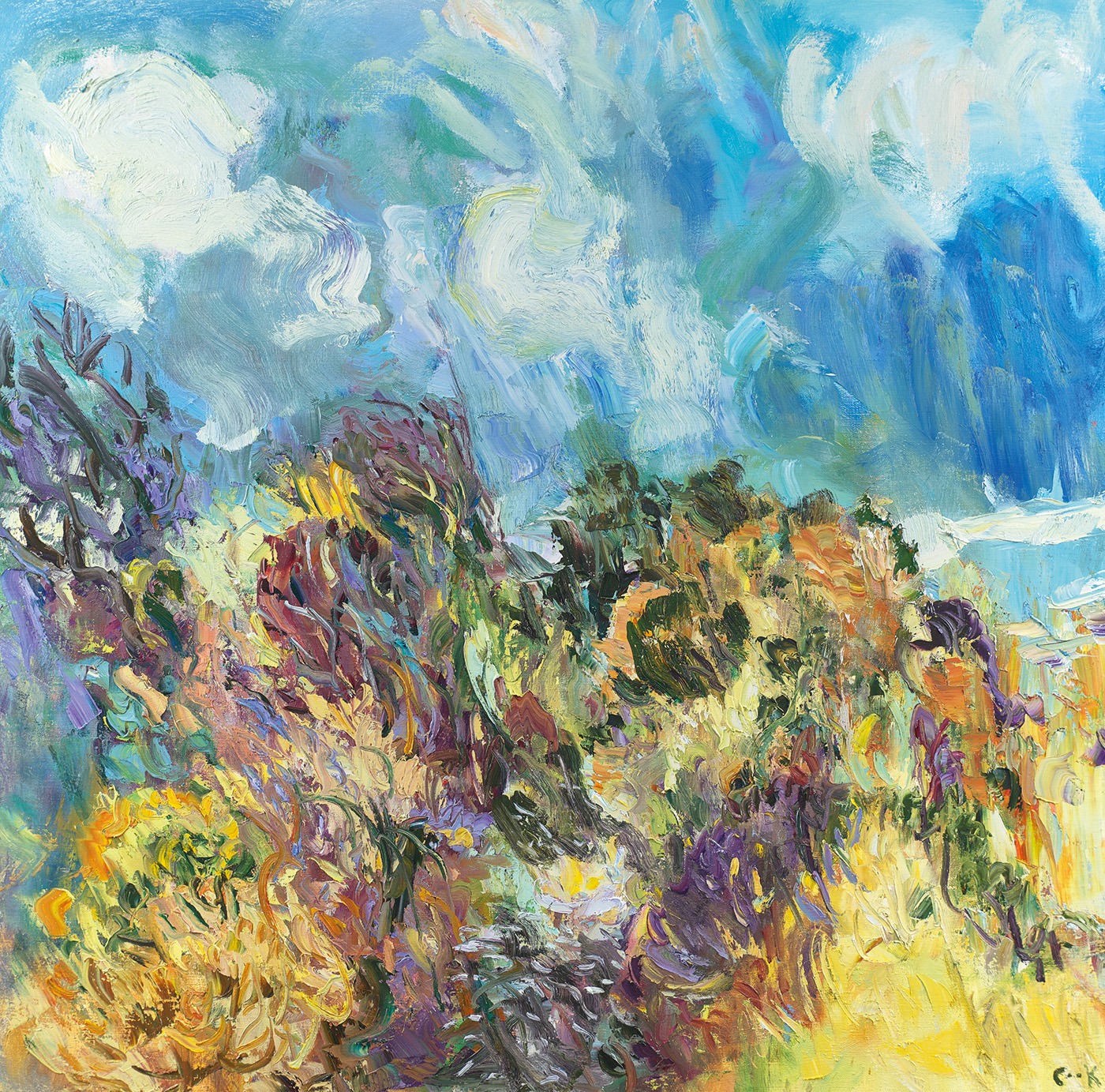
David Cook, Embankment at Seagreens. Oil on linen. 120 × 120cm. Date unknown. Courtesy of The Scottish Gallery, Edinburgh.
In spring and summer, landscapes and garden subjects predominate. The land takes on an extraordinary appearance in these paintings. Plants and land forms bend and twist as if warped by the sheer intensity of the artist’s experience. An extreme version, if you will, of Emile Zola’s dictum that paintings of the natural world are always “a corner of nature seen through a temperament”. Objective reality is filtered through the subjective vision of the artist’s psychological make up. Paint is made to bear the weight of the communication of that vision. Verbal cues are kept to a bare minimum, or omitted entirely. Paintings may be given no identifying title at all and simply left with a number designating their place in the catalogue of the exhibition in which they appear. The implication being that should they appear in a different context the title would likewise differ. If a title is given it is utterly prosaic – Sea XXV11; Line of Trees; Row of Autumn Trees – a simple descriptor of the artist’s starting place.
There have been suggestions that what Cook is painting is a celebration of the glories of the world, a sort of twenty-first century take on the horn of plenty. This misses the point. The world is not there to give humanity its fruits. Cook’s world was not given to human beings to have domain over, revel in and exploit. Rather it is a mirror in which to examine oneself, whatever that may reveal.
John Morrison
Notes:
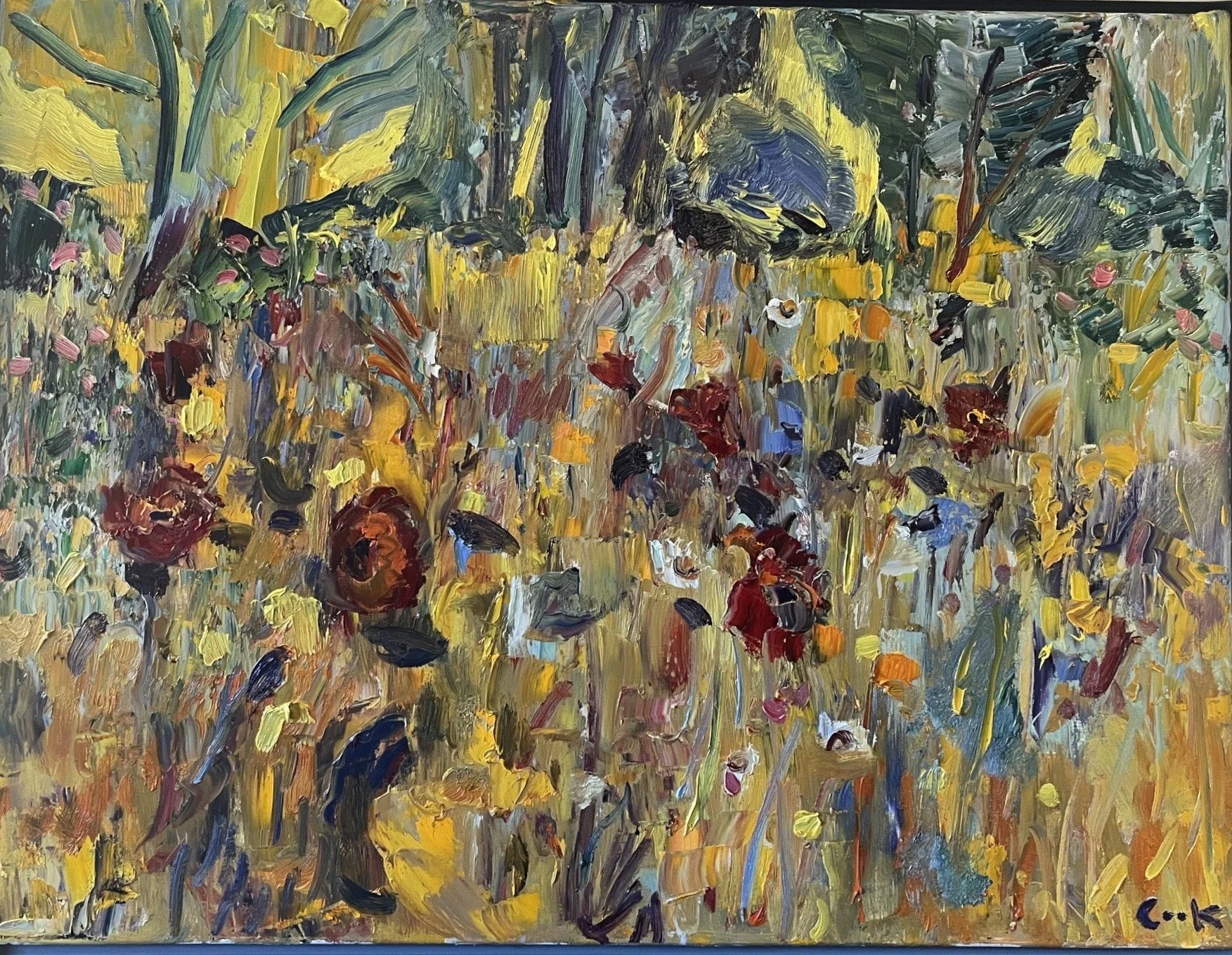
David Cook, Line of Trees. Oil on linen. 76 × 102cm. 2025. Courtesy of The Scottish Gallery, Edinburgh.