
Colin R. Greenslade: Director’s Take
Colin R Greenslade is the first-ever Director of the Royal Scottish Academy. As the Academy’s strategic lead, he manages the staff, the collections, the business development and the awards and residency programmes of Scotland’s national art academy. In 2026, the RSA celebrates its bicentenary with a remarkably ambitious birthday celebration. RSA200: Celebrating Together stands up as the biggest-ever celebration of Scottish art, and Colin’s the man at the helm.
Since his arrival at the RSA in 2003, Colin has written and lectured extensively, served on myriad boards, and presided over all manner of exhibitions and events. He is the curator of a frankly staggering number of national and international shows, embracing artists whose names – Bellany, Blackadder, Byrne, et al – read like a who’s who in Scottish art. And more often than not, the names of some of the biggest and best in the business have a place on Colin’s Christmas card list.
It’s hardly surprising for an arts professional of his standing, but it also speaks volumes about his artist-driven approach. Throughout his 35 year career, Colin’s focus has largely been on the artists themselves, their work and their legacies. Much of his professional life has been devoted to working within and alongside artist collectives. Today, he’s a trusted friend and confidant of many fine, famous artists, here in Scotland and further afield; his closely-guarded Moleskine journal heavy with anecdotal evidence of relationships well-nurtured, and surely worth its weight in gold to any archive.
Colin’s contact book has been pulling its weight in the run-up to the RSA’s bicentenary. But this year, the RSA has given much of the vision for its celebrations to other venues, far and wide. In engaging with cultural partners from public galleries to private collections all across the country, the RSA have prompted a dynamic national celebration which is as engaging for art lovers in Lerwick on Shetland and Tobermory on the Isle of Mull as it is for those in the heart of Edinburgh. The Academy’s doors have been flung wide open.
The RSA has been at the core of a huge network of exhibitions which have popped up all across the country. Wide-ranging partners, big and small, have answered the call to reflect on the RSA’s birthday. The Hunterian, the Lillie and the Maclaurin, for instance, have shown excellent mixed exhibitions of collection work by Academicians. Venues like the Arthur Watson and Fergus Purdie Architects’ Window Gallery in Perth take a more inventive approach, perhaps: throughout January, they showed images of Marina Abramović’s first performance of Rhythm 10 made outside of former Yugoslavia, hosted by Honorary Academician Richard Demarco in 1973. And the celebrations extend beyond Scotland too: the work of Wilhelmina Barns-Graham hangs in a special presentation over 600 miles from the Fifer’s birthplace in St Andrews, with Tate St Ives standing up as another partner venue.
RSA200 might be overwhelming for its scale and scope, if it weren’t for the surprising interconnectivity which binds even the most unexpected exhibitions and events together, and of course for the RSA’s position at the core. It shows the RSA as ambitious, engaging and entirely modern: a far cry indeed from the rather stuffy, stagnant reputation to which it had been subject in the past.
It’s an enormous undertaking, and Colin thrives in the busyness. By his own admission, he can never sit still. He makes prints, pots and recently returned to the bench as a jeweller: he’s a silversmith with his own hallmark, who trained at Gray’s in Aberdeen in the 90s. He’s an avid collector of Scottish art, with one eye firmly planted on auction websites at any given time. He’s also a hobbyist dealer of twentieth century design. And his daily priorities coincide with the start and the end of the school day, as he picks-up and drops-off the younger of his two kids, before and after taking his place in the RSA.
In July 2026, Douglas Erskine sat down with the busiest man in Scotland. Their conversation covered Colin’s life in art, the people and places he counts as his influences, the journey towards RSA200 and the importance of what comes next.
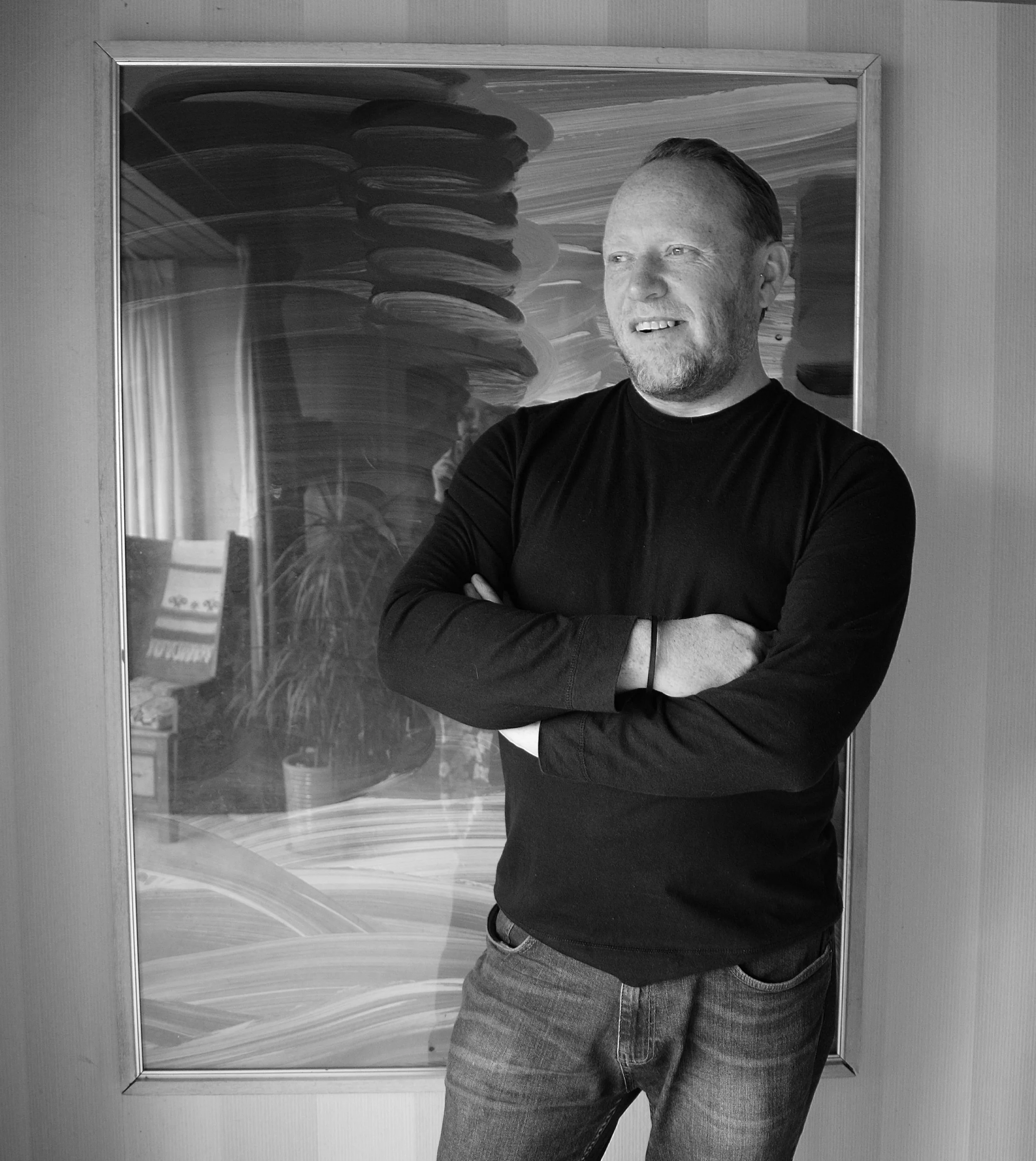
Colin R Greenslade, 2026, a painting by Alexander Fraser behind him. Photograph by Susan Bradford.
We’re halfway through the RSA’s bicentenary year now, Colin. I know it’s been a long time coming… How have this year’s celebrations been going? Has all the preparation paid off?
It’s felt like it has been going very smoothly. We had years of preparation in place. But the beauty of our project is that we didn't really know how things would run, because we gave the curatorial vision to other people.
Way back in 2017, we were building the Ages of Wonder exhibition at the RSA, which focussed on the RSA’s collection, the National Galleries’ collection and the connectivity between the two. It was a great show, but I did think, “this mustn’t steal the thunder from year 200”. But by doing that Collections show then, it meant it was done and dusted. We couldn't go back. We had to look forward. We had to ask ourselves questions like “what are we doing to put ourselves on the map, to make sure we’re relevant to everyone?”
Some time ago, I was at an online event for administrators, run by Museums Galleries Scotland, and each of us were asked to speak about a challenge we faced and how we were going to get over it. I said, “well, this is something I’m working towards… We’re trying to make plans for our bicentenary in 2026…” And someone said that any birthday, or anniversary, is all about one person. That person’s excited, but nobody else really cares. That was really good for me to hear, if only because it made me think “I’ll show you…!” It made me want to open things up. So this year, it is relevant to more people nationally, because RSA200 is not just about the Academy. It’s about other collections and programmes.
Ages of Wonder was an exhausting project. I can’t remember why now, because this has been so much bigger! But I remember I was bathing my son, who was maybe two years old at the time, and I was thinking “what do we do now? How are we going to fund a big thing in 2026?” And I just had this eureka moment - in the bath, as you’d imagine! I was kneeling on the floor, trying to hold my son in the bath, and I thought “every public collection in Scotland has Academicians’ work on their walls… How do we engage that?” It was a lightbulb moment.
We came out of a really difficult period, as everybody did, after the pandemic. We'd been planning year 200 for a long time, and then everything changed. Some things for the better and some things were concerning. The funding, for instance, changed, and so we had to reassess the project we were running. That was really great opportunity which made us ask “how do we be fully representative of Academicians over 200 years without being inward-looking with regards to our own programme and collections? How do we let people understand how Academicians have engaged with a wider geography of Scotland over that period? And also, how do we assist to connect people with the public collections across Scotland that hold work by Academicians, so that visitors don’t have to come to Edinburgh if they want to see work by these artists?”
So we wanted to stress that Academicians are in these widely and easily accessible locations, whether the collections are civic, institutional, hospital-based, or even private. Our team worked really hard to encourage different collections all across Scotland to engage. Their participation could be extensive curatorially, or they could borrow work from us, or their involvement in RSA200 could simply be about reannotating the labels of the Academicians’ works which were already on the walls. Everyone’s busy after all, so things could be in-depth or hands-off. Being flexible and understanding of how collections teams work helped with the range and constraints of the programme and its expectations.
We wanted to have some sort of evaluation system in place with all of the 120-plus partners we’re working with. At the end of the year, we’ll have a good idea as to what’s been happening all around the country. At the moment, the first 15 evaluations have come back to us and visitor figures are in excess of 250,000, just on those 15 venues alone. On top of this, there have been events like films and drawing classes that have been engaging people, which is great. In Dunfermline, where I live, we're supporting a project with the City Heritage Group which looks at the history of Dunfermline from an architectural point of view, which is great because it involves school kids who are working towards an exhibition at the end of the project. It’s really good. It's got arms and legs.
Within our own programme in the galleries here in Edinburgh, we've got so much going on. Some things are part of our annually-recurring programme, like our New Contemporaries exhibition. But a mix of things keeps it all fresh. We’re looking forward to new practice on one hand, but we’re also looking back with shows like Origin Stories, which took place in the Lower Galleries in January and February. We’re trying to look at where the Academy is now. How did we get here? Where are we going from here? How do we build upon the amazing links that we're making this year?
It’s a refreshingly open, flexible approach to take. Giving so much of the curatorial vision to other people also sounds like quite a bold move at such an important moment. It makes me think that this year must have been rich in the element of surprise.
I think one of things that has made such a big difference this year has been the surprise inter-connectivity between some of the projects. Also, the volume of research that different public collections have been doing for the benefit of their own collections, prompted by RSA200. The knock-on effect of people researching the works in their collections is that it enriches our holdings here at the RSA, and enriches the whole story of Scottish art.
Before RSA200, we couldn't have believed the amount of work that would be going on. Take the hospitals project, for example. The hospitals had never sat down to discuss their collections as a unified group before. Through the RSA200 project, we now have touring exhibitions of the work in their collections and they've now developed a platform to speak to one another and collaborate further.
It’s one of many exciting developments this year. It’s no surprise: it is, after all, a big moment. It’s striking to note that we’re in the midst of the biggest-ever celebration of Scottish art.
Yes, it is. I've been part of previous celebrations of Scottish art, like the exhibition Here and Now: Scottish Art 1990-2001, which was the final show from the series Scottish Art Since 1945, and GENERATION for the 2014 Commonwealth Games. In 2014, we showed work from our New Contemporaries show, which resulted in us being the oldest institution showing the newest art. That was about saying “well, you may think that you know what to expect from us … but this is what we’re actually going to do!”
So when I was thinking about the RSA200 project, I thought it had to involve contemporary work, and it also had to relate to the culture of Scotland much more broadly, to our artists and our interconnectivity. It had to concern our culture centres and the artists in them, and in their hinterlands, in a way that no-one’s done before. It’s quite magnanimous as well, because the partner collections really see it as an opportunity to find out more about their own collections. It’s an opportunity for them to further research and contextualise the work they hold and marry that up with projects that are going on in other parts of Scotland this year.
So RSA200 is a fantastic catalyst for these connections. It’s not about RSA200 being a tsunami. When this year’s over, we want to keep that interconnectivity, that dialogue, going. We want to keep those relationships moving forward.
As the man at the helm of the biggest-ever celebration of Scottish art, I wonder if you’re any closer than the rest of us to defining Scottish art, in the year 2026?
I don't think it can be defined. I think if it's definable then we’re in a sad state of stasis, aren’t we? If you say on record “this is what Scottish art is”, then it’s obsolete immediately because there's always something else just around the corner. I think the beauty of culture in Scotland is that it is so rich. We see the richness in art, music, all types of cultural activity. We can see some of the interconnectivity in people like John Byrne, a figure who you felt could just do everything.
It's a discussion about what's gone before and what can be achieved going forward. We have amazing artists here, and it's a relatively small pool of creatives. We still have a sector where we’ve got people who are masters, people the next generation are looking up to, and the younger artists who are taking that discussion forward. Origin Stories explored that in much more depth. There, we saw the huge interconnectivity within and between art schools. And that was just a tiny slice of the cake, since there were so many more artists we could have involved in that discussion.
There's the collegiate nature of things, where people know other people, they enjoy their work, they talk to other people about their work, and they get excited. The artists collectives in Scotland are very strong. The workshop networks are strong. They’re collaborative. Rather than defining Scottish art, maybe that helps to shed light on the collegiate nature of Scottish practice. It helps it to flourish. For example, what Sam Ainsley, David Harding and the artists involved in their Environmental Art course were doing in Glasgow is all part of that discussion. It's about encouraging a supportive network in which artists can flourish.
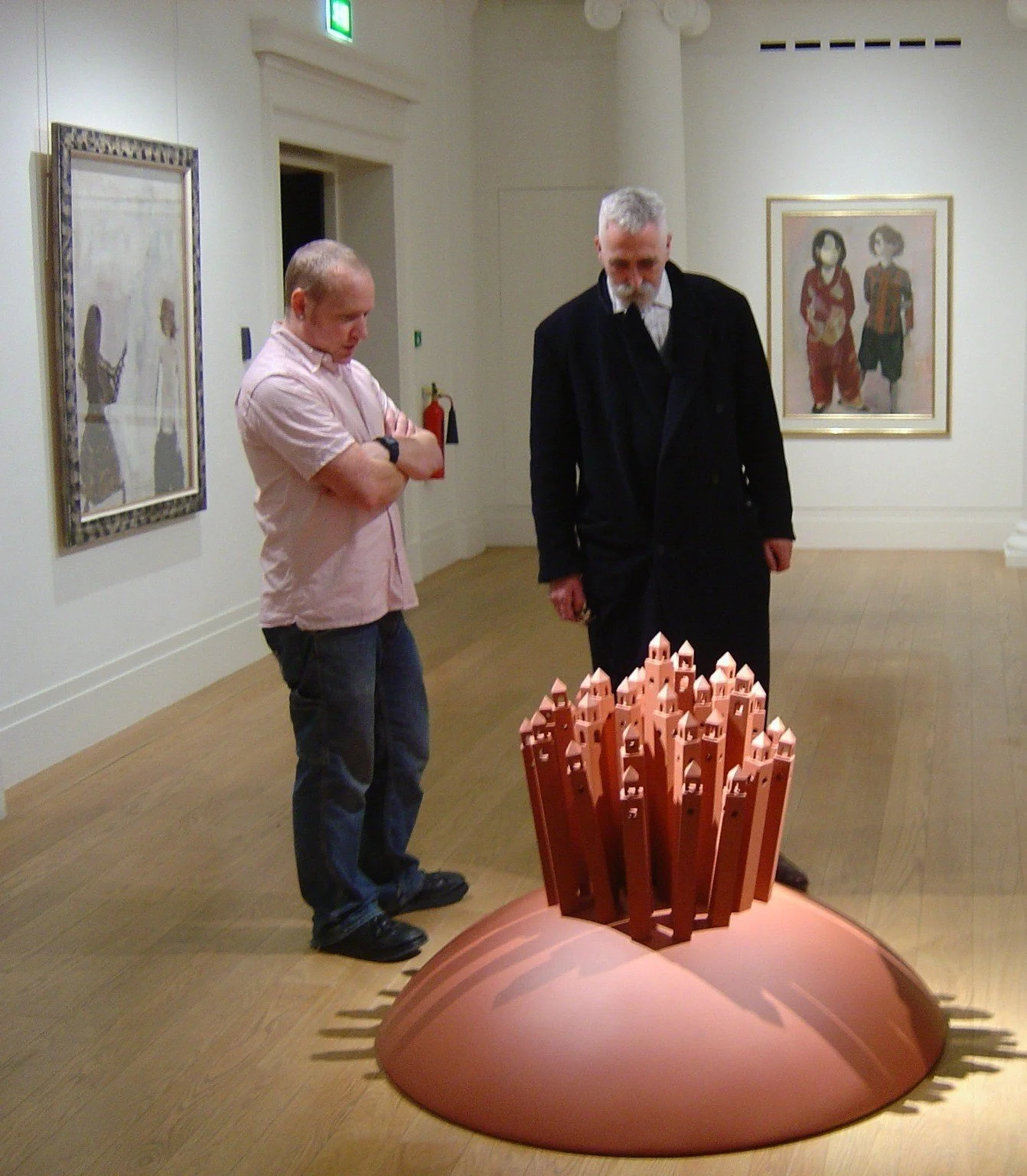
CRG with John Byrne, 2004. Photograph by Alisa Lindsay.
I have the sense you’re well-acquainted with that sort of network yourself. You are after all an active maker, invested in your field, and you trained at art school with other creatives long before your time at the RSA. When you consider all this, what has it given you that affects your role today?
Well, I've always wanted to do something. I can't sit still. I can't just go “there’s nothing for me to do today… I might go and sit in the garden”. I never had any aspirations to be a painter or a fine artist. But I do make prints, I used to make pottery. I studied Jewellery at Gray’s in Aberdeen under Gordon Burnett, leaving in 1991. Someone encouraged me to go back to the bench fairly recently and I realised I’d missed that work all my life, so I reestablished a hallmark, and I haven’t looked back. I work with silver, sometimes with gold. Sometimes, stone-setting. I’ve made people’s wedding rings and all sorts.
Understanding the practice, understanding the creative journey, is all-important. It's not a case of being divorced or separated in any way from the research, the development, the mistakes, the editing of practice. It’s about realising that for an artist, all of that is heading towards one thing. So in enabling awards for artists, you know that they're not going to take the cash and just do nothing with it. You know that artists are driven to make work. You know that that new practice will happen, you just need to assist in the nurturing.
Take us back to the start of your professional life, when you left Gray’s and went to work at Peacock Printmakers in Aberdeen. What are your memories of that time and place? A happy time?
Effectively, I went straight from Gray’s to Peacock. That was my first job. I learned. I've always been hungry to learn. So I rolled up my sleeves and said “yeah, I can do that”. And even if I couldn’t do it, I just got on with it. I was working on reception to start with, on the front desk, making sales, and soon I was working with exhibitions. I did the classes and I learned how to make prints.
When Arthur Watson, a founding member of the workshop, diminished his hours, I was taken forward to work in a role to do with the exhibition programme. The Arts Council grant was quite small and we had to bring in the money. I was working with lots of businesses. Even after many years, I continued working with lots of those businesses, helping to develop their art collections, review them, catalogue them. A lot of the companies were oil-related, and they had funds to allow them to “give back” to the community. One way to do that was to invest in local talent. Through these meetings and discussions I met so many amazing artists, and it became a hotbed of learning for me.
I was really interested in what young artists were doing in Aberdeen, as well as across Scotland. I was looking at what they were producing and thinking about their work in a wider context. We used to lose a lot of artists to the bright lights of Edinburgh and Glasgow and I felt that in order for culture in Aberdeen to be more vibrant, we needed to have opportunities for artists to stay. There were great examples of people who had massive careers in Aberdeen, but it felt like change was needed, and Peacock could be a catalyst. So Peacock went through a whole range of changes to engage with a wider group of makers. There was a digital suite, a photography dark room, printmaking studios. We took advantage of a massive opportunity to make sales. Also, to show internationally. In Aberdeen, we had great international connections through the oil. People from all over the world would come into the workshop and make offers to us such as “I would love for you to show in Austin, Texas!” And we’d seldom say no.
It was a great atmosphere at Peacock. The team was really small and tightly bonded and we just had fun. We’d go out drinking together, we’d do karaoke together… It was a really great time in Scotland, as well. There was lots happening in the 90s. A lot of change afoot. So with all of that excitement going on, I felt that I could help to reinvigorate what the Academy was doing. I have to say, though, a friend of mine told me “that's the end of your career, mate… That will be the death of you!” They saw the Academy as a stuffy old boy’s drinking club.
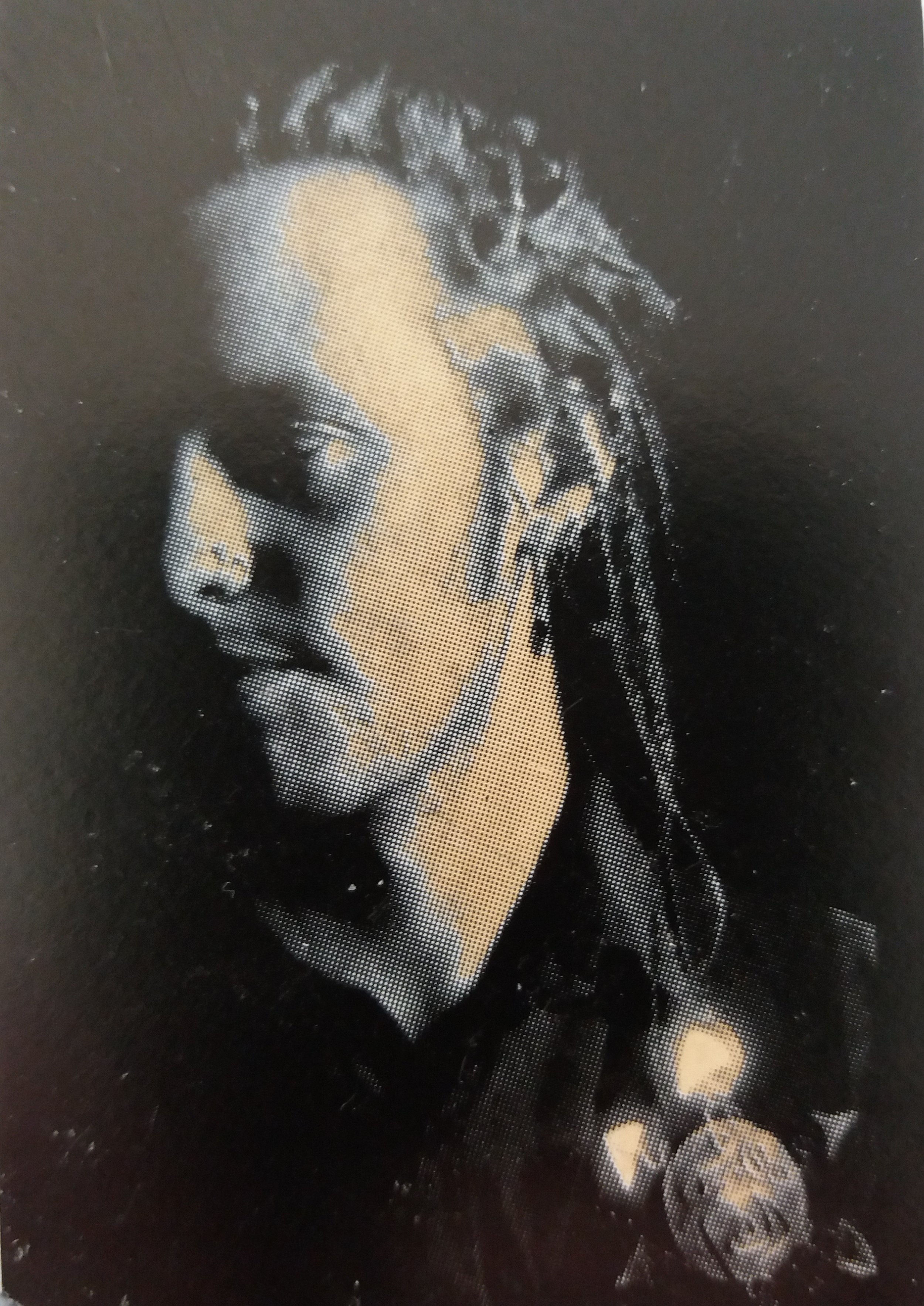
CRG, 1990s. Photograph by Stuart Johnstone.
Did you sense a serious challenge, moving into this old Edinburgh institution you’d been warned against?
I moved city in my early 30s, just out of a long-term relationship, and my whole friend network was in Aberdeen. I knew people, artists, gallerists in Glasgow and Edinburgh. I knew a lot of people. But my entire comfort zone was thrown to the wolves! I had to start again. When I came to the Academy as Exhibition Coordinator, it was a point where I just thought: “bull by the horns! Let's do it! I have to make it, I have to do it…” In those early days at the Academy, someone might say “have you thought about doing this…?” And I’d just say, “no, but now I cannae think of anything else!” It was an exciting time.
At Peacock, I’d go to an art fair and I’d put new graduates’ work on the wall along with established artists such as Ian McKenzie Smith and Frances Walker. They’d all sell. It didn't do those established names any harm to be seen alongside new graduates who were making really interesting, challenging work, and it gave those new graduates a leg-up, being seen on the wall with people who had established careers. I just saw my work at the RSA as a continuation of that.
Also, of course, I’d been working with a lot of Academicians in Aberdeen anyway. And coming to Edinburgh, the necessity to shake things up fitted with my post-punk attitude. I don’t like being told “you can't do that”, because I always can!
Some said the Academy was stuffy. It was all a PR thing, because the RSA wanted to change its image, they just didn’t have a staff to push it forward. They employed me to think about managing the change and I could see the opportunity for a massive turn-around. They were already giving out money to artists, they had an established student show and a long-standing open exhibition. They just needed someone to review all of those areas and expand upon them.
Of course, we put in a year-round exhibition programme, which the Academy had never had before. It was about turning things over really quickly, so there would always be something new to see whenever you came to the Academy. We weren’t interesting in doing a big summer show that would be on for five months. We were turning shows over every month. We looked at film, photography, installation, performance... We did shows with artist collectives around Scotland. Things that you wouldn't imagine the Academy doing. These shows would be short and sharp and if you didn’t get there in time, you missed it. That created an initial buzz that suggested there was something happening here.
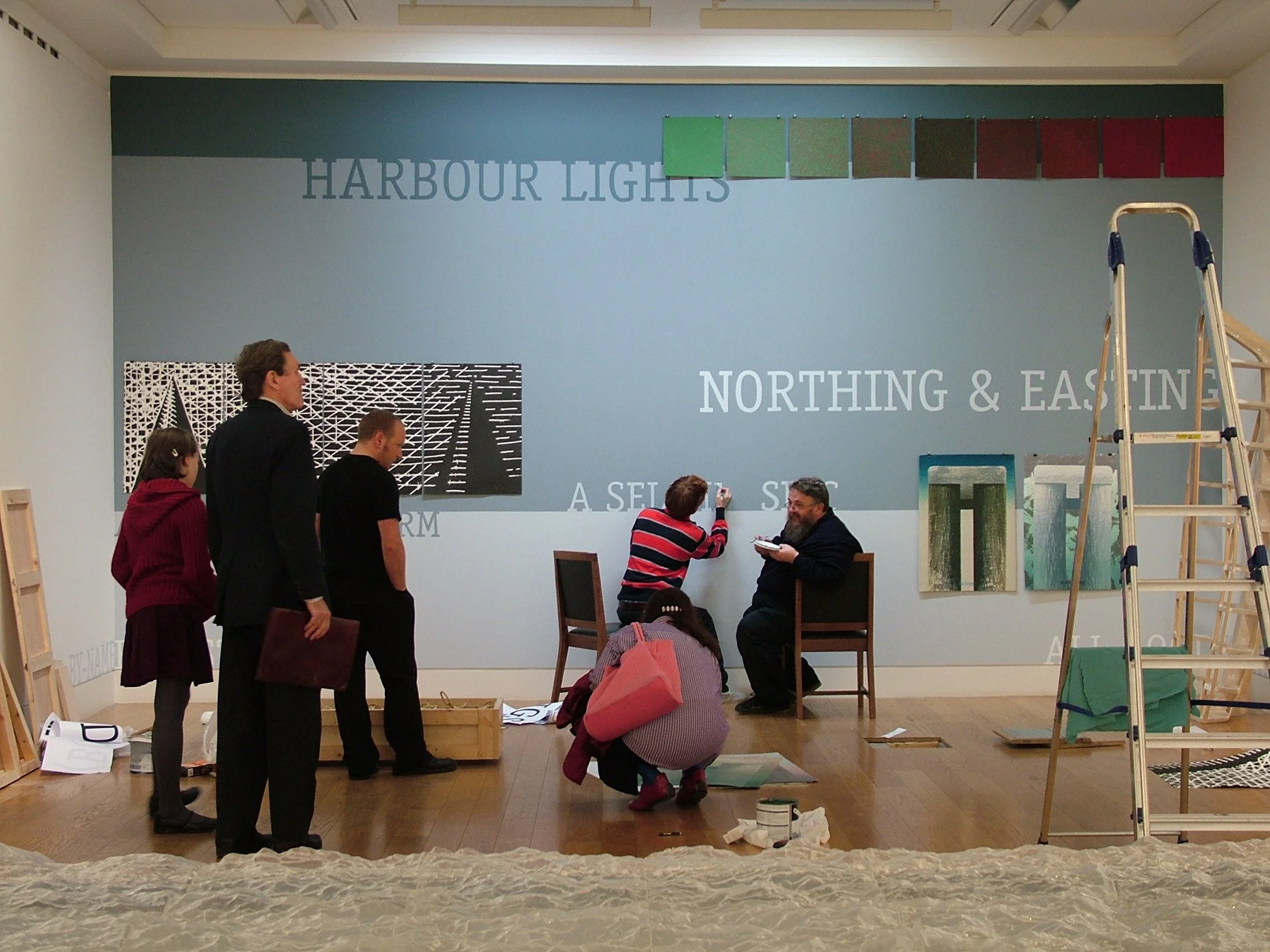
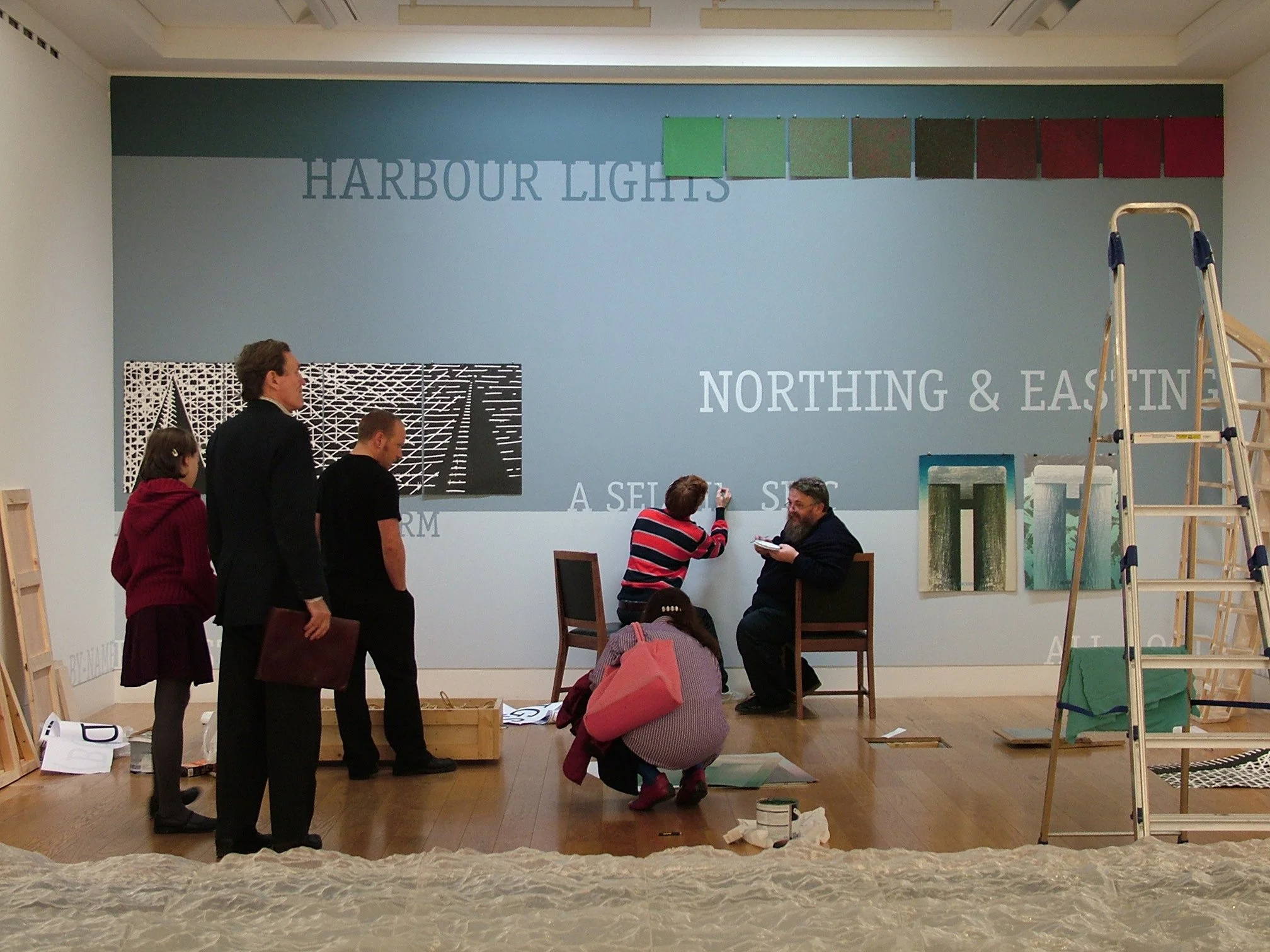
Arthur Watson installing SEA, 2005. Left to right: Michale Spens, CRG, Janet Spens, David Maclean, Arthur Watson.
From the start of your time at the RSA in 2003, up to the present day, you’ve managed some significant changes. Are there moments that stand out for you, when things clearly shifted?
Managing change happens piece by piece. What is the next necessary step? What's the priority here? How do we achieve that? Do we need extra resource to do that? And of course, you always need extra resources, because as soon as you lift up a stone, there’s another world underneath!
We built on the residency and awards programmes a great deal. In 2003, we were administering one small award after another and the process just seemed crazy. So sometime around 2009, I said to Wendy Law at the Scottish Arts Council, “look Wendy, we’ve got these pots of money and we just feel like we're on a treadmill, administering them. If we were to find a way of amalgamating those pots, do you think the Arts Council would help to seed a project with it?” And they came back and said “yeah, what do you want to do?” And the Residencies for Scotland programme was born.
We want artists to tell us where they want to go. If they’re going to get five grand from the Academy, where would they go and spend it? We don’t want a “worthy” response. We want them to say “I want to investigate my work in printmaking” or some such other achievable outcome which was just out-of-reach financially for them at that time.
It wasn’t about us going out to the partners. It was about the artists telling us who those partners should be. They’ve changed over time as well. We wanted to ask “what is necessary for the participants, from their point of view? And how can the Academy help to facilitate that?” As opposed to artists being told by the Academy, “we’ll give you the money, but you must spend it here”.
In the early years of that programme, some of them would say “I want to do this here, and this here, and this here”. Anthony Schrag asked to go to five venues. Three of them said yes. We told Anthony that we would like the venues to have some sort of connectivity. And he said, “well of course they will: through me!” And they did! And it was great.
We still do all the administration, realising these venues have tiny teams and small grants. We’d prepare a shortlist of artists, which the venues could consider in line with their own curatorial vision, then they could approach the artists themselves. So the programme became a catalyst which helped to seed those interconnecting relationships between artists and venues. We could be the hub of it, and we could show the work, but we didn’t have to arbitrate. Having been in Aberdeen, I understood how busy smaller teams could be. So how could we at the Academy help that? How can we take the burden off and still get the artists to go everywhere they want? It was sector-driven, not bureaucracy-driven.
We also focussed closely on the student show. The old student show used to include anybody who was in a fine art department in a Scottish art school above third year. They could put a work into that show. So all the pictures would arrive at the Academy on a Monday morning. We wouldn’t know who any of these artists were. There would be maybe 450 works. They’d be handed in, and sometimes you’d hang the lot and only then discover a box in the corner, and in that box would be a six-metre-square drawing on different sheets of paper. Seriously! Then you’d go “shit! We’ve got to fit that in!”
Some works would sell, other works would be distributed back to the schools, and you didn’t really build any relationship with the artist. In developing New Contemporaries, we said “why don’t we select works from the degree shows? Why don’t we build a relationship with a group of artists year on year? And also, why don’t we offer this opportunity after art school, rather than doing it at a time when the artists are trying to finish off their degree shows, etc?” That was an example of an instance where we felt it’s not broke, we don’t need to fix it, but there’s got to be a better way of doing this.
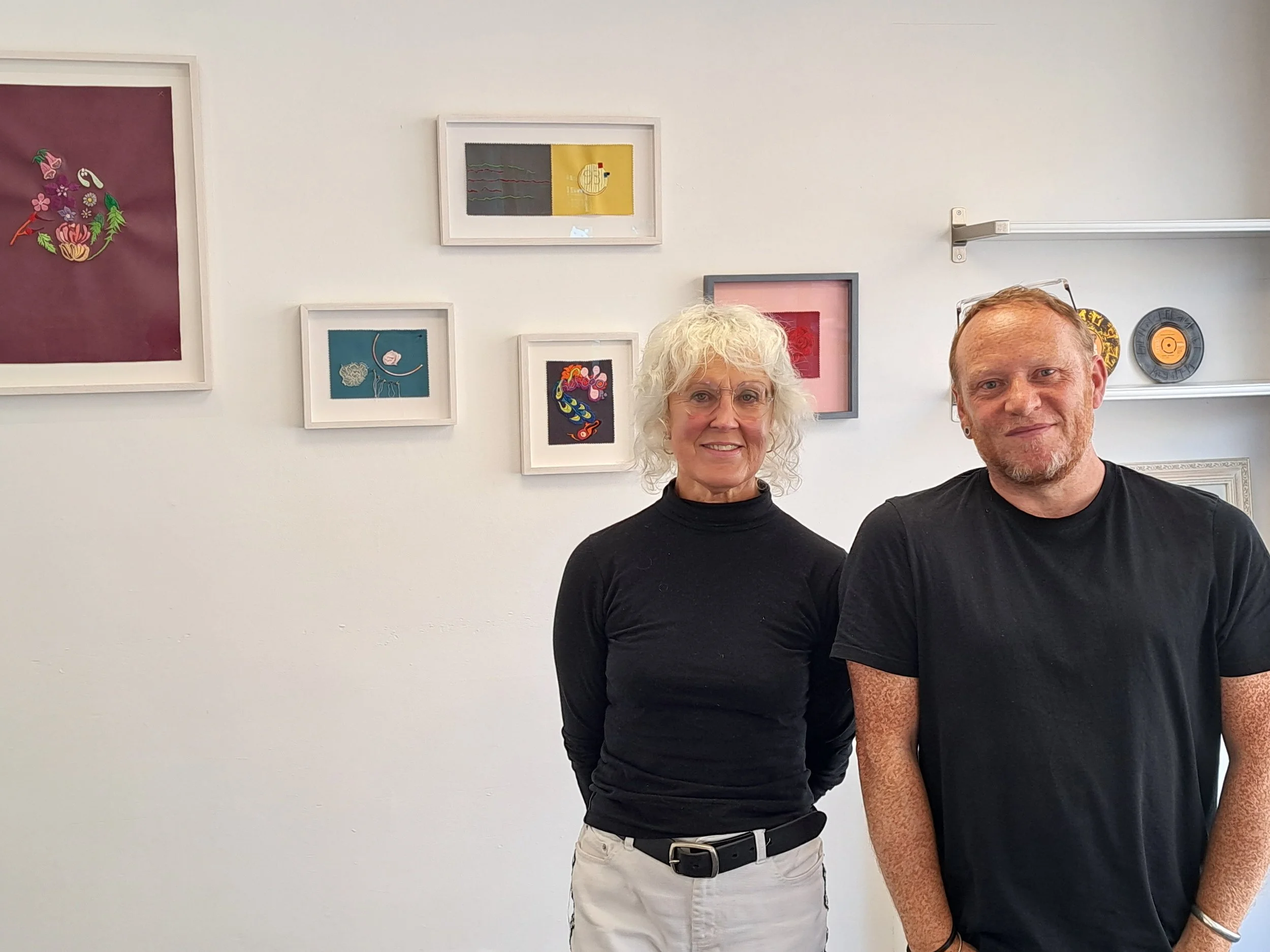
CRG with Wendy Law
There have been so many highlights, I’m sure, but when you think back about exhibitions in particular, which stand up as the most memorable ones?
There have been so many memorable exhibitions. I have really fond memories of working on the Demarco and European Avant-Garde show, which involved trips to Poland. I realised that at that time, Poland felt like Scotland in the ‘80s. We were going into really grubby spaces, taken over by artists. They hadn’t even bothered to sweep the floor but there were amazing films going on. It was all a little bit underground, really lo-fi. I loved that: artists’ collectives just doing it. Even though, as I found, the artists collectives in Poland were quite often steered by galleries and they weren’t quite as independent as I’d imagined. But I loved the ‘80s and ‘90s, where there would be a happening, people would take over a shop unit to sling mud at the walls… Actually, I have a work in my personal collection from that particular performance!
I visited Poland with Arthur Watson to reconnect with Richard Demarco’s contacts. I remember going to Magdalena Abakanowicz’s house. Now, I can speak to anyone. Terrifying elderly ladies are not terrifying to me! But our guide, the art historian and critic Karol Sienkiewicz, was visibly shaking in his shoes as we approached. He said “I don't know how this is going to go…” The visit didn’t phase me, but as we went in, it was actually quite scary! Then Magdalena’s cat tottered over and I patted his head, I picked him up, and then suddenly Magdalena was just a delight! So, I broke the ice with some cat talk. That was a pinch-me moment.
Things like that have often happened to me throughout my career. I’ve found myself in really interesting places. Bert Irvin’s birthday party. George Mackay Brown's birthday party. I’d tag along to anybody's birthday party, it seems…
You just find yourself in these crazy situations. I remember sitting next to Eve Arnold at dinner and thinking “oh, I don’t want to sound stupid in front of you…” But she was really interested in me, or at least she seemed to be. When I moved to Edinburgh, she wrote to me and said how wonderful it was that I’d moved to the RSA. We kept up our contact and it was terrific.
I also worked for a long time with Ralph Steadman and he was just fascinating. I would ask him to tell stories about Hunter S. Thomson, William Burroughs… Steadman editioned many prints with us at Peacock and, with one, he took it to Burroughs and had him shoot it. When it came back to us, the print was full of bullet holes. The image was partly obliterated. It was amazing. I’m always hungry for those stories and connections.
I’ve known people who could tell such amazing stories. I used go and visit David Michie a couple of times a month, always on a Thursday afternoon, and he would just stand and tell me about his amazing life. I remember him making me coffee one day. He stood there and said “oh yes, I think that was a dinner party my mother had with Picasso…” And I'm writing this all down!
Art history is written and studied but nobody writes down the social history of artists. Harvey Daniels, the English abstract artist, once gave me a Moleskine book and said over dinner “you have to put all of the stories you’ve heard into writing”. And over the years I have written lots down. One artist said to me “please don’t publish those notebooks until after I've died”. And I said, “you’re only saying that because you’ve been one of the best fun ones!”
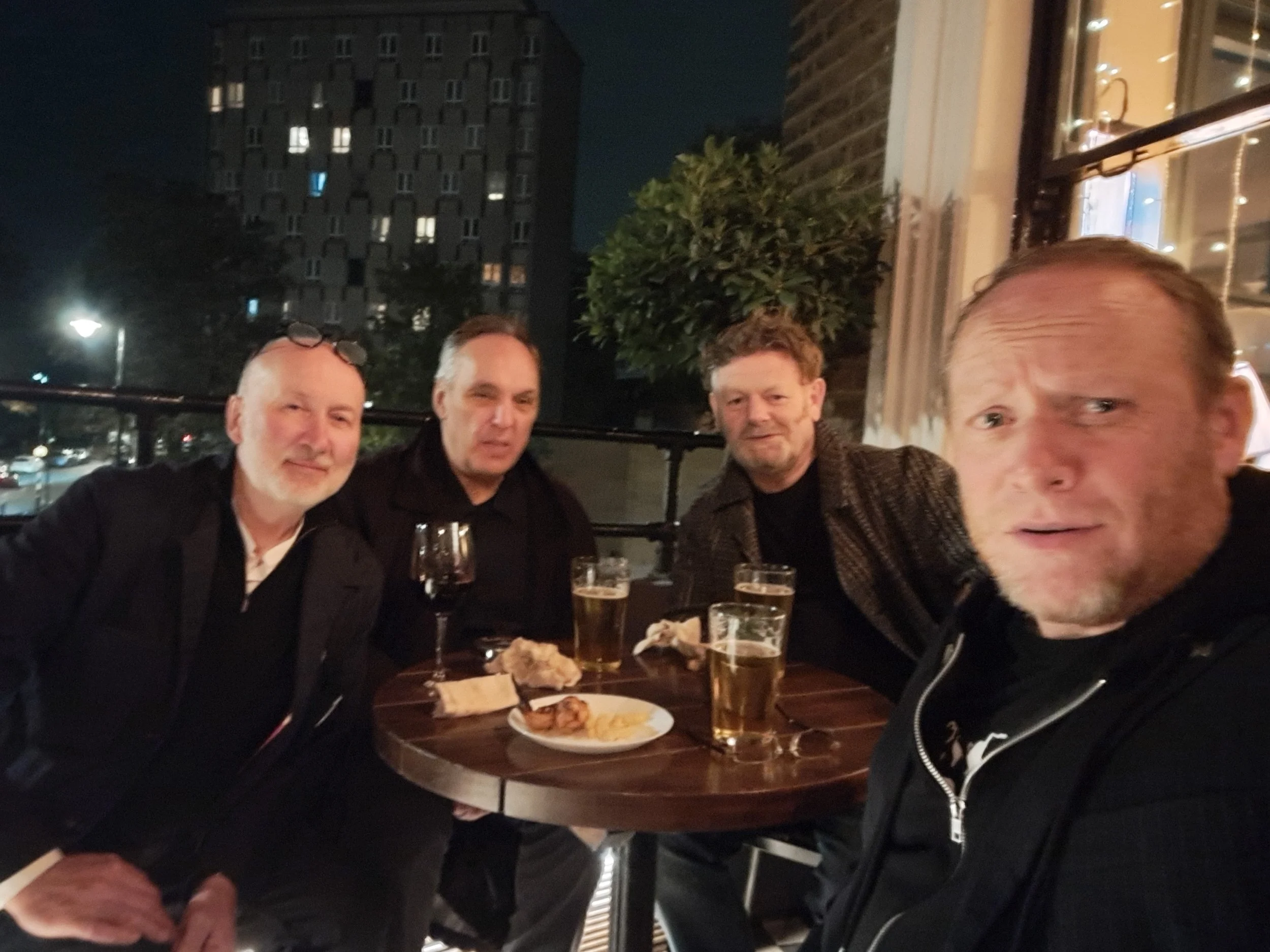
Ken Currie, Adrian Wiszniewski, Keith McIntyre and CRG in London, 2023.
You’ve spent so much time with artists, and particularly in their studios – those spaces so few of us are privy to. Can you share some of the things you’ve learned, having spent so much time with these people, in these spaces?
It’s a real privilege to spend time with artists in their studios. The studio’s an inner sanctum. It’s a place where artists can be creative, where they can be themselves. Some people live in their studio, so it’s their entire world.
For someone like Frances Walker, the studio isn’t just about the work that’s produced there. The studio’s a lifetime. It's a lifetime of resources, materials, collecting. Frances, for example, collects objects that have washed up on the shore. They’ve been kept by her for a long, long period, so this thing might have much longer an existence sat on a shelf than it had as the skull of an animal, say. I’m fascinated by that kind of connection to object. The way people hoard and reuse, and the way objects become part of people’s story.
Whenever you visited Sylvia Wishart in Orkney, you’d see this beautiful view from her studio window, which she painted in so many of her later pictures. This extraordinary view was never the same. It might be sunny one day, and the fields are tilled. It might be sunny another day, but there’s corn. But the objects on the windowsill pretty much stayed the same. I like the whole nature of wabi-sabi, the beauty in imperfection and transience. There’s a series of paintings and drawings by Sylvia where we see a dove in the middle of the composition, because her friend Bryce Wilson drew the dove on her window one day when he came round and found Sylvia was out. She just left it. In her pictures, over time, it gets more and more faint, and it becomes part of the landscape she paints. I love those static studio objects, like the boat in the bottle: another item that features a lot in Sylvia’s paintings. The stories of important objects play out in lots of people’s studios.
When I moved to the Academy, I remember moving a collection item by an artist, and as I picked it up with my bare hands, my colleague Joanna Soden was shouting to me “Gloves! Gloves!” And I thought, “if only she knew that the artist and I had been carting these things around the studio, sometimes without a frame, hands right against the paint…”
When I first went to visit Jimmy Robertson’s studio, out in the countryside in Kilbarchan, I was astounded because he had had someone design it so it looked like one of the studios in the Glasgow School of Art. It had the same Mackintosh-style panelling, the same details, but looking out the window, instead of Glasgow rooftops, you were looking at sheep!
I'm fascinated by artists’ studios, whether they’re out in the country or the city, whether they’re underground, how they’re lit… How they’re populated. How an artist builds a world around themselves.
Then of course, shared spaces like sculpture or printmakers’ workshops are totally different. Much more impersonal. Artists create their work in public, almost. I remember John Bellany used to come to Peacock and there would be students in from Gray’s, making prints. They’d be in awe, watching John at work. He’d say, “you don’t have to watch, you know… I’m just making prints”. But it really was like a performance. It’s all a bit performative when you’re printing in the studio. You know, if you get the press wrong, or if the weight’s wrong, or something clunks, everyone’s going to turn around!
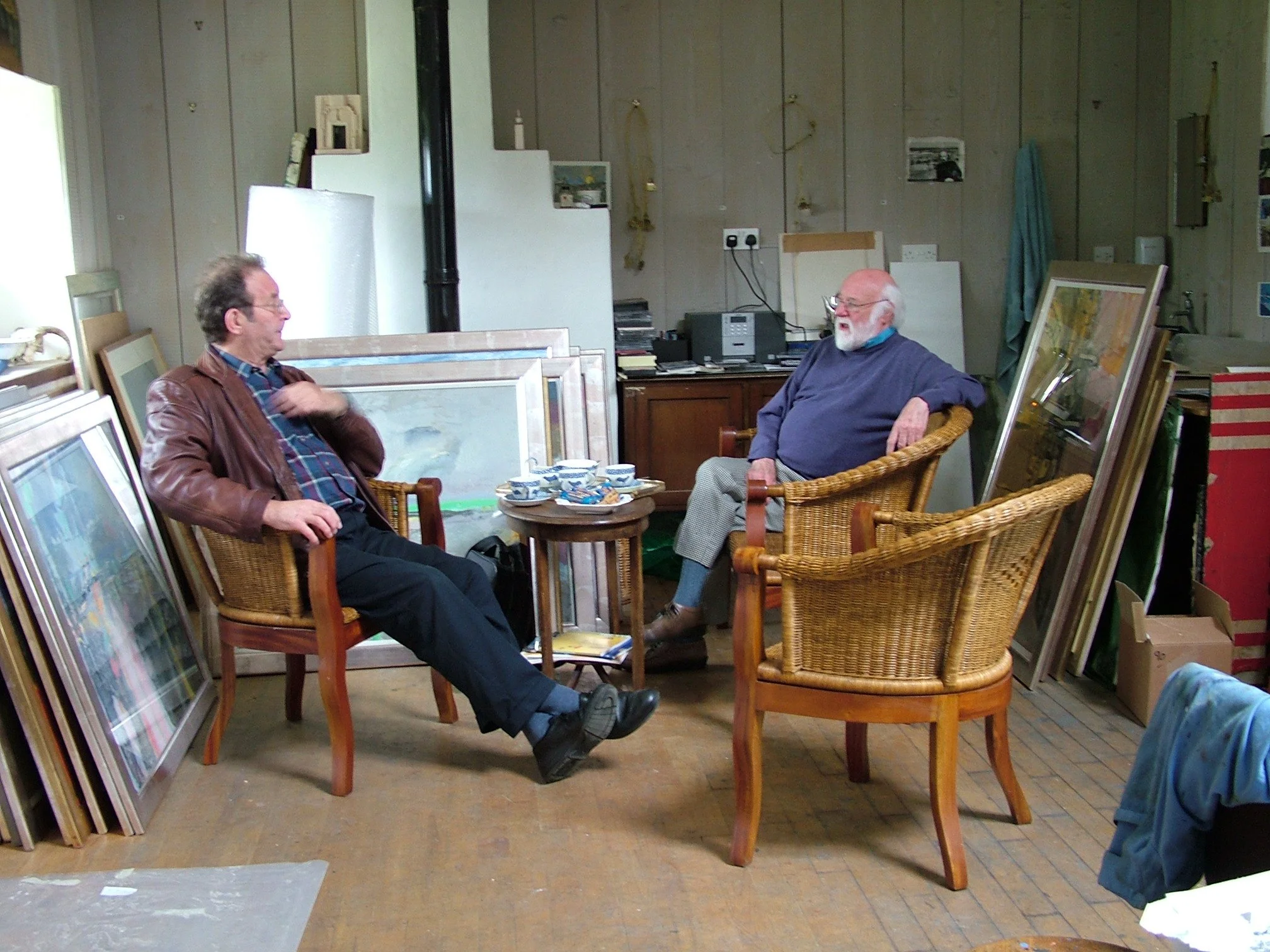
James Robertson (right) in his studio, Kilbarchan. Left, sculptor Bill Scott. Photograph by CRG
It’s sad to note that many of the artists we’re speaking about are no longer with us. You’ve known so many hugely talented figures. Who are the artists you miss?
There are so many for lots of different reasons. It’s difficult to say one over the other. But I really miss Ian McKenzie Smith because he was one of only a few main mentors, and someone whose career I looked at and felt “I could learn a lot from you”. He was the President of the RSA when I came here in 2003, but I knew him from Aberdeen. I knew what he had done in Aberdeen as a young man. He’d changed the entire landscape of art and culture in Aberdeen. He was the catalyst for that. I’d bounce ideas off him, sometimes rant in frustration at him.
It’s not so much a regret, but I wish I’d asked more of Ian Fleming. He would talk a lot about the past, but there are specific points that I’m really interested in asking about, and now I won’t know. I wish I’d asked more about the time of the Two Roberts in Glasgow in the 1940s. I wish I’d asked more about what was happening in that mid-century period in Scotland, which would really give more clues as to how things burgeoned.
I miss Syliva Wishart as well because she was always good fun. In this job, you’re working with so many people, there are quite a lot of people that you lose, people you’ve come to know over their career, a long career, and they’re gone too soon or you haven’t asked them enough, you haven’t said enough. There haven’t been enough chats.
I have the sense that your relationships with artists have some serious professional bearing, as well as being deeply personal. Is it fair to say that these people weigh heavily, albeit very positively, on your mind when you come into work at the RSA?
In a job like this, you are a custodian. You’re part of the link that makes the leap from person to person. You’re part of that story. I’m fascinated by this idea of transience, imperfection. Living in the moment. Enjoying the moment. It’s not about collecting these names. It’s about them being with you, you’re part of their story. The friendships I’ve had with these artists, they mean a lot because they’re not really based around my career. Or rather, they’re not solely linked to the wider career. They’re not incidental relationships I have because I’m working in this role. They’re genuine friendships that have developed. Often, they’re cross-generational, which is really important to me as well.
I do believe that you don’t throw the baby out with the bathwater and you learn from these people who are, to coin a Japanese cultural term, living national treasures. I have David Michie’s voice ringing in my ears at Assembly meetings, because he was one of the most vocal people in the Assemblies when I first started here. He would offer sage advice. He’d lived a long time and he had a lot to say, he made a lot of sense. John Houston too. I don’t think these relationships weigh heavily, I just think they are a presence.
I think the catalyst of change means that you have to keep remembering what it was like before, and why it was like that. Someone coming into this role after me may not have the volume of that history so I am the part of these links here and now. When something is in flux, it’s really helpful for an institution to remember. Changes always have to reference back, otherwise you lose the unique nature of why things were set up in the first place. And at 200 years old, the Academy has probably always done that, because it’s had a succession of people taking it on short, midterm or long-term journeys.
I suppose the RSA collection is beautiful because it hasn’t had a linear curatorial strategy across its 200 years. It’s been amassed by a body of artists who are giving and collecting, which means it’s quite eclectic, but it also means it has brought in things from different areas that talk about Scotland in a different way, so it’s not just about landscape painting or Victorian art. That collective voice is something you carry forward.
That’s where I think “those artists I knew, I can still be a voice for them, with a forward view. I can still think about what they would say, what they would think about a certain point”. Lots of them were really progressive too, otherwise we wouldn’t be here now. Moving things forward with that ethos in place. If you
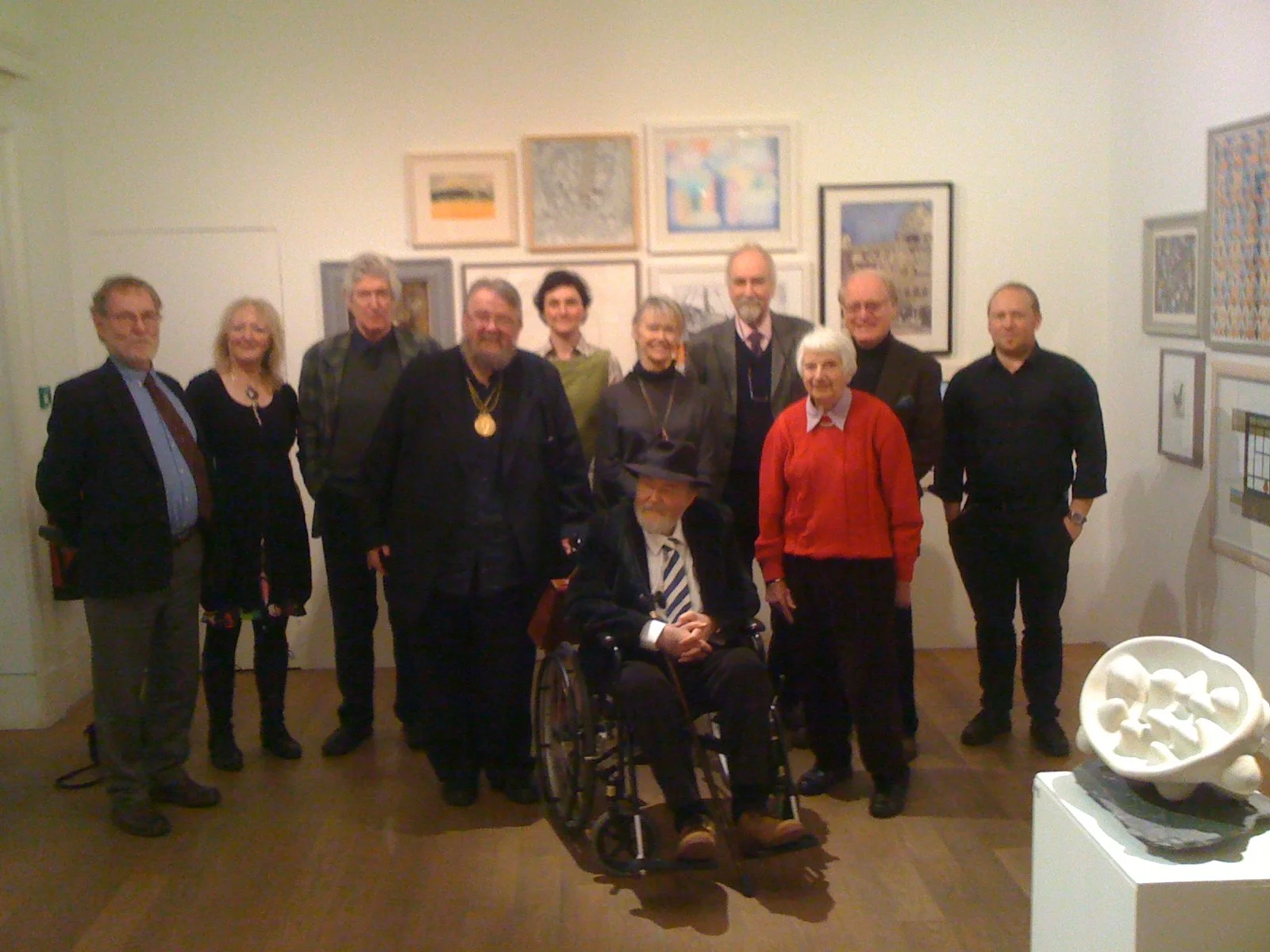
A lunch in honour of John Bellany, hosted at the Royal Scottish Academy. Left to right: Duncan Macmillan, Joyce W. Cairns, Alexander (Sandy) Moffat, Arthur Watson, Marion Smith, Helen Bellany, John Bellany (seated), David Michie, Elizabeth Blackadder, Ian McKenzie Smith, CRG.
Speaking of artists and their memories, I’m interested to hear more about the work you do in supporting legacies. How important is a bequest, or even a well-organised studio, to an artist’s legacy?
I think it’s important because an artist has, usually, done their very best to keep their career at a level as it builds. Once they’re gone, it’s about ensuring their name stays prominent. How do we keep them part of the story? Having access to the wider studio and the objects which relate to sketchbooks, study drawing, whatever, is really important. It’s important to see their process. So it doesn’t need to be the work, the finished painting, standing on its own any longer.
I wrote an essay for a book by Shelagh Atkinson. She directed the cataloguing of her own studio, her own output over the years. It’s fascinating to hear about an artist doing that themselves. Not enough artists do that. They just make, make, make. Frances Walker, however, is an example of an artist who is very careful with their accompanying archive. I remember buying a drawing by Frances years ago, and telling her about it, and then in the space of less than five minutes, she came back into the room with the original sales receipt from 1978 or something. She had everything catalogued.
A bugbear of mine is that there are all these studios of artists whose families aren’t connected, even to other artists, and when we lose them, we lose contact entirely. We don’t know what happens to the studio, to the work. Someone’s entire career has just gone. I’ve spent probably whole weeks of my life in auction rooms, trying to stop studio auctions from going ahead, trying to stop things selling for £20 apiece. I’ve heard about sketchbooks going on the fire so many times.
I encourage artists to edit their body of work. I hate seeing things come onto the market which were never meant to be sold. I’m not suggesting that the families do that deliberately, but it’s sometimes just something that happens. I remember once having to destroy an edition of prints because they were unsigned and they weren’t to go onto the market. I felt awful. There are archive copies, there are examples, but I felt that destroying the prints was a huge disservice to the work the artist had put into that. Now, I say to artists “look, I don’t want to be the one who’s destroying this on your behalf. If you don’t like it, you do something about it. If you don’t want it on the market, don’t let it be. Or put a caveat on it, saying that it’s for research purposes only”.
So it’s about having the confidence to say to artists, “what do you want to happen when you’re not here? How do you want to be represented in Scottish art history? Where do you want to be seen? Where don’t you want to be seen?”
In 2022, we received a huge bequest from the estate of Elizabeth Blackadder and John Houston. In 1973, William Gillies was responsible for a big bequest. But between them, there was the William Littlejohn Bequest too, which was the catalyst really for the Blackadder Houston Bequest. When it came to Bill Littlejohn, after the artist’s death, we received a sum of money and the studio: the studio objects, the library, the art materials and the works on paper and canvas.
In order for us to get a handle on the Littlejohn Bequest, I worked with Arthur Watson and we asked ourselves “how are we going to cope with this?!” We thought, “we’ll have an exhibition. We’ll accession the studio objects, so we’ll always have that as a research tool. Some of the works will be accessioned, then we’ll make gifts to collections, so that collections who don’t have Littlejohn’s work, and should do, will receive some”. That was the ethos of it. We also, of course, set up a fund for a watercolour award.
At the time, John Houston said to me, “you can never take on the volume of that studio”. I explained to John that this is what we wanted to do to keep Littlejohn’s name alive, to keep access to the market open. It was clear John was quizzing me on what might happen after he and Elizabeth were gone, should they also make a bequest. While this was going on, John was rewriting the will, and when he asked these questions, I had answers for him. Carrying that conversation forward, John set up a trust, so that Elizabeth would be looked after when he was gone, then really that trust would be responsible for closing their estate, after Elizabeth’s death.
The volume of the Bequest is quite something. When I learned about it, the trustees came to us at the RSA and said “we’d like you to think about what you could do based on the wishes included in the will”. I think there were nine wishes. I looked at the basis of what we did with Littlejohn, took it to the trust with some significant changes, and they were happy with the plan, which all went ahead.
So the sum of money has been invested and the proceeds, the invested gains as opposed to the fund itself, underwrite events like the New Contemporaries. We give out awards, there’s a publishing fund, and we fund a position which keeps research going into their legacy. That has been a really good opportunity which lets us say “this is how we keep John and Elizabeth’s names alive, through awards and through support of other projects”.
While we’re doing this, if we step outside of the wishes, then all of those people sitting watching in the wings will go “well, we’re not going to give you any money unless our wishes are at the core of the disbursement…” So of course we follow that. You wouldn’t betray those artists’ trust by not following their wishes. We’ve been entrusted with this opportunity to do good. That’s a real privilege.
The nature of that Bequest has changed so many things. We’ve been presenting the work to a wider market, which is a huge development. When John set the trust up, the Academy didn’t have access to the market in the way it does now. Now, we have a dedicated Academicians’ Gallery. We have a selling website, which we reinvested in during the pandemic. We have connections with other galleries. We’ve just had a really successful show of Elizabeth’s work at Jenna Burlingham Gallery, outside London. Dovecot have a show of Elizabeth’s work on just now. Meanwhile, the work is still going through the salerooms. There’s still competition, we don’t want to flood the market, but we have these opportunities and partnerships to hand. And we’re now working through the huge number of works by John. They’re just fantastic. The colours are just beautiful.
It sounds like an enormous undertaking, as you continue to work on ongoing projects alongside all the events of RSA200. How do you manage it all?
I think I thrive in the busyness. But I think I prioritise too. There’s a really great team at the RSA and we’re all working enormously hard, and even harder this year. Everyone is dedicated. People can switch off from other jobs but that’s not something that people in the arts do very easily. I try and say no to some things now. It’s not very easy. I get really excited by ideas. People say to me, “that would be really exciting…” And I usually say “how do we do that?” Not “how do I get out of this?” I recognise that as a problem, because by me saying “that’s exciting”, somewhere else in the team they’ll be saying “oh God, please not more…”
There’s no typical day. Some days you’ll come in and think “this is what I’m going to do” and you don’t even sit down because there are clients in, or something serious has happened, someone’s died, or maybe someone’s comes in and said “I’ve got a collection of art and I don’t know what to do with it”, and your plans stop there.
I think I’ve always been really lucky in so far as the people I’ve worked with have entrusted me just to get on with it, and they know that I’ll ask if I need anything. So I’ve always been like that with the staff team too. They know what needs to be done and they take ownership of it. That’s not saying I just delegate everything, but I just want to let them flourish. I didn’t get where I am by someone micromanaging my work. People are here because they’re great. I’m comfortable that they’re all doing well, so it all comes together.
I see the team work on these shows and it always looks effortless, but the volume of research and planning that goes into every exhibition, large or small, is enormous. We know we’re going to get over 1000 visitors a day, and sometimes in the middle of the Edinburgh Festival we get 3000 visitors in a single day. It’s just nuts! The access that an exhibiting artist has had to the wider visiting public is astounding. Being able to show new, contemporary practice in a space that effectively looks like a museum, particularly to many visitors who come in during times of high footfall, is fantastic. It’s great for everyone to discover something extraordinary.
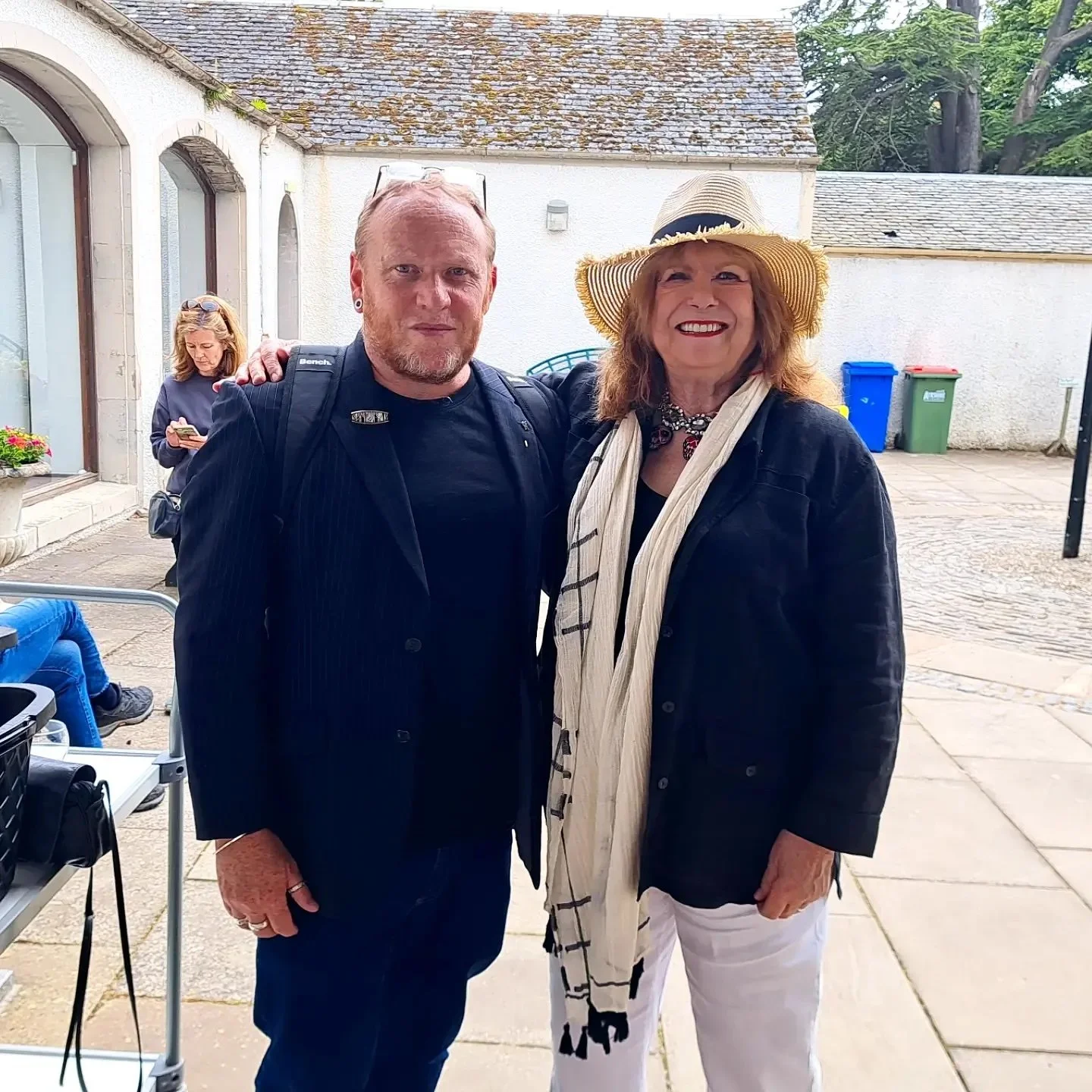
CRG with Barbara Rae, 2024. Photograph by Ian McNicol.
Thinking ahead to the latter half of the bicentenary year, what are you most looking forward to?
I’m really looking forward to seeing Joyce W. Cairns’ work on the walls. I’ve known Joyce all of my career. She’s just fantastic. We’re showing work from the ‘60s right up to the present day. I remember her Ship to Shore exhibition, I remember War Tourist, and we’re showing snippets of those, but we’re also showing works from before and in-between, and that’s something wonderful.
We’re also working with Dame Barbara Rae on the Antarctic show, Charting South. After Barbara had travelled to the Arctic in 2015, 2016 and 2017 and we showed the resulting work in the exhibition Northwest Passage, she said “I’d love to go to the Antarctic next”. She has now had two trips to the Antarctic, researching Shackleton’s journeys, and the results are brilliant. When I selected work for the Arctic show, I was in the studio with Barbara and there were so many works, more than we could ever put in, and I found myself going “no, no, no… Maybe that one… Yes, no…” And this is Barbara Rae we’re talking about! I had imposter syndrome, telling Barbara Rae we had to slim it down.
These are strong women. They’ve probably been the people I’ve been most inspired by in my life. I know lots of men with really strong careers, really strong work, but these women like Barbara, Joyce, Sylvia Wishart, Frances Walker, Barbara Balmer, Victoria Crowe… They’re lovely people who are great artists, and not seen as great women artists. I don’t mean that to be a diminishing statement, but they’ve found a footing, being the only women in a staff, having large and robust paintings on the wall next to men at a time when that was more difficult than it is now.
For Autumn, we will exhibit This26, which will pick an artist from each year of this century who has been funded or supported in some way by the Academy. One artist for each year. It’s a nuts idea, because there are hundreds of artists we could choose from, and we disperse hundreds of thousands of pounds a year. But it’ll be really good to reconnect with some of these artists. I’ve been around at the RSA for most of those 26 years. That’s an exciting thought.
There is also the consideration of what we do next. There’s so much. We’ve been working with volunteers on pulling together a database of architecture, looking at buildings that have been realised by Academicians. Trying to build some kind of archive which shows the Academy’s engagement across all sorts of locales. People can go to their local school, leisure centre or church and find it was built by an Academician. That will hopefully launch at the end of the year.
We’ll collate the activities which have happened around the country, then the discussion will be about how we build on all that. What’s our manifesto, going into 2027? Or going into the next 100 years? We’ve come a long way in the last 20-odd years, in changing an institution that wanted to change but needed somebody to lead that process. It’s been about being open enough for artists to feel part of the story, even if they’re not Academicians. Scottish art isn’t just Academicians. It’s a much wider story.
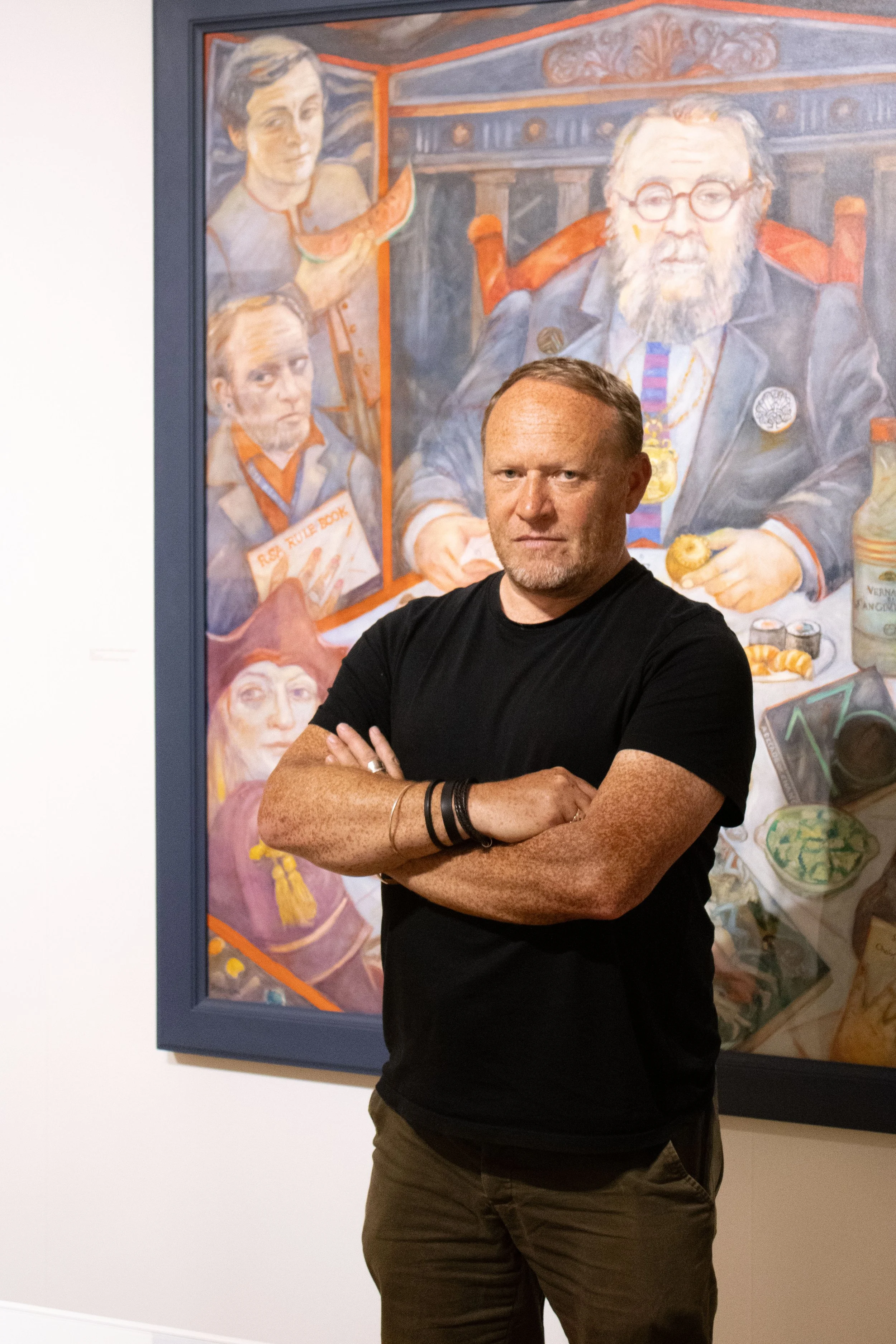
CRG with Joyce W. Cairns’ Presidential Portrait of Arthur Watson, 2026. In the painting, holding “RSA Rule Book”, a portrait of CRG.
Acknowledgements
With many thanks to Colin R Greenslade for his time and support as well as for providing the images in this article.
Douglas Erskine