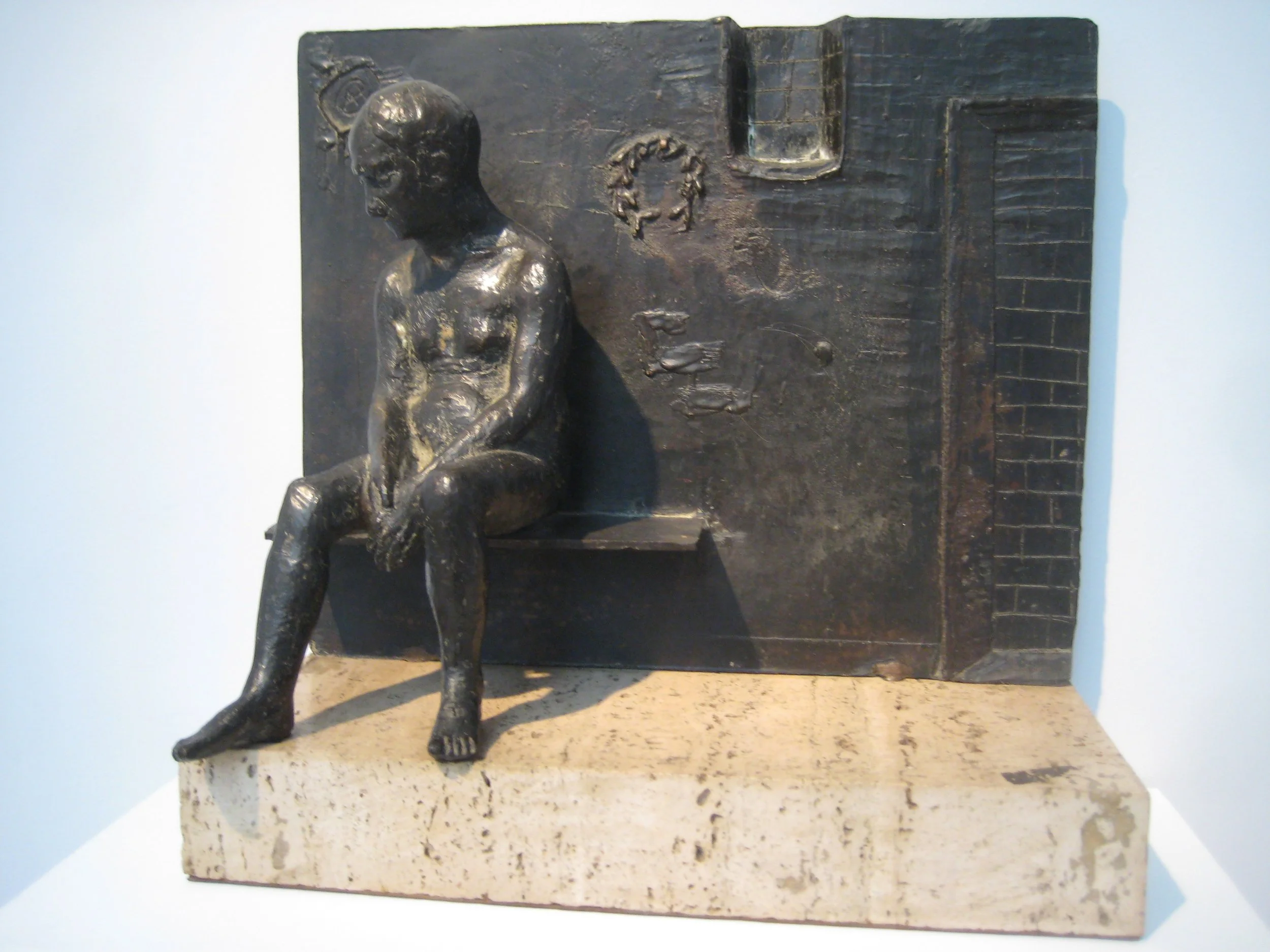
Ann Henderson: Nature and Nurture
Ann Henderson RSA (1921-1976) was a gifted Scottish sculptor and a Senior Lecturer in Sculpture at Edinburgh College of Art. She was elected Associate, Royal Scottish Academy (RSA) in 1967, to full membership in 1973 and held the post of Curator of the RSA Library jointly with David Michie RSA in 1974 and 1975, just before her untimely death. Awarded prizes for her figurative works in bronze, she also expressed her love of nature and the human form in stone, plaster, concrete and wood, and worked in abstract forms with innovative materials. She nurtured the careers of her many sculpture students during her 28 years of teaching and raised more prize-winners at her croft in the Highlands.
Names are often omitted from art history. Recent writings on Joan Eardley (1921-1963) mention her solo Festival Exhibition at The 57 Gallery, Edinburgh in 1959, but press extracts show this was, in fact, a double bill with the sculptor Ann Henderson. The Scotsman’s Art Critic was impressed:
“One of the most interesting shows is a joint display of sculpture and painting by Ann Henderson and Joan Eardley at The 57 Gallery in George Street. Ann Henderson has the ability, rare in women, of suggesting breadth and power, without violent, emotionally distorted forms. Even in the restricted space allowed to her, she demonstrates a remarkable range, from the Manzù-like stillness of Group to the almost frivolous charm of Joie de Vivre, a study of a horse rolling on its back. Frivolousness has been avoided by rejecting the sentimental - the shapes of the horse have been conceived in glyphic terms.” (Note 1)
The 57, run by artists for artists, was based in Daphne Dyce-Sharp’s (sculptor, 1924-2010) second-floor studio. Henderson and Eardley were likely friends; exact contemporaries, Eardley was perhaps more reserved in character, but both driven and determined, and neither was a native of Edinburgh, although Henderson was by then a Junior Assistant in the School of Sculpture at Edinburgh College of Art. Both women preferred to escape the city as often as they could for the completely different, rural life of North East Scotland, which became their muse.
Henderson was born in Thurso in 1924, the daughter of a farmer at Ormlie who moved in 1941 to Culrain Mains, Ardgay, where the family still farms today. Henderson’s talent was nurtured at Thurso’s Miller Academy, but she had to persuade her reluctant parents to allow her to enrol at Edinburgh College of Art in 1940 to study under Alexander Carrick RSA (1882-1966), who was Head of the Sculpture School until 1945. Henderson was the only woman sculptor to graduate that year (Note 2).
Eric Schilsky RA, RSA (1898-1974) arrived as the new Head of the School of Sculpture in the autumn of 1945 and was Henderson’s tutor for her post-graduate year. His course was a continuation of the traditional sculptor’s training; life drawing, drawing from and copying from the antique, modelling in preference to carving. Schilsky described her as “one in particular” of his “possible good students… She is intelligent, very critical of her own work and other people’s.” (Note 3)
Henderson was Highly Commended for her Diploma work and awarded a generous Andrew Grant travelling scholarship. She took this up after a year as a part-time assistant in the School of Sculpture, leaving for Paris in 1947 to study at the École des Beaux Arts in the Atelier of Marcel Gimond (French 1894-1961). This choice was perhaps on Schilsky’s recommendation, as Gimond had worked for Schilsky’s hero Aristide Maillol (French 1861-1944) during the 1920s, following his master in the sculpture of female figures in bronze. By 1947, Gimond also had a successful studio producing portrait busts. Schilsky’s address book lists Henderson’s address as “℅ Monsieur Grivet, 135, Boulevard de Saint-Michel”, just a few doors along from a block of artists’ studios at No 115, a short distance from the sculptor Ossip Zadkine’s studio (Russian-French 1888-1967), and an easy walk to the iconic cafés of Montparnasse. She was at the heart of things; it must have been an extraordinary year for her, and a long way from Thurso.
Henderson returned from Paris in 1948 to join the ECA staff as a part-time Junior Assistant teacher, which gave her time to sculpt, but it must have been a relief to be appointed to a full-time post in 1950. She exhibited a portrait head and a wood carving at the RSA that year, showing an early interest in materials other than clay and bronze. In 1952, she won the RSA’s Keith Prize for best student work in the RSA annual exhibition, and also exhibited with the Society of Scottish Artists and the Royal Glasgow Institute. In 1954, her bronze Composition of two people and a cow won the prestigious RSA Guthrie Award for the most outstanding work in the RSA Annual Exhibition for someone under 35. Cows were frequent visitors to the RSA in landscape paintings, but this may have been a first in three dimensions, and not the last submitted by Henderson. Bill Scott found a stillness in her figures, carefully placed to be experienced in the round, yet as each element turns towards another, the composition has a dynamism; the woman looks at the man who is linked to the cow by the highest of touches, the cow bows towards his leg and, as ever in the Highlands, it is windy. The importance of the spaces between the figures and the spare treatment of the forms hint at a future move towards abstraction.
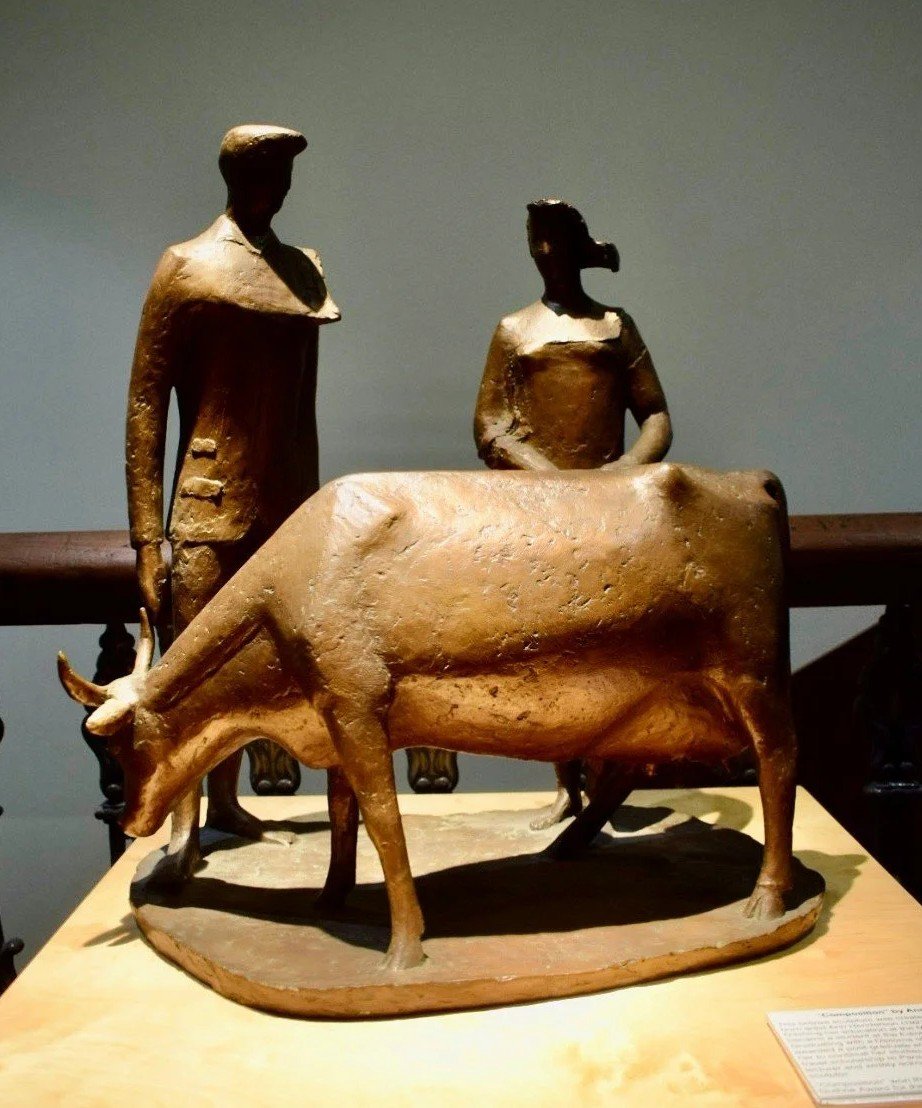
Ann Henderson, Composition, Two Figures and a Cow. Bronze. 50 x 60cm. Image courtesy of North Coast Visitor Centre, Thurso, High Life Highland.
Henderson told the John O’Groat Journal in May 1954 that the Guthrie Award would take her to Greece for three months, but so far, we have no sketchbooks or records to show that she went there. (Note 4) Her later work shows Cycladic elements, but she was not alone in turning to Archaic Greek sculpture for inspiration. She exhibited a work titled Vallauris at the RSA the following year, showing that she had been to the South of France. Picasso had been in Vallauris since 1946, sculpting with found objects, making vibrant ceramics with Madoura and producing a series of small clay, plaster and bronze women on fluid plinths (1945-1950). He was also starting to work large and abstract in concrete. In 1949, he gifted the bronze L’Homme au Mouton (Man with a Sheep) to Vallauris in thanks for the warm welcome he received, and it is still in the spot he chose in the market square. By 1954, he had recently completed La Guerre et La Paix, a haunting, monumental mural covering the walls and vault of the chapel of the Chateau de Vallauris, which closes one side of the market square. For Henderson, this may have been a place of pilgrimage.
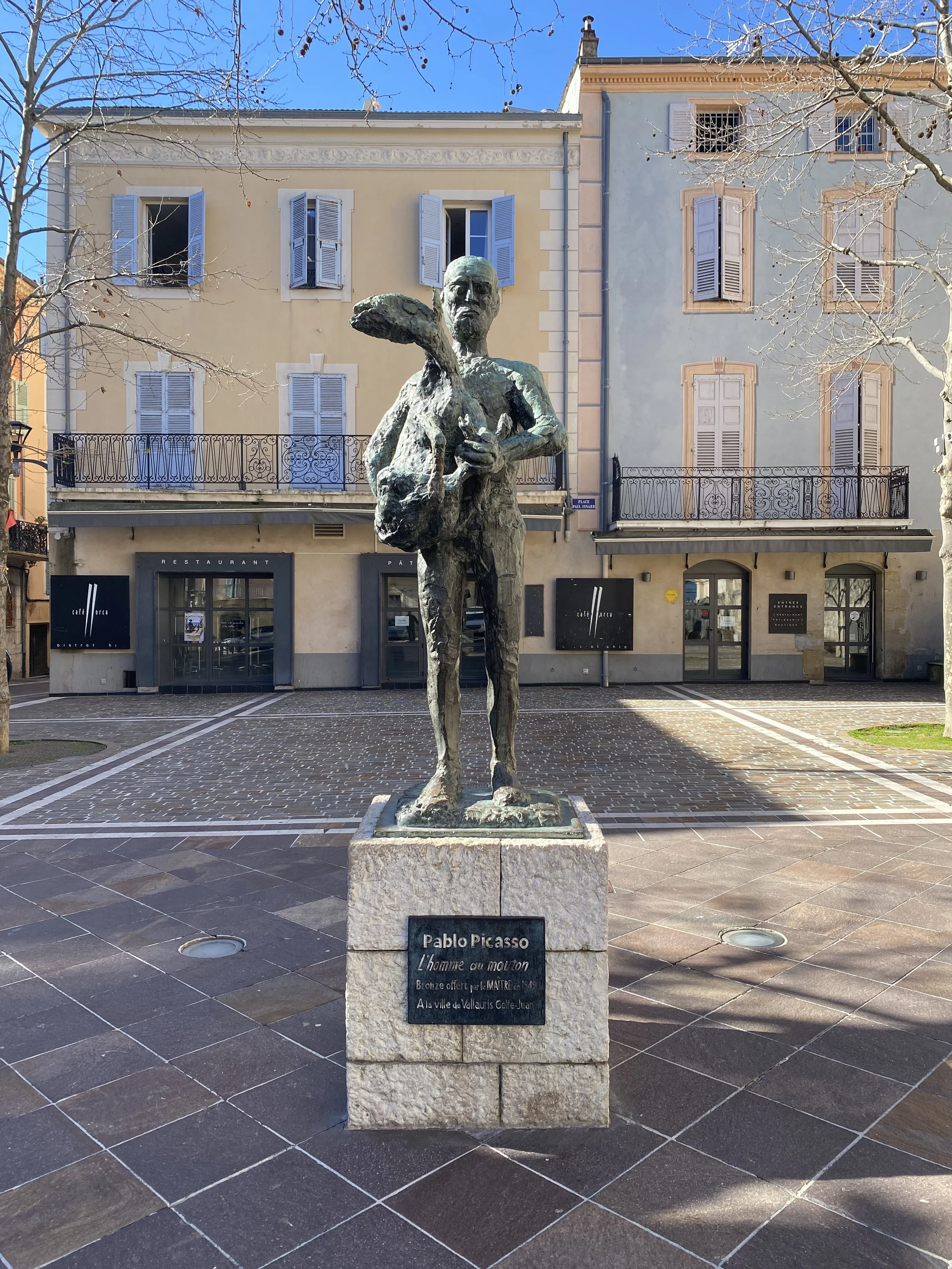
Pablo Picasso, L’Homme au Mouton. Bronze. Dimensions Unknown. Place Paul Isnard, Vallauris, France. 2026. Image: Anne Emerson
Returning from her travels, Henderson began to work in concrete and new materials such as resin and fibreglass. Between 1960 and 1965 she set up a course in fabricated (as distinct from carved or modelled) sculpture with her colleague, the sculptor Sidney Birnie Stewart RSA (1914-1976). There were tensions as Schilsky, their Head of School, stayed with his traditional approaches and figurative work, but he did not actively discourage their new ideas and tolerated studio discussions of Henry Moore, his exact contemporary, though he enjoyed pretending not to know who he was (Note 5). Anthony Hatwell (1931-2013) was appointed as Head of School in 1969 and brought a modernist approach, a welcome change in direction for Henderson and others. Another of her ECA students, William Brotherston RSA, remembered Henderson’s admiration for the expressionist work of Germaine Richier (French 1902-1959) and Scott and Jake Kempsell later recalled her studio library of books on Rodin, Matisse, Giacometti and Picasso. But when asked about her work, Henderson replied that she “liked to reflect the life around her.” There are more echoes of Picasso’s use of found materials in her life-size Hen Wife, a richly textured figure holding a hen, which Henderson made in the woods at her farm from plaster and fragments of tree bark.
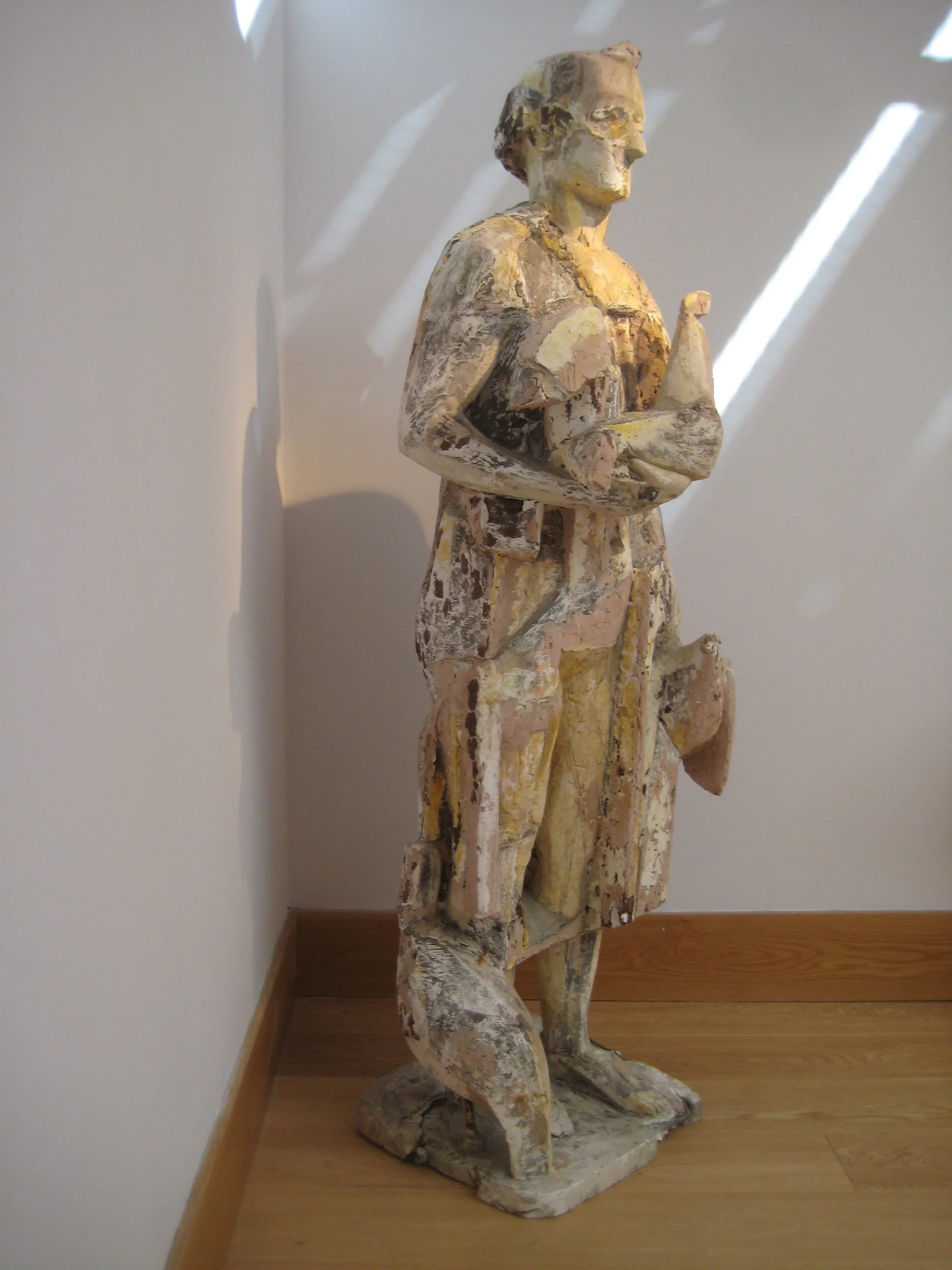
Ann Henderson, Hen Wife. Plaster and wood. Dimensions unknown; life size. Courtesy of William Brotherston.
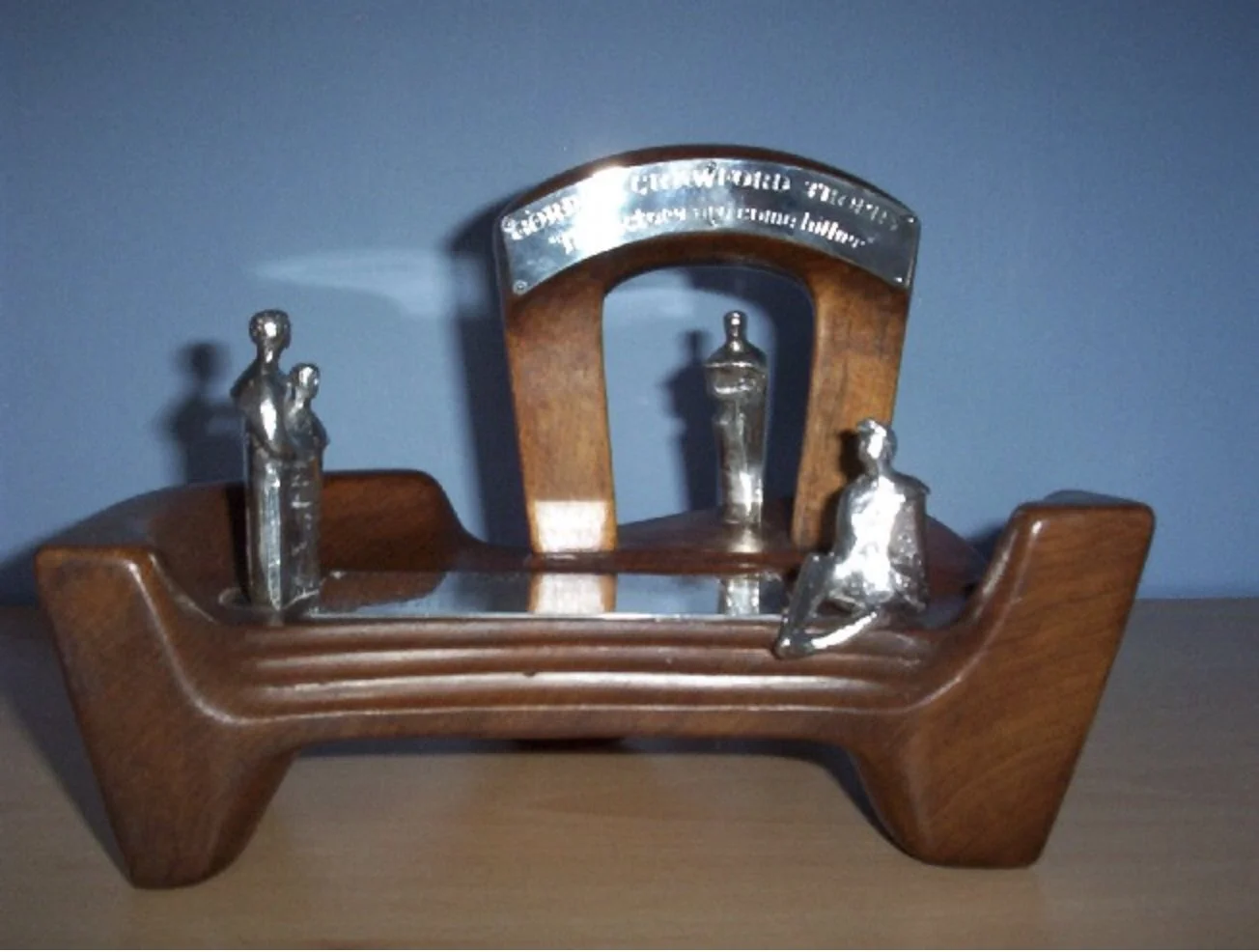
Ann Henderson, The Gordon Crawford Trophy, SCDA. Wood and silver. No dimensions. 1956. (image copyright: Buccaneer Theatre Club of Lossiemouth 2009)
Commissions were small at the start of her career; she exhibited a few portrait heads, but this small theatre scene in the round offered more scope for the compositions she enjoyed. The Gordon Crawford Trophy for the highest mark in Acting was made for the Highland Scottish Community Drama Association. Henderson exhibited it at the RSA in 1956, and it was last awarded in Portree in 2009. Here is early versatility, working in wood and silver. Four simple figure forms, one seated, are posed on a stage. Earlier, in 1952, she exhibited a Project for a Trophy at the RSA with two jumping horses; she loved to draw and sculpt horses, and they became another great passion.
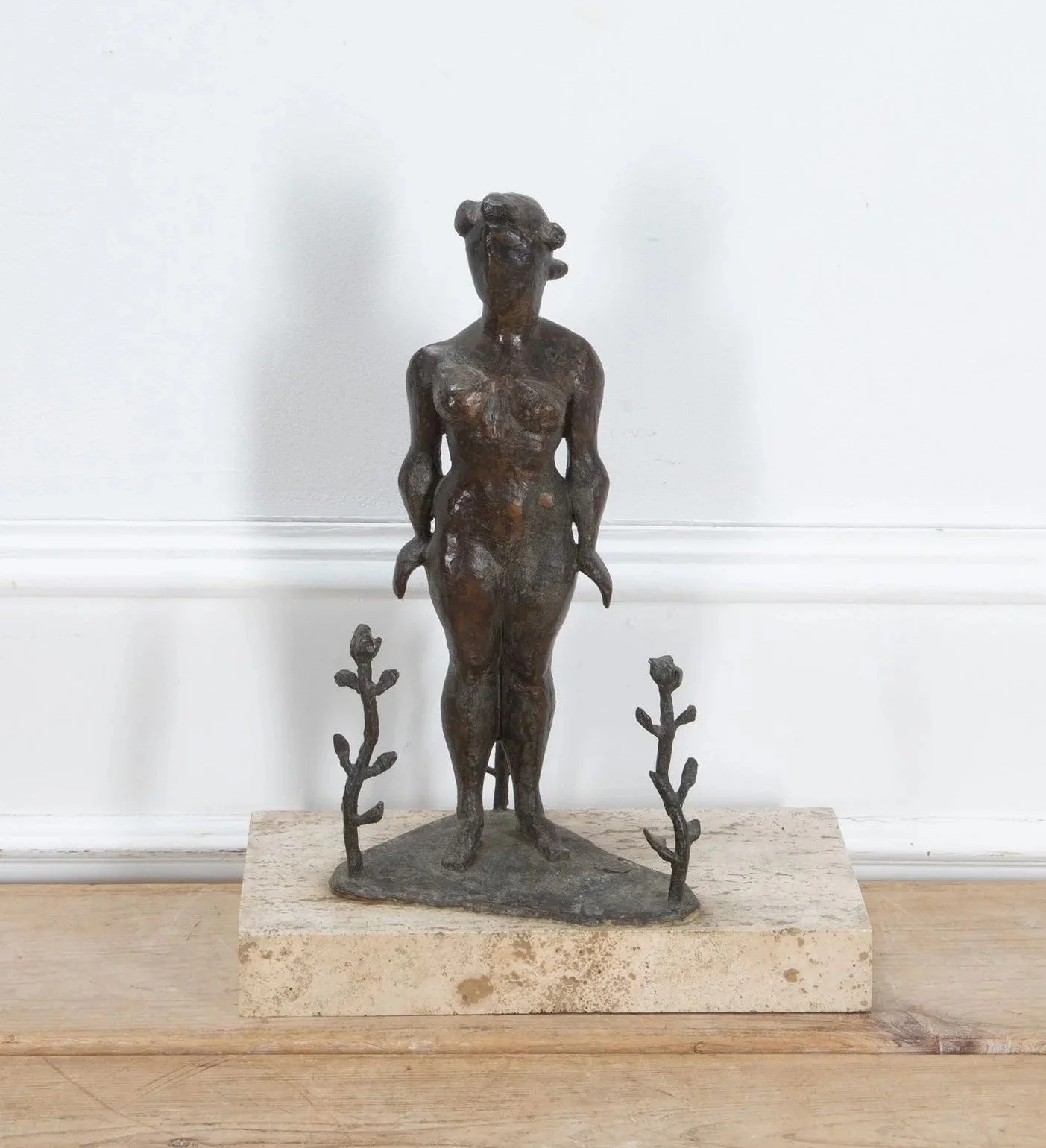
Ann Henderson, Flowers. Bronze. 45cm x 35cm x 19cm. c. 1970. Courtesy of Lorfords Antiques, Tetbury.
Henderson revisited the female form many times throughout her career in clay, plaster and bronze. This goddess with her three flowers has just re-emerged from a private collection. Another scene in the round, with symbols of spring, regeneration, and fertility, was exhibited at the RSA in 1971 and at the Royal Academy in 1972. It may date from an earlier period; Schilsky often presented his earlier work at a later date, leading to confusion as to when it was made. Some forms on this figure have been reduced; the hands are paddle-like, and her face is almost Cycladic.
Carol Carnevale was employed as an ECA studio model for about a decade from the late 1950s. In 2002, she recalled posing on occasion for Henderson in her little garage studio at weekends (Learmonth Gardens Mews, Edinburgh) and that Henderson would make them both lunch after the session (Note 6). Simon Manby, Schilsky and Henderson’s former student, told me that Carol was “as near to a Maillol as Schilsky was ever likely to have found!” (Note 7).
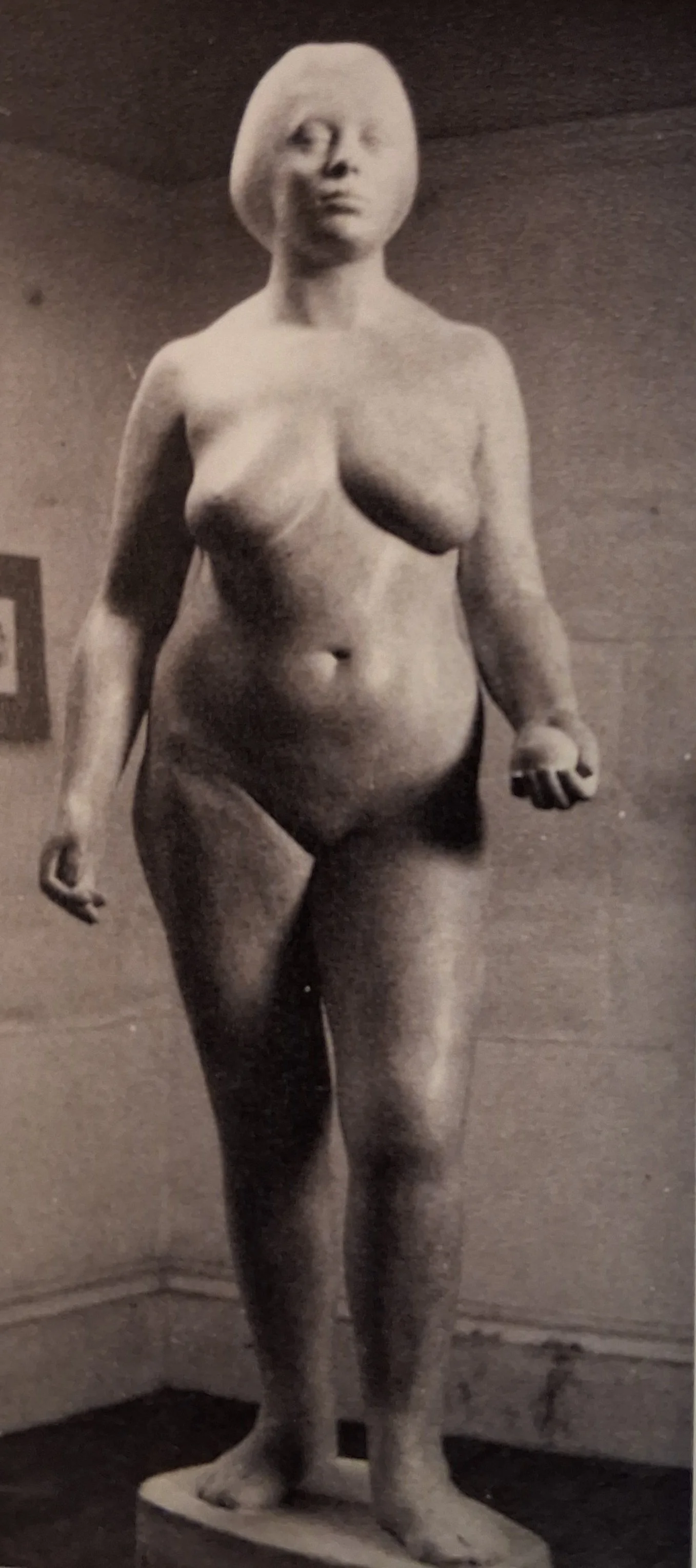
Simon Manby, Carol. Plaster. Dimensions unknown; life size. Courtesy of Simon Manby.
Simon Manby recalls: “When I went back after my final year for a post-diploma scholarship, I learned that the college janitors had consigned it (his sculpture of Carol) for disposal, not kept as I had requested; disappointing at the time, but perhaps just as well!”
He described his tutor in the studio: “Ann Henderson was physically not very tall, with a compact, chunky build. A strong personality, she was forthright in criticism, but if one's work merited praise. she was always generous and encouraging. I liked and admired her, but remember that some other students were less enthusiastic.” She habitually wore a “workmanlike white smock”, and “she always treated studio work as a serious commitment. There could be laughter and fun from time to time, but no fooling around or bad behaviour.” However, he said Henderson “never flaunted her own work, nor worked alongside us, so I only remember seeing some of her non-representational work in RSA exhibitions.”
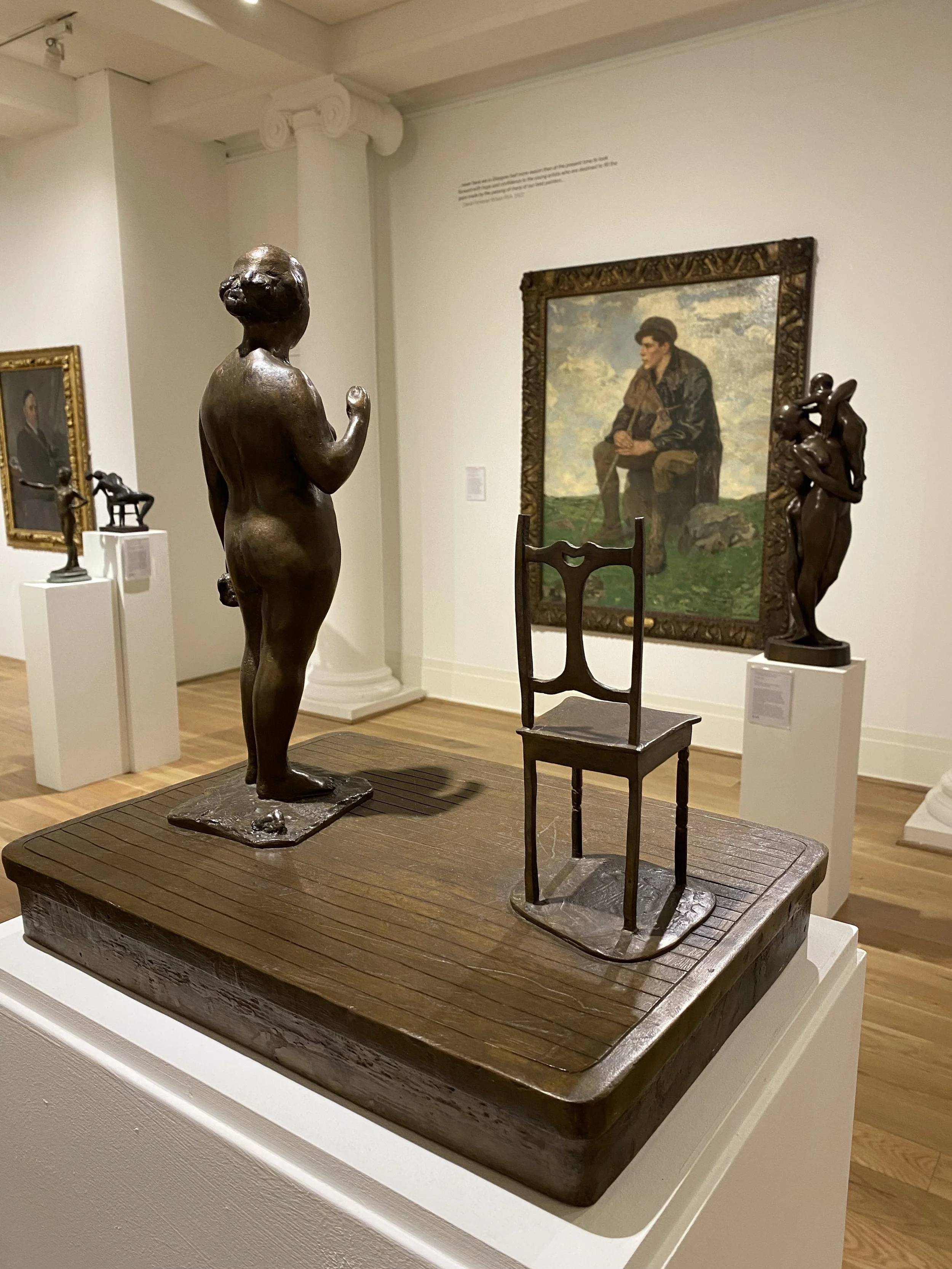
Ann Henderson, Woman and a Chair. Bronze. 46.3cm x 45.7cm x 33.7cm. c. 1970. Image: Anne Emerson) Here in conversation at the RSA200 Origin Stories exhibition 2026.
Carol Cavernale was probably the model for Woman and a Chair which Henderson submitted to the RSA as her Diploma piece in 1973. A rounded, nude woman stands near a chair on a flat metal plinth. The simplicity of Henderson’s piece is deceptive; she has carefully placed the two elements with just enough distance between them to create tension. Has the woman got up from the chair, might she sit down, or are they both just there by chance? Currently on display in the RSA200 exhibition, Origin Stories, her sculpture is in conversation in the gallery with those of her mentors, students and colleagues.

Ann Henderson, The Awakening, or Education, or Lady Releasing a Dove. Stone. Dimensions unknown. 1958-59. Courtesy of Thurso High School.
From the late 50s onwards, Henderson was keen to explore abstraction, and the resulting works were increasingly confident, powerful forms. In 1958, the farmland where Henderson grew up at Ormlie, Caithness, was redeveloped to a design by the architect Basil Spence as the new Thurso High School; the town was growing thanks to the nuclear research site at nearby Dounreay. The John O’Groat Journal reported that Henderson offered a piece of sculpture for the school courtyard to celebrate the new school and rebirth of the county, charging only £150 for the stone and its transport. She wanted to use Caithness stone from the Bower Quarry, but found this split too easily, so chose a whin stone from Ratho quarry instead. Henderson exhibited two studies for this work in her exhibition with Eardley in 1959. First named The Awakening, The Scotsman said these studies were: “a notable achievement… particularly interesting in their revelation of the progress of the sculptor’s thought. The association of differing materials as, for instance, in the contrast of colour and patina of bronze and stone is also exploited with unusual subtlety.” (Note 8).
The design developed from that of the model illustrated in The Scotsman to become a more Brutalist form in stone of a reclining woman, releasing a bird of hope. It is still in situ at the school, but sadly, the bird has flown. The sculpture was cleaned a few years ago, and the holes where the bird was originally attached were plugged. A brave plaque is now next to it, whose words are particularly poignant given the uncertain future of the Spence school buildings:
“This sculpture Lady Releasing a Dove by Ann Henderson, born in Thurso, was sculpted in the 1950s. It was gifted to the school for its opening in 1958. Until recently the sculpture suffered from ageing and many years of neglect but a previous 6th year cleaned it and tried to restore it to its near original condition. The Classic sculpture has always been a part of the school and will remain so for many years to come.” (Note 9).
Henderson won the RSA Ottilie Helen Wallace prize in 1962 for her exhibit, Form. This is likely to be this stone abstract sculpture in the form of a table, now on display in the North Coast Visitor Centre in Thurso. Her deepening interest in pure form is also evident in her sensitive Seated Figure of 1967 and The Citadel, exhibited in 1972.
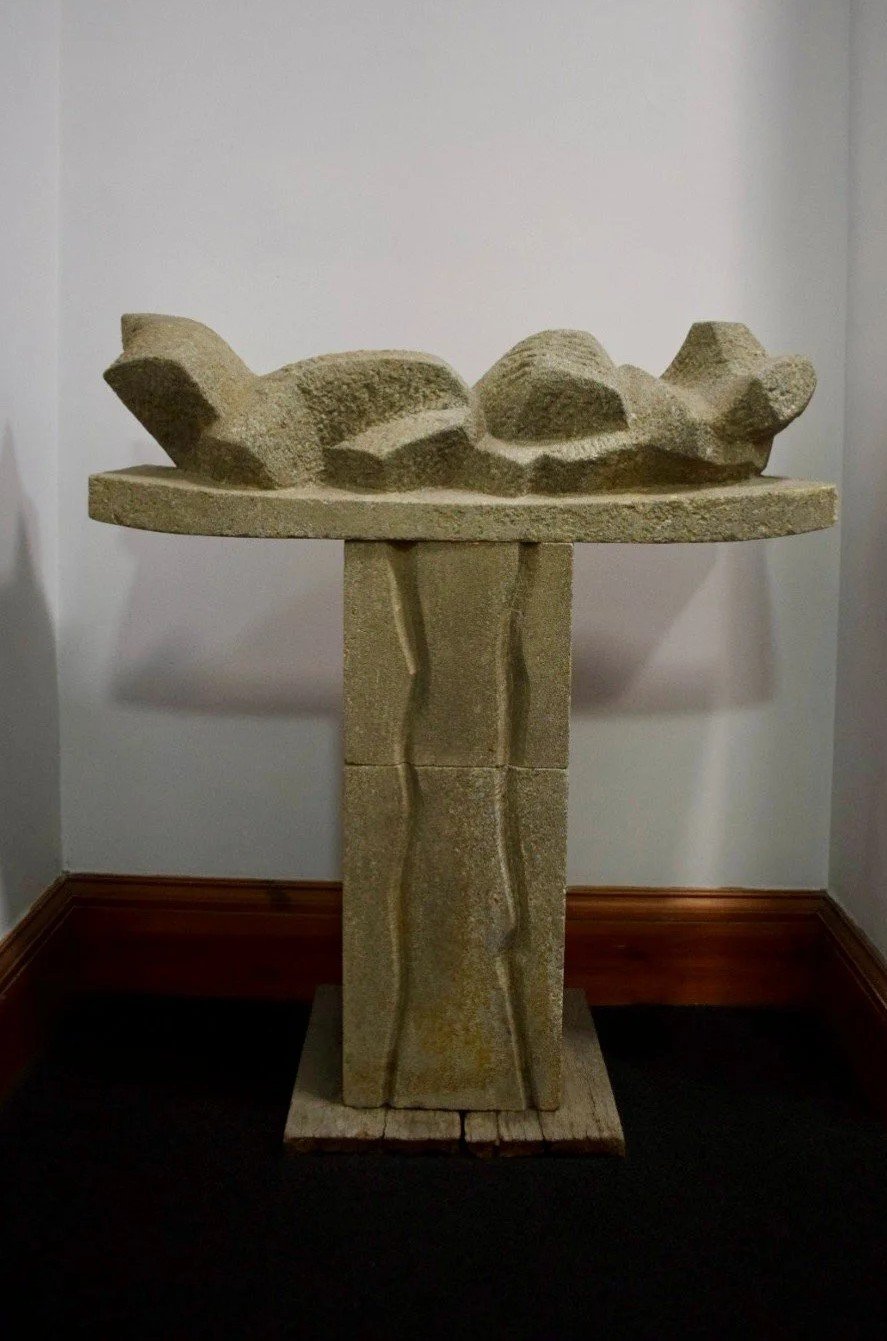
Ann Henderson, Form. Stone. 92cm x 102cm. 1962. Courtesy of North Coast Visitor Centre, Thurso, High Life Highland. Sculpture donated to Caithness Horizons by Wilma and Jim Wilson.
Jake Harvey RSA, an ECA Sculpture student from 1966 to 1972, found Henderson’s approach to form greatly influenced the development of his work:
“What I remember from Ann Henderson is being encouraged to be experimental in my use of clay and plaster… Ann would ask you to make a kind of cube, and it was like Bauhaus in her style of teaching. So you’d make a cube in clay and then disrupt that cube in certain ways, cutting angles off it, or setting its surface in a completely different way. So it gave it another kind of spatial dynamic. So that was instructive, really. And it was about making you aware of the work people like Brancusi made, looking at a kind of purity of form.
You were made aware of the importance of making a form that had a particular kind of tension and strength in it, and how that affected the peripheral space around an object. I've never forgotten that aspect or the idea of when you put two or three separate forms together, how important it is to be aware of the space between them, and to consider that almost as important. So making a form and a volume, all these things have never left me.” (Note 10).
Henderson began to receive larger commissions, working with architects who, at this date, often invited a sculptor to partner with their designs. Her exuberant bronze screen Music for George Watson’s College Music School was commissioned and presented by the architect Michael Laird (he had trained at ECA) and sits opposite the entrance. His design includes the sculptural pavilion of 1964, with an innovative parabolic roof structure. Henderson may have made a model of her screen in fibreglass and resin, but the finished screen is a deep relief cast in bronze, over two meters high, supported on a steel frame (Note 11). There seems to be a figure dancing among a luxurious growth of scrolling, richly modelled leaf and flower forms which push upwards and outwards.
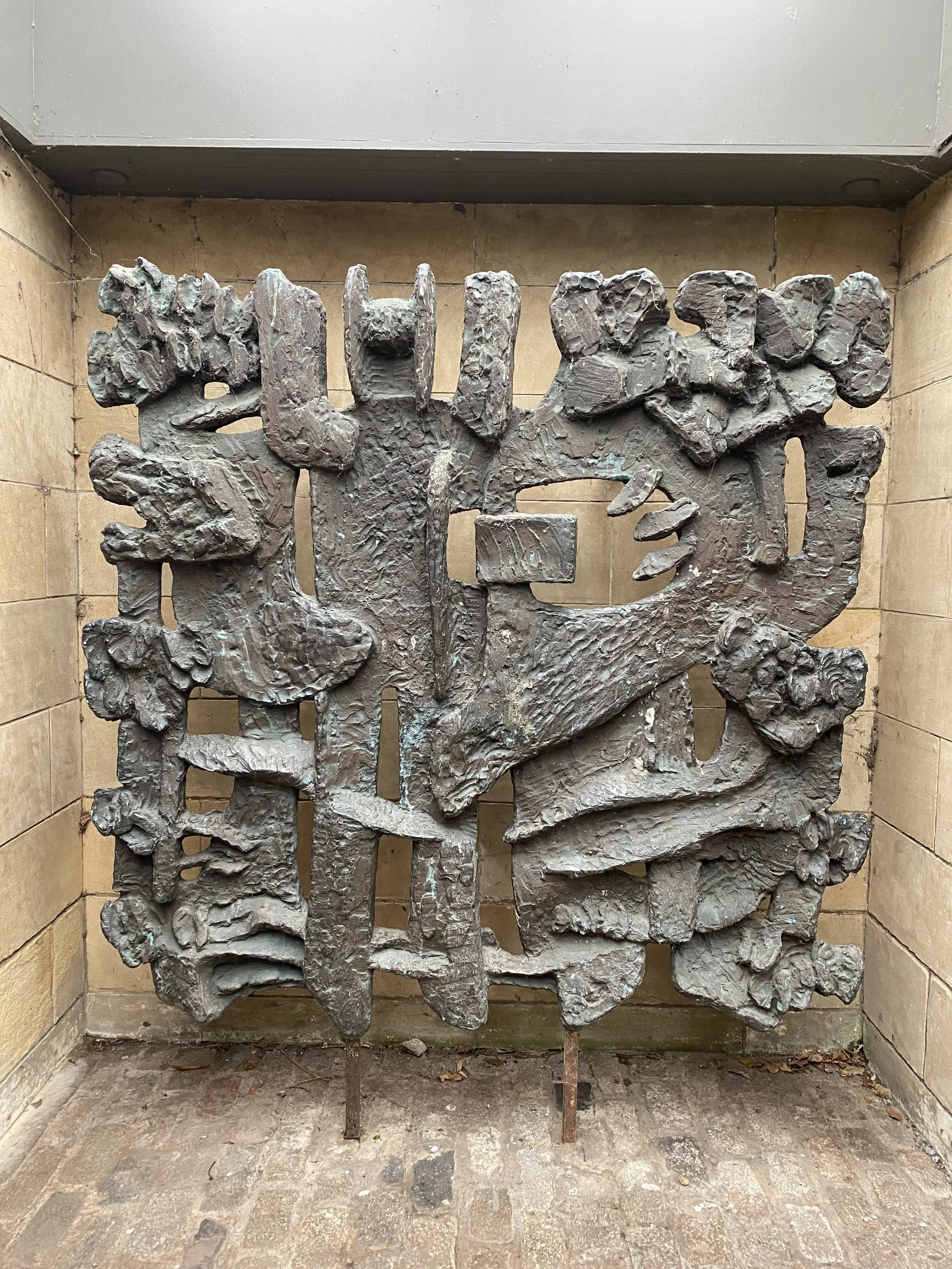
Ann Henderson, Music. Bronze. Dimensions unknown. 1964. Image: Anne Emerson. With thanks to George Watson’s College.
In 1970, Henderson exhibited a small Man with a Sheep at the RSA. This may have been the plaster prototype for a very large, public sculpture commissioned by the Wool Board for the Market Square in Galashiels and paid for by local landowner Christopher Scott and the Scottish Arts Council, erected in 1971. By the time she came to carve the final work in stone, her forms were Cubist; the sheep is raised across the shoulders of the man whose short, outstretched arms form a cross, his exaggerated legs are strong, rectangular blocks. The man with a sheep had become a Christian good shepherd. There is energy and joy here; the shepherd appears to be smiling, the sheep is definitely smiling, and viewed from behind, Henderson had fun applying Cubist principles to his musculature and flared trousers. It no longer serves as a market cross as it was moved in the 1980s from the Market Square to a pedestrian zone at the top of Channel Street.
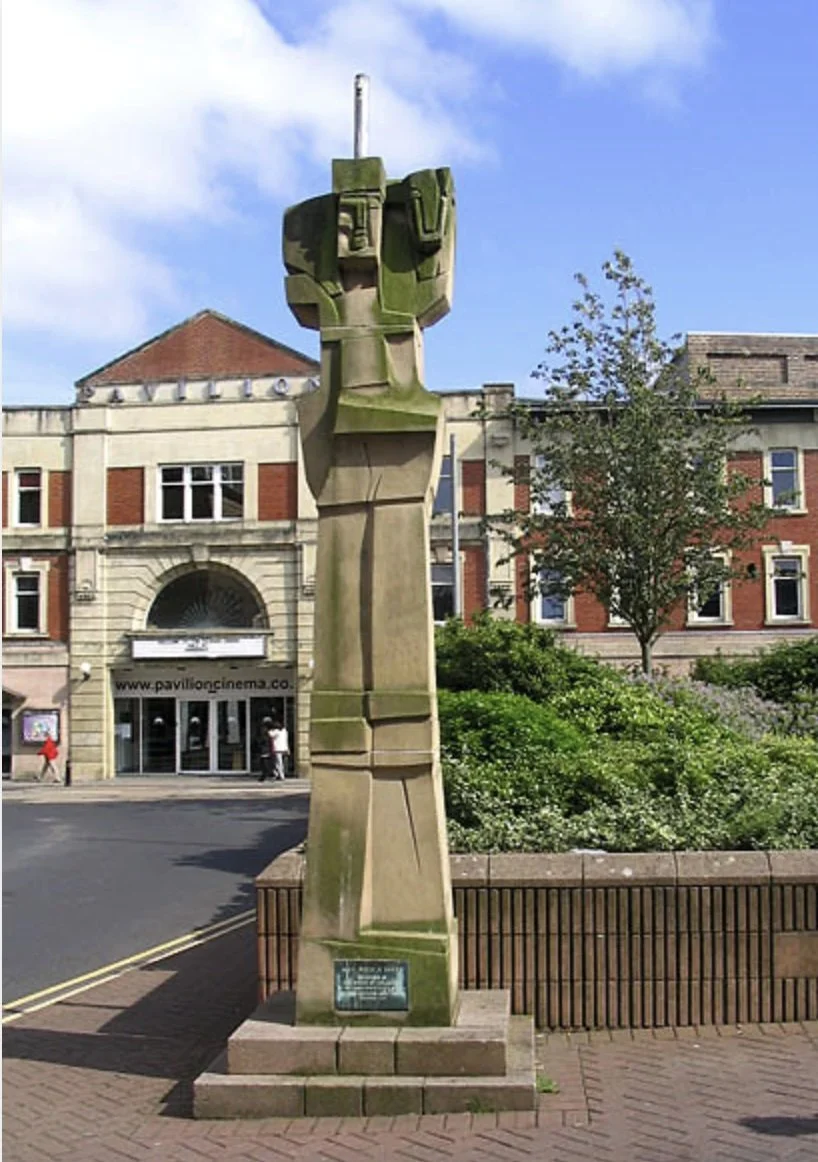
Ann Henderson, Man with a Sheep. Stone. Dimensions unknown. 1971. Courtesy of Walter Baxter, reproduced under Creative Commons Licence.
In the fine summer of 1967, Henderson somehow found the time and energy to herd sixty sculptures into Pittencrieff Park, Dunfermline for the Carnegie Trust-sponsored International Sculpture Exhibition. This included exhibits by Henry Moore and Barbara Hepworth as well as Scottish sculptors, and the press reported attendance of 30-to-50,000 people (Note 12). She returned to the park with a smaller outdoor exhibition in 1972. Henderson was also an active member of the RSA as its librarian.
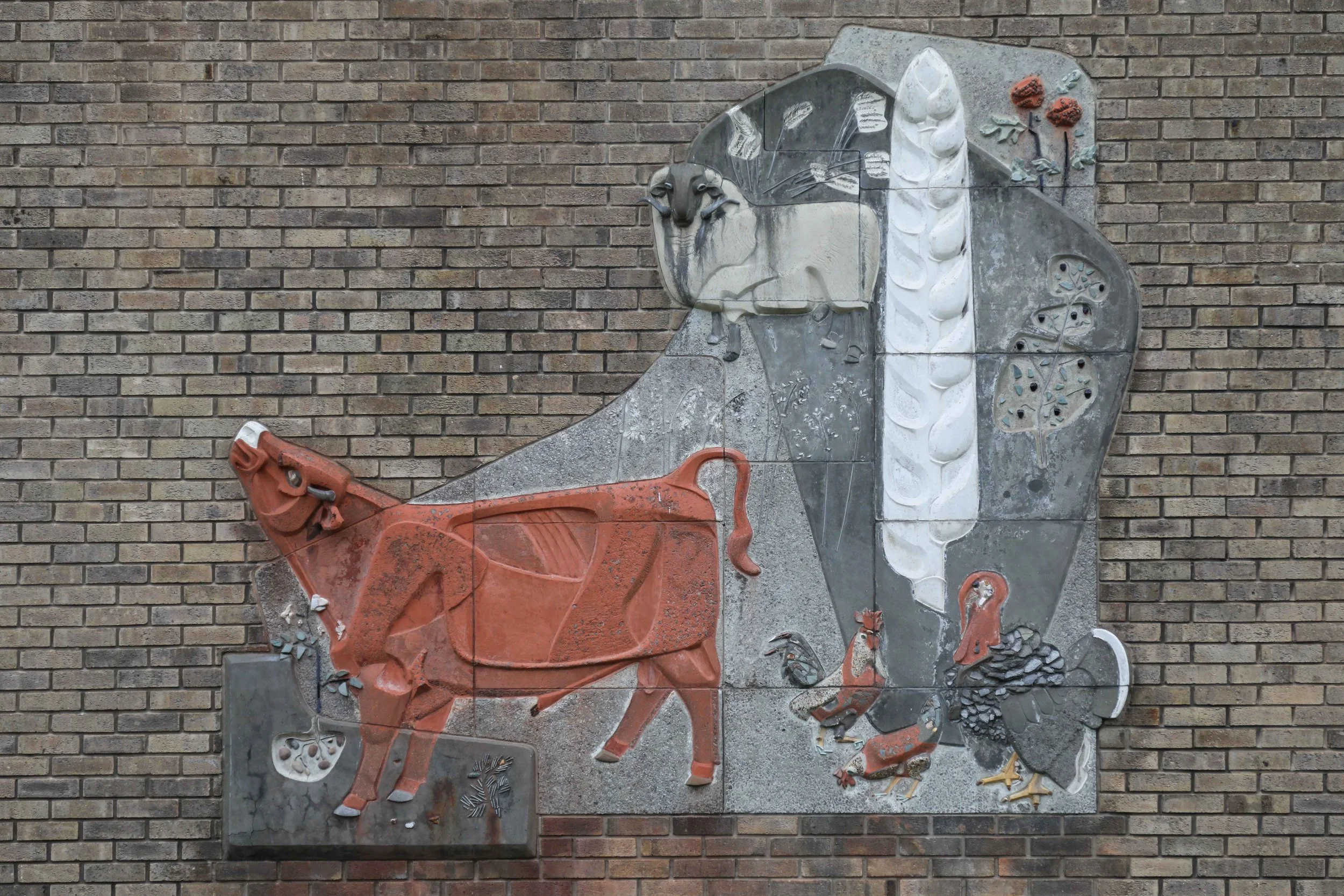
In 1958, Henderson brought her love of animals, themes of regeneration and innovative use of modern materials together and gave them colour in her commission Agriculture for Reiach and Cowan’s new School of Agriculture Building at King’s Buildings, University of Edinburgh. Ralph Cowan was Head of Architecture at ECA and Alan Reiach, RSA, was a great friend of the Schilskys’ and a teaching fellow there. Another ECA colleague, the mosaicist John Kingsley Cook, also worked at King’s Buildings, and she would have been aware of his work. Her panel is a celebration of life in the farmyard; a lowing, russet brown bull, turkeys, chickens, sheep and flowers all clustered around a tree of life. Executed in concrete and mixed media and mounted on the corner of the building beside a car park, it is well worth finding. This is a snapshot of Henderson’s farmyard, her other life in the countryside, which so inspired her.
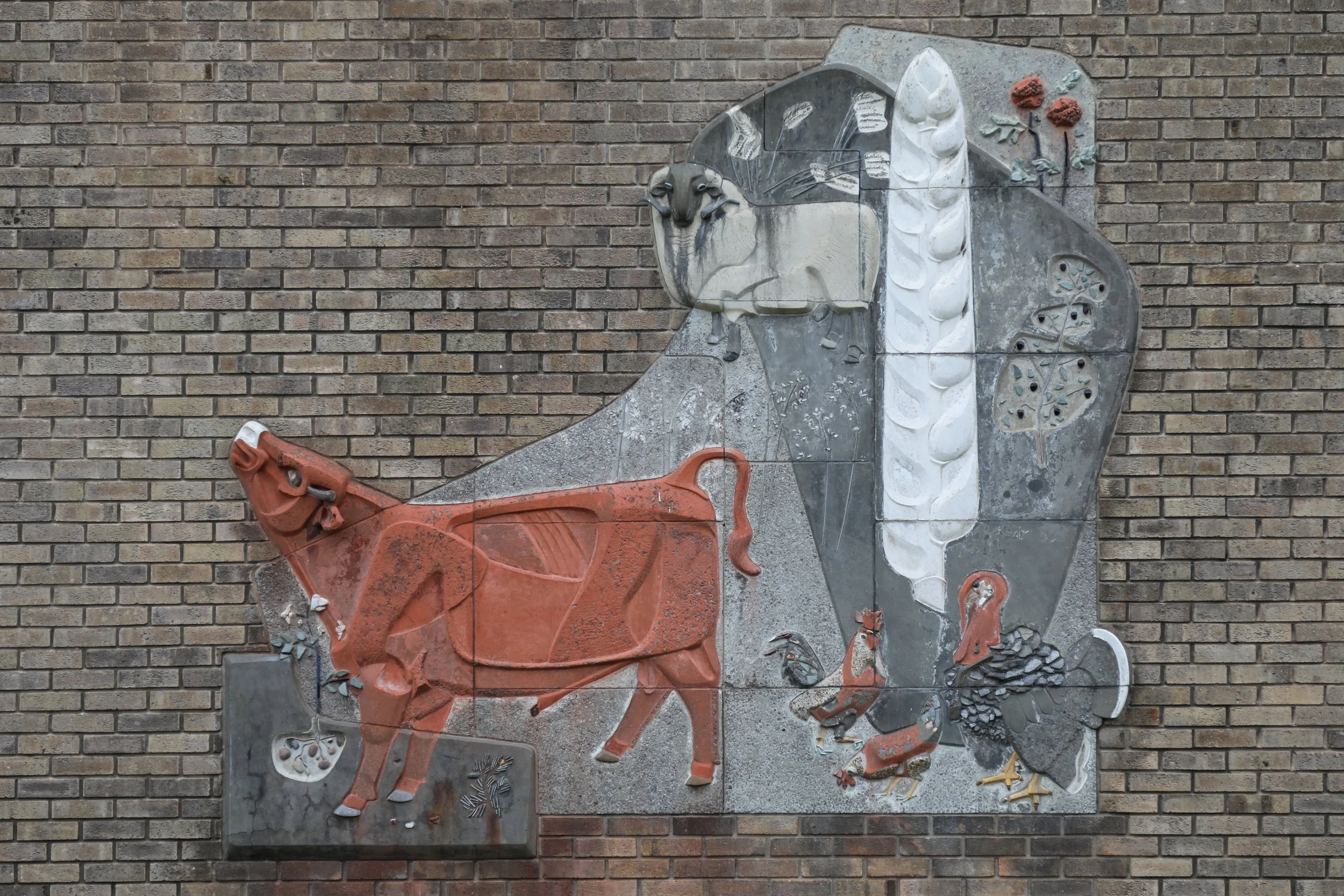
Ann Henderson, Agriculture, Concrete and mixed media. Dimensions unknown. The Peter Wilson Building at King’s Buildings, Edinburgh. Image courtesy of Nick Haynes.
Bill Scott recalled that Henderson would spend as much time as possible at her croft in Balinoe, about a mile from her family at Culrain Mains, Ardgay. Here, with her crofting partner, Lorna Robertson, she farmed and bred Highland Ponies and cattle. Robertson also came from Caithness and took on the croft first in 1948. They were successful, winning prizes for their livestock at agricultural shows, including the Royal Highland Show, and producing a twice-yearly publication, Highland Pony NewsMagazine (Note 13). Balinoe was a large croft, with three habitable houses on it. Henderson had a makeshift studio there too, and her niece recalls that in the 1970s, a new studio with a mezzanine level was built, replacing the original barn. Henderson was very excited about it, but sadly never used it as she fell seriously ill and died in Edinburgh on 13th March 1976. Her niece has kindly shared these memories of growing up at the Croft:
“As Ann was away in Edinburgh so much of the time, help was needed for Lorna Robertson to look after all their animals. My father took on this role alongside his own day job as an accountant in Bonar Bridge, and in return, we lived in the cottage, right beside Ann’s. It was just a lovely, happy childhood.
I can remember clearly when Ann came home from Edinburgh on breaks, my brother and I were excited about that as she frequently took us out with her on the croft in her old Land Rover or she took us walking far and wide with her. We had many happy hours being bounced around in the Land Rover caring for the cows or ponies. She was great fun to be with as long as we behaved ourselves, as she didn’t take any nonsense. We knew if we didn’t behave that would be the end of time spent with her, so we were always very well behaved. She believed we should be allowed to help out on the croft, be kept active in all weathers, not be mollycoddled and took time to teach us new things. She was a very enthusiastic, knowledgeable and hands-on crofter. She would do any job and come up with innovative ideas on all sorts of things. There really was never a dull moment. She liked everything in good order, very organised, and although she wasn’t tall, she was strong and fearless.
I remember thinking Ann was very like her father, George, in character; my Grandpa! He was a hard-working, no-nonsense farmer, but with a twinkle in his eye and kindness for us children. They both had a good sense of humour but took their working life seriously and worked all hours. We had great respect for him and the same for Ann.
My parents were always telling stories about life at the croft with Ann and Lorna long after we moved away to Bonar Bridge in 1969 and frequently we would all make a return visit at weekends and we sometimes helped out if needed. Indeed, we all continued to visit Lorna at the Croft until she passed away a few years ago.
Ann did spend quite a bit of her home time in her art studio, sculpting mostly, I remember, with new pieces always in production. I remember vividly the smell of fibreglass resin too as she was keen to work in that in her studio. Most of the work I remember however, was clay sculptures with lots of sketches everywhere. I was allowed to watch her sometimes and I wish now I could remember more of what we chatted about. I remember adults (probably my parents) talking about her work and saying that the croft had given her a lot of inspiration for her pieces.
When I was about four or five, she sculpted my head in clay and also one of my seven-year-old brother, John. We both still have those and they are treasured. I can remember sitting for her to do that and being told to sit still and not fidget.
I think Ann’s other great love, apart from her art work in Edinburgh, was for her animals, for nature and the croft. She was so fond of each and every one of the animals; the croft had sheep, cows, ponies, ducks, geese, chickens, cats and her beloved dogs. We even had guinea fowl roosting in the trees, but I think that was my Dad’s idea after his time in Kenya.
I remember her great enthusiasm and love for the Highland ponies. She was a very knowledgeable horsewoman and the first time I ever rode a pony would have been with her on the croft. Occasionally she would ride the ponies across the croft or to the peat cutting in the hills behind the croft. They took great pride in breeding the best foals and talking about their plans for which ones to take to the Highland Show every year. They had many rosettes displayed in the stables and at least one stallion of their own, perhaps more, so it was a serious business for them. Many of the stock were sold on as young ponies, but they kept their breeding mares as retired family ponies. One in particular I remember, a grey called Morach was a favourite.
Ann was very sociable (there were always family and friends visiting) and she loved a good ceilidh. There was a lot of visits back and forth to the home farm at Culrain too where my grandfather lived until 1978, two years after Ann’s death. Her mother, Jessie had died in 1963. Ann’s younger brother Billy took on the Culrain farm after Grandpa’s time and his youngest son now farms at Culrain.
I remember as an older child of say 12, going down to Edinburgh to see Ann at her home there in Learmonth Garden Mews. It was a very different environment from the croft. She wore different clothes and had lots of fascinating works of art spread all around. I remember feeling it was nice to know where she lived when she wasn’t at the croft.
Thinking of her Thurso exhibition, I remember clearly looking at the tall piece called The Hen Woman and noting how very like my Granny, Ann’s Mum, it was. She looked after a lot of hens at the farm, so perhaps that was inspiration for The Hen Lady.
Lorna Robertson retained many pieces of Ann’s work and was very knowledgeable about everything Ann had done. Various pieces of Ann’s work were distributed amongst the wider family too and they are greatly valued and treasured… Many of the exhibit pieces for the exhibition (Thurso, 2011) were loaned to the Thurso museum by Lorna Robertson and other family members.”
In 2024, Henderson returned to The 57, which transformed into Edinburgh’s Fruitmarket Gallery, as the central figure in an exhibition by the artist Holly Davey. Davey, who works with photography, collage, text and performance, gave voice to the ‘silent’ areas of the Fruitmarket’s archive with an installation spotlighting the 354 women artists who had exhibited there, many of whose names have been forgotten. Davey took the outline of Henderson’s Little Bather II figurine (acquired by the City Art Centre in 1968) as the basis for a host of terracotta figures and traced and enlarged it in the form of a large felt shadow, cast across the floor of the studio from a central wooden structure, to represent Henderson’s large, yet shadowy, contribution to Scottish art (Note 14).
Although Henderson never became Head of Sculpture at ECA, her ability to teach and nurture the talents of her many students is recognised in the Art School Family Tree prepared by the RSA for the Origin Stories exhibition. More time is needed for a closer look at her work, particularly her Little Bather and poignant 1969 Guilt and Sorrow series. Fifty years after she died, almost to the day, and to mark International Women’s Day, this article seeks to bring Henderson out from the shadows and to celebrate the diversity of her work, her exuberant expression of form, the variety of her materials and colour, all inspired by nature and life in the rural Scotland she loved.
Anne Emerson
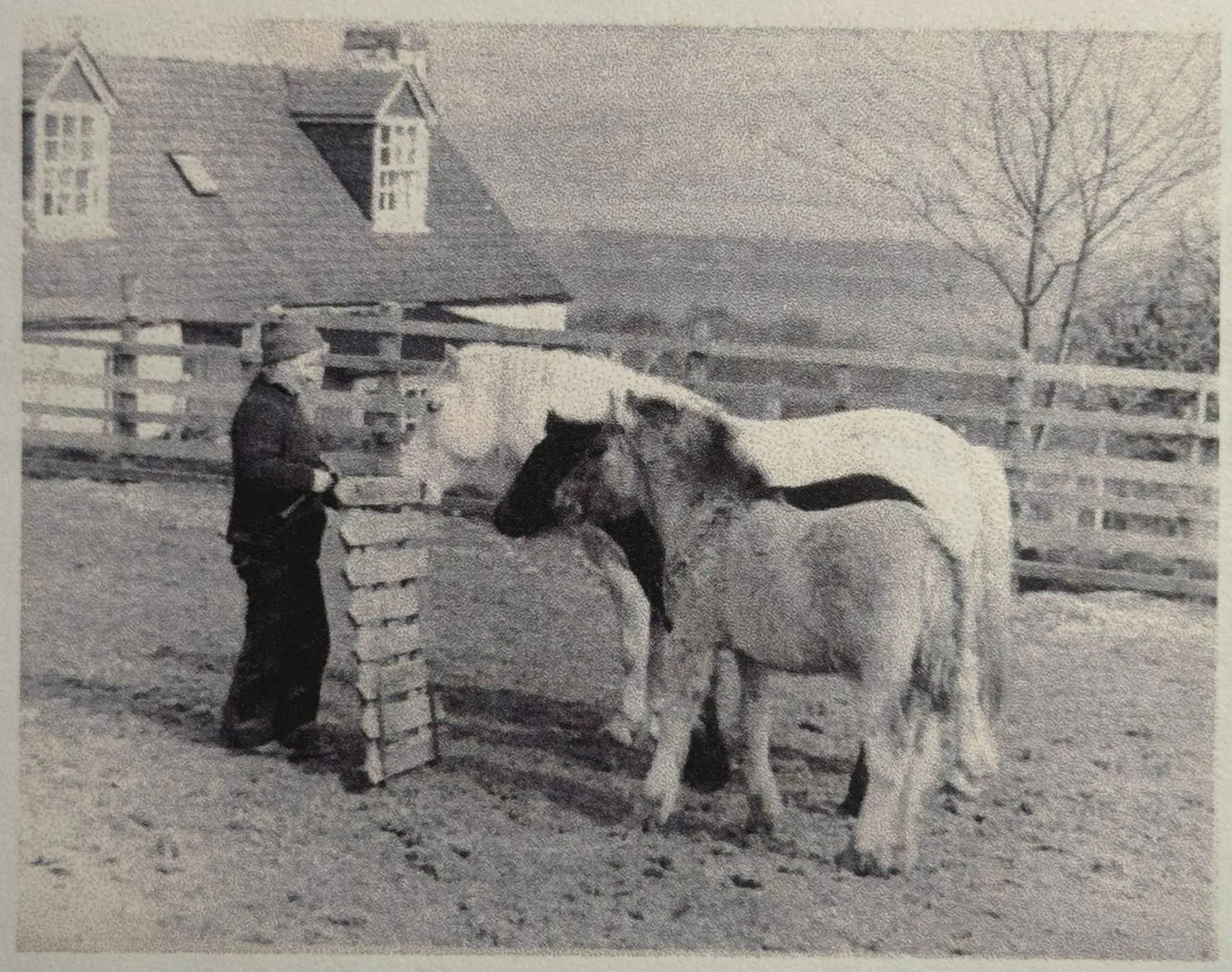
Ann Henderson with her Highland Ponies, Balinoe, Easter Ross. (image copyright the Henderson Estate).
NOTES:
The Scotsman, Saturday 15th August 1959
In 1976, Ann Henderson’s friend, former student and colleague Bill Scott RSA wrote an obituary for Henderson following her untimely death after a long illness.
In 2011, with Jake Kempsell RSA, Scott wrote an account of her life to assist with the preparation of an illustrated catalogue for “Ann Henderson, A Retrospective” at Thurso Museum. These brief texts were the starting point for this article.
Letter from Eric Schilsky to Victorine Foot, 6th November, 1945 from Schilsky Family Archive
John O’Groat Journal, Friday 7th May 1954
Transcript of conversation between Dave Cohen, Andrew Brown and Chiara Schilska, 1998, Schilsky Family Archive
Transcript of an interview by Chiara Schilska with Carol Carnevale, May 2002 Schilsky Family Archive
Email exchange regarding the work of Ann Henderson between Anne Emerson and Simon Manby, January 2026
The Scotsman, Saturday 15th August 1959
Photos of sculpture and nearby plaque provided Thurso High School Secretariat, January 2026. Simon Manby feels that two of the goddesses from the Parthenon east pediment must have inspired this composition, consciously or not. Plaster casts of all the carvings from the Parthenon were prominently displayed in the sculpture court at ECA.
Extract from from an interview with Jake Harvey, RSA by Sandy Wood, Head of Collections RSA, 25th September 2025
Bill Scott’s obituary says that this work was carried out in fibreglass and resin, but on visiting it I found that it is bronze supported on a steel frame.
Dunfermline Carnegie Library and Galleries, Facebook Post, 12 June 2025
Ross-shire Journal, Friday 21st May 1976 Obituary Miss Ann Henderson, Culrain
Holly Davey The Unforgetting see https://www.hollydavey.com/copy-of-the-unforgetting-1 and https://www.fruitmarket.co.uk/wp-content/uploads/2025/09/HD_Newspaper2024_p6_7.pdf
BIBLIOGRAPHY:
N Cooper The 57 and New 57 Gallery: 40 years Gone 10.07.2024
https://www.flemingcollection.com/scottish_art_news/news-press/the-57-and-new-57-gallery-40-years-gone
Nick Haynes, Clive B Fenton “Building Knowledge: An Architectural History of the University of Edinburgh”, HES, 2017 N ……
Flowers Statue ℅ Lorsford Antiques https://www.lorfordsantiques.com/scottish-20th-century-bronze-sculpture-by-ann-henderson-da0739324
http://www.buccaneertheatre.co.uk/Trophies.htm
Brotherston W “The Royal Scottish Academy of Art and Sculpture in Scotland” in Ages of Wonder Exhibition Catalogue, RSA, 2017
C Bailie de Laperrier The Royal Scottish Acedemy Exhibitors 1826-1990 Volume 2 E to K ed. Charles 1991
“The Sculptures of Pablo Picasso”, Gagaosian Gallery Exhibition Catalogue 2003
https://www.flemingcollection.com/scottish_art_news/news-press/the-57-and-new-57-gallery-40-years-gone
Helen Miles Mosaics, “A Guide to the Mosaics of Scotland” (https://helenmilesmosaics.org/blog/mosaics-of-scotland/)
WITH MANY THANKS TO:
Ann Henderson’s niece, the Henderson and Robertson Estates
William Brotherston, RSA, Sculptor
George Watson’s School, Edinburgh, School Development Office
Nick Haynes
James Holloway, CBE
Simon Manby, DA (Edin) MA, MAFA, PAI, Sculptor
Chiara Schilska, the Eric Schilsky archive
Lorford Antiques, Tetbury
North Coast Visitor Centre, Thu
Thurso High School Secretariat
Robin Rodger, Sandy Wood, The Royal Scottish Academy
Copyright for all images of Ann Henderson’s work is with The Henderson Estate.