

Alexander Allan: Frustration and Joy
Alexander Allan, born in 1914, was an extraordinarily gifted young artist, whose talent burned brightly in Dundee in the late 1930s. The war years and their aftermath saw him distracted from his desire to draw and paint, and even though he started to produce more work in the 50s, it was only at the turn of the 1960s that he began to realise the promise of his early work. He died in 1972, aged 58.
His legacy is mostly based on his student work and what he produced in the last decade of his life. Very little material is in the public domain and what there is seems to come from very different approaches. Roger Spence has been following the tracks he left behind and doing his best to fill in the gaps.
THE BACKGROUND
In Issue 14, I examined the artists Patrick Hennessy and W.P. Vannet through the prism of a 1938 exhibition they held in Arbroath. I spent much time discussing the influence of their teachers, Edward Baird and James McIntosh Patrick, and the direct and indirect impact of James Cowie.
Hovering in the background of the article was Alexander Allan. He has as much claim to be a “Baird-Patrick Boy” as Hennessy and Vannet. He was one of Hennessy’s best friends at Dundee College of Art where they both studied under Baird and Patrick from 1936-1938, and the pair then went to the post-graduate school headed by Cowie at Hospitalfield together in the summer of 1939.
In the course of writing on Hennessy and Vannet I made contact with Alexander Allan’s son, Neil, and after meeting him and with access to his substantive archive, I resolved to complete my Baird-Patrick sequence with a survey of Alexander Allan’s life and work. The article that follows could not have been produced without Neil Allan’s very considerable input. He has read it and approved.
Alexander Allan was born on the 29th October, 1914. Neil was born in 1949 and was 22 when his father died in 1972. Neil’s knowledge of his father’s early years is based on family oral history and pictures. There are no first-hand written documents that shed light on his father’s life. I take responsibility for omissions and mistakes.
Alexander was known by his family as ‘Alex’, and by his art friends as ‘Sandy’. He signed his paintings ‘Alexander’. We’re art people; let’s call him Sandy.
THE EARLY YEARS
Sandy’s parents were David and Margaret (nee Crawford). David grew up in Dundee, and worked as a power loom tenter in the jute industry until just after World War One, when he emigrated to Calcutta, India, where he was a foreman in a jute factory. The family, Margaret, Sandy and his sister, Dorothy, stayed in Dundee. Sandy was born in a tenement in Lochee, but the family moved to Blackness Road, still in a tenement, but not too far from the villas of the Perth Road and an easy walk for Sandy to attend Harris Academy. Harris was (and is) a state school, but had a status to it. Robert Plenderleith was Head of Art throughout Sandy’s time there.
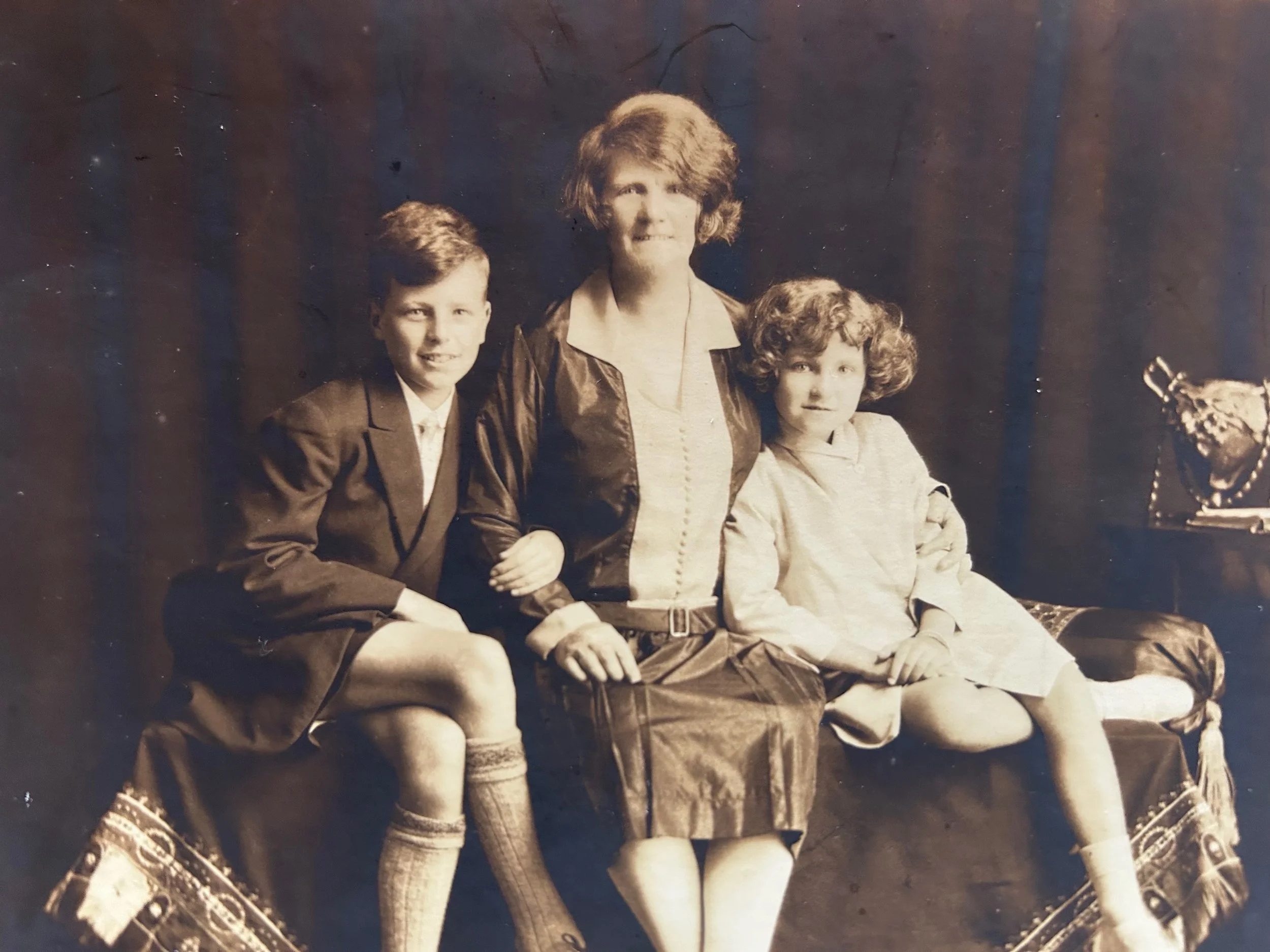
Alexander Allan as a boy with his mother and sister, Dorothy. c. 1927. Courtesy of Neil Allan.
David Allan returned from Calcutta in 1927 and bought a pub in the Seagate. This was a short-lived and fateful decision, exacerbating his drink problem and leading to his death in 1930 at the age of 51, when Sandy was 16. Neil is unsure whether there was any inheritance, but he recalls that the family were left with very limited financial resources (and, of course, there was no state welfare system). Neil suggests that this may have been a factor in Sandy’s mother re-marrying relatively quickly in 1933 to become Mrs. George Lumsden.
Neil advised that when Sandy went to art college eighteen months later, “my father would spend exceptionally long hours round the college as he did not take to his step-father nor his step-brothers with whom he had to share a room.”
Sandy left school shortly after his father’s death, aged 16, and tried to get a job. Perhaps he felt a responsibility to bring some money into the family. The circumstances could not have been worse. The Wall Street Crash had happened the previous Autumn and the worldwide depression was having its worst impact on industrial towns like Dundee. Unemployment rose swiftly into the 20-30% territory.
We don’t know much about Sandy’s artistic capabilities or interests on completion of his school studies. The H.M. Inspectorate report on the art department at Harris Academy from 1930 didn’t suggest much excitement or flair: “This is an efficient art department. The pupils are competent and work methodically and rapidly.” Ian Eadie was the star student, and art dux in 1930 and 1931.
What we do know is that Sandy started at Dundee College of Art in the Autumn of 1932. At some point, I can’t pin it down, he turned a four-year course into five years and joined the class of the year below in which Patrick Hennessy was a dominant figure. They both completed their diploma in 1937 and got a maintenance grant of £66 each towards post-diploma study, which they completed in 1938 with commendations. Sandy’s home address had changed to Monifieth by this point.

Alexander Allan, Portrait of a Young Woman (Hilda Soutar). Ink on paper. 50 × 38cm. 1930s. Courtesy of University of Dundee Fine Art Collections.
Hilda Soutar, Sandy’s future wife, who had also been a Harris Academy student, and lived in Magdalen Yard Road, (which is where James McIntosh Patrick moved to in 1940) was in the year below, gaining her diploma in 1938. Her cousin, Hamish Soutar (Note 1), was in the same year. In the 1938 prize giving, Hamish Soutar was awarded a scholarship to study at the Reimann School in London, as Horatio Greensmith had in the previous year. (Note 2)
All of Sandy’s biographies state that Sandy studied at the Reimann School and then at Central School in London. This is Neil’s understanding too. The dates and details are not known. The Reimann School’s short-lived but high-profile tenure in London (it had re-located from Berlin) only lasted from 1937-1939. Sandy was at the Art College in Dundee until June 1938 and then at Hospitalfield from April 1939.
Austin Cooper, principal of the Reimann School, had himself been a full-time student at Hospitalfield from 1906-1910 and was the visiting assessor for Design and Decoration at Dundee College of Art in 1938. It was the year that The Studio Magazine published his book, Making A Poster, in their How to do it series.
The Reimann School had awarded Greensmith additional monies to enable him to travel. And Dundee College of Art was sending Hamish Soutar. Perhaps Cooper, keen to maintain positive relations with Dundee, found a means of funding Sandy to allow him to attend his School at some point in late summer/autumn 1938. Perhaps Sandy had generated his own funds through part-time work during his student years? There was much work in the field of illustration and printing at that time: major Dundee industries that were just on the cusp of change through mass-market comics (Dudley Watkins’ first Oor Wullie strip was drawn in March 1936; The Dandy launched in December 1937 and The Beano in July 1938).
One has to assume that once in London, Sandy was drawn to fine art rather than commercial art and given his references to Mark Gertler in future biographical information that he produced, he may have specifically sought out his teaching at Westminster School.
Gertler was having huge personal and financial difficulties over the winter of 1938/39 and his part-time teaching job was his only income. There is no record of Gertler doing any private teaching or having private pupils. He taught mostly in the evenings at Westminster. Gertler killed himself in June 1939. So, my best guess is that Sandy was one of his last pupils at Westminster over the October 1938-March 1939 period.
And my next best guess is that Sandy moved from day-time study at Reimann to the Central, and then travelled one or two evenings per week from the Central’s Southampton Row building to the Westminster in Vincent Square.
Enough guesswork!
By this point, aged 24, he was a master draughtsman, producing work almost without parallel in Scotland. In England, Edgar Holloway, Sandy’s contemporary, was perhaps the last of a line of fine-detailed draughtsmen (Tunnicliffe, Brockhurst, Rushbury, etc.) who drew mostly for etching. Sandy Allan was their equal.

Alexander Allan, Battery Powered Torch. Ink on paper. 29 × 24cm. 1930s. Courtesy of University of Dundee Fine Art Collections.
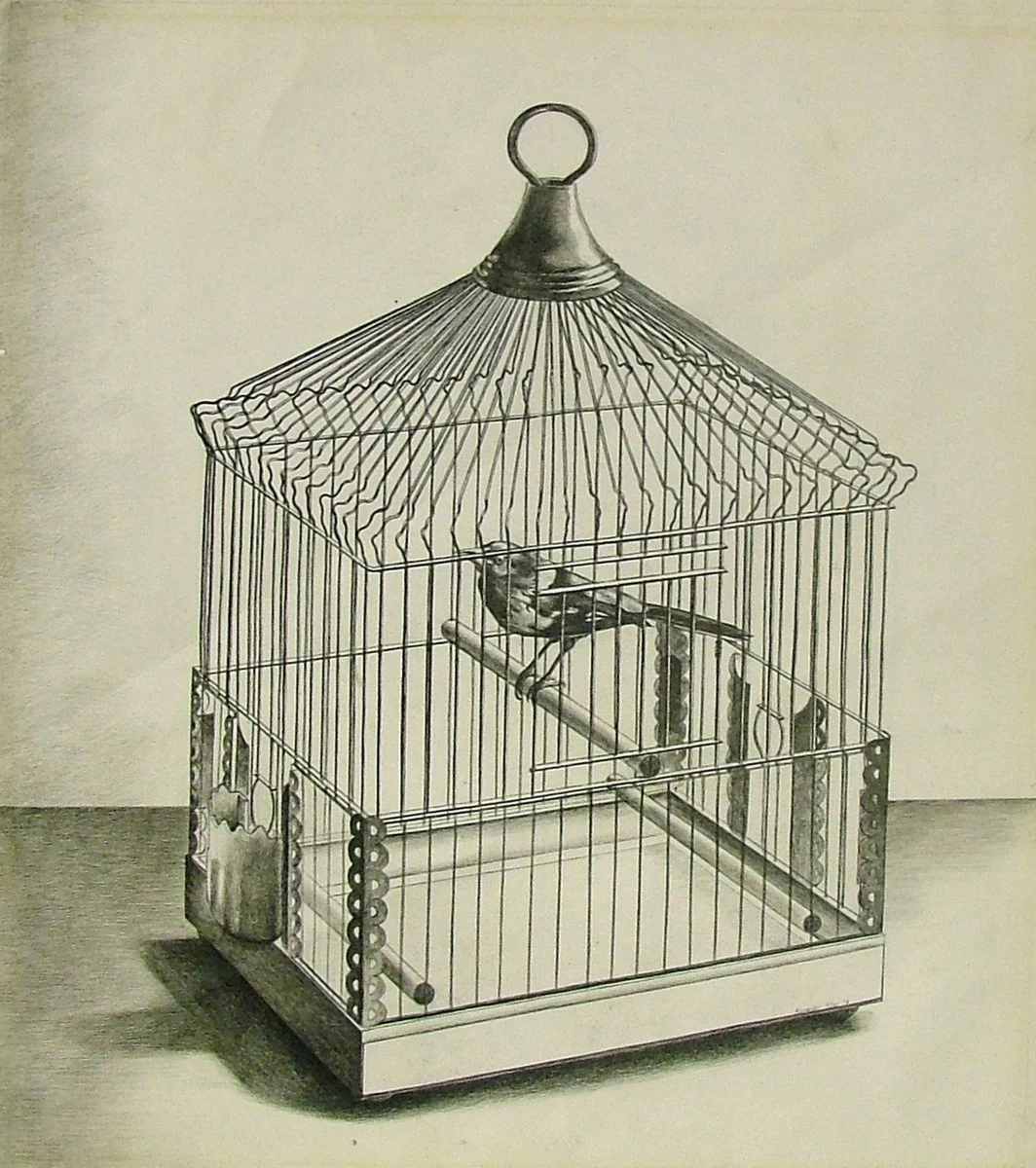
Alexander Allan, Bird in Cage. Ink on paper. 38 × 37cm. 1938. Courtesy of University of Dundee Fine Art Collections.
Sandy would have been well aware of the collapse of the market for etching. Skilled draughtsmen and recorders of reality who previously found outlets through etching editions were having to find new ways of making a living: teaching, advertising, illustration…
His strengths were in observation and detailed drawing, and he was capable of producing images of objects that could trump photographs in terms of accurate representation. A 1930s print of a black and white photograph couldn’t replicate Sandy’s torch. Other people were making money in marketing and advertising with just these skills. Neil reports that “there was a meticulous etching of a Wolseley car in my father's studio which he explained had been part of a portfolio when he contemplated applying for jobs in that sphere, though I don't know if he ever did.”
There was also an ongoing demand for accurate portraits and Sandy’s interests and technical capability suited this format too. He was especially good at heads, and applied the same obsessive skill levels to their realistic representation as he did with objects. Ink was his favoured media, but he was already skilled at transferring his concepts into oil. Look at his ink portrait of his sister and then this oil portrait of Norma McLaren from 1936.
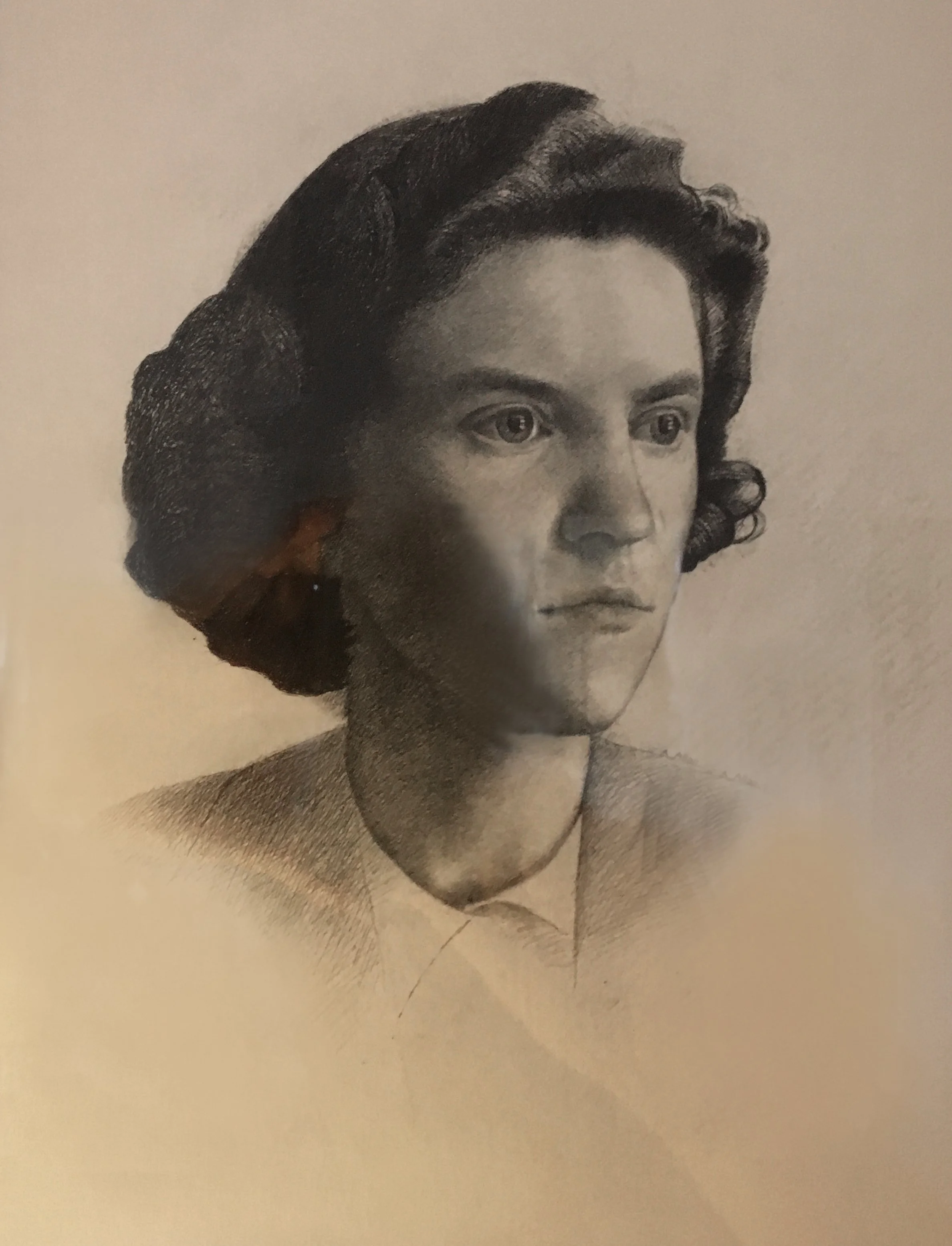
Alexander Allan, The Artist’s Sister (Dorothy). Ink on paper. No dimensions. 1940. Courtesy of Neil Allan

Alexander Allan, Norma McLaren. Oil on canvas. 46 × 35cm. 1936.
Around the same time, Sandy produced Fantastic Landscape, a work that positioned him close to Edward Baird and pre-dated Patrick Hennessy’s mining of this theme. In oils too, Sandy Allan was creating work that stood comparison with the best painters in Scotland - and the UK - working in super-realism, as it bordered into surrealism. Baird, influenced by James Cowie, had juxtaposed highly polished, detailed paintings of still-life objects with expansive landscapes rooted in reality. Here, Sandy superimposed the highly stylised peeling paint wall, detached two-tone flower heads and horizontal classical pillar shapes that presage a zebra crossing (still fifteen years in the future) on to a landscape he knew well: Glen Clova. Strange dark clouds and an exploding flare invade the summer valley, imposing inner thought on to outer reality.
Sandy held on to this painting all of his life. It was exhibited at his Memorial Exhibition at Dundee Art Society in 1974 and was bought there by the Scottish Arts Council. It regularly turns up in surveys of Scottish art history in exhibition or print. And yet it represents only a fleeting moment in Sandy’s opus.
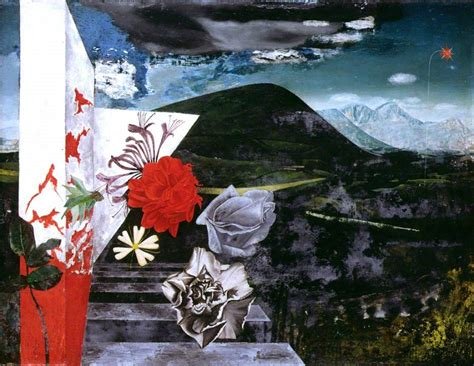
Alexander Allan, Fantastic Landscape. Oil on Board, 34 × 45cm. 1938. Courtesy of Dundee Art Galleries and Museums Collection.
How did Sandy arrive at this point?
There is no evidence that his schooling pointed him in the direction of art as a career. In later life, Neil reports, art was a fairly all-consuming passion. It was what Sandy spent most of his spare time doing. We don’t know when that passion took hold and whether it motivated him to set the standard that he was able to achieve in his early 20s. Surely it was!
What we know is that one year after leaving school, without his father’s influence, he was applying to go to art college. Having had a year in the job market he considered his options and applied. He must have got a portfolio together and it must have been good enough to get him in. It was either the legacy of the rigour and teaching competence at Harris Academy, or he somehow found the motivation and resource to advance his capabilities himself. Who knows? But once he was there, James McIntosh Patrick with his meticulous drawing and etching example, could have been a model and inspiration.
Patrick only taught part-time, but the students knew of his success and prowess. And he was only 25 in 1932, seven years older than Sandy. John Milne-Purvis, Head of Drawing and Painting, was 47, and must have seemed ancient in comparison. Students regarded Patrick as a bit of a ‘star’.
Edward Baird arrived at the College of Art, also to teach part-time, in 1936. Baird and Patrick had been close friends and admirers since their first week as students at Glasgow School of Art. And Baird was also a ‘star’ who had injected a flavour of Surrealism into the Scottish art scene with his 1934 Birth of Venus . Patrick and Baird put high value on detailed observation and meticulous drawing. They regarded these technical skills and eye-to-hand intuition as the foundation for art, and these were surely key elements of their teaching message.
As we discovered in Issue 14 with Hennessy and Vannet, Dundee College of Art -probably through Patrick and Baird - produced a raft of exceptionally gifted draughtsmen and women; and Sandy was associated with the best. His closest friend was Patrick Hennessy and Hennessy amassed awards throughout their College time. But by 1938, Sandy had eclipsed him and all of his peers and tutors as a draughtsman.
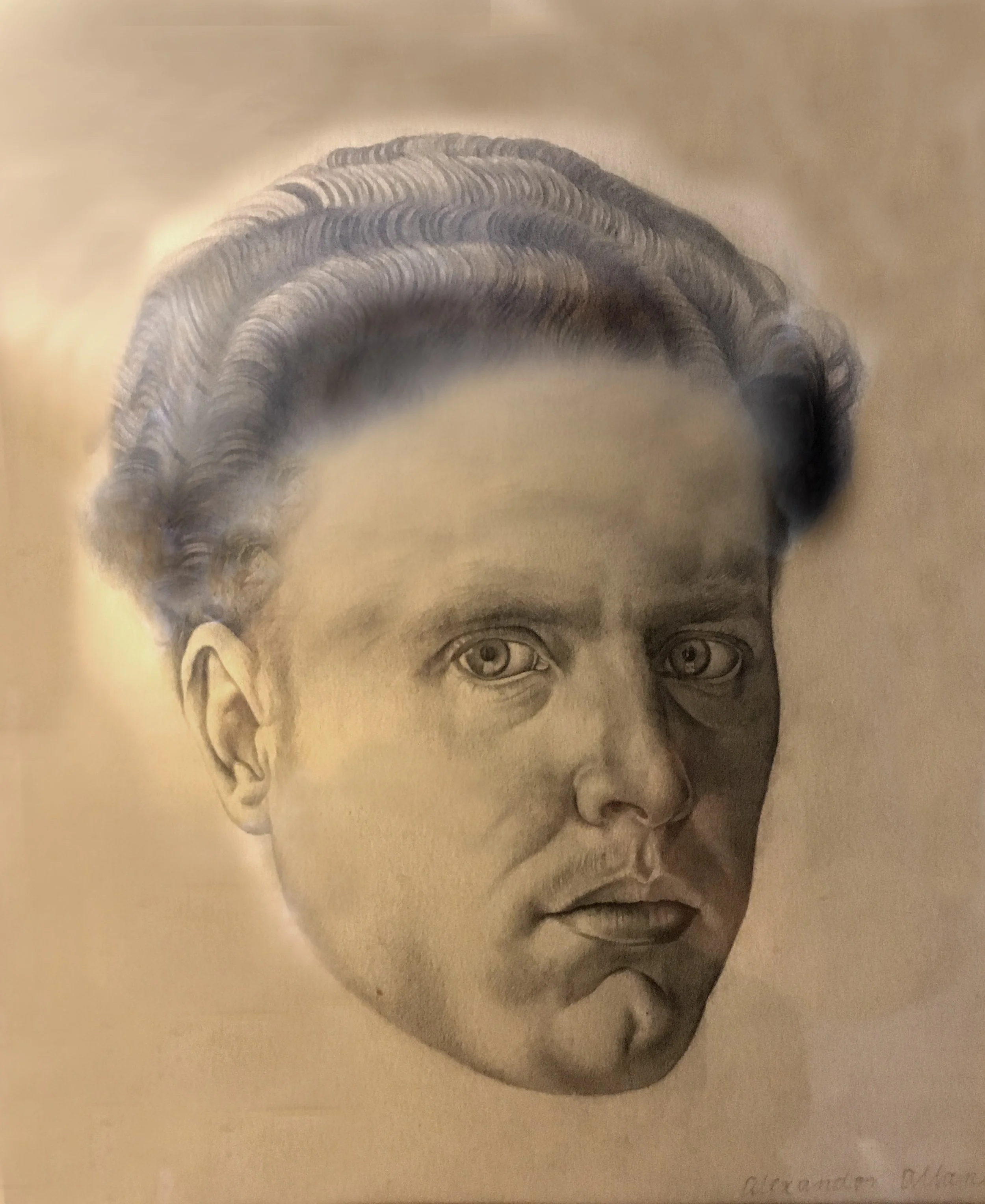
Alexander Allan, Self-portrait. Ink on paper. Dimensions unknown. 1939. Courtesy of Neil Allan.
Hennessy was a charismatic figure at the College, the lead figure in the dramatic activities; and the partying. He was a brilliant talent and destined for a high-profile artistic career. He was also gay. Neil doesn’t know and doesn’t care whether Hennessy’s camping trips with Sandy involved anything more than sketching, but he is in no doubt that Hilda disapproved of Hennessy’s sexuality. And Hilda and Sandy were definitely romantically involved by 1939, if not well before, because Neil remembers comments about a pre-war holiday at Roundyhill, near Kirriemuir. Once Hennessy emigrated to Ireland in September 1939, they lost touch - apart from an out-of-the-blue letter from Hennessy in 1946 (Note 3).
The summer of 1939 was a pivotal moment for the two young artist friends. They attended Hospitalfield College together as part of a cohort that included Charles Pulsford and Waistel Cooper. Robert MacBryde and Robert Colquhoun, who had attended in 1938, were visitors, and William Gear was too. They had been away from art school travelling and studying, Hennessy in Europe with the Two Roberts, Sandy in London with Mark Gertler and others. The impending war, their collective art experiences, the devil-may-care atmosphere which included, one imagines, an element of highly-charged sexuality; was too much for the Warden, James Cowie. Artistically, Cowie managed to steer Sandy, Pulsford, Hennessy and possibly others to consider his ideas seriously, but he couldn’t handle the hi-jinks. Sandy and Hennessy were asked to leave.
Suddenly, the realities for a young artist hit home. Hennessy left - never to return - for Ireland, escaping the War. Meanwhile, Ian Eadie had taken the last available job before the War at the College of Art. Edward Baird had resigned, unwell, and was living in near-poverty.
Throughout 1938 and 1939 the shadow of war hung over Britain. Artists were preparing themselves for it. The Scotsman of December 8th, 1938, carried a letter from a raft of pre-eminent London artists and art historians (Vanessa Bell, Austin Cooper, Herbert Read, Henry Moore, etc.) seeking support for German artists driven out of their country. Mark Gertler, in London, was writing to friends wondering how he might survive without any teaching or gallery income. Sandy, along with a number of colleagues at the College of Art signed a Peace Pact, promising to refuse to fight.
And he followed through. When he was called up, he turned himself into a ‘conchie’ (a conscientious objector). Neil says that his father’s character was such that once he had made a commitment, he felt duty-bound to honour it.
The Dundee Courier, 2nd May 1940, reported: “an applicant told the South-East of Scotland Tribunal for Conscientious Objectors at Edinburgh yesterday that he thought Hitler could be prevented from overrunning this country by the training of a non-violent army.
He was Alexander Allan (25), poster designer and commercial artist, 1 Windsor Terrace, Monifieth, who based his claim for exemption on moral and aesthetic grounds. He stated he thought we would be better to adopt the same principles as Denmark had done.
He was rather unpopular with the students at the Art College because of his strong views as a pacifist which he had held for several years. Allan was conditionally registered as an objector, provided he takes up civil ambulance work or forestry.”
Here might be a clue as to how Sandy was funding his life - poster design and commercial artist work. But only two days later, the Courier was reporting on his “fine portrait of Miss May Dignan at the RSA’s Annual Exhibition (and his Red Tower at the RA in London), and telling us that “when he is not at work in his studio in Castle Street, Broughty Ferry, Mr Allan finds relaxation in books and in music.”
Hilda Soutar also exhibited at the RSA exhibition of 1940 - an oil painting of Sea Wynd, the narrow Dundee close that ran towards the sea from the Nethergate.

Hilda Soutar, Sea Wynd. Oil on canvas, 41 × 51cm. 1940. Private Collection.
As we can see, Hilda was an artist of considerable skill too. This was a bold entry, but perhaps apt for the mood of the moment. Darkness, shadows, two-dimensional silhouettes to represent people; its management of low-toned gradations of sky and rooftops is based on keen colour observation; and she uses her single source of light, centre stage, with its illuminated theatre to essay the diffusion of brightness playing on flat surfaces and subdued colour. Look at how she demonstrates the effect of the lamp’s astragal and its metal base on the shadow patterns beneath it.
THE MOMENTUM CHANGES
Hilda continued to paint, presumably whilst she was doing her teacher-training, and submitted a watercolour and a well-received oil Still Life of flowers to the RSA in 1943 and 1944 respectively.
Perhaps Sandy lost some friends and some respect, but his reaction to the Tribunal judgement was to volunteer to work in forestry and he was sent to Benmore near Dunoon, where he met fellow artist, Tom Shanks. Shanks became a friend for life.
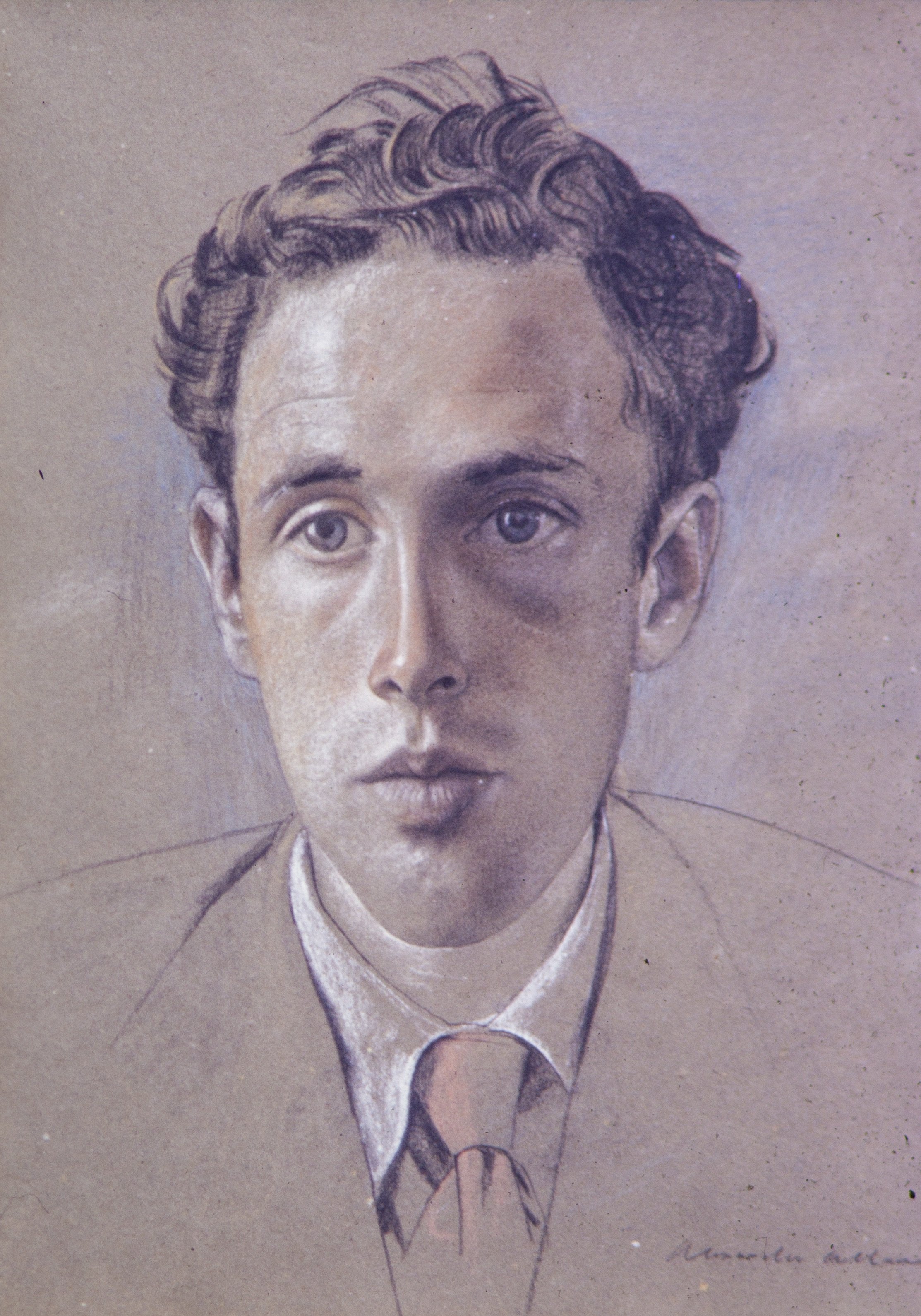
Alexander Allan, Tom Shanks. Mixed Media on paper. Dimensions unknown. 1940. Courtesy of Neil Allan.
Sandy’s drawing of Shanks was one side of a bargain, the exchange being a pair of Shanks’ wellington boots. The Cowal forests were the first stop on an itinerant tour of forestry jobs through the Second World War, including Tentsmuir and Glen Clova. Attachments to trees and to Glen Clova were also life-long artistic interests. Sandy’s sketchbooks and much of his future pen and ink work focused on trees. In Glen Clova in the war years Sandy befriended a farming family at Middlehill Farm. Here’s a portrait of Mrs. Edgar, wife of the farmer.
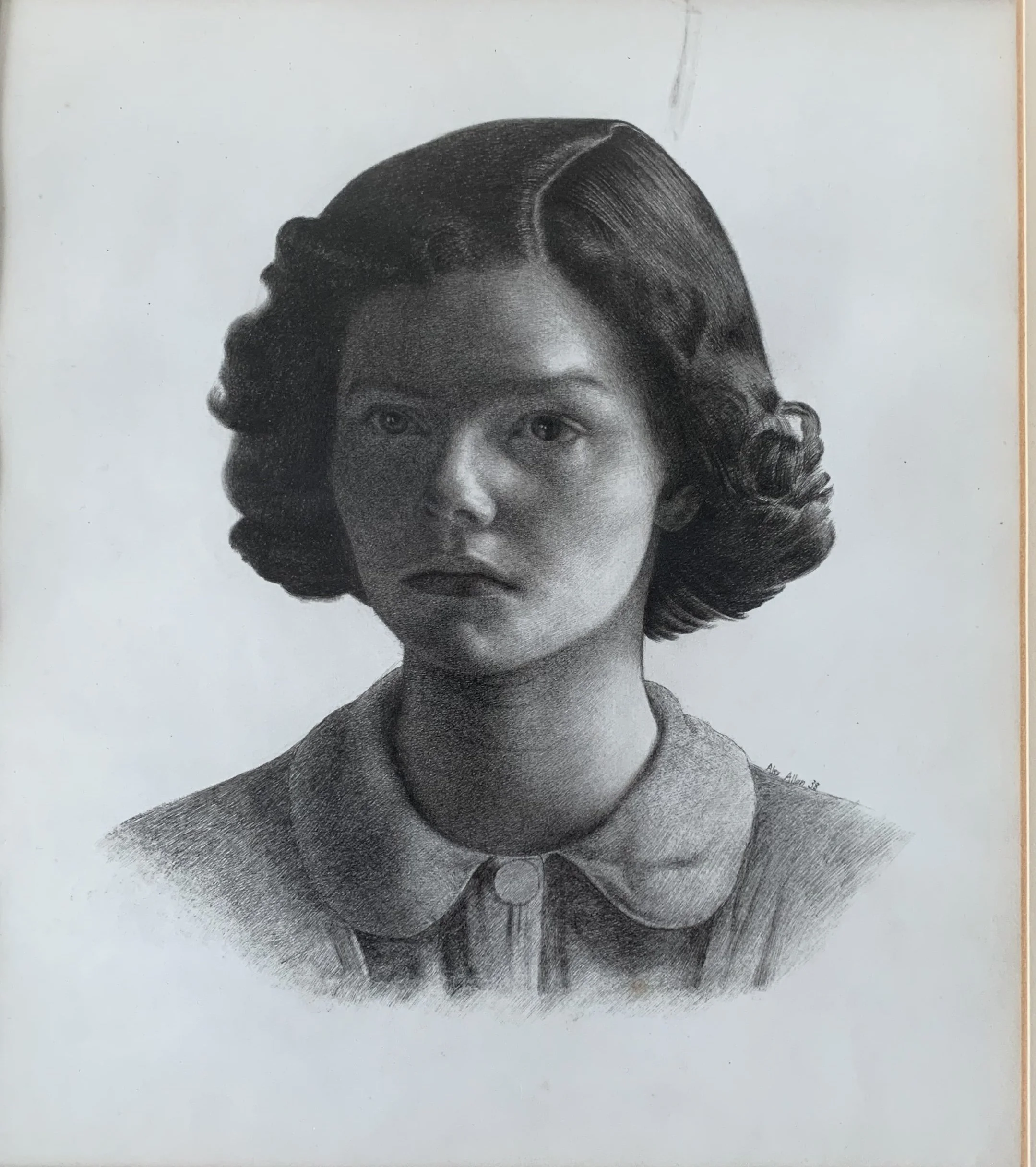
Alexander Allan, Mrs Edgar. Ink on paper. Dimensions unknown. 1945. Courtesy of Neil Allan.
His friendship with the family was enduring and as a consequence many of his future landscapes were Clova scenes. He loved spending time there.
Between the forestry jobs, his relationship with Hilda progressed, and they were married on 22nd August 1944 at 85 Magdalen Yard Road, her mother’s house (Hilda’s father was no longer alive).
By this time, Hilda was teaching art at Dunoon Grammar School, and the couple spent their first five years of marriage in Cowal. Sandy took a teacher training course. Hilda resigned her post, perhaps due to being pregnant with Neil, but according to Neil himself, she did so in the hope that Sandy would be employed in her stead. Sandy applied for the post, but didn’t get it, and the couple moved back in with Hilda’s mother in Dundee.
Neil was born in 1949 and Sandy became the family breadwinner, getting a three-year contract to teach art peripatetically in Angus Schools. This was either in 1949 or 1950; I assume the former.
Reviewing his artistic life to date, there was an extraordinary student flourishing that included exhibition of paintings and drawings at the RSA in 1939 and 1940, and presented Sandy Allan as a draughtsman and painter of international standard. Then there was a decade of Sandy’s life (between the ages of 26 and 36) during which only one painting was recorded as being exhibited (Dorothy at the RSA in 1943) and one other in Neil’s records (Archeline from Guyana, dated 1944, shown at the RSA in 1952). Apart from Dorothy, there are no records of any other paintings shown, either at one of the exhibiting societies or a commercial gallery, nor even Dundee Art Society.
To all intents and purposes, Sandy Allan’s professional career as an exhibiting artist doesn’t seem to have started until he was 36 in 1950, when he was back submitting work to the RSA’s Annual Exhibition (he submitted every year from 1950 until his death, with the exception of 1965 and 1969). At this point, his momentum had changed. His burning desire to paint had been compartmentalised into marriage, a family life, with work as a teacher, parental responsibilities, and residence with his mother-in-law.
My understanding is that the Angus teaching - which by all accounts was successful - led to Sandy getting an assistant art teacher job at Bell Baxter High School in Cupar in 1952, and to Sandy and Hilda buying a house at 4 Shepherds Road, Newport-on-Tay. It was to be their home for the rest of both of their lives.
There is not much evidence of huge production through the early-to-mid-fifties. But what there is shows that his re-emergence into the public art world was with a different approach.
The world had loosened up and landscape sketches in ink and wash, sometimes with touches of coloured or white shading, were his main artistic vehicle, apart from portraits. You can tell from these sketches that the artist had a good eye and could move quickly to represent what he saw, but the painstaking, meticulous detail had been binned; the technical skills that made his student work so thrilling had been set aside.
In the worlds of architectural drawing and portraiture, the old principles held true - careful observation and detailed articulation of reality. Look at his portrait of Graeme Soutar. It might have been a private family sketch in his early years, but he was happy for it to be shown at the RSA in 1953.
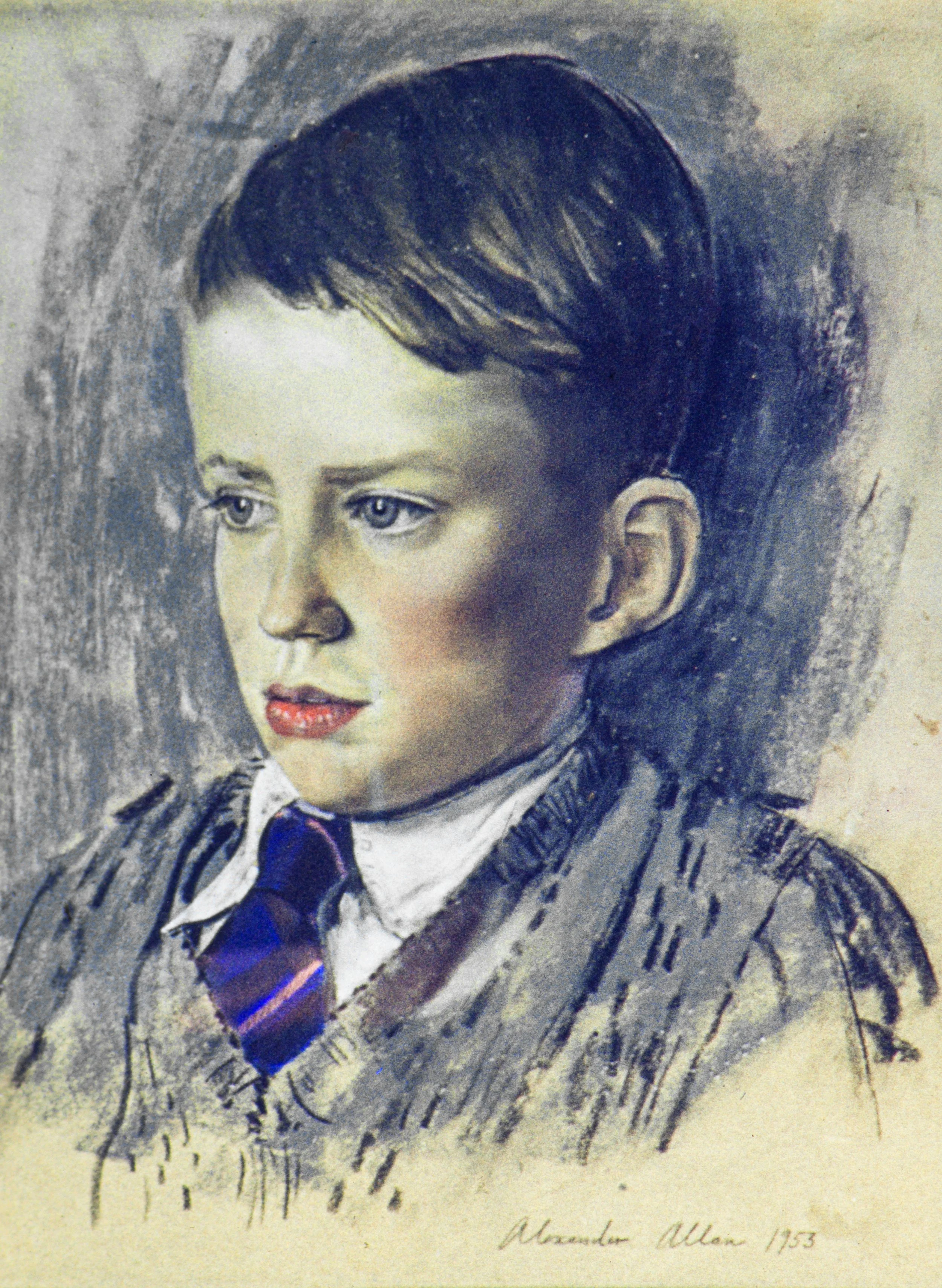
Alexander Allan, Graeme Soutar. Mixed media on paper. No dimensions. 1953. Courtesy of Neil Allan.
There were single entries at the RSA in 1950 and 1951, then three per annum from 1952-1960, with the exception of ’54 and ’57 where there were two - presumably through selection. At the same time, Sandy exhibited a couple of pictures at the Fife Teachers Exhibitions in Kirkcaldy from 1954 and at the Royal Academy in London from 1956-1959. He didn’t have a solo show anywhere until the one at the RGI-supported Blythswood Gallery in Glasgow in 1958. His next one would be at The 57 Gallery in Edinburgh in 1960, at which point he was 46. These were both small galleries and the exhibitions were for short time periods.
In 1961 he resigned his post at Bell Baxter, where his relationship with the Head of Art, George Liddle, had reached breaking point, and he got a job as Head of Art at Rockwell School in Dundee. Here he is, with his teaching colleagues, at the point in his life where his art moved back to the front and centre of his world. According to Neil, he was always well dressed - even when he was painting (see the sketch by Emilio Coia at the end of the article).

Alexander Allan, Marguerite Deas, Jimmy Wallace, Rockwell School Art Teachers, c. 1962.
The passion that burned so brightly in the late 1930s returned in the 1960s. Most of his reputation is based on these two periods.
FULL ENGAGEMENT IN ART
From the late 50s, Sandy was actively producing work to exhibit, and engaged with galleries and exhibiting societies, perhaps even pro-actively. Presumably he saw the opportunity, which he took up in 1967, to finally become a professional artist, earning enough to support his family. From 1966 to 1968 his output peaked and he exhibited with the RSW, the RGI, the RSA, Dundee Art Society, Aitken Dott, The Richard Demarco Gallery, The Glasgow Group, The Fife Group, The Blythswood Gallery, Douglas and Foulis’ Gallery, and The Dundee Art Teachers Exhibition.
Graphs that measured Sandy’s profile, sales and status across the Scottish art world would have commenced at a very low base in 1958 and would still be rising in 1972.

Alexander Allan, Thistles. Mixed media on paper. 28 × 42.5cm. 1960.
His first Edinburgh solo show - all ink and wash works - at The 57 Gallery in 1960 kick-started his upward trajectory with a review by Sidney Goodsir-Smith that made heads turn. It possibly helped cement the decision by Glasgow Museums to buy a picture, Cullow, Sandy’s first in a public gallery.
It’s worth re-printing the section of the article in full:
“Alexander Allan’s exhibition of ink and wash drawings at the '57 Gallery, 53 George Street, Edinburgh, is very much to be recommended to anyone with a delight in sensitive, delicate, albeit muscular, line, of great fluency and tension, controlled by a poetic and most idiosyncratic eye. These landscapes are not sketches for larger oil paintings, but finished works of art existing in their own right. To give some vague idea of their style, imagine some such recipe as this: take Segonzac's airy vistas, mix in subtly a trace of tree stump and smashed plane from Paul Nash, gnarled tree-bark by early Sutherland, add a soupcon of Chinesey calligraphic branches across an empty sky, distil, forget all about it, and you have something a bit like Alexander Allan, except that we are forgetting the rich stock of Allan upon which the mixture must be based. His subjects are landscapes and trees, but his choice from this enormous range is extremely individual and unusual: the torture of branches, tree trunks spotted with fungus, a row of wind-bashed huts fallen like a pack of cards, enormous boulders taken close-up in a stream. He makes very sparing use of colour, often relying merely on a pink, grey or sepia coloured paper, and yet his pictures are full of the sense of colour — as it were “‘understood.” He is particularly good with black and white. Three of the very finest of these exquisite drawings are merely black ink and wash on a creamy yellow paper — Glen Clova, Overlapping Hills, Glen Clova and Cullow. His restraint is consummate. Having put down boldly but delicately what he wants to say, he leaves it at that. There is great space in these drawings, the world is all about the scene depicted, wide open under the sky. You will be cheating yourself of a simple, innocent, but soul-lifting pleasure if you neglect to visit these seductive drawings.”
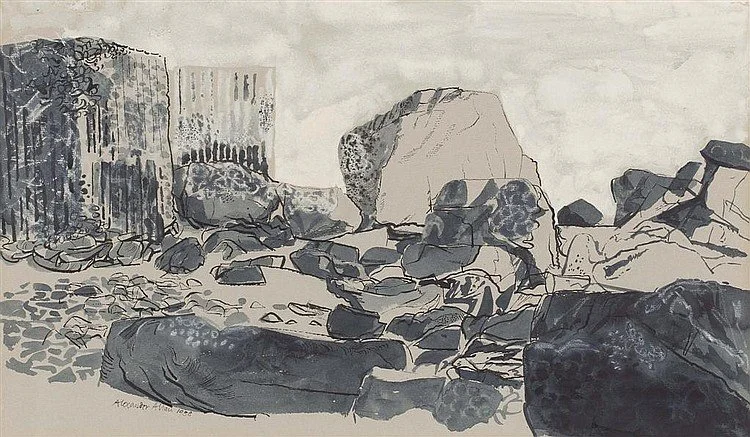
Alexander Allan, Title unknown, possibly On The Beach At Longniddry, Ink on paper. 29 × 49cm. 1958.
These are the years that Neil remembers best. He reports that his father would come home from teaching, eat with the family, and then head upstairs to his converted bedroom studio in the top floor of the house for the rest of the evening, working till late at night.
His output continued to include the portraits and ink-sketched landscapes in this second period of intense production, but as the 60s progressed studio work in oil and watercolour became a staple. His approach may have had its foundation in the concentrated observation, meticulous drawing and realistic content of the 1930s, but, apart from the portraits, his 60s style was unrecognisable from the earlier Sandy’s work.
Out and about in Scotland, he tended towards pen and ink. On holidays abroad, he favoured pastels. He rarely worked up his field observations. As far as he was concerned, they were finished works and he was ready to sign and sell them.

Alexander Allan, Machinery and Farmhouse. Ink and chalk on paper. 33 × 51cm. 1964.
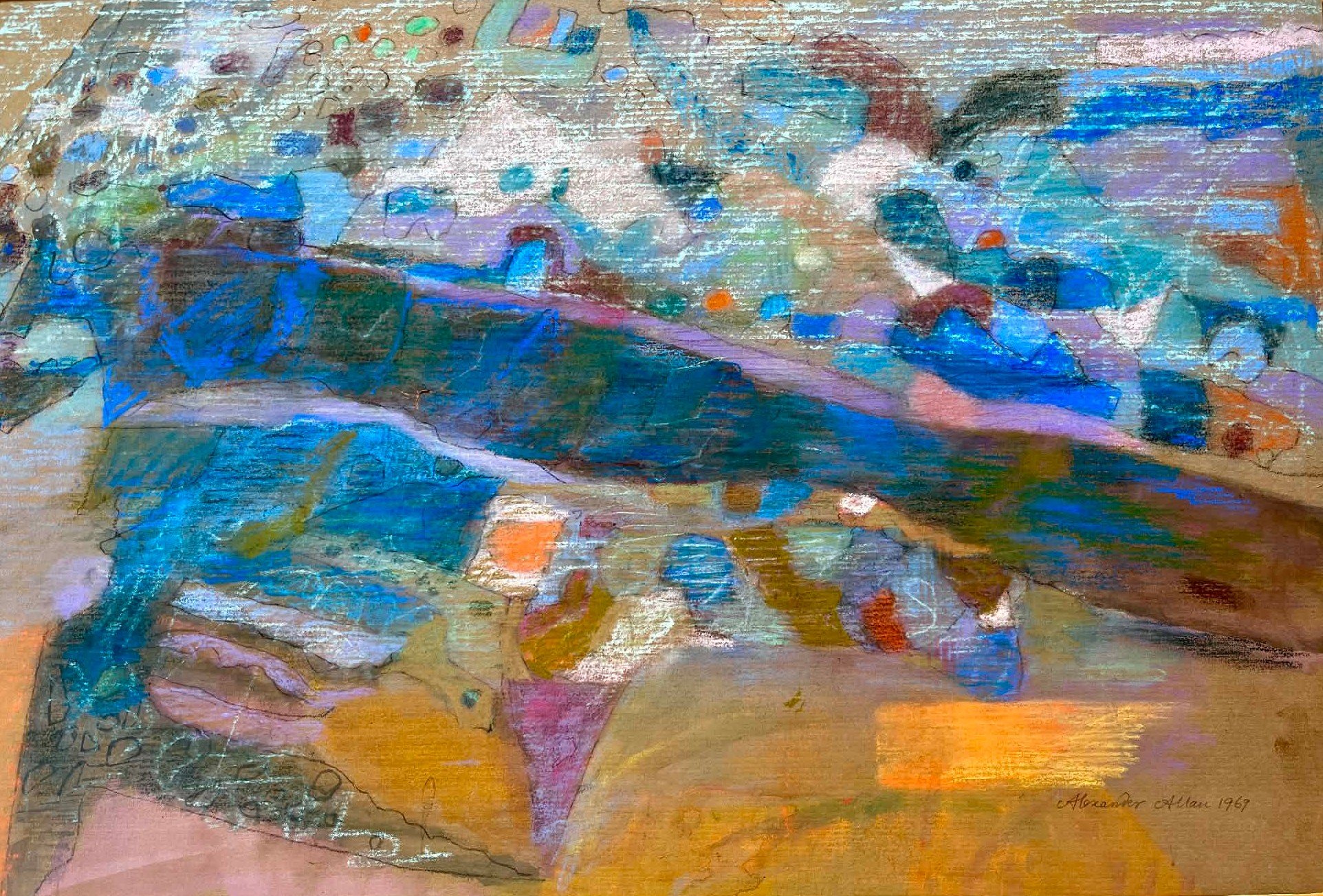
Alexander Allan, Rocky Hillside near Florence. Pastel on paper. 37 × 53cm. 1969. Courtesy of Judith Spence.
In other people’s homes, mostly, he would paint oil portraits, especially of children, using his classic technique, but turning out more relaxed poses and settings to suit the mood of the moment. This was a line of work that Sandy felt comfortable in, good at, and in which he knew he could make money - guaranteed in advance. Neil remembers that his father sometimes went away to stay with families for a short period of time in order that he could complete works over multiple sittings, often with multiple family members.
At home in the studio, he developed a new way of seeing still life and table-top assemblages, producing chromatic harmonies that made him identifiable in a busy Scottish art scene. He fragmented reality into patterns that were probably formed by colour combinations rather than real perspectives. He was moving objects and elements of objects around in his painting plane to create new sensual responses, and colour was at the core of his experiments. This was work predominantly in oil paint, but he would try mixed media and watercolour in the same mode.
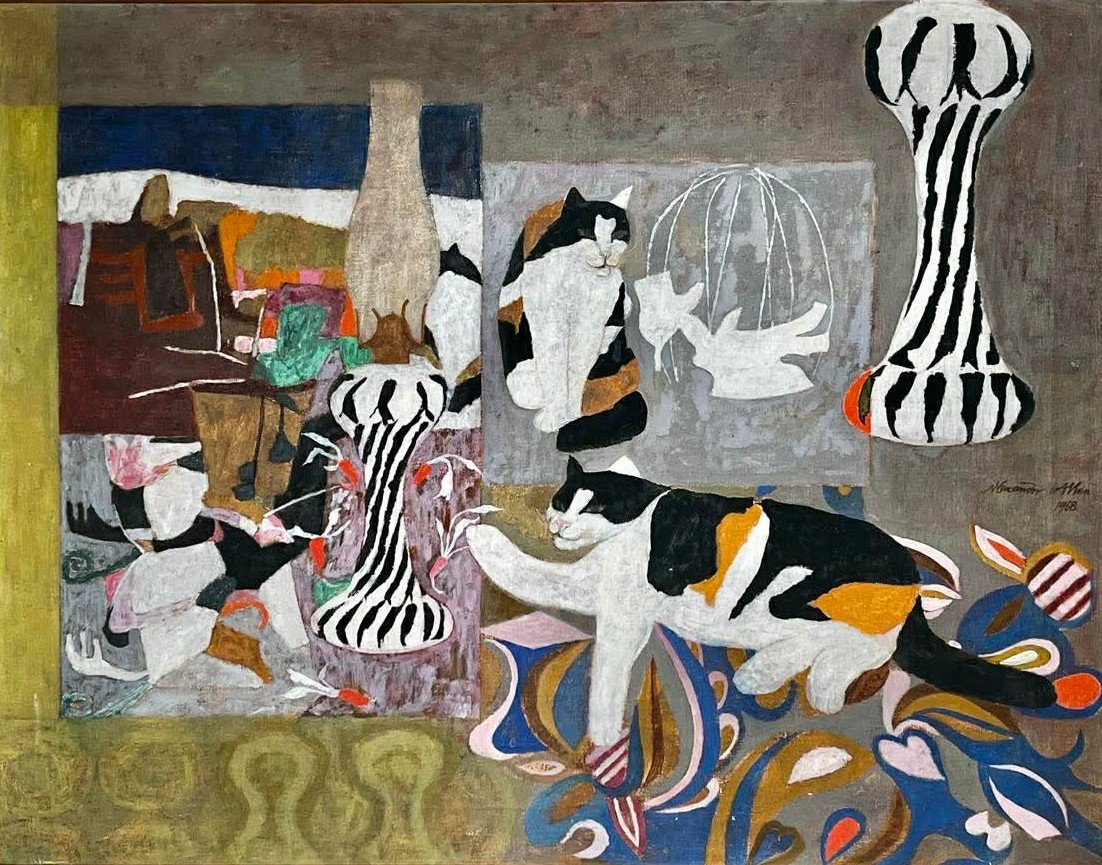
Alexander Allan, Studio (3). Oil on canvas. 71 × 91cm. 1968. Courtesy of Judith Spence.
In the studio, the family cat would often wander across the painting, its black and white body flashing a leg in motion in one section and then a curled and sleeping body in another. A stuffed bird was going to be thrown out by Rockwell School, so Sandy gave it a home in his studio, moving it around his field of vision to paint it gazing at different perspectives in his pictures, sometimes having different vantages in the same one. Patterned rugs and paper, teapots, gourds, plants, ornamental figures and mirrors were amongst the range of domestic objects that would find themselves translocated into the studio, then into a painting, then into another painting that included the previous painting lying against a wall in the studio…
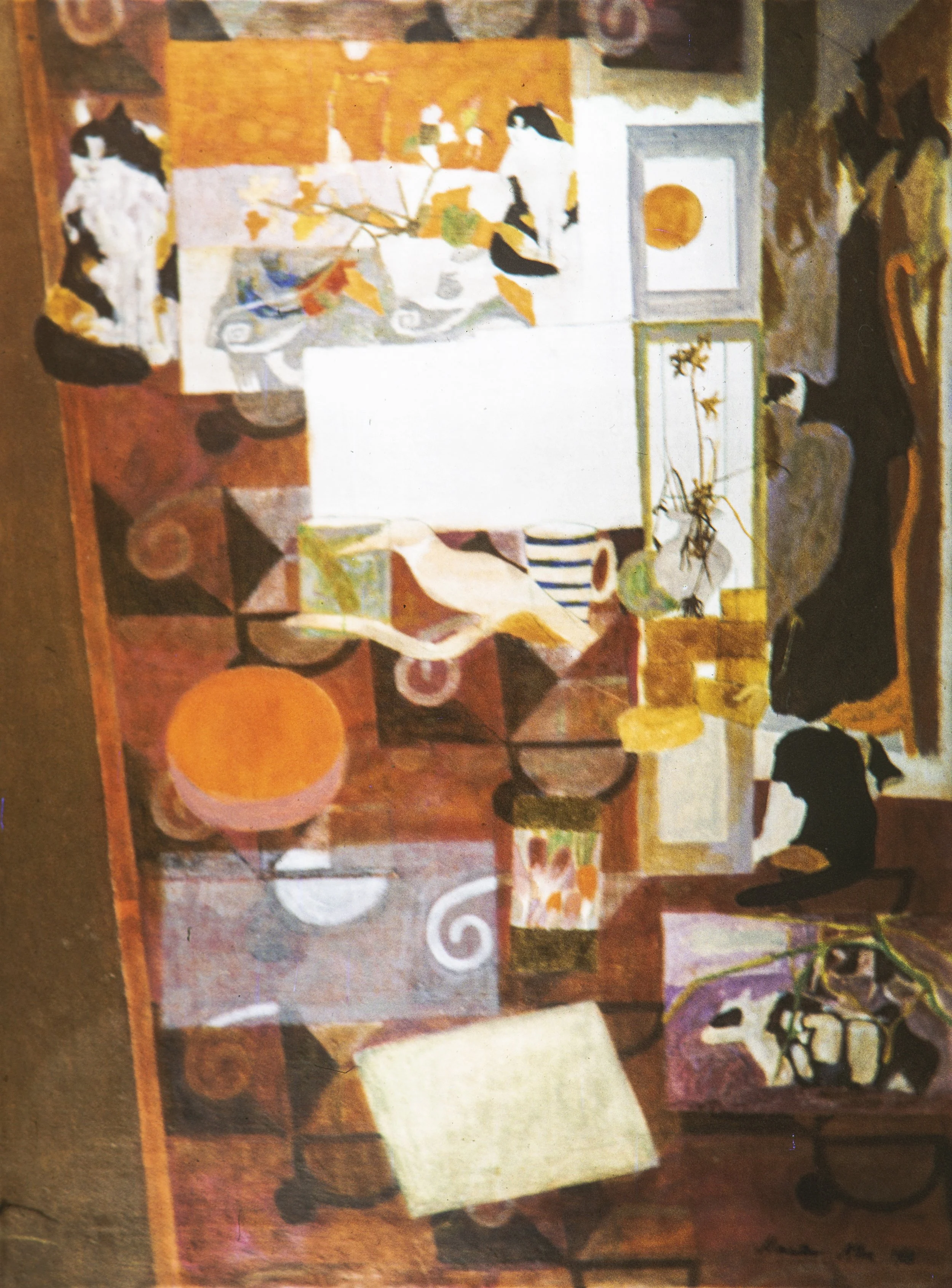
Alexander Allan, Studio 1. Oil on canvas. Dimensions unknown. No date. Courtesy of Neil Allan..
Sandy’s upstairs room became a kind of laboratory in which he observed relationships in pattern and colour and considered approaches to composition, probably working with trial and error, and enjoying accident and caprice. This table-top experimentation was, at this point, a fairly unique practice in Scottish art. Later, it was taken up in a public conversation in which Elizabeth Blackadder, William Littlejohn and others engaged in producing paintings with a similar concept. Sandy’s work had its own language, rich in colour, harmony and content, with a sense of dynamism and vitality that belied a “still life” tag. His studio observations were internally distilled, memorised and reconsidered as mental images rather than recreations, of which we know he was perfectly capable. The objects were alive and in play in his ‘test and respond’ process.
Sandy’s ink and wash drawings were close to the way in which his old friend, Tom Shanks, would look at landscape when he was off-duty from producing paintings to be sold in galleries; catching the sense of movement in the field, with the sensual hits described by ink explosions and masses, rather than the dense colour stews of those with 1960s modernistic tendencies.
His portraits remained in the same place as James McIntosh Patrick’s work: they valued clear likeness and character portrayal. In child-portraits, Sandy held back on his deep examination of facial features and the techniques that enabled him to clearly identify the structure of a head beneath the skin. These were portraits for parents who just wanted their offspring celebrated in oil. No examination was required. Patrick had become a friend and a colleague: Sandy was Patrick’s assistant on his famed weekend open-classes in Dundee.
Sandy’s other close artistic friends, Robert (Bob) Leishman and James Reville, closer in age and social ties, were ready to engage in one of Sandy’s other passions: philosophy and politics. But one feels that Sandy’s familiarity with their work in the 60s would be part of his conceptual thinking: Leishman’s impish wit and saturated deep colours and Reville’s bold-painting flourish book-ended Sandy’s practice.
Just like his art, Sandy’s politics changed. His youthful radicalism shifted to a right of centre view in the 60s, but his anti-authoritarian approach probably held throughout. He liked knowing what was happening and spent much time reading and analysing political news at all levels. Neil says that “Our bookshelves were full of 1930s and later upmarket non-fiction books and periodicals (Horizon, and later Life, and The Listener, for instance).”
Hilda was an avid church-goer, and she would attend church every Sunday. Sandy didn’t go with her - apart from on big occasions - and he didn’t apply political views to the church. Meanwhile, Neil never heard his mother describe herself as an artist, and to his knowledge, with the exception of a couple of watercolours produced very late in her life - she died in 2004 - she never drew or painted once married. Sandy was the artist.
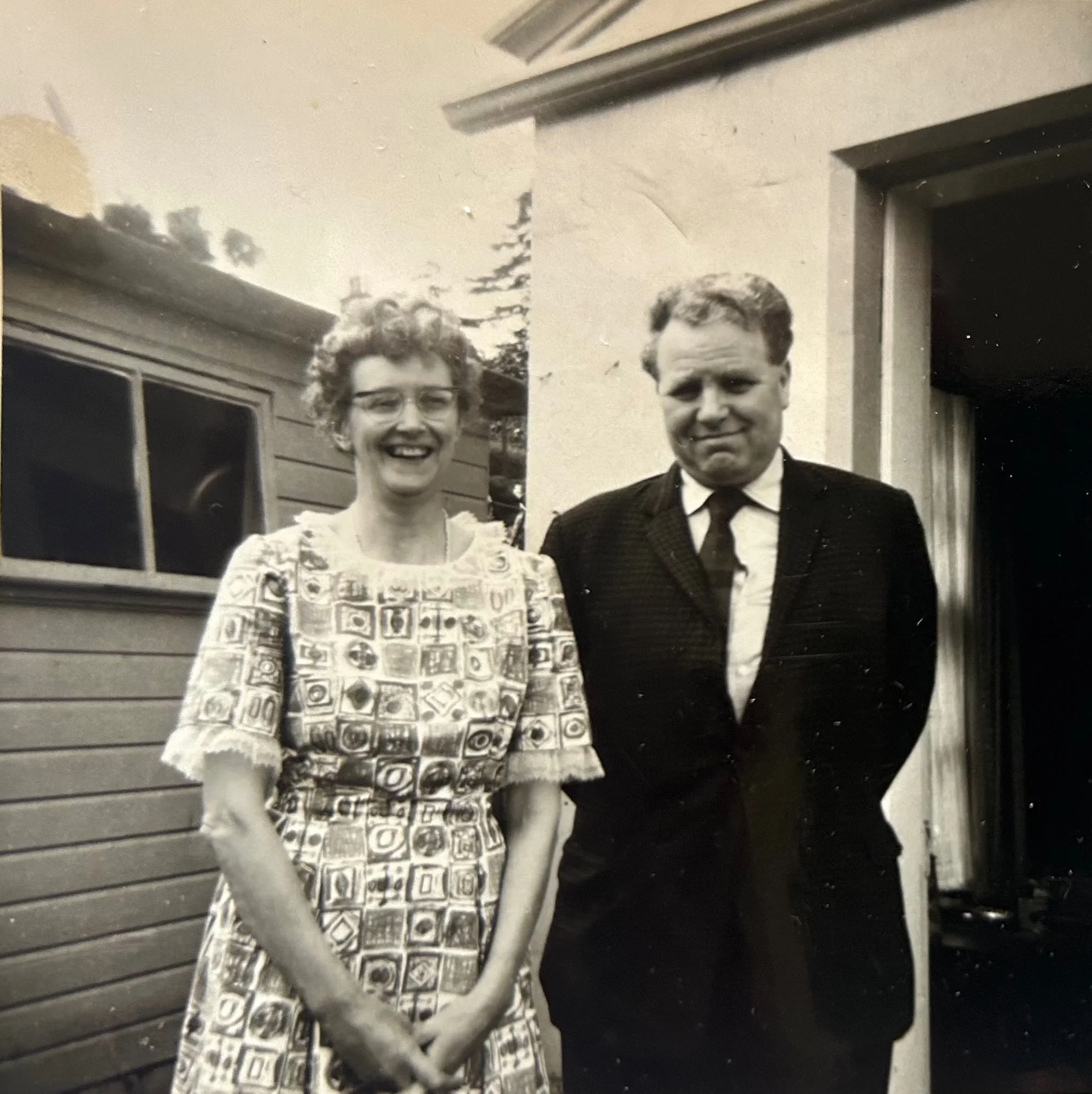
Hilda and Alexander Allan outside their house, Newport-on-Tay, 1970. Courtesy of Neil Allan
Sandy wasn’t a drinker, but according to Neil, he couldn’t abide people who shrank away from alcohol. He would always have one. He liked social worlds with a little lubrication, enough to encourage fun and humour, but never anything that would blunt quick-thinking and clever quip. His own contributions were likely to be in smart word-play and puns. And he liked full engagement in local politics, sometimes as close to home as the antics of politicians and council officers managing Dundee educational decisions. Leishman, also an art teacher, and formerly Liddle’s assistant at Bell Baxter, was, by all accounts, an accomplice in Sandy’s political discourses (Note 4). And interestingly, Bob gave up teaching when Sandy died.
Sandy gave up school teaching in 1967. He had been elected an RSW in 1966 and had been featured with Jimmy Morrison on the BBC TV arts programme. His momentum had reached the point that he thought he could make ends meet with part-time College of Art teaching (which he started in 1968), helping McIntosh Patrick, and through his painting sales and commissions. He had six pictures at the RSA Annual Exhibition in 1966, and five in 1967. He had five at the RGI that year too. Through Morrison, he was about to be made a member of the Glasgow Group, giving him even more secured exhibiting opportunities.
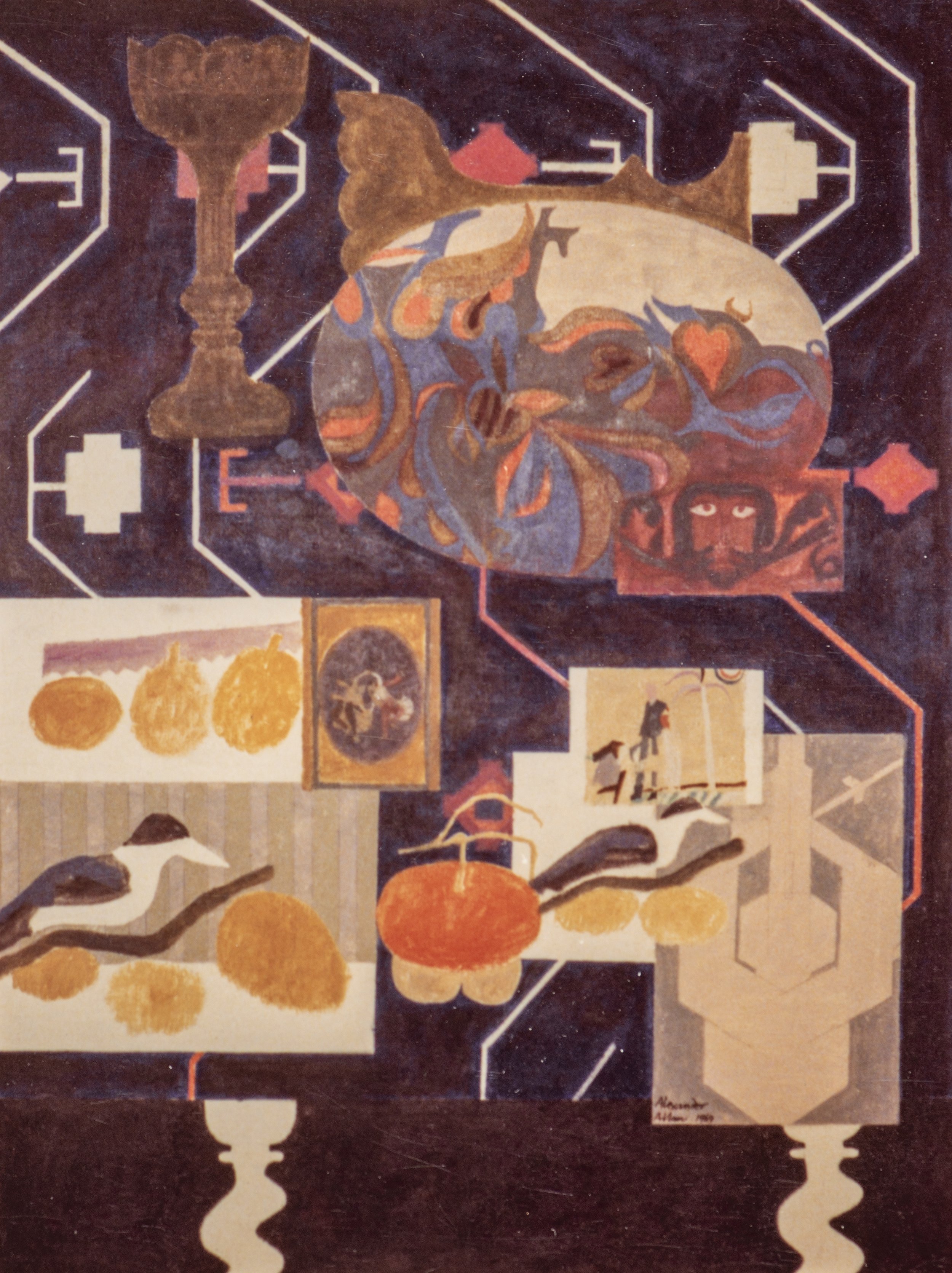
Alexander Allan, Studio 4. Oil on canvas. Dimensions unknown. 1968. Courtesy of Neil Allan.
His studio experimentations continued, with his stuffed bird proving more amenable to manipulation than the cat. Many of his recipes seem to have evolved in a spontaneous way, with ingredients being added (and perhaps subtracted) in reaction to testing and adjusting according to his artistic judgement as he progressed with both the object assembly and the painting. In Studio 4 he applies a formal angular line pattern on which he throws a selection of scaled down rectangular and oval pictures. Then he studies the sometimes dissonant sometimes pleasing harmonies, and the rhythmical results. He’s playing here with repetition, using the same image of bird and branch three times in different sizes. His tankards turn into cut-outs in this 2-D pattern. And then, in what seems a final twist, he adds a footer which could suggest that the rest of the construct is another picture-within-a-picture. Games and fun, play, conceit and deceit: a long way from meticulous drawing of reality.
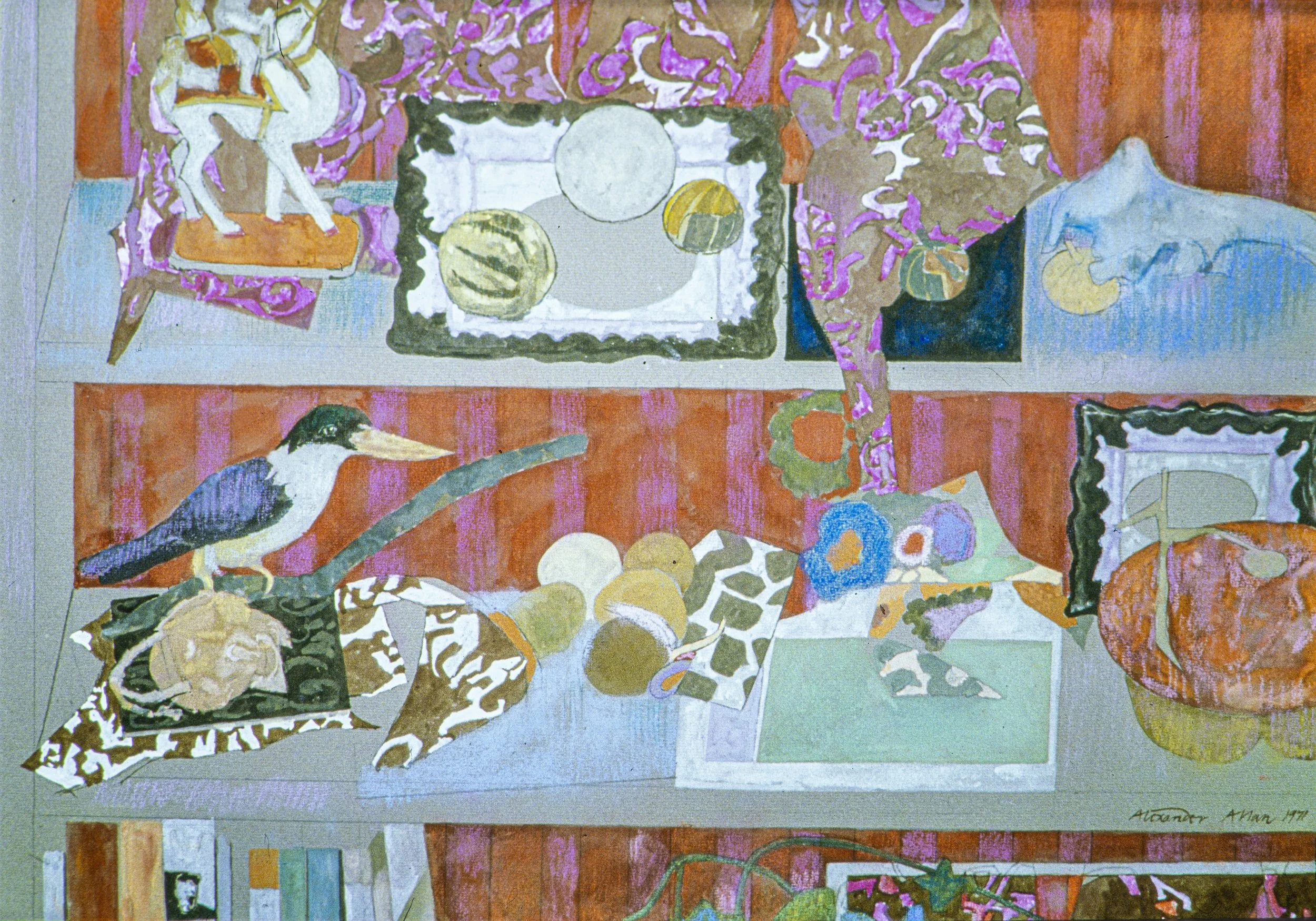
Alexander Allan, Bird and Two Sunderland Plates. Mixed Media. Dimensions unknown. 1971. Courtesy of Neil Allan.
And look at the flourish of the “D” in that signature. Sandy liked this one. A triple decker of table-top compositions with formality taken away by the bleeding off top and tail discourses, and the patterned bridge of drape/paper. The framing to the left gives strength to the 3D/2D paradox, throwing objects forward and back depending on how you look. The firm angle at the back of the shelves is consistently disguised by surface games that slip and slide. And the eye is encouraged to avoid focus. One object carries the eye into another, a little assemblage might hold the viewer for a moment, but the logic can’t be pinned down without the context, and off you go again.
By standing back and taking in the whole, we see an everyday scene, a clutter of colours and shapes that tell the story of a home and a person. Rich in pattern, a confusion of colour, through which warmth and a generous spirit glow.
With domesticity left downstairs, a lone artist in his studio upstairs is describing his haven, his imagination free, his bar lines dancing with pretty pattern and rhythm.(Note 5) Look at the way he’s shaded in colours at the end with fast and loose-limbed strokes, on the floors and edges of the shelves, on the bird’s wing, on the mud-yellow shape above the signature. These are marks of great confidence and elan. He’s been in dialogue with his materials and he’s delighted to bring the conversation to a close with some light-hearted finishing remarks. ‘We’ve enjoyed the game. The result looks good. Don’t be too serious!’, he’s saying.
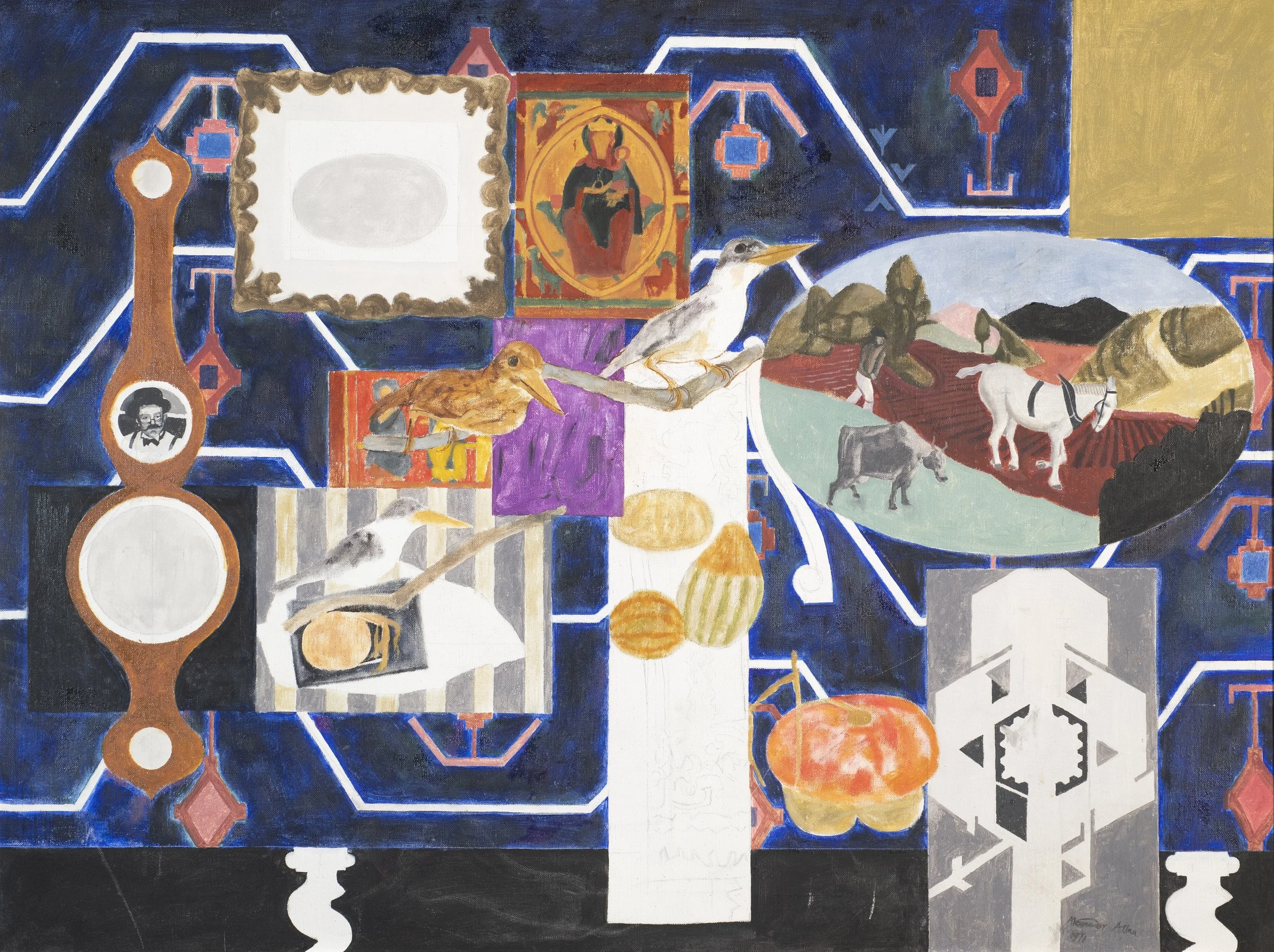
Alexander Allan, Studio 6. Oil on canvas. Dimensions unknown. 1971. Courtesy of Neil Allan.
And finally, in Studio 6, also painted in his last active year, we find Sandy in a much more composed mode, using many of the same ingredients from Studio 4, but with greater articulation. The structure has a control and tension that holds the individual objects in the frame with a purpose and certainty that makes the Studio 4 assemblage look more like a work in progress. That tautness amplifies the breaks across the grid. The gourds are gently caressing the lines; the stuffed bird is freed from its painting to sit on its perch outside its frame, and then it is redeployed, now in brown rather than grey and white, to stand obscuring the content of a small picture. Sandy’s utilising a much broader palette than his close-toned norm, encouraged perhaps by his decision to make use of someone else’s picture in his arrangement. The oval picture, Neil remembers, was painted by a farming friend and hung in the house.
The black and white sections strongly contrast with all of the chromatic excitement and firmly grip the scaffold of the piece. And there is fascination everywhere in the small detail. One more piece of insider knowledge pointed out by Neil, and which I missed, is the small portrait of a moustachioed man with hat, tie and braces inside the barometer/mirror. It’s Sandy in art school Revels dress, taken from a photograph of one of the many productions that Patrick Hennessy put together for end-of-term entertainment, thirty-five years before.
I quoted an in-the-moment review of Sandy’s ink and wash work from 1960 above. I wanted to demonstrate the regard in which Sandy was held in at the time. Let’s quickly check what was being said about his painting ten years later.
Edward Gage, a most perceptive critic, reviewing Sandy’s late-1970 Douglas and Foulis joint exhibition with Tom Shanks in The Scotsman, said: “Allan’s painting is quite original and complete in itself. To discover something by him in a mixed exhibition is almost always an enhancing experience, but he emerges here as a veritably small master within his chosen narrow compass. The superb quality of his execution, the sustained accomplishment of his arrangement and handling - those things make him, above all perhaps, a painter’s painter, to be universally admired and approved of by his colleagues. His originality as a colourist and pattern maker is evident everywhere… jewels of orderly invention and atmosphere treated with immense variation and exquisite control.”
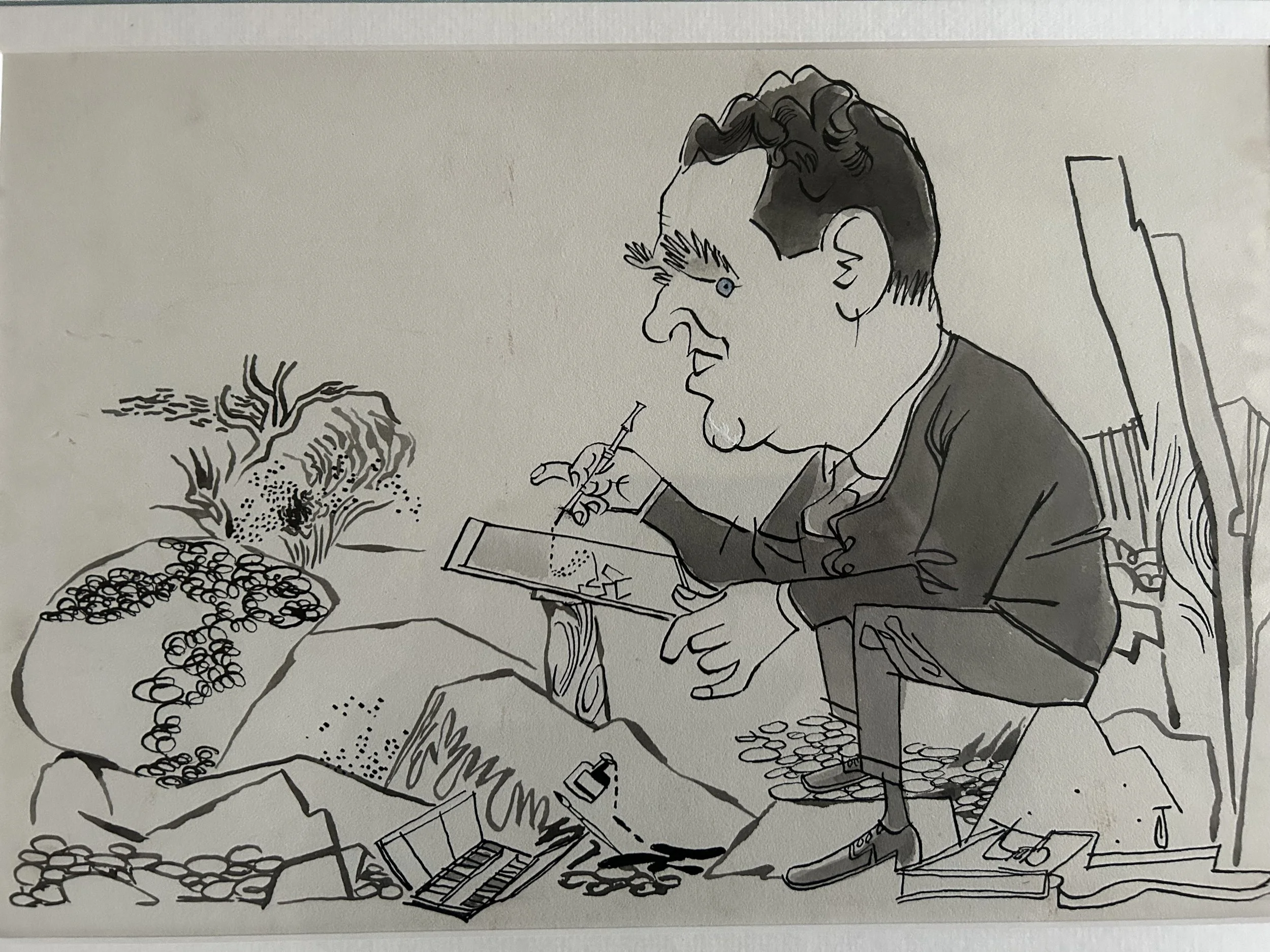
Emilio Coia, Alexander Allan. Ink on paper. Dimensions unknown. No date. Courtesy of Neil Allan.
And my final words are that here was an artist whose early work was sensational; who was forced, or forced himself, to put a career as an artist to one side; dealt with much frustration; and came back with a playful, joyous flowering, reinventing his art for the new environment he found himself in. He may have started as a Baird-Cowie-Patrick ‘Boy’, but his Second Coming was more complex, more individualistic, more comforting and pleasure-based. The austerity of his technical brilliance was diffused in a bouquet of sensations that he could re-arrange and refine in a constant stream of pictures. He was loving the ride. He was setting himself challenges, and progressing, learning, and pushing himself into new places, both for himself and his viewer. It was a cruel age for him to be caught by cancer. It feels like he was just starting out.
Roger Spence
Notes:
Note 1: Later in life, Hamish was one of Sandy’s close friends
Note 2: The Reimann School was established by Albert Reimann and his wife, Klara, in Berlin in 1902. Its work encompassed many of the interfaces between art and industry. In 1935, National Socialism forced them to sell the business and they moved to London where Albert and his son, Heinz, re-opened the school at 4-10 Regency Street in January 1937. There were five departments: Exhibition and Display Design, Commercial Art (graphic design and posters etc), Fashion and Dressmaking, Photography, and Fine arts and Crafts. The school closed at the outbreak of World War Two, never to re-open.
Note 3: Hennessy rejected nearly every aspect of his Scottish upbringing and training, and had no time for their mutual art school friends and colleagues. See reference to this letter in my piece on Hennessy and Vannet in art-scot 14.
Note 4: Leishman had a long-term relationship with and later married Pat Edgar, Sandy’s colleague at Bell Baxter.
Note 5: On domesticity, Neil reports: “He cooked weekend breakfast, sawed a lot of wood no doubt as a hangover from forestry days, but did little or no domestic duties. (His) mild irascibility or intolerance derived from finding some people, not least relations, to an extent his sister and elderly in-laws, dull. He would tend to absent himself if he knew they were coming. But this was mixed with a closer than average ease with his own friends' company…” Neil also noted that his father would ask him if he wanted to go to the theatre or the cinema, but rarely if ever asked his mother or his sister.
Acknowledgements
Many thanks to Neil Allan for providing his own archival research as well as his memories and, of course, images; to Judith Spence for providing images; and to Matthew Jarron for connections, suggestions and images. Copyright for all the artist’s images is with the artist’s estate.