
Alan Davie: Dancing Yourself Clean (In A Dirty City)
On the occasional evenings that Aikman’s in St Andrew’s hosted live jazz, Bell Street would come alight with students spilling out of the establishment, lazily waltzing, twirling, or stooping outside, bumming a cigarette for brief respite. For those unfamiliar, Aikman’s is a well-worn local bistro, with warm lamps to console you from the perpetual coastal chill outside and wrinkled leather seats, sagging from the weight of many students before you.
It has an eternal quality; I felt that if I returned many decades on, Aikman’s would still be there, with someone inside plucking away at a bluesy melody. Students will always crave that escape into rhythm, the respite from the monotonous thrum of deadlines. Like the noble arts of taking a paintbrush to canvas or chisel to marble, jazz breathes into the room those rarely spoken, but universally felt (and sometimes bemoaned), notes of life. And so too has jazz inspired some of the most fantastic, audacious, and daring artwork.
London is a metropolitan symphony. Impatient car horns become the brass, the rush of business shoes and heels, the percussion. The rushing whine of the tube is a swinging trumpet. Passing chatter on the high street flutters by like the keys of a piano. This grand city's jazz ensemble has drawn so many of the world’s most beloved artists, ensnaring them in its jostling maze of streets and staggering landmarks.
Alan Davie arrived in London in 1949 amid a vibrant flurry of prosperous artists, but what made him so enigmatic was his refusal to be categorised. He was a poet, an artist, a jeweller and a Jazz musician, many things at once, always making strides in bold improvisation. For Davie, jazz was a way of life. His canvases gather moons, serpents, wheels and birds into dense, brightly coloured fields of overlapping symbols and symphonies, shaped by Carl Jung’s idea of the collective unconscious, and built as improvisation rather than strict composition. Jazz is in the method as much as it is the subject: a warbling leap into the unknown.
To follow Davie on his journey throughout and beyond London is to follow a man who wrought a rowdy rhythm of modernity into his own and, in doing so, composed a place for himself in it. But Davie was not the only Scot to arrive in London with music in his luggage, and his work joins several other Scottish artists moving through Britain in the artistic quest for uninhibited liberty and expression. In 1926, the Scottish painter John Bulloch Souter sent The Breakdown to the Royal Academy: a saxophonist playing for a dancer in a trance, its title punning on a musical breakdown as much as a social one. Within days it was pulled from the walls at the Colonial Office’s request, and jazz entered Burlington House as a scandal. Souter’s stated aim was to show jazz seeping into daily life, and so it had, with a controversial crash. British or Scottish alike, a litany of artists deemed that the escape within music spoke to the country’s yearning for detachment.
Placing Davie in their company changes how he is usually described, as a lone figure of British post-war abstraction. He becomes part of a longer conversation between artists, music and the capital in a time of disordered recovery – and a legacy that would invigorate future artists. This article follows that conversation through London’s collections and beyond, trailing the sound of unrestricted joy and experimentation. It looks at where Davie’s work has left its mark in the city, how jazz and improvisation shaped him, and how jazz speaks to other artists who found in music a way of seeing their country, and themselves.
Music truly enraptured Davie during his time in Edinburgh. Born in Grangemouth, Scotland, Davie later enrolled at the Edinburgh College of Art from 1938 to 40. Here, in a record shop, Davie heard Coleman Hawkins play and swiftly switched from playing piano to playing saxophone himself. [1] After completing his education at the Edinburgh College of Art, Davie was conscripted into the Royal Artillery in 1942. Although Davie was never sent into frontline combat, the war crucially shaped his art. Stationed at an aircraft battery in Warwickshire, Davie was encompassed by the prosperous and lush fields and greenery of the English countryside. [2] Like many, Davie carried a pervasive sense of alienation and disaffection in the post-war milieu, and his art reflected that shared desire to immerse himself in a world wholly encompassed by the inspiration and beauty of nature.
Fleeing the severe and mechanised slap of reality, the plumes of metallic smoke and the piles of rubble, Davie’s artworks were submerged in a misted realm ruled by spiritual forces, humming with kaleidoscopic journeys and teeming arrangements of symbols and biomorphic figures. But these vivid networks of seemingly uncoordinated forms and gestures were not untethered. Rather, they were arranged into a chaotic unity through the rhythm of improvisation. The magic that invigorated his work into a buzzing amalgamation of symbols was conjured on his travels throughout Europe between 1948 and 1949. Davie ventured beyond Paris – where so many British artists had become spellbound and stayed quite happily – into the reaches of Switzerland. The great might of Matterhorn shone through the thickened air with a supernatural potency, and in Italy, the Venice Biennale enthralled, with Peggy Guggenheim’s spectacle of Surrealist American artworks. Renaissance relics commanded a mysterious omnipotence, and Byzantine mosaics danced in glistening rows.
Davie painted The Saint in 1948 during his travels in Florence, capturing the fervent nonconformity he saw in the work of American Abstract Expressionists and Surrealists. Erratic, jagged brushstrokes merge into a bold figure, illuminated with vibrant tones reminiscent of antiquated mosaics and stained glass panels. When Davie returned to his studio in New Barnet, London, and to the pervasive longing for liberation that washed over society, he brought with him all that he saw on the continent: the release of the pictorial flow, the canvas that contained a natural, innate freedom and endless possibilities in colour and brushstrokes. Entrance to a Paradise, painted in 1949 and now part of Tate Britain’s extensive Davie collection, reflects Davie’s fascination with the unconscious and the power of spontaneous, improvised painting. Davie worked quickly with large brushes and pots of liquid paint, moving without any thought for subject or form and letting images appear unexpectedly. [3] Layer upon layer, Davie constructed a dense, grid-like surface from which a sinuous web of signs and symbols emerged, seemingly to take on a life of its own. Its title suggests a way into a mysterious and joyous world of colour and light.
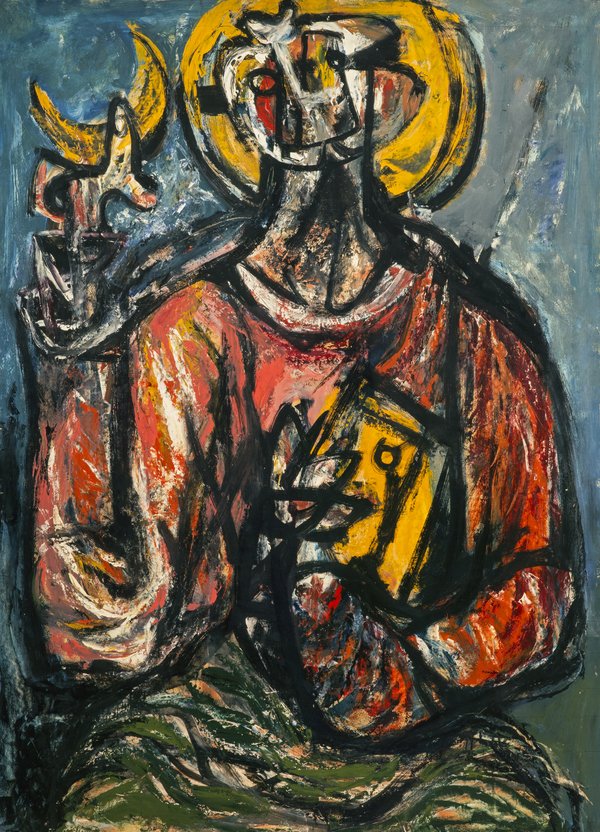
Alan Davie, The Saint. Oil on paper. 122 x 89 cm. 1948. Courtesy of the National Galleries of Scotland.
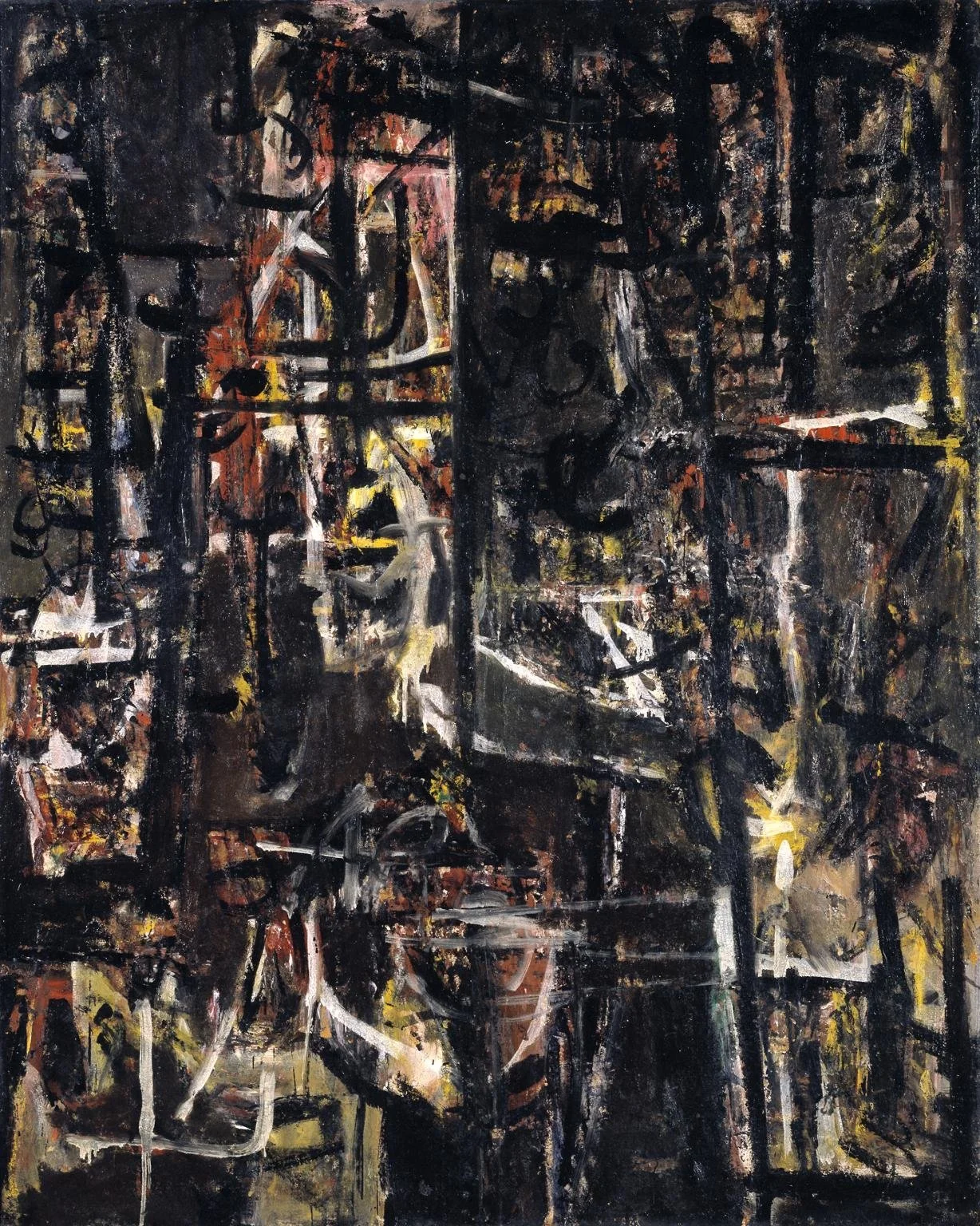
Alan Davie, Entrance to a Paradise. Oil on board. 151.8 x 121 cm. 1949. Courtesy of Tate.
Black Mirror (1952), permanently on display at Tate Britain’s Modern and Contemporary wing, was also painted in his New Barnet Studio, in the cramped conditions of a single attic room at the Abbey Art Centre, where Davie, his wife and their baby lived, and where he painted and made jewellery in the same small space. Few of the paintings from this period survive. Davie described them as ‘the outcome of violent and mainly destructive work,’ most with several earlier paintings underneath, each new image obliterating the last rather than removing it. [4] Money shaped the method as much as temperament did: boards were cheaper than canvas and better able to ‘withstand my violent onslaughts,’ and with nothing else to hand he would simply paint over something that was ‘probably good but really not good enough.’ [5] Black Mirror is the last painting he made in 1952, and its surface carries that history of decisions made, abandoned and overwritten.
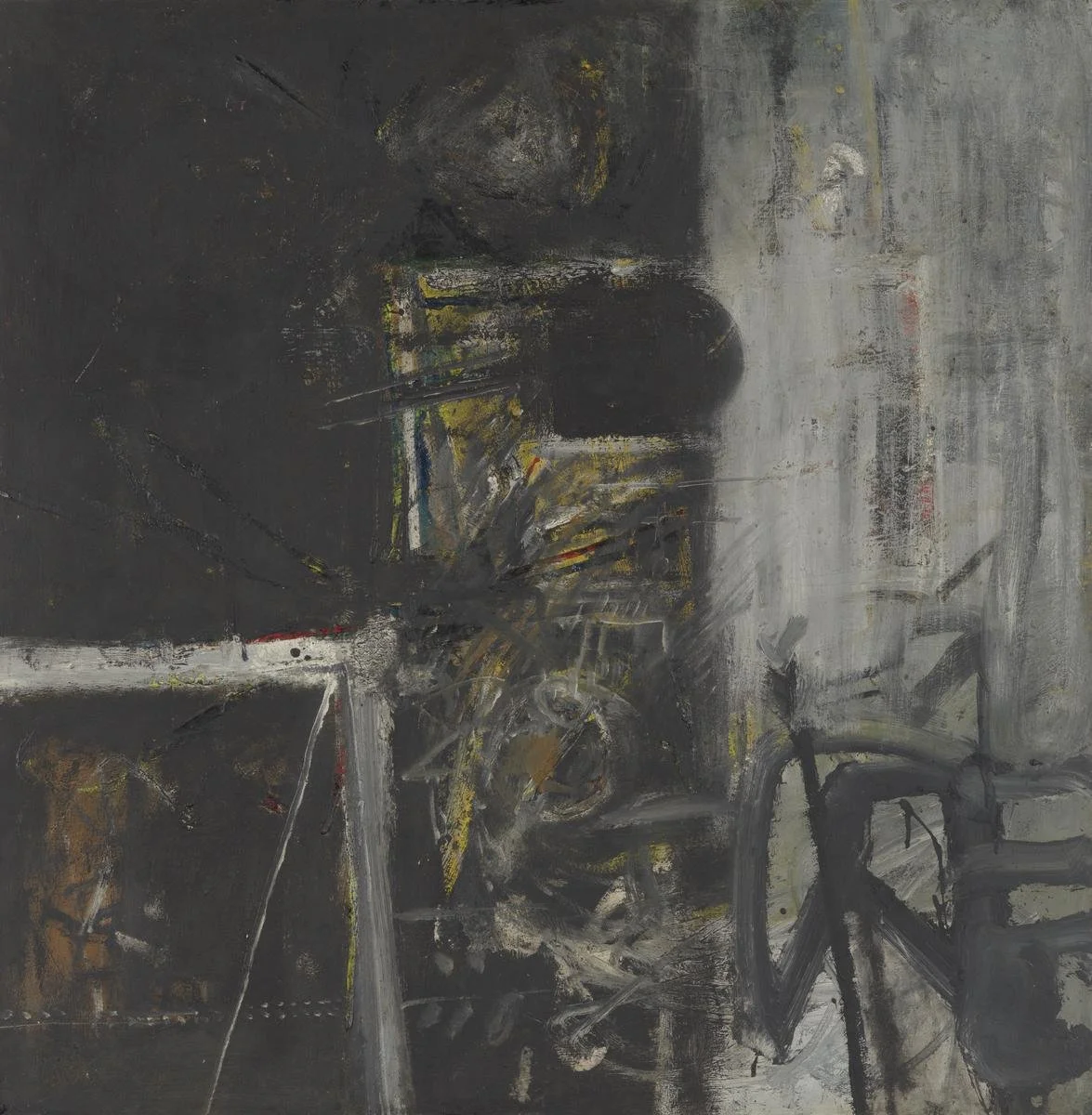
The composition is a dark, dominant field broken by blocks and bars of colour. Davie insisted that ‘the structure in the paintings wasn’t put there for any specific purpose,’ [6] and the forms do read as intuitive rather than planned. They sit unevenly against the square format of the board, the rectilinear framework loosened by the speed and force of the handling. His work arrived by bursts of intuition, and if it failed, he began again, an approach that fits the improvised, in-the-moment attitude he also brought to music as a saxophonist and lover of jazz.
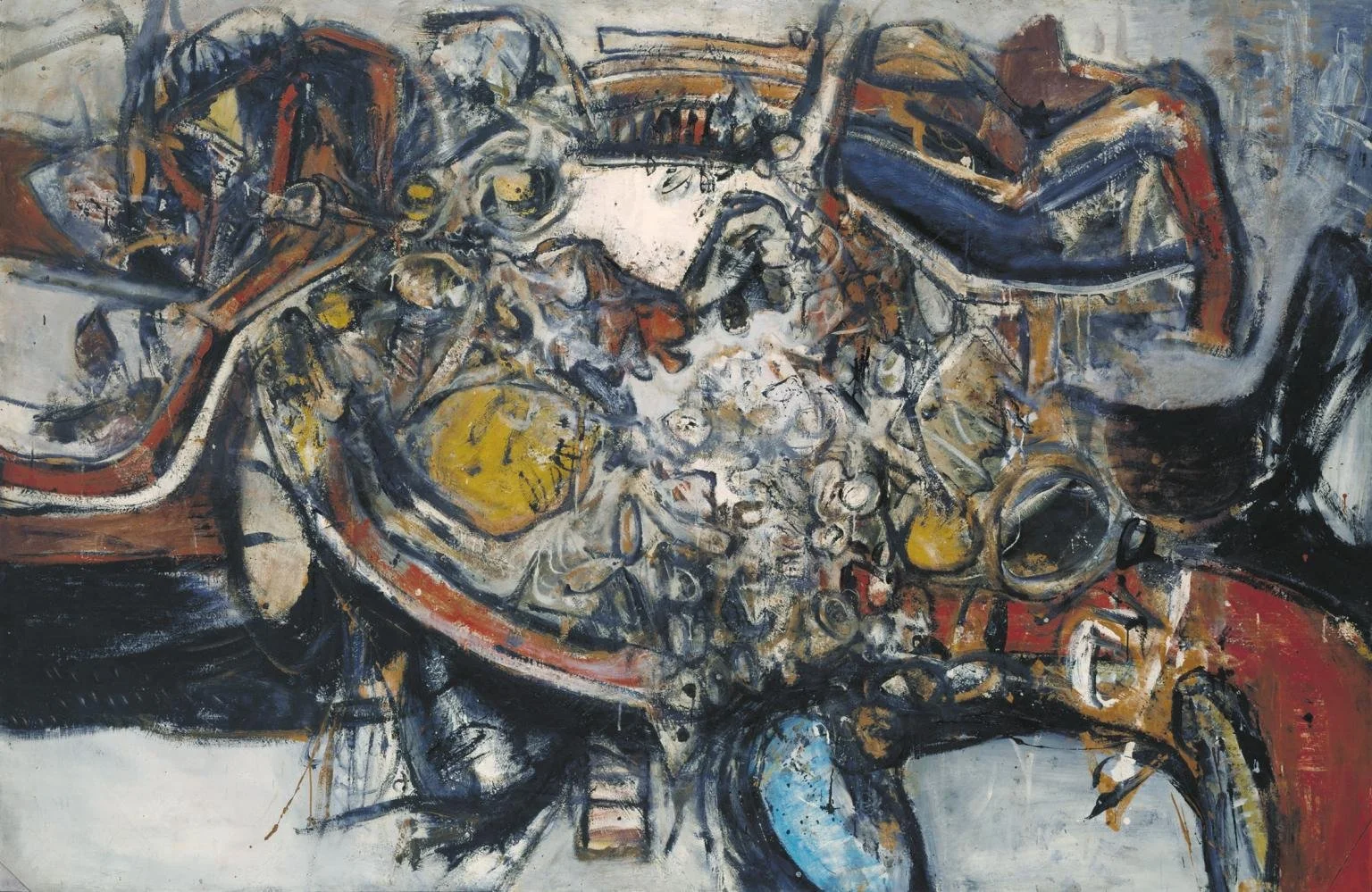
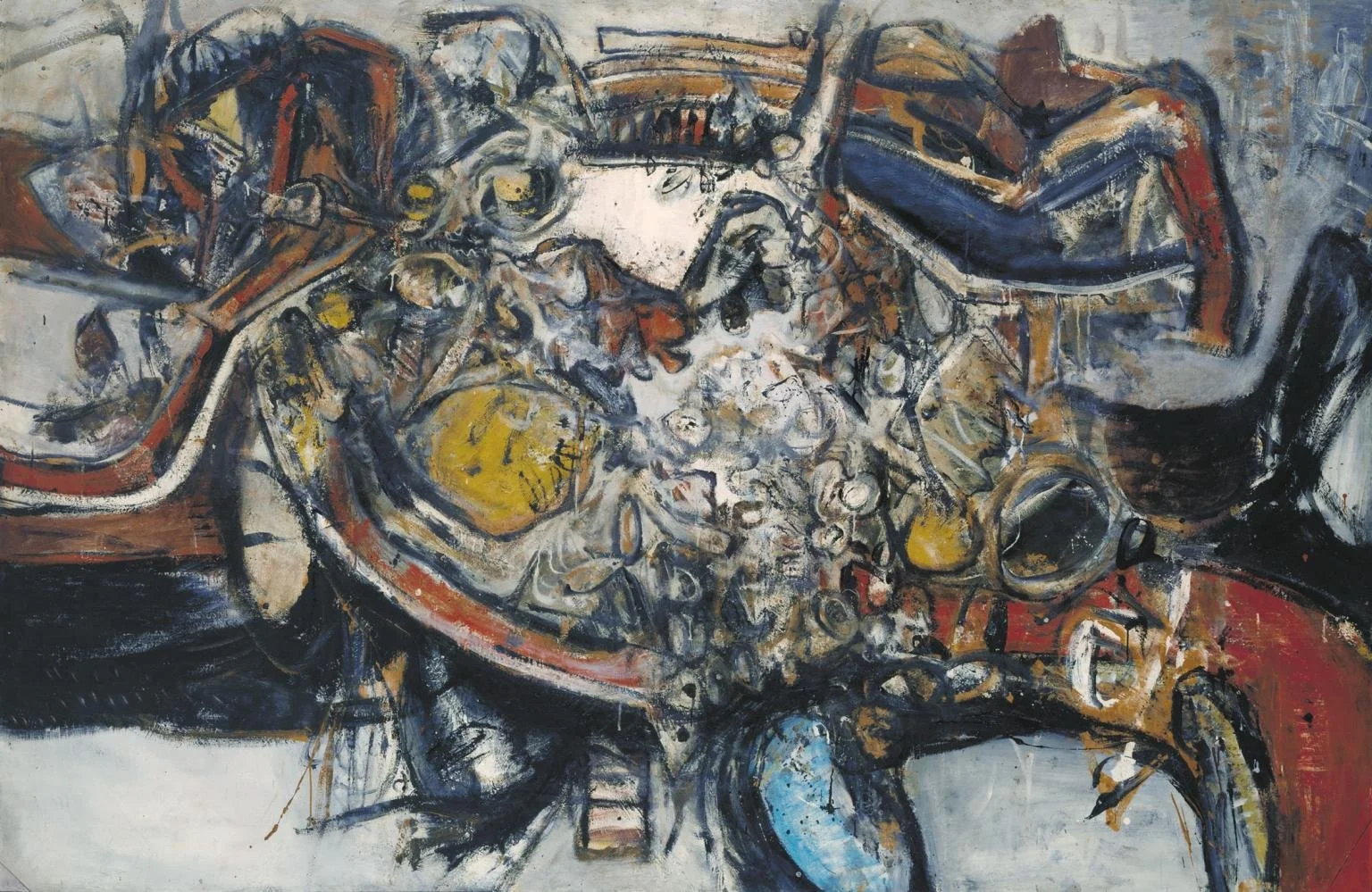
Alan Davie, Birth of Venus. Oil on board. 160 x 243.8 cm. 1955. Courtesy of Tate.
In Birth of Venus (1955), Davie brought the same intuitive method to a larger and more turbulent surface, bursting with wild colour that later associated his work with the drip paintings of Jackson Pollock. Davie rejected the comparison. Although he shared Pollock’s interest in the art of primitive peoples, he believed that pursuing absolute freedom led to a dead end, and he turned instead to Celtic sources such as Pictish stones, the Book of Kells and the Lindisfarne Gospels. [7] The title follows the same logic as the handling. Davie explained that his titles were never meant literally but were poetic interpretations added after a work was finished. Ideas of a primeval womb, a cavern, a source of fruitfulness and love did not occur to him while he was painting. They surfaced afterwards, as the image began to read as something more than static, a picture of emergence and becoming.
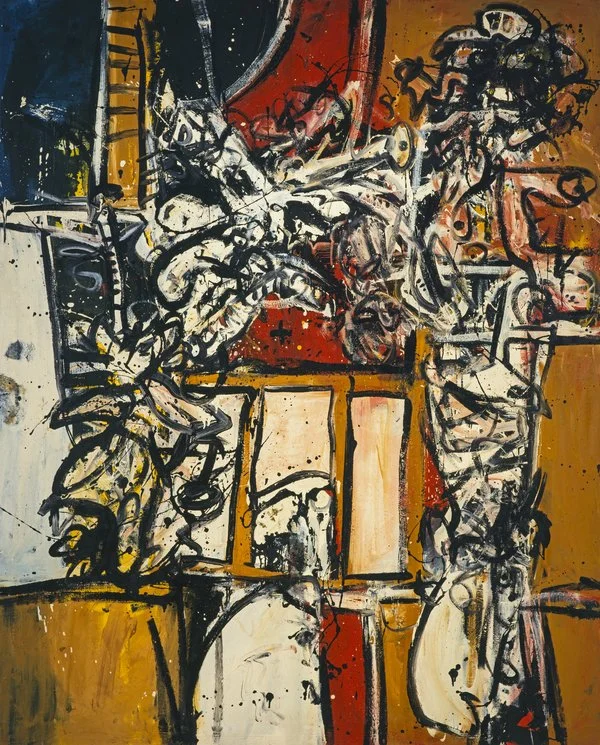
Alan Davie, Farmer’s Wife No. 2 (Jazz Musician and Lady). Oil on canvas. 213.7 x 172.8 cm. 1957. Courtesy of the National Galleries of Scotland.
This way of working sits alongside his discovery of Eugen Herrigel’s Zen in the Art of Archery, the book that allowed him to fully embody his connection to music in his art, and it shows what Davie considered the true purpose of art: each painting should reveal something previously unknown even to its maker. Jazz continues to inspire in Farmer's Wife No. 2 (Jazz Musician and Lady), painted in 1957 and now held by the National Galleries of Scotland. Music enters through the title and the pairing of figures before any attempt to illustrate sound. It belongs to a group of works made in 1956 and 1957 that feature male and female figures and carry strongly sexual overtones, a charge that echoes the fertility Davie earlier read into Birth of Venus. As with Davie’s paintings before, the canvas was made spontaneously, with no premeditated idea of what image might result, and the figures emerged from the process rather than preceding it. Davie often mixed grit into his paint in the fifties, and here it gives the large canvas a crusty, tactile surface that holds the evidence of his handling. The painting feels physical and unrefined, closer to the earthy energy of folk ritual than to anything polished. The title pairs a musician with a lady, and in doing so it places the music Davie played away from the studio within the same instinctive, bodily world as the paint itself.
Jazz is in many senses an extension of the body. Dance halls, nightclubs, and the physical, rhythmic pull between performer and audience. Davie knew that world first-hand, having occasionally worked as a jazz musician in the London scene during the late forties. [8] Read this way, the musician and the lady are figures of attraction and display, and the painting treats desire and music as the same kind of instinctive, bodily energy. The figures emerged unplanned, as desire itself does. The title, then, is not incidental. For Davie – and indeed many of us to this day – the pleasure of music and the pull between bodies were part of the same unforced, instinctive life that his paintings sought to reveal.
Around this time, Davie found more commercial success, with a retrospective exhibit at London’s Whitechapel Gallery in 1958. Alongside this growing recognition, critics increasingly read his work through psychoanalysis, though Davie’s approach followed Carl Jung rather than Sigmund Freud. Jung’s view of the unconscious as a shared reservoir of memory and symbol shaped how Davie thought about the signs that recur across his canvases. He resisted pinning any one meaning to them, describing them as obsessive images that surfaced without a conscious purpose and could mean different things at different times.
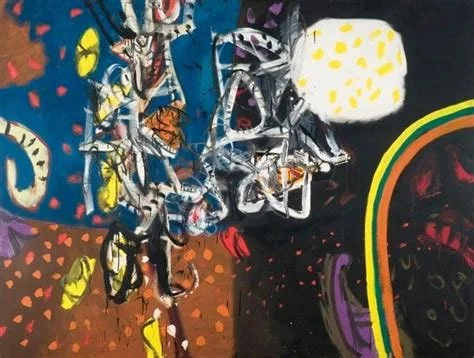
Alan Davie, Crazy Gondolier. Oil on canvas. 183 x 244.2 cm. 1960. Courtesy of Amgueddfa Cmyru – Museum Wales.
Davie’s 1960 painting Crazy Gondolier shows his symbolic work in even more intensity. Totemic figures such as a snake and a rainbow rise out of the unconscious, shaped by his interest in Zen Buddhism and by an automatic way of working that he took from the Surrealists and, for a time, from Jackson Pollock. Simplified block shapes and bands of colour sit against frenetic brushwork that seems to dance across the canvas, so the picture is more structured than his earlier work while keeping a loose, unmediated gesture. The brushwork moves across the canvas in quick, staccato specks and then thick, sluggish lines, swinging between shapes and patterns with restless energy, like a dancer moving to a beat. Urgent, graffiti-like lines cross bright shapes and dotted patterns, and the painting keeps the raw, unmediated and expressive gesture that Davie had trusted since his earliest improvised work.
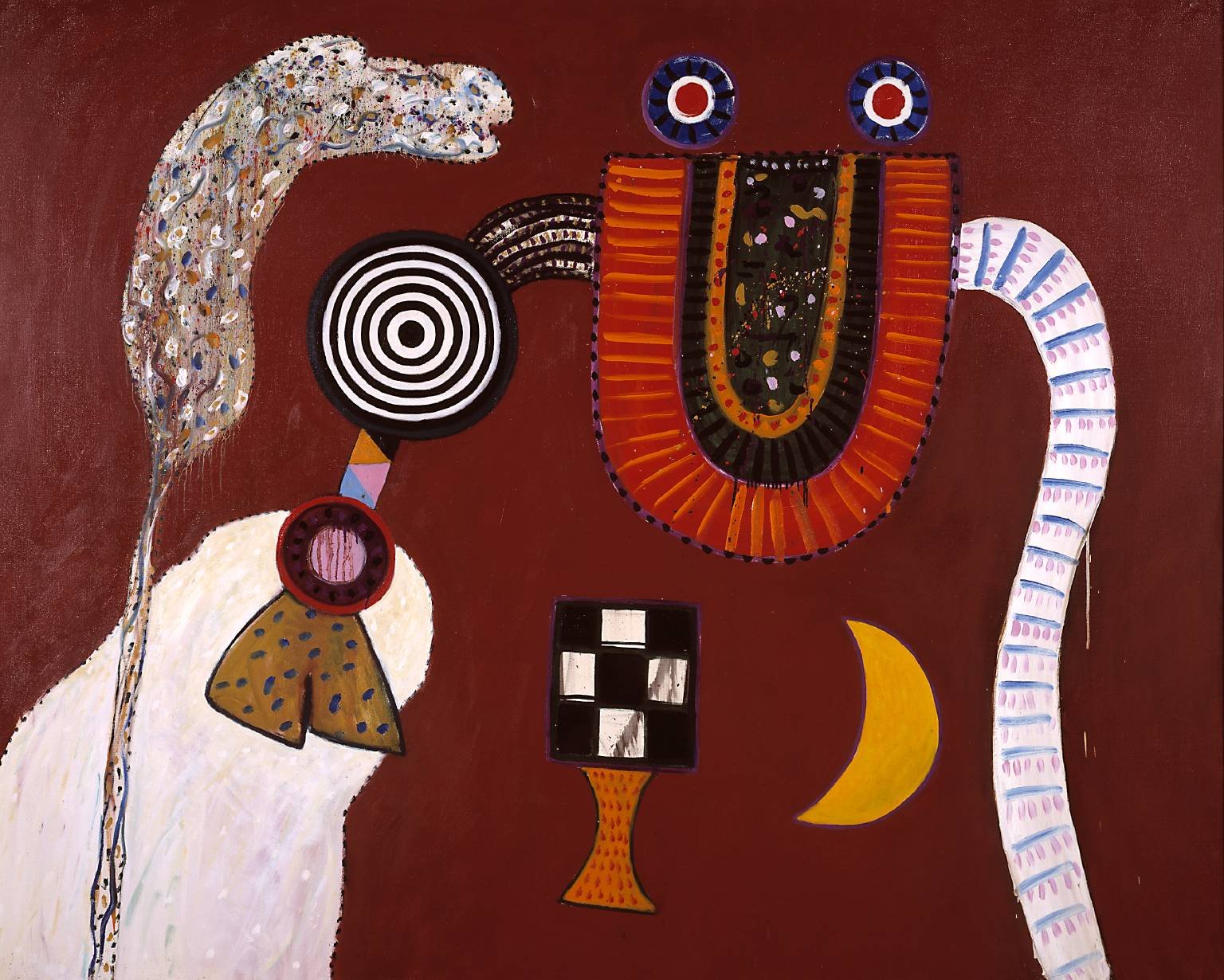
Alan Davie, Fairy Tree No. 5. Oil on canvas. 172.7 x 213.4 cm. 1971. Courtesy of Tate.
As the 1960s went on, Davie moved away from the post-painterly abstraction taken up by many of his British contemporaries, turning back towards figuration, narrative and myth. After 1971, Davie began spending part of each year on the Caribbean island of St Lucia, where he produced automatic drawings and gouaches whose strongest imagery was carried into oil paintings at his studios in Hertfordshire and Cornwall. Fairy Tree No. 5 (1971) shows how far Davie’s method had changed from the violent, one-shot painting of the early fifties. The loose brushwork of his earlier work is gone, replaced by a more controlled and structured composition. A free cascade of watercolour running off the bottom beyond the canvas suggests a magic tree, and this was the first of four oil versions that followed four earlier gouaches. Rather than painting in flashes of intuition, Davie was now taking spontaneous discovery and working it patiently through many versions, revisiting a painting later instead of destroying it.
By the early 1980s, Davie’s long engagement with non-Western and ancient art had grown into a body of work built on cultures coexisting. He owned a substantial collection of African, North American Indian and Oceanic objects, which have often been shown alongside his paintings, and he became deeply absorbed in Jainism after coming across its diagrams in a New York gallery. Elements of Davie’s cultural exploration show themselves in glimpses within Village Myths No. 36, painted in his Rush Green studio in 1983. At this stage, Davie was creating automatic drawings in black ink, made with no preconceived idea and no message to convey. Davie compared this to Paul Klee’s suggestion of taking a line for a walk, but also to the improvisations of a musician: ‘I can sit down at the piano and just play a few notes. Before I know it, I am entering a world of ideas which are presenting themselves to me out of the manipulation of sounds.’ [9]
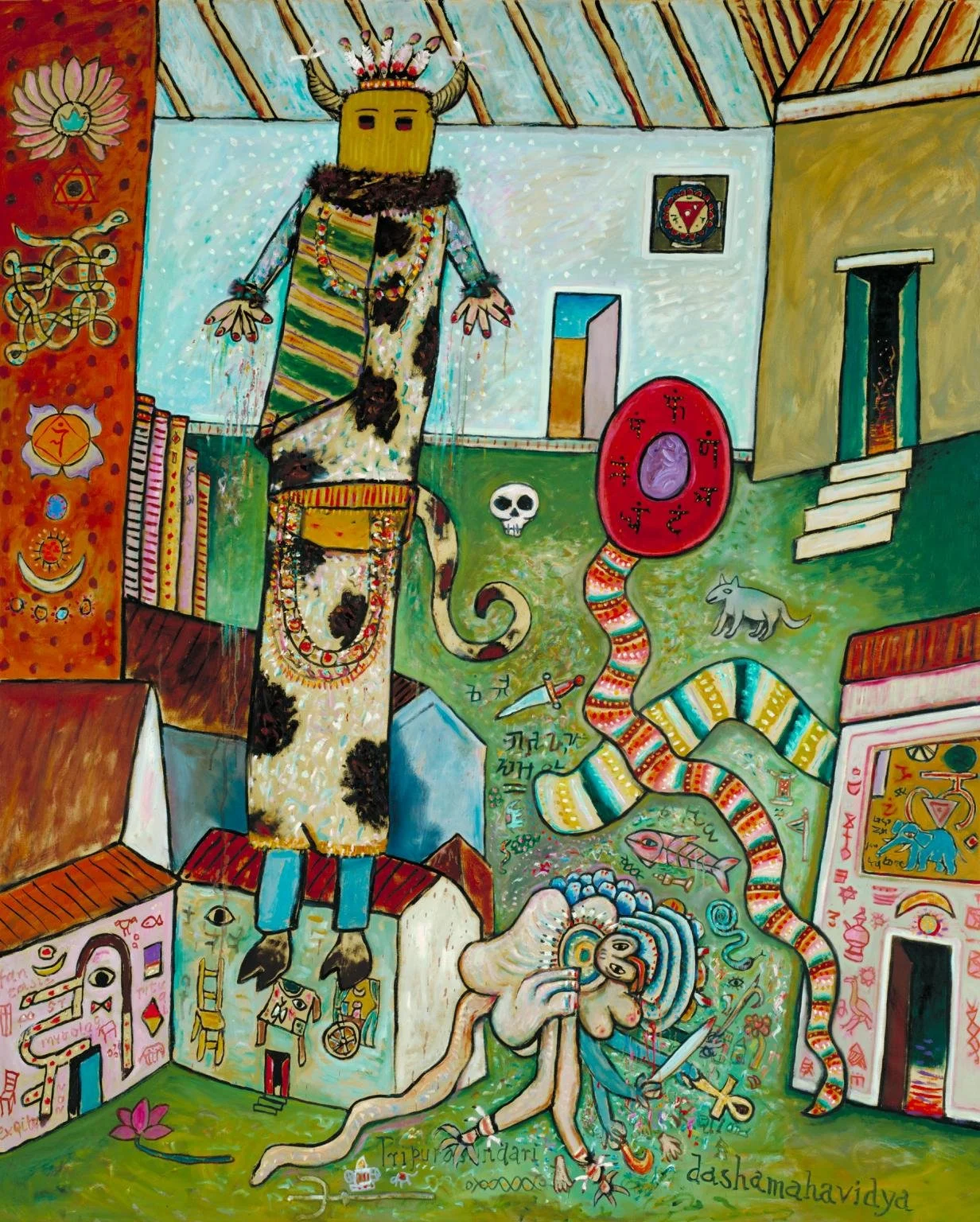
Alan Davie, Village Myths No.36. Oil on canvas. 213.5 x 173 cm. 1983. Courtesy of Tate.
In Village Myths no.36, now in possession of Tate, Davie chose the strongest, most magical imagery. A horned figure looms in the centre of the canvas, particularly potent and curious. Nonsensical writing and sigils are scattered across the scene, accompanied by an incomprehensible assortment of objects: a skull, serpent, fish, dagger, and then plenty of unidentifiable articles too. Like sitting at a piano and surrendering to an instinctual litany of notes, Davie arranged the nonsensical into something harmonious, finding himself inside a world of ideas, of mystic sounds, a dream in waking life. It suited his wish that the pictures be open to poetic interpretation and work as a magical experience.[10]
During the 1980s, Davie’s influence had carried on to the next generation of Scottish artists. John Bellany’s 1987 painting The Pianist Entertains, displayed at the Royal Academy of Arts, London, uses the same symbolism and vivid colour that characterised Davie’s work. Bellany depicts the titular pianist dutifully entertaining within a lively scene. His sheet music assures a ‘Celubrious Soirée’; a garbled misspelling, perhaps deliberately tripping over the mocking, grand tone of a “salubrious” invitation. The mood is less carefree than the initial vibrancy suggests. Of the couple playing cards, the gaunt-faced gentleman resembles Bellany himself, who was grappling with a severe illness at the time, and was subsequently increasingly drawn to self-portraiture as an expressive outlet. [11] The figure is watched over by a clock with ominous, unblinking eyes, promising the passing of time. On the table, next to the cards, a monkey sits as a pervasive reminder of one’s inner demons. Like Davie, Bellany uses a crowded, symbol-laden picture to say what cannot be put plainly. But where Davie’s signs stay deliberately open and unexplained, Bellany’s objects point more directly to his own life. Music enters the frames of both Bellany’s and Davie’s work. For Davie, it shaped how a picture came into being: an improvisational process he compared to finding ideas at the piano. For Bellany, it becomes part of the picture’s symbolism, an emblem of pleasure and conviviality that transports us into the room of the card game.
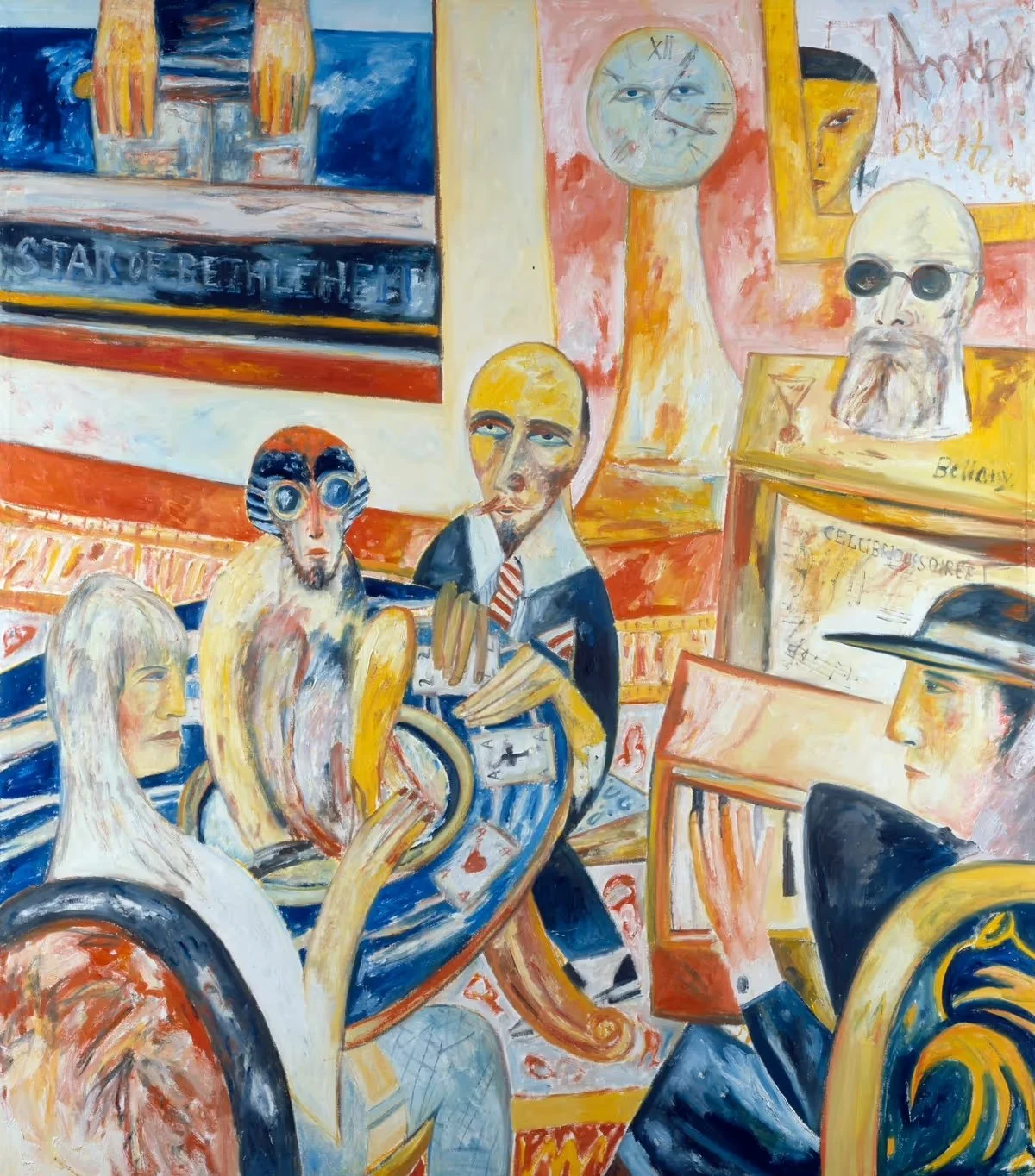
John Bellany, The Pianist Entertains. Oil on canvas. 171.6 x 151.5 cm. 1987. Courtesy of the Royal Academy of Arts, London.
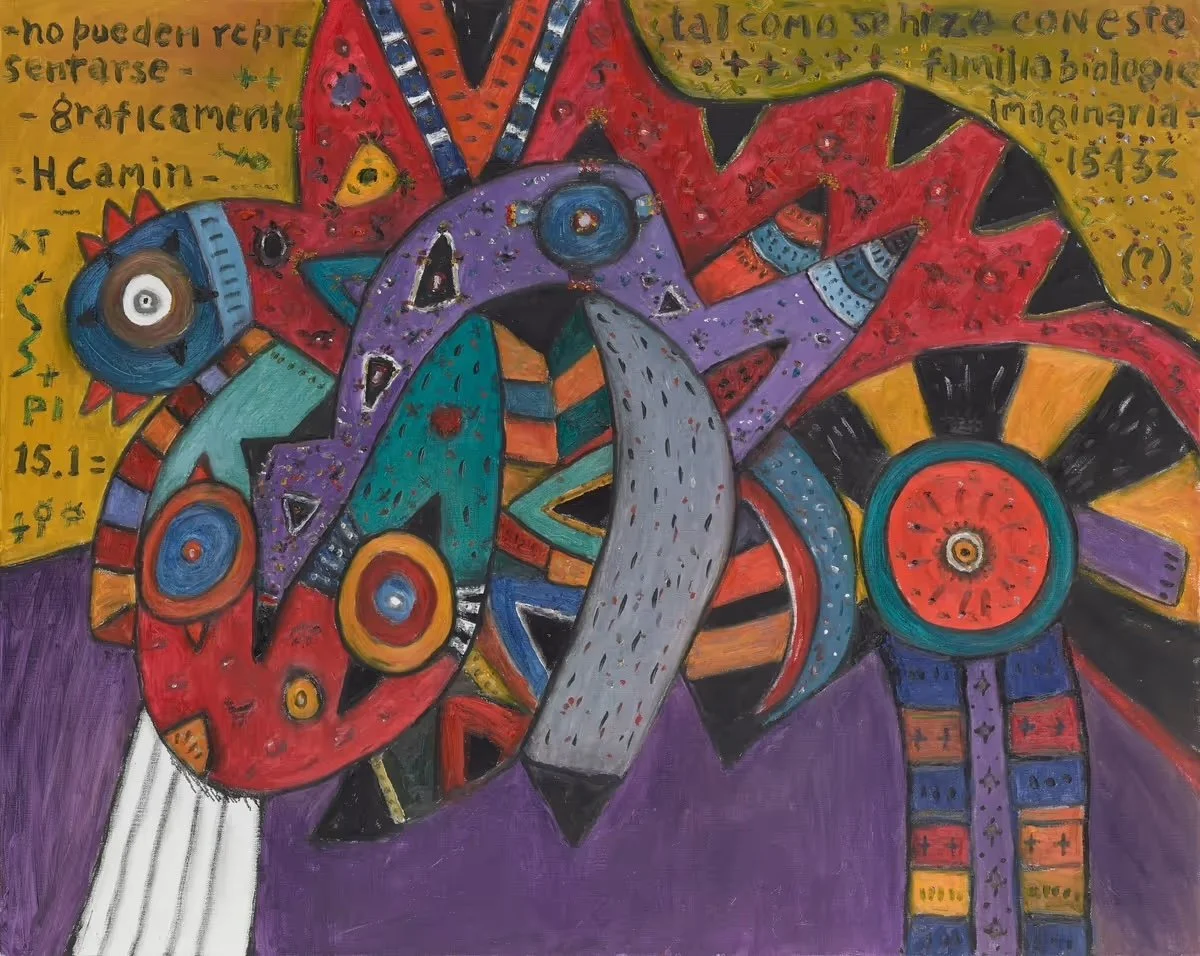
Alan Davie, Opus O.2178 (Camin’s Concept). Oil on canvas. 122 x 152 cm. 2010. Courtesy of the Royal Academy of Arts, London.
Also at the RA (although not currently on display) is Davie’s 2010 Opus O.2178 Camin's Concept, a crowded canvas where wild shapes intermingle. Its title refers to the entomologist Joseph H. Camin, who invented a set of animal-like life forms, the “caminacules,” to help study how related organisms vary. The painting alludes to their physical features, such as a large eye-like form on the left and antennae or tentacles drooping at the bottom right, while Spanish text across the mustard yellow ground refers to biological families and the drawing of imaginary creatures. [12] Davie described how ideas from one theme continue into another. Here, a single borrowed concept seems to generate many related forms, each varying slightly from the last.
Jazz has long been bound up with the body, the crowd and public anxiety. 100 years ago at the very same RA, London, Souter’s original The Breakdown showed a Black saxophonist seated on a broken statue of Minerva, whilst a nude white woman swayed in a trance. The original was later destroyed, and the surviving version is a 1962 reconstruction. The scandal was about race and empire as much as “savage” music, and the careful monitoring of sexuality. Souter’s figures also point to the loosening of an old order, in a Britain where the war had redefined gender roles, and women had more room to claim a similar freedom. [13] Decades later, in Davie’s Farmer’s Wife No. 2 (Jazz Musician and Lady), music and desire are again linked.
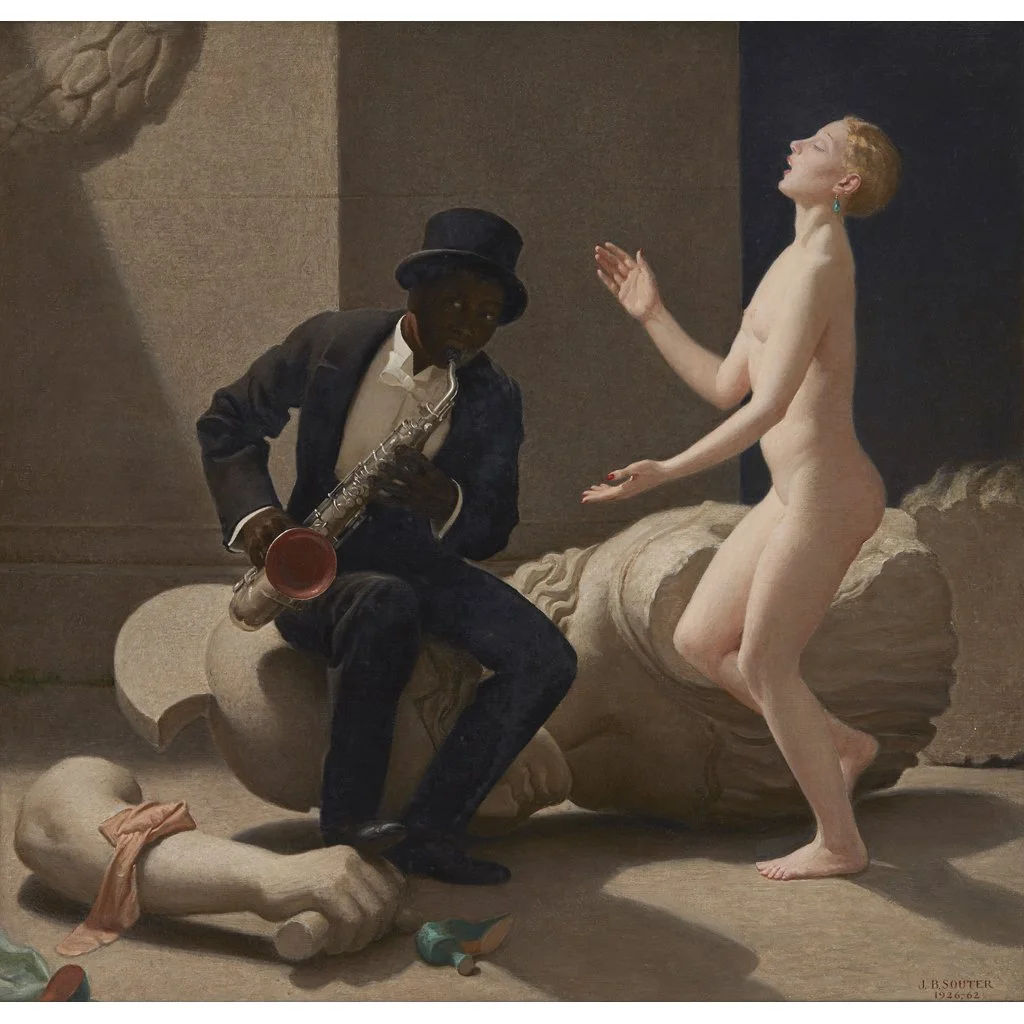
John Bulloch Souter, The Breakdown. 1962 reconstruction of the lost 1926 original. Oil on canvas. 51 x 53.5 cm. 1962. Courtesy of Lyon & Turnbull.
The English William Patrick Roberts’s The Dance Club (The Jazz Party) (1923), now in Leeds Art Gallery, shows a liberated group in the fashions of the day, with sharp, Vorticist forms that give the bodies a newfound power. After serving as a gunner on the Western Front in the First World War, Roberts returned to London and his subject matter increasingly focused on urban life in the city. [14] Freedom is seen as much in the embrace of nouveau synchronisations as it is in the shedding of conservative dress. We feel the thrumming rhythm in the staccato of the sharp angles and rigid lines that form dancing figures. Jazz in both of these works is loud, restless and impossible to ignore. By the time of Davie and Bellany, jazz had moved from the dance floor into the painter’s own method, memory and private symbolism. But the same freedom, pleasure and risk that Roberts and Souter identified still emerge. Across a century of change, from dance floors and salacious sashaying to emotional symphonies that we experience at card tables and in studios, jazz wills us to perform some consuming, rambunctious mental dance. Jazz stands for release: from convention, from the old order, from the weight of a life.
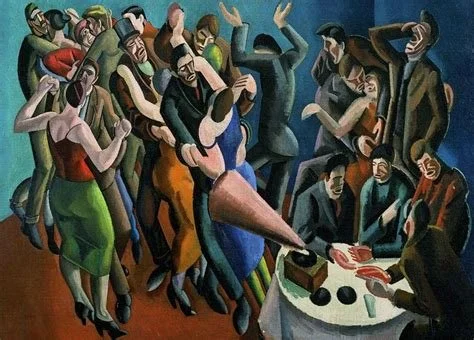
William Patrick Roberts, The Dance Club (The Jazz Party). Oil on canvas. 76.2 x 106.6 cm. 1923. Courtesy of Leeds Art Gallery, Leeds Museums and Galleries.
Davie was in pursuit of that magical thrum of being. He found it in a dazzling, inspiring, enviable array of places across the world, moving with a curiosity and sincerity that most people can spend a lifetime never comprehending. His canvases, full of symbols and prophetic figures surfacing from the cacophony, unplanned and entirely exposed. London keeps his tune going. It is there in the galleries of Tate Britain, and quietly in the rooms of Burlington House, where a saxophonist once caused a scandal; but now the only sound is footsteps on parquet, keeping time – perhaps without meaning to. It is the same rhythm of students spilling out onto streets in any corner of any city, of bodies gallivanting between bars, of a borrowed cigarette passing between hands. The dances of life, the brief harmonious moments of release. Davie understood that this was never a luxury, but a necessity to life. The freedom of improvisation was a way of working through a cramped attic and a damaged city. Jazz, like painting, often forces us to loosen our grip, to play without knowing where the next note will land, and to trust that something true will arrive precisely when it is meant to.
London is still loud and hurried, and still full of people looking for a way out of their own heads. But when I find myself feeling out of beat, I find it’s worth listening to the rhythm in the rush. One day, as I’m walking and pushing through the crowds, somewhere a door will open as I pass, and the notes of someone’s melody inside will spill out like an invitation, and I have arrived at precisely the right time.
Isabella Nicoletti
Notes
[1] - Royal Scottish Academy (2015) ‘Alan Davie: obituary’, in Catalogue for the 189th annual exhibition of art and architecture. Edinburgh: Royal Scottish Academy.
[2] - Tate (n.d.) Alan Davie 1920–2014 ‘Alan Davie: Entrance to a Paradise’. Available at: https://www.tate.org.uk/art/artists/alan-davie-979/essay
[3] - Tate (n.d.) Alan Davie 1920–2014. Available at: https://www.tate.org.uk/art/artists/alan-davie-979/essay
[4] - Tate (n.d.) Alan Davie, Black Mirror, 1952. Available at: https://www.tate.org.uk/art/artworks/davie-black-mirror-t01749
[5] - ibid.
[6] - ibid.
[7] - Tate (n.d.) Alan Davie 1920–2014. Available at: https://www.tate.org.uk/art/artists/alan-davie-979/essay
[8] - National Galleries of Scotland (n.d.) Alan Davie, Jingling Space. Available at: https://www.nationalgalleries.org/art-and-artists/468
[9] - Tate (n.d.) Alan Davie, Village Myths No. 36, 1983. Available at: https://www.tate.org.uk/art/artworks/davie-village-myths-no-36-t03815
[10] - ibid.
[11] - Royal Academy of Arts (n.d.) John Bellany, The Pianist Entertains, 1987. Available at: https://www.royalacademy.org.uk/art-artists/work-of-art/the-pianist-entertains
[12] - Royal Academy of Arts (n.d.) Alan Davie, Opus O.2178 Camin’s Concept, 2010. Available at: https://www.royalacademy.org.uk/art-artists/work-of-art/opus-o-2178-camins-concept
[13] - McKay, George (26 January 2018). "Jazz, Race and J.B. Souter's 'The Breakdown' (1926)".
[14] - David Cleall, 'At the Hippodrome', in Sarah MacDougall and Rachel Dickson (eds.), Uproar! The First 50 Years of The London Group 1913–63 (London: Lund Humphries, 2013).