
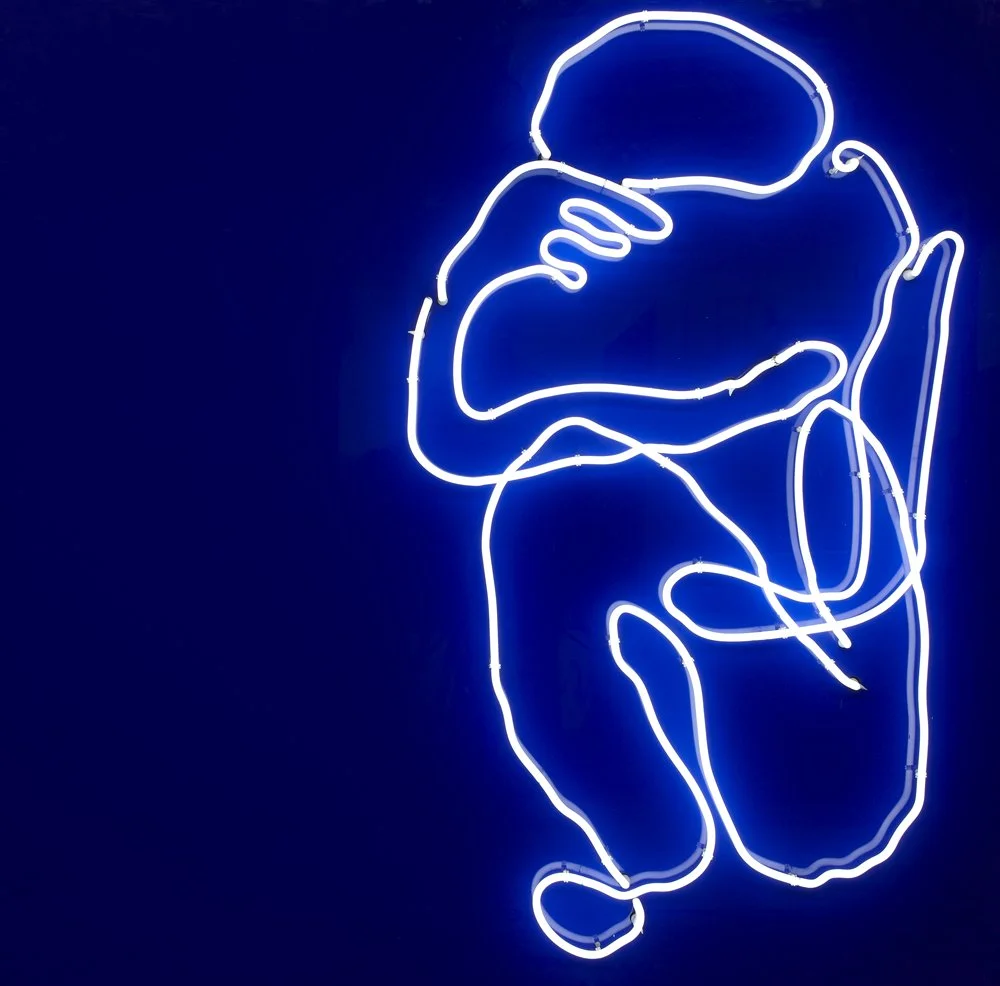
Adrian Wiszniewski: Beyond Expectation
The art of Adrian Wiszniewski is full of surprises. Best known as a star graduate of the Glasgow School of Art, the “New Glasgow Boy” achieved sudden, international acclaim in the mid-1980s. He made his name as a painter at a time when abstraction and conceptualism dominated, then he bounded along a path less-trodden. As a creative, Wiszniewski is about as intrepid as they come.
A picture-maker, first; a Wiszniewski painting can be built up stroke-by-stroke and colour-by-colour, until its subject – a dreamy youth, a blooming flower – seems to stir in the thick currents of paint. Then, elsewhere, Wiszniewski’s tact changes dramatically. He can lay out a multi-figure drama with disarming clarity, flattening forms into something simple, strong, almost frieze-like.
In his drawings, Wiszniewski can mark the entire page in wee, wandering lines, spots and scores, signs and symbols; or he can navigate the whole sheet with a single sweep of brilliant economy. His prints range from small, painstakingly-worked, action-packed etchings to truly enormous feats of artistic bravura in woodcut and silkscreen.
He can use the might of his skills to build and embellish the surface, seducing the viewer, or he can get right down to the brass tacks of line, colour and content: the central facts of his art. Some images demand the time and concentration of the viewer, while others are almost iconic in their impact. Many deal with the stuff of fantasy, featuring a cast of enigmatic, almond-eyed innocents out to make their fortune in a weird, disorienting, airlessly still otherworld.
Wiszniewski won great acclaim with such work upon graduating from the Glasgow School of Art in 1983. One of the central players in that exciting moment for painting in Scotland, “Whizz-kid Wiszniewski” had his first solo show only months after graduating [1]. Exhibitions sold out in Scotland and London. Soon, his paintings hung in public and private collections in the UK and internationally: the Tate bought one as early as 1985. The attention was wholly deserved if quite unexpected.
What happens next may shock you. Ultra-chic neon installations and minimal Perspex sculptures. Designs for interiors, furnishings, furniture: in GG123, Wiszniewski explores the concept of the Holy Trinity in the form of a chair. Novels, plays, screenplays: Touching Cloth, GBH (The Girl, The Boy and The Hag). The drawing, painting and printmaking continued, along with the exhibitions, commissions and sales, but Wiszniewski’s early success did not have him resting on his laurels. In fact, the result was experimentation with enthusiasm.
“I’ve got to make a living out of everything creative, so I do”, he says. It’s true that artists, out to earn a crust, might not seek to box themselves into a corner. But few experiment so daringly, across such a breadth of media, across such an extended period and – importantly - with such successful results. His body of work is remarkable for its scope and maturity. Wiszniewski might deserve to sit alongside John Byrne and Alasdair Gray, his fellow graduates of the Glasgow School of Art – albeit one generation removed – and be celebrated as a great Glasgow polymath.
Now aged 68, busily absorbed in various new projects and certainly as creative as ever, Adrian spoke to me about the creative life which has embraced so much. We spoke about the big moments and some of the most central works, and the instinct to experiment which has driven his exciting, incredibly broad-ranging oeuvre. Alongside much else, Adrian told me about the nature of his versatility, the importance of excitement and the danger of flogging dead horses.
Adrian Wiszniewski, Netherlandische. Oil on canvas. 249 x 257.5 cm. 2002. Private collection. Courtesy of Bonhams.
Adrian, how did your artistic life start? Take us back to the Glasgow School of Art in 1975.
I always had an interest in art, but I didn't do art at school. I was relatively good at mathematics and science, so it was suggested that I combine my interests and become an architect. So in 1975, when I was 17, I went to the Mackintosh School of Architecture at the Glasgow School of Art.
I had friends across other disciplines at art school, so it was always easy to go and find a friend in Sculpture or Ceramics or Painting and find out how their mind worked. Their minds worked quite differently from an architect’s. I found that very enjoyable.
When I was about 20 or 21 years old, I thought “I’d really better get this art bug out of my system”. I’d done a trial period in an architect’s office called Baxter, Clark and Paul, just next door to the Glasgow Film Theatre. I really enjoyed that, but in the architect’s office I always felt I was in the company of frustrated artists. I thought I should really try to do art then make a decision about what I was going to do with myself.
I went straight into second year Drawing and Painting at the Glasgow School of Art in 1979. I put a portfolio together quickly and showed it to David Donaldson, the Head of Department. We got on really well, he cut all the red tape and got me straight into second year, even though I didn’t have Higher Art. So I got into Drawing and Painting, even though my plan was originally to be a sculptor. It was quite easy to work two-dimensionally rather than three-dimensionally when putting together a portfolio.
Anyway, I got into second year Drawing and Painting, then in third year I went into the Mixed Media course, where I met Steven Campbell. We did a two-person show in the studio at the end of third year. We got a lot of attention around the art school because we were quite carefree and sort of rebellious. But creative. We were making films, doing performance…
In fourth year, I found myself back in the Drawing and Painting Department, after the Mixed Media course was closed. And I thought “God, I’d better get some drawing and painting done”. I decided to do some very quick drawings after Boucher and Fragonard. In 1982, I was given a postgraduate year and that was when I got a grant, and I decided to do some serious work. All this time, because I’d spent time doing Architecture, I hadn't had a grant.
Drawing, painting, architecture, sculpture, performance, film… Art school is all about experimenting, but you were casting a very wide net indeed.
The first books I read when I went to art school, when I went to do Architecture, were books on Charles Rennie Mackintosh. They were full of his designs and watercolours, as well as his architecture. Also, Le Corbusier, who was a great painter as well as an architect and town planner. Then I was reading about Michelangelo who was a great painter, sculptor, architect, poet... And I thought, “you can just do what you like!”
The experience of moving between departments at art school, meeting people and trying your hand at different things sounds invaluable.
I just wondered how people worked. Their constructs to make art. How do you make art? What is it that makes ceramics ceramics? What is it that makes textiles textiles? And when is a rug a rug and when is it a floor sculpture? The same with a chair. Take a lot of furniture from the twentieth century; most of the time, seats are sculptures, and they only become seats when you sit on them.
When I left art school, I thought “maybe I’ll just end up having a couple of exhibitions, then maybe I’ll end up getting a teaching job somewhere, and that will give me money and I’ll be able to continue my growth that way”. Or “maybe I’ll go and do architecture and use my experience in doing art to help to enrich my architectural experience”. But in the end, it was getting more and more difficult to not be an artist.
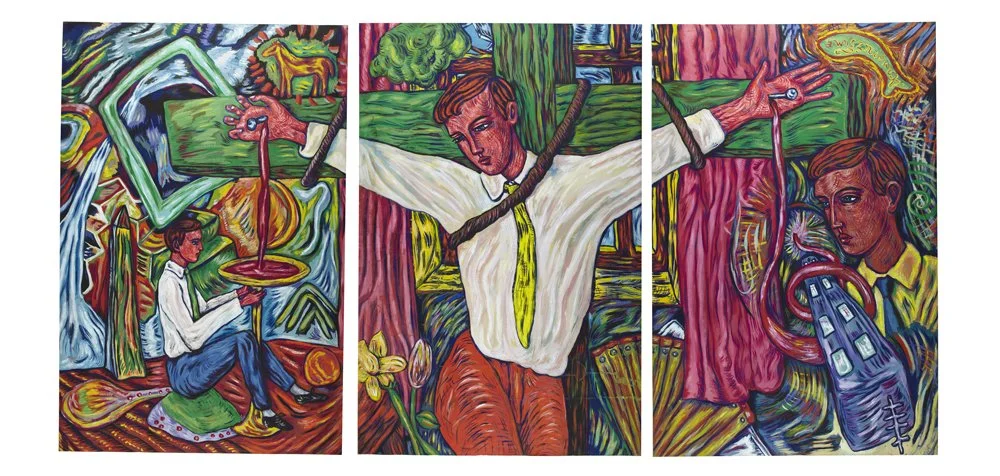
Adrian Wiszniewski, Crucifixion. Gouache on paper. Triptych: each section 152.5cm x 101.5cm. 1985. Private collection. Courtesy of Lyon and Turnbull.
Very soon after you left art school, you were snapped up by the galleries and several successful solo shows followed.
When I was in my postgraduate year, I was offered a one-man show in London. They’d come up to Glasgow, saw my postgraduate show, made the offer, and that gave me a year to work for the exhibition at the AIR gallery in London, which was quite prestigious.
I went to the Compass Gallery in Glasgow and told them I had a one-man show in London coming up. They had a certain process at the Compass Gallery. Cyril Gerber, the director, would say, “we’ll put some of your work in the Christmas show and we’ll see how it goes”. Build a career slowly, sort of thing. But I didn't want a slow growth. I used the fact that I’d been offered a solo show in London as a sort of bargaining chip. That was a way of wangling my first solo show, which happened in spring 1984. It gave me some experience before my show in London.
It sounds like a bit of a bolshy move for a young painter at the very start of their career. You clearly had confidence in your work.
Well, if you don't ask you don't get. I would speak to a lot of other young art students at the same time and they’d say, “I’m not really worthy of all this...” And I thought, “I need to get on with things. I can't hang around for a career. I don’t have any income, so I need to make money”. If I did a painting, I had to try and sell it. If I was in a group show, then I would do a painting that people would notice. It wouldn’t be a humble wee thing in the corner. It had to be a blaster!
When I came to be included in the British Art Show, a survey exhibition in London of British art, it was just after art school and I’d only done two paintings since I left. The first painting I did was called My Jewish Brother, which was six feet by eight feet. I put it into the Society of Scottish Artists and it got rejected. A year later, it was in a Thames and Hudson book of painting. I was quite chuffed by that.
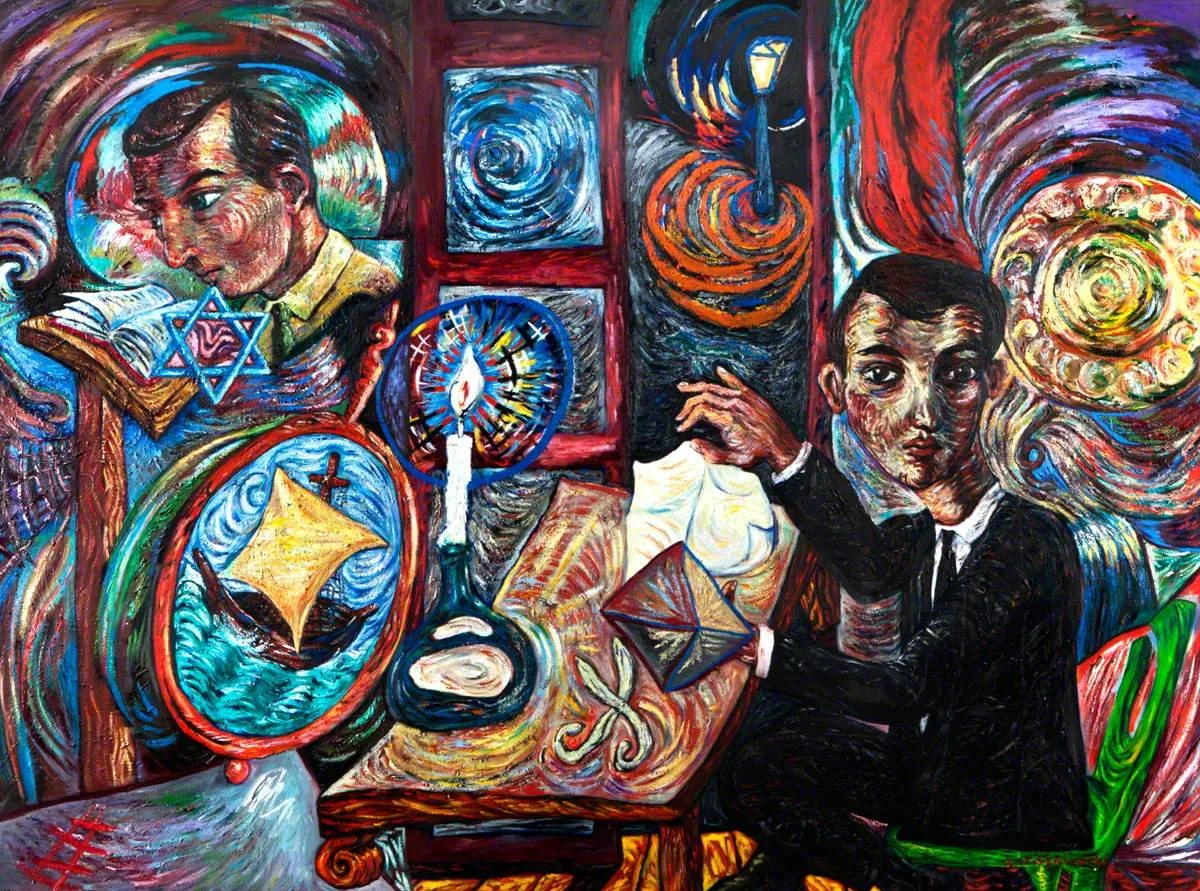
Adrian Wiszniewski, My Jewish Brother. Oil on canvas. 184.8 x 246cm. 1983. Collection of High Life Highland.
So just out of art school, you were certainly on the move.
The Scottish Arts Council bought a big painting from the Compass Gallery. The show at AIR in London sold out. Soon, I was taken on by the Nicola Jacobs Gallery in London. I was being covered in the newspapers. Everything was happening very fast. It just seemed to be a phenomenon. I was quite well dressed at the time, too. I was tall and thin and wore flashy, second-hand suits, so I cut a bit of a dash by the mid-80s, which was the time for doing it.
In 1984, I was in the British Art Show, and that brought me and Steven Campbell together again. We stole the show, really. The press called it “The Campbell-Wiszniewski Show”. A little later, in 1986, Arena decided to do a documentary on the both of us for the BBC, called Two Painters Amazed.
Left: Steven Campbell, Portrait of Adrian Wiszniewski. Oil on canvas. 89 x 59 cm. 1987. Private collection. Courtesy of Bonhams.
Right: Adrian Wiszniewski, Portrait of Steven Campbell. Oil on canvas. 89 x 59 cm. 1987. Private collection. Courtesy of Bonhams.
But it was quite fraught. There was a lot of heat in Glasgow and I felt I needed to go and concentrate on my work. I didn't like to be a part of anywhere, so I asked my wife Diane – we got married in 1985 - if we could settle in a place near the Borders. I didn't want to be in Scotland specifically or England specifically, so we went right to the border between Scotland and England and settled in Alnmouth, Northumberland. It was the perfect place to work. We didn't have a car, but we could actually get a train straight from Alnmouth to Edinburgh or London on that line, just walking from the house. You could get up in the morning, go and get the train, and be in London in time for lunch. It was ideal.
Around the time you moved to Northumberland, your old teacher, Sandy Moffat, curated New Image Glasgow, which opened to rave reviews at the Third Eye Centre in 1985. Your work featured centrally.
I think Sandy had a big role in the promotion of my work. Sandy was one of the selectors for the British Art Show in 1984. He selected Steven Campbell and myself for that. We must have impressed him when we were art students. I think Alasdair Gray was supposed to be putting on a show at the Third Eye Centre on Sauchiehall Street, which later became the CCA, but it was cancelled late on. So they asked Sandy to put a show together. They asked myself, Steven, Ken Currie - Ken had given up painting at that time, and he was busy making documentary films – Peter Howson, Stephen Conroy, Mario Rossi and Steven Barclay to contribute. That was New Image Glasgow.
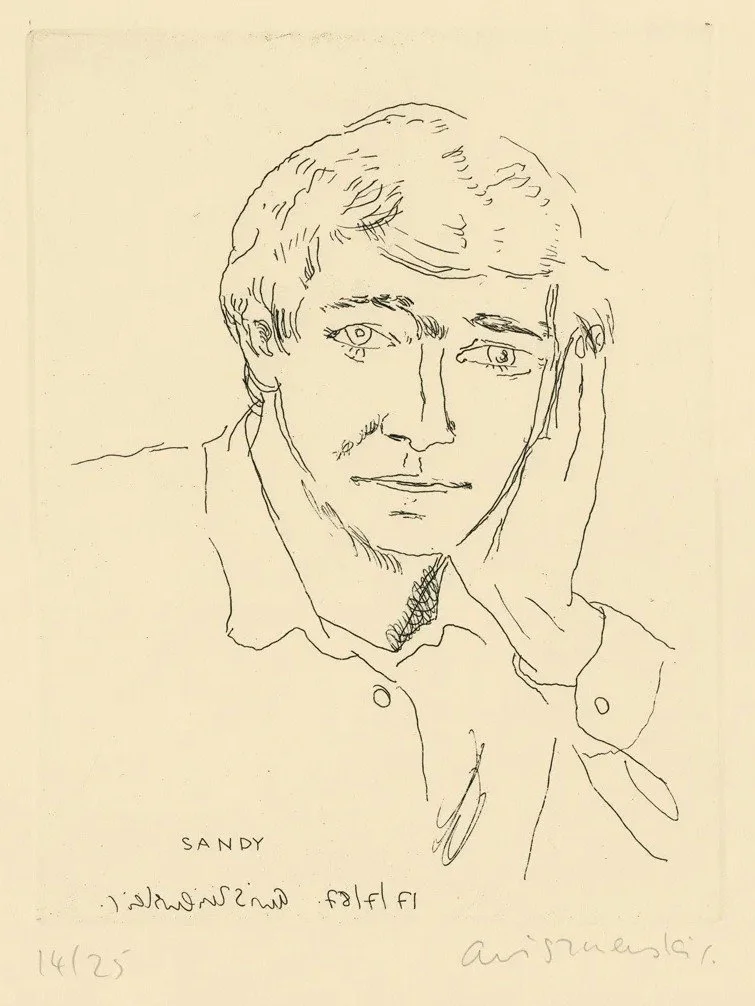
Adrian Wiszniewski, Sandy (Moffat). Etching on paper. 29 x 22cm. 1987. Edition of 25. Courtesy of Edinburgh Printmakers.
You and your fellow painters – talented male figurative painters – were grouped together as “The New Glasgow Boys”. But you and Steven Campbell were often paired.
There was quite a divide between my work and Steven’s work on one hand, and maybe Ken Currie’s work and Peter Howson’s work on the other. There were other artists in that show, but for some reason the press focussed on the four of us. They suggested there was one stream that was very class conscious - that was Peter Howson and Ken Currie - and the other one not. Steven and I didn’t feel we weren’t class conscious, we just felt that we weren’t manacled to it. So Steven Campbell and myself ended up having much more in common than not in common. We'd been in British art shows in Sweden, representing Britain with British sculptors like Tony Cragg and Bill Woodrow. That was when I first met Christopher Le Brun and had a very good chat with him about art politics.
It became quite clear that British painting wasn’t what was going to be promoted on an international stage. The Germans and the Italians had dominated painting in Europe. Julian Schabel and David Salle had done that in America. So what Britain was doing was heavily promoting the sculptors. There seemed to be all these British sculptors who were winning. It seemed that our role as painters was being marginalised.
But in mid-80s Glasgow, painting was enjoying an extremely exciting moment. The New Image Glasgow show was quite momentous.
I felt there was such a buzz when I was at art school. I knew people who were going down to London, but I just felt the spotlight was on Glasgow. We had people like Bill Forsyth making films like Gregory's Girl and Local Hero. Peter Capaldi, who was in our year at art school, starred in Local Hero. There were all these new bands coming through the art school too. It just seemed to be a really good place to be. There was a scene and the scene was in Glasgow.
The New Image Glasgow show happened when I was about three months out of art school. When it came to the opening, people were queuing up outside. Journalists came up and caught the buzz. Waldemar Januszczak got really involved in it. He came to the opening at the Third Eye Centre. He called me “The Byron of the Gorbals”. Everything was buzzing. But I wanted a career in art. How to make this thing last? What happens when the spotlight goes off Glasgow?
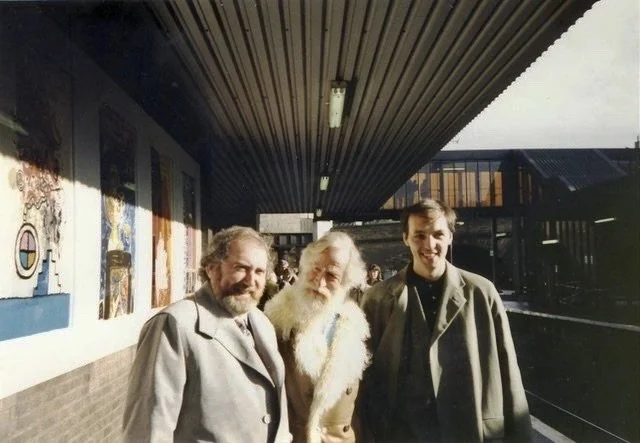
On the move: a young Adrian Wiszniewski with giants of Scottish art John Bellany (left) and Alan Davie (centre), photographed by Alexander (Sandy) Moffat. Haymarket train station, Edinburgh. Late-1980s. Image courtesy of Sandy Moffat.
Despite all the excitement, you were aware the bubble might burst?
Very much so. I was trying to understand the reality of where I was. I got married soon after leaving art school. It was important for me to have a normal life. I didn’t want to have a traditional artist’s life. In the 70s, artists had to wear beards, drink heavily, be raucous… But I wanted to be a responsible parent and do art as a professional job, and not be a suffering artist, an egomaniac.
I had solos shows in London which were really, really successful. I showed at the Nicola Jacobs Gallery, and the show sold out. My work was getting bought internationally. But I didn’t want to be in a position where I was just producing work for the purpose of selling it. I didn’t want to be a slave to the style that got me to where I’d got. I didn't want to be trapped into a style of artwork. In fact, it’s not a style. It’s a set of processes that get you from start to finish. And I needed to expand my processes.
In 1985 or 1986, I started doing printmaking. I think I’d made a poster at art school for the postgraduate degree show, but I didn't actually get involved in printmaking until I was invited to work at the Glasgow Print Studio by John Mackechnie. Then I realised there were things I could do in printmaking that I couldn't do in painting or drawing. It had a very different language. The language of woodcut was very different to the language of silkscreen or lithography. I tried to understand how these things could be made. I wanted my silkscreens to look like silkscreens. I didn’t want them to look like reproductions of a painting.
The first etching I did was a big one. John Mackechnie asked me “what size do you want your first etching to be?” And I said “what's the biggest one I can do?” That saved me from thinking about it. I’d been reading about Andy Warhol, who had said that he liked to do his paintings on squares because that way he didn't have to think about the height of the picture compared to the width. They’d all just be the same. He cut down the thought process. So I said “give me the biggest bit of steel you can get through the press!” The result was a print called The Sculptor’s Nightmare. That was my first etching. My first silkscreen was called Po-et, which was also probably the biggest print I could do.
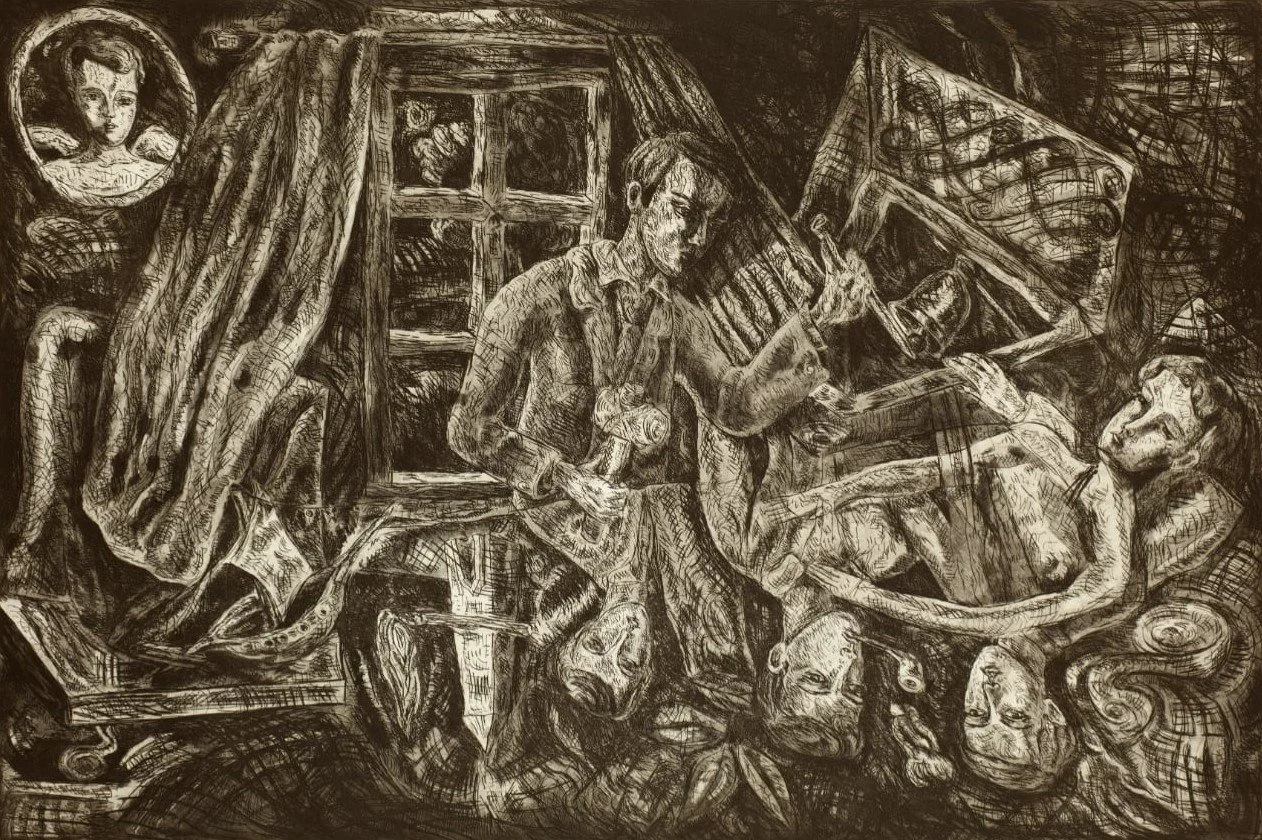
Adrian Wiszniewski, The Sculptor’s Nightmare. Etching. 74 x 104 cm. Edition of 70. 1986. Published by Glasgow Print Studio. Courtesy of Glasgow Print Studio.
Printmaking’s a great departure from painting, particularly when your early painting involved such rich surface texture.
I never really learned how to paint as such. If I was going to do a big canvas, I always thought “how can you do it?” I might only have one brush, maybe a thin one. And I hated mixing colours for no apparent reason. I remember when I was at art school, some rich students would go down to the art school shop and they’d buy these really expensive, really beautiful colours. Then they’d take them to the studios, mix them all up and do these horrible brown paintings. I just wanted to use the colours from the tube.
I did drawings with pastels - chalks or oil pastels – where I’d use one colour then I’d work with a different one, then a different one. I did the same thing with oil paints. I’d use the pink, then the blue, then the yellow, the overlaps would be green… Until every single colour was woven together into a painting. It meant I was drawing, redrawing, redrawing all the time. In doing that, I was very influenced by Matisse, even though he worked in a slightly different sort of way. He would do a painting during the day, then his assistant would wipe it out at nighttime and that would leave a ghost. He’d go and work on top of this ghost the next morning. He’d build it up, build it up, and it would get wiped out again at the end of the day. He’d do this process again and again till he got a buildup of “ghosts” which were superimposed upon each other, until he’d do the final flourish and that was the painting finished. I learned how to do that, and then I tried to do something else.
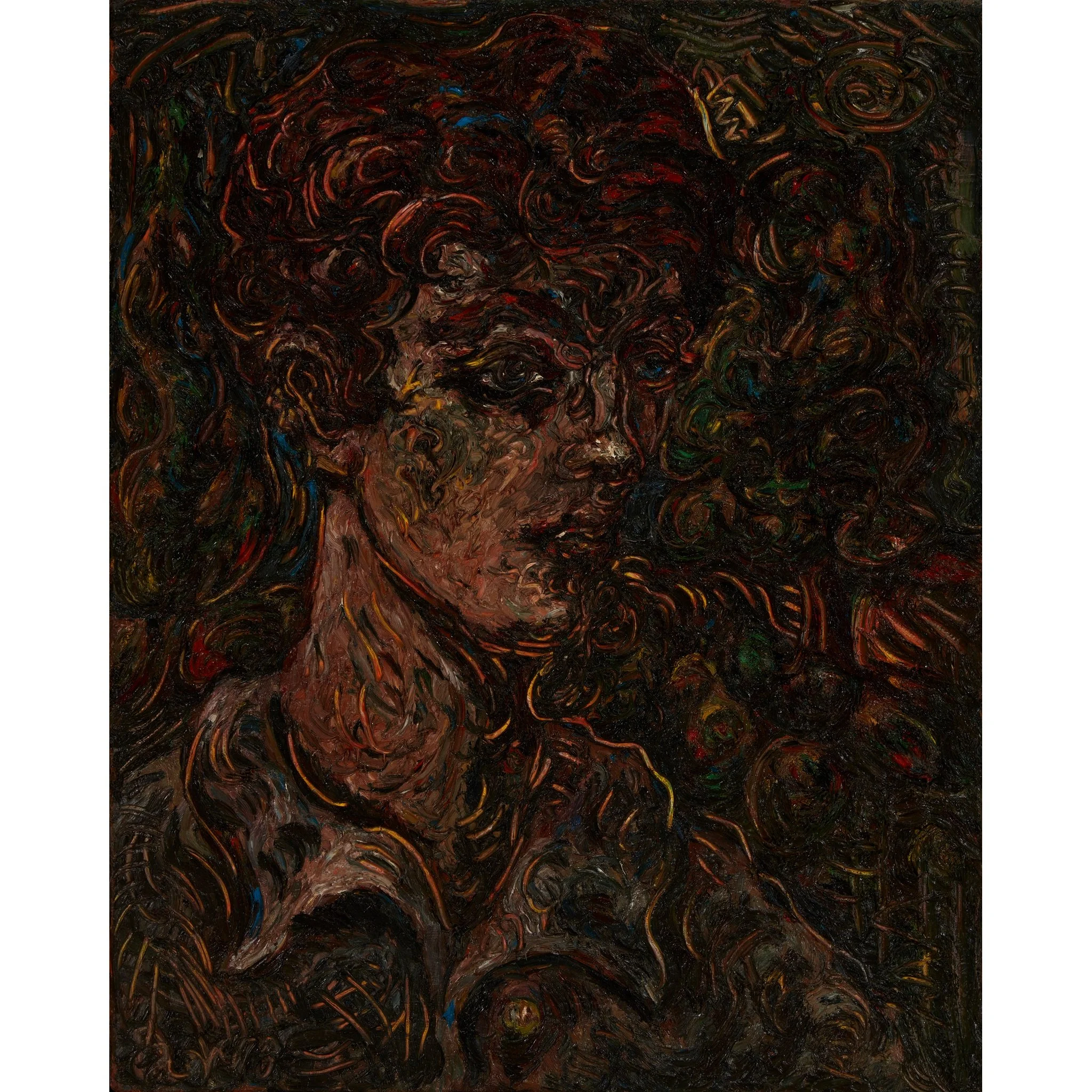
Adrian Wiszniewski, Portrait of a Boy. Oil on canvas. 77cm x 62cm. Private collection. Courtesy of Lyon and Turnbull.
How did you make the transition into your neon works? It’s a striking departure from any sort of painting.
Towards the end of the 80s, I wanted to get away from the fetishistic quality of painting with oils. People get weak at the knees at the thought of “paint!” I’d done a lot of paintings and I just thought “ok, I'm interested in line, I'm interested in colour, I’m interested in content” and I thought I could do something using neon. The result of that was I was invited to do the whole length of Princes Street in neon for Lux Europae, the European summit held in Edinburgh in 1992. They kept it all up for Christmas as well because it featured giant fairy lights, so that was great. People don't buy neons in Britain, so I started showing with a gallery in Belgium at that time too.
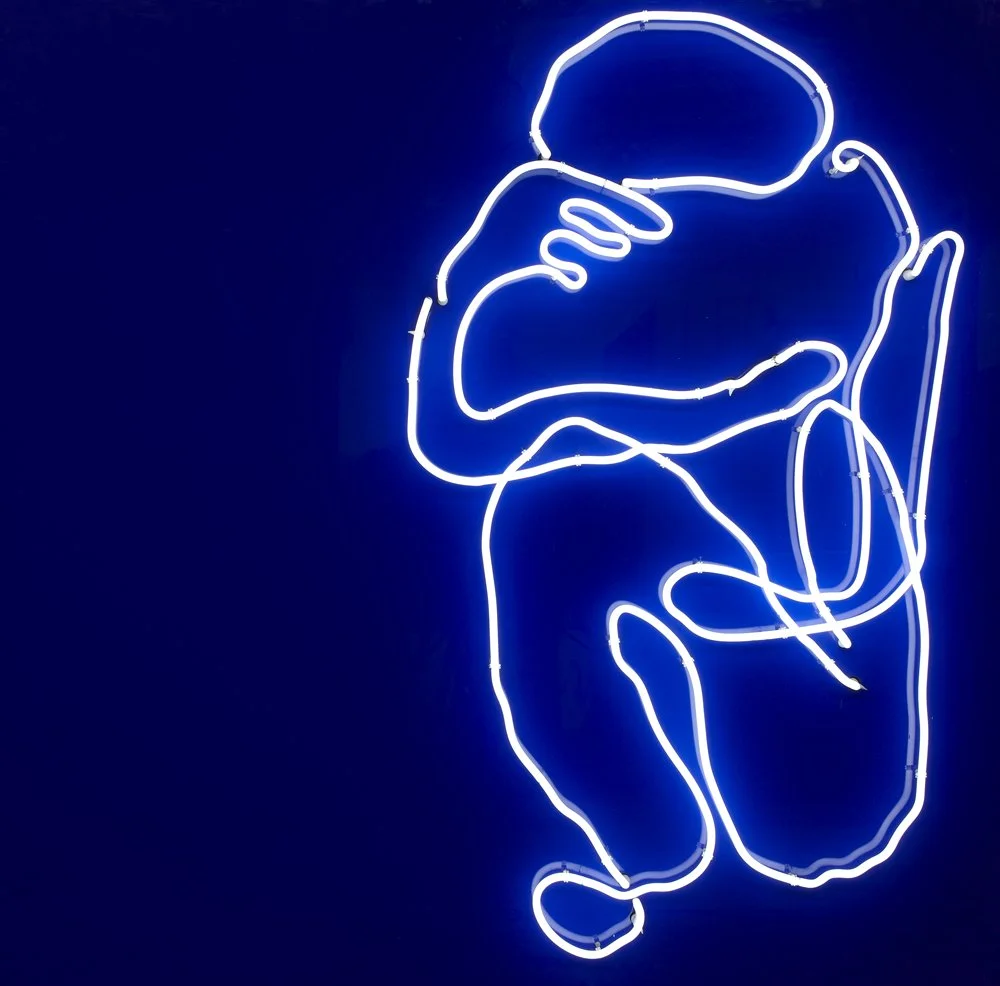
Adrian Wiszniewski, Down and Out. Neon and Perspex. 152.5cm x 152.5cm. Private collection. Courtesy of Lyon and Turnbull.
You were making serious efforts to expand your practice, moving far away from the paintings that had made your name.
In 1986, we left Alnmouth to go to Liverpool and I did a year-long residency there. I didn’t have to sell anything for a year, which meant I could really develop my work. That’s when I really took up printmaking and also started working in ceramics. The V&A bought some ceramics. My first etching, The Sculptor’s Nightmare, went to the British Museum around that time. And by 1985, I was in the Tate Gallery.
I was always aware of Orson Welles, who said he started at the top and worked his way down. I just had to be careful I didn't work myself too far down. I was always doing the best I could. I think doing different things and bringing that experience back to painting or whatever else is always a good thing.
For example, Steven Campbell and I decided to write the screenplay for a film. We sat in the pub, we had a chat about the content, and I went back and typed up a story based on that conversation, developing it so it made sense. Then STV got interested and wanted to make it into a partly-animated partly-live-action film. We had several meetings. The film was going to be called A Jacobean Tragedy. Unfortunately, on his CV, Stephen kept on writing the subtitle “a collaboration between Steven Campbell and Scottish Television”. And I said “well Steven, it's a collaboration between you and I and Scottish Television… You've got to change the CV”. But he wouldn’t change his CV. I wasn't going to do all the work and him take all the glory. I don't mind sharing, obviously, in collaborations. In the end, it didn’t happen. We didn’t really fall out. We just decided not to spend time together.
Really, I don't think Steven’s ideas actually add up to a lot. Steven was a collagist in a way. He’d throw images at a wall and see what stuck. So if he wanted something in the left-hand corner, he’d open a wee book, and there would be a flower which he’d copy and put in the corner of the painting. Or something else, or something else. He was always changing it. He was a bit of a serialist really. I was quite different. I liked to make statements which were singular and clear. In paintings like Kasmin and Kapo or My Jewish Brother, I was trying to do something you could understand by looking at it. Or Culture-Vulturing City Slickers, which was one that was bought by the British Council. I understood Stephen's methodology but there was no point in me working in a similar sort of way. Someone called Steven’s work a “Campbell’s soup”. He had a group of ideas floating around. I knew his process and it wasn't my process.
I think it's always important to paint something about something. I did a painting called Blank Verse, about an artist who can’t think of anything to say. He’s a poet, staring at an empty page. He’s blocked. He’s got nothing to say. Meanwhile, his alter ego, an art critic, is leaning over the wall, admiring the blank page. Sometimes saying nothing is better than saying nothing of consequence. I also did a painting called Two Men Doing Absolutely Nothing. I got very interested in the idea “what is nothing?” It became an art form within the Italian aristocracy; how do you spend your life doing nothing? I found that a very interesting way to live.
The relationship between word and image is all-important in your work. Sometimes, the title of a painting is crucial to its content.
That was the good thing about neon, because I could do a title without an image. I did a piece called Picasso’s Balls. It was just the title “Picasso’s Balls” written in neon, attached to the wall, just above floor height, with two white Perspex cubes in front. It was a celebration of his macho bravura. The balls were shaped as cubes, which is a pun on Cubism. It’s a bit of a rubbish joke, but rubbish jokes are ok sometimes. Tony Cragg had just done his piece Britain Seen from the North, where he had this guy on a wall upside down, so he was looking at Britain from a fresh point of view. It was such a strong image. Sometimes, one-liners can work really well.
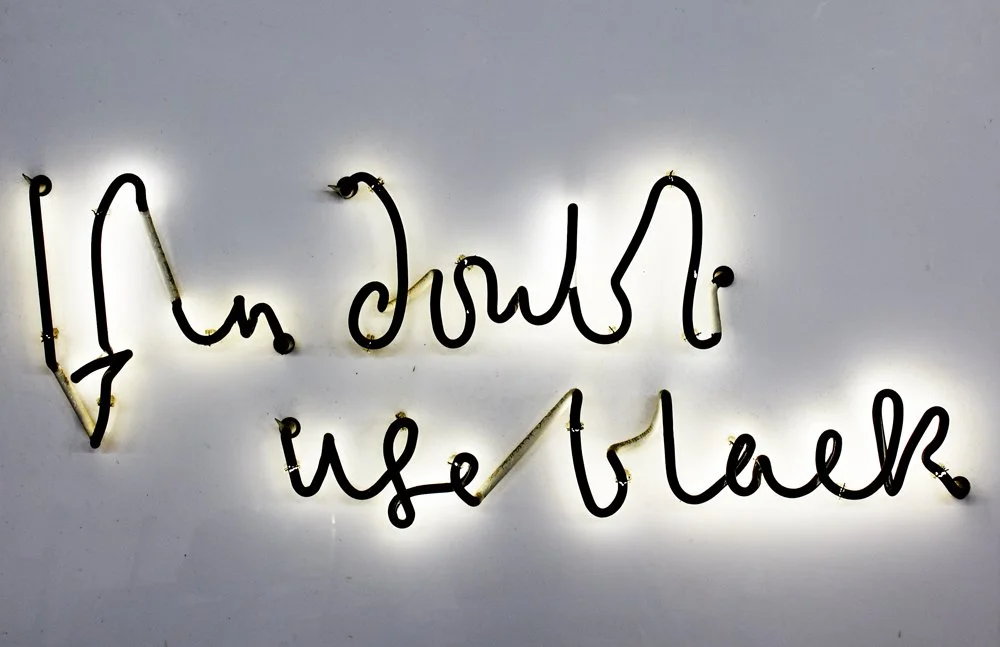
Adrian Wiszniewski, If In Doubt Use Black. Neon and Perspex. 61cm x 91cm. c.1990. Private collection. Courtesy of Lyon and Turnbull.
Around this time, you were taking on more and more design work.
In 1995, a chap who was running the arts projects for Middlesborough council, John Cairns, got in touch. I think he’d seen some of my neon work. He didn’t have much money, but he said “maybe you could do a lot with a little… Maybe you could do five or six projects”. One was to design furniture, one was to make work for a sculpture garden… And the projects included designing flags. I designed 12 flags for places that either existed and didn’t have flags, or places that didn't exist at all. I did a flag for Atlantis. How do you design a flag? What happens if you cut up coloured paper and play around with things till everything works together?
I enjoyed doing all the projects. I used it as seed money as well. When I came to do the design of the 12 flags, I also did silkscreens – the Twelve Flags series – so in the end, the project paid for itself. I tried to make things work in relation to the bigger picture.
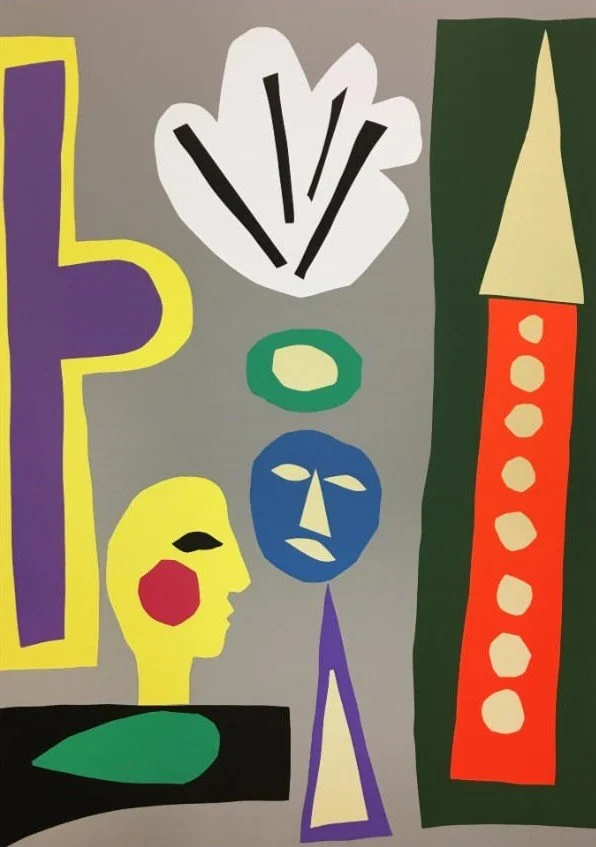
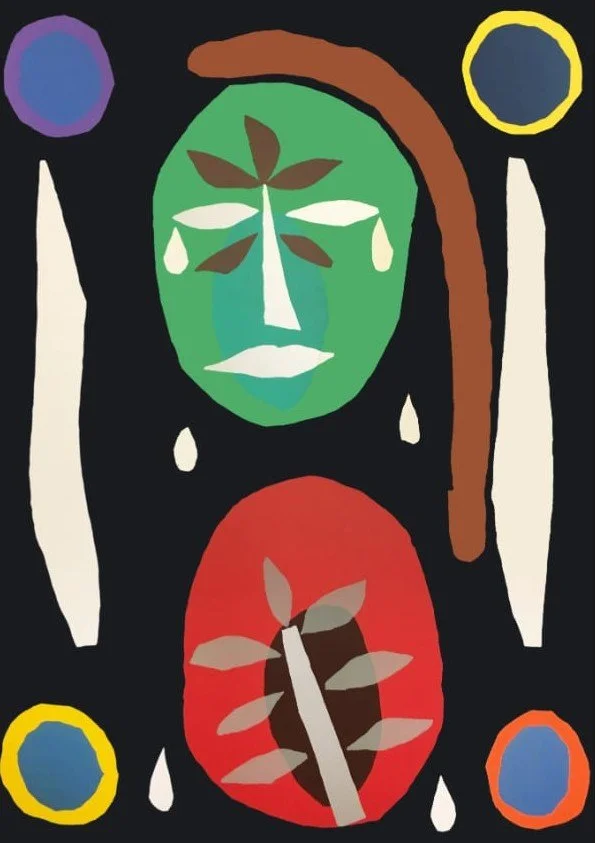
Left: Adrian Wiszniewski, Atlantis. Screenprint. 76 x 57 cm. Edition of 40. 1995. Published by Glasgow Print Studio. Courtesy of Glasgow Print Studio.
Right: Adrian Wiszniewski, Echo Beach. Screenprint. 76 x 57 cm. Edition of 40. 1995. Published by Glasgow Print Studio. Courtesy of Glasgow Print Studio.
Then someone else asked me to design some furniture. I designed a chair called GG123, which was an exploration of the Holy Trinity in the form of a chair. The Holy Trinity is one of these impossible things to describe, so it was nice to describe it in the form of a chair. The cathedra is the name of the bishop’s seat and the cathedral is the building that holds the seat. So it was interesting to take a seat, a single chair, which a whole cathedral holds, and do an exploration of the Holy Trinity in the form of that chair. I suppose it was an intellectual pursuit.
More intellectual than painting or drawing?
Painting and drawing are intellectual. Look at the great minds of the past. A lot of them have been painters, sculptors, architects. The idea of painting has been dumbed down. I got into a bit of a situation where a lot of my paintings appeared quite seductive. People really enjoyed the surface and the quality of the paint. The message behind the painting was getting a bit lost. I had been using the paint to sort of seduce the viewer into paying attention to the content. But a lot of the time, I felt that the viewer wasn’t interested as much in the content as in the fetishistic quality of a good-looking painting. It’s quite a problem when you’re a painter. You end up going off and doing Perspex boxes and things like that.
Is content easier to handle in commissioned portraits, where a likeness is central?
A likeness is ok. I can do that. When I was in Liverpool, I was asked to do a portrait of Sir John Moores, who was very elderly at the time. I didn’t find that difficult. It was quite expressionistic, I think because I had to get it done in a short period of time, and it was a very big painting. Quite different from the Citizens Theatre one, commissioned by the Portrait Gallery in 1995.
The most important thing about the Citizens portrait was that it wasn’t just a portrait of three people. It was a portrait of an institution. A hugely creative conversation between three directors, who all had different roles from each other. Giles Havergal, Philip Prowse and Robert David MacDonald. Even as a teenager, I’d go to the Citizens and see their plays, and they were really quite revolutionary at the time. The Marquis de Sade show. Their very provocative restaging of Shakespeare’s plays. Also, when I was a student, you could get in for nothing with your Unemployment Benefit card. So Giles Havergal would meet me at the stage door and say “come this way Adrian, I’ll get a seat for you”. I’d watch the plays they’d put on. I got really interested in the theatre through the Citizens.
For the Citizens Theatre portrait, I knew I could do a likeness, but I had to think of a new way of doing it. I asked each director to sit for a day. I read up on the Citizens. They took me out for lunch and I asked them about who they were, how their career was going, how they worked together… And that was the basis of how I managed to put these three figures together into one composition. It was a very theatrical composition. It had an everyman quality to it, with its Leger-style background. I think it works really well. It’s a statement.
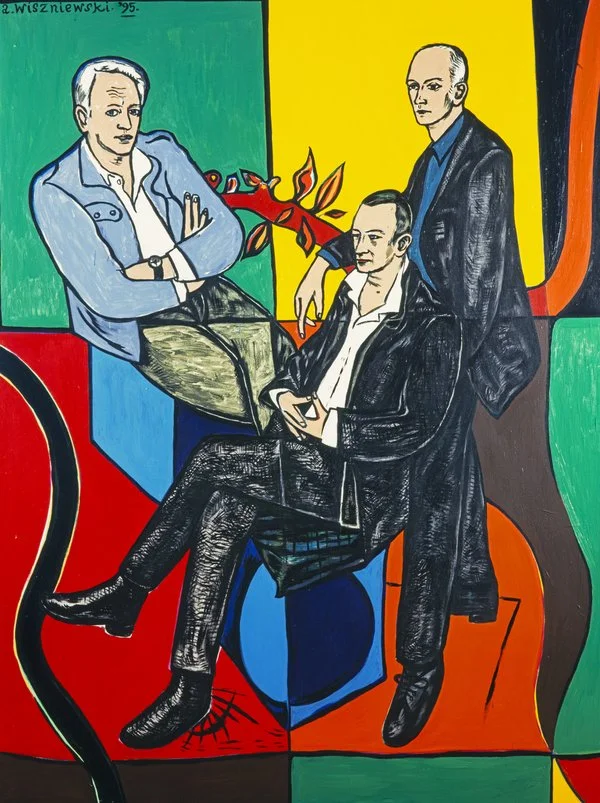
Adrian Wiszniewski, The Citizens (Robert David MacDonald, Philip Prowse, Giles Havergal). Acrylic on canvas. 244 x 183cm. 1995. Collection of National Galleries of Scotland.
I think people are quite surprised when they see me do a drawing of somebody and they say “that looks just like him”. I make a conscious effort of not doing that in my paintings because they’re not generally portraits of individual people. They’re everyman portraits. Or the figures have a particular look of a sort of character. They’re usually quite youthful and innocent, exploring the world.
A lot of my figures are influenced by the image of Byron, who had a very strong Scottish connection. He was a Gordon. At one point, Byron was the second most famous person in the western world, second only to Napoleon. He really was quite an exciting character. Sandy Moffat played an important role in making me think about him. Sandy did an exhibition at the Third Eye Centre called Seven Scottish Poets. I thought “gosh, poets, as subject matter is so interesting”. I have to give that to Sandy.
But also, one day, I had this large bit of paper attached to the wall. I don’t plan what to do. I take a line for a walk, rub it out, start again, rub it out, start again, until something sticks. You're building it then rebuilding, redrawing, redrawing... Towards the end of one particular drawing, I was listening to Kenneth Clark in his Civilisation series and he was talking about Lord Byron, then Lord Byron appeared as I was drawing on the paper. I thought it was so strange. I went and bought a book on Byron and I was surprised by the likeness of him, comparing it to my drawing. But also, in this drawing, his right foot was really awkward and twisted. In the book, I read he was born with a club foot. It was a creepy coincidence. How did that work out?
In 1995, around the same time you were working on the Citizens portrait, you were commissioned to paint an image for Liverpool Anglican Cathedral. It represented another departure for you: a public artwork, in alignment with a particular source, in this case the Bible.
Yes, but it wasn’t just biblical. It was about the parables. I’d always been interested in the parables. The parables are like Aesop’s tales. They’re very short and they’re there to make a point. That was a good way of getting into the work. I did two and Christopher Le Brun did two. He did them for the choir and I did them for the nave. It was in my nature to do them for the nave: a bit more working class maybe.
It’s not about the brushstrokes in a cathedral. You have to be able to read an image. So I planned it out so you could read the image at a distance. It’s all very clear. There’s the zigzag wall with the bolt of lightning coming down. There’s the shadow from the window, where it affects the red cross of the Church of England. Also, in my work, the Good Samaritan was a woman. In the interview for getting the commission, they asked me why I’d made the Good Samaritan a woman, when he was clearly a man. I said “well, you’ll need to show me where it says that in the text…” I wanted to do something that showed that women were doing so much in the church to help people and they weren’t getting recognised for it. It was important to put them in the picture as the Good Samaritan.
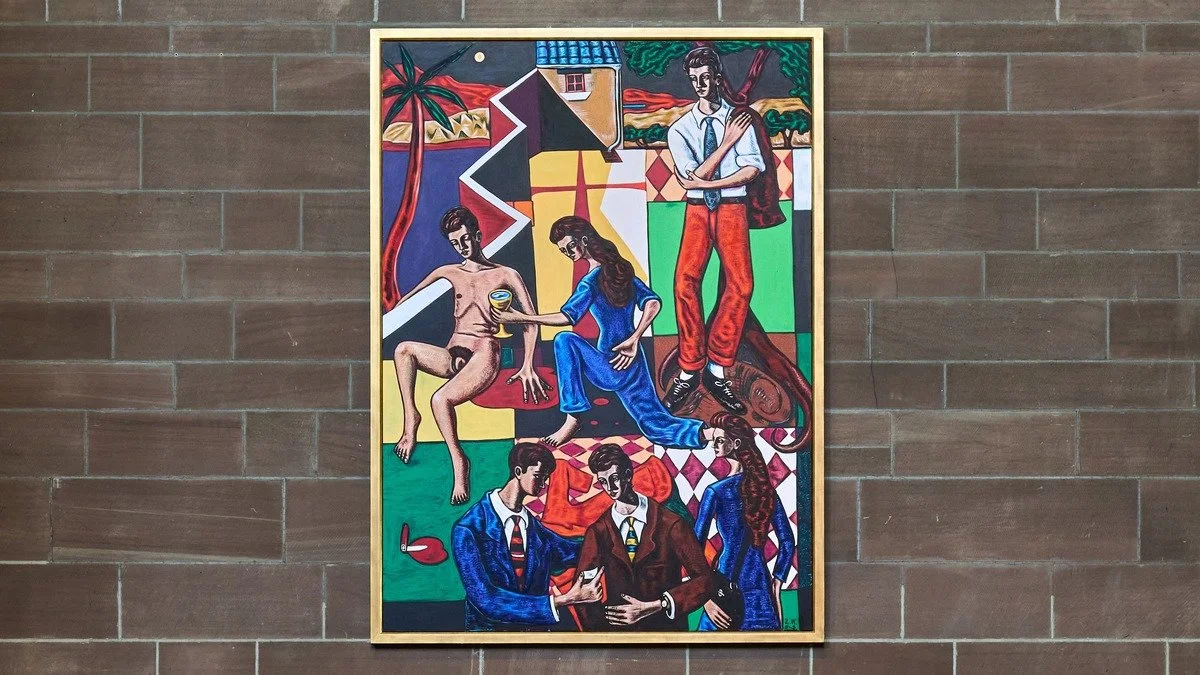
Adrian Wiszniewski, The Good Samaritan. Acrylic on canvas. 336 x 244cm. 1995. Courtesy of Rob Battersby/Liverpool Cathedral.
There was a lot of very “macho” art going about when I was at art school. I found Peter Howson’s art very macho. I think he’s a good artist. Ken Currie too. But Ken at that time was doing lots of images of working-class people and I thought “why do working-class people have to be ugly?” That's not right. I don't believe in class, I think the class system is something people box themselves into, just to be part of something. I don't believe in class. I believe in quality.
But Julian Schabel, Georg Baselitz and lots of other artists were doing very macho stuff. Most of my friends at art school had been girls. I would have found it offensive to do really macho art because I was very aware of the feminine role in society. Other people were doing it: that was one reason to avoid doing it. But the other reason was because I just didn't want to. I also didn't want to do nude women. You have to be very careful about how you paint women, so I avoided it for quite a long time. When I did do it, I did a big drawing called An Act of Barbarism, which was a man cutting a woman’s hair. It was a pun on being a barber, of course, and a comment on how men manipulate women into certain styles.
While you were working on the Liverpool commission, you were also starting work on a new project at Glasgow’s new Gallery of Modern Art.
Yes, I was busy working on a few projects at the same time. I was working on the Citizens for the Portrait Gallery, I was doing the Liverpool Cathedral work, then I was asked to go to the Gallery of Modern Art in Glasgow. Julian Spalding, the curator, had asked me to come up with some ideas for the café space. Then they asked “when can you start?” And I said “whenever you like!” I couldn’t get in until January and the gallery had to be opened in March, so I think there were only about five weeks that I could work on it. The space had been cut into two areas. In one, I could start working. I was working on one wall as they were plastering another one.
I decided that instead of doing the walls as particular scenes, I would do the whole space as a sort of three-dimensional pop-up sketchbook of all these different ideas and processes, and all based on something very pro-European. There was a wall with a boy putting his fist in it: the Dutch boy who stopped the dikes from flooding. At the time they had surplus of wine in Europe. There was a lot of talk about European “wine lakes”. So I did my own take on that: a painting of a sculptor by a mountain of Belgian chocolate. Then beside him there was a person who was copying plaster casts, as you’d traditionally do at art school, but he was copying casts of minimalist art. Ideas popping up all over the place. On one door, I painted an arrow. I knew that when I could start work on another section, I could paint an Amazonian women firing at that target from the other side of the room. So I was very aware of the space.
Space, architecture, lots of content… And your usual preoccupation with line and colour. A total work of art?
Yes. Julian even asked me to design the flooring, which was in laser-cut lino. There was etched glass. It's all been taken down now because of the politics, but it was really good at the time. There were people queuing up outside to get into the cafe. Every time you had a seat at a table you were getting a different view. You were getting a different experience.
I wanted the room to be very angular, as if you’d stepped inside a piece of origami. That’s why I had that pop-up sketchbook idea. In a sketchbook, you could do a line drawing, a working drawing, whatever you like. It could be a really exciting sketchbook. It's not the same finish all through a sketchbook. It depends what ideas you have. You do the drawing depending on the content. It’s all very mashed up.
Julian and I disagreed on some things. Julian was a populist. He told me that when he was curator at Manchester, he spent a lot of time trying to convince the people of Manchester that art was for them. “Art is for all”. He came with the same idea to Glasgow, but when he arrived, he realised that everyone in Glasgow thought that the art was for them anyway. “That's my Salvador Dali! That's my Rembrandt!” We just felt, in Scotland, that art was part of our environment. He was surprised by that. We disagreed about populism because I think it's patronising and condescending.
Since the 1990s, your work has continued its very varied course. Landscape seems to have featured even more notably, as opposed to strictly human-based drama?
I've always been interested in the environment. I did a big oil in 1989 called Troubled Landscape. Then I did another one was which was a monotype, Balance of Nature. Then there’s Weeds in a Landscape from 1990. It’s a celebration of weeds. It’s about people who have physical or mental weaknesses but at the same time, they have great strengths.
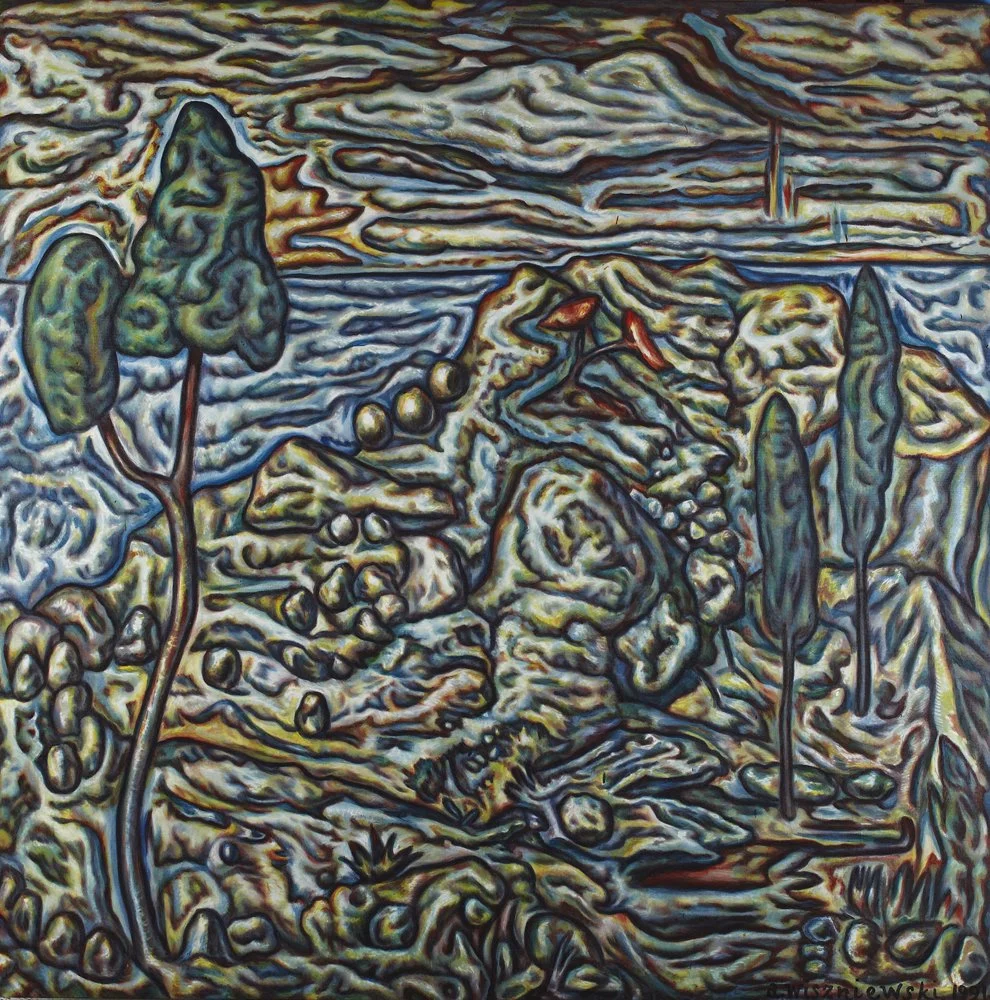
Adrian Wiszniewski, Troubled Landscape. Oil on canvas. 183cm x 183cm. 1991. Private collection. Courtesy of Lyon and Turnbull.
In 2010, a group of us did the Caledonian Challenge, hiking 54 miles in one day, walking non-stop from Fort William down through the hills. It was really strenuous. We had to train for that, so we did a lot of walking around Loch Katrine. I discovered views of Scotland I hadn’t seen before. Then I also fell in love with the paintings of Horatio McCulloch, who painted that part of the world. I’m not a fan of Turner but I love McCulloch. There’s something about his work I really, really like. I love Constable too.
I got really interested in the landscape, in the meaning of landscape, when I went to New Zealand, courtesy of the Scottish Arts Council. They gave me a grant to tour Scotland and New Zealand and do a lot of work. I did a huge painting of Lake Tekapo, which is about 20 feet long. It’s an enormous painting. I also did about 120 drawings, quick drawings. Back in Scotland, I did some laser woodcuts of Crail. I'd never done that before. I don’t think anyone had done laser woodcuts using that process before either. I felt as though I’d invented something.
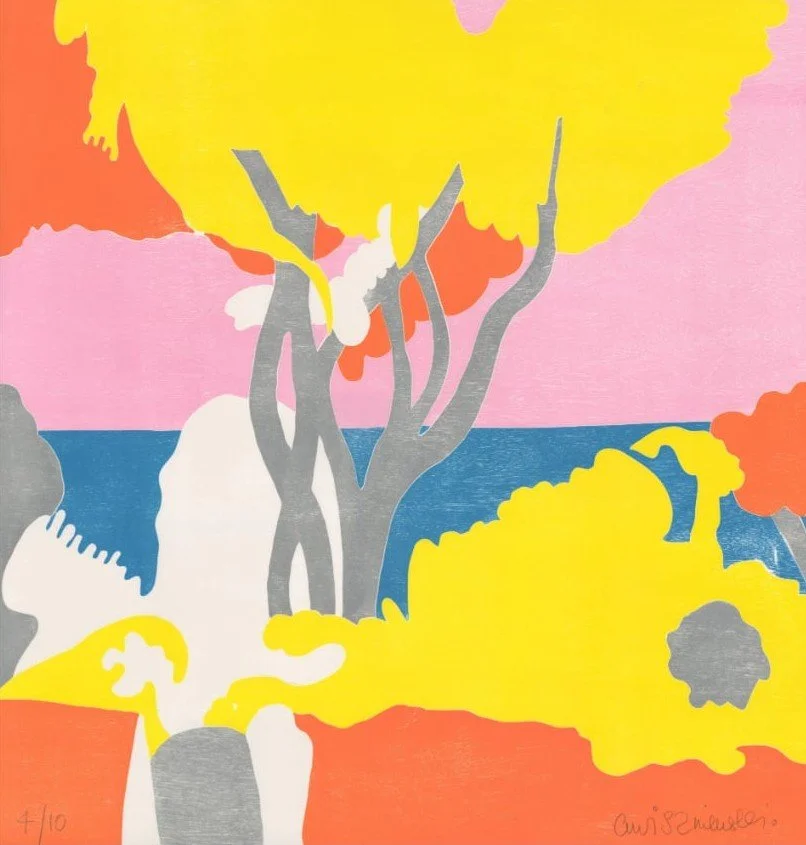
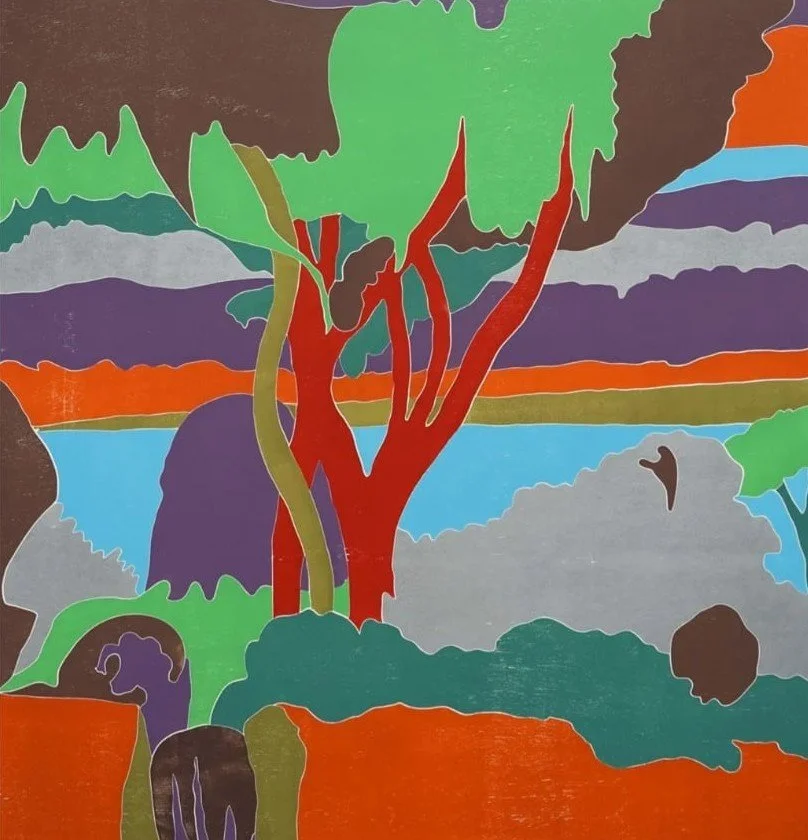
Left: Adrian Wiszniewski, Crail I. Laser-cut woodblock. 85 x 88 cm. Edition of 10. 2017. Published by Glasgow Print Studio. Courtesy of Glasgow Print Studio.
Right: Adrian Wiszniewski, Crail III. Laser-cut woodblock. 89 x 85 cm. Edition of 10. 2017. Published by Glasgow Print Studio. Courtesy of Glasgow Print Studio.
So although the processes were changing, your concerns were quite constant?
I’d always been interested in landscape as an idea. What was in a landscape? The first one, Troubled Landscape, happened because I was worried about the environment. When I was in Liverpool in 1986, not far from the landscape of the Lake District, it was during the time of Chernobyl. Also, my first child Max was born around that time, so as a father I was really conscious of world events and the environment.
But despite these concerns, I’m interested in different ways of making things. I don't like to repeat myself too much. “You’ve done that. You're just flogging a dead horse here...” I don't want to be known for doing these.
I've been very lucky. Galleries want to show my work. Buyers want to buy my work. I'm not a millionaire by any means, but I’m quite comfortable. And I’ve always thought that if you have integrity, it’ll show.
When you compare the current arts climate today to the world you knew in the 1980s, what strikes you most? I wonder if you think it’s more difficult to be an artist today?
I don’t know. It’s always been difficult. In the 70s, I don't think many people made a living exclusively out of their art. They'd be working in an art school, building up a reputation through exhibitions at the same time, getting in touch with galleries. Being a self-employed artist wasn’t common at all.
I knew things were about to hit the fan around 1990 because the Young British Artists were coming in, all heavily supported by Michael Craig Martin. Michael Craig Martin was very, very close to Nicholas Serota, long-time director of the Tate. So my days were numbered as far as the spotlight in London was concerned. But that was fine. I thought “I just have to be creative”. When you're not in the spotlight, you can be creative and do unusual things.
For example, I've got a friend, Gordon Rigby, who is a composer. In 2006, he said “would you like to write a story and I’ll do the music?” He was thinking about Peter and the Wolf. But we ended up doing a thing called GBH: The Girl, The Boy and The Hag. I spoke to the director and producer David McLennan about it. I said I’d written this thing, Gordon had written the music, we knew where we wanted put it on… but it comes with a 26-piece orchestra. And he just said “that’s fantastic!” So we did it at Oran Mor in Glasgow and it got rave reviews. Then we did it at the Edinburgh Festival. Then they commissioned us to do another one, which was called La Befana, then the third one was commissioned by Glasgow University. It was called Stone, all about Sawney Bean.
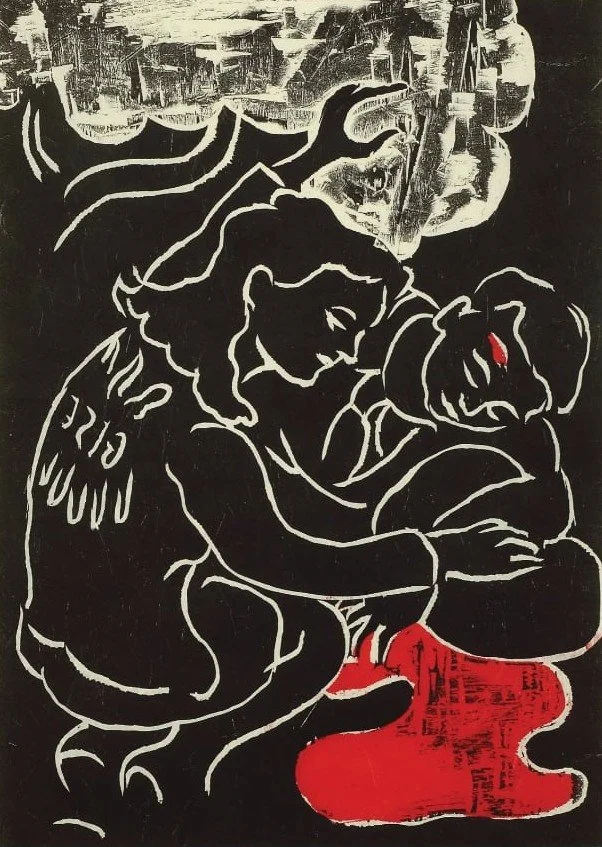
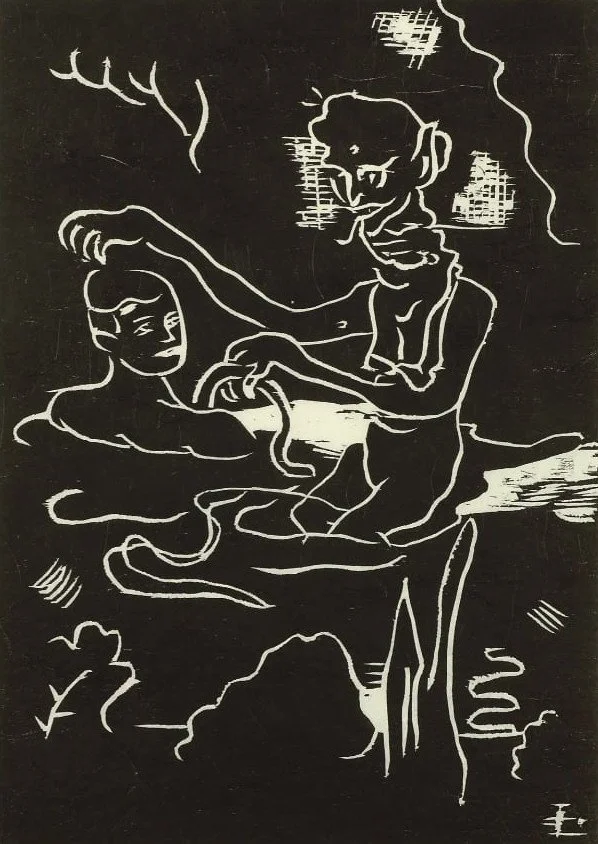
The project also gave me the opportunity to become involved in set design, which I’d always wanted to do. I had to come up a concept of how to present the play. For GBH, I decided to come up with images in woodcut because it’s a very gothic tale, set in Germany. I’d taken the story of Giselle and the story of Galahad from the Arthurian legends. Both of these stories had very unsatisfactory endings. We don’t even know what happened to Galahad. I knew that Shakespeare would take two stories and stick them both together, so I did that for GBH. This got me very excited. The whole project got me working and collaborating with musicians and people from the theatre. Now, if I see a play on television, I understand it more because I know what it is like to sit down and write a play. In a way, I enjoy life better by getting involved in a different artistic media.
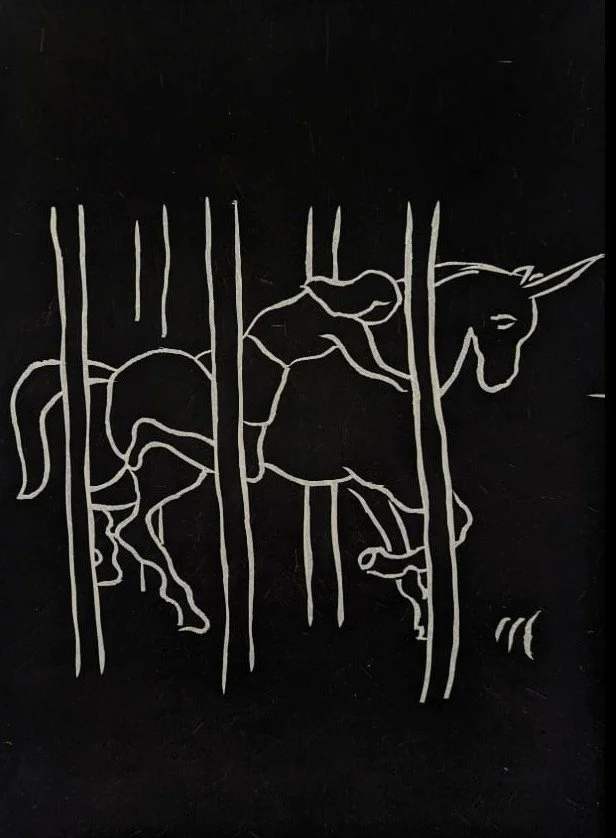
Left: Adrian Wiszniewski, Unicorn II (The Girl, the Boy and the Hag). Woodcut. 62 x 50 cm. Edition of 25. 2007. Published by Glasgow Print Studio. Courtesy of Glasgow Print Studio.
Centre: Adrian Wiszniewski, Finding Galahad (The Girl, the Boy and the Hag). Woodcut. 63 x 50 cm. Edition of 25. 2007. Published by Glasgow Print Studio. Courtesy of Glasgow Print Studio.
Right: Adrian Wiszniewski, Pool (The Girl, the Boy and the Hag). Woodcut. 62 x 50 cm. Edition of 25. 2007. Published by Glasgow Print Studio. Courtesy of Glasgow Print Studio.
Today, Adrian is as busy as ever. He’s forging new collaborations, preparing whole exhibitions of work for private galleries and happily fulfilling his obligations to the Royal Scottish Academy, where he’s been a member since 2004. It’s business as usual for Adrian, whose engagements this past year alone have included a successful show at Edinburgh’s Open Eye Gallery and a retrospective exhibition at the Glasgow Print Studio.
Even in a retrospective show, which saw him exhibit a suite of images from across his 40-year-long collaboration with the Print Studio, Adrian relished finding new ways to produce work. In Full Colour had him hand-colouring his prints, many for the first time. He put his “heart and soul” into the process: in the explosive colour of his prints - worked over with oil, acrylic, ink, coloured pencils - his efforts shine through. His excitement in experimentation is undimmed.
Adrian is blessed with the curiosity which has driven a lifelong desire to understand. It’s about more than absorbing, learning, repeating artistic lessons. When Adrian sought to learn “what makes ceramics ceramics” while exploring his friends’ studios at the Glasgow School of Art, or when he came to design the set for his play GBH, he was driven by genuine – and genuinely excited – enquiry: a thirst for understanding. His intelligence, energy and enthusiasm have allowed him to chart the course towards understanding, that great goal, through his art. In this sense, it would be strange to see him restricted to one art form only.
Anyone who explores the breadth of Adrian’s work will find it rich in the element of surprise: from tiny etching plates to 20-feet-long canvases; designs for ceramics, rugs and imaginary flags; scripts and screenplays, realised and as-yet unrealised. Across all of this, to paraphrase Adrian himself, the work has integrity, and the integrity shows.
Douglas Erskine
Notes
[1] Clare Henry, “Adrian Wiszniewski: Compass Gallery”, The Herald, 17/4/84. Available via Scottish Art Archive. https://pixelbeans74679275.wordpress.com/
Acknowledgements
With many thanks to Adrian Wiszniewski.
Images courtesy of Bonhams, Edinburgh Printmakers, High Life Highland, Glasgow Print Studio, Liverpool Cathedral, Lyon and Turnbull, Alexander (Sandy) Moffat RSA, National Galleries of Scotland.